What is a Team?
What is Team Work?
Importance of Team Work.
Benefits of Team Work.
Stages of Team Development.
Examples of some Team Work.
Characteristics of a Team.
10 lessons about Team Work.
Communication within Team.
Communication Do’s & Don’ts.
Closing Thought.
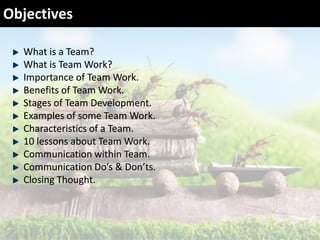
Objectives
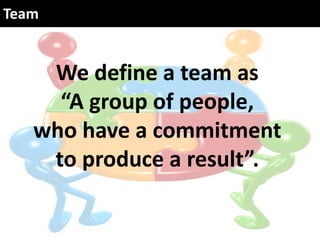
Team
We define a team as
“A group of people,
who have a commitment
to produce a result”.
“The ability to cooperate and
communicate effectively with
others to achieve a
common goal.”
Team Work
Importance of Team Work
ogether
veryone
chieves
ore
T
E
A
M
When teams are working well it can be very enjoyable and
bonding experience.
Most people enjoy working with others. Man is after all a
social animal!
 Quick Solution.
 Improved productivity.
 Distribution of work load.
 Diversity of Ideas.
 Better decision.
 Motivation.
 Learning.
Benefits of Team Work
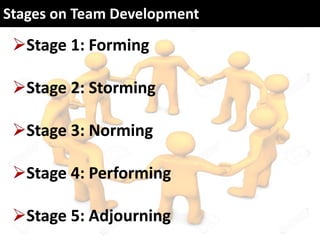
Stages on Team Development
Stage 1: Forming
Stage 2: Storming
Stage 3: Norming
Stage 4: Performing
Stage 5: Adjourning
 Determining individual roles.
 Develop trust and communication.
 Develop norms.
 Task.
 Define problems and strategy.
 Identify information needed.
Stage 1: Forming
 During this stage team members:
1. Realize that the task is more difficult than they imagined.
2. Have fluctuations in attitude about chances of success.
3. May be resistance to task.
4. Have poor collaboration.
Stage 2: Storming
 During this stage members accept:
1. Their team.
2. Team rules and procedures.
3. Their roles in the team.
4. The individuality of fellow members.
 Team members realize that they are not going to crash-and –
burn and start helping each other.
Stage 3: Norming
 Team members have:
1. Gained insight into personal and team processes.
2. A better understanding of each other’s strengths and
weaknesses.
3. Gained the ability to prevent or work through group conflict
and resolve differences.
4. Developed a close attachment to the team.
5. Commitment to shared goals.
Stage 4: Performing
Stage 5: Adjourning
 During this stage :
1. It is important to achieve closure for the group on a positive
note.
2. It is therefore important to recognize the group members for
their accomplishments and celebrate the group's overall
success.
Examples of Team Work
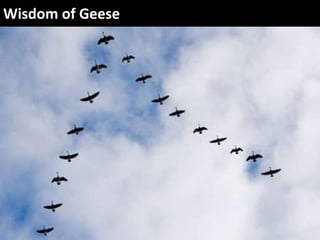
Wisdom of Geese
Team characteristics
Participation5
Work Effortlessly1
Trust2
Good Communication3
Supportive4
Motivation7
Innovative6
Lesson 1: First of All, Knowing Your People
Lesson 2: Choosing the right team members
Lesson 3: Having one common goal
Lesson 4: Developing teamwork requires commitment
Lesson 5: Sharing Information
Lesson 6: Empowering the team
Lesson 7: Facilitating open communication
Lesson 8: Creating problem solving environment
Lesson 9: Measuring teamwork performance continually
Lesson 10: Sharing the outcomes together
Communication within Team
When the team doesn’t work, 99 out of 100 times there
is a communication break.
Effective communication is a vital part of any team.
To create a successful team, effective communication
methods are necessary for both team members and
leaders.
Clear Job description
 Team goals
 Who in the team responsible for what.
 Timelines or SLA.
 Performance Matrix.
Communication – Do’s
 Support Group Member's Ideas.
 If there is a problem, talk.
 Listen actively.
 Get involved.
 Be proactive, than reactive.
 Give and take feedback.
 Be open.
 Have fun.
Communication – Don’ts
 Do not blame others.
 No Bragging.
 Do not take credit for what others are doing.
 Being unprepared.
 Do not speak poorly of those in authority.
 Do not make others look bad.
 Don’t cheat.
 Don’t lie.
 Don’t steal.
Closing thought
The strength of the team is each individual
member…
The strength of each member is the team.
Team work

Team work

  • 2.
    What is aTeam? What is Team Work? Importance of Team Work. Benefits of Team Work. Stages of Team Development. Examples of some Team Work. Characteristics of a Team. 10 lessons about Team Work. Communication within Team. Communication Do’s & Don’ts. Closing Thought. Objectives
  • 3.
    Team We define ateam as “A group of people, who have a commitment to produce a result”.
  • 4.
    “The ability tocooperate and communicate effectively with others to achieve a common goal.” Team Work
  • 5.
  • 6.
  • 7.
    When teams areworking well it can be very enjoyable and bonding experience. Most people enjoy working with others. Man is after all a social animal!
  • 8.
     Quick Solution. Improved productivity.  Distribution of work load.  Diversity of Ideas.  Better decision.  Motivation.  Learning. Benefits of Team Work
  • 9.
    Stages on TeamDevelopment Stage 1: Forming Stage 2: Storming Stage 3: Norming Stage 4: Performing Stage 5: Adjourning
  • 10.
     Determining individualroles.  Develop trust and communication.  Develop norms.  Task.  Define problems and strategy.  Identify information needed. Stage 1: Forming
  • 11.
     During thisstage team members: 1. Realize that the task is more difficult than they imagined. 2. Have fluctuations in attitude about chances of success. 3. May be resistance to task. 4. Have poor collaboration. Stage 2: Storming
  • 12.
     During thisstage members accept: 1. Their team. 2. Team rules and procedures. 3. Their roles in the team. 4. The individuality of fellow members.  Team members realize that they are not going to crash-and – burn and start helping each other. Stage 3: Norming
  • 13.
     Team membershave: 1. Gained insight into personal and team processes. 2. A better understanding of each other’s strengths and weaknesses. 3. Gained the ability to prevent or work through group conflict and resolve differences. 4. Developed a close attachment to the team. 5. Commitment to shared goals. Stage 4: Performing
  • 14.
    Stage 5: Adjourning During this stage : 1. It is important to achieve closure for the group on a positive note. 2. It is therefore important to recognize the group members for their accomplishments and celebrate the group's overall success.
  • 15.
  • 16.
  • 17.
    Team characteristics Participation5 Work Effortlessly1 Trust2 GoodCommunication3 Supportive4 Motivation7 Innovative6
  • 18.
    Lesson 1: Firstof All, Knowing Your People
  • 20.
    Lesson 2: Choosingthe right team members
  • 22.
    Lesson 3: Havingone common goal
  • 24.
    Lesson 4: Developingteamwork requires commitment
  • 26.
    Lesson 5: SharingInformation
  • 28.
  • 30.
    Lesson 7: Facilitatingopen communication
  • 32.
    Lesson 8: Creatingproblem solving environment
  • 34.
    Lesson 9: Measuringteamwork performance continually
  • 36.
    Lesson 10: Sharingthe outcomes together
  • 38.
    Communication within Team Whenthe team doesn’t work, 99 out of 100 times there is a communication break. Effective communication is a vital part of any team.
  • 39.
    To create asuccessful team, effective communication methods are necessary for both team members and leaders. Clear Job description  Team goals  Who in the team responsible for what.  Timelines or SLA.  Performance Matrix.
  • 40.
    Communication – Do’s Support Group Member's Ideas.  If there is a problem, talk.  Listen actively.  Get involved.  Be proactive, than reactive.  Give and take feedback.  Be open.  Have fun.
  • 41.
    Communication – Don’ts Do not blame others.  No Bragging.  Do not take credit for what others are doing.  Being unprepared.  Do not speak poorly of those in authority.  Do not make others look bad.  Don’t cheat.  Don’t lie.  Don’t steal.
  • 42.
    Closing thought The strengthof the team is each individual member… The strength of each member is the team.