MA. JOSEFA C. PEREGIL JOCELYN P. PALMERO RIFFY LYN B. AMOTO
Facilitators
What is a Team?
What is Team Work?
Importance of Team Work.
Benefits of Team Work.
Stages of Team Development.
Examples of some Team Work.
Characteristics of a Team.
10 lessons about Team Work.
Communication within Team.
Communication Do’s & Don’ts.
Closing Thought.
Objectives
Energizer
Energizer
Never Have I Ever
· Team type: Remote and in-person
· Equipment: Candy
As a fantastic conversation starter, this 5-minute indoor team building
activity gets your team connecting on a much deeper level. They will get
to share things about each other that their colleagues might not already
know, which is bound to start some interesting conversations!
How to play:
· Team members must say “Never have I ever” and end the sentence
with something they have never done. For example, “Never have I ever
gone skydiving”.
· If anyone in the group has gone skydiving, they must say. Give this
person a piece of candy and tell them not to eat it just yet!
· Go around the room so that every player has a chance to say their
“Never Have I Ever” sentence.
· The player with the most candy at the end wins.
Team
We define a team as
“A group of people,
who have a commitment
to produce a result”.
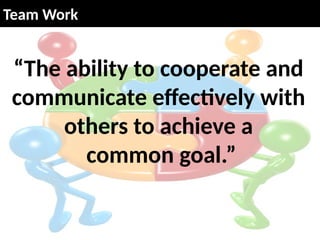
“The ability to cooperate and
communicate effectively with
others to achieve a
common goal.”
Team Work
Importance of Team Work
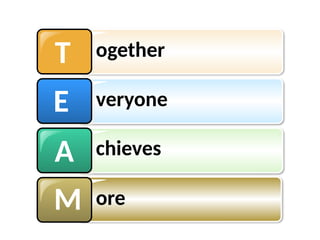
ogether
veryone
chieves
ore
T
E
A
M
Leadership is essential to making
teamwork into a reality.
Negative leadership traits can ruin a
team and destroy all sense of teamwork they
possess.
Adversely, positive leadership traits can
encourage teams to work together
seamlessly and achieve greater goals.
In the professional setting it is
team leaders or managers who are
responsible for the teamwork environment
in their place of work.
How Leadership Relates To Teamwork
When teams are working well it can be very enjoyable and
bonding experience.
Most people enjoy working with others. Man is after all a
social animal!
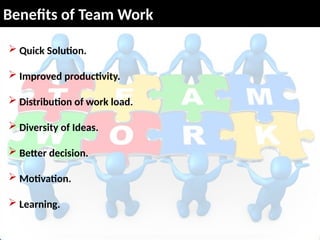
 Quick Solution.
 Improved productivity.
 Distribution of work load.
 Diversity of Ideas.
 Better decision.
 Motivation.
 Learning.
Benefits of Team Work
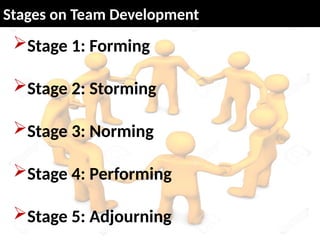
Stages on Team Development
Stage 1: Forming
Stage 2: Storming
Stage 3: Norming
Stage 4: Performing
Stage 5: Adjourning
 Determining individual roles.
 Develop trust and communication.
 Develop norms.
 Task.
 Define problems and strategy.
 Identify information needed.
Stage 1: Forming
 During this stage team members:
1. Realize that the task is more difficult than they imagined.
2. Have fluctuations in attitude about chances of success.
3. May be resistance to task.
4. Have poor collaboration.
Stage 2: Storming
 During this stage members accept:
1. Their team.
2. Team rules and procedures.
3. Their roles in the team.
4. The individuality of fellow members.
 Team members realize that they are not going to crash-and –
burn and start helping each other.
Stage 3: Norming
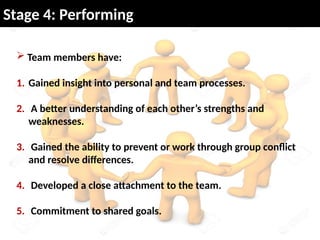
 Team members have:
1. Gained insight into personal and team processes.
2. A better understanding of each other’s strengths and
weaknesses.
3. Gained the ability to prevent or work through group conflict
and resolve differences.
4. Developed a close attachment to the team.
5. Commitment to shared goals.
Stage 4: Performing
Stage 5: Adjourning
 During this stage :
1. It is important to achieve closure for the group on a positive
note.
2. It is therefore important to recognize the group members for
their accomplishments and celebrate the group's overall
success.
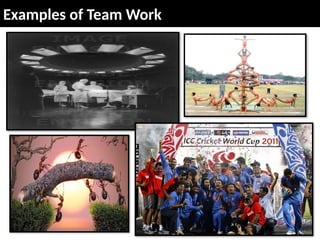
Examples of Team Work
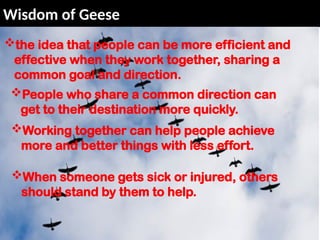
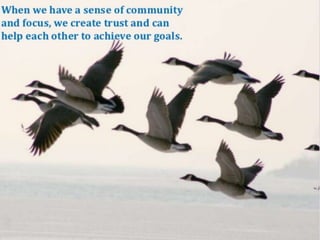
Wisdom of Geese
Wisdom of Geese
the idea that people can be more efficient and
effective when they work together, sharing a
common goal and direction.
People who share a common direction can
get to their destination more quickly.
Working together can help people achieve
more and better things with less effort.
When someone gets sick or injured, others
should stand by them to help.
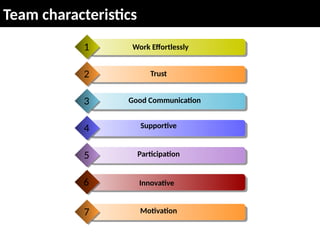
Team characteristics
Participation
5
Work Effortlessly
1
Trust
2
Good Communication
3
Supportive
4
Motivation
7
Innovative
6
Lesson 1: First of All, Knowing Your People
Lesson 2: Choosing the right team members
Lesson 3: Having one common goal
Lesson 4: Developing teamwork requires commitment
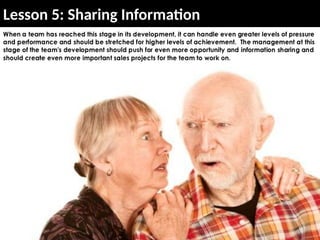
Lesson 5: Sharing Information
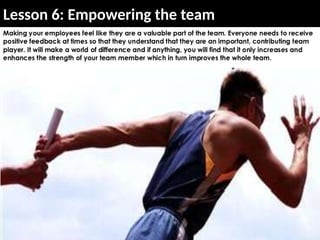
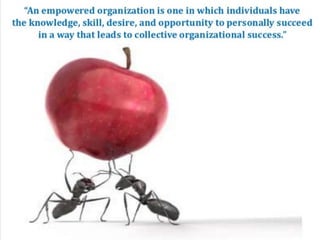
Lesson 6: Empowering the team
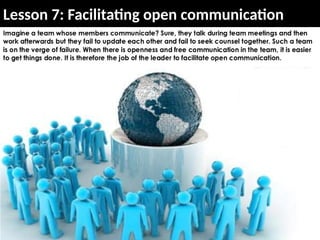
Lesson 7: Facilitating open communication
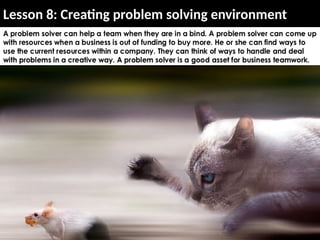
Lesson 8: Creating problem solving environment
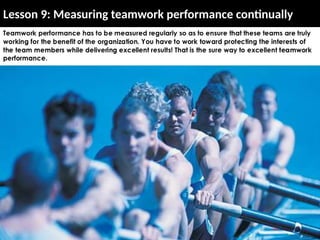
Lesson 9: Measuring teamwork performance continually
Lesson 10: Sharing the outcomes together
Communication within Team
When the team doesn’t work, 99 out of 100 times there
is a communication break.
Effective communication is a vital part of any team.
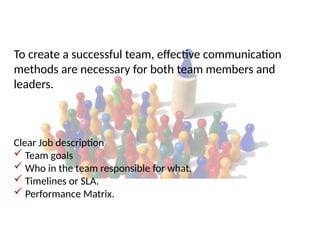
To create a successful team, effective communication
methods are necessary for both team members and
leaders.
Clear Job description
 Team goals
 Who in the team responsible for what.
 Timelines or SLA.
 Performance Matrix.
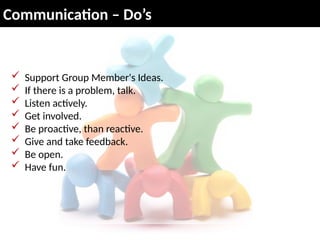
Communication – Do’s
 Support Group Member's Ideas.
 If there is a problem, talk.
 Listen actively.
 Get involved.
 Be proactive, than reactive.
 Give and take feedback.
 Be open.
 Have fun.
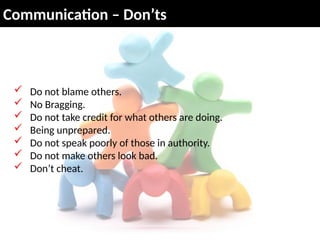
Communication – Don’ts
 Do not blame others.
 No Bragging.
 Do not take credit for what others are doing.
 Being unprepared.
 Do not speak poorly of those in authority.
 Do not make others look bad.
 Don’t cheat.
Closing thought
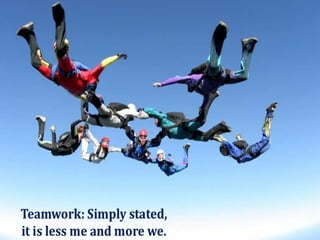
The strength of the team is each individual
member…
The strength of each member is the team.
Collaboration Expertise_Team Work Topic.pptx

Collaboration Expertise_Team Work Topic.pptx

  • 1.
    MA. JOSEFA C.PEREGIL JOCELYN P. PALMERO RIFFY LYN B. AMOTO Facilitators
  • 2.
    What is aTeam? What is Team Work? Importance of Team Work. Benefits of Team Work. Stages of Team Development. Examples of some Team Work. Characteristics of a Team. 10 lessons about Team Work. Communication within Team. Communication Do’s & Don’ts. Closing Thought. Objectives
  • 3.
  • 4.
    Energizer Never Have IEver · Team type: Remote and in-person · Equipment: Candy As a fantastic conversation starter, this 5-minute indoor team building activity gets your team connecting on a much deeper level. They will get to share things about each other that their colleagues might not already know, which is bound to start some interesting conversations! How to play: · Team members must say “Never have I ever” and end the sentence with something they have never done. For example, “Never have I ever gone skydiving”. · If anyone in the group has gone skydiving, they must say. Give this person a piece of candy and tell them not to eat it just yet! · Go around the room so that every player has a chance to say their “Never Have I Ever” sentence. · The player with the most candy at the end wins.
  • 5.
    Team We define ateam as “A group of people, who have a commitment to produce a result”.
  • 6.
    “The ability tocooperate and communicate effectively with others to achieve a common goal.” Team Work
  • 7.
  • 8.
  • 9.
    Leadership is essentialto making teamwork into a reality. Negative leadership traits can ruin a team and destroy all sense of teamwork they possess. Adversely, positive leadership traits can encourage teams to work together seamlessly and achieve greater goals. In the professional setting it is team leaders or managers who are responsible for the teamwork environment in their place of work. How Leadership Relates To Teamwork
  • 10.
    When teams areworking well it can be very enjoyable and bonding experience. Most people enjoy working with others. Man is after all a social animal!
  • 11.
     Quick Solution. Improved productivity.  Distribution of work load.  Diversity of Ideas.  Better decision.  Motivation.  Learning. Benefits of Team Work
  • 12.
    Stages on TeamDevelopment Stage 1: Forming Stage 2: Storming Stage 3: Norming Stage 4: Performing Stage 5: Adjourning
  • 13.
     Determining individualroles.  Develop trust and communication.  Develop norms.  Task.  Define problems and strategy.  Identify information needed. Stage 1: Forming
  • 14.
     During thisstage team members: 1. Realize that the task is more difficult than they imagined. 2. Have fluctuations in attitude about chances of success. 3. May be resistance to task. 4. Have poor collaboration. Stage 2: Storming
  • 15.
     During thisstage members accept: 1. Their team. 2. Team rules and procedures. 3. Their roles in the team. 4. The individuality of fellow members.  Team members realize that they are not going to crash-and – burn and start helping each other. Stage 3: Norming
  • 16.
     Team membershave: 1. Gained insight into personal and team processes. 2. A better understanding of each other’s strengths and weaknesses. 3. Gained the ability to prevent or work through group conflict and resolve differences. 4. Developed a close attachment to the team. 5. Commitment to shared goals. Stage 4: Performing
  • 17.
    Stage 5: Adjourning During this stage : 1. It is important to achieve closure for the group on a positive note. 2. It is therefore important to recognize the group members for their accomplishments and celebrate the group's overall success.
  • 18.
  • 19.
  • 20.
    Wisdom of Geese theidea that people can be more efficient and effective when they work together, sharing a common goal and direction. People who share a common direction can get to their destination more quickly. Working together can help people achieve more and better things with less effort. When someone gets sick or injured, others should stand by them to help.
  • 21.
    Team characteristics Participation 5 Work Effortlessly 1 Trust 2 GoodCommunication 3 Supportive 4 Motivation 7 Innovative 6
  • 22.
    Lesson 1: Firstof All, Knowing Your People
  • 24.
    Lesson 2: Choosingthe right team members
  • 26.
    Lesson 3: Havingone common goal
  • 28.
    Lesson 4: Developingteamwork requires commitment
  • 30.
    Lesson 5: SharingInformation
  • 32.
  • 34.
    Lesson 7: Facilitatingopen communication
  • 36.
    Lesson 8: Creatingproblem solving environment
  • 38.
    Lesson 9: Measuringteamwork performance continually
  • 40.
    Lesson 10: Sharingthe outcomes together
  • 42.
    Communication within Team Whenthe team doesn’t work, 99 out of 100 times there is a communication break. Effective communication is a vital part of any team.
  • 43.
    To create asuccessful team, effective communication methods are necessary for both team members and leaders. Clear Job description  Team goals  Who in the team responsible for what.  Timelines or SLA.  Performance Matrix.
  • 44.
    Communication – Do’s Support Group Member's Ideas.  If there is a problem, talk.  Listen actively.  Get involved.  Be proactive, than reactive.  Give and take feedback.  Be open.  Have fun.
  • 45.
    Communication – Don’ts Do not blame others.  No Bragging.  Do not take credit for what others are doing.  Being unprepared.  Do not speak poorly of those in authority.  Do not make others look bad.  Don’t cheat.
  • 46.

    Closing thought The strengthof the team is each individual member… The strength of each member is the team.