For audio, it is recommended you dial in A copy of the slide and the recording will be available post webinar Audio: 1-877-668-4493 Access Code: *** *** *** Event Password: 1234 WebEx Support: 1-866-863-3910 
Team Building Magic The Secret Behind High Performing Teams 
October 15th, 2014 
Paula CALDERON 
Talent Management Solutions Consultant
AGENDA 
2. What Is A High Performing Team? 
3. How To Create A High Performing Team 
Conclusion 
Questions And Answers 
1. What Is A Team? 
2 
4. Five Steps To Building Your High Performing Team
1. What is a Team? Definition 
“A real team is made up of a group of people who share a passion for a common and collective goal. 
They know that achieving the goal demands a high level of interdependency amongst team members, as it is something that can only be accomplished together. 
There are also clear and stable boundaries so that membership is not constantly changing, and it is easy to tell who is on the team.” 
- Adapted from J. Richard Hackman, Groups that Work (and Those that Don’t) 
3
2. What is a Team? Definition 
►Performs at an elite level, 
►Extraordinary results, 
►Not seen as a separate activity but is integrated into every action, interaction and communication. 
4
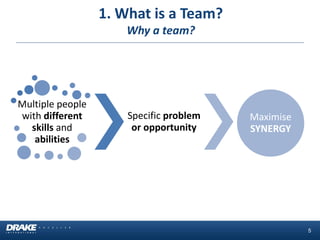
1. What is a Team? Why a team? 
5 
Multiple people with different skills and abilities 
Specific problem or opportunity 
Maximise SYNERGY
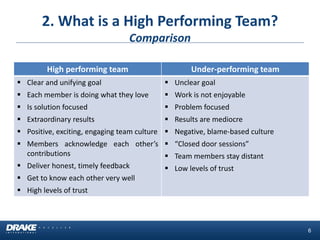
2. What is a High Performing Team? Comparison 
6 
High performing team 
Under-performing team 
Clear and unifying goal 
Each member is doing what they love 
Is solution focused 
Extraordinary results 
Positive, exciting, engaging team culture 
Members acknowledge each other’s contributions 
Deliver honest, timely feedback 
Get to know each other very well 
High levels of trust 
Unclear goal 
Work is not enjoyable 
Problem focused 
Results are mediocre 
Negative, blame-based culture 
“Closed door sessions” 
Team members stay distant 
Low levels of trust
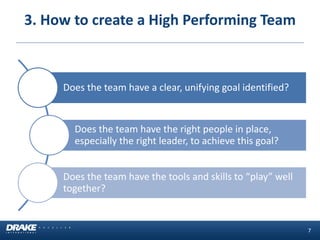
3. How to create a High Performing Team 
Does the team have a clear, unifying goal identified? 
Does the team have the right people in place, especially the right leader, to achieve this goal? 
Does the team have the tools and skills to “play” well together? 
7
8 
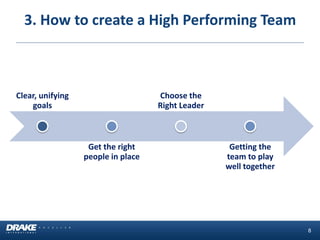
Clear, unifying goals 
Get the right people in place 
Choose the Right Leader 
Getting the team to play well together 
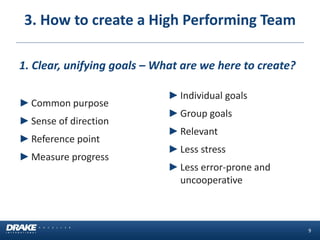
3. How to create a High Performing Team
9 
1. Clear, unifying goals – What are we here to create? 
►Common purpose 
►Sense of direction 
►Reference point 
►Measure progress 
►Individual goals 
►Group goals 
►Relevant 
►Less stress 
►Less error-prone and uncooperative 
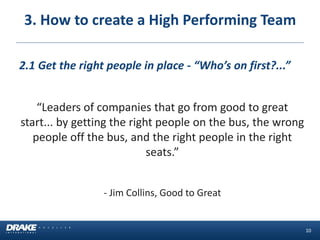
3. How to create a High Performing Team
10 
2.1 Get the right people in place - “Who’s on first?...” 
“Leaders of companies that go from good to great start... by getting the right people on the bus, the wrong people off the bus, and the right people in the right seats.” 
- Jim Collins, Good to Great 
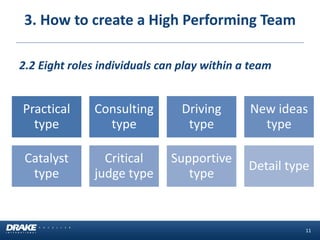
3. How to create a High Performing Team
11 
2.2 Eight roles individuals can play within a team 
Practical type 
Consulting type 
Driving type 
New ideas type 
Catalyst type 
Critical judge type 
Supportive type 
Detail type 
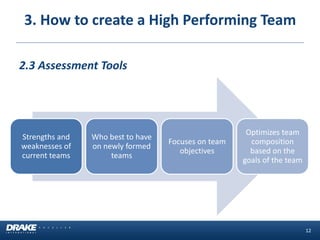
3. How to create a High Performing Team
12 
2.3 Assessment Tools 
Strengths and weaknesses of current teams 
Who best to have on newly formed teams 
Focuses on team objectives 
Optimizes team composition based on the goals of the team 
3. How to create a High Performing Team
13 
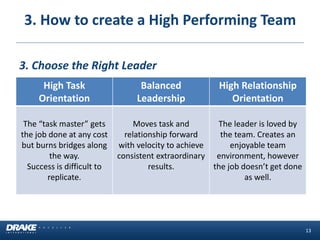
3. Choose the Right Leader 
High Task Orientation 
Balanced Leadership 
High Relationship Orientation 
The “task master” gets the job done at any cost but burns bridges along the way. 
Success is difficult to replicate. 
Moves task and relationship forward with velocity to achieve consistent extraordinary results. 
The leader is loved by the team. Creates an enjoyable team environment, however the job doesn’t get done as well. 
3. How to create a High Performing Team
14 
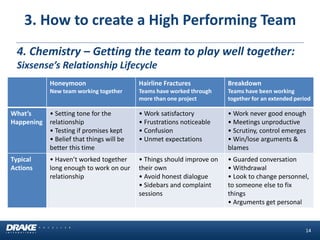
4. Chemistry – Getting the team to play well together: 
Sixsense’s Relationship Lifecycle 
Honeymoon 
New team working together 
Hairline Fractures 
Teams have worked through more than one project 
Breakdown 
Teams have been working together for an extended period 
What’s Happening 
• Setting tone for the relationship 
• Testing if promises kept 
• Belief that things will be better this time 
• Work satisfactory 
• Frustrations noticeable 
• Confusion 
• Unmet expectations 
• Work never good enough 
• Meetings unproductive 
• Scrutiny, control emerges 
• Win/lose arguments & blames 
Typical Actions 
• Haven’t worked together long enough to work on our relationship 
• Things should improve on their own 
• Avoid honest dialogue 
• Sidebars and complaint sessions 
• Guarded conversation 
• Withdrawal 
• Look to change personnel, to someone else to fix things 
• Arguments get personal 
3. How to create a High Performing Team
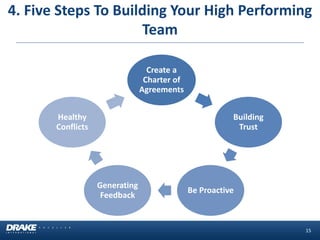
4. Five Steps To Building Your High Performing Team 
15 
Create a Charter of Agreements 
Building Trust 
Be Proactive 
Generating Feedback 
Healthy Conflicts
16 
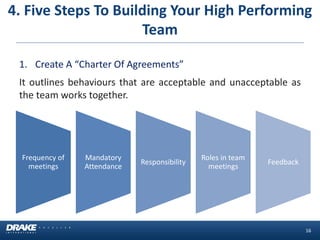
1.Create A “Charter Of Agreements” 
It outlines behaviours that are acceptable and unacceptable as the team works together. 
Frequency of meetings 
Mandatory Attendance 
Responsibility 
Roles in team meetings 
Feedback 
4. Five Steps To Building Your High Performing Team
17 
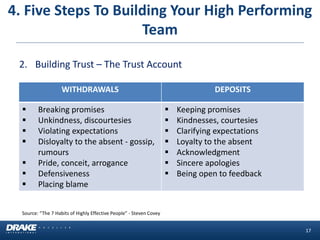
2.Building Trust – The Trust Account 
WITHDRAWALS 
DEPOSITS 
Breaking promises 
Unkindness, discourtesies 
Violating expectations 
Disloyalty to the absent - gossip, rumours 
Pride, conceit, arrogance 
Defensiveness 
Placing blame 
Keeping promises 
Kindnesses, courtesies 
Clarifying expectations 
Loyalty to the absent 
Acknowledgment 
Sincere apologies 
Being open to feedback 
4. Five Steps To Building Your High Performing Team 
Source: “The 7 Habits of Highly Effective People” - Steven Covey
18 
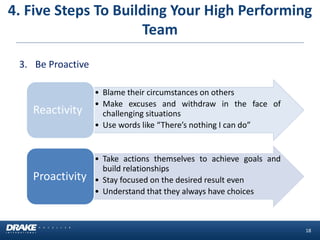
3.Be Proactive 
•Blame their circumstances on others 
•Make excuses and withdraw in the face of challenging situations 
•Use words like “There’s nothing I can do” 
Reactivity 
•Take actions themselves to achieve goals and build relationships 
•Stay focused on the desired result even 
•Understand that they always have choices 
Proactivity 
4. Five Steps To Building Your High Performing Team
19 
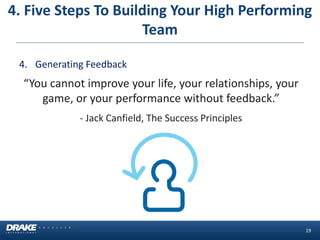
4. Generating Feedback 
“You cannot improve your life, your relationships, your 
game, or your performance without feedback.” 
- Jack Canfield, The Success Principles 
4. Five Steps To Building Your High Performing 
Team
20 
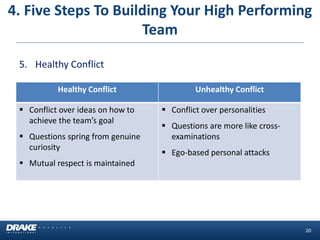
5.Healthy Conflict 
Healthy Conflict 
Unhealthy Conflict 
Conflict over ideas on how to achieve the team’s goal 
Questions spring from genuine curiosity 
Mutual respect is maintained 
Conflict over personalities 
Questions are more like cross- examinations 
Ego-based personal attacks 
4. Five Steps To Building Your High Performing Team
21 
Where To Start Creating Magic? 
Nothing speaks louder than the action you take! 
4. Five Steps To Building Your High Performing 
Team
CONCLUSION 
►Real team building is a process that works 
►Definition of a clear, unifying goal 
►Have the right people in the right roles 
►Use a proven assessment tool to help you understand your team’s strengths and weaknesses 
►Respect the 5 steps to building your high performance team 
►Have the spirit of continuous improvement 
22
FREE OFFER 
•We’re offering a free 30-minute Consultation that will include: 
–Complimentary Drake P3 Personality Profiling assessment 
–Personalized debrief on how your behavioural tendencies can impact your leadership style and effectiveness 
Contact Paula to take advantage of this exclusive offer! 
pcalderon@na.drakeintl.com 
416.216.1094
QUESTIONS / ANSWERS 
24
THANK YOU FOR YOUR PARTICIPATION 
Paula Calderon 
Talent Management Solutions Consultant 
pcalderon@na.drakeintl.com 
(1) 416-216-1094 
Team Building Magic The Secret Behind High Performing Teams

Team building magic oct 15 (2)

  • 1.
    For audio, itis recommended you dial in A copy of the slide and the recording will be available post webinar Audio: 1-877-668-4493 Access Code: *** *** *** Event Password: 1234 WebEx Support: 1-866-863-3910 Team Building Magic The Secret Behind High Performing Teams October 15th, 2014 Paula CALDERON Talent Management Solutions Consultant
  • 2.
    AGENDA 2. WhatIs A High Performing Team? 3. How To Create A High Performing Team Conclusion Questions And Answers 1. What Is A Team? 2 4. Five Steps To Building Your High Performing Team
  • 3.
    1. What isa Team? Definition “A real team is made up of a group of people who share a passion for a common and collective goal. They know that achieving the goal demands a high level of interdependency amongst team members, as it is something that can only be accomplished together. There are also clear and stable boundaries so that membership is not constantly changing, and it is easy to tell who is on the team.” - Adapted from J. Richard Hackman, Groups that Work (and Those that Don’t) 3
  • 4.
    2. What isa Team? Definition ►Performs at an elite level, ►Extraordinary results, ►Not seen as a separate activity but is integrated into every action, interaction and communication. 4
  • 5.
    1. What isa Team? Why a team? 5 Multiple people with different skills and abilities Specific problem or opportunity Maximise SYNERGY
  • 6.
    2. What isa High Performing Team? Comparison 6 High performing team Under-performing team Clear and unifying goal Each member is doing what they love Is solution focused Extraordinary results Positive, exciting, engaging team culture Members acknowledge each other’s contributions Deliver honest, timely feedback Get to know each other very well High levels of trust Unclear goal Work is not enjoyable Problem focused Results are mediocre Negative, blame-based culture “Closed door sessions” Team members stay distant Low levels of trust
  • 7.
    3. How tocreate a High Performing Team Does the team have a clear, unifying goal identified? Does the team have the right people in place, especially the right leader, to achieve this goal? Does the team have the tools and skills to “play” well together? 7
  • 8.
    8 Clear, unifyinggoals Get the right people in place Choose the Right Leader Getting the team to play well together 3. How to create a High Performing Team
  • 9.
    9 1. Clear,unifying goals – What are we here to create? ►Common purpose ►Sense of direction ►Reference point ►Measure progress ►Individual goals ►Group goals ►Relevant ►Less stress ►Less error-prone and uncooperative 3. How to create a High Performing Team
  • 10.
    10 2.1 Getthe right people in place - “Who’s on first?...” “Leaders of companies that go from good to great start... by getting the right people on the bus, the wrong people off the bus, and the right people in the right seats.” - Jim Collins, Good to Great 3. How to create a High Performing Team
  • 11.
    11 2.2 Eightroles individuals can play within a team Practical type Consulting type Driving type New ideas type Catalyst type Critical judge type Supportive type Detail type 3. How to create a High Performing Team
  • 12.
    12 2.3 AssessmentTools Strengths and weaknesses of current teams Who best to have on newly formed teams Focuses on team objectives Optimizes team composition based on the goals of the team 3. How to create a High Performing Team
  • 13.
    13 3. Choosethe Right Leader High Task Orientation Balanced Leadership High Relationship Orientation The “task master” gets the job done at any cost but burns bridges along the way. Success is difficult to replicate. Moves task and relationship forward with velocity to achieve consistent extraordinary results. The leader is loved by the team. Creates an enjoyable team environment, however the job doesn’t get done as well. 3. How to create a High Performing Team
  • 14.
    14 4. Chemistry– Getting the team to play well together: Sixsense’s Relationship Lifecycle Honeymoon New team working together Hairline Fractures Teams have worked through more than one project Breakdown Teams have been working together for an extended period What’s Happening • Setting tone for the relationship • Testing if promises kept • Belief that things will be better this time • Work satisfactory • Frustrations noticeable • Confusion • Unmet expectations • Work never good enough • Meetings unproductive • Scrutiny, control emerges • Win/lose arguments & blames Typical Actions • Haven’t worked together long enough to work on our relationship • Things should improve on their own • Avoid honest dialogue • Sidebars and complaint sessions • Guarded conversation • Withdrawal • Look to change personnel, to someone else to fix things • Arguments get personal 3. How to create a High Performing Team
  • 15.
    4. Five StepsTo Building Your High Performing Team 15 Create a Charter of Agreements Building Trust Be Proactive Generating Feedback Healthy Conflicts
  • 16.
    16 1.Create A“Charter Of Agreements” It outlines behaviours that are acceptable and unacceptable as the team works together. Frequency of meetings Mandatory Attendance Responsibility Roles in team meetings Feedback 4. Five Steps To Building Your High Performing Team
  • 17.
    17 2.Building Trust– The Trust Account WITHDRAWALS DEPOSITS Breaking promises Unkindness, discourtesies Violating expectations Disloyalty to the absent - gossip, rumours Pride, conceit, arrogance Defensiveness Placing blame Keeping promises Kindnesses, courtesies Clarifying expectations Loyalty to the absent Acknowledgment Sincere apologies Being open to feedback 4. Five Steps To Building Your High Performing Team Source: “The 7 Habits of Highly Effective People” - Steven Covey
  • 18.
    18 3.Be Proactive •Blame their circumstances on others •Make excuses and withdraw in the face of challenging situations •Use words like “There’s nothing I can do” Reactivity •Take actions themselves to achieve goals and build relationships •Stay focused on the desired result even •Understand that they always have choices Proactivity 4. Five Steps To Building Your High Performing Team
  • 19.
    19 4. GeneratingFeedback “You cannot improve your life, your relationships, your game, or your performance without feedback.” - Jack Canfield, The Success Principles 4. Five Steps To Building Your High Performing Team
  • 20.
    20 5.Healthy Conflict Healthy Conflict Unhealthy Conflict Conflict over ideas on how to achieve the team’s goal Questions spring from genuine curiosity Mutual respect is maintained Conflict over personalities Questions are more like cross- examinations Ego-based personal attacks 4. Five Steps To Building Your High Performing Team
  • 21.
    21 Where ToStart Creating Magic? Nothing speaks louder than the action you take! 4. Five Steps To Building Your High Performing Team
  • 22.
    CONCLUSION ►Real teambuilding is a process that works ►Definition of a clear, unifying goal ►Have the right people in the right roles ►Use a proven assessment tool to help you understand your team’s strengths and weaknesses ►Respect the 5 steps to building your high performance team ►Have the spirit of continuous improvement 22
  • 23.
    FREE OFFER •We’reoffering a free 30-minute Consultation that will include: –Complimentary Drake P3 Personality Profiling assessment –Personalized debrief on how your behavioural tendencies can impact your leadership style and effectiveness Contact Paula to take advantage of this exclusive offer! pcalderon@na.drakeintl.com 416.216.1094
  • 24.
  • 25.
    THANK YOU FORYOUR PARTICIPATION Paula Calderon Talent Management Solutions Consultant pcalderon@na.drakeintl.com (1) 416-216-1094 Team Building Magic The Secret Behind High Performing Teams