For audio, it is recommended you dial in
A copy of the slides + recording will be available post webinar

AUDIO: 1-877-668-4493
Access Code: 665 806 266
Event Password: 1234
WebEx Support: 1-866-863-3910

8 Necessary Roles Within All Strong Teams
January 22, 2014

Presented by: Zoe Mitchell,
Lead – HR Consulting, North America
Free Offer
• We’re offering a free Drake P3 Personality Assessment
and a complimentary 30 minute Debrief
• $200 Discount Upcoming P3 Certification course – 13
CPD points
Contact Zoe to take advantage of these exclusive offers!
zmitchell@na.drakeintl.com
416.216.1093

2
Agenda
What is a Team?
Why a Team?
Types of Teams
Let’s Talk Personality
8 Essential Roles

Effective Tools
What is a Team?
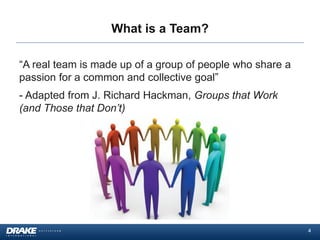
“A real team is made up of a group of people who share a
passion for a common and collective goal”
- Adapted from J. Richard Hackman, Groups that Work
(and Those that Don’t)

4
Why a Team?
• Creates synergy
 Contributions as a whole are greater than the sum of
its parts

• Maximizing synergy
• Directly affects bottom-line performance

5
Types of Teams
• Permanent/Functional Teams
• Cross Functional Teams
• Self Directed Teams
• Virtual Teams

6
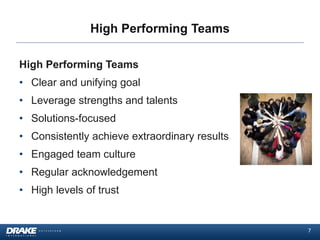
High Performing Teams
• Clear and unifying goal
• Leverage strengths and talents
• Solutions-focused
• Consistently achieve extraordinary results

• Engaged team culture
• Regular acknowledgement
• High levels of trust

7
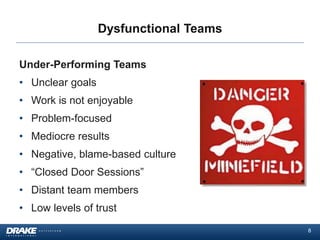
Dysfunctional Teams
Under-Performing Teams
• Unclear goals
• Work is not enjoyable
• Problem-focused
• Mediocre results

• Negative, blame-based culture
• “Closed Door Sessions”
• Distant team members
• Low levels of trust
8
The Power of Alignment
• Clear goals and a common purpose
• Individual and group goals CAN co-exist
Try this exercise:
Ask the individual members to write down on a piece of
paper what they believe is the most important goal of the
team. Collect all the papers and read out what has been
written.

9
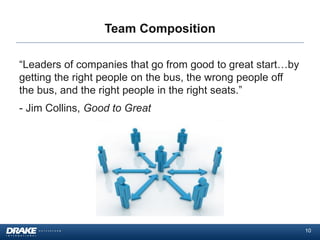
Team Composition
“Leaders of companies that go from good to great start…by
getting the right people on the bus, the wrong people off
the bus, and the right people in the right seats.”
- Jim Collins, Good to Great

10
Selection of Team Members
• What are your team’s core competencies?
• What are the gaps?
• Who is the unofficial leader in your team?
• Is there an alignment between personal and group
goals?
• Is your compensation strategy aligned with what you
want the team to achieve?
• What are the consequences of your team’s Strengths
and Weaknesses?

11
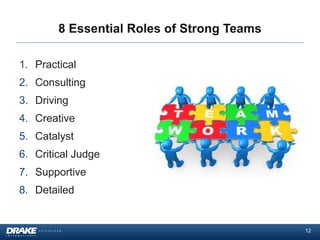
8 Essential Roles of Strong Teams
1. Practical
2. Consulting
3. Driving
4. Creative
5. Catalyst

6. Critical Judge
7. Supportive
8. Detailed

12
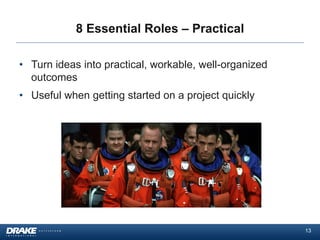
8 Essential Roles – Practical
• Turn ideas into practical, workable, well-organized
outcomes
• Useful when getting started on a project quickly

13
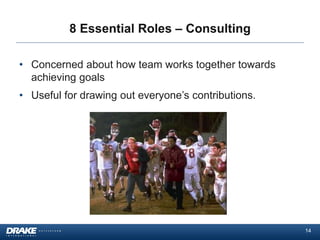
8 Essential Roles – Consulting
• Concerned about how team works together towards
achieving goals
• Useful for drawing out everyone’s contributions.

14
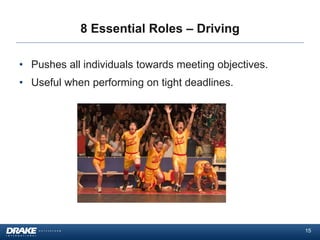
8 Essential Roles – Driving
• Pushes all individuals towards meeting objectives.
• Useful when performing on tight deadlines.

15
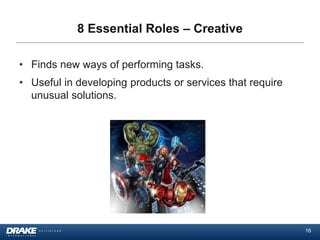
8 Essential Roles – Creative
• Finds new ways of performing tasks.
• Useful in developing products or services that require
unusual solutions.

16
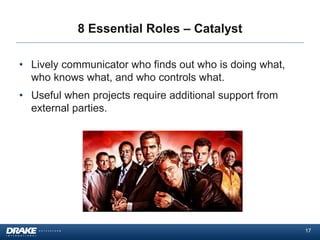
8 Essential Roles – Catalyst
• Lively communicator who finds out who is doing what,
who knows what, and who controls what.
• Useful when projects require additional support from
external parties.

17
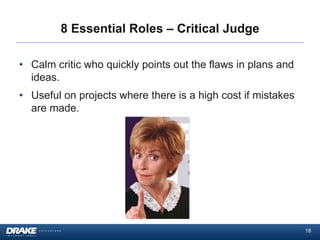
8 Essential Roles – Critical Judge
• Calm critic who quickly points out the flaws in plans and
ideas.
• Useful on projects where there is a high cost if mistakes
are made.

18
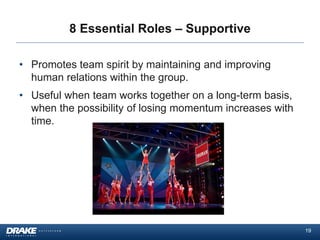
8 Essential Roles – Supportive
• Promotes team spirit by maintaining and improving
human relations within the group.
• Useful when team works together on a long-term basis,
when the possibility of losing momentum increases with
time.

19
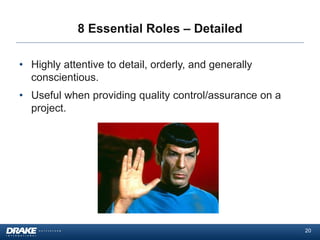
8 Essential Roles – Detailed
• Highly attentive to detail, orderly, and generally
conscientious.
• Useful when providing quality control/assurance on a
project.

20
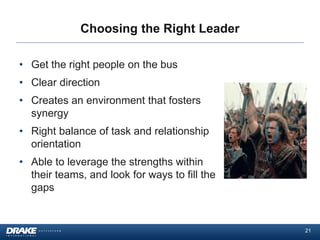
Choosing the Right Leader
• Get the right people on the bus
• Clear direction
• Creates an environment that fosters
synergy
• Right balance of task and relationship
orientation
• Able to leverage the strengths within
their teams, and look for ways to fill the
gaps

21
Tools for Better Teams
• Personality Assessments
• Team Communication Profiles and Reports
• 360 as a feedback tool

22
Team Communication Report
• Work more effectively with the individual members of
your team.
• Learn how to adjust your behaviours for optimal
communication
• Create a more open, positive relationship with your team
members.

• Maximize your influence when communicating with
peers, team members and your manager

23
How does a Team Communication Report
help?
• Understand your team’s priorities
• Learn how to create rapport with team members
• Learn how to communicate effectively through adjusting
your style
• Determine the sensitive areas to consider and/or avoid

24
In Conclusion
Strong teams don’t just happen, they are a result of a
deliberate process that involves the following:
– Selection of team members according to
competencies needed for type of team
– Understanding of individual’s goals and priorities to
create an alignment with team goals

– Adjusting communication style to effectively motivate
and drive the right behaviours
– Leveraging team member’s strengths

25
Free Offer
• We’re offering a free Drake P3 Personality Assessment
and a complimentary 30 minute Debrief
• $200 Discount Upcoming P3 Certification course – 13
CPD points: www.P3Certification.com
Contact Zoe to take advantage of these exclusive offers!
zmitchell@na.drakeintl.com
416.216.1093

26
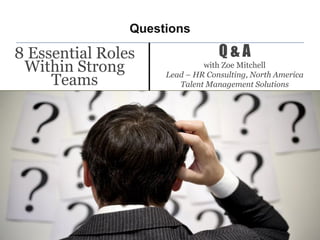
Questions

8 Essential Roles
Within Strong
Teams

Q&A
with Zoe Mitchell
Lead – HR Consulting, North America
Talent Management Solutions

27
Upcoming Webinar
Register @
Drake-Webinars.com
Feb 26, 12pm EDT
How to Improve Your BottomLine With Lean Six Sigma
Presented by:
Zoe Mitchell
Lead - HR Consulting

Thank You for Attending
For questions, please contact Zoe Mitchell

zmitchell@na.drakeintl.com
416.216.1093
29

8 Necessary Roles Within Successful Teams

  • 1.
    For audio, itis recommended you dial in A copy of the slides + recording will be available post webinar AUDIO: 1-877-668-4493 Access Code: 665 806 266 Event Password: 1234 WebEx Support: 1-866-863-3910 8 Necessary Roles Within All Strong Teams January 22, 2014 Presented by: Zoe Mitchell, Lead – HR Consulting, North America
  • 2.
    Free Offer • We’reoffering a free Drake P3 Personality Assessment and a complimentary 30 minute Debrief • $200 Discount Upcoming P3 Certification course – 13 CPD points Contact Zoe to take advantage of these exclusive offers! zmitchell@na.drakeintl.com 416.216.1093 2
  • 3.
    Agenda What is aTeam? Why a Team? Types of Teams Let’s Talk Personality 8 Essential Roles Effective Tools
  • 4.
    What is aTeam? “A real team is made up of a group of people who share a passion for a common and collective goal” - Adapted from J. Richard Hackman, Groups that Work (and Those that Don’t) 4
  • 5.
    Why a Team? •Creates synergy  Contributions as a whole are greater than the sum of its parts • Maximizing synergy • Directly affects bottom-line performance 5
  • 6.
    Types of Teams •Permanent/Functional Teams • Cross Functional Teams • Self Directed Teams • Virtual Teams 6
  • 7.
    High Performing Teams HighPerforming Teams • Clear and unifying goal • Leverage strengths and talents • Solutions-focused • Consistently achieve extraordinary results • Engaged team culture • Regular acknowledgement • High levels of trust 7
  • 8.
    Dysfunctional Teams Under-Performing Teams •Unclear goals • Work is not enjoyable • Problem-focused • Mediocre results • Negative, blame-based culture • “Closed Door Sessions” • Distant team members • Low levels of trust 8
  • 9.
    The Power ofAlignment • Clear goals and a common purpose • Individual and group goals CAN co-exist Try this exercise: Ask the individual members to write down on a piece of paper what they believe is the most important goal of the team. Collect all the papers and read out what has been written. 9
  • 10.
    Team Composition “Leaders ofcompanies that go from good to great start…by getting the right people on the bus, the wrong people off the bus, and the right people in the right seats.” - Jim Collins, Good to Great 10
  • 11.
    Selection of TeamMembers • What are your team’s core competencies? • What are the gaps? • Who is the unofficial leader in your team? • Is there an alignment between personal and group goals? • Is your compensation strategy aligned with what you want the team to achieve? • What are the consequences of your team’s Strengths and Weaknesses? 11
  • 12.
    8 Essential Rolesof Strong Teams 1. Practical 2. Consulting 3. Driving 4. Creative 5. Catalyst 6. Critical Judge 7. Supportive 8. Detailed 12
  • 13.
    8 Essential Roles– Practical • Turn ideas into practical, workable, well-organized outcomes • Useful when getting started on a project quickly 13
  • 14.
    8 Essential Roles– Consulting • Concerned about how team works together towards achieving goals • Useful for drawing out everyone’s contributions. 14
  • 15.
    8 Essential Roles– Driving • Pushes all individuals towards meeting objectives. • Useful when performing on tight deadlines. 15
  • 16.
    8 Essential Roles– Creative • Finds new ways of performing tasks. • Useful in developing products or services that require unusual solutions. 16
  • 17.
    8 Essential Roles– Catalyst • Lively communicator who finds out who is doing what, who knows what, and who controls what. • Useful when projects require additional support from external parties. 17
  • 18.
    8 Essential Roles– Critical Judge • Calm critic who quickly points out the flaws in plans and ideas. • Useful on projects where there is a high cost if mistakes are made. 18
  • 19.
    8 Essential Roles– Supportive • Promotes team spirit by maintaining and improving human relations within the group. • Useful when team works together on a long-term basis, when the possibility of losing momentum increases with time. 19
  • 20.
    8 Essential Roles– Detailed • Highly attentive to detail, orderly, and generally conscientious. • Useful when providing quality control/assurance on a project. 20
  • 21.
    Choosing the RightLeader • Get the right people on the bus • Clear direction • Creates an environment that fosters synergy • Right balance of task and relationship orientation • Able to leverage the strengths within their teams, and look for ways to fill the gaps 21
  • 22.
    Tools for BetterTeams • Personality Assessments • Team Communication Profiles and Reports • 360 as a feedback tool 22
  • 23.
    Team Communication Report •Work more effectively with the individual members of your team. • Learn how to adjust your behaviours for optimal communication • Create a more open, positive relationship with your team members. • Maximize your influence when communicating with peers, team members and your manager 23
  • 24.
    How does aTeam Communication Report help? • Understand your team’s priorities • Learn how to create rapport with team members • Learn how to communicate effectively through adjusting your style • Determine the sensitive areas to consider and/or avoid 24
  • 25.
    In Conclusion Strong teamsdon’t just happen, they are a result of a deliberate process that involves the following: – Selection of team members according to competencies needed for type of team – Understanding of individual’s goals and priorities to create an alignment with team goals – Adjusting communication style to effectively motivate and drive the right behaviours – Leveraging team member’s strengths 25
  • 26.
    Free Offer • We’reoffering a free Drake P3 Personality Assessment and a complimentary 30 minute Debrief • $200 Discount Upcoming P3 Certification course – 13 CPD points: www.P3Certification.com Contact Zoe to take advantage of these exclusive offers! zmitchell@na.drakeintl.com 416.216.1093 26
  • 27.
    Questions 8 Essential Roles WithinStrong Teams Q&A with Zoe Mitchell Lead – HR Consulting, North America Talent Management Solutions 27
  • 28.
    Upcoming Webinar Register @ Drake-Webinars.com Feb26, 12pm EDT How to Improve Your BottomLine With Lean Six Sigma
  • 29.
    Presented by: Zoe Mitchell Lead- HR Consulting Thank You for Attending For questions, please contact Zoe Mitchell zmitchell@na.drakeintl.com 416.216.1093 29