How  and  Why  To  Build  High-­‐Performing  Teams  
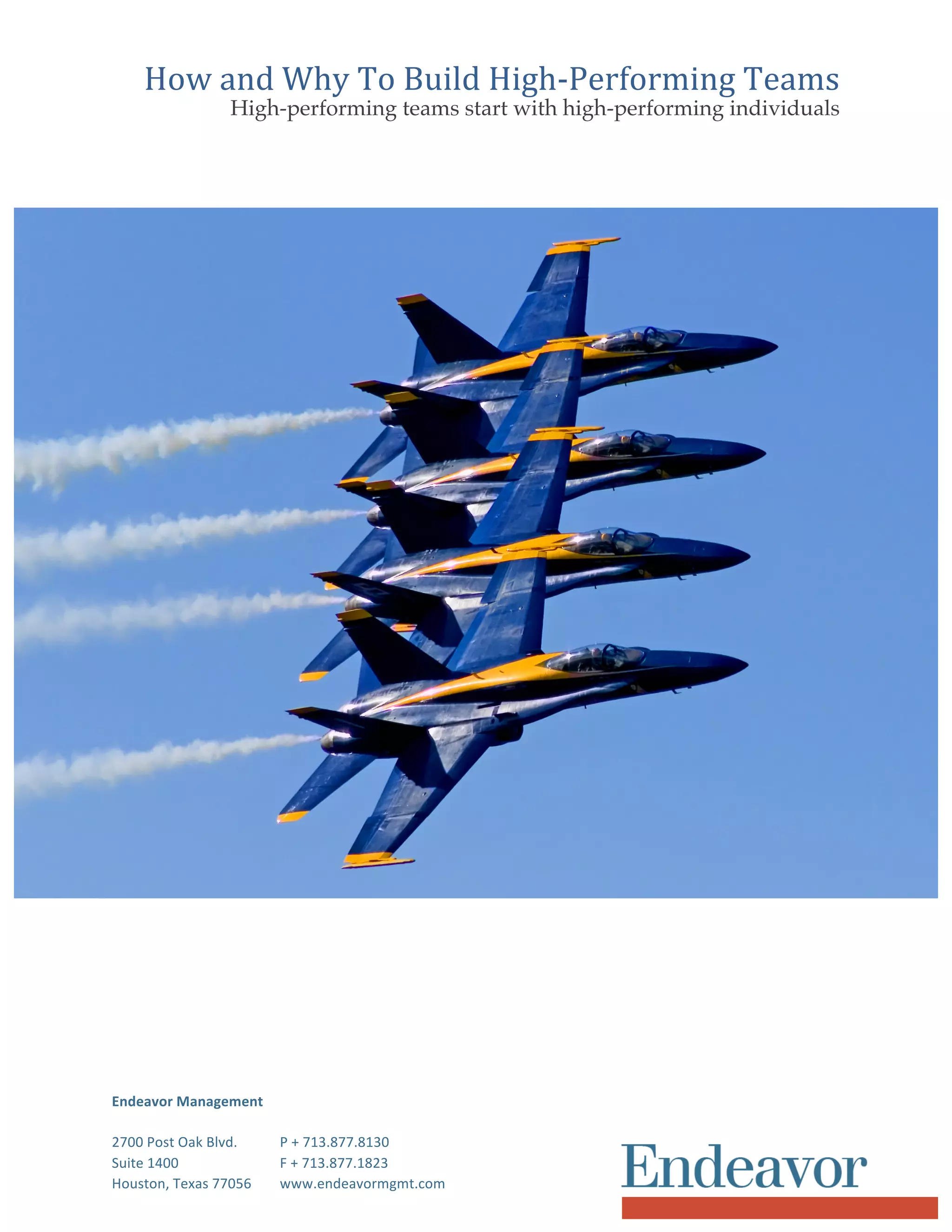
High-performing teams start with high-performing individuals  


Endeavor  Management              
2700	
  Post	
  Oak	
  Blvd.	
   P	
  +	
  713.877.8130	
  
Suite	
  1400	
   F	
  +	
  713.877.1823	
  
Houston,	
  Texas	
  77056	
   www.endeavormgmt.com	


How  and  Why  to  Build  High-­‐Performing  Teams  


©	
  2014	
  Endeavor	
  Management.	
  All	
  Rights	
  Reserved.	


Page	
  2	
  
High-­performing  teams  start  with  high-­performing  individuals  
  
In	
  any	
  business,	
  people	
  make	
  the	
  difference.	
  And	
  people	
  make	
  the	
  difference	
  when	
  they	
  operate	
  as	
  
a	
  team,	
  but	
  only	
  if	
  they	
  operate	
  as	
  a	
  high-­‐performing	
  team.	
  One	
  of	
  the	
  most	
  elusive	
  outcomes	
  is	
  
that	
  of	
  creating	
  a	
  high-­‐performing	
  team.	
  Why	
  is	
  this	
  so?	
  As	
  it	
  has	
  been	
  said	
  many	
  times,	
  if	
  it	
  was	
  
easy…	
  every	
  leader	
  would	
  do	
  it.	


The	
  high-­‐performing	
  team	
  starts	
  with	
  high-­‐performing	
  individuals,	
  who	
  have	
  a	
  certain	
  awareness	
  of	
  
themselves	
  and	
  the	
  value	
  that	
  others	
  can	
  bring.	
  High-­‐performing	
  teams	
  have	
  many	
  interesting	
  
characteristics	
  and	
  are	
  clear	
  on	
  what	
  they	
  are	
  trying	
  to	
  accomplish,	
  how	
  they	
  are	
  going	
  to	
  achieve	
  
their	
  goals,	
  and	
  why	
  they	
  want	
  to	
  achieve	
  their	
  goals.	


So	
  for	
  leaders,	
  the	
  key	
  is	
  to	
  start	
  with	
  the	
  frame;	
  create	
  and	
  foster	
  individual	
  work	
  style,	
  awareness	
  
and	
  motivation;	
  and	
  help	
  the	
  team	
  define	
  the	
  characteristics	
  and	
  behaviors	
  that	
  truly	
  make	
  for	
  a	
  
high-­‐performing	
  team,	
  which	
  achieves	
  its	
  goals	
  despite	
  organizational	
  barriers	
  and	
  resistance.	
  For	
  
our	
  sake,	
  let’s	
  define	
  a	
  high-­‐performing	
  team	
  as	
  research	
  has	
  defined	
  it.	


A	
  high-­‐performing	
  team	
  is	
  defined	
  as	
  a	
  team	
  that:	


• Identifies	
  with	
  the	
  organization’s	
  beliefs	
  and	
  values	
  as	
  to	
  why	
  the	
  company	
  exists	
  
• Understands	
  and	
  demonstrates	
  a	
  “systems	
  approach”	
  in	
  defining	
  performance	
  to	
  support	
  
strategy	
  
• Understands	
  and	
  demonstrates	
  how	
  to	
  build	
  deep	
  and	
  multi-­‐level	
  trust	
  
• Is	
  culturally	
  aware,	
  adaptive	
  and	
  flexible	
  in	
  leveraging	
  constructive	
  conflict	
  
• Has	
  individuals	
  who	
  are	
  passionately	
  committed	
  to	
  the	
  team	
  and	
  its	
  objectives	
  
• Holds	
  self	
  and	
  each	
  member	
  accountable	
  for	
  their	
  actions	
  and	
  deliverables	
  
• Focuses	
  on	
  the	
  right	
  metrics	
  and	
  objectives	
  to	
  create	
  the	
  successful	
  outcome	
  the	
  team	
  
seeks	


A	
  high-­‐performing	
  team	
  requires	
  three	
  areas	
  of	
  clarity	
  to	
  begin	
  their	
  journey:	


1. Clarity	
  on	
  the	
  team	
  task,	
  resources,	
  and	
  goals	
  of	
  the	
  team	
  
2. Clarity	
  of	
  the	
  team	
  process	
  or	
  how	
  the	
  team	
  will	
  work	
  together	
  
3. Clarity	
  around	
  the	
  team	
  dynamics	
  or	
  how	
  the	
  team	
  will	
  act	
  toward	
  one	
  another	


We	
  typically	
  refer	
  to	
  this	
  effort	
  to	
  create	
  clarity	
  as	
  framing	
  or	
  chartering	
  the	
  team.	
  The	
  idea	
  is	
  for	
  
each	
  team	
  member	
  to	
  be	
  initially	
  aligned	
  on	
  what	
  success	
  looks	
  like,	
  what	
  resources	
  are	
  available	
  
to	
  the	
  team	
  to	
  create	
  success,	
  and	
  what	
  specific	
  goals	
  the	
  team	
  must	
  reach	
  (both	
  along	
  the	
  way	
  
and	
  in	
  the	
  end)	
  to	
  achieve	
  success.	


How  and  Why  to  Build  High-­‐Performing  Teams  


©	
  2014	
  Endeavor	
  Management.	
  All	
  Rights	
  Reserved.	
   	
  
Page	
  3	
  
Many	
  teams,	
  having	
  failed	
  to	
  reach	
  their	
  goals,	
  look	
  back	
  to	
  find	
  that	
  different	
  team	
  members	
  were	
  
working	
  on	
  very	
  different	
  views	
  of	
  what	
  success	
  looked	
  like,	
  causing	
  workflows	
  that	
  were	
  either	
  at	
  
cross	
  purposes	
  or	
  that	
  didn’t	
  flow	
  together	
  very	
  well.	
  Further,	
  many	
  after-­‐action	
  reviews	
  identified	
  
misalignment:	
  team	
  members	
  were	
  making	
  different	
  assumptions	
  about	
  the	
  resources	
  and/or	
  
constraints	
  that	
  were	
  available	
  or	
  placed	
  on	
  the	
  team.	
  Finally,	
  many	
  teams	
  find	
  that	
  their	
  failures	
  
were	
  attributable	
  to	
  different	
  work	
  styles,	
  different	
  personalities,	
  and/or	
  different	
  assumptions	
  
about	
  how	
  the	
  team	
  members	
  will	
  act	
  toward	
  one	
  another.	


In	
  our	
  experience,	
  this	
  last	
  area,	
  around	
  how	
  people	
  treat	
  one	
  other,	
  communicate,	
  intend	
  to	
  and	
  
deliver	
  value,	
  is	
  one	
  of	
  the	
  most	
  difficult	
  for	
  leaders.	
  All	
  teams	
  start	
  with	
  individuals,	
  who	
  have	
  their	
  
own	
  work	
  motivations,	
  career	
  desires,	
  communication	
  patterns,	
  cultural	
  patterns,	
  and	
  leadership	
  
and	
  influence	
  styles.	
  What	
  must	
  happen	
  in	
  any	
  high-­‐performing,	
  team-­‐building	
  process	
  is	
  an	
  effort	
  
to	
  help	
  the	
  individual	
  team	
  members	
  become	
  more	
  aware	
  of	
  their	
  motivations	
  and	
  styles,	
  and	
  their	
  
impact	
  on	
  others	
  in	
  the	
  team.	
  The	
  key	
  to	
  this	
  process	
  is	
  to	
  bring	
  into	
  focus	
  how	
  high-­‐performing	
  
teams	
  learn	
  to	
  use	
  the	
  strengths	
  of	
  each	
  individual	
  team	
  member,	
  while	
  honoring	
  the	
  differences	
  in	
  
how	
  team	
  members	
  work.	
  This	
  understanding	
  of	
  individuals	
  is	
  the	
  basis	
  for	
  initiating	
  and	
  building	
  
deeper	
  trust	
  between	
  individuals	
  in	
  the	
  team.	


Generally,	
  industries	
  are	
  not	
  teaching	
  its	
  leaders	
  how	
  to	
  educate	
  teams	
  on	
  the	
  differences	
  in	
  work	
  
styles	
  and	
  not	
  creating	
  the	
  trust	
  necessary	
  to	
  build	
  high-­‐performing	
  teams.	
  A	
  recent	
  study	
  was	
  
done	
  to	
  help	
  further	
  define	
  the	
  problem.	
  Over	
  1,000	
  leaders	
  were	
  asked	
  if	
  they	
  were	
  trust	
  worthy,	
  
(are	
  they	
  honest,	
  do	
  they	
  tell	
  the	
  truth,	
  did	
  they	
  have	
  the	
  best	
  interest	
  of	
  the	
  company	
  at	
  heart,	
  
etc.).	
  Over	
  95%	
  of	
  the	
  respondents	
  said,	
  “Yes.”	
  However,	
  when	
  those	
  same	
  leaders	
  were	
  asked	
  if	
  
they	
  were	
  good	
  at	
  building	
  trust	
  in	
  teams	
  or	
  in	
  the	
  organization,	
  only	
  40%	
  of	
  the	
  respondents	
  said,	
  
“Yes.”	


What	
  goes	
  wrong?	
  Why	
  can’t	
  we	
  build	
  trust	
  and	
  thus	
  high-­‐performing	
  teams?	
  First	
  and	
  foremost,	
  
our	
  leaders	
  don’t	
  always	
  have	
  the	
  tools	
  or	
  understanding	
  of	
  human	
  motivation	
  and	
  work	
  styles,	
  to	
  
pre-­‐empt	
  the	
  inevitable	
  conflict	
  that	
  high-­‐performing	
  individuals	
  create	
  when	
  they	
  come	
  together	
  
as	
  a	
  team.	
  These	
  tools	
  and	
  processes	
  revolve	
  around	
  helping	
  high-­‐performing	
  individuals	
  
understand	
  and	
  learn	
  to	
  utilize	
  what	
  “others	
  are	
  best	
  at”	
  in	
  a	
  team	
  setting.	
  While	
  we	
  may	
  be	
  able	
  
to	
  use	
  the	
  individual	
  skills	
  others	
  bring,	
  where	
  we	
  fall	
  down	
  is	
  in	
  learning	
  to	
  utilize	
  others’	
  
communication,	
  cultural,	
  and	
  work	
  styles	
  for	
  the	
  benefit	
  of	
  the	
  team.	
  In	
  fact,	
  it	
  is	
  often	
  those	
  
differences	
  that	
  cause	
  teams	
  of	
  high-­‐performing	
  to	
  split	
  apart,	
  by	
  making	
  assumptions	
  about	
  why	
  
someone	
  communicates	
  a	
  particular	
  way,	
  or	
  fails	
  to	
  respond	
  in	
  a	
  way	
  that	
  “I	
  would.”	


While	
  there	
  are	
  many	
  tools,	
  we	
  often	
  find	
  that	
  assessments	
  of	
  individual	
  work	
  styles	
  (Birkman	
  
Method,	
  Myers-­‐Briggs,	
  StrengthsFinder,	
  DISC,	
  etc.)	
  and	
  team	
  workshops	
  designed	
  to	
  create	
  an	
  
understanding	
  of	
  different	
  work	
  styles	
  and	
  motivations,	
  can	
  help	
  teams	
  start	
  the	
  journey	
  to	
  
becoming	
  high-­‐performing	
  and	
  building	
  the	
  trust	
  between	
  team	
  members.	
  Understanding	
  and	
  
trust	
  are	
  required	
  to	
  achieve	
  success.	
  
How  and  Why  to  Build  High-­‐Performing  Teams  


©	
  2014	
  Endeavor	
  Management.	
  All	
  Rights	
  Reserved.	
   	
  
Page	
  4	


The	
  characteristics	
  and	
  actual	
  behaviors	
  of	
  high-­‐performing	
  teams	
  are	
  well	
  understood	
  and	
  defined	
  
by	
  years	
  of	
  team	
  research.	
  There	
  are	
  tools	
  that	
  enable	
  teams	
  to	
  rapidly	
  overcome	
  their	
  internal	
  
barriers	
  and	
  organizational	
  challenges,	
  providing	
  a	
  clear	
  and	
  imbedded	
  roadmap	
  to	
  high	
  
performance	
  and	
  team	
  success.	
  Good	
  leaders	
  learn	
  about	
  these	
  tools	
  and	
  employ	
  processes	
  to	
  
create	
  clarity	
  and	
  individual	
  team	
  member	
  trust	
  in	
  the	
  team,	
  in	
  order	
  to	
  achieve	
  their	
  
organizational	
  goals	
  and	
  objectives.	
  
  
About  Endeavor  
  
Endeavor	
  Management,	
  is	
  an	
  international	
  management	
  consulting	
  firm	
  that	
  collaboratively	
  works	
  
with	
  their	
  clients	
  to	
  achieve	
  greater	
  value	
  from	
  their	
  transformational	
  business	
  initiatives.	
  Endeavor	
  
serves	
  as	
  a	
  catalyst	
  by	
  providing	
  pragmatic	
  methodologies	
  and	
  industry	
  expertise	
  in	
  
Transformational	
  Strategies,	
  Operational	
  Excellence,	
  Organizational	
  Effectiveness,	
  and	
  
Transformational	
  Leadership.	


Our	
  clients	
  include	
  those	
  responsible	
  for:	
  
• Business	
  Strategy	
  
• Marketing	
  and	
  Brand	
  Strategy	
  
• Operations	
  
• Technology	
  Deployment	
  
• Strategic	
  Human	
  Capital	
  
• Corporate	
  Finance	


The	
  firm’s	
  40-­‐year	
  heritage	
  has	
  produced	
  a	
  substantial	
  portfolio	
  of	
  proven	
  methodologies,	
  deep	
  
operational	
  insight	
  and	
  broad	
  industry	
  experience.	
  	
  This	
  experience	
  enables	
  our	
  team	
  to	
  quickly	
  
understand	
  the	
  dynamics	
  of	
  client	
  companies	
  and	
  markets.	
  	
  Endeavor’s	
  clients	
  span	
  the	
  globe	
  and	
  
are	
  typically	
  leaders	
  in	
  their	
  industry.	


Gelb	
  Consulting	
  Group,	
  a	
  wholly	
  owned	
  subsidiary,	
  monitors	
  organizational	
  performance	
  and	
  
designs	
  winning	
  marketing	
  strategies.	
  	
  Gelb	
  helps	
  organizations	
  focus	
  their	
  marketing	
  initiatives	
  by	
  
fully	
  understanding	
  customer	
  needs	
  through	
  proven	
  strategic	
  frameworks	
  to	
  guide	
  marketing	
  
strategies,	
  build	
  trusted	
  brands,	
  deliver	
  exceptional	
  experiences	
  and	
  launch	
  new	
  products.	


Our	
  websites:	
  
www.endeavormgmt.com	
  
www.gulfresearch.com  
  

How and why to build high performing teams

  • 1.
    How  and  Why To  Build  High-­‐Performing  Teams   High-performing teams start with high-performing individuals       Endeavor  Management           2700  Post  Oak  Blvd.   P  +  713.877.8130   Suite  1400   F  +  713.877.1823   Houston,  Texas  77056   www.endeavormgmt.com                  
  • 2.
    How  and  Why to  Build  High-­‐Performing  Teams       ©  2014  Endeavor  Management.  All  Rights  Reserved.       Page  2   High-­performing  teams  start  with  high-­performing  individuals     In  any  business,  people  make  the  difference.  And  people  make  the  difference  when  they  operate  as   a  team,  but  only  if  they  operate  as  a  high-­‐performing  team.  One  of  the  most  elusive  outcomes  is   that  of  creating  a  high-­‐performing  team.  Why  is  this  so?  As  it  has  been  said  many  times,  if  it  was   easy…  every  leader  would  do  it.     The  high-­‐performing  team  starts  with  high-­‐performing  individuals,  who  have  a  certain  awareness  of   themselves  and  the  value  that  others  can  bring.  High-­‐performing  teams  have  many  interesting   characteristics  and  are  clear  on  what  they  are  trying  to  accomplish,  how  they  are  going  to  achieve   their  goals,  and  why  they  want  to  achieve  their  goals.     So  for  leaders,  the  key  is  to  start  with  the  frame;  create  and  foster  individual  work  style,  awareness   and  motivation;  and  help  the  team  define  the  characteristics  and  behaviors  that  truly  make  for  a   high-­‐performing  team,  which  achieves  its  goals  despite  organizational  barriers  and  resistance.  For   our  sake,  let’s  define  a  high-­‐performing  team  as  research  has  defined  it.     A  high-­‐performing  team  is  defined  as  a  team  that:     • Identifies  with  the  organization’s  beliefs  and  values  as  to  why  the  company  exists   • Understands  and  demonstrates  a  “systems  approach”  in  defining  performance  to  support   strategy   • Understands  and  demonstrates  how  to  build  deep  and  multi-­‐level  trust   • Is  culturally  aware,  adaptive  and  flexible  in  leveraging  constructive  conflict   • Has  individuals  who  are  passionately  committed  to  the  team  and  its  objectives   • Holds  self  and  each  member  accountable  for  their  actions  and  deliverables   • Focuses  on  the  right  metrics  and  objectives  to  create  the  successful  outcome  the  team   seeks     A  high-­‐performing  team  requires  three  areas  of  clarity  to  begin  their  journey:     1. Clarity  on  the  team  task,  resources,  and  goals  of  the  team   2. Clarity  of  the  team  process  or  how  the  team  will  work  together   3. Clarity  around  the  team  dynamics  or  how  the  team  will  act  toward  one  another     We  typically  refer  to  this  effort  to  create  clarity  as  framing  or  chartering  the  team.  The  idea  is  for   each  team  member  to  be  initially  aligned  on  what  success  looks  like,  what  resources  are  available   to  the  team  to  create  success,  and  what  specific  goals  the  team  must  reach  (both  along  the  way   and  in  the  end)  to  achieve  success.    
  • 3.
    How  and  Why to  Build  High-­‐Performing  Teams       ©  2014  Endeavor  Management.  All  Rights  Reserved.     Page  3   Many  teams,  having  failed  to  reach  their  goals,  look  back  to  find  that  different  team  members  were   working  on  very  different  views  of  what  success  looked  like,  causing  workflows  that  were  either  at   cross  purposes  or  that  didn’t  flow  together  very  well.  Further,  many  after-­‐action  reviews  identified   misalignment:  team  members  were  making  different  assumptions  about  the  resources  and/or   constraints  that  were  available  or  placed  on  the  team.  Finally,  many  teams  find  that  their  failures   were  attributable  to  different  work  styles,  different  personalities,  and/or  different  assumptions   about  how  the  team  members  will  act  toward  one  another.     In  our  experience,  this  last  area,  around  how  people  treat  one  other,  communicate,  intend  to  and   deliver  value,  is  one  of  the  most  difficult  for  leaders.  All  teams  start  with  individuals,  who  have  their   own  work  motivations,  career  desires,  communication  patterns,  cultural  patterns,  and  leadership   and  influence  styles.  What  must  happen  in  any  high-­‐performing,  team-­‐building  process  is  an  effort   to  help  the  individual  team  members  become  more  aware  of  their  motivations  and  styles,  and  their   impact  on  others  in  the  team.  The  key  to  this  process  is  to  bring  into  focus  how  high-­‐performing   teams  learn  to  use  the  strengths  of  each  individual  team  member,  while  honoring  the  differences  in   how  team  members  work.  This  understanding  of  individuals  is  the  basis  for  initiating  and  building   deeper  trust  between  individuals  in  the  team.     Generally,  industries  are  not  teaching  its  leaders  how  to  educate  teams  on  the  differences  in  work   styles  and  not  creating  the  trust  necessary  to  build  high-­‐performing  teams.  A  recent  study  was   done  to  help  further  define  the  problem.  Over  1,000  leaders  were  asked  if  they  were  trust  worthy,   (are  they  honest,  do  they  tell  the  truth,  did  they  have  the  best  interest  of  the  company  at  heart,   etc.).  Over  95%  of  the  respondents  said,  “Yes.”  However,  when  those  same  leaders  were  asked  if   they  were  good  at  building  trust  in  teams  or  in  the  organization,  only  40%  of  the  respondents  said,   “Yes.”     What  goes  wrong?  Why  can’t  we  build  trust  and  thus  high-­‐performing  teams?  First  and  foremost,   our  leaders  don’t  always  have  the  tools  or  understanding  of  human  motivation  and  work  styles,  to   pre-­‐empt  the  inevitable  conflict  that  high-­‐performing  individuals  create  when  they  come  together   as  a  team.  These  tools  and  processes  revolve  around  helping  high-­‐performing  individuals   understand  and  learn  to  utilize  what  “others  are  best  at”  in  a  team  setting.  While  we  may  be  able   to  use  the  individual  skills  others  bring,  where  we  fall  down  is  in  learning  to  utilize  others’   communication,  cultural,  and  work  styles  for  the  benefit  of  the  team.  In  fact,  it  is  often  those   differences  that  cause  teams  of  high-­‐performing  to  split  apart,  by  making  assumptions  about  why   someone  communicates  a  particular  way,  or  fails  to  respond  in  a  way  that  “I  would.”     While  there  are  many  tools,  we  often  find  that  assessments  of  individual  work  styles  (Birkman   Method,  Myers-­‐Briggs,  StrengthsFinder,  DISC,  etc.)  and  team  workshops  designed  to  create  an   understanding  of  different  work  styles  and  motivations,  can  help  teams  start  the  journey  to   becoming  high-­‐performing  and  building  the  trust  between  team  members.  Understanding  and   trust  are  required  to  achieve  success.  
  • 4.
    How  and  Why to  Build  High-­‐Performing  Teams       ©  2014  Endeavor  Management.  All  Rights  Reserved.     Page  4     The  characteristics  and  actual  behaviors  of  high-­‐performing  teams  are  well  understood  and  defined   by  years  of  team  research.  There  are  tools  that  enable  teams  to  rapidly  overcome  their  internal   barriers  and  organizational  challenges,  providing  a  clear  and  imbedded  roadmap  to  high   performance  and  team  success.  Good  leaders  learn  about  these  tools  and  employ  processes  to   create  clarity  and  individual  team  member  trust  in  the  team,  in  order  to  achieve  their   organizational  goals  and  objectives.     About  Endeavor     Endeavor  Management,  is  an  international  management  consulting  firm  that  collaboratively  works   with  their  clients  to  achieve  greater  value  from  their  transformational  business  initiatives.  Endeavor   serves  as  a  catalyst  by  providing  pragmatic  methodologies  and  industry  expertise  in   Transformational  Strategies,  Operational  Excellence,  Organizational  Effectiveness,  and   Transformational  Leadership.     Our  clients  include  those  responsible  for:   • Business  Strategy   • Marketing  and  Brand  Strategy   • Operations   • Technology  Deployment   • Strategic  Human  Capital   • Corporate  Finance     The  firm’s  40-­‐year  heritage  has  produced  a  substantial  portfolio  of  proven  methodologies,  deep   operational  insight  and  broad  industry  experience.    This  experience  enables  our  team  to  quickly   understand  the  dynamics  of  client  companies  and  markets.    Endeavor’s  clients  span  the  globe  and   are  typically  leaders  in  their  industry.       Gelb  Consulting  Group,  a  wholly  owned  subsidiary,  monitors  organizational  performance  and   designs  winning  marketing  strategies.    Gelb  helps  organizations  focus  their  marketing  initiatives  by   fully  understanding  customer  needs  through  proven  strategic  frameworks  to  guide  marketing   strategies,  build  trusted  brands,  deliver  exceptional  experiences  and  launch  new  products.     Our  websites:   www.endeavormgmt.com   www.gulfresearch.com