

True teamwork
Fun and effective?
Ville Marjusaari 2018-3-23
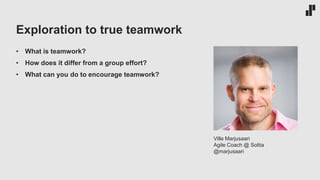
Exploration to true teamwork
• What is teamwork?
• How does it differ from a group effort?
• What can you do to encourage teamwork?
Ville Marjusaari
Agile Coach @ Solita
@marjusaari
• What is your energy level right now?
Check-in
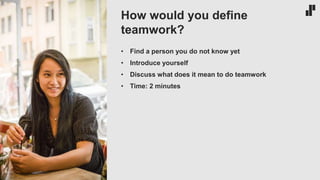
• Find a person you do not know yet
• Introduce yourself
• Discuss what does it mean to do teamwork
• Time: 2 minutes
How would you define
teamwork?
• Professional relationships.
• People exchange information and help each other
but they do this only to achieve their individual
goals for a common outcome.
• No synergy: achieves the sum of its parts at best.
Work group
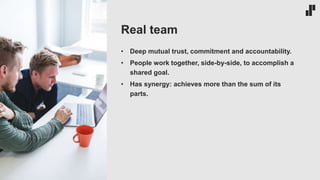
• Deep mutual trust, commitment and accountability.
• People work together, side-by-side, to accomplish a
shared goal.
• Has synergy: achieves more than the sum of its
parts.
Real team
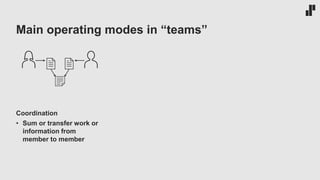
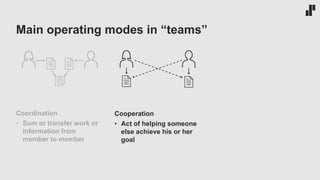
Main operating modes in “teams”
Coordination
• Sum or transfer work or
information from
member to member
Main operating modes in “teams”
Coordination
• Sum or transfer work or
information from
member to member
Cooperation
• Act of helping someone
else achieve his or her
goal
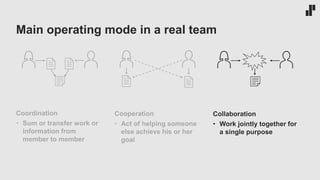
Main operating mode in a real team
Coordination
• Sum or transfer work or
information from
member to member
Cooperation
• Act of helping someone
else achieve his or her
goal
Collaboration
• Work jointly together for
a single purpose
Origami time!
Let’s simulate different operating modes
From Collaborative Games by Sam Laing & Karen Greaves
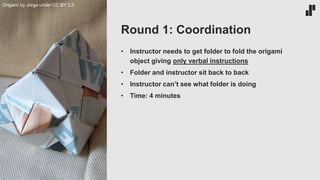
• Instructor needs to get folder to fold the origami
object giving only verbal instructions
• Folder and instructor sit back to back
• Instructor can’t see what folder is doing
• Time: 4 minutes
Round 1: Coordination
Origami by Jorge under CC BY 2.0
• Instructor needs to get folder to fold the origami
object giving verbal instructions
• Folder and instructor sit face to face
• Instructor can see what the folder is doing but folder
can’t see the instructions
• Time: 4 minutes
Round 2: Cooperation
Cubetto simpaticamente decorativo by
Daniel Adami under CC BY 2.0
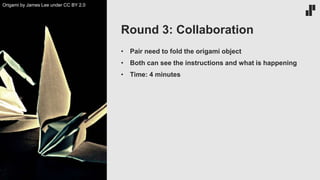
• Pair need to fold the origami object
• Both can see the instructions and what is happening
• Time: 4 minutes
Round 3: Collaboration
Origami by James Lee under CC BY 2.0
• How did different rounds feel?
• How did the results compare?
• Discuss with your pair
• Time: 2 minutes
Debrief
Why is collaboration so
hard?
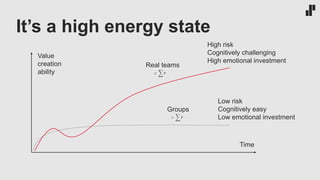
It’s a high energy state
Value
creation
ability
Time
High risk
Cognitively challenging
High emotional investment
Real teams
> 𝑃
Groups
= 𝑃
Low risk
Cognitively easy
Low emotional investment
• I’m free to choose my tools, working hours and how
I work
Society values individuals’
freedom
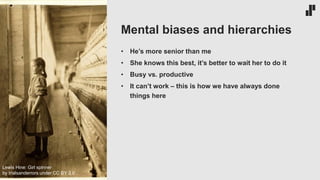
• He’s more senior than me
• She knows this best, it’s better to wait her to do it
• Busy vs. productive
• It can’t work – this is how we have always done
things here
Mental biases and hierarchies
Lewis Hine: Girl spinner
by trialsanderrors under CC BY 2.0
Psychological safety
Prerequisite for collaboration
You can be fully present
• We must feel that we will not be punished or humiliated for speaking up with ideas,
questions, concerns or mistakes
• We must know that we can be free enough, sometimes, to share the things that scare us
without fear of recriminations.
• We must be able to talk about what is messy or sad, to have hard conversations with
colleagues who are driving us crazy.
What you can do to build
psychological safety
Leaders play important role but there are things you can do, too
Slow down
Be present and give time to your slow thinking to prevent old mental models to take over
Meet others as whole human
beings
Learn the real person behind the co-worker
Personal Map (Management 3.0)
Moving Motivators (Management 3.0)
Model curiosity
Ask questions
Build on others ideas: “yes, and” instead of “but”
123 go!
From Collaborative Games by Sam Laing & Karen Greaves
Thank you
VILLE MARJUSAARI
Agile Coach
+358 50 428 2046
ville.marjusaari@solita.fi
@marjusaari
True teamwork

True teamwork

  • 1.
    True teamwork Fun andeffective? Ville Marjusaari 2018-3-23
  • 2.
    Exploration to trueteamwork • What is teamwork? • How does it differ from a group effort? • What can you do to encourage teamwork? Ville Marjusaari Agile Coach @ Solita @marjusaari
  • 3.
    • What isyour energy level right now? Check-in
  • 4.
    • Find aperson you do not know yet • Introduce yourself • Discuss what does it mean to do teamwork • Time: 2 minutes How would you define teamwork?
  • 5.
    • Professional relationships. •People exchange information and help each other but they do this only to achieve their individual goals for a common outcome. • No synergy: achieves the sum of its parts at best. Work group
  • 6.
    • Deep mutualtrust, commitment and accountability. • People work together, side-by-side, to accomplish a shared goal. • Has synergy: achieves more than the sum of its parts. Real team
  • 7.
    Main operating modesin “teams” Coordination • Sum or transfer work or information from member to member
  • 8.
    Main operating modesin “teams” Coordination • Sum or transfer work or information from member to member Cooperation • Act of helping someone else achieve his or her goal
  • 9.
    Main operating modein a real team Coordination • Sum or transfer work or information from member to member Cooperation • Act of helping someone else achieve his or her goal Collaboration • Work jointly together for a single purpose
  • 10.
    Origami time! Let’s simulatedifferent operating modes From Collaborative Games by Sam Laing & Karen Greaves
  • 11.
    • Instructor needsto get folder to fold the origami object giving only verbal instructions • Folder and instructor sit back to back • Instructor can’t see what folder is doing • Time: 4 minutes Round 1: Coordination Origami by Jorge under CC BY 2.0
  • 12.
    • Instructor needsto get folder to fold the origami object giving verbal instructions • Folder and instructor sit face to face • Instructor can see what the folder is doing but folder can’t see the instructions • Time: 4 minutes Round 2: Cooperation Cubetto simpaticamente decorativo by Daniel Adami under CC BY 2.0
  • 13.
    • Pair needto fold the origami object • Both can see the instructions and what is happening • Time: 4 minutes Round 3: Collaboration Origami by James Lee under CC BY 2.0
  • 14.
    • How diddifferent rounds feel? • How did the results compare? • Discuss with your pair • Time: 2 minutes Debrief
  • 15.
  • 16.
    It’s a highenergy state Value creation ability Time High risk Cognitively challenging High emotional investment Real teams > 𝑃 Groups = 𝑃 Low risk Cognitively easy Low emotional investment
  • 17.
    • I’m freeto choose my tools, working hours and how I work Society values individuals’ freedom
  • 18.
    • He’s moresenior than me • She knows this best, it’s better to wait her to do it • Busy vs. productive • It can’t work – this is how we have always done things here Mental biases and hierarchies Lewis Hine: Girl spinner by trialsanderrors under CC BY 2.0
  • 19.
  • 20.
    You can befully present • We must feel that we will not be punished or humiliated for speaking up with ideas, questions, concerns or mistakes • We must know that we can be free enough, sometimes, to share the things that scare us without fear of recriminations. • We must be able to talk about what is messy or sad, to have hard conversations with colleagues who are driving us crazy.
  • 21.
    What you cando to build psychological safety Leaders play important role but there are things you can do, too
  • 22.
    Slow down Be presentand give time to your slow thinking to prevent old mental models to take over
  • 23.
    Meet others aswhole human beings Learn the real person behind the co-worker Personal Map (Management 3.0) Moving Motivators (Management 3.0)
  • 24.
    Model curiosity Ask questions Buildon others ideas: “yes, and” instead of “but”
  • 25.
    123 go! From CollaborativeGames by Sam Laing & Karen Greaves
  • 26.
    Thank you VILLE MARJUSAARI AgileCoach +358 50 428 2046 ville.marjusaari@solita.fi @marjusaari

Editor's Notes

  • #3 Rules: Opt-out Hands up if I want attention Vote: thumbs up/down
  • #5 Take a quick poll
  • #8  Examples? Developer submits code for testing Dveloper informs UX designer that the layout is ready in testing environment to be checked
  • #9 Properties of group’s output can be traced back to individuals Examples? PO adjust priorities to meet dependencies with other team a developer continues to code the work of other developer who got sick These two operating modes are where most teams stay
  • #10 Examples? Members build on top of each other’s ideas, and the collective result exceeds anything that could have been achieved individually. Participants are using data to create something new, not just transmitting or sharing data. The diversity of experience, skills, and knowledge is focused all at once on a single effort. Properties of the output cannot be traced back to individuals. It’s not a talent, it’s skill
  • #11 Form pairs Decide who will fold and who will instruct --> Stand up First round simulates coordination: transferring information from member to member.
  • #12 Go through the instructions carefully Any questions? Pick up material --- Next round simulates co-operation where instructors help folders to achieve their goal
  • #13 Go through the instructions carefully You may switch roles Pick up material --- Next round simulates collaboration: working jointly towards a common goal
  • #14 Go through the instructions carefully You may switch roles Pick up material
  • #15 Collaboration is not the only way – you need to consider the challenge ahead If you need innovation, collaboration is the most direct & effective way
  • #17 Explain patiently & remain open for criticis Take keen interest on others and how they work
  • #20 Google studied
  • #21 Environment of trust and openness where team members can be vulnerable without penalty.
  • #22 Psychological safety is not nearly complicated as it may sound. After all, it's really about truly making a team come together as one and putting forth an environment that sets up everyone for success.
  • #25 Instead of rejecting: no, that doesn’t work, ask how do think it will work?
  • #26 Two rounds Debrief: System 1&2: We often have “hard-wired” automatic responses. It’s important to really listen and take your time instead of leaping to an automated conclusion. Non-verbal: It’s important to also see all non-verbal actions when communicating with a group.