Teams and teamwork Manuel E. Contreras KNL/SDI March 2009 This presentation does not represent the official position of the Inter-American Development Bank or its member countries.  It was developed for training purposes only.  The author gratefully acknowledges the comments of Christel Steinvorth and Gabrielle Vetter to a previous version.  The usual caveats apply.
Contents What are we speaking about? What is a team? Four lenses: Skills, accountability and commitment Characteristics  of high performance teams Team performance model Five dysfunctions of a team Where is  your  team?
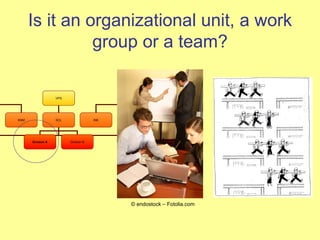
Is it an organizational unit, a work group or a team? © endostock – Fotolia.com VPS KNM SCL INE Division A Division B
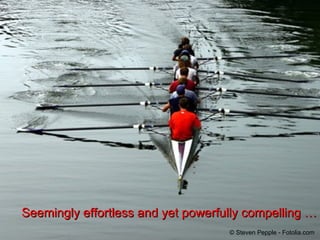
Seemingly effortless and yet powerfully compelling … © Steven Pepple - Fotolia.com
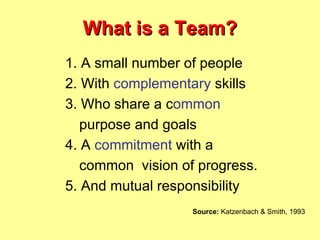
1.   A small number of people  2. With  complementary  skills 3. Who share a c ommon  purpose and goals  4. A  commitment  with a common  vision of progress. 5. And mutual responsibility  What is a Team? Source:  Katzenbach & Smith, 1993
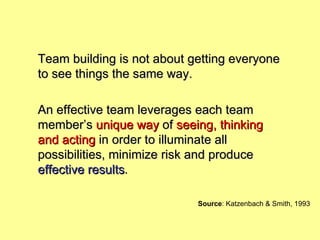
Team building is not about getting everyone to see things the same way.  An effective team leverages each team member’s  unique way  of  seeing, thinking and acting  in order to illuminate all possibilities, minimize risk and produce  effective results . Source : Katzenbach & Smith, 1993
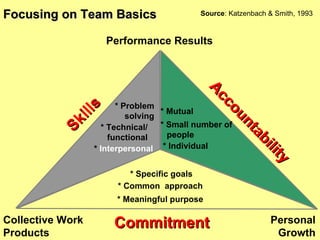
Focusing on Team Basics Performance Results Skills Accountability Commitment Collective Work Products Personal Growth * Problem solving * Technical/ functional *  Interpersonal * Mutual * Small number of people * Individual * Specific goals * Common  approach * Meaningful purpose Source : Katzenbach & Smith, 1993
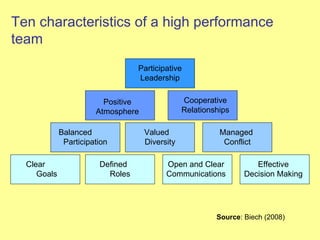
Ten characteristics of a high performance team Source : Biech (2008) Clear  Goals Defined  Roles Open and Clear Communications Effective Decision Making Balanced  Participation Valued  Diversity Managed  Conflict Positive Atmosphere Cooperative Relationships Participative Leadership
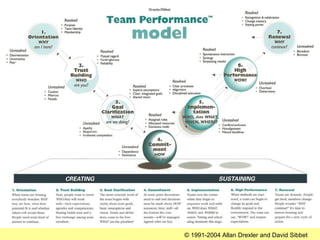
© 1991-2004 Allan Drexler and David Sibbet
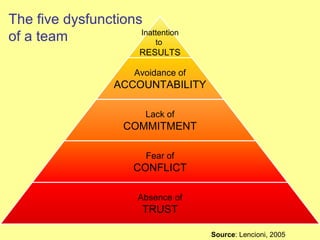
The five dysfunctions of a team Inattention to  RESULTS Avoidance of ACCOUNTABILITY Lack of COMMITMENT Fear of CONFLICT Absence of TRUST Source : Lencioni, 2005
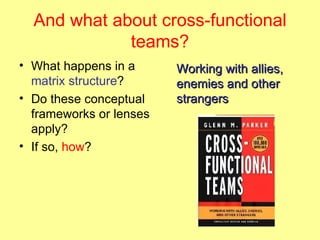
And what about cross-functional teams? What happens in a  matrix structure ? Do these conceptual frameworks or lenses apply? If so,  how ? Working with allies, enemies and other strangers
Issues in cross-functional teams Empowerment  through a greater need to clarify team’s authority Team leadership with greater  process skills Boundary management: flow of info to and from  all stakeholders  (vertical and horizontal)
Questions to evaluate team behavior Was there a “compelling”  shared  sense of direction?  Was the team task clear?  Were roles and responsibilities clearly defined? Was there trust among the team members? Was conflict acknowledged and managed? Did learning take place?
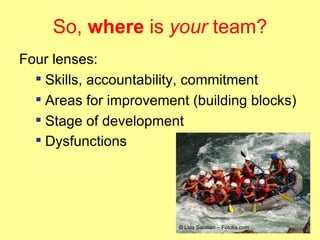
So,  where  is  your  team? Four lenses: Skills, accountability, commitment  Areas for improvement (building blocks) Stage of development Dysfunctions   © Lida Salatian – Fotolia.com
Bibliography Biech, E. (ed).  The Pfeiffer Book of Successful Team-Building Tools . 2 nd  ed. San Francisco, CA, Pfeiffer, 2008. Hackman, R. J.  Leading Teams: Setting the Stage for Great Performance.  Cambridge, MA. Harvard Business School Press, 2002. Katzenbach, J.R. and Smith, D.K.  The wisdom of teams . New York, Harper Business, 1993.  Lencioni, P.  Overcoming the five dysfunctions of a Team .  San Francisco, CA., Jossey Bass, 2005. Parker, G.M.  Cross-functional Teams: Working with Allies, Enemies, and Other Strangers,  John Wiley and Sons, 2002 Web Resources Effective Team Model Leading a Team of Strangers

Teams and Teamwork

  • 1.
    Teams and teamworkManuel E. Contreras KNL/SDI March 2009 This presentation does not represent the official position of the Inter-American Development Bank or its member countries. It was developed for training purposes only. The author gratefully acknowledges the comments of Christel Steinvorth and Gabrielle Vetter to a previous version. The usual caveats apply.
  • 2.
    Contents What arewe speaking about? What is a team? Four lenses: Skills, accountability and commitment Characteristics of high performance teams Team performance model Five dysfunctions of a team Where is your team?
  • 3.
    Is it anorganizational unit, a work group or a team? © endostock – Fotolia.com VPS KNM SCL INE Division A Division B
  • 4.
    Seemingly effortless andyet powerfully compelling … © Steven Pepple - Fotolia.com
  • 5.
    1. A small number of people 2. With complementary skills 3. Who share a c ommon purpose and goals 4. A commitment with a common vision of progress. 5. And mutual responsibility What is a Team? Source: Katzenbach & Smith, 1993
  • 6.
    Team building isnot about getting everyone to see things the same way. An effective team leverages each team member’s unique way of seeing, thinking and acting in order to illuminate all possibilities, minimize risk and produce effective results . Source : Katzenbach & Smith, 1993
  • 7.
    Focusing on TeamBasics Performance Results Skills Accountability Commitment Collective Work Products Personal Growth * Problem solving * Technical/ functional * Interpersonal * Mutual * Small number of people * Individual * Specific goals * Common approach * Meaningful purpose Source : Katzenbach & Smith, 1993
  • 8.
    Ten characteristics ofa high performance team Source : Biech (2008) Clear Goals Defined Roles Open and Clear Communications Effective Decision Making Balanced Participation Valued Diversity Managed Conflict Positive Atmosphere Cooperative Relationships Participative Leadership
  • 9.
    © 1991-2004 AllanDrexler and David Sibbet
  • 10.
    The five dysfunctionsof a team Inattention to RESULTS Avoidance of ACCOUNTABILITY Lack of COMMITMENT Fear of CONFLICT Absence of TRUST Source : Lencioni, 2005
  • 11.
    And what aboutcross-functional teams? What happens in a matrix structure ? Do these conceptual frameworks or lenses apply? If so, how ? Working with allies, enemies and other strangers
  • 12.
    Issues in cross-functionalteams Empowerment through a greater need to clarify team’s authority Team leadership with greater process skills Boundary management: flow of info to and from all stakeholders (vertical and horizontal)
  • 13.
    Questions to evaluateteam behavior Was there a “compelling” shared sense of direction? Was the team task clear? Were roles and responsibilities clearly defined? Was there trust among the team members? Was conflict acknowledged and managed? Did learning take place?
  • 14.
    So, where is your team? Four lenses: Skills, accountability, commitment Areas for improvement (building blocks) Stage of development Dysfunctions © Lida Salatian – Fotolia.com
  • 15.
    Bibliography Biech, E.(ed). The Pfeiffer Book of Successful Team-Building Tools . 2 nd ed. San Francisco, CA, Pfeiffer, 2008. Hackman, R. J. Leading Teams: Setting the Stage for Great Performance. Cambridge, MA. Harvard Business School Press, 2002. Katzenbach, J.R. and Smith, D.K. The wisdom of teams . New York, Harper Business, 1993. Lencioni, P. Overcoming the five dysfunctions of a Team . San Francisco, CA., Jossey Bass, 2005. Parker, G.M. Cross-functional Teams: Working with Allies, Enemies, and Other Strangers, John Wiley and Sons, 2002 Web Resources Effective Team Model Leading a Team of Strangers

Editor's Notes

  • #2 Teamwork and working in teams have become staple phrases in organizations. Moreover, both terms (teams and teamwork) have an aura of “that's the way things should be done.” This presentation seeks to address some issues surrounding teams and teamwork. The underlying premise is that a team is a particular way of organizing in order to achieve a specific task. Not all tasks require teams . Teams and teamwork, therefore, are not an end in themselves but rather a means to a specific end . I posit there is no “intrinsic” value in teams and teamwork.