Title: Teaching Vocabulary through Stories: A
meaningful way to improve pupils’ reading
comprehension
Seminar Pendidikan Perlis 2016
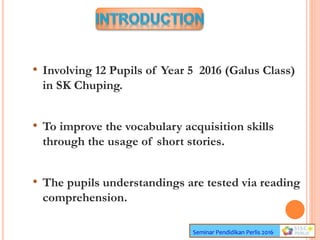
• Involving 12 Pupils of Year 5 2016 (Galus Class)
in SK Chuping.
• To improve the vocabulary acquisition skills
through the usage of short stories.
• The pupils understandings are tested via reading
comprehension.
Seminar Pendidikan Perlis 2016
• To develop a plan that will improve the
vocabulary acquisition skills of pupils and
thus their overall reading comprehension
skills.
• To create a meaningful way for pupils to
learn the language
• To familiarise the pupils with the topic in
the textbook and UPSR format
Seminar Pendidikan Perlis 2016
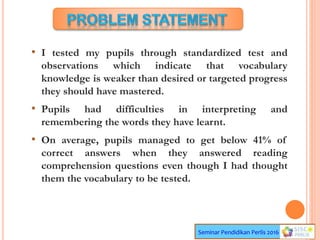
• I tested my pupils through standardized test and
observations which indicate that vocabulary
knowledge is weaker than desired or targeted progress
they should have mastered.
• Pupils had difficulties in interpreting and
remembering the words they have learnt.
• On average, pupils managed to get below 41% of
correct answers when they answered reading
comprehension questions even though I had thought
them the vocabulary to be tested.
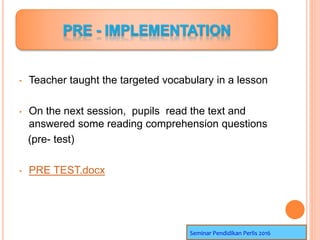
• Teacher taught the targeted vocabulary in a lesson
• On the next session, pupils read the text and
answered some reading comprehension questions
(pre- test)
• PRE TEST.docx
Seminar Pendidikan Perlis 2016
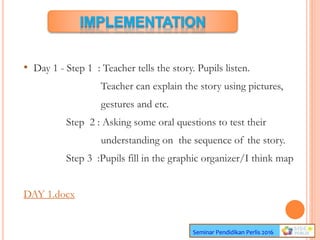
• Day 1 - Step 1 : Teacher tells the story. Pupils listen.
Teacher can explain the story using pictures,
gestures and etc.
Step 2 : Asking some oral questions to test their
understanding on the sequence of the story.
Step 3 :Pupils fill in the graphic organizer/I think map
DAY 1.docx
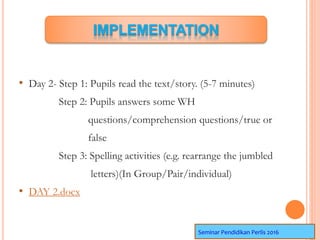
• Day 2- Step 1: Pupils read the text/story. (5-7 minutes)
Step 2: Pupils answers some WH
questions/comprehension questions/true or
false
Step 3: Spelling activities (e.g. rearrange the jumbled
letters)(In Group/Pair/individual)
• DAY 2.docx
Seminar Pendidikan Perlis 2016
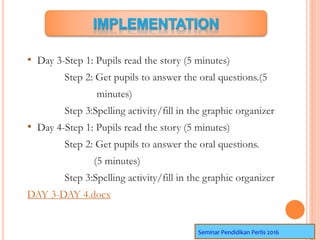
• Day 3-Step 1: Pupils read the story (5 minutes)
Step 2: Get pupils to answer the oral questions.(5
minutes)
Step 3:Spelling activity/fill in the graphic organizer
• Day 4-Step 1: Pupils read the story (5 minutes)
Step 2: Get pupils to answer the oral questions.
(5 minutes)
Step 3:Spelling activity/fill in the graphic organizer
DAY 3-DAY 4.docx
Seminar Pendidikan Perlis 2016
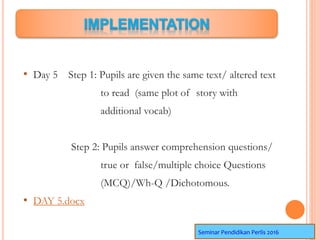
• Day 5 Step 1: Pupils are given the same text/ altered text
to read (same plot of story with
additional vocab)
Step 2: Pupils answer comprehension questions/
true or false/multiple choice Questions
(MCQ)/Wh-Q /Dichotomous.
• DAY 5.docx
Seminar Pendidikan Perlis 2016
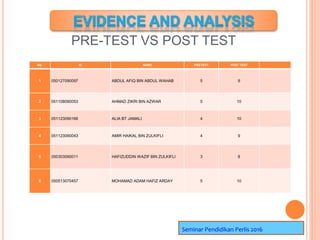
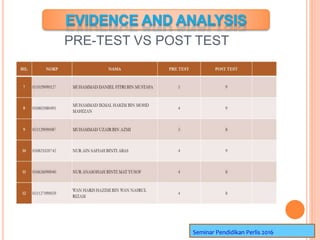
PRE-TEST VS POST TEST
BIL IC NAME PRETEST POST TEST
1 050127090097 ABDUL AFIQ BIN ABDUL WAHAB 5 9
2 051108090053 AHMAD ZIKRI BIN AZWAR 5 10
3 051123090166 ALIA BT JAMALI 4 10
4 051123090043 AMIR HAIKAL BIN ZULKIFLI 4 9
5 050303090011 HAFIZUDDIN WAZIF BIN ZULKIFLI 3 8
6 050513070457 MOHAMAD ADAM HAFIZ ARDAY 5 10
Seminar Pendidikan Perlis 2016
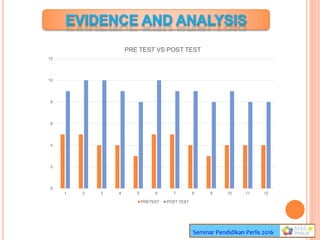
PRE-TEST VS POST TEST
Seminar Pendidikan Perlis 2016
0
2
4
6
8
10
12
1 2 3 4 5 6 7 8 9 10 11 12
PRE TEST VS POST TEST
PRETEST POST TEST
0
5
10
15
20
25
30
35
40
45
50
1 2 3 4 5 6 7 8 9 10 11 12
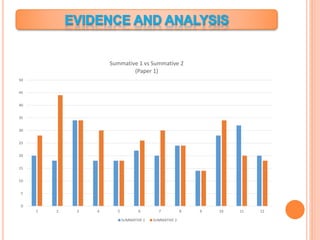
Summative 1 vs Summative 2
(Paper 1)
SUMMATIVE 1 SUMMATIVE 2
 1. First stage: The pupils will likely to have a clear
idea of the topic as the new vocabulary being
explained graphically. At the same time, they also
learn groups of words that travel together. (Day 1)
 2. Second stage: Using story telling and reading
technique, pupils memorized the new vocabulary
effectively. Once they have actually thought about a
word, this gave their minds a way to engage with it and
to put it into some sort of context – even an imaginary
one – their brain has got something to grip onto and
can remember it. The learners were willing to respond
the oral questions and participated in other activities as
they started to remember the words. (Day 1-Day 3)
 3. Third stage: The pupils were learning new
vocabulary in context. Pictures that associated
with the new vocabulary and the story retelling
process have also further strengthening their
memory towards the new words. By reading
engaging stories pupils can begin to build emotional
and sensory contexts around new vocabulary.
Instead of just studying isolated words by rote, new
vocabulary can be memorized quicker and deeper
because it is linked to characters, places and
relationships, just like in real life. (Day 3-Day 4)
 4. Final Stage: Pupils’ reading comprehension
level was increasing as their vocabulary kept on
expanding. This was attested by the assessment
whereby the pupils were capable to comprehend
the text and answer 80% of the given post test
questions correctly .There was also a significant
increment of pupils’ marks in Summative 2
compared to Summative 1.
 The ultimate purpose of my research is to develop
a plan that will improve the vocabulary acquisition
skills of pupils and thus their overall reading
comprehension skills. As far as it may concerned,
the combination of several techniques has finally
brought a positive progress not solely to the pupils,
but also to my teaching approach. This research
proves that teaching vocabulary in context (story as
context) has a significant influence to the pupils’
reading comprehension.
Seminar Pendidikan Perlis 2016
 All the committee members of Seminar Pendidikan
Perlis 2016,Jabatan Pendidikan Perlis
 SISC + officers
 Seminar participants

Teaching Vocabulary through Stories

  • 1.
    Title: Teaching Vocabularythrough Stories: A meaningful way to improve pupils’ reading comprehension Seminar Pendidikan Perlis 2016
  • 2.
    • Involving 12Pupils of Year 5 2016 (Galus Class) in SK Chuping. • To improve the vocabulary acquisition skills through the usage of short stories. • The pupils understandings are tested via reading comprehension. Seminar Pendidikan Perlis 2016
  • 3.
    Seminar Pendidikan Perlis2016 • To develop a plan that will improve the vocabulary acquisition skills of pupils and thus their overall reading comprehension skills. • To create a meaningful way for pupils to learn the language • To familiarise the pupils with the topic in the textbook and UPSR format
  • 4.
    Seminar Pendidikan Perlis2016 • I tested my pupils through standardized test and observations which indicate that vocabulary knowledge is weaker than desired or targeted progress they should have mastered. • Pupils had difficulties in interpreting and remembering the words they have learnt. • On average, pupils managed to get below 41% of correct answers when they answered reading comprehension questions even though I had thought them the vocabulary to be tested.
  • 5.
    • Teacher taughtthe targeted vocabulary in a lesson • On the next session, pupils read the text and answered some reading comprehension questions (pre- test) • PRE TEST.docx Seminar Pendidikan Perlis 2016
  • 6.
    Seminar Pendidikan Perlis2016 • Day 1 - Step 1 : Teacher tells the story. Pupils listen. Teacher can explain the story using pictures, gestures and etc. Step 2 : Asking some oral questions to test their understanding on the sequence of the story. Step 3 :Pupils fill in the graphic organizer/I think map DAY 1.docx
  • 7.
    • Day 2-Step 1: Pupils read the text/story. (5-7 minutes) Step 2: Pupils answers some WH questions/comprehension questions/true or false Step 3: Spelling activities (e.g. rearrange the jumbled letters)(In Group/Pair/individual) • DAY 2.docx Seminar Pendidikan Perlis 2016
  • 8.
    • Day 3-Step1: Pupils read the story (5 minutes) Step 2: Get pupils to answer the oral questions.(5 minutes) Step 3:Spelling activity/fill in the graphic organizer • Day 4-Step 1: Pupils read the story (5 minutes) Step 2: Get pupils to answer the oral questions. (5 minutes) Step 3:Spelling activity/fill in the graphic organizer DAY 3-DAY 4.docx Seminar Pendidikan Perlis 2016
  • 9.
    • Day 5Step 1: Pupils are given the same text/ altered text to read (same plot of story with additional vocab) Step 2: Pupils answer comprehension questions/ true or false/multiple choice Questions (MCQ)/Wh-Q /Dichotomous. • DAY 5.docx Seminar Pendidikan Perlis 2016
  • 10.
    PRE-TEST VS POSTTEST BIL IC NAME PRETEST POST TEST 1 050127090097 ABDUL AFIQ BIN ABDUL WAHAB 5 9 2 051108090053 AHMAD ZIKRI BIN AZWAR 5 10 3 051123090166 ALIA BT JAMALI 4 10 4 051123090043 AMIR HAIKAL BIN ZULKIFLI 4 9 5 050303090011 HAFIZUDDIN WAZIF BIN ZULKIFLI 3 8 6 050513070457 MOHAMAD ADAM HAFIZ ARDAY 5 10 Seminar Pendidikan Perlis 2016
  • 11.
    PRE-TEST VS POSTTEST Seminar Pendidikan Perlis 2016
  • 12.
    Seminar Pendidikan Perlis2016 0 2 4 6 8 10 12 1 2 3 4 5 6 7 8 9 10 11 12 PRE TEST VS POST TEST PRETEST POST TEST
  • 13.
    0 5 10 15 20 25 30 35 40 45 50 1 2 34 5 6 7 8 9 10 11 12 Summative 1 vs Summative 2 (Paper 1) SUMMATIVE 1 SUMMATIVE 2
  • 14.
     1. Firststage: The pupils will likely to have a clear idea of the topic as the new vocabulary being explained graphically. At the same time, they also learn groups of words that travel together. (Day 1)  2. Second stage: Using story telling and reading technique, pupils memorized the new vocabulary effectively. Once they have actually thought about a word, this gave their minds a way to engage with it and to put it into some sort of context – even an imaginary one – their brain has got something to grip onto and can remember it. The learners were willing to respond the oral questions and participated in other activities as they started to remember the words. (Day 1-Day 3)
  • 15.
     3. Thirdstage: The pupils were learning new vocabulary in context. Pictures that associated with the new vocabulary and the story retelling process have also further strengthening their memory towards the new words. By reading engaging stories pupils can begin to build emotional and sensory contexts around new vocabulary. Instead of just studying isolated words by rote, new vocabulary can be memorized quicker and deeper because it is linked to characters, places and relationships, just like in real life. (Day 3-Day 4)
  • 16.
     4. FinalStage: Pupils’ reading comprehension level was increasing as their vocabulary kept on expanding. This was attested by the assessment whereby the pupils were capable to comprehend the text and answer 80% of the given post test questions correctly .There was also a significant increment of pupils’ marks in Summative 2 compared to Summative 1.
  • 17.
     The ultimatepurpose of my research is to develop a plan that will improve the vocabulary acquisition skills of pupils and thus their overall reading comprehension skills. As far as it may concerned, the combination of several techniques has finally brought a positive progress not solely to the pupils, but also to my teaching approach. This research proves that teaching vocabulary in context (story as context) has a significant influence to the pupils’ reading comprehension.
  • 18.
    Seminar Pendidikan Perlis2016  All the committee members of Seminar Pendidikan Perlis 2016,Jabatan Pendidikan Perlis  SISC + officers  Seminar participants