Principles and
Methods of Teaching
Shela L. Caballero
PRINCIPLES AND METHODS OF TEACHING
Keys LET-sensitive
Syllabus
Drill
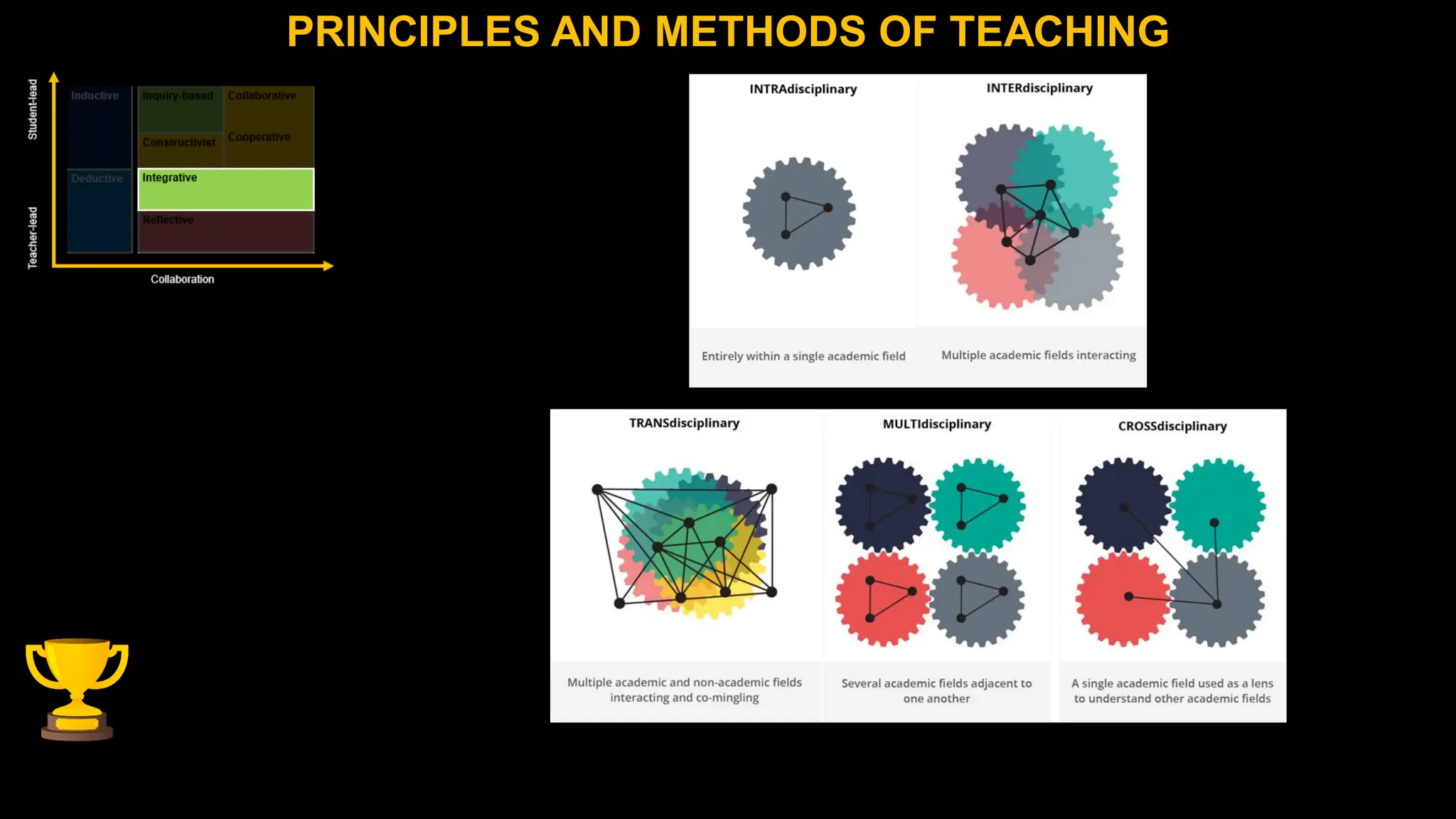
Integrative interdisciplinary
intradisciplinary
PRINCIPLES AND METHODS OF TEACHING
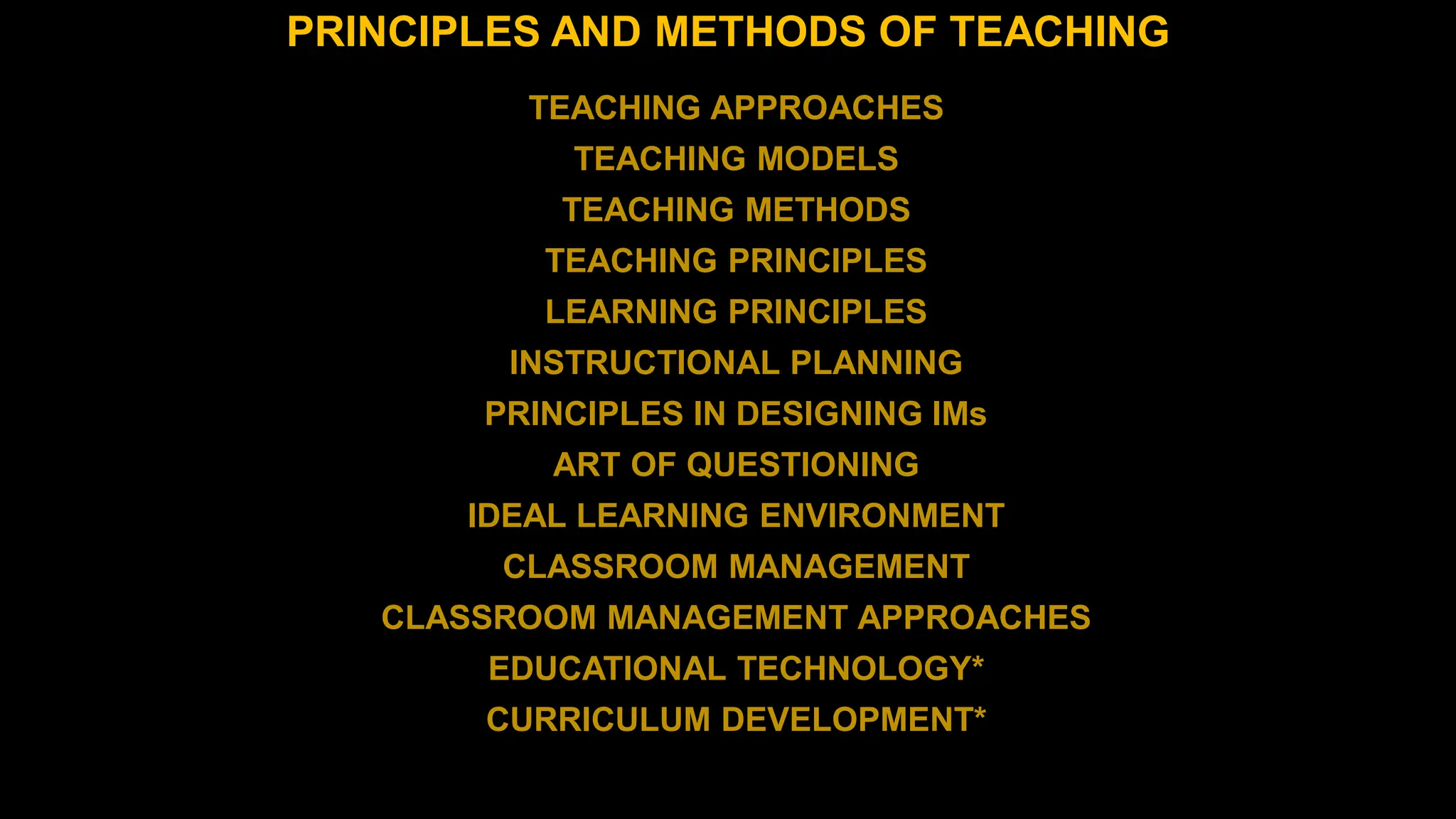
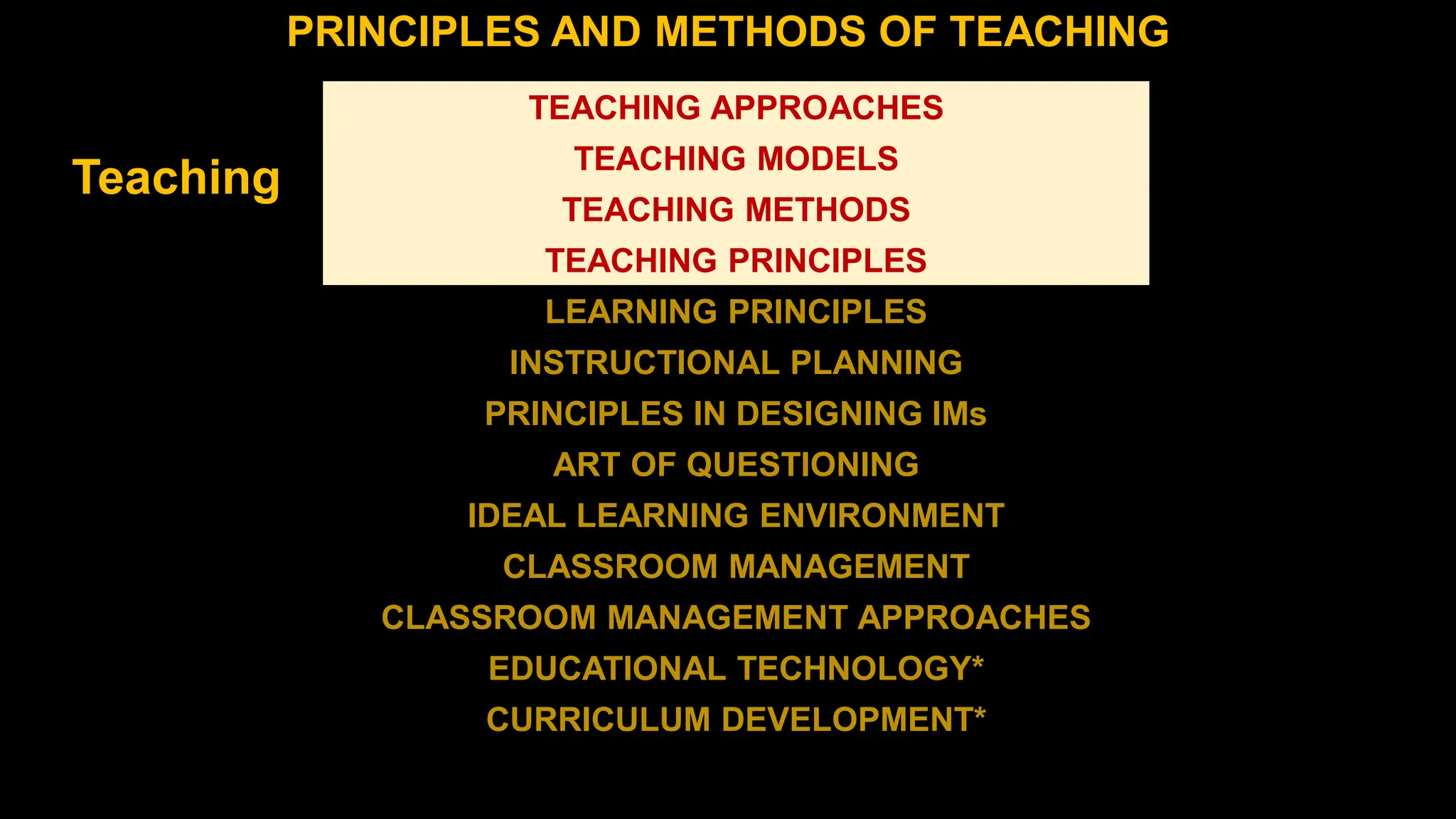
TEACHING APPROACHES
TEACHING MODELS
TEACHING METHODS
TEACHING PRINCIPLES
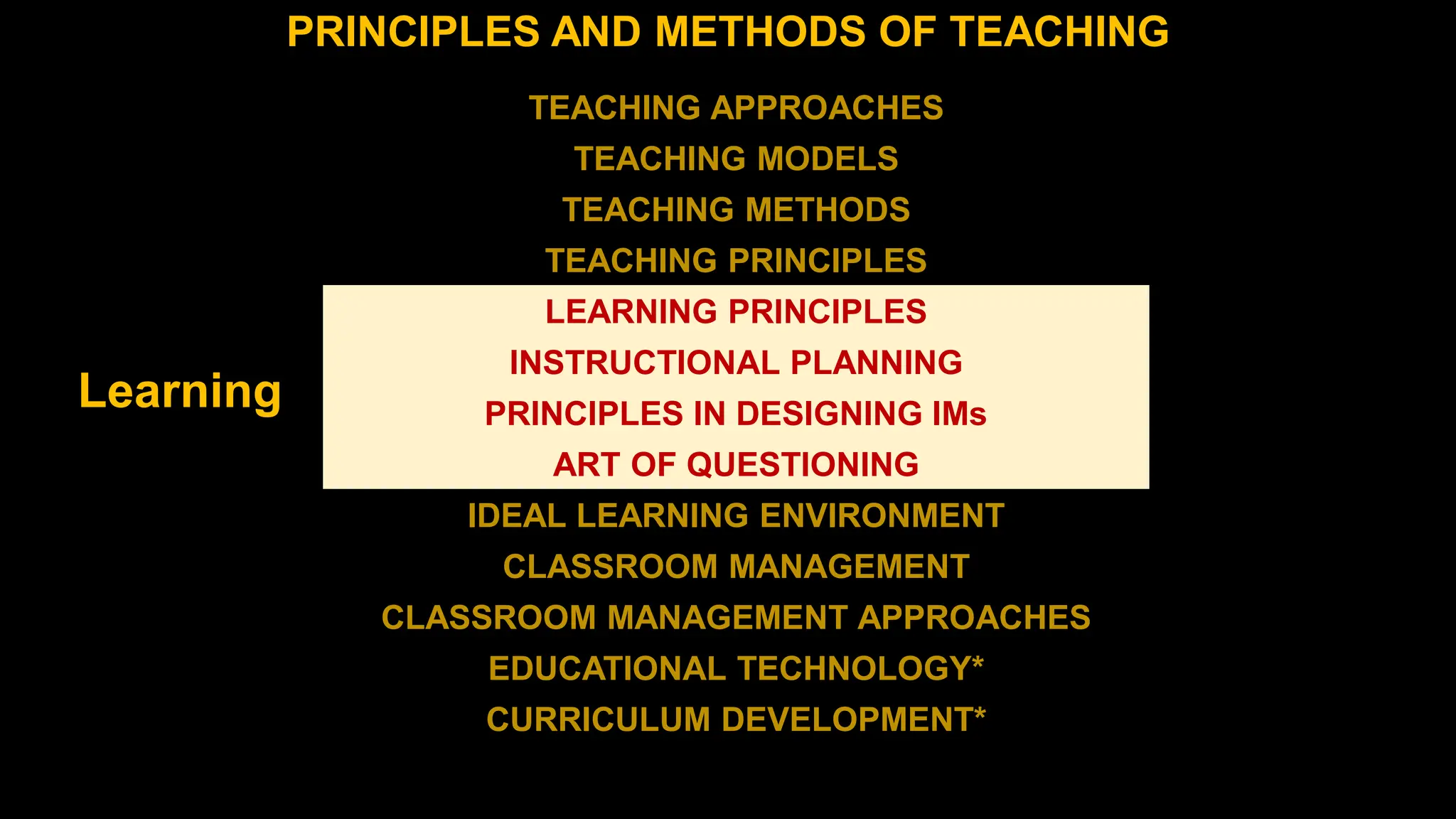
LEARNING PRINCIPLES
INSTRUCTIONAL PLANNING
PRINCIPLES IN DESIGNING IMs
ART OF QUESTIONING
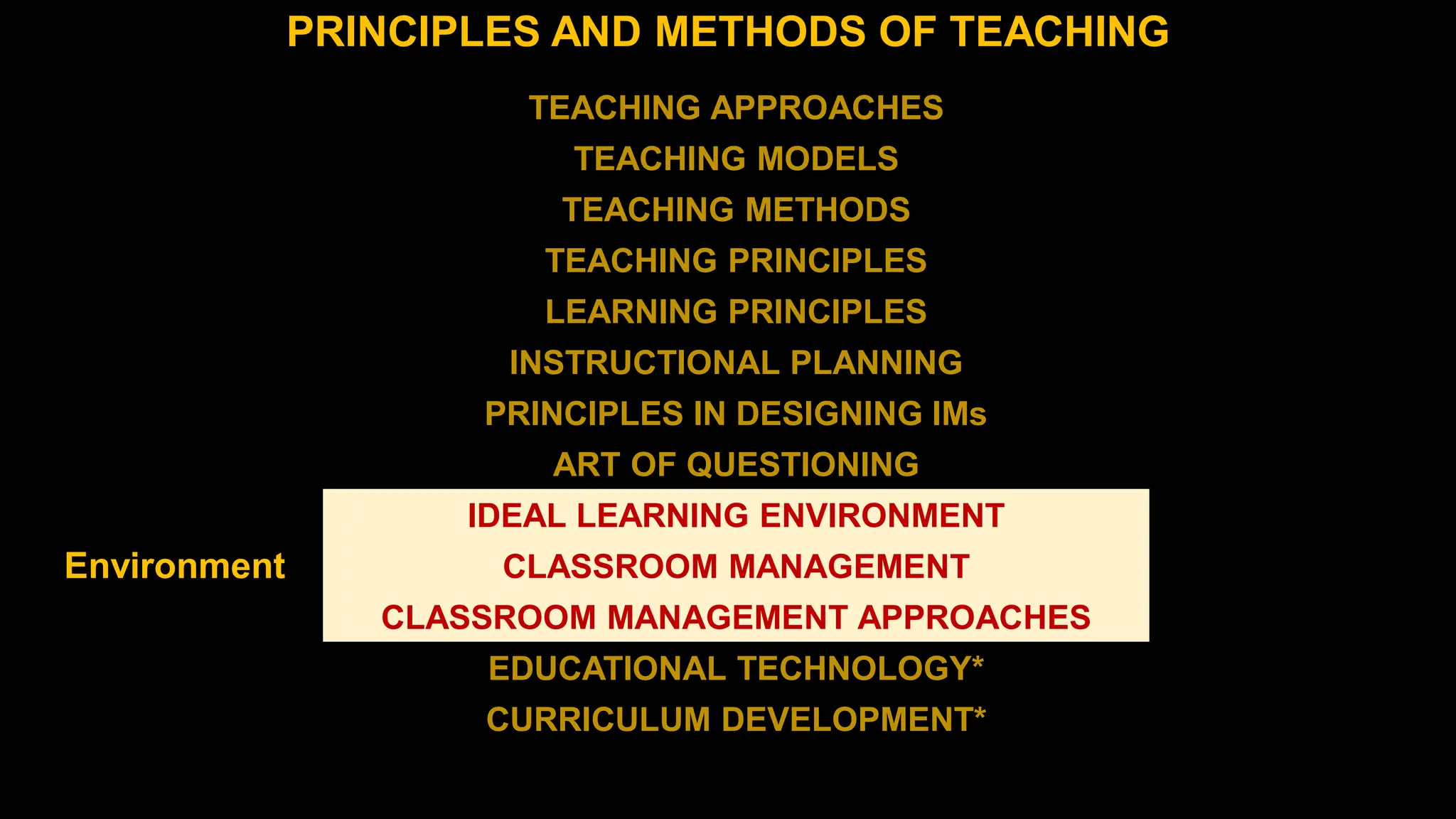
IDEAL LEARNING ENVIRONMENT
CLASSROOM MANAGEMENT
CLASSROOM MANAGEMENT APPROACHES
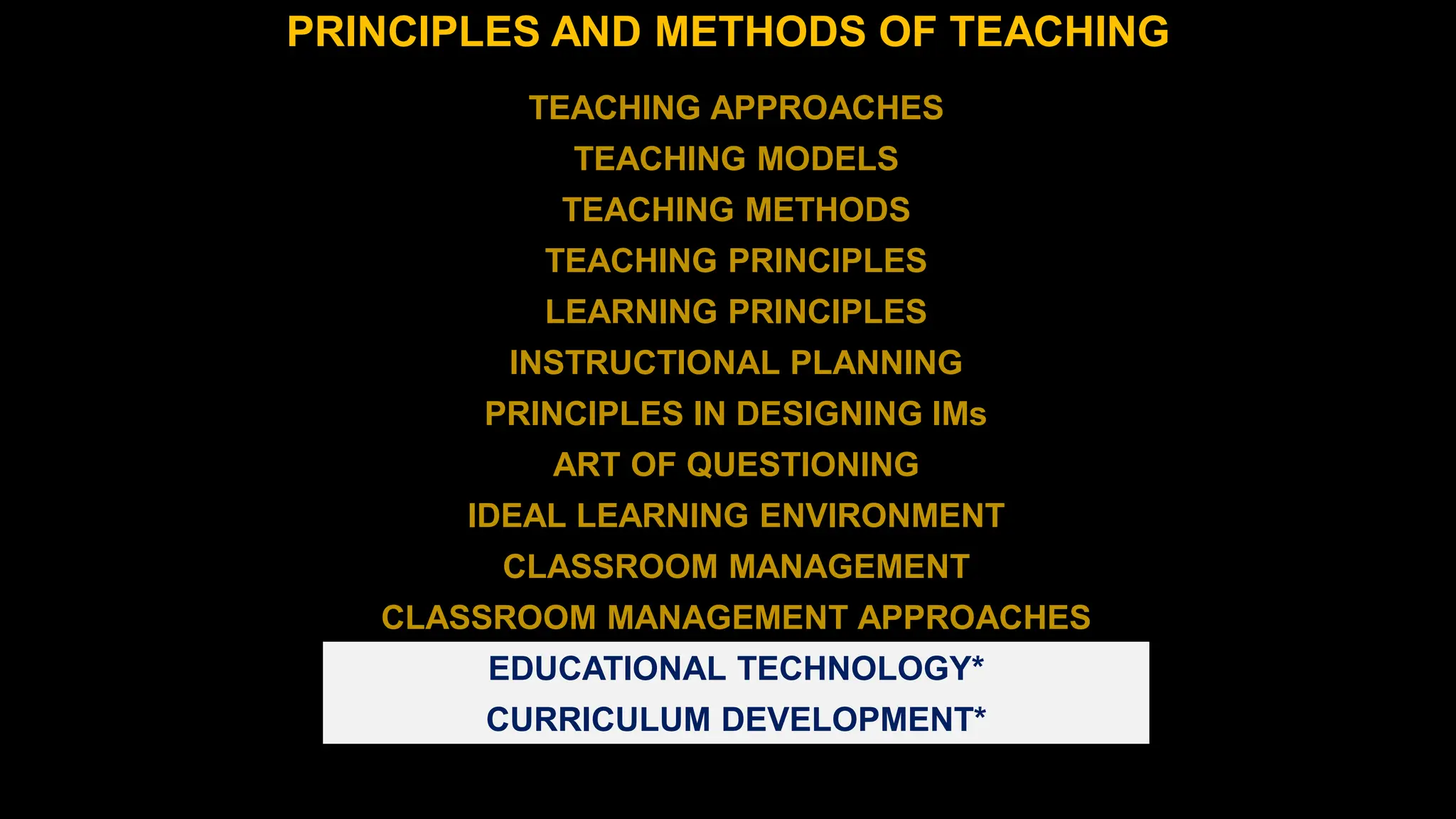
EDUCATIONAL TECHNOLOGY*
CURRICULUM DEVELOPMENT*
PRINCIPLES AND METHODS OF TEACHING
TEACHING APPROACHES
TEACHING MODELS
TEACHING METHODS
TEACHING PRINCIPLES
LEARNING PRINCIPLES
INSTRUCTIONAL PLANNING
PRINCIPLES IN DESIGNING IMs
ART OF QUESTIONING
IDEAL LEARNING ENVIRONMENT
CLASSROOM MANAGEMENT
CLASSROOM MANAGEMENT APPROACHES
EDUCATIONAL TECHNOLOGY*
CURRICULUM DEVELOPMENT*
Teaching
PRINCIPLES AND METHODS OF TEACHING
TEACHING APPROACHES
TEACHING MODELS
TEACHING METHODS
TEACHING PRINCIPLES
LEARNING PRINCIPLES
INSTRUCTIONAL PLANNING
PRINCIPLES IN DESIGNING IMs
ART OF QUESTIONING
IDEAL LEARNING ENVIRONMENT
CLASSROOM MANAGEMENT
CLASSROOM MANAGEMENT APPROACHES
EDUCATIONAL TECHNOLOGY*
CURRICULUM DEVELOPMENT*
Learning
PRINCIPLES AND METHODS OF TEACHING
TEACHING APPROACHES
TEACHING MODELS
TEACHING METHODS
TEACHING PRINCIPLES
LEARNING PRINCIPLES
INSTRUCTIONAL PLANNING
PRINCIPLES IN DESIGNING IMs
ART OF QUESTIONING
IDEAL LEARNING ENVIRONMENT
CLASSROOM MANAGEMENT
CLASSROOM MANAGEMENT APPROACHES
EDUCATIONAL TECHNOLOGY*
CURRICULUM DEVELOPMENT*
Environment
PRINCIPLES AND METHODS OF TEACHING
TEACHING APPROACHES
TEACHING MODELS
TEACHING METHODS
TEACHING PRINCIPLES
LEARNING PRINCIPLES
INSTRUCTIONAL PLANNING
PRINCIPLES IN DESIGNING IMs
ART OF QUESTIONING
IDEAL LEARNING ENVIRONMENT
CLASSROOM MANAGEMENT
CLASSROOM MANAGEMENT APPROACHES
EDUCATIONAL TECHNOLOGY*
CURRICULUM DEVELOPMENT*
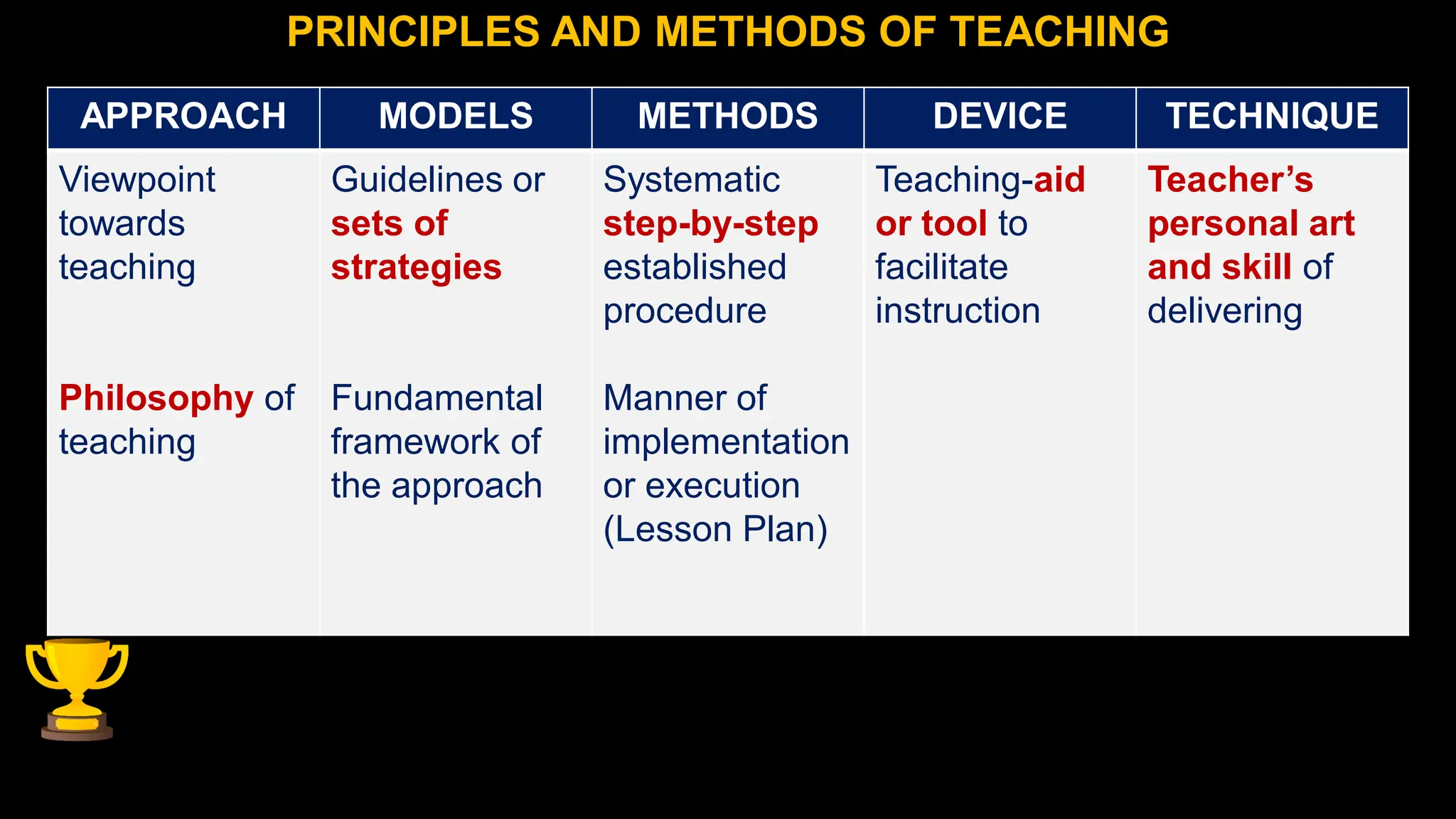
APPROACH MODELS METHODS DEVICE TECHNIQUE
Viewpoint
towards
teaching
Philosophy of
teaching
Guidelines or
sets of
strategies
Fundamental
framework of
the approach
Systematic
step-by-step
established
procedure
Manner of
implementation
or execution
(Lesson Plan)
Teaching-aid
or tool to
facilitate
instruction
Teacher’s
personal art
and skill of
delivering
PRINCIPLES AND METHODS OF TEACHING
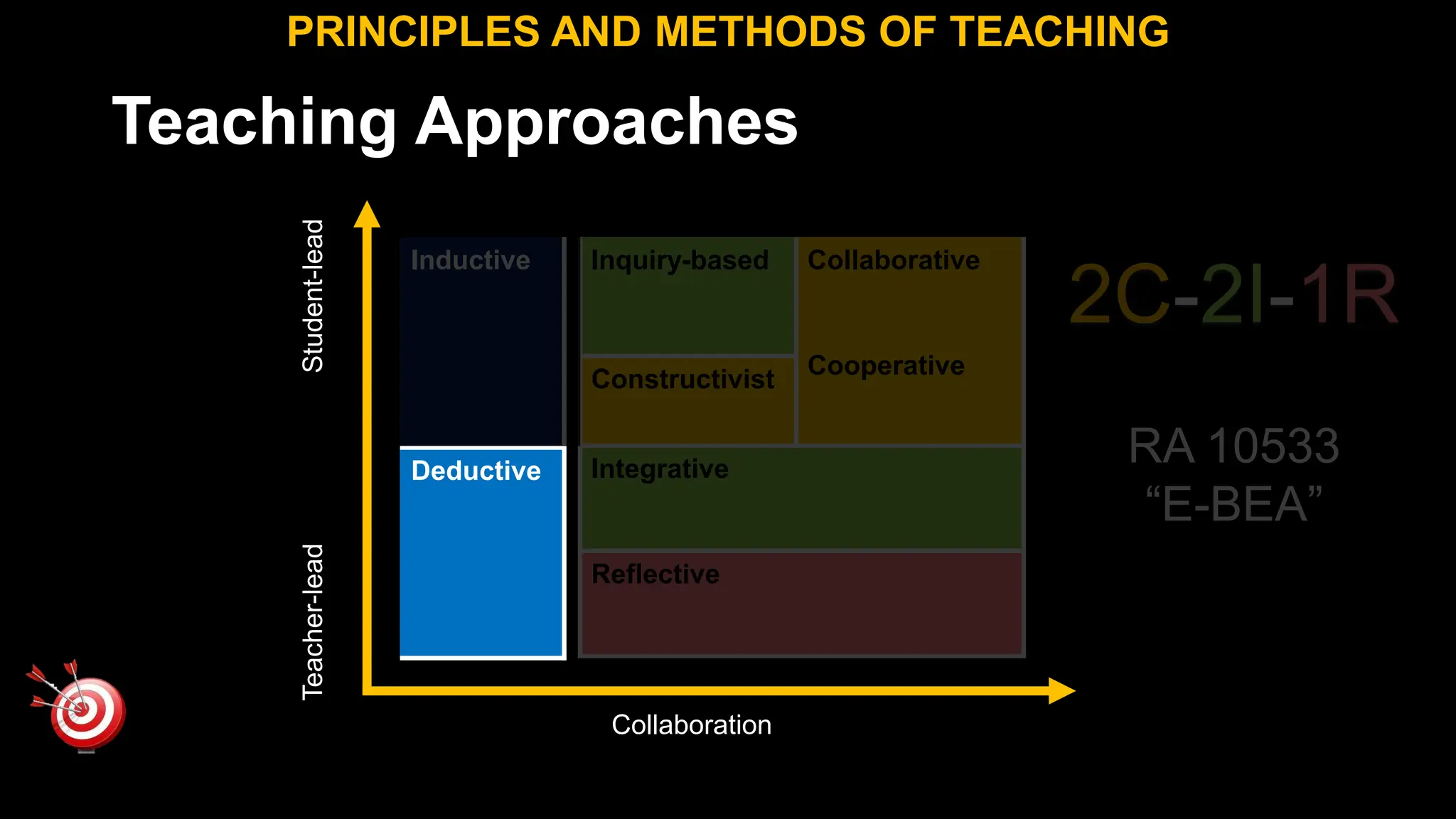
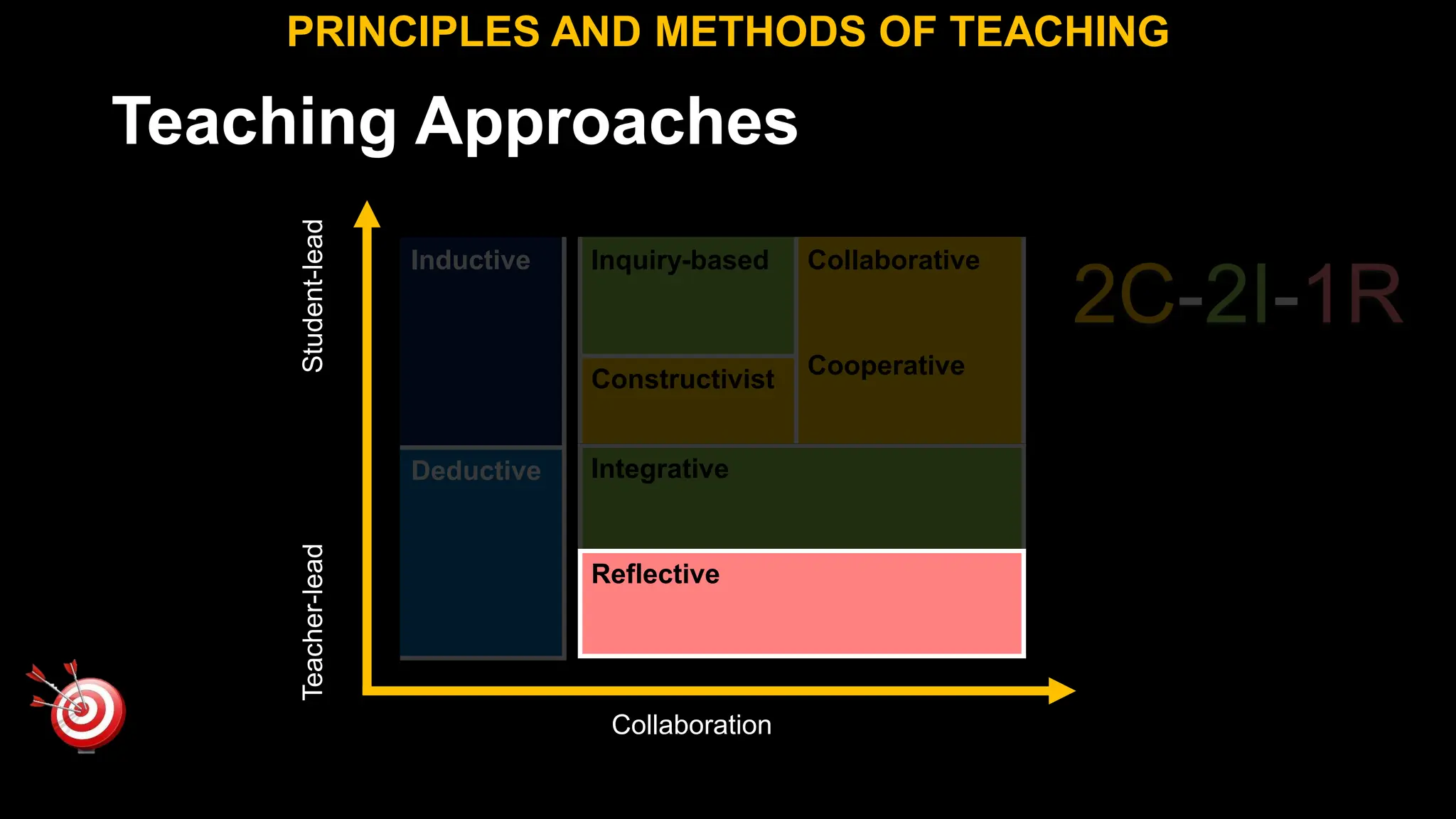
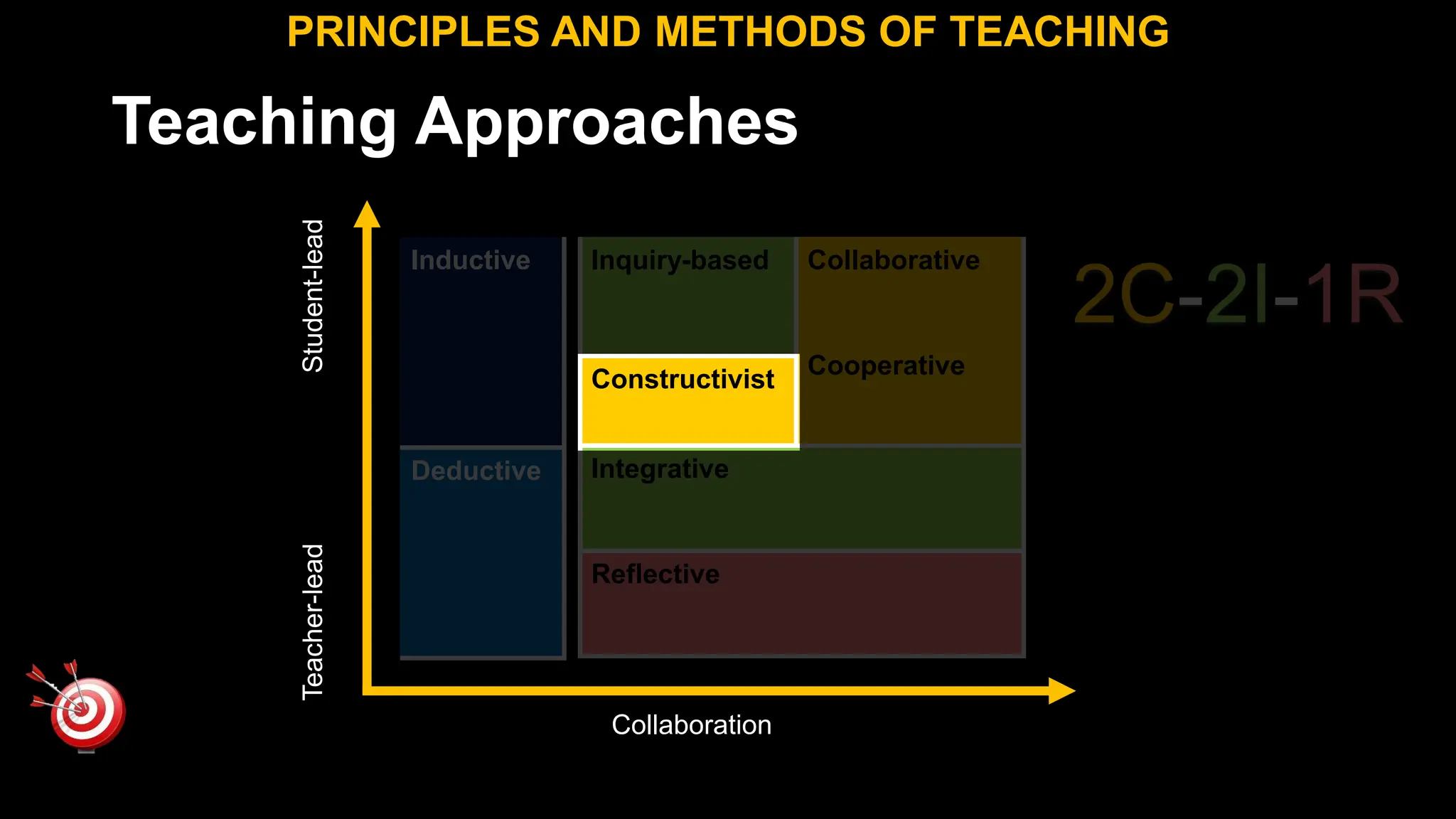
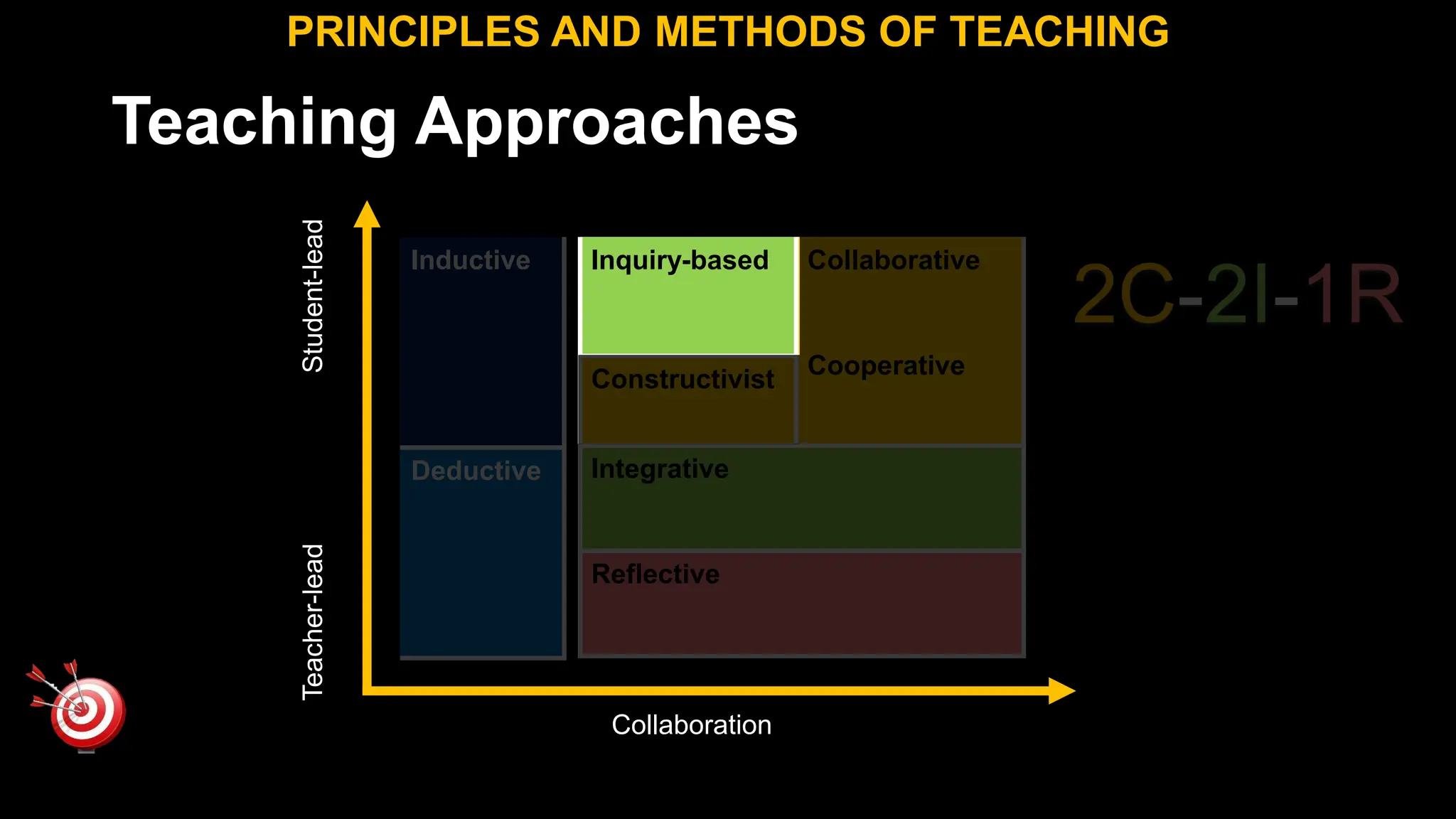
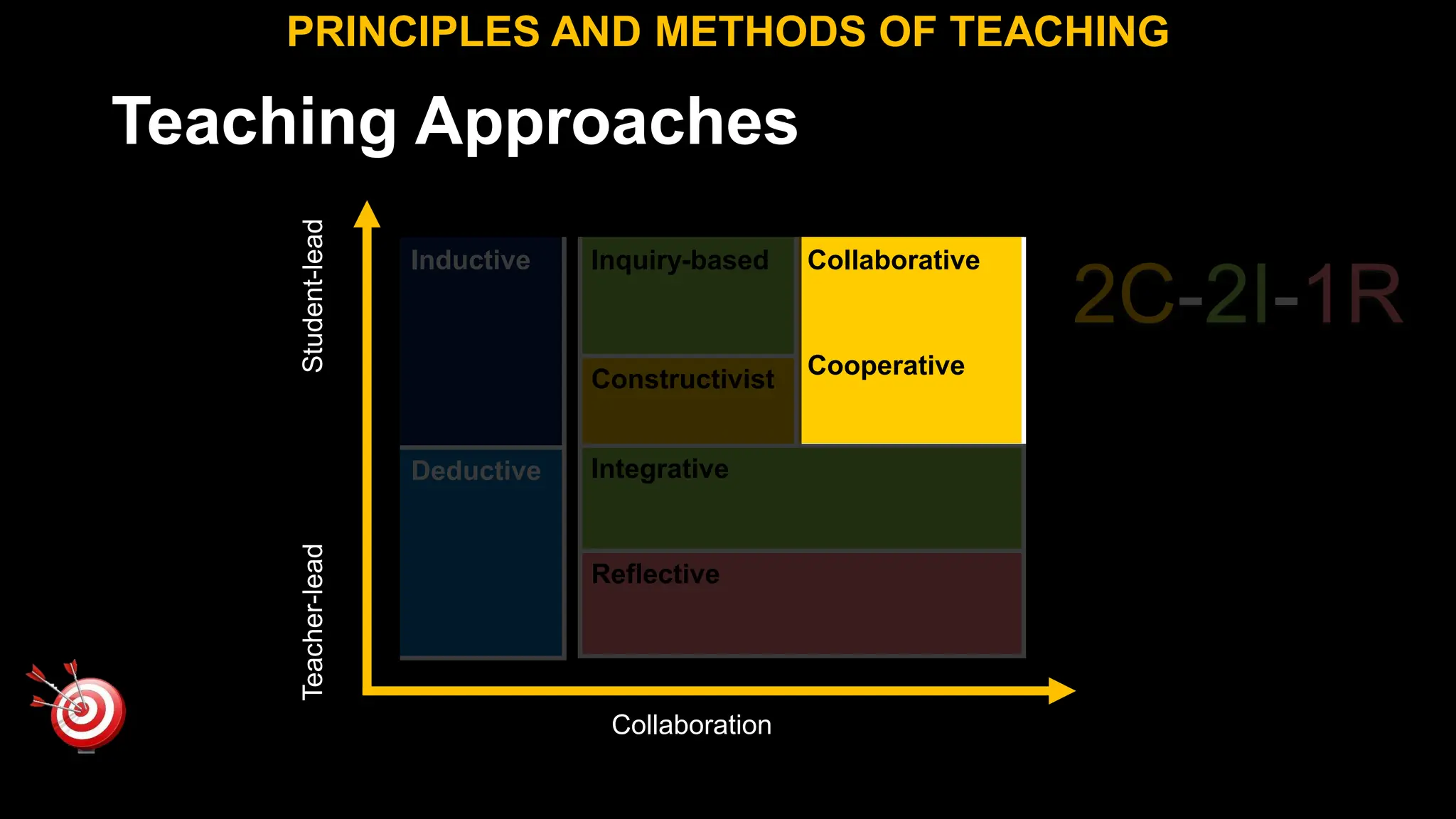
Teaching Approaches
PRINCIPLES AND METHODS OF TEACHING
Inductive
Deductive
Teacher-lead
Student-lead
Collaboration
Inquiry-based Collaborative
Cooperative
Constructivist
Integrative
Reflective
2C-2I-1R
RA 10533
“E-BEA”
PRINCIPLES AND METHODS OF TEACHING
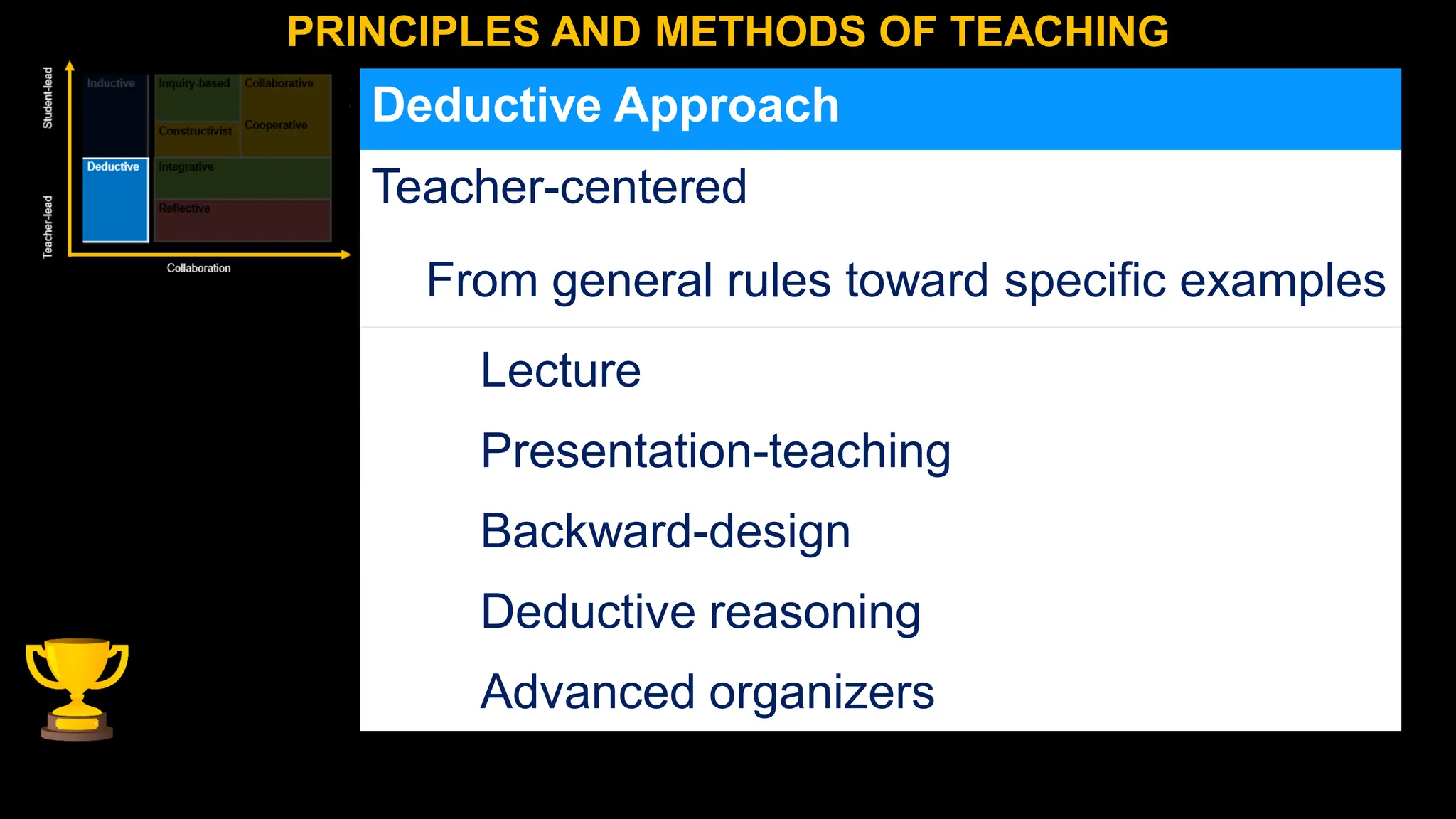
Deductive Approach
Teacher-centered
From general rules toward specific examples
Lecture
Presentation-teaching
Backward-design
Deductive reasoning
Advanced organizers
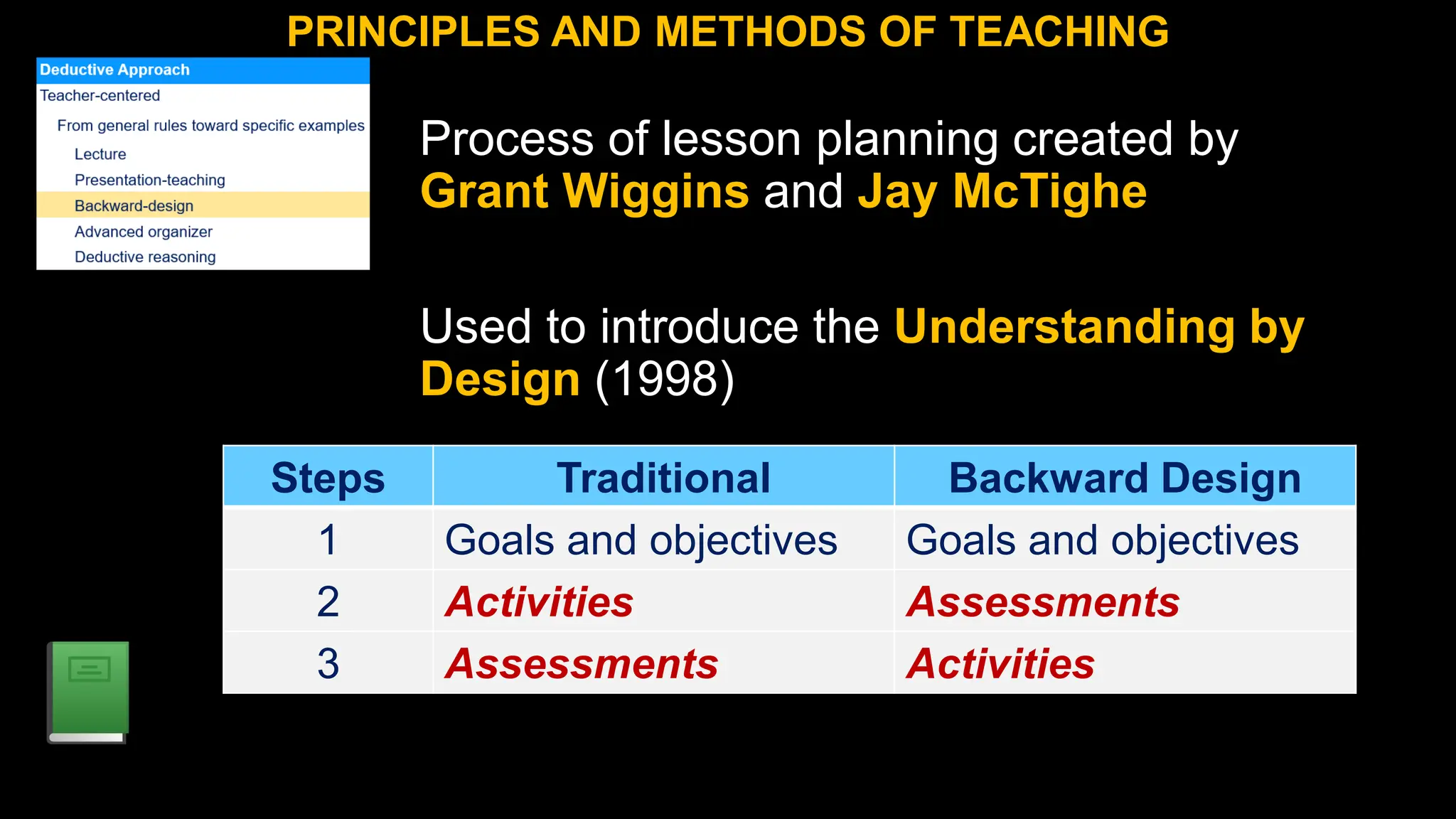
Process of lesson planning created by
Grant Wiggins and Jay McTighe
Used to introduce the Understanding by
Design (1998)
PRINCIPLES AND METHODS OF TEACHING
Steps Traditional Backward Design
1 Goals and objectives Goals and objectives
2 Activities Assessments
3 Assessments Activities
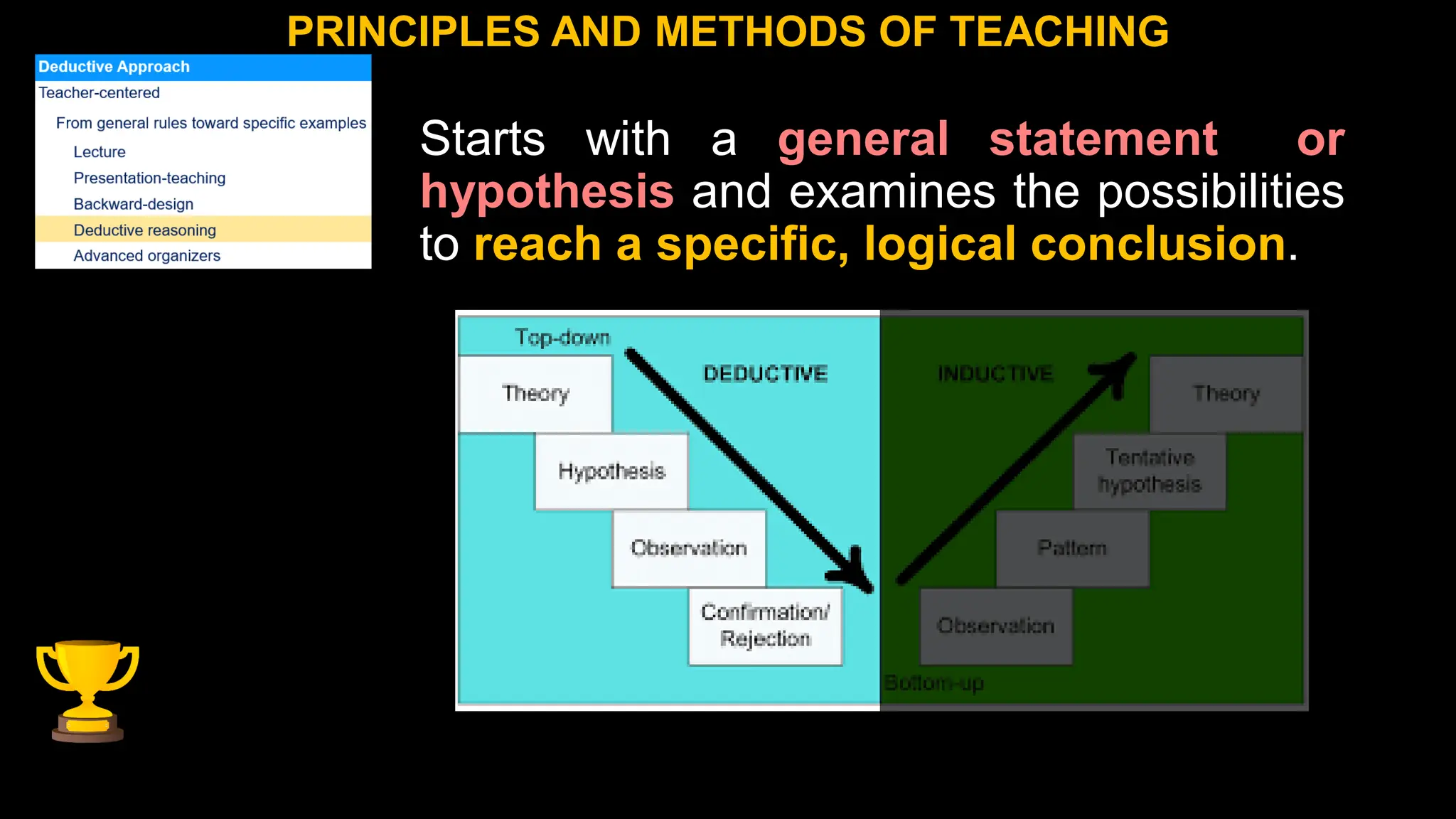
Starts with a general statement or
hypothesis and examines the possibilities
to reach a specific, logical conclusion.
PRINCIPLES AND METHODS OF TEACHING
Which of the following best describes
deductive reasoning?
a. Using logic to draw conclusion based on accepted
statements
b. Accepting the meaning of a term without definition
c. Defining mathematical terms to correspond with
physical objects
d. Inferring a general truth by examining a number of
specific examples
PRINCIPLES AND METHODS OF TEACHING
Graphic Organizers
Developed by David Ausbel
Directs to what is important.
Highlight relationships among ideas.
PRINCIPLES AND METHODS OF TEACHING
Subsumption Theory
A learner absorbs new information by
connecting it to existing concepts and
ideas that they have already acquired.
PRINCIPLES AND METHODS OF TEACHING
Subsumption Theory
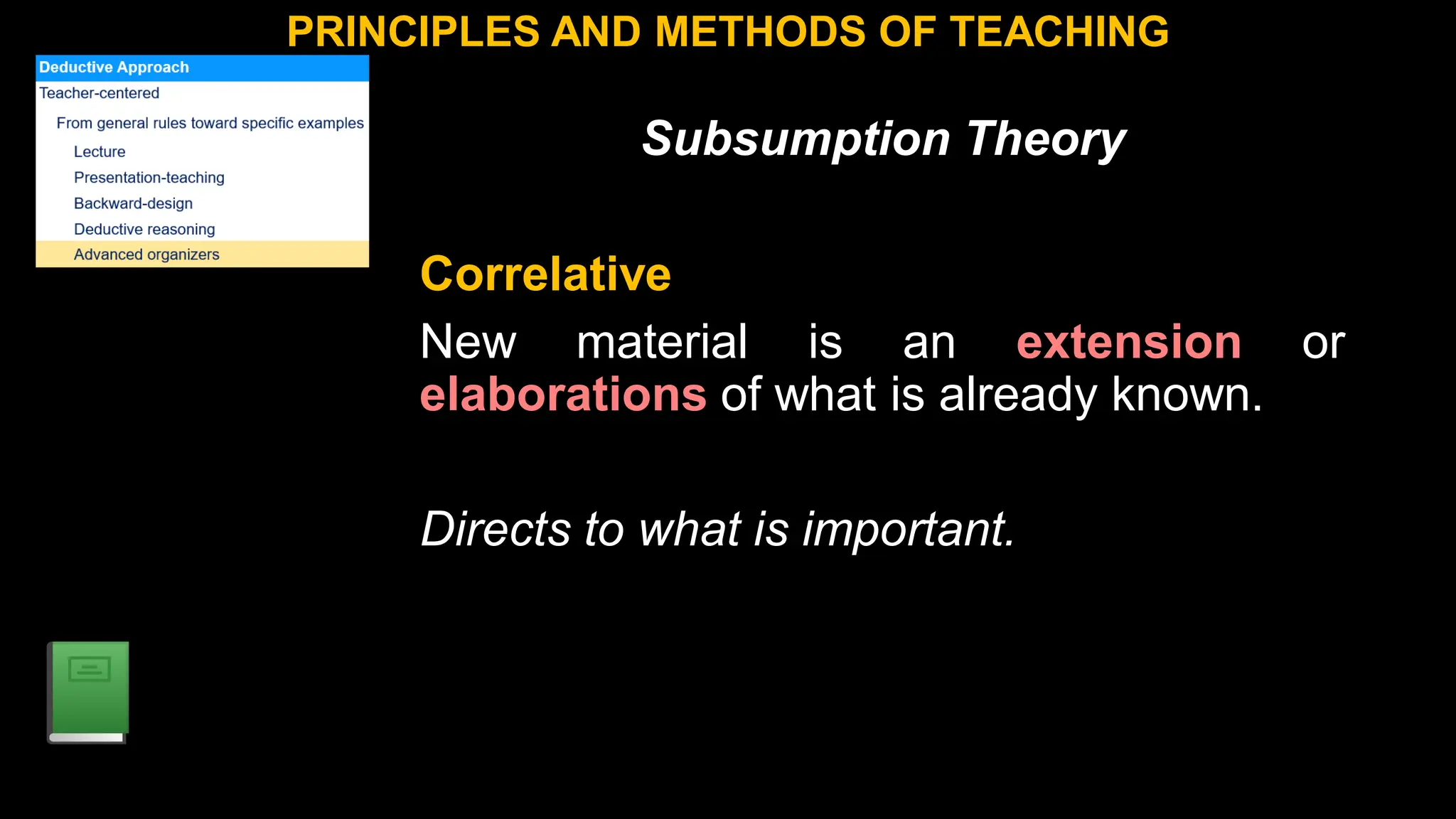
Correlative
New material is an extension or
elaborations of what is already known.
Directs to what is important.
PRINCIPLES AND METHODS OF TEACHING
Subsumption Theory
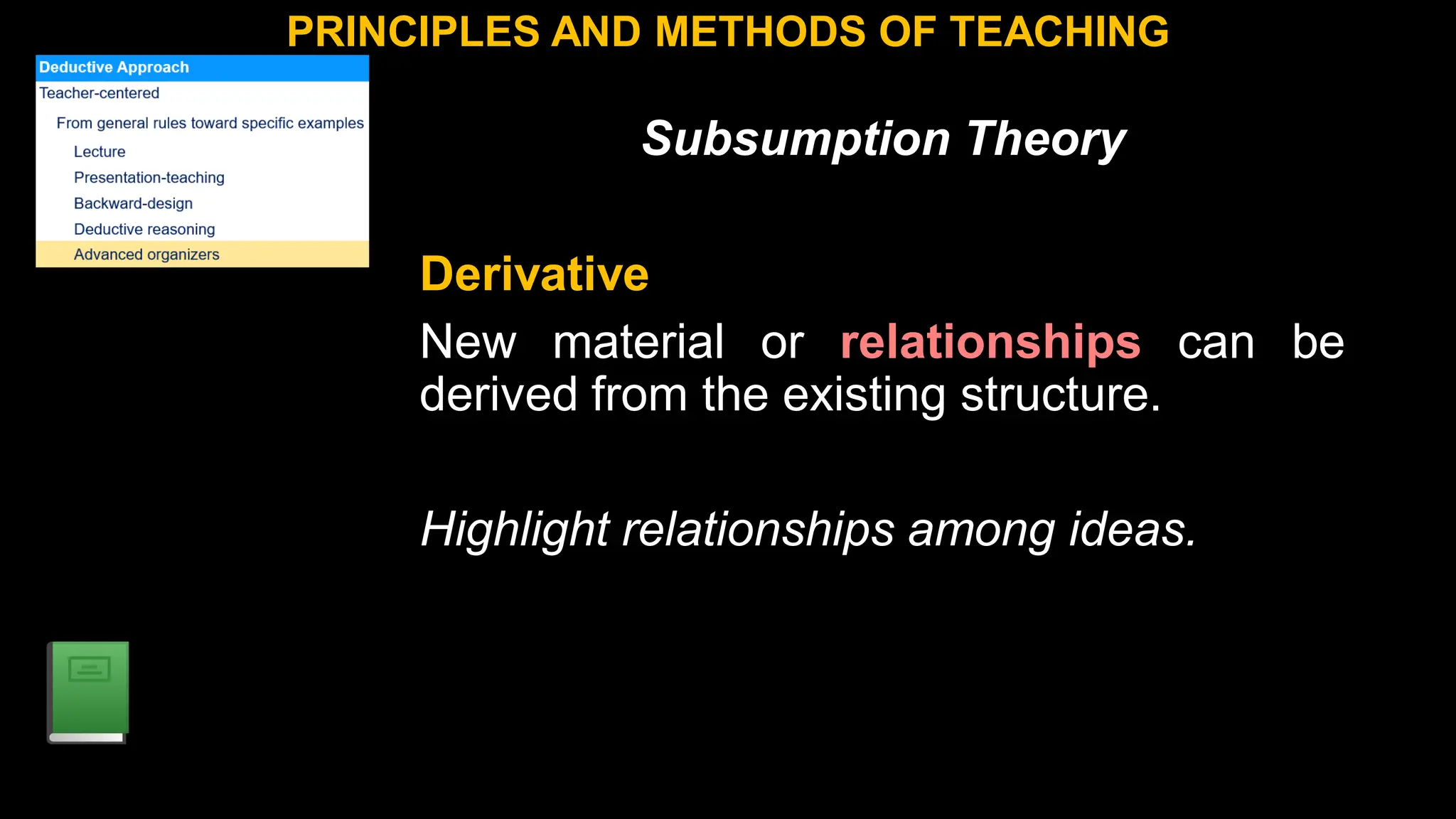
Derivative
New material or relationships can be
derived from the existing structure.
Highlight relationships among ideas.
PRINCIPLES AND METHODS OF TEACHING
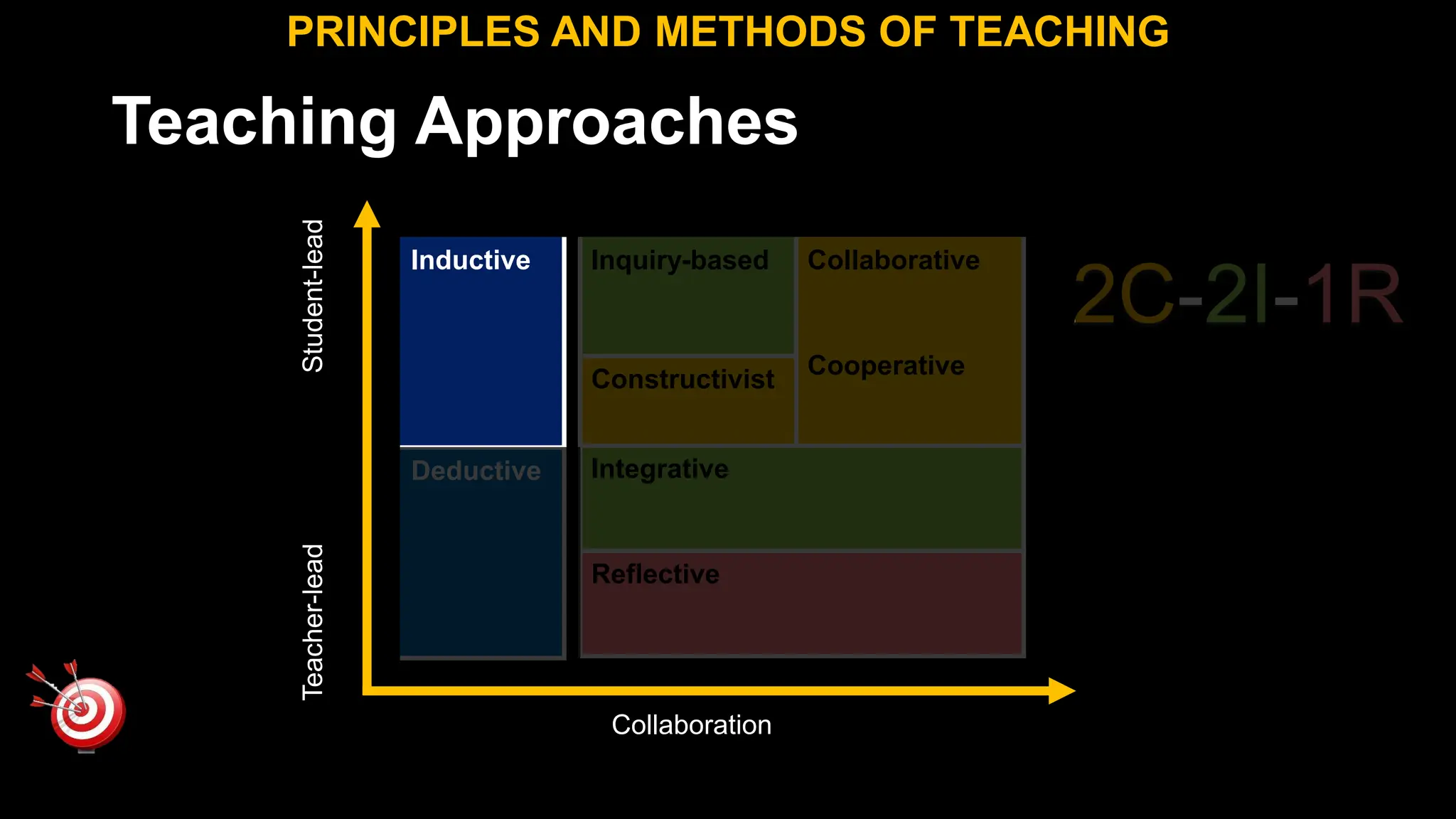
Teaching Approaches
PRINCIPLES AND METHODS OF TEACHING
Inductive
Deductive
Teacher-lead
Student-lead
Collaboration
2C-2I-1R
Inquiry-based Collaborative
Cooperative
Constructivist
Integrative
Reflective
PRINCIPLES AND METHODS OF TEACHING
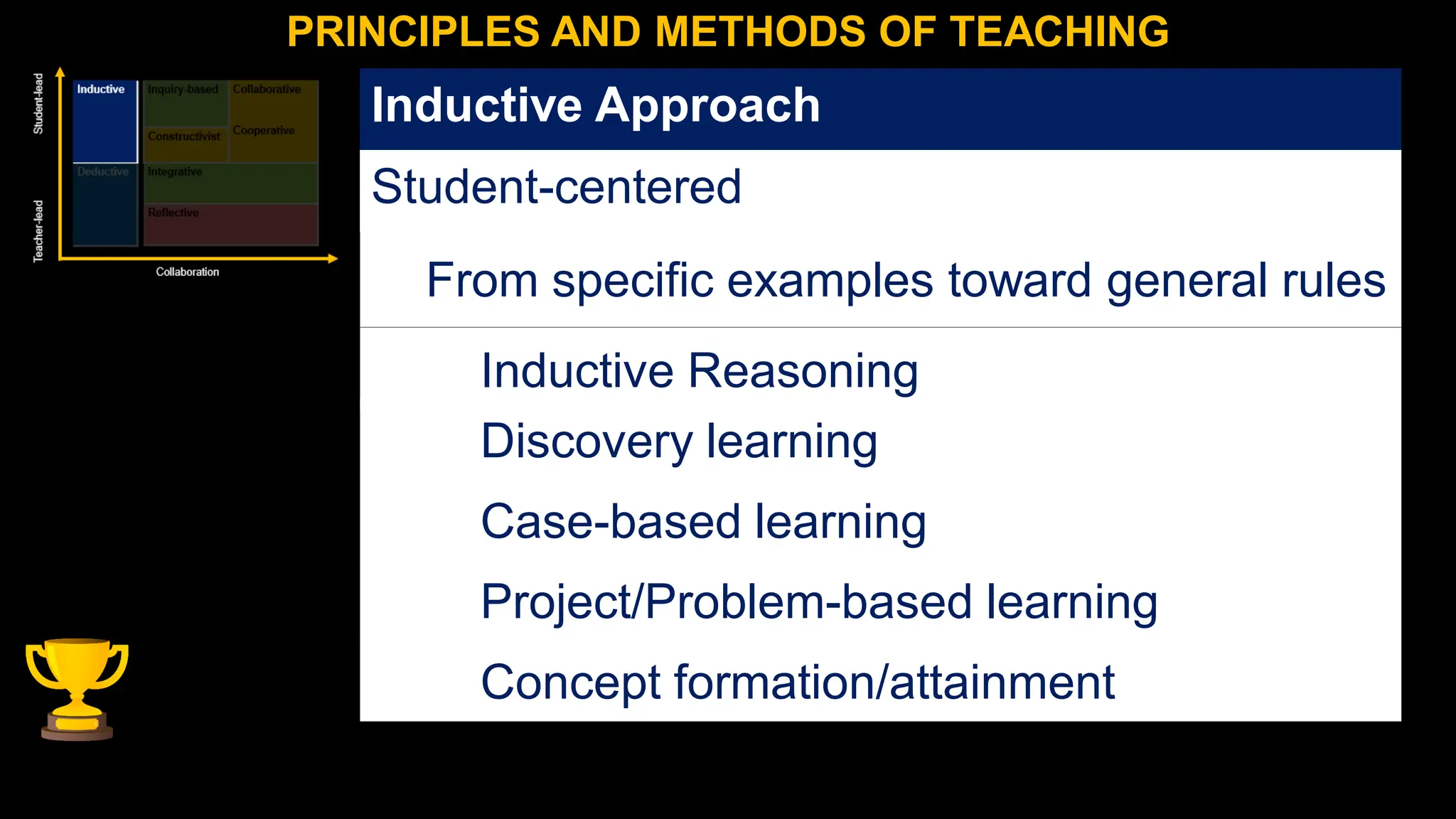
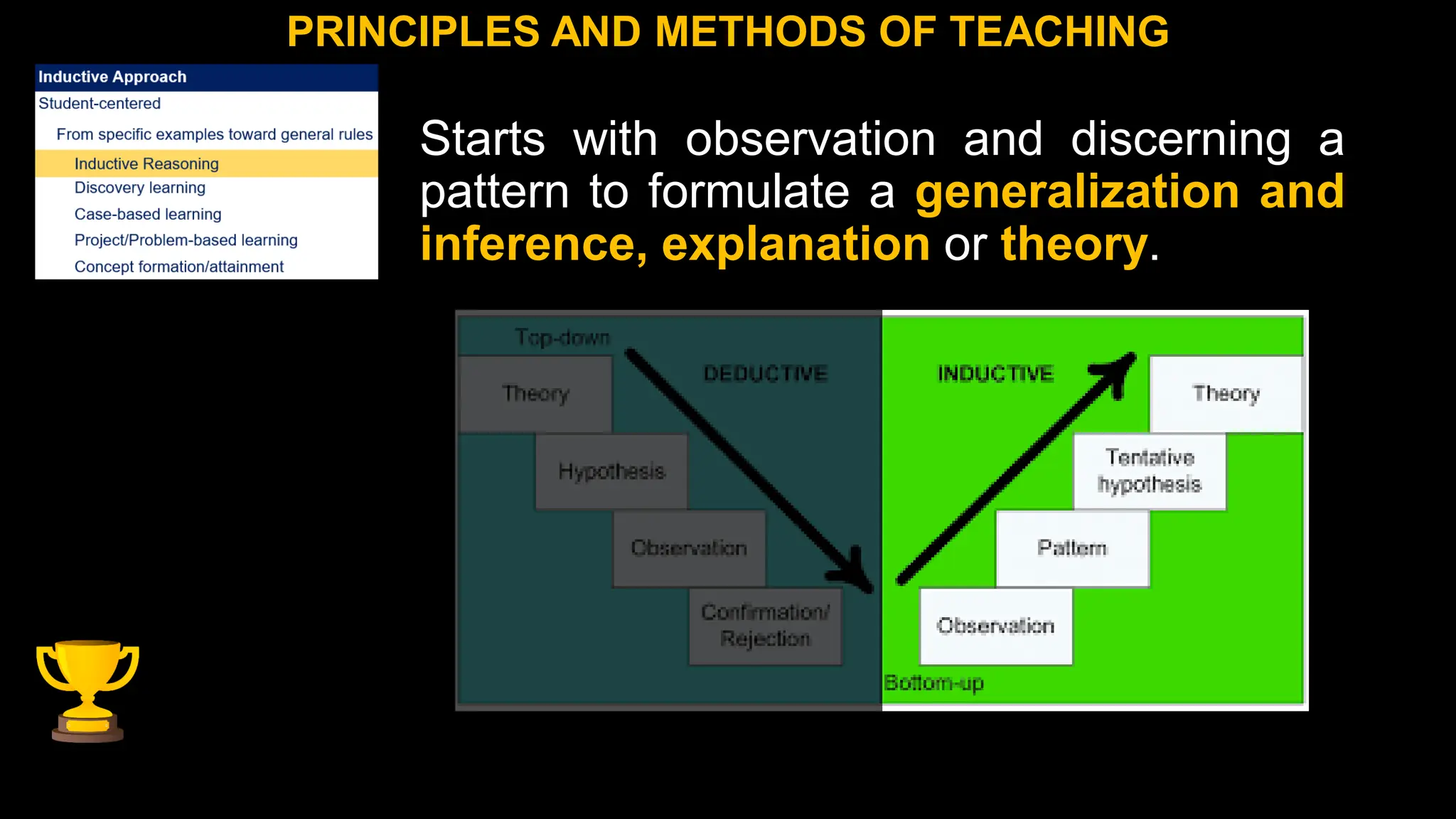
Inductive Approach
Student-centered
From specific examples toward general rules
Discovery learning
Case-based learning
Project/Problem-based learning
Concept formation/attainment
Inductive Reasoning
Starts with observation and discerning a
pattern to formulate a generalization and
inference, explanation or theory.
PRINCIPLES AND METHODS OF TEACHING
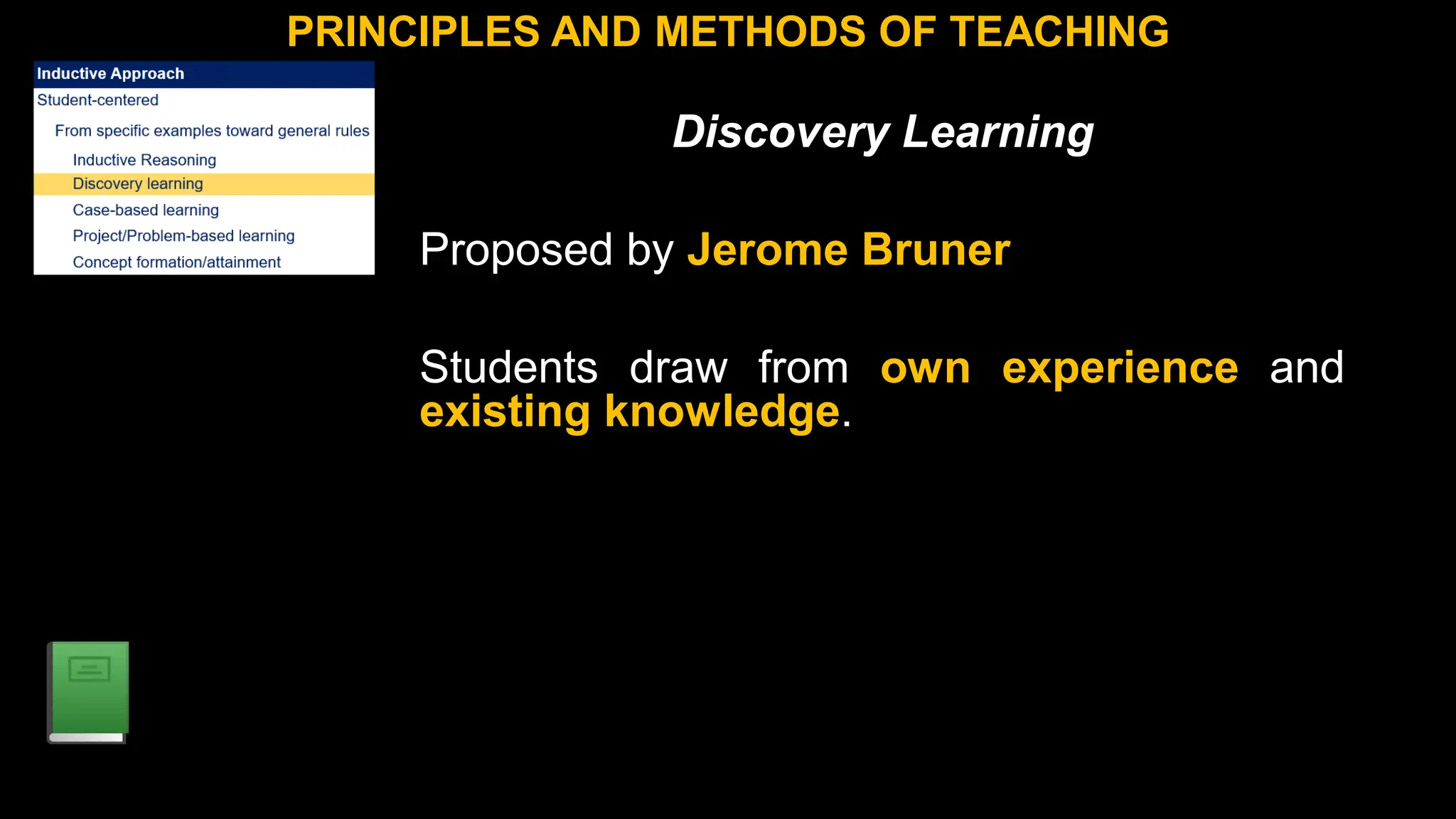
Discovery Learning
Proposed by Jerome Bruner
Students draw from own experience and
existing knowledge.
PRINCIPLES AND METHODS OF TEACHING
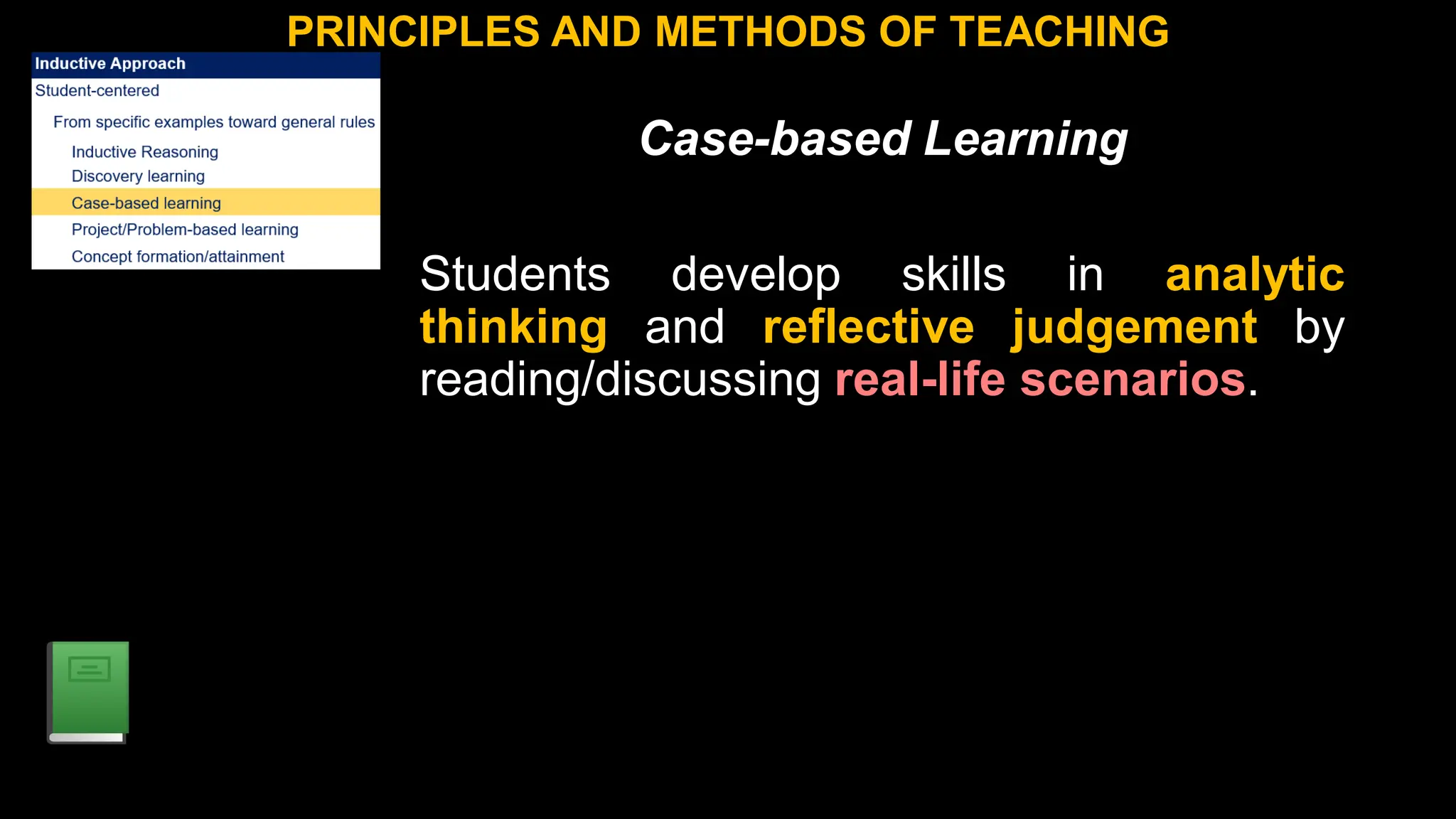
Case-based Learning
Students develop skills in analytic
thinking and reflective judgement by
reading/discussing real-life scenarios.
PRINCIPLES AND METHODS OF TEACHING
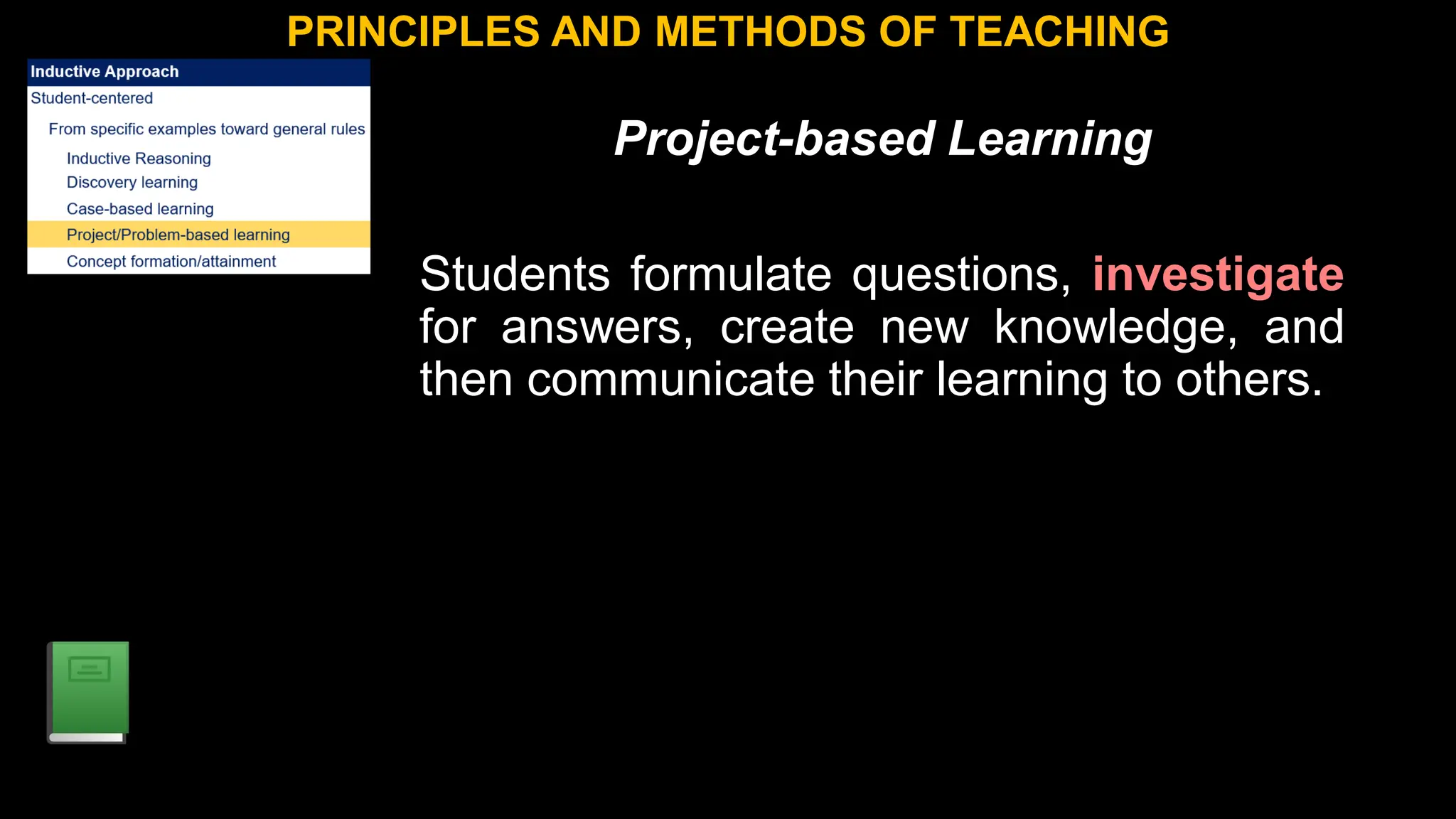
Project-based Learning
Students formulate questions, investigate
for answers, create new knowledge, and
then communicate their learning to others.
PRINCIPLES AND METHODS OF TEACHING
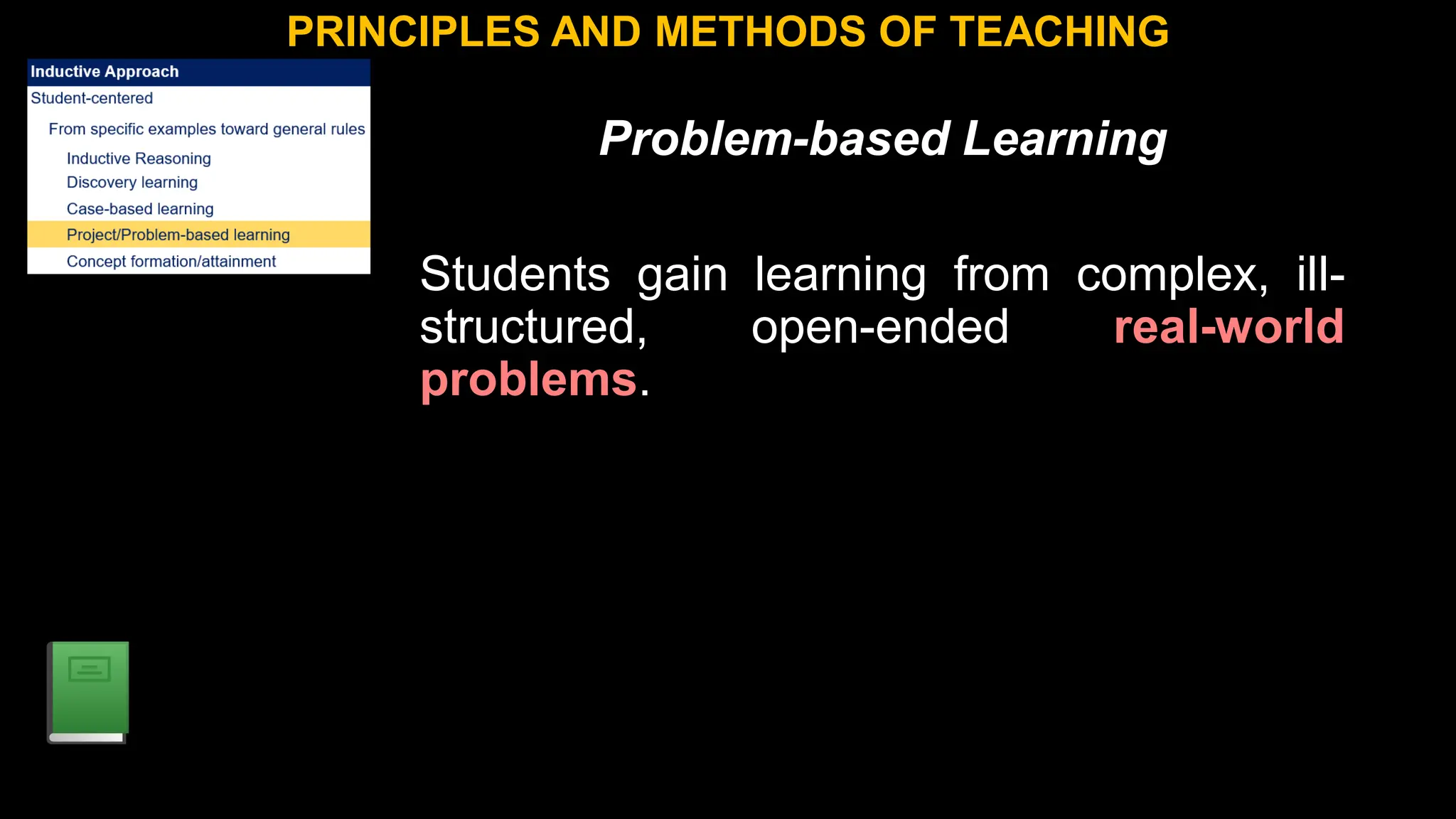
Problem-based Learning
Students gain learning from complex, ill-
structured, open-ended real-world
problems.
PRINCIPLES AND METHODS OF TEACHING
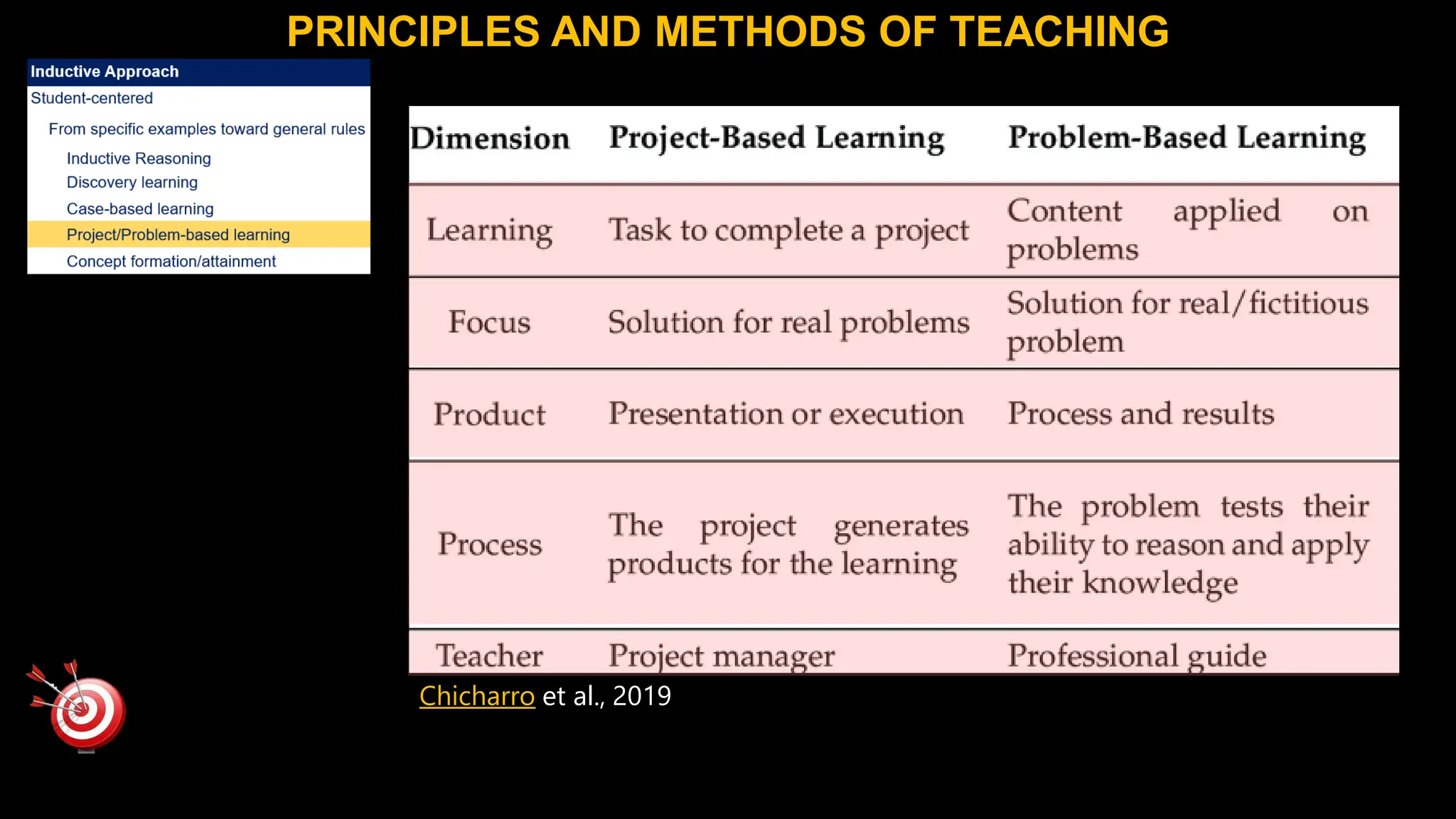
Chicharro et al., 2019
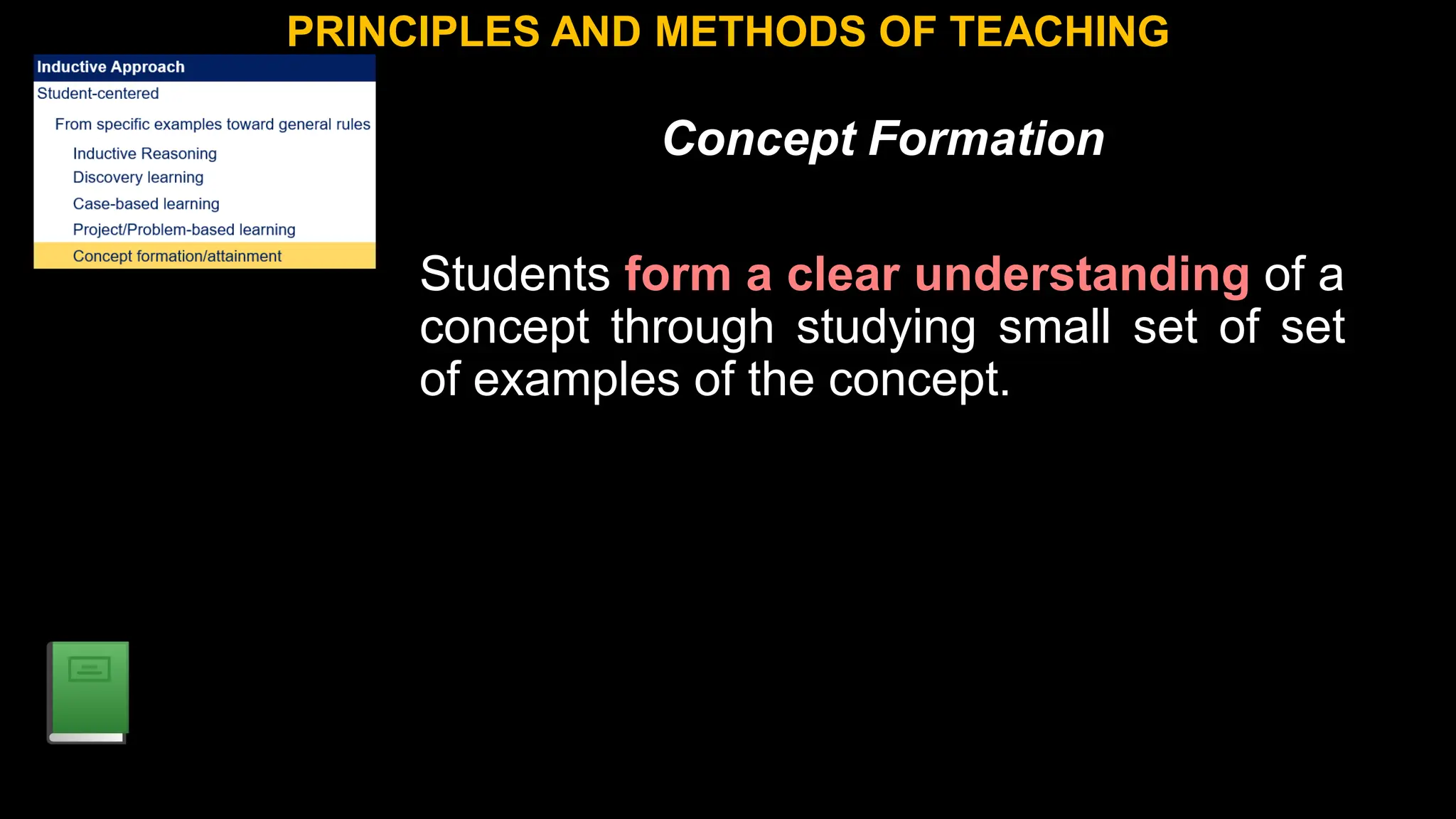
Concept Formation
Students form a clear understanding of a
concept through studying small set of set
of examples of the concept.
PRINCIPLES AND METHODS OF TEACHING
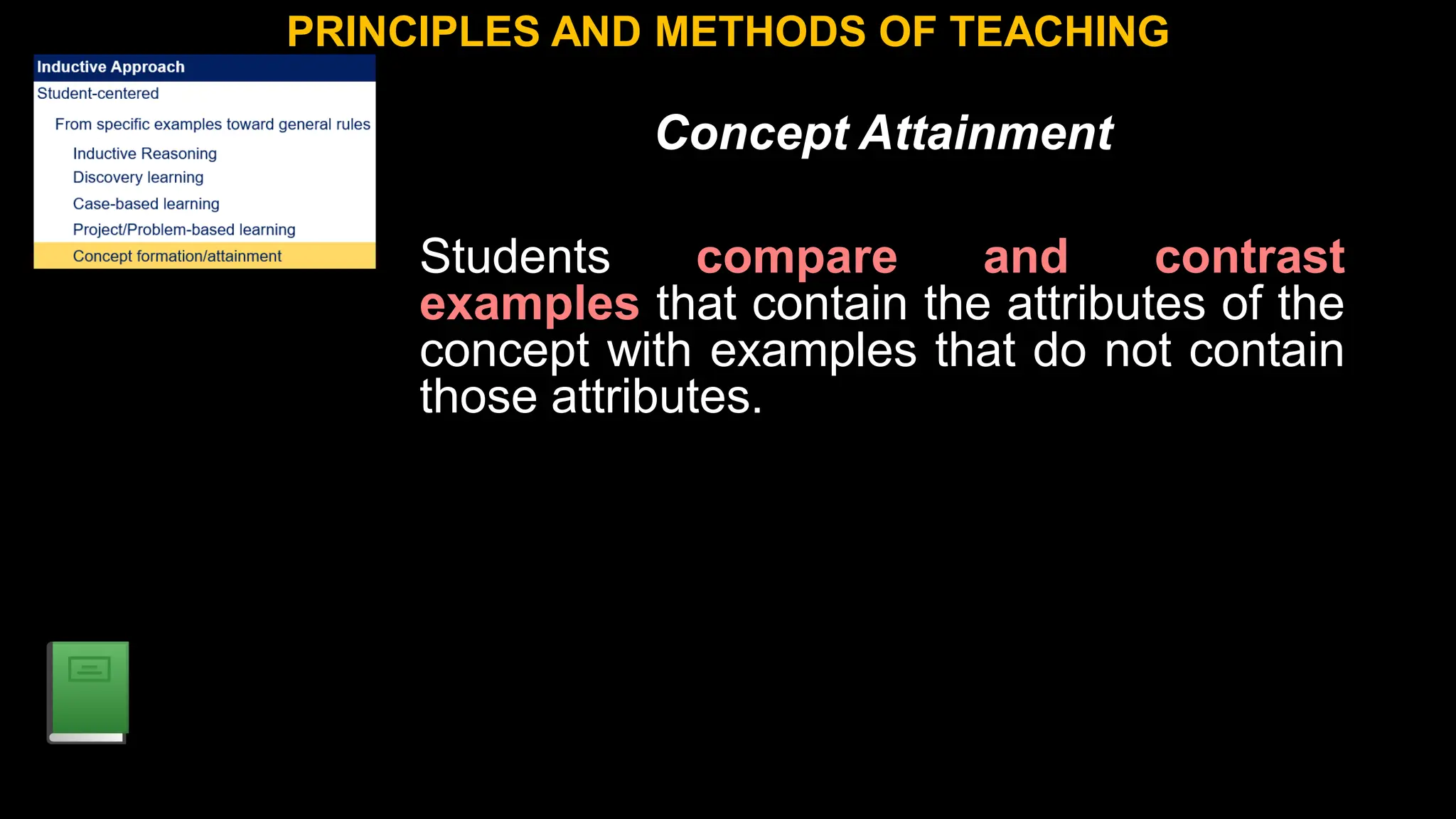
Concept Attainment
Students compare and contrast
examples that contain the attributes of the
concept with examples that do not contain
those attributes.
PRINCIPLES AND METHODS OF TEACHING
Teaching Approaches
PRINCIPLES AND METHODS OF TEACHING
Inductive
Deductive
Teacher-lead
Student-lead
Collaboration
2C-2I-1R
Inquiry-based Collaborative
Cooperative
Constructivist
Integrative
Reflective
PRINCIPLES AND METHODS OF TEACHING
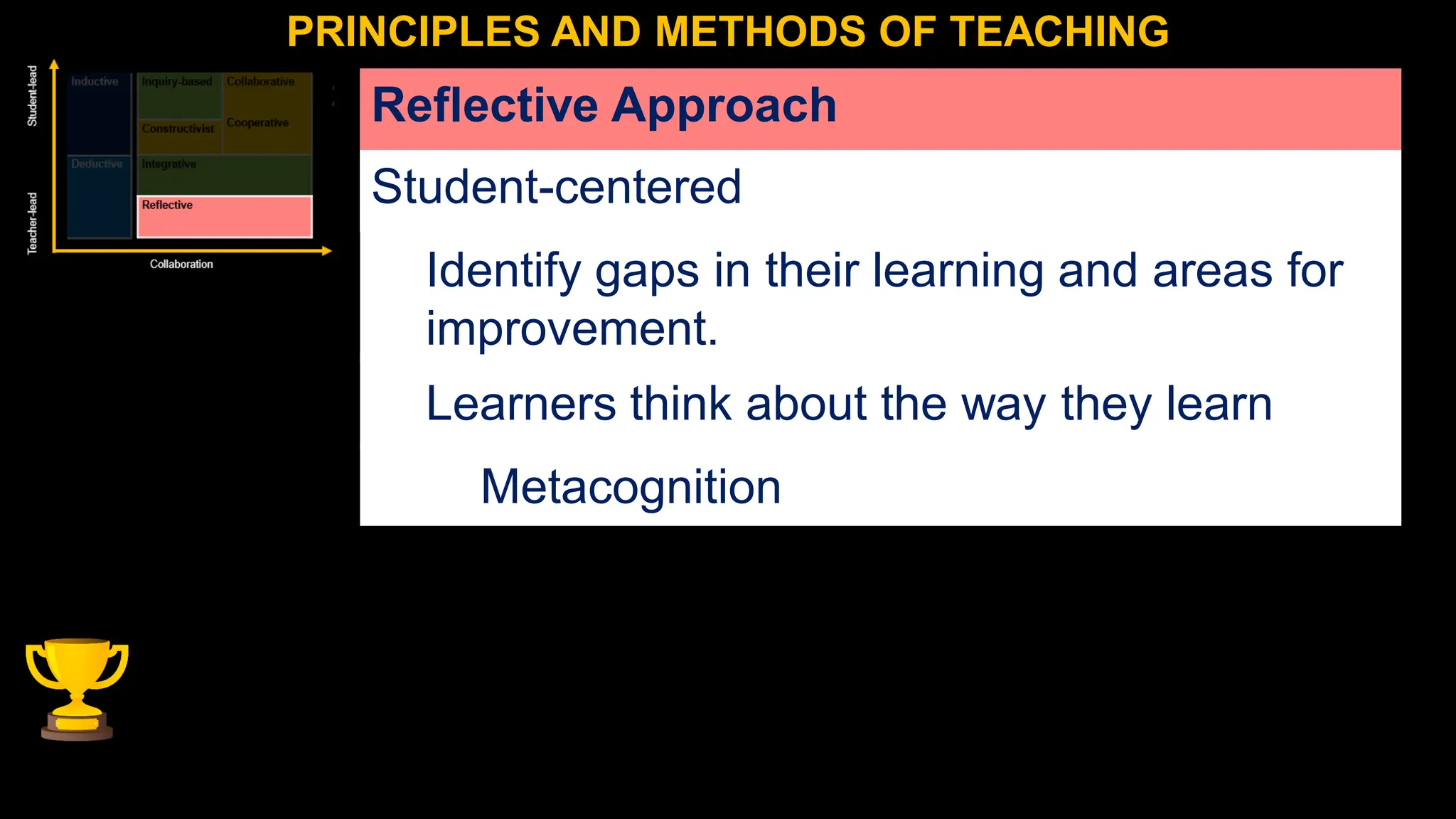
Learners think about the way they learn
Reflective Approach
Student-centered
Metacognition
Identify gaps in their learning and areas for
improvement.
PRINCIPLES AND METHODS OF TEACHING
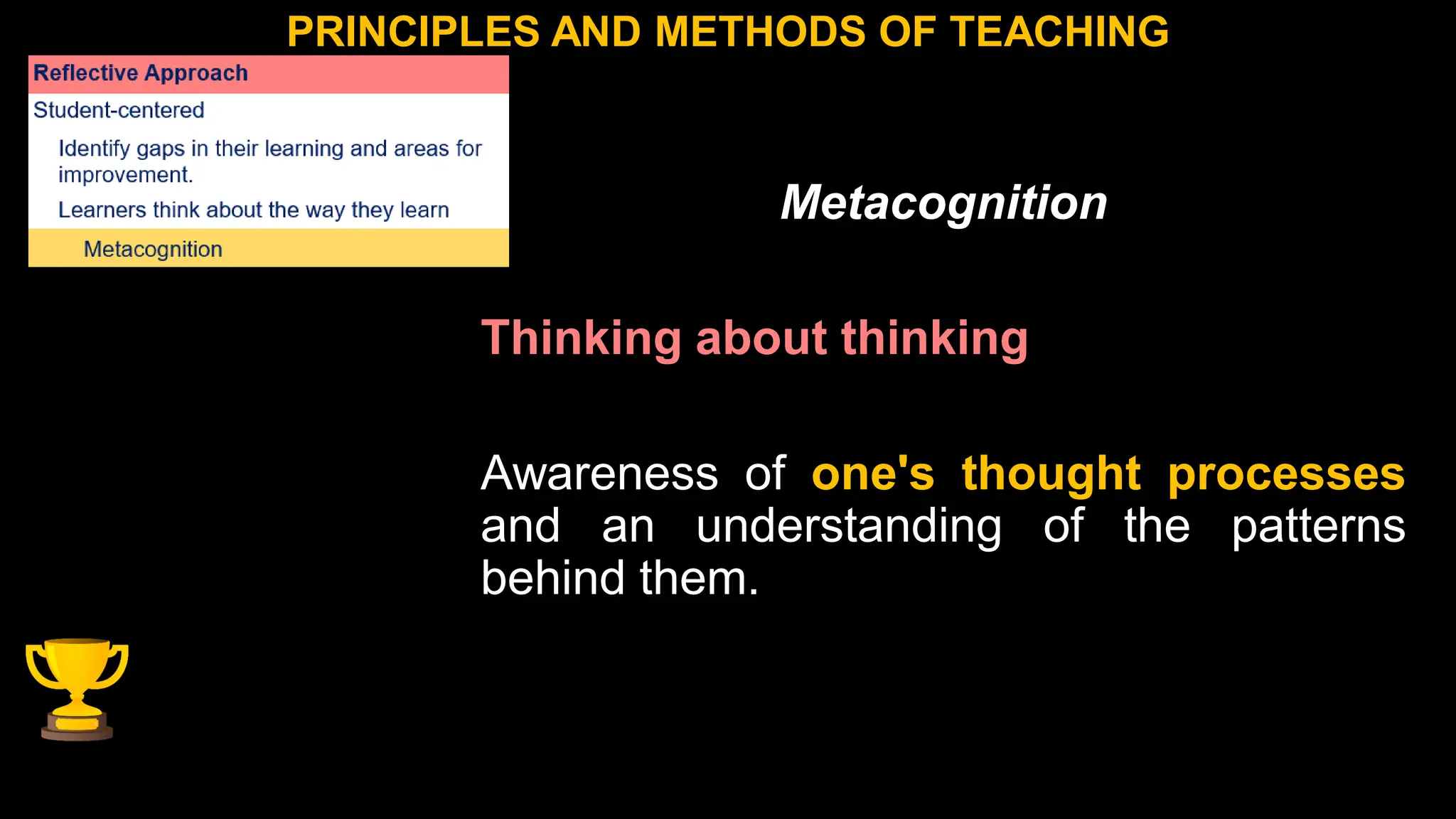
Metacognition
Thinking about thinking
Awareness of one's thought processes
and an understanding of the patterns
behind them.
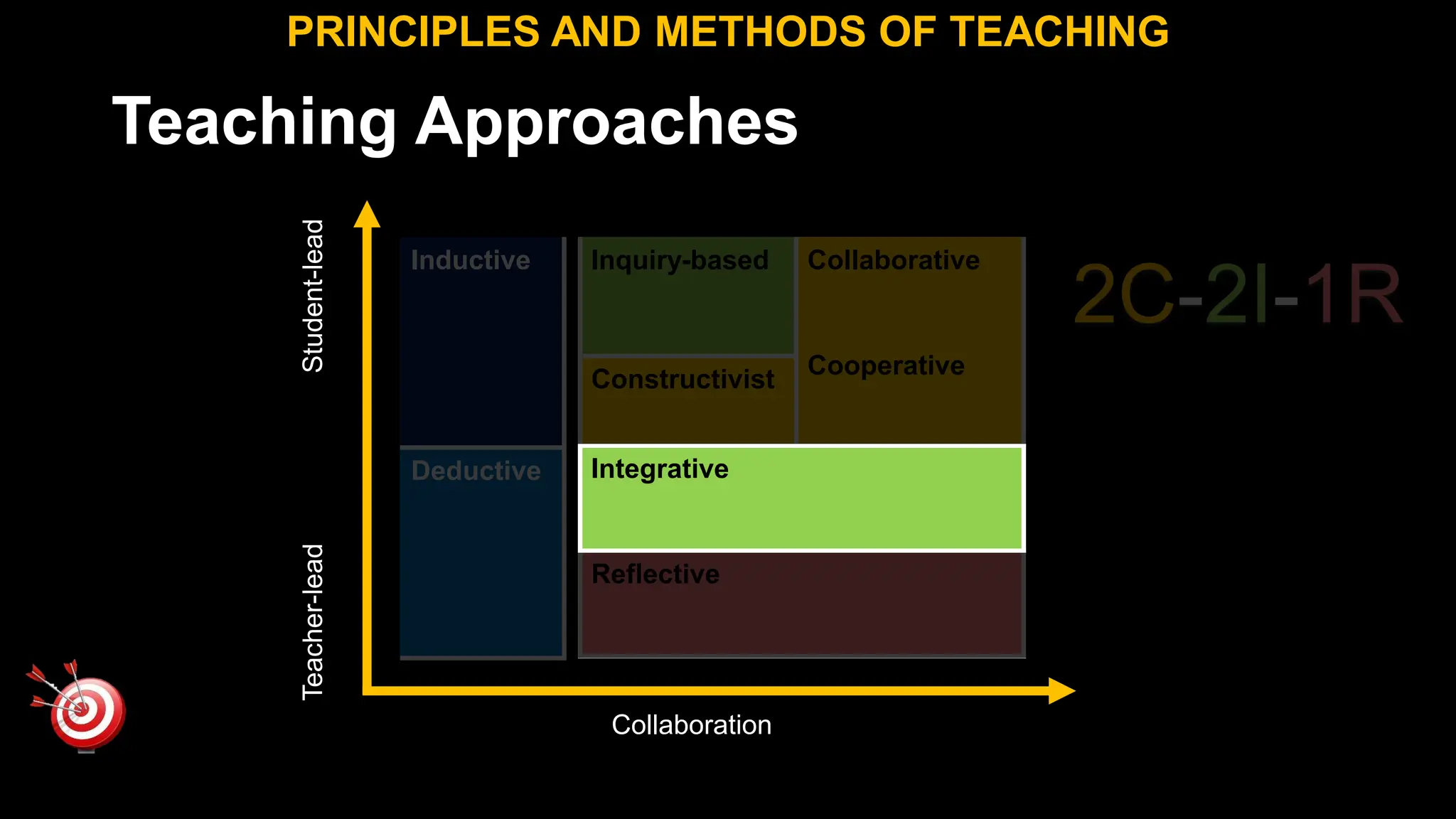
Teaching Approaches
PRINCIPLES AND METHODS OF TEACHING
Inductive
Deductive
Teacher-lead
Student-lead
Collaboration
2C-2I-1R
Inquiry-based Collaborative
Cooperative
Constructivist
Integrative
Reflective
PRINCIPLES AND METHODS OF TEACHING
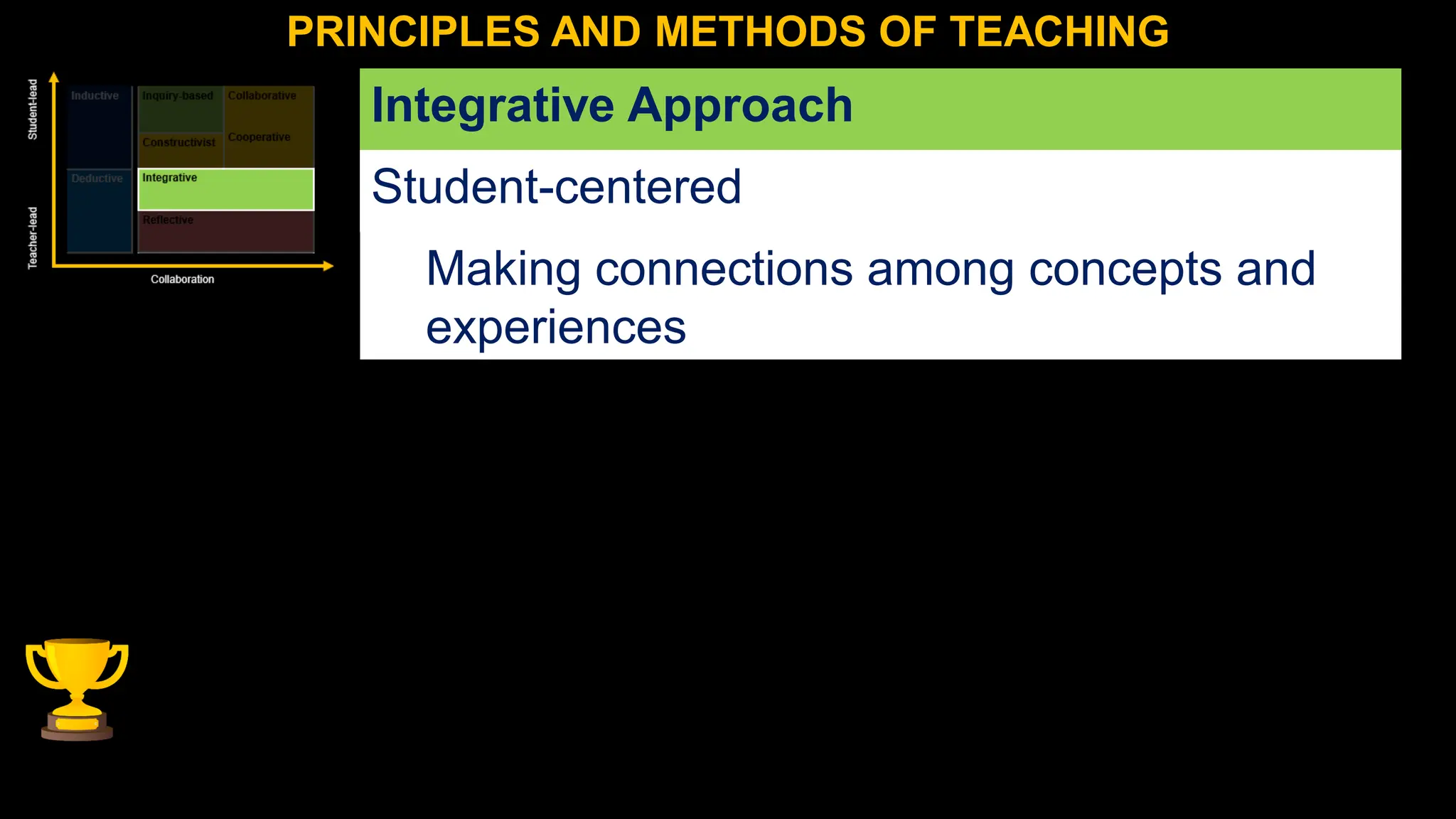
Integrative Approach
Student-centered
Making connections among concepts and
experiences
PRINCIPLES AND METHODS OF TEACHING
Teaching Approaches
PRINCIPLES AND METHODS OF TEACHING
Inductive
Deductive
Teacher-lead
Student-lead
Collaboration
2C-2I-1R
Inquiry-based Collaborative
Cooperative
Constructivist
Integrative
Reflective
PRINCIPLES AND METHODS OF TEACHING
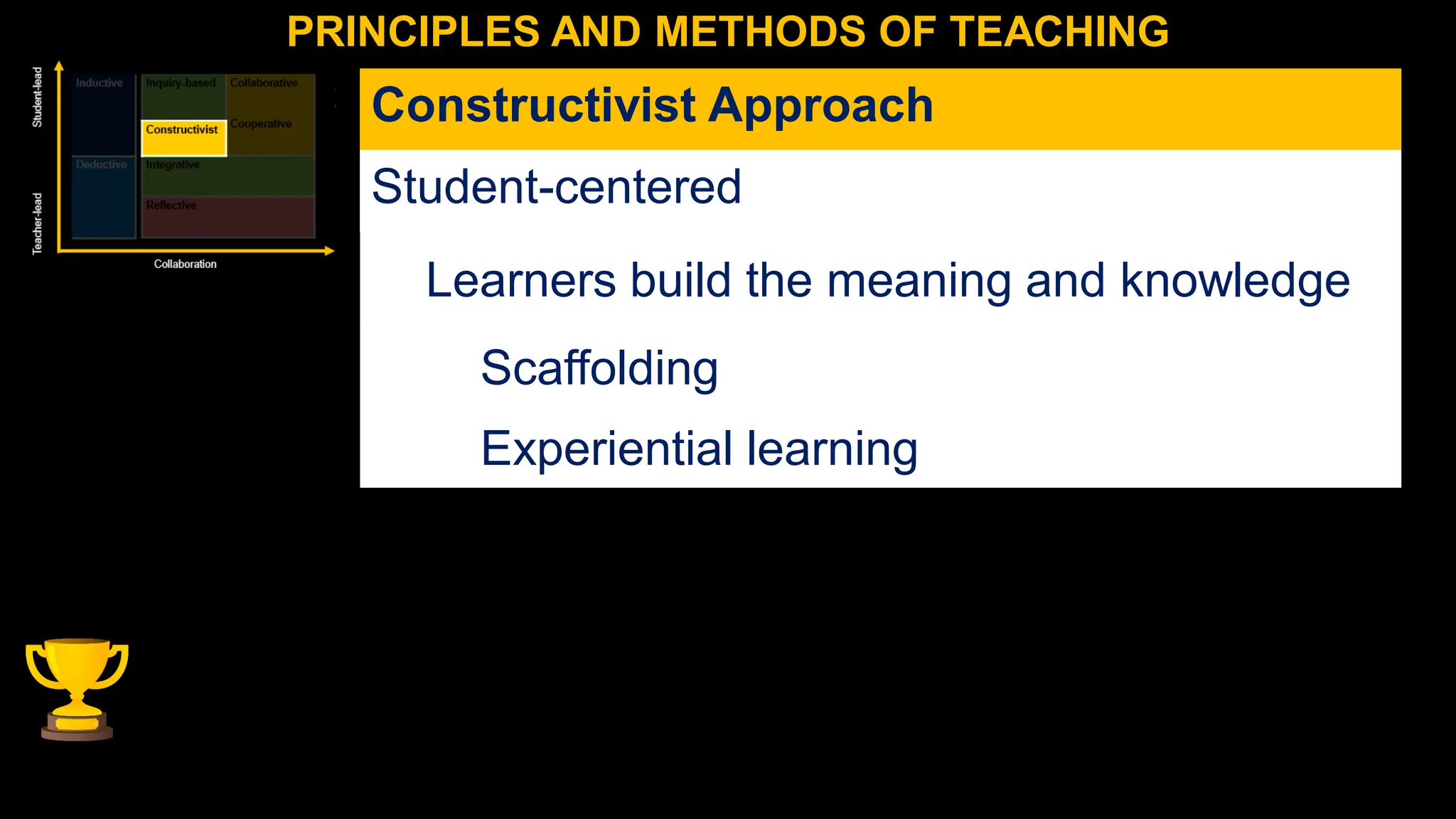
Constructivist Approach
Student-centered
Learners build the meaning and knowledge
Scaffolding
Experiential learning
PRINCIPLES AND METHODS OF TEACHING
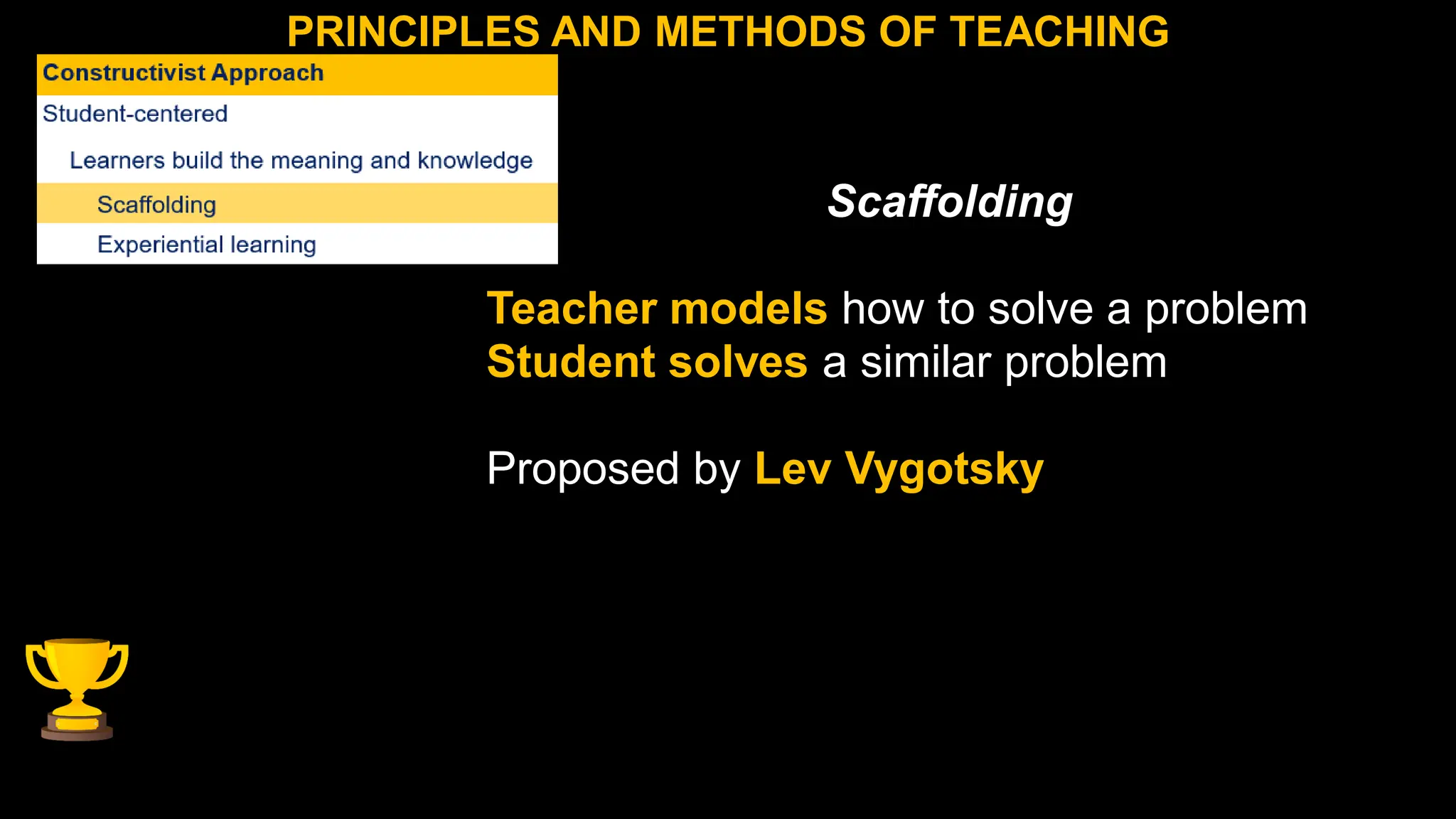
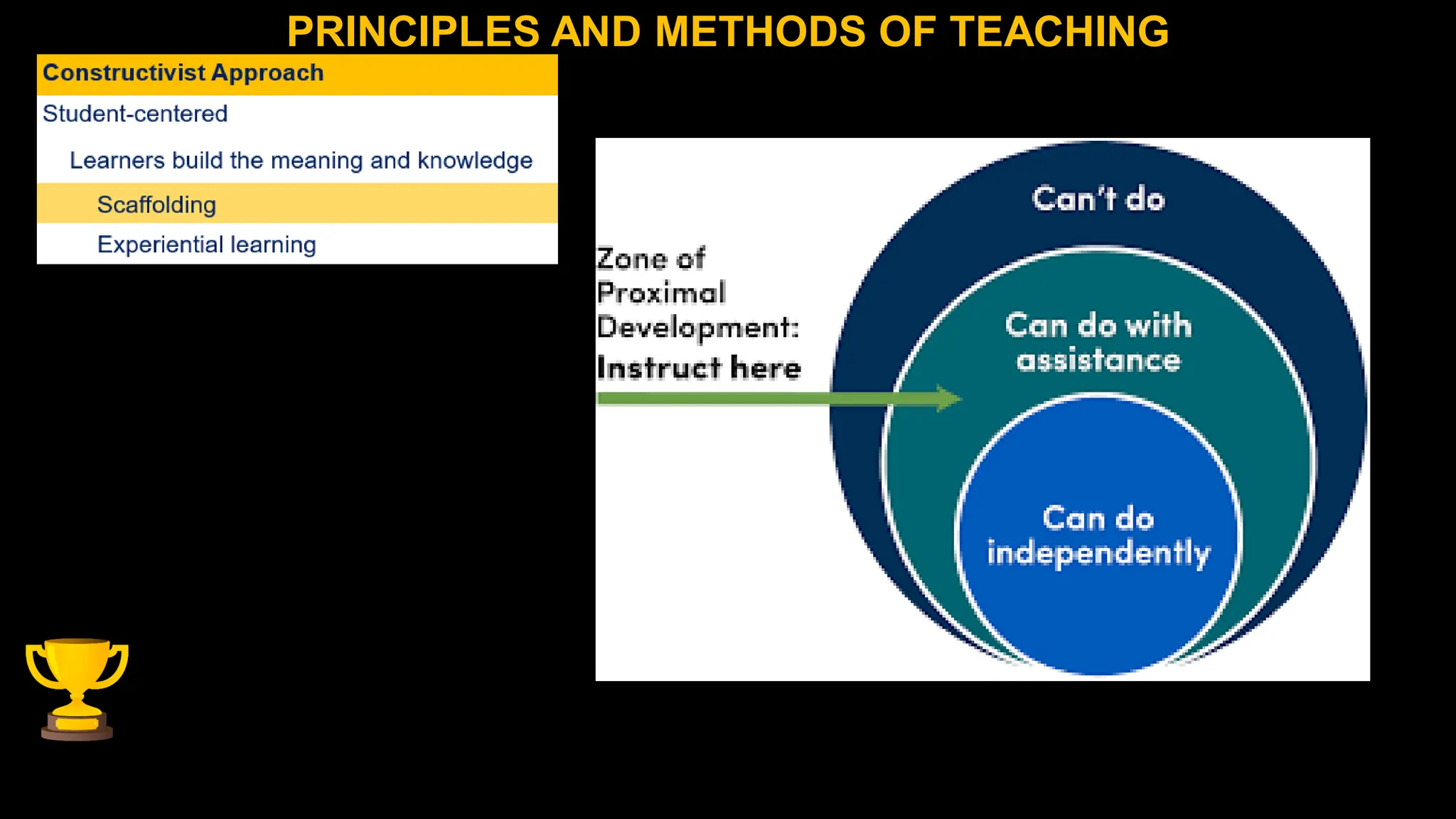
Scaffolding
Teacher models how to solve a problem
Student solves a similar problem
Proposed by Lev Vygotsky
PRINCIPLES AND METHODS OF TEACHING
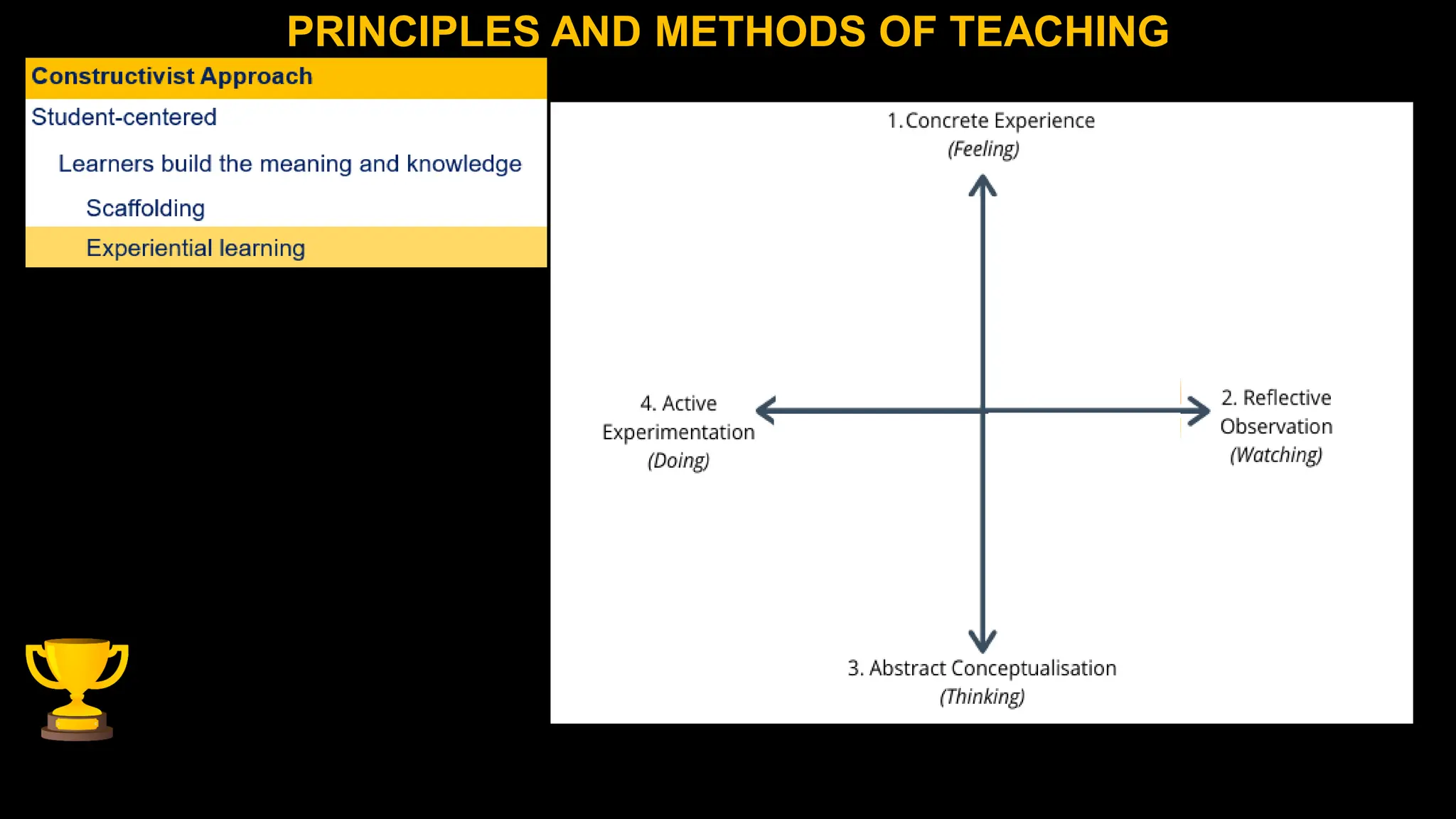
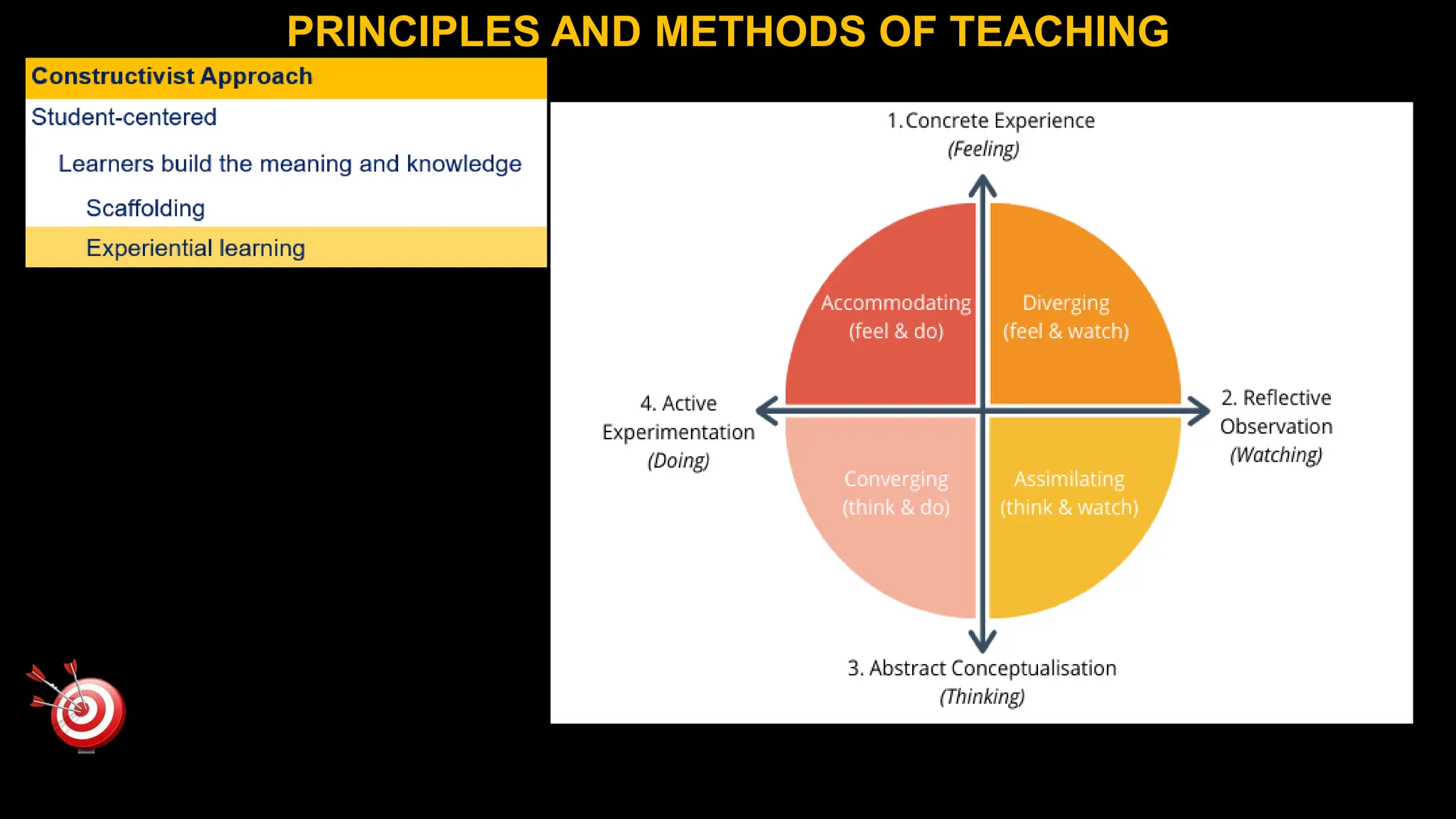
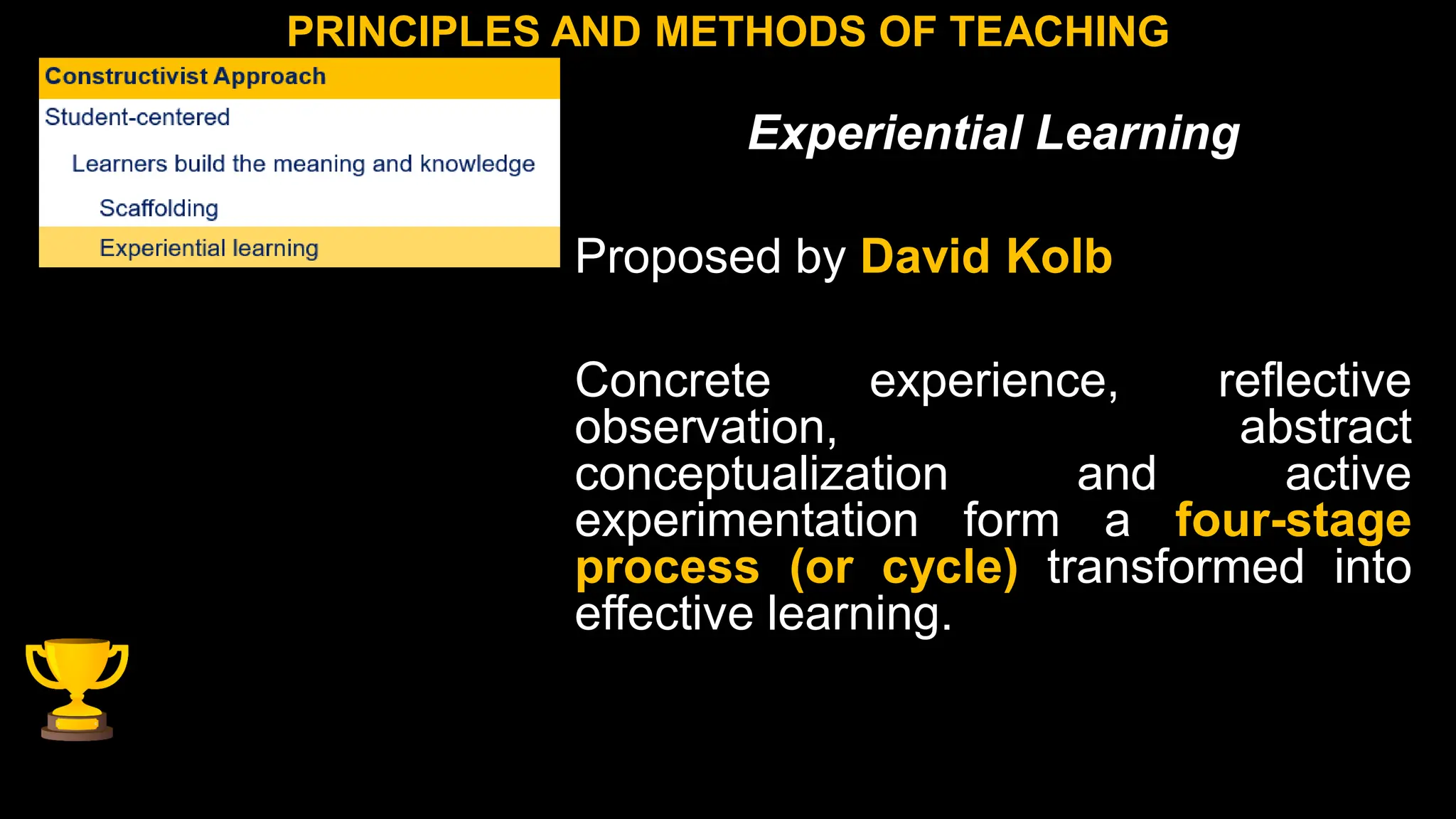
Experiential Learning
Proposed by David Kolb
Concrete experience, reflective
observation, abstract
conceptualization and active
experimentation form a four-stage
process (or cycle) transformed into
effective learning.
PRINCIPLES AND METHODS OF TEACHING
Teaching Approaches
PRINCIPLES AND METHODS OF TEACHING
Inductive
Deductive
Teacher-lead
Student-lead
Collaboration
2C-2I-1R
Inquiry-based Collaborative
Cooperative
Constructivist
Integrative
Reflective
PRINCIPLES AND METHODS OF TEACHING
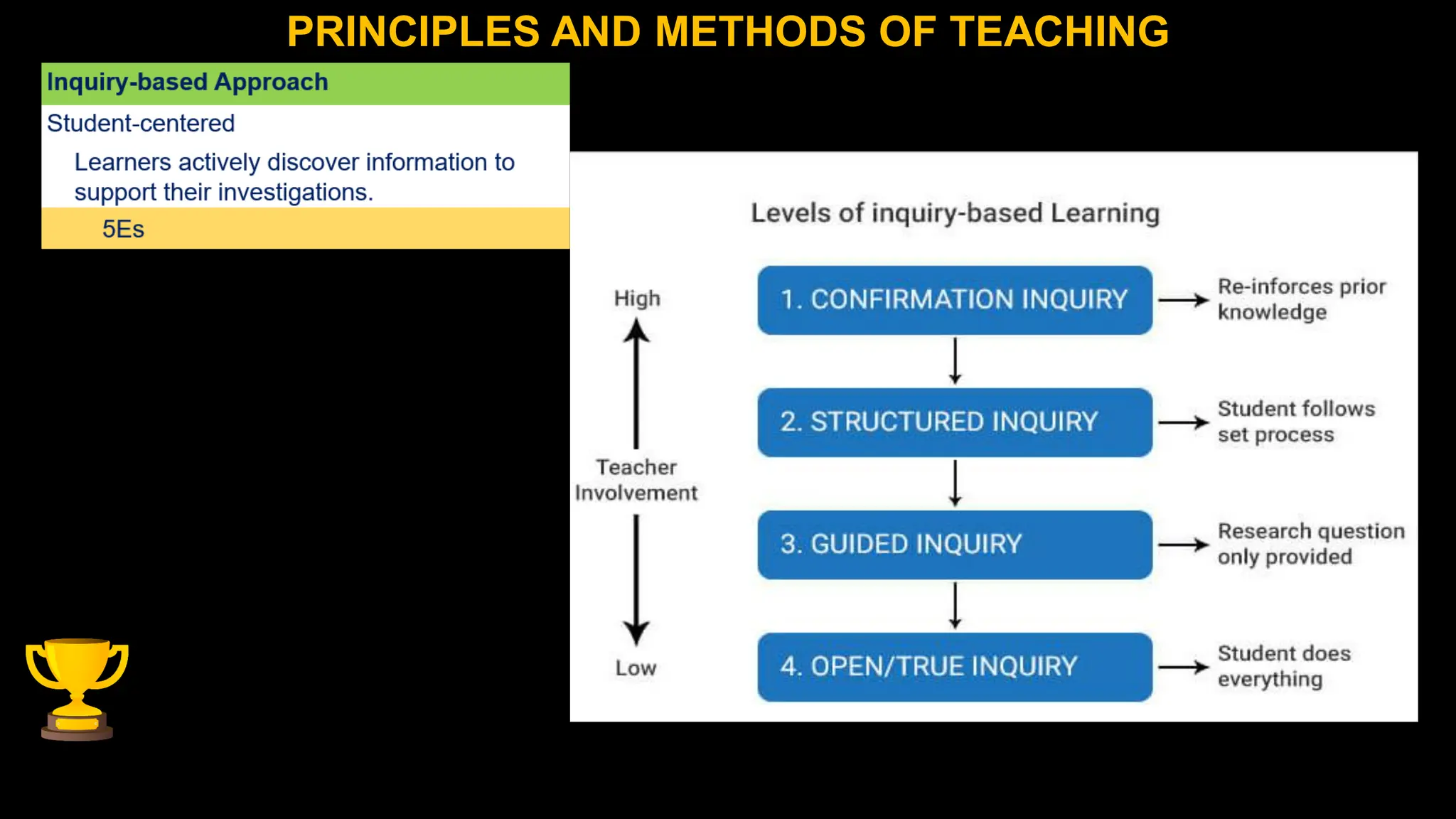
Inquiry-based Approach
Student-centered
Learners actively discover information to
support their investigations.
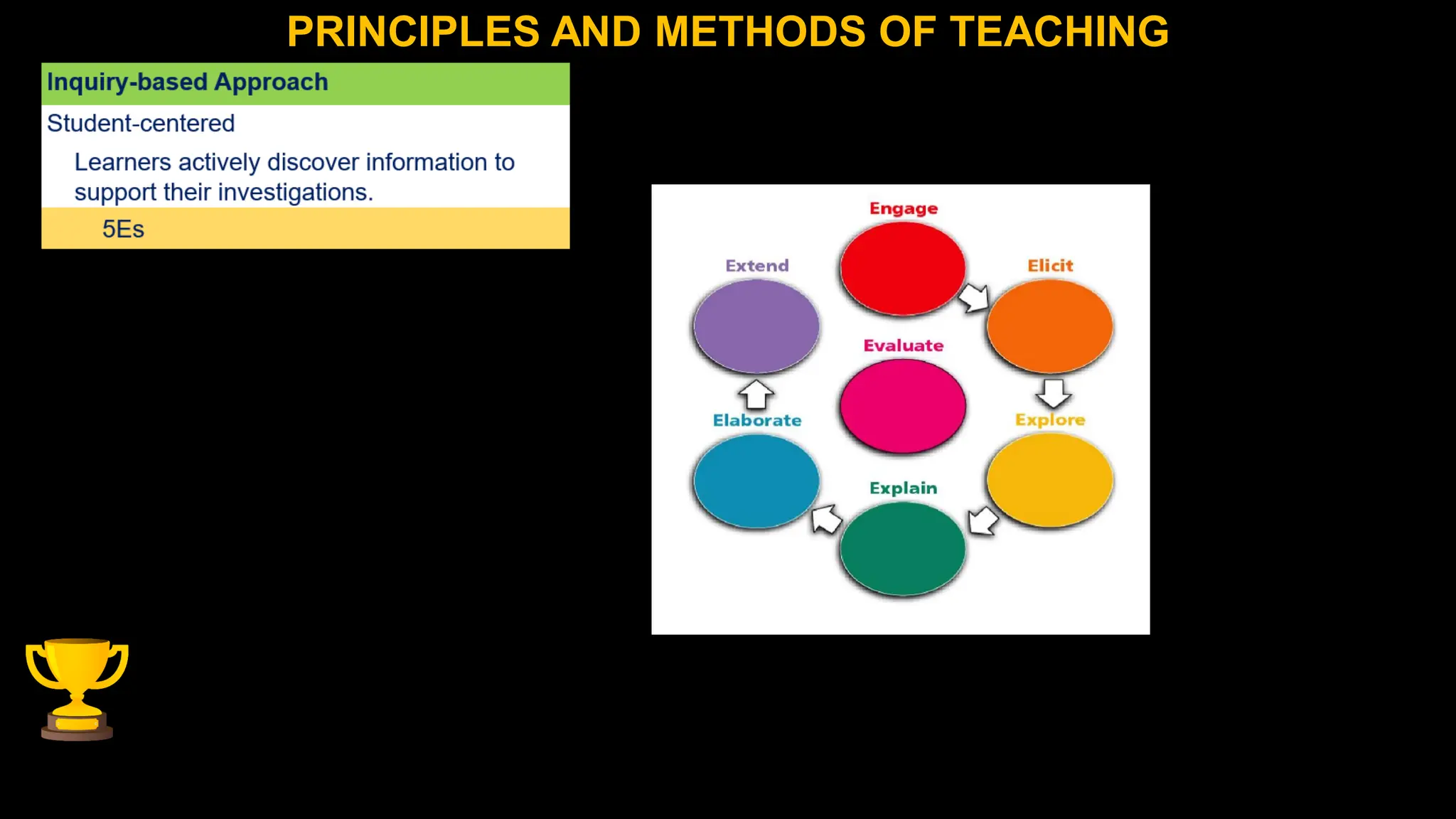
5Es
PRINCIPLES AND METHODS OF TEACHING
Teaching Approaches
PRINCIPLES AND METHODS OF TEACHING
Inductive
Deductive
Teacher-lead
Student-lead
Collaboration
2C-2I-1R
Inquiry-based Collaborative
Cooperative
Constructivist
Integrative
Reflective
PRINCIPLES AND METHODS OF TEACHING
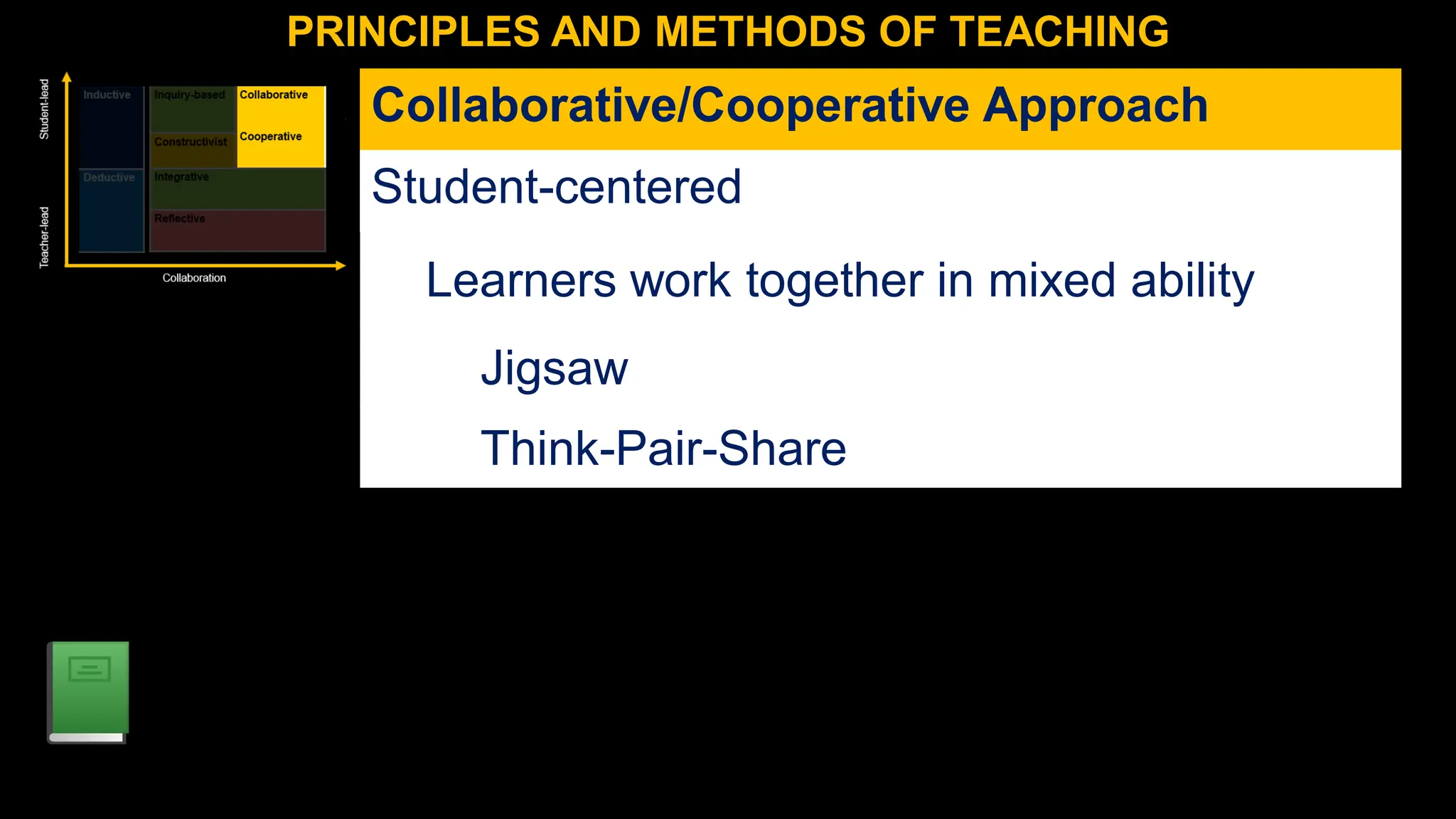
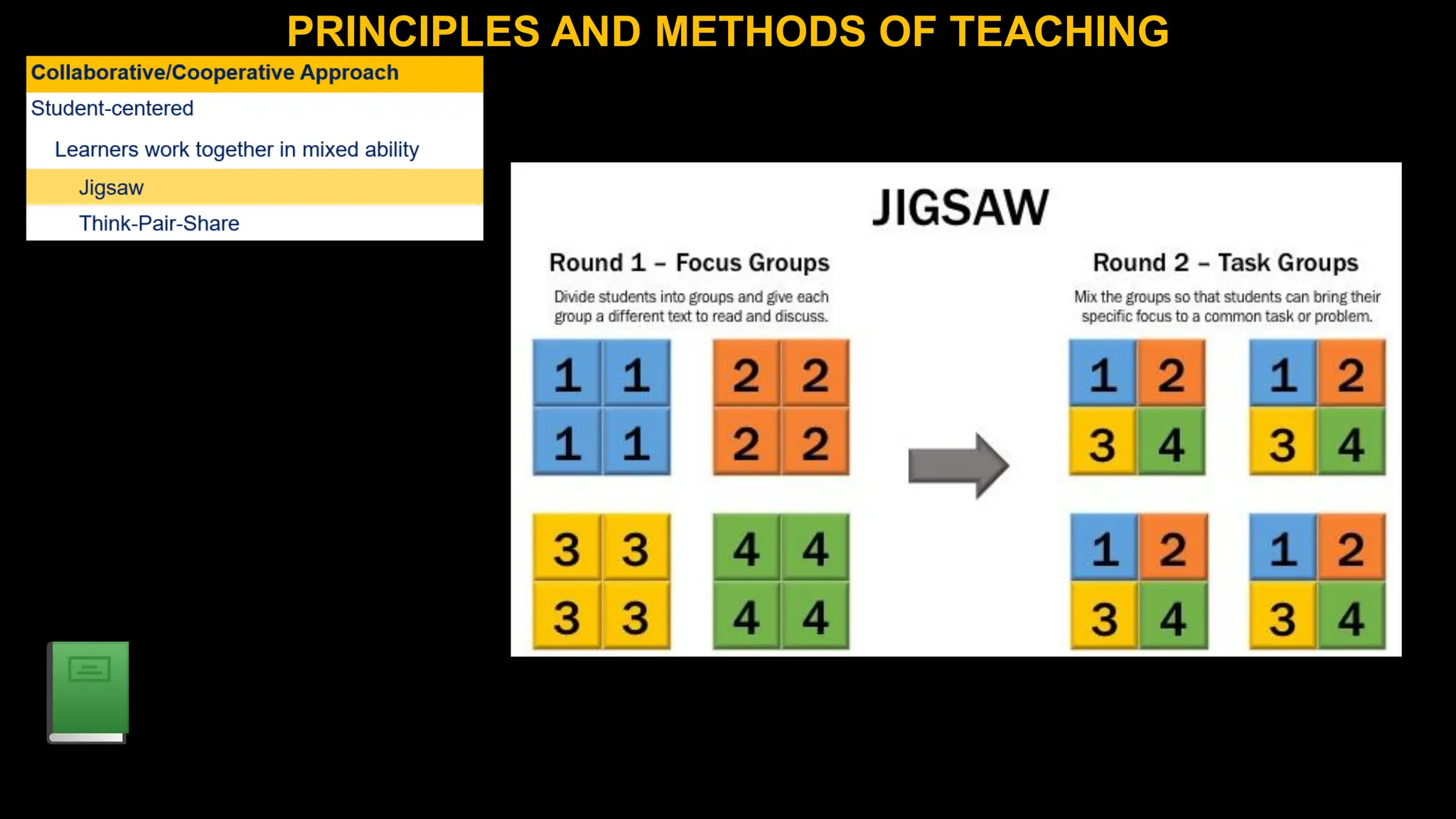
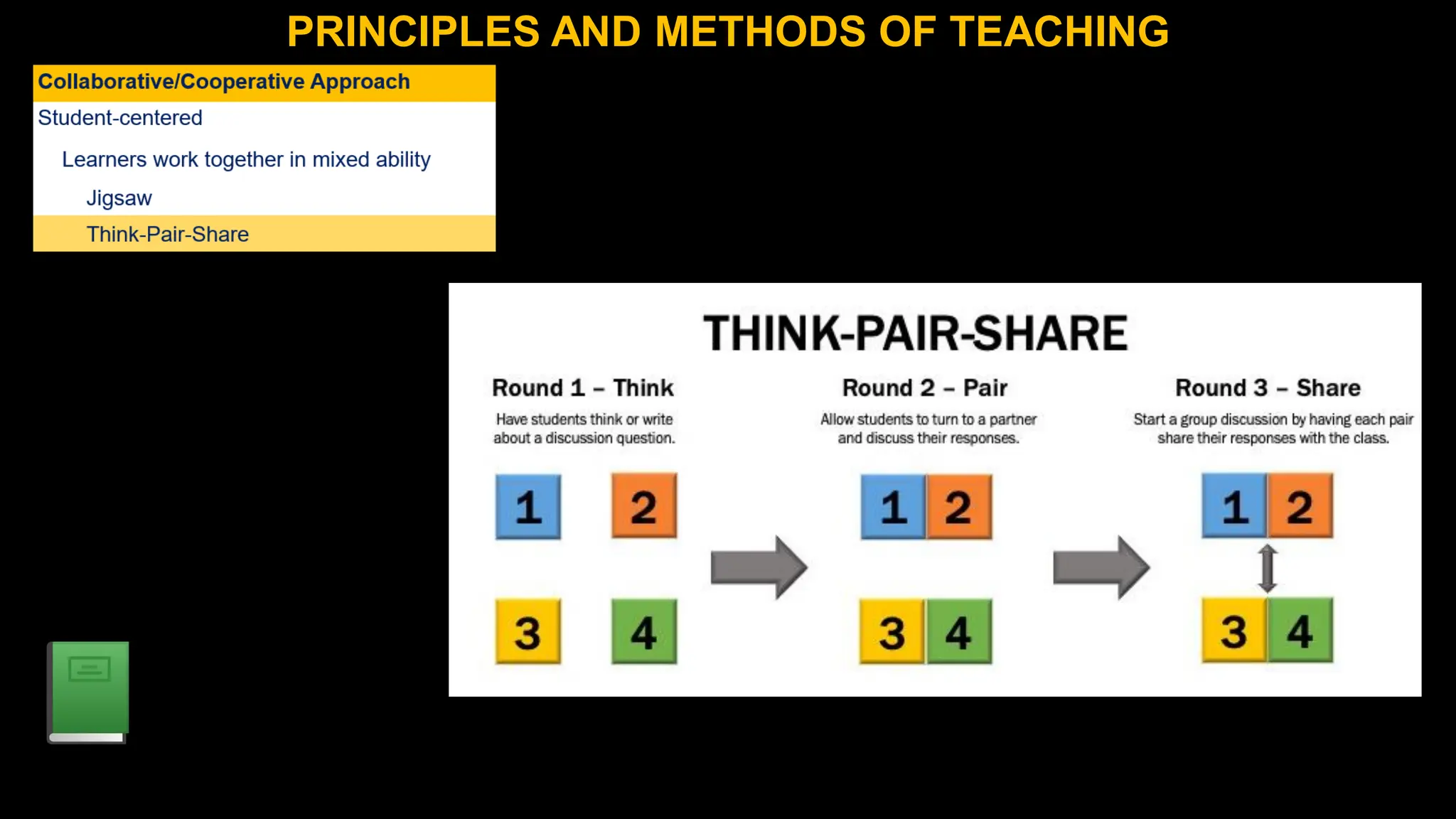
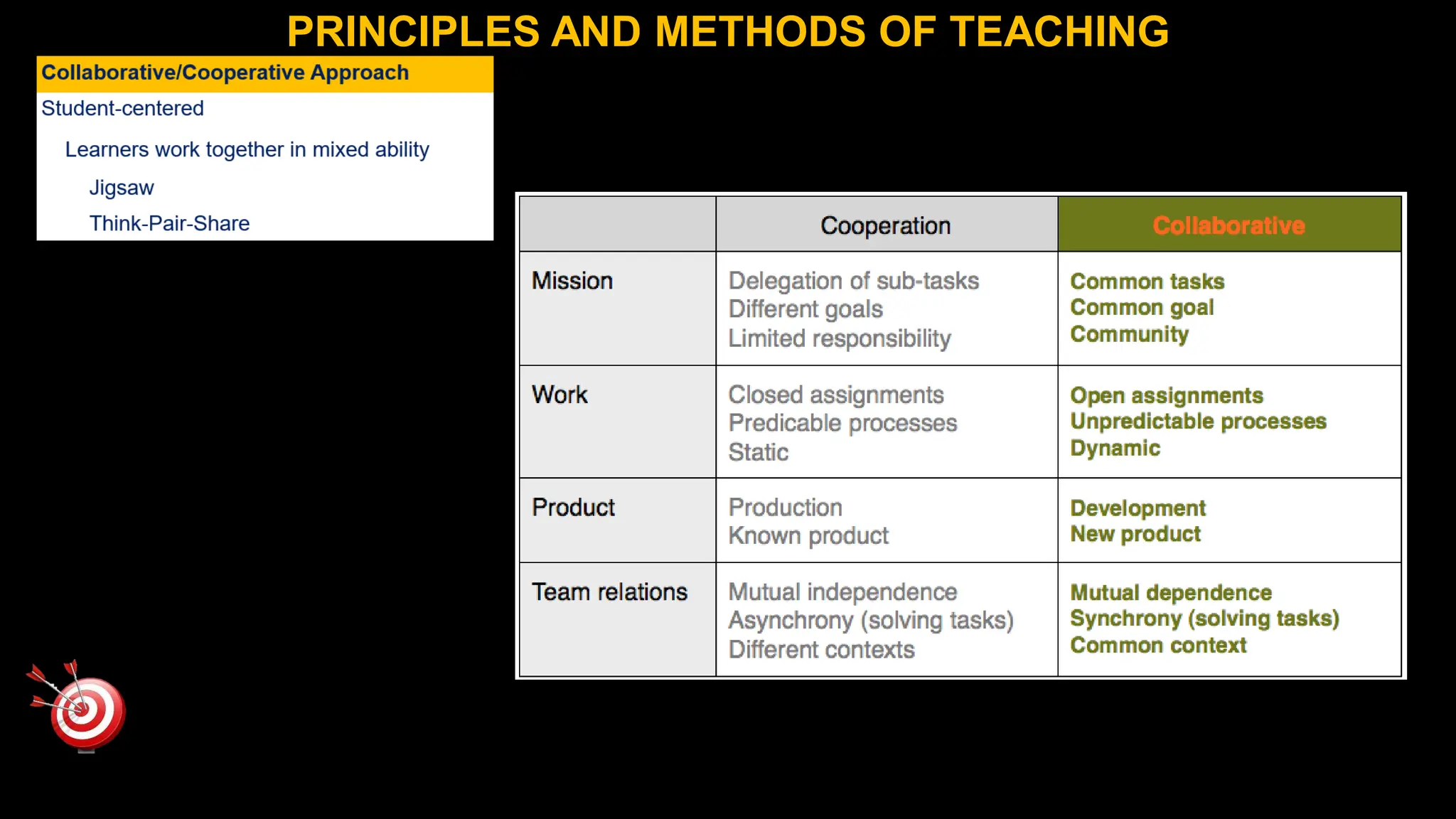
Collaborative/Cooperative Approach
Student-centered
Learners work together in mixed ability
Jigsaw
Think-Pair-Share
PRINCIPLES AND METHODS OF TEACHING
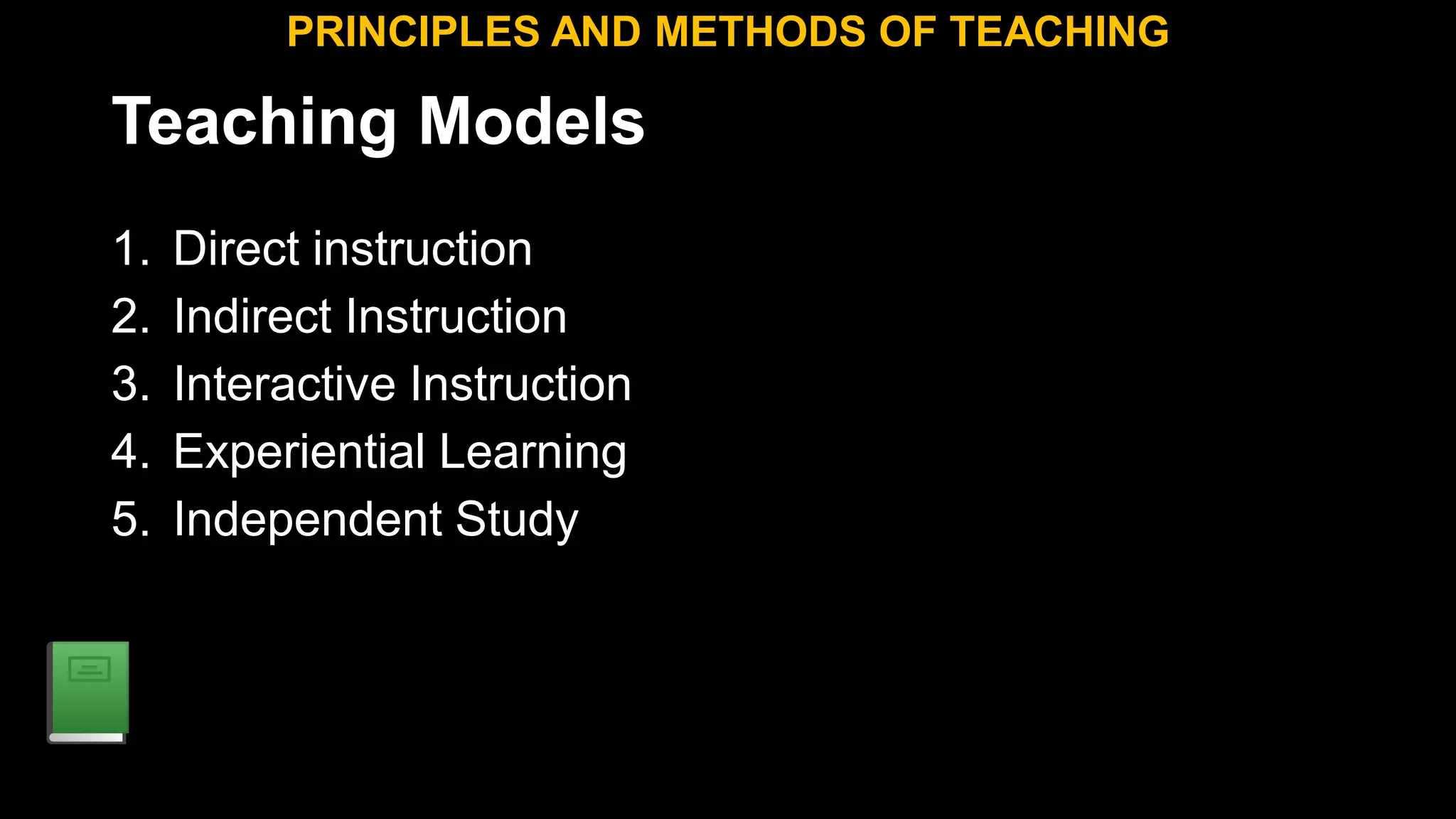
Teaching Models
1. Direct instruction
2. Indirect Instruction
3. Interactive Instruction
4. Experiential Learning
5. Independent Study
PRINCIPLES AND METHODS OF TEACHING
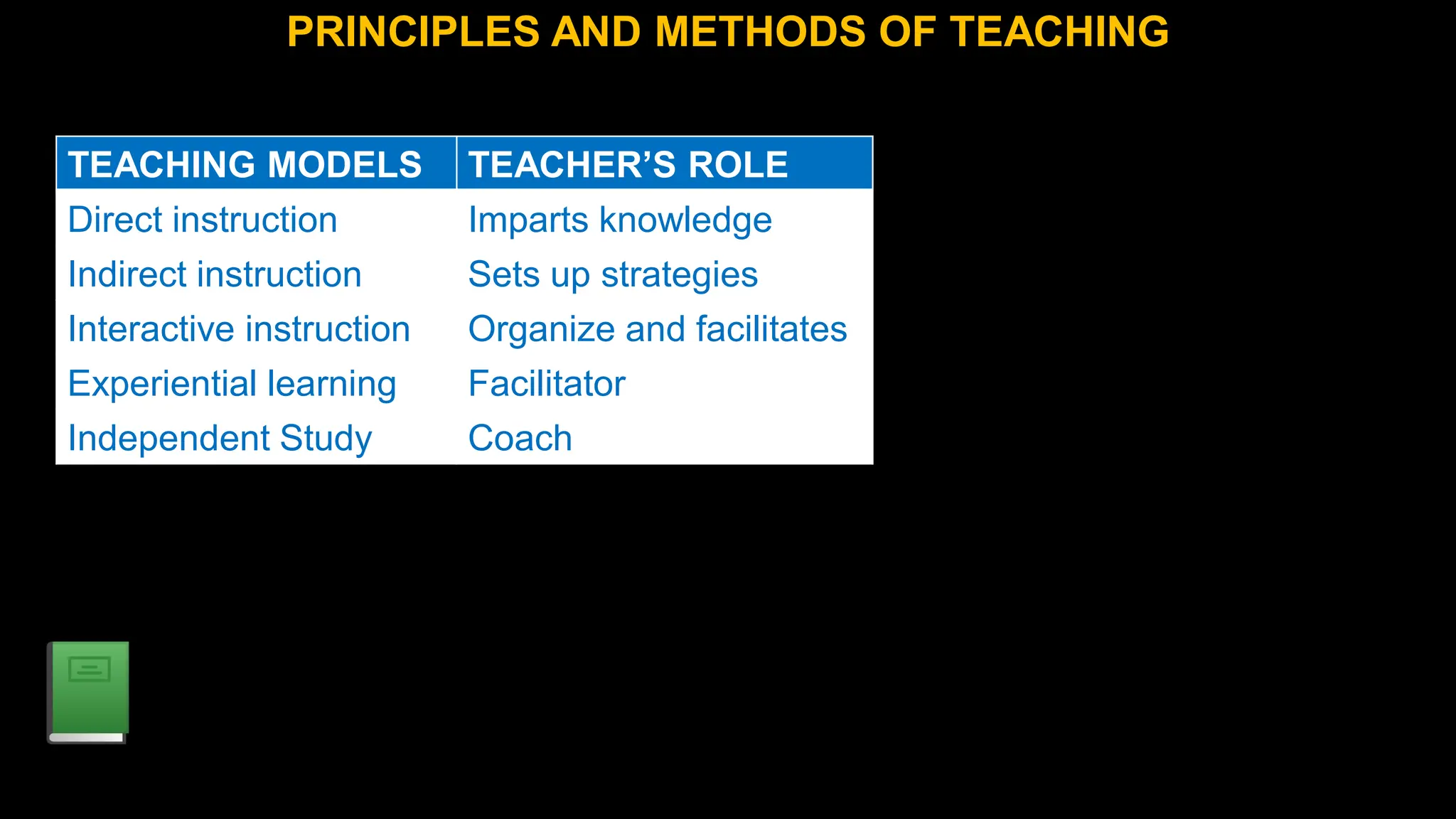
TEACHING MODELS TEACHER’S ROLE
Direct instruction Imparts knowledge
Indirect instruction Sets up strategies
Interactive instruction Organize and facilitates
Experiential learning Facilitator
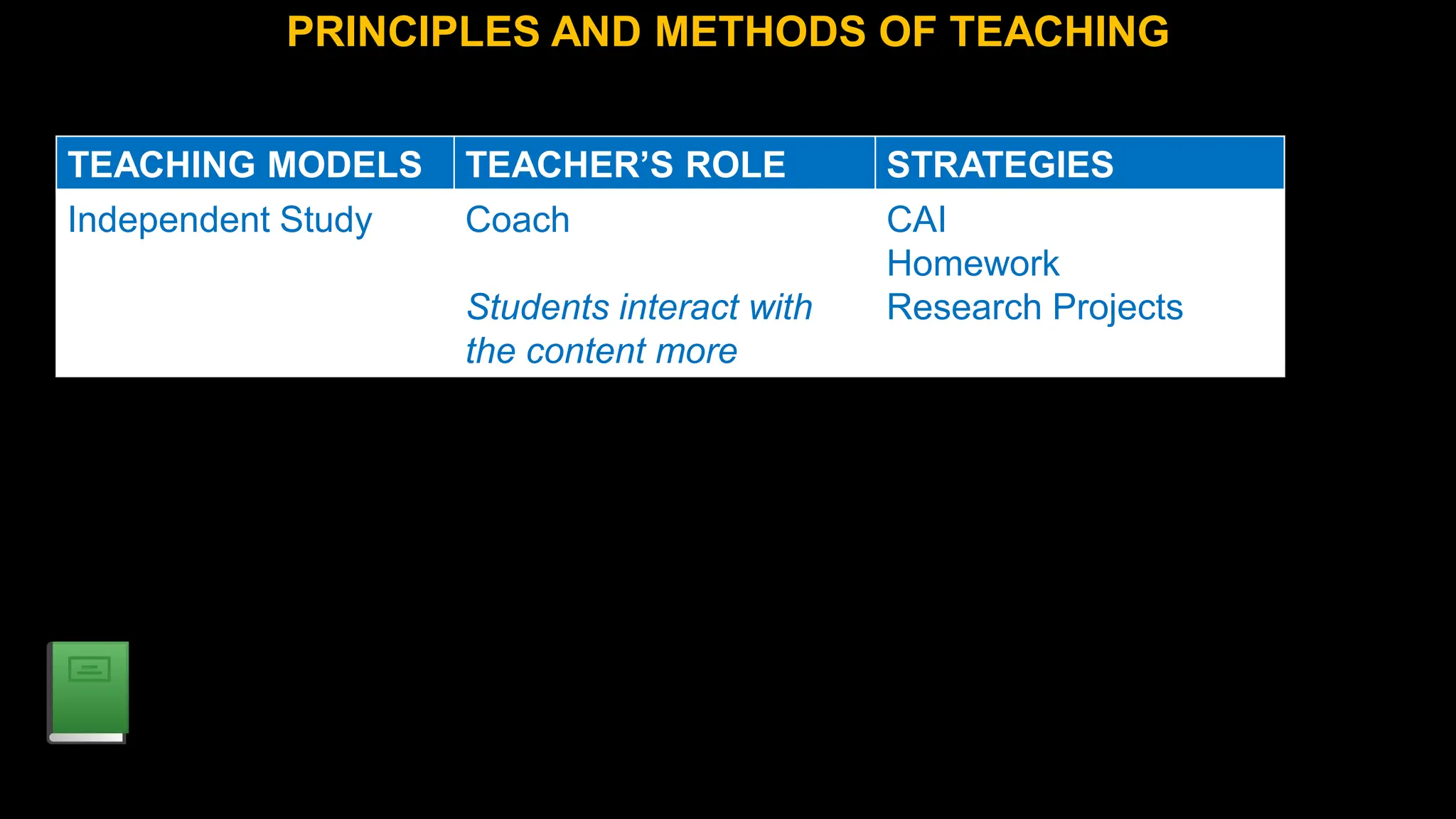
Independent Study Coach
PRINCIPLES AND METHODS OF TEACHING
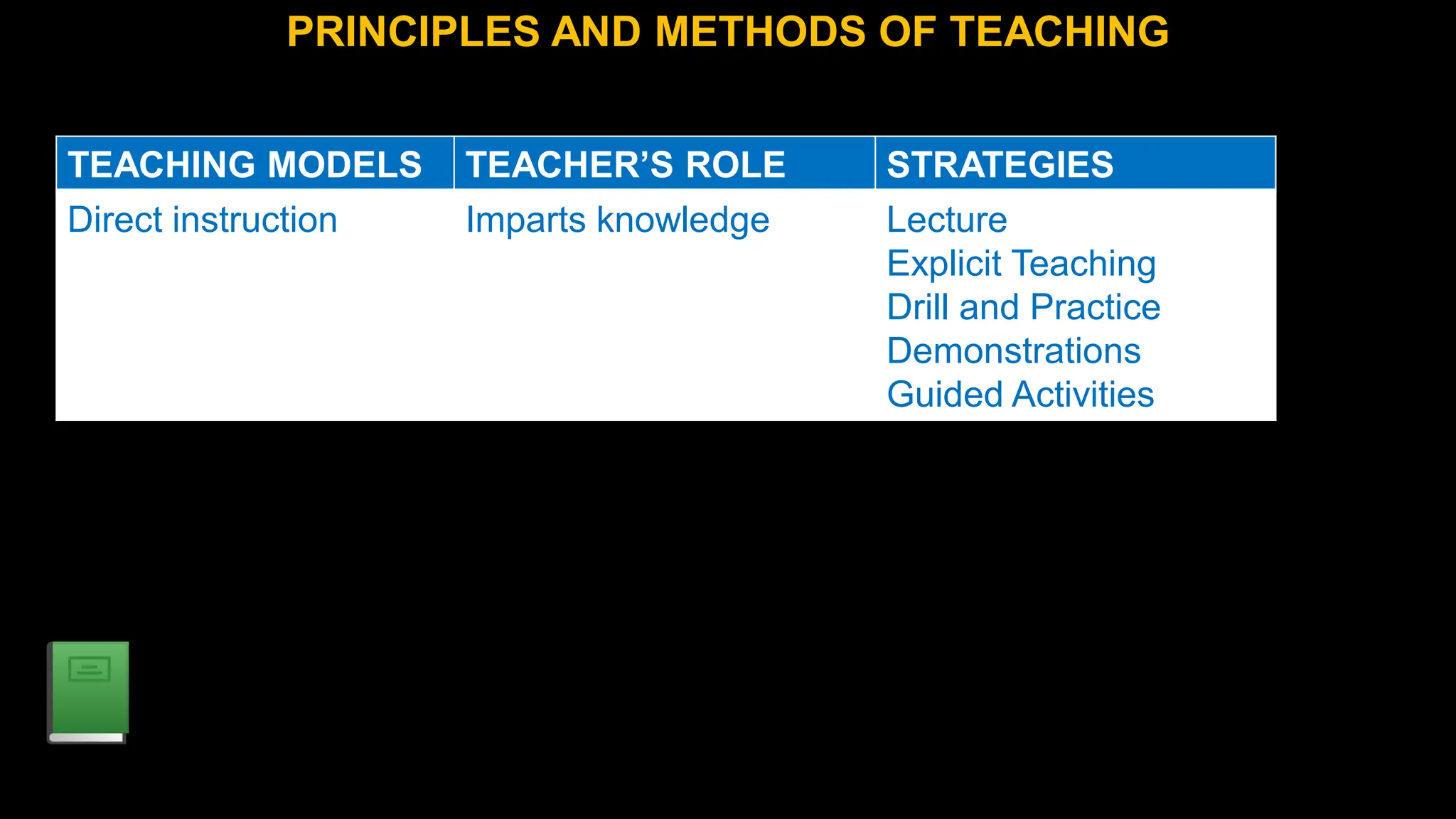
TEACHING MODELS TEACHER’S ROLE STRATEGIES
Direct instruction Imparts knowledge Lecture
Explicit Teaching
Drill and Practice
Demonstrations
Guided Activities
PRINCIPLES AND METHODS OF TEACHING
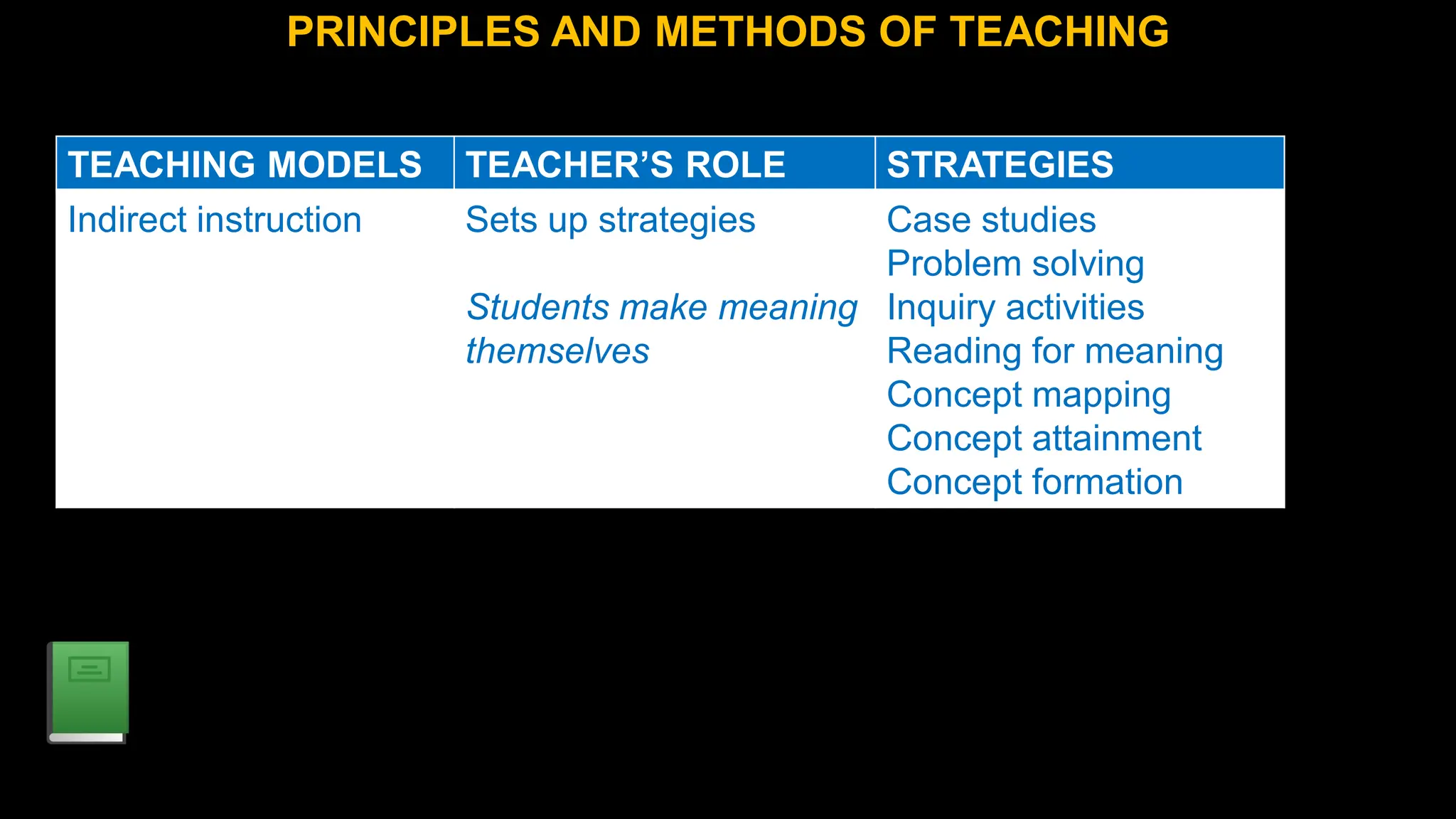
TEACHING MODELS TEACHER’S ROLE STRATEGIES
Indirect instruction Sets up strategies
Students make meaning
themselves
Case studies
Problem solving
Inquiry activities
Reading for meaning
Concept mapping
Concept attainment
Concept formation
PRINCIPLES AND METHODS OF TEACHING
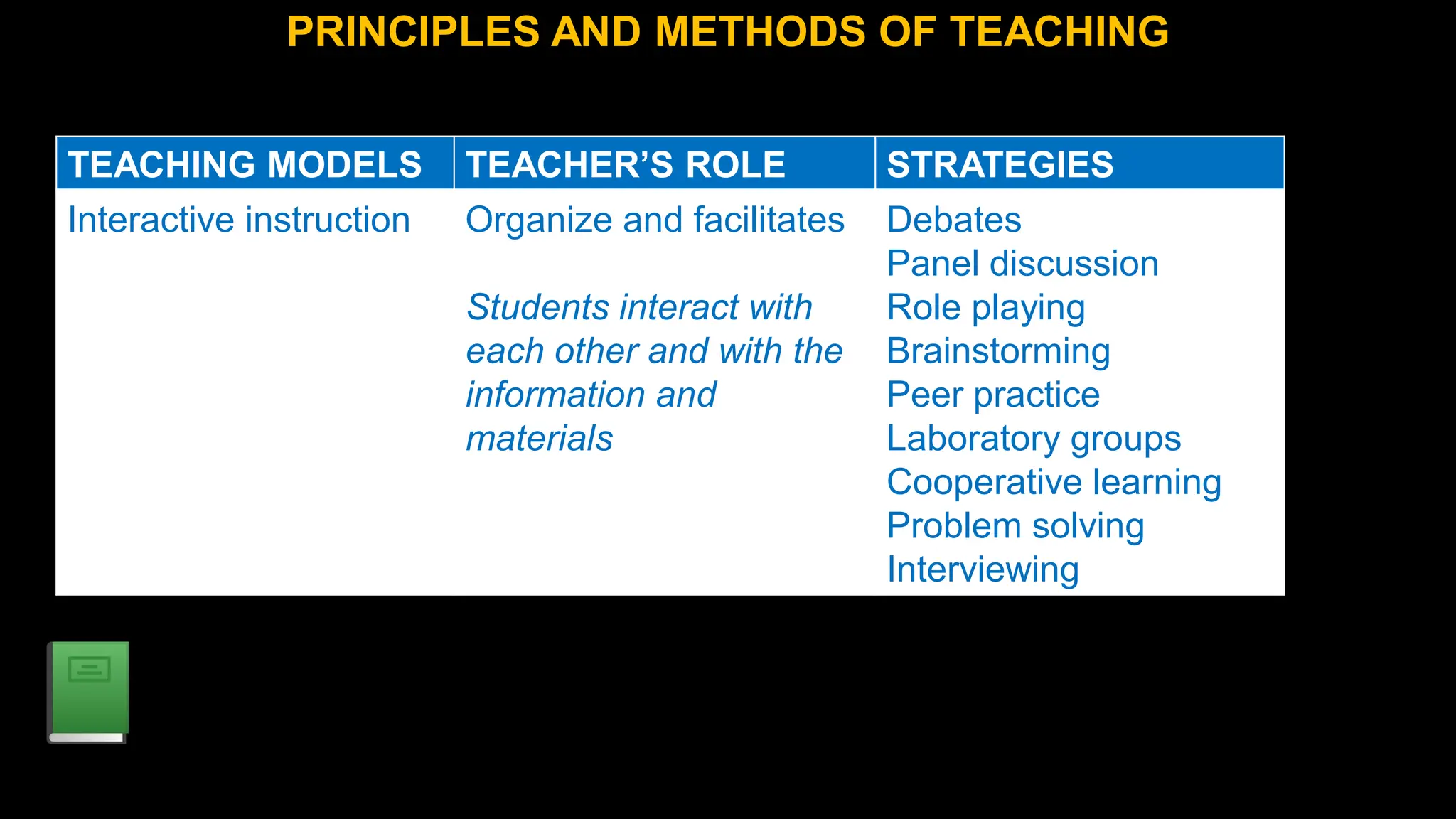
TEACHING MODELS TEACHER’S ROLE STRATEGIES
Interactive instruction Organize and facilitates
Students interact with
each other and with the
information and
materials
Debates
Panel discussion
Role playing
Brainstorming
Peer practice
Laboratory groups
Cooperative learning
Problem solving
Interviewing
PRINCIPLES AND METHODS OF TEACHING
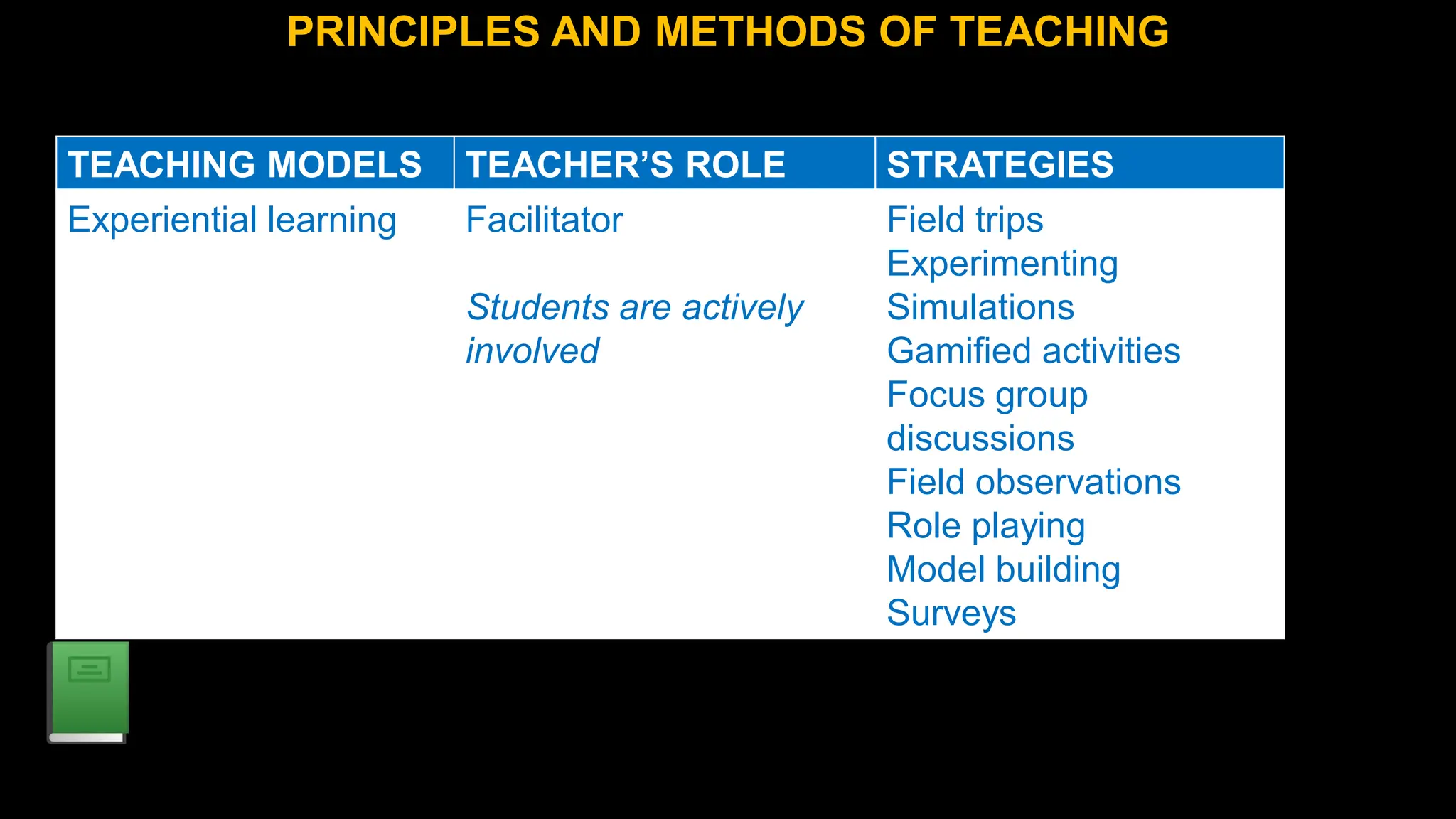
TEACHING MODELS TEACHER’S ROLE STRATEGIES
Experiential learning Facilitator
Students are actively
involved
Field trips
Experimenting
Simulations
Gamified activities
Focus group
discussions
Field observations
Role playing
Model building
Surveys
PRINCIPLES AND METHODS OF TEACHING
TEACHING MODELS TEACHER’S ROLE STRATEGIES
Independent Study Coach
Students interact with
the content more
CAI
Homework
Research Projects
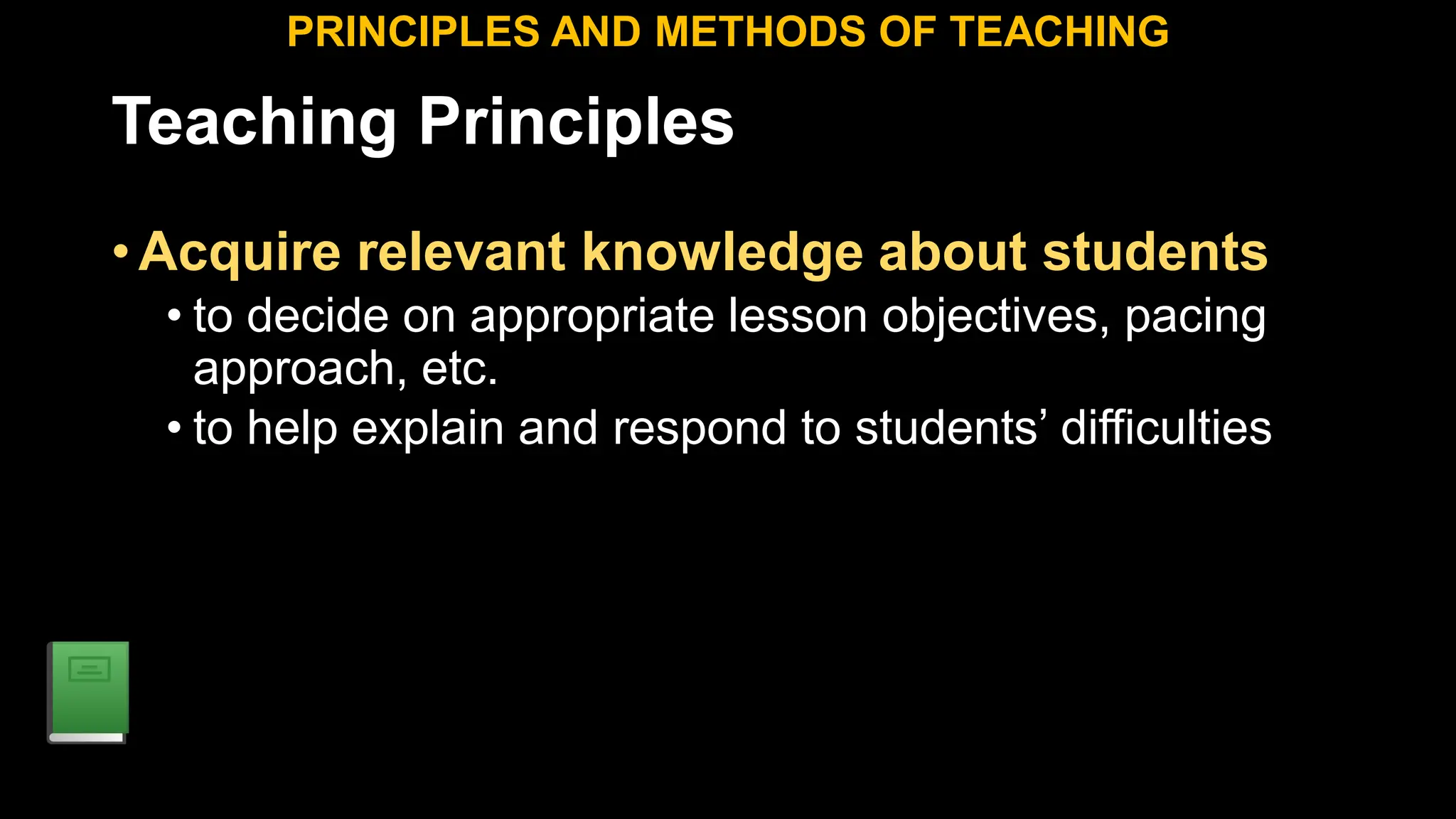
Teaching Principles
•Acquire relevant knowledge about students
• to decide on appropriate lesson objectives, pacing
approach, etc.
• to help explain and respond to students’ difficulties
PRINCIPLES AND METHODS OF TEACHING
Teaching Principles
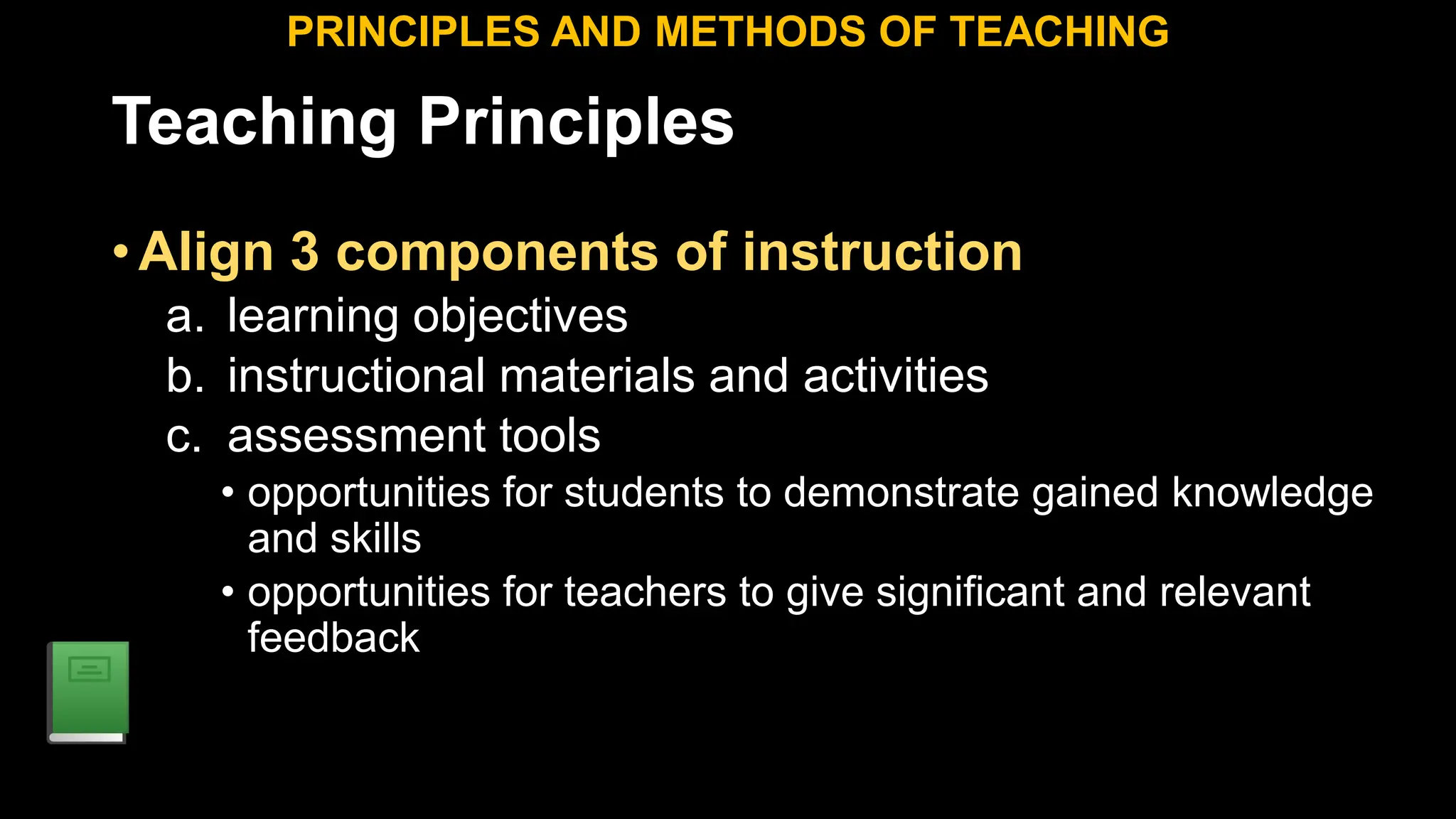
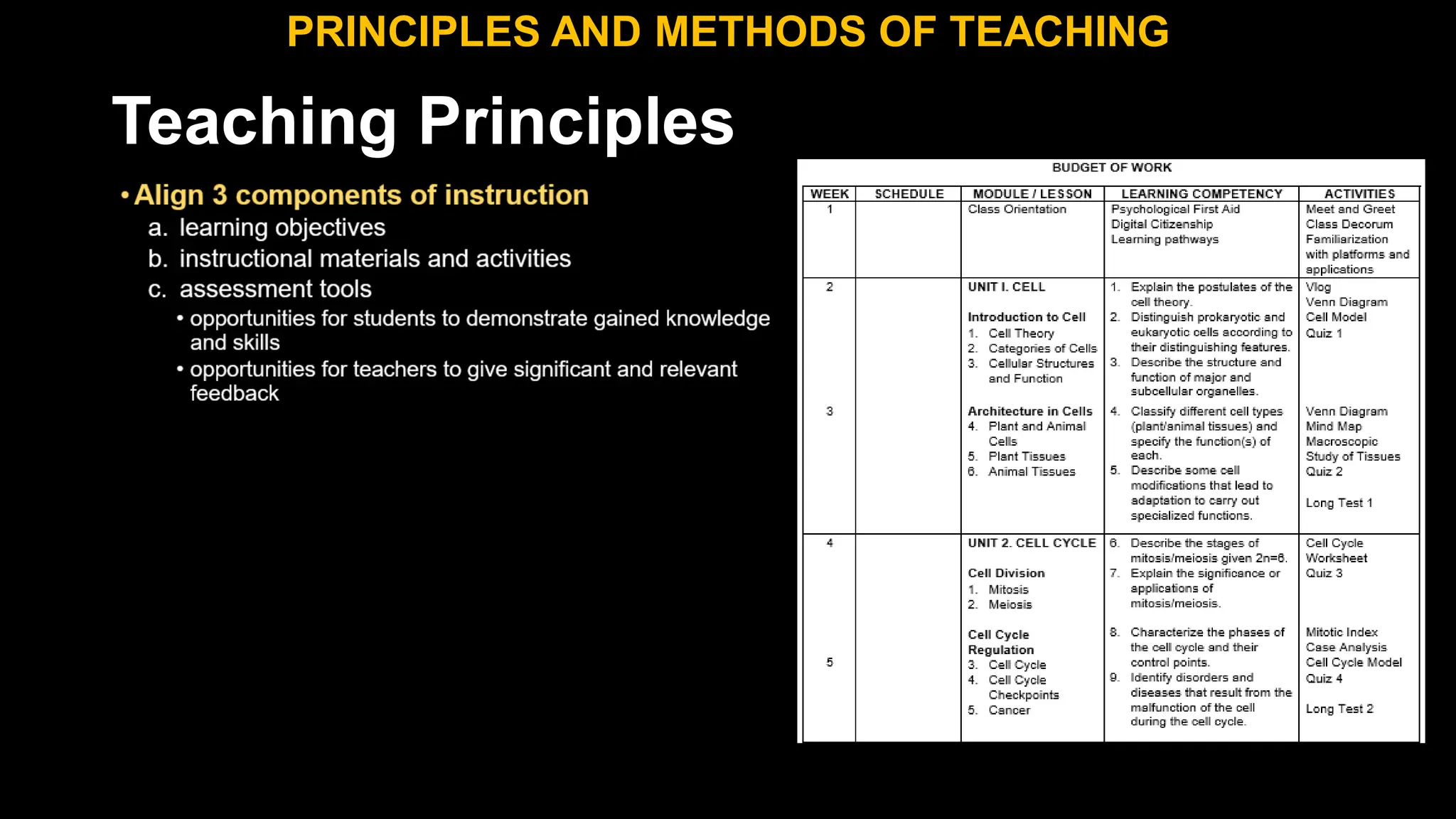
•Align 3 components of instruction
a. learning objectives
b. instructional materials and activities
c. assessment tools
• opportunities for students to demonstrate gained knowledge
and skills
• opportunities for teachers to give significant and relevant
feedback
PRINCIPLES AND METHODS OF TEACHING
Teaching Principles
PRINCIPLES AND METHODS OF TEACHING
Teaching Principles
•Articulate learning objectives and class rules for
productive learning environment.
•Know the subject matter.
PRINCIPLES AND METHODS OF TEACHING
Teaching Principles
PRINCIPLES AND METHODS OF TEACHING
Teaching Principles
•Actively involve learners considering their
capabilities and learning styles.
•Challenge learners to develop higher order
thinking skills and to apply what they have learned.
PRINCIPLES AND METHODS OF TEACHING
Teaching Principles
•Progressively refine teaching style based on
reflection and feedback.
•Establish and develop constructive and healthy
relationship with learners.
PRINCIPLES AND METHODS OF TEACHING
Teaching Principles
•Encourage “beyond the classroom”.
•Create and maintain a positive learning
environment.
PRINCIPLES AND METHODS OF TEACHING
Learning Principles
• Students’ prior knowledge can help or hinder learning.
• Students’ ways of organizing knowledge affects how
they learn and apply what they know.
PRINCIPLES AND METHODS OF TEACHING
Learning Principles
• Students’ motivation determines, directs and sustains
what they do to learn.
• Students develop mastery when they:
• acquire component skills
• practice integration of knowledge
• can determine when and how to apply knowledge
PRINCIPLES AND METHODS OF TEACHING
Learning Principles
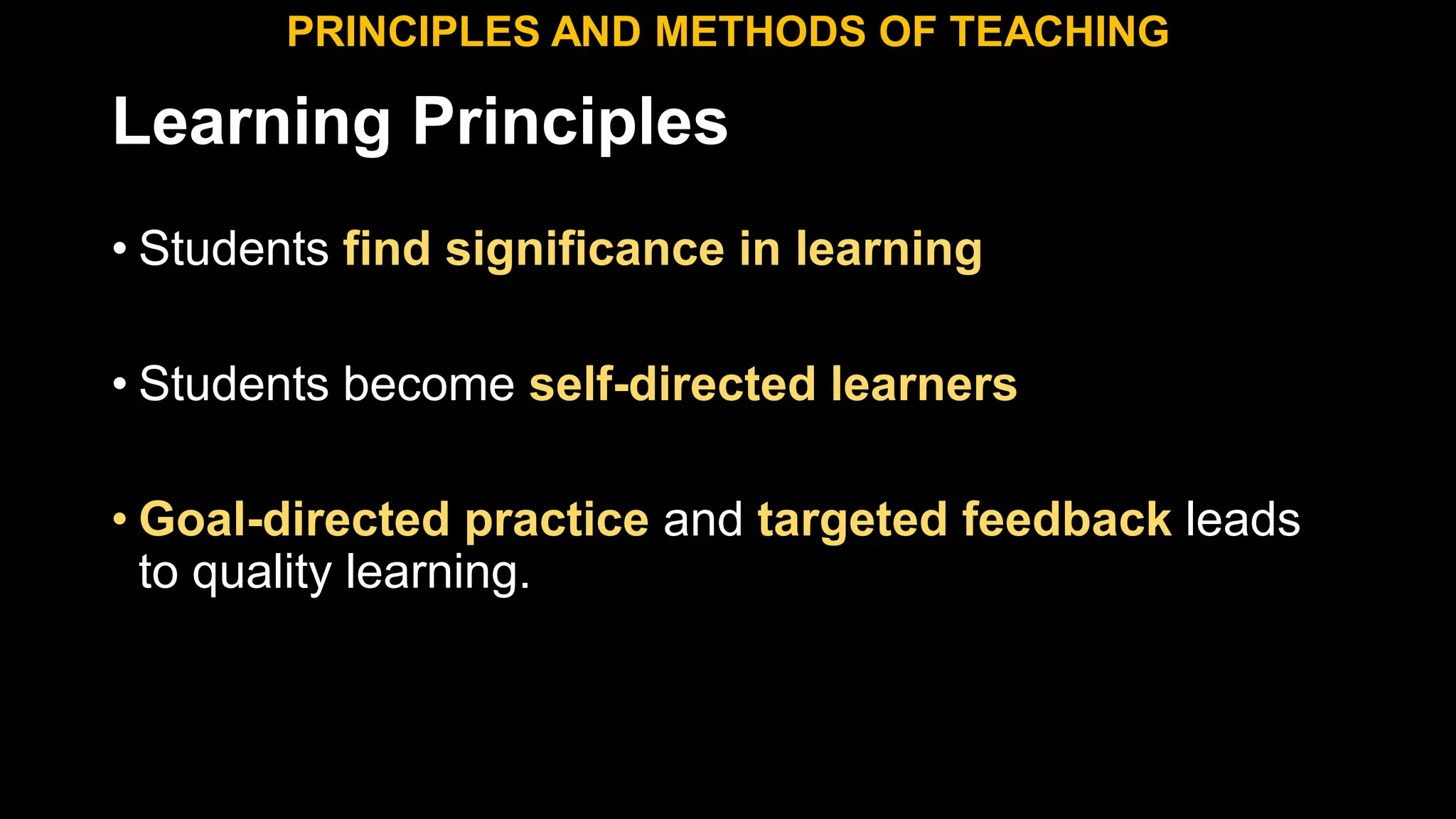
• Students find significance in learning
• Students become self-directed learners
• Goal-directed practice and targeted feedback leads
to quality learning.
PRINCIPLES AND METHODS OF TEACHING
Learning Principles
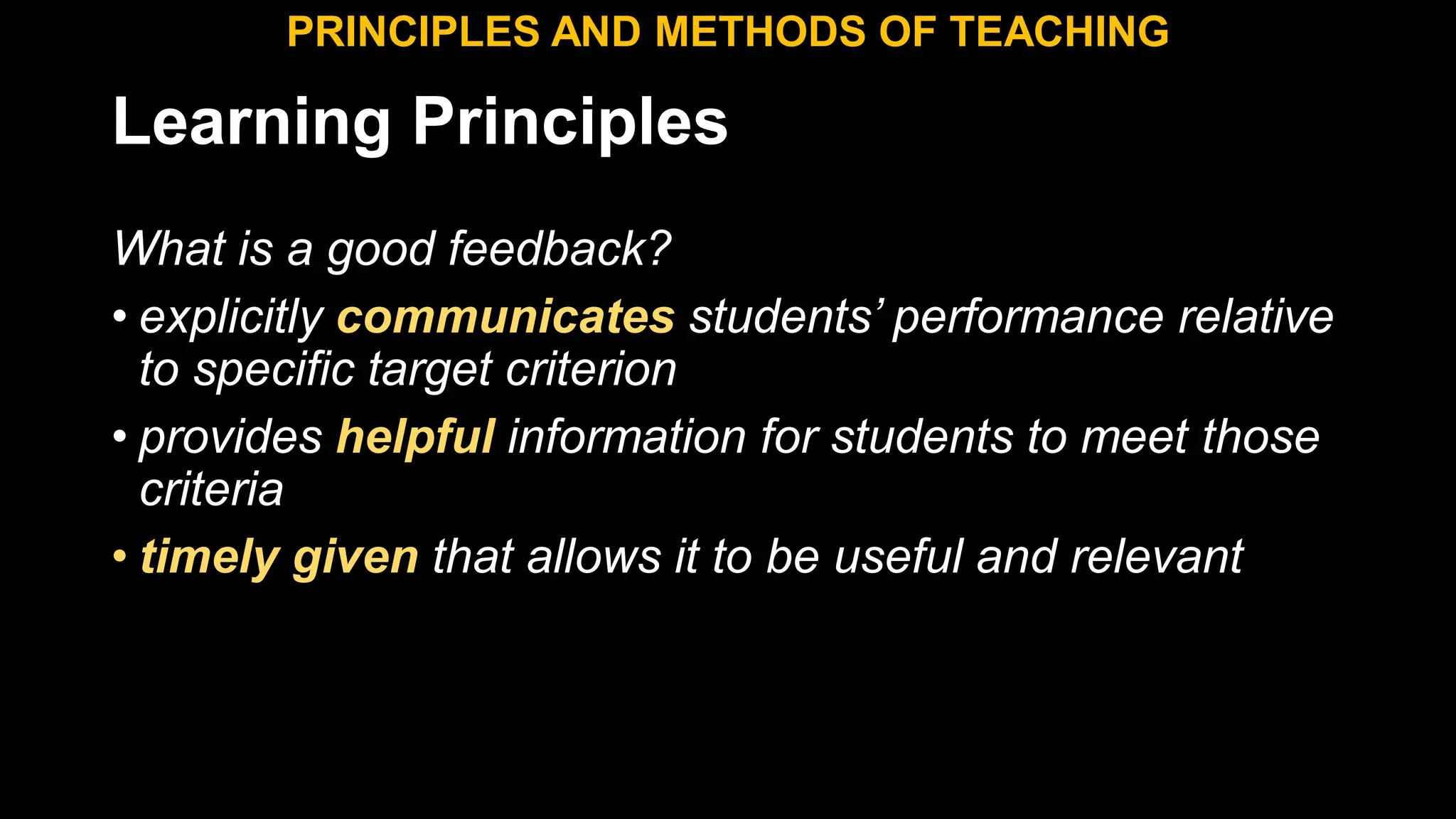
What is a good feedback?
• explicitly communicates students’ performance relative
to specific target criterion
• provides helpful information for students to meet those
criteria
• timely given that allows it to be useful and relevant
PRINCIPLES AND METHODS OF TEACHING
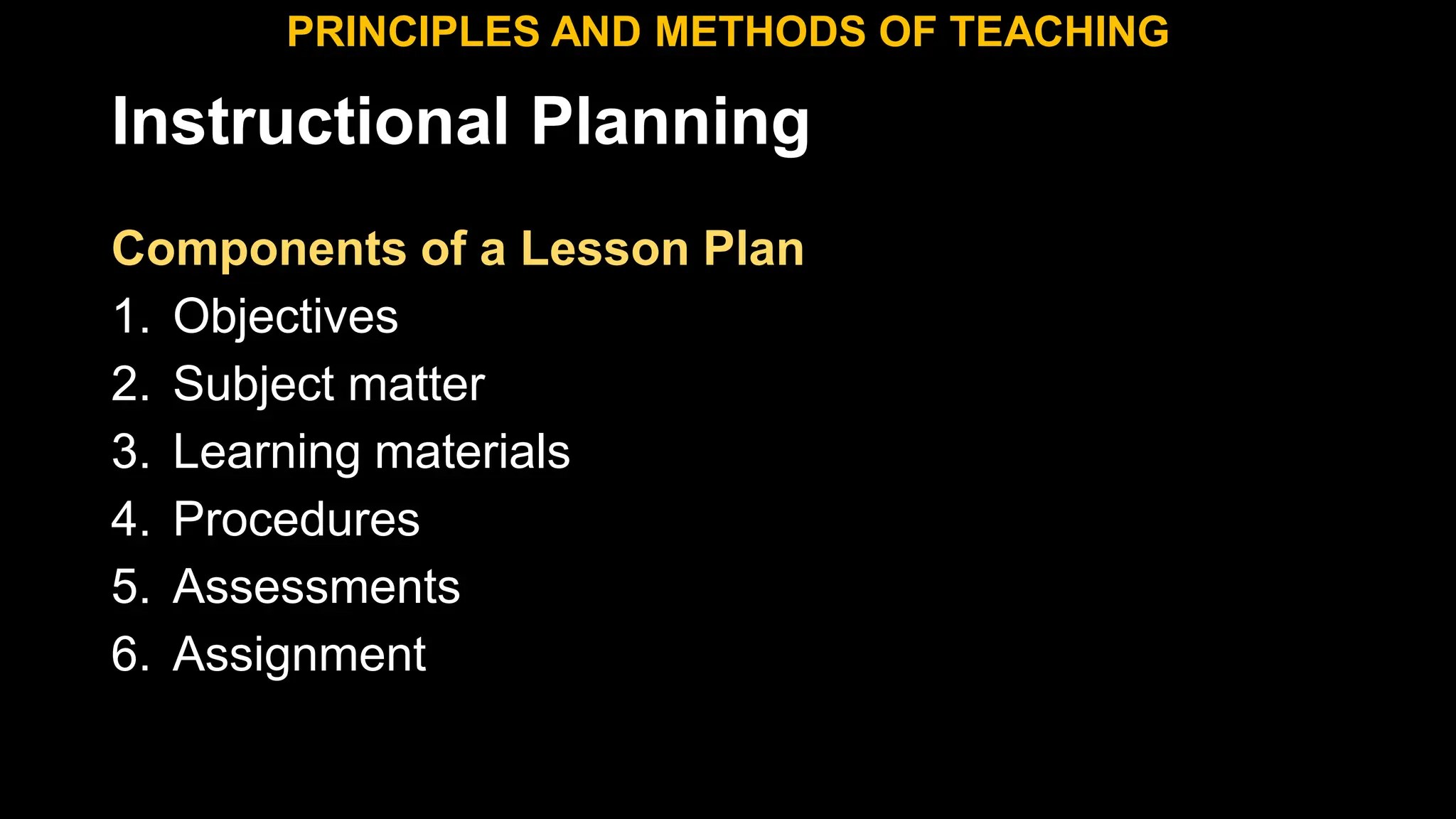
Instructional Planning
Components of a Lesson Plan
1. Objectives
2. Subject matter
3. Learning materials
4. Procedures
5. Assessments
6. Assignment
PRINCIPLES AND METHODS OF TEACHING
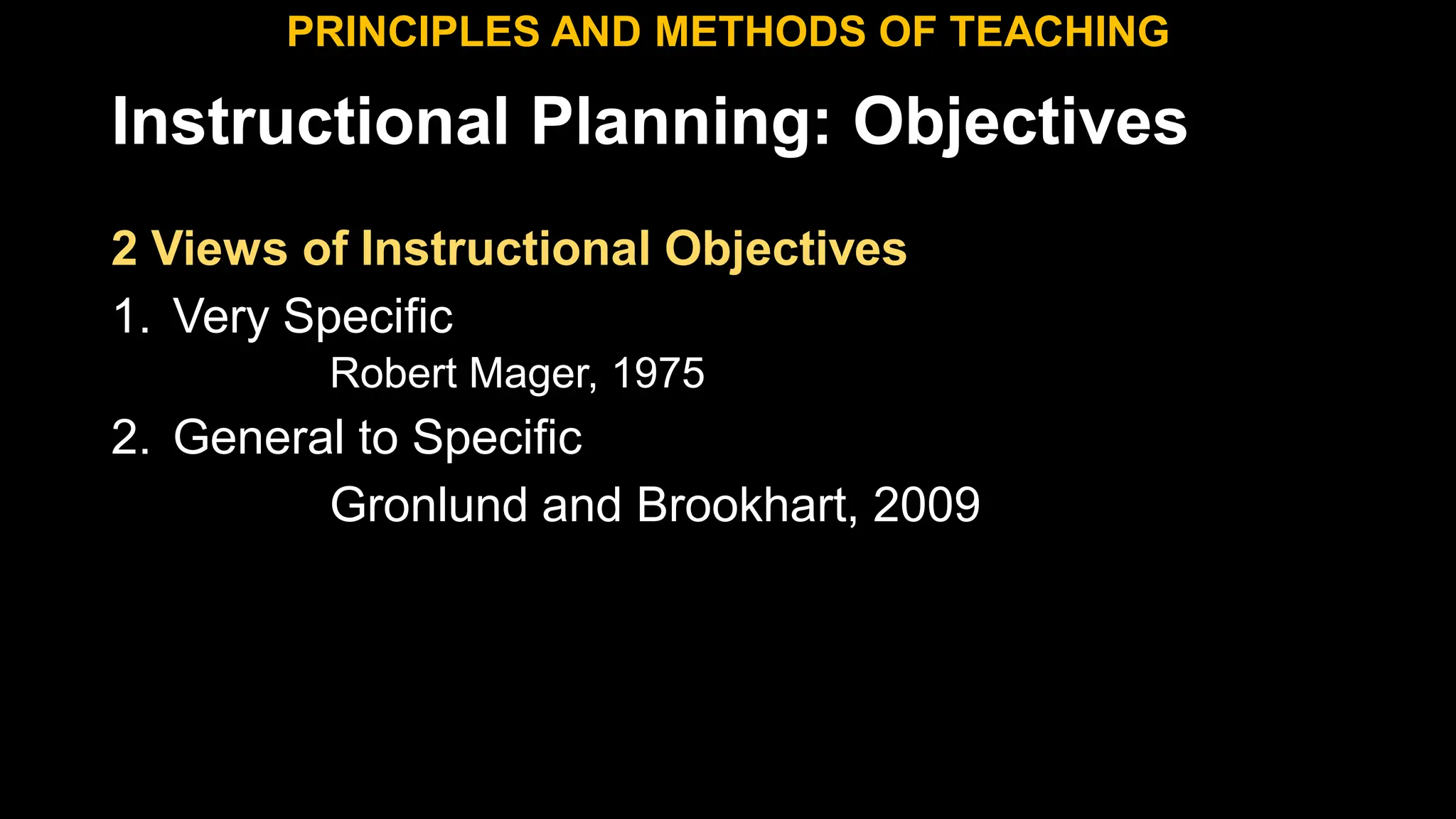
Instructional Planning: Objectives
2 Views of Instructional Objectives
1. Very Specific
Robert Mager, 1975
2. General to Specific
Gronlund and Brookhart, 2009
PRINCIPLES AND METHODS OF TEACHING
Instructional Planning: Objectives
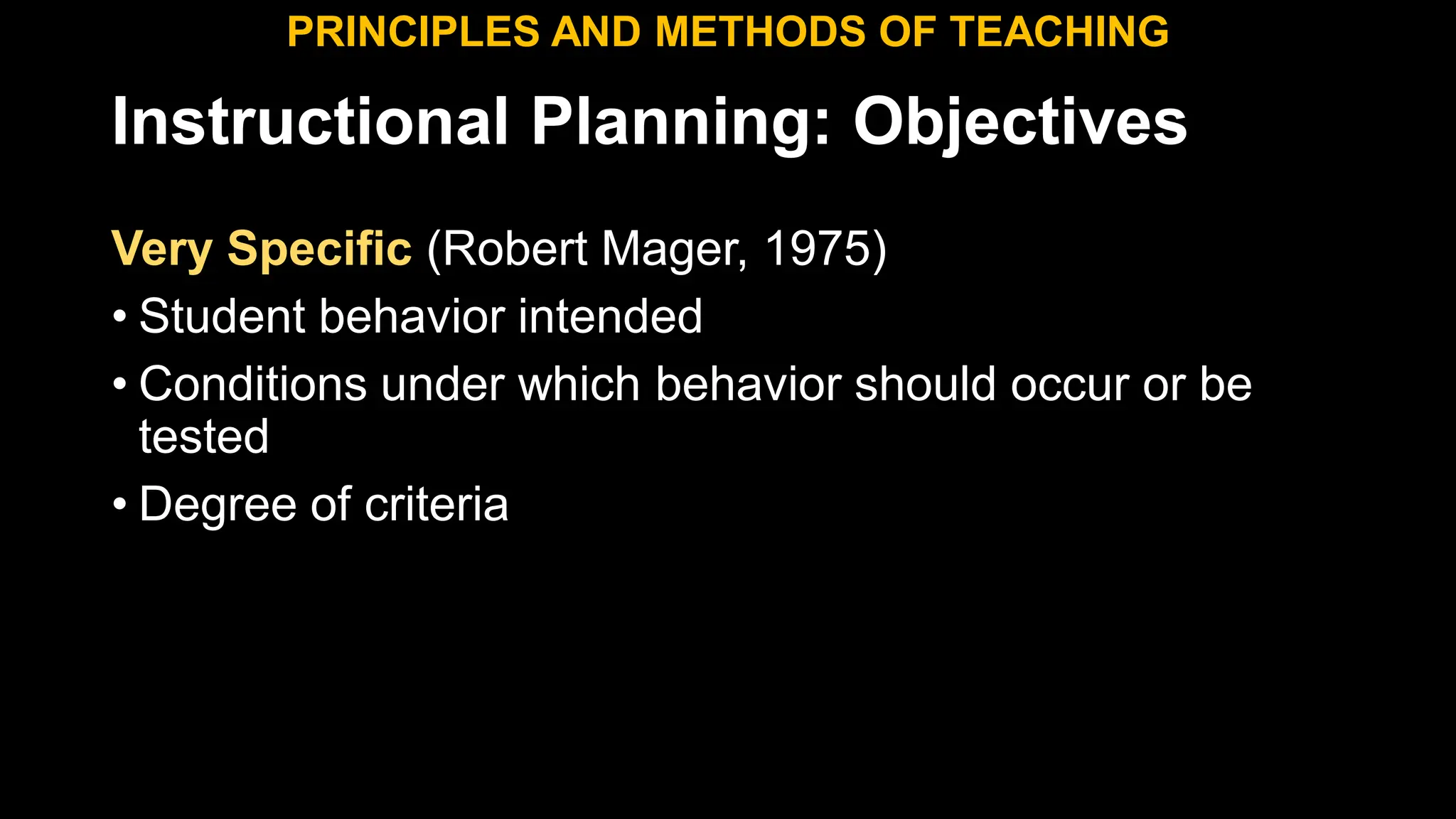
Very Specific (Robert Mager, 1975)
• Student behavior intended
• Conditions under which behavior should occur or be
tested
• Degree of criteria
PRINCIPLES AND METHODS OF TEACHING
Instructional Planning: Objectives
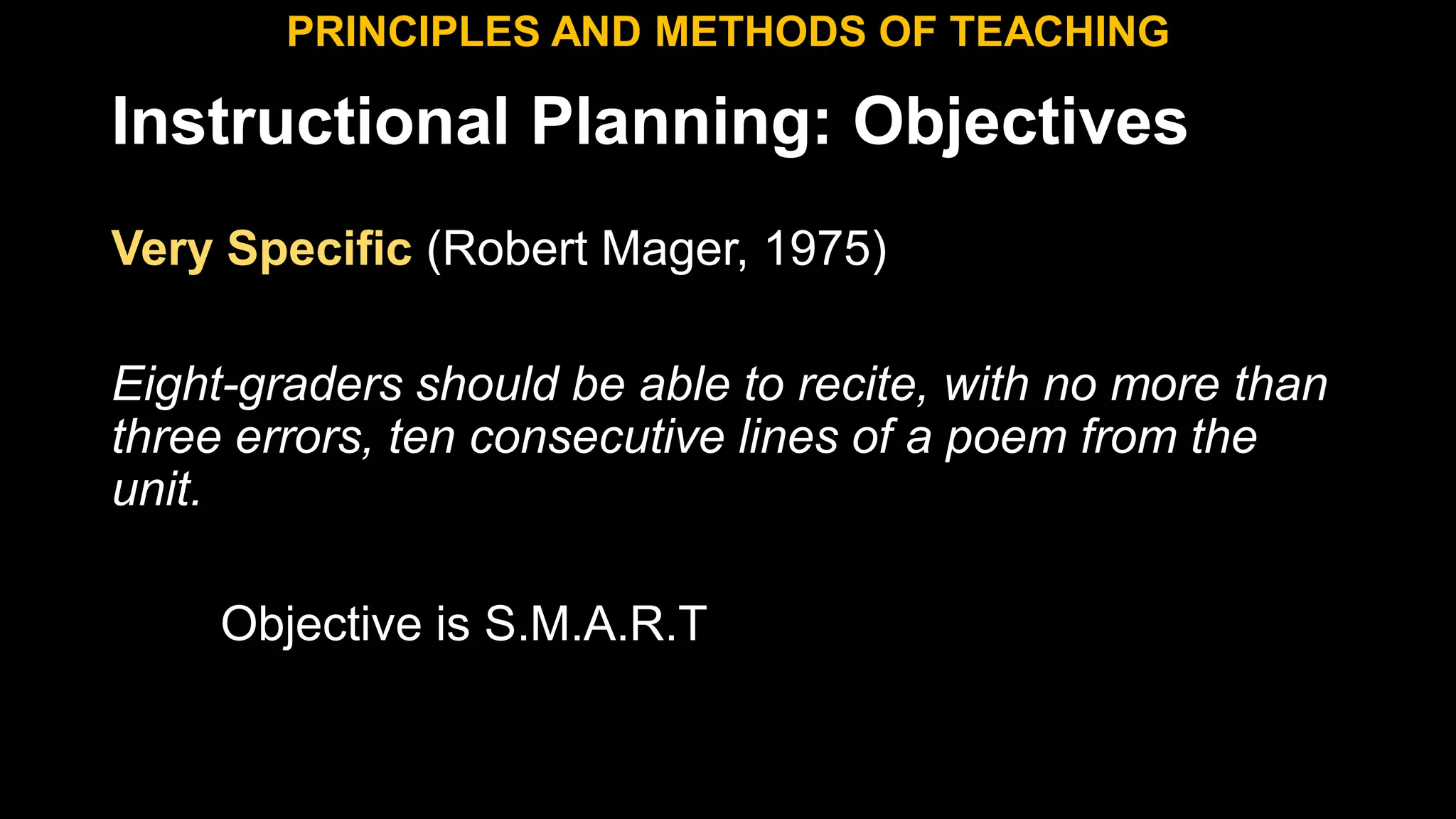
Very Specific (Robert Mager, 1975)
Eight-graders should be able to recite, with no more than
three errors, ten consecutive lines of a poem from the
unit.
Objective is S.M.A.R.T
PRINCIPLES AND METHODS OF TEACHING
Instructional Planning: Objectives
Very Specific (Robert Mager, 1975)
Eight-graders should be able to recite, with no more than
three errors, ten consecutive lines of a poem from the
unit.
PRINCIPLES AND METHODS OF TEACHING
Instructional Planning: Objectives
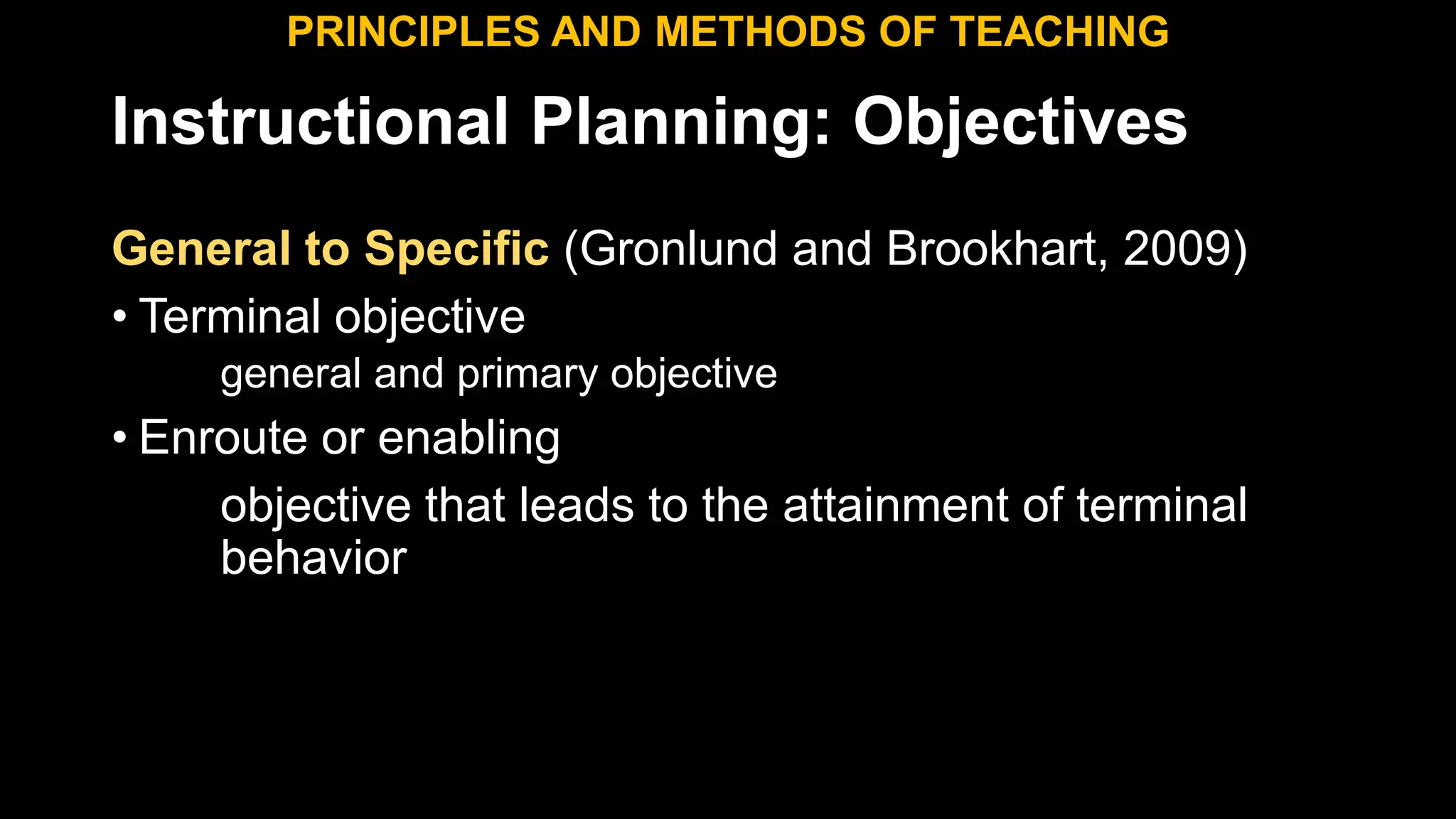
General to Specific (Gronlund and Brookhart, 2009)
• Terminal objective
general and primary objective
• Enroute or enabling
objective that leads to the attainment of terminal
behavior
PRINCIPLES AND METHODS OF TEACHING
Instructional Planning: Objectives
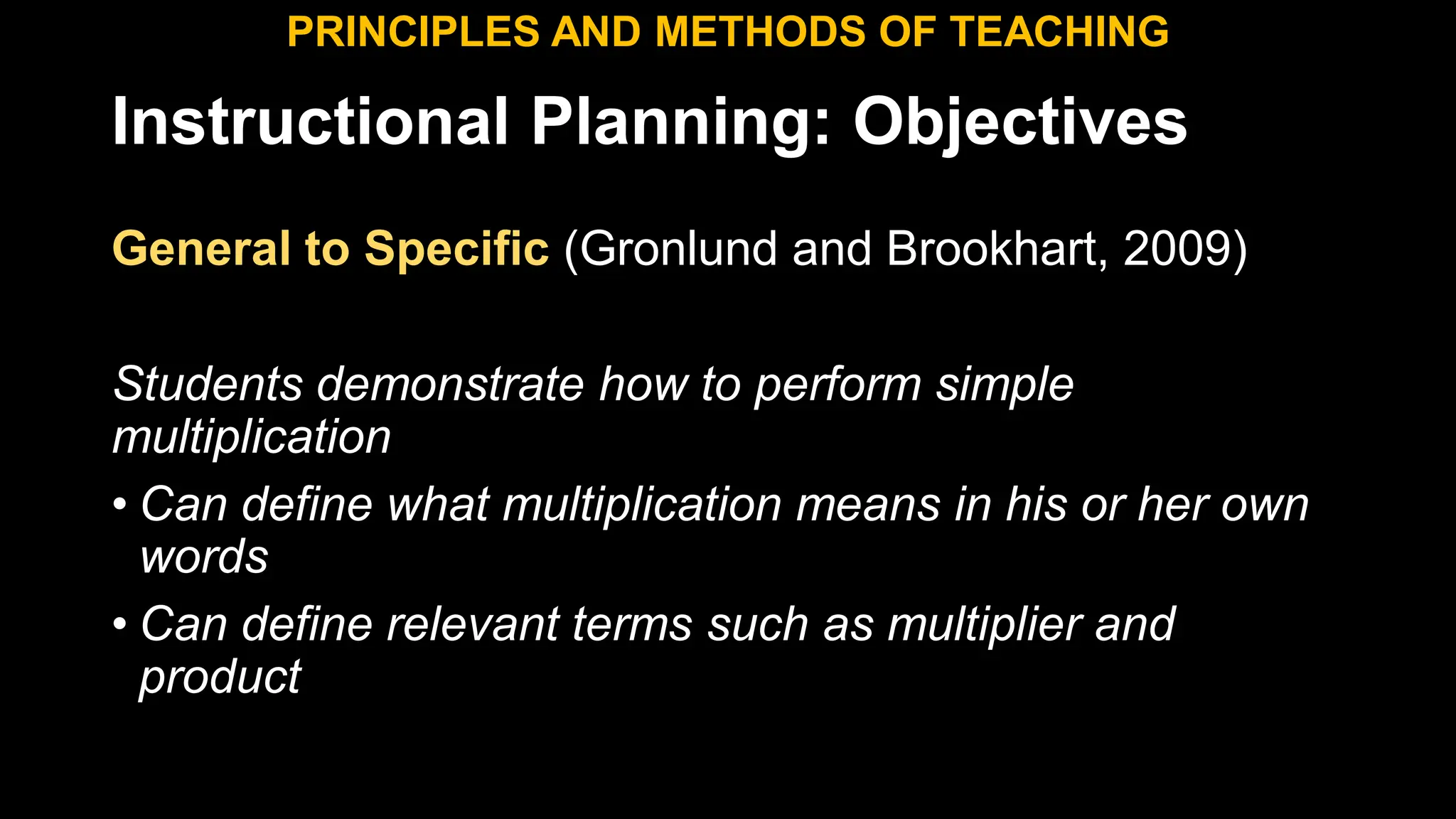
General to Specific (Gronlund and Brookhart, 2009)
Students demonstrate how to perform simple
multiplication
• Can define what multiplication means in his or her own
words
• Can define relevant terms such as multiplier and
product
PRINCIPLES AND METHODS OF TEACHING
Instructional Planning: Objectives
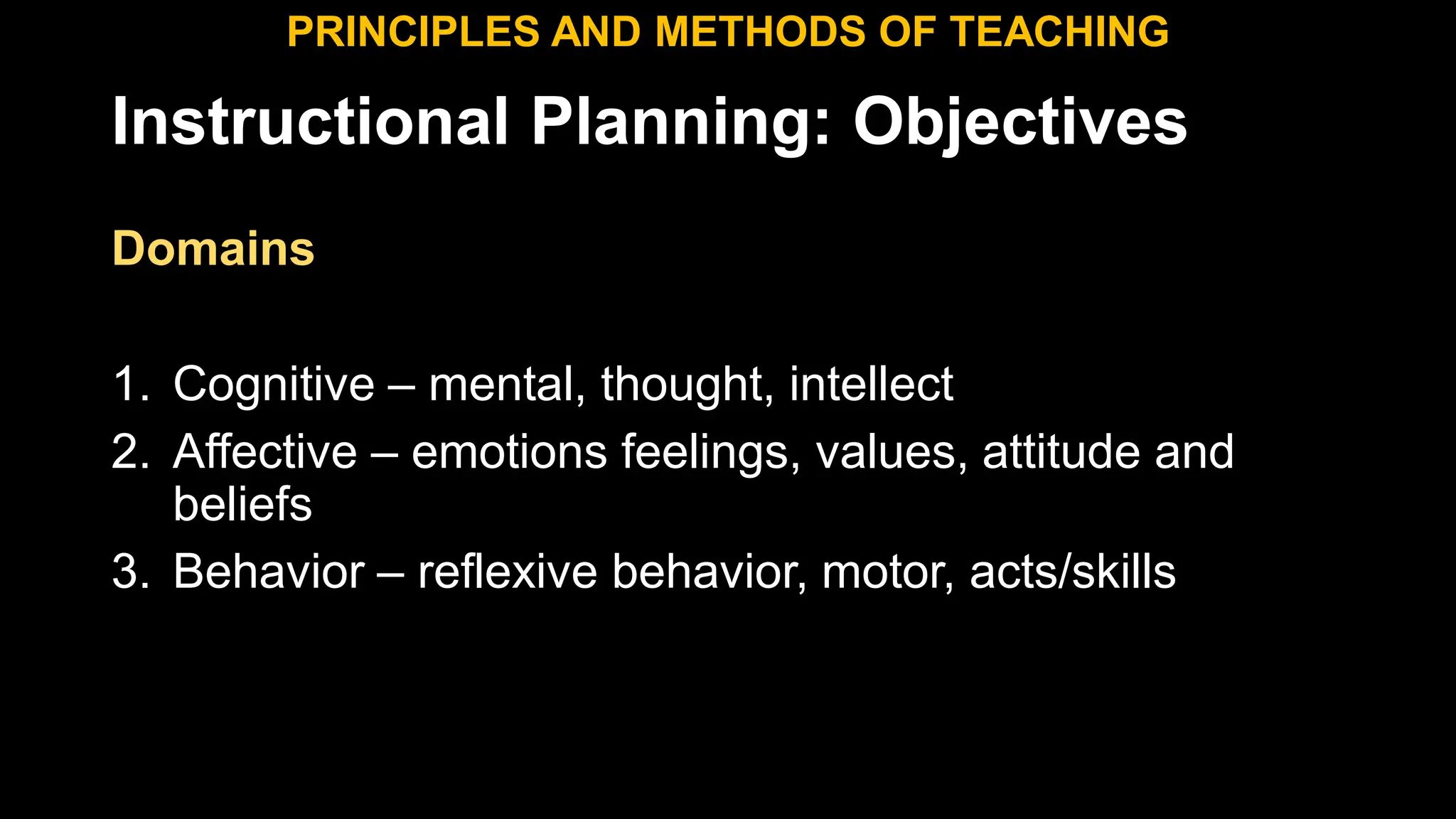
Domains
1. Cognitive – mental, thought, intellect
2. Affective – emotions feelings, values, attitude and
beliefs
3. Behavior – reflexive behavior, motor, acts/skills
PRINCIPLES AND METHODS OF TEACHING
Instructional Planning: Objectives
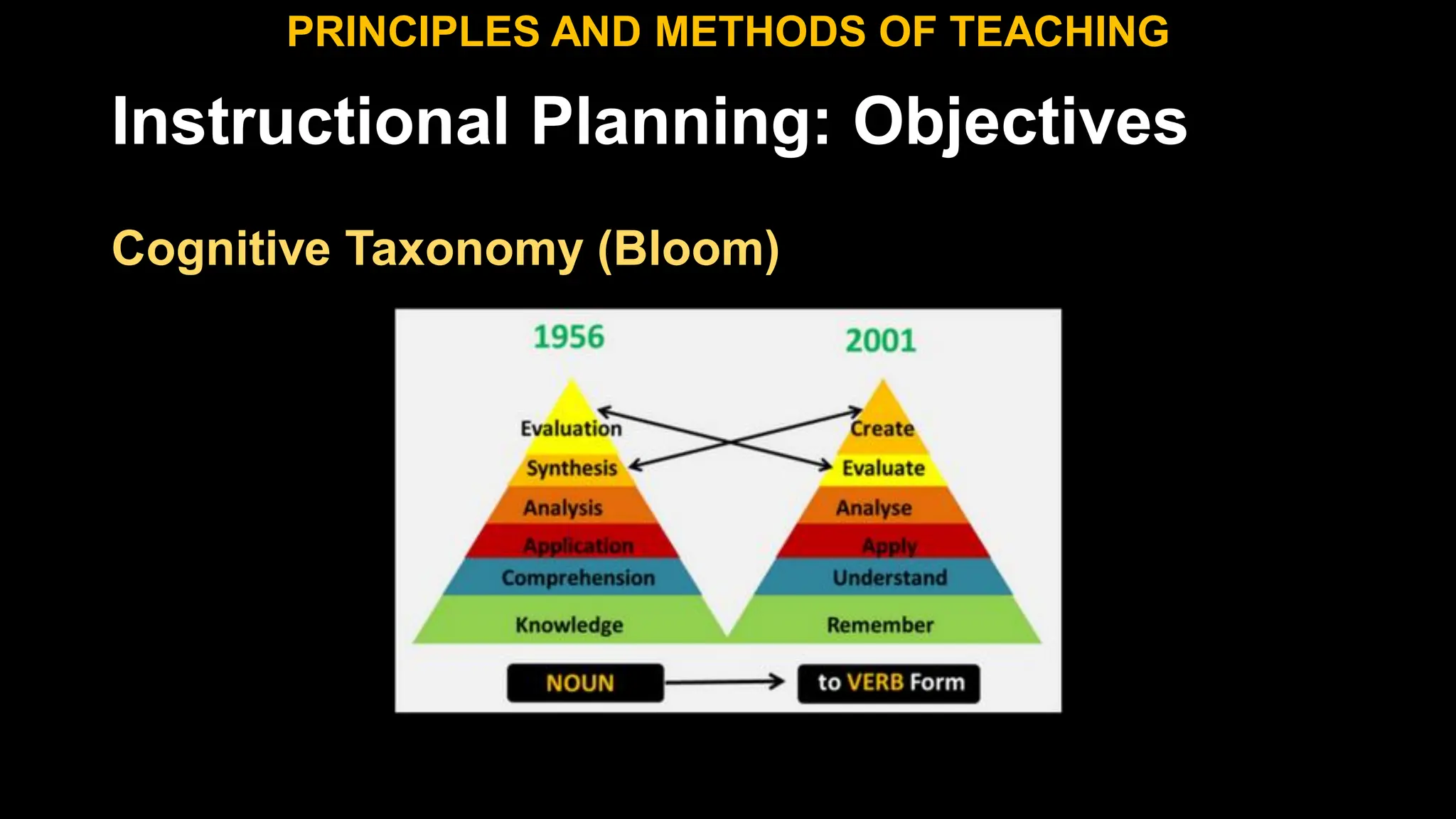
Cognitive Taxonomy (Bloom)
PRINCIPLES AND METHODS OF TEACHING
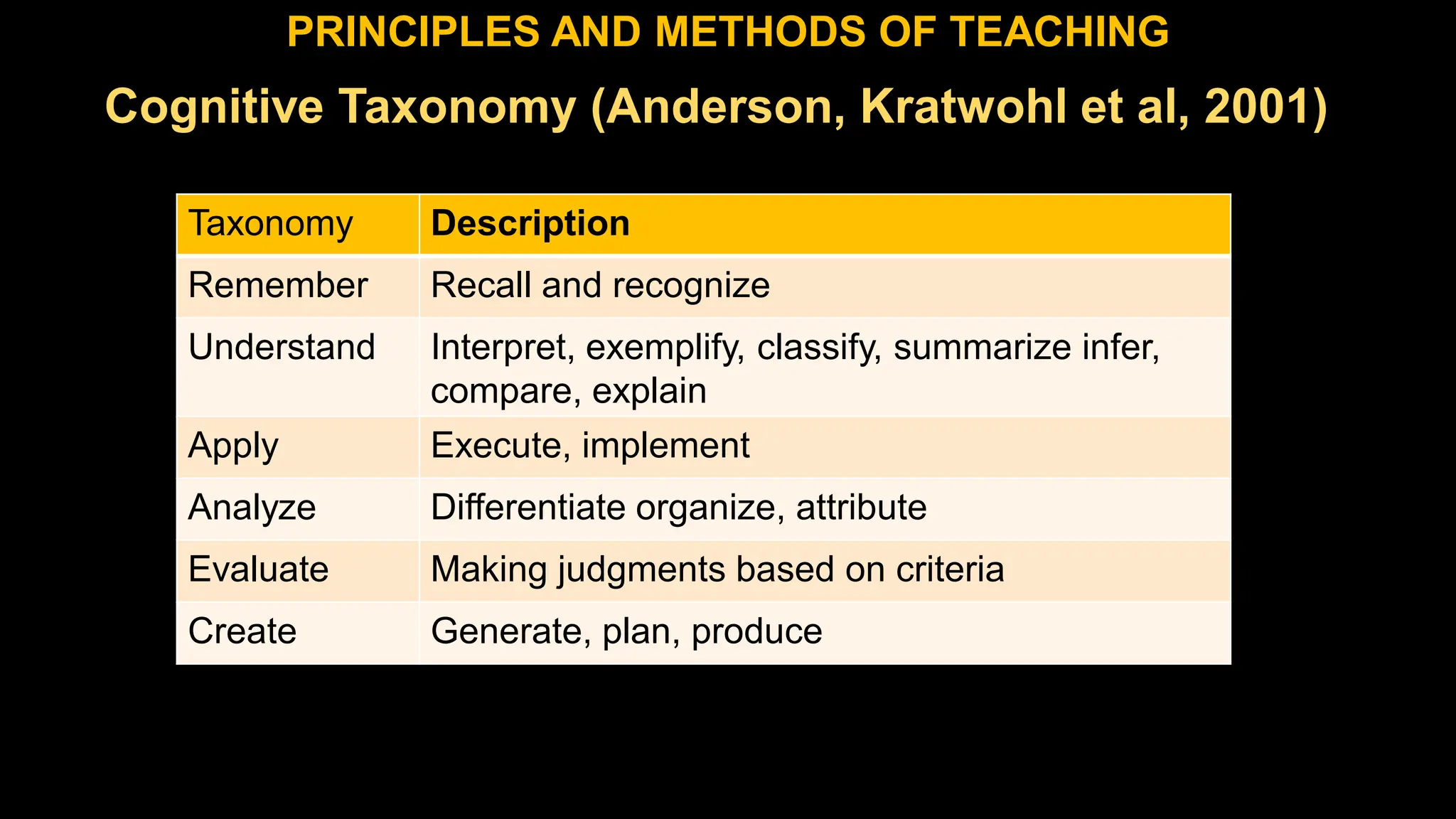
Cognitive Taxonomy (Anderson, Kratwohl et al, 2001)
PRINCIPLES AND METHODS OF TEACHING
Taxonomy Description
Remember Recall and recognize
Understand Interpret, exemplify, classify, summarize infer,
compare, explain
Apply Execute, implement
Analyze Differentiate organize, attribute
Evaluate Making judgments based on criteria
Create Generate, plan, produce
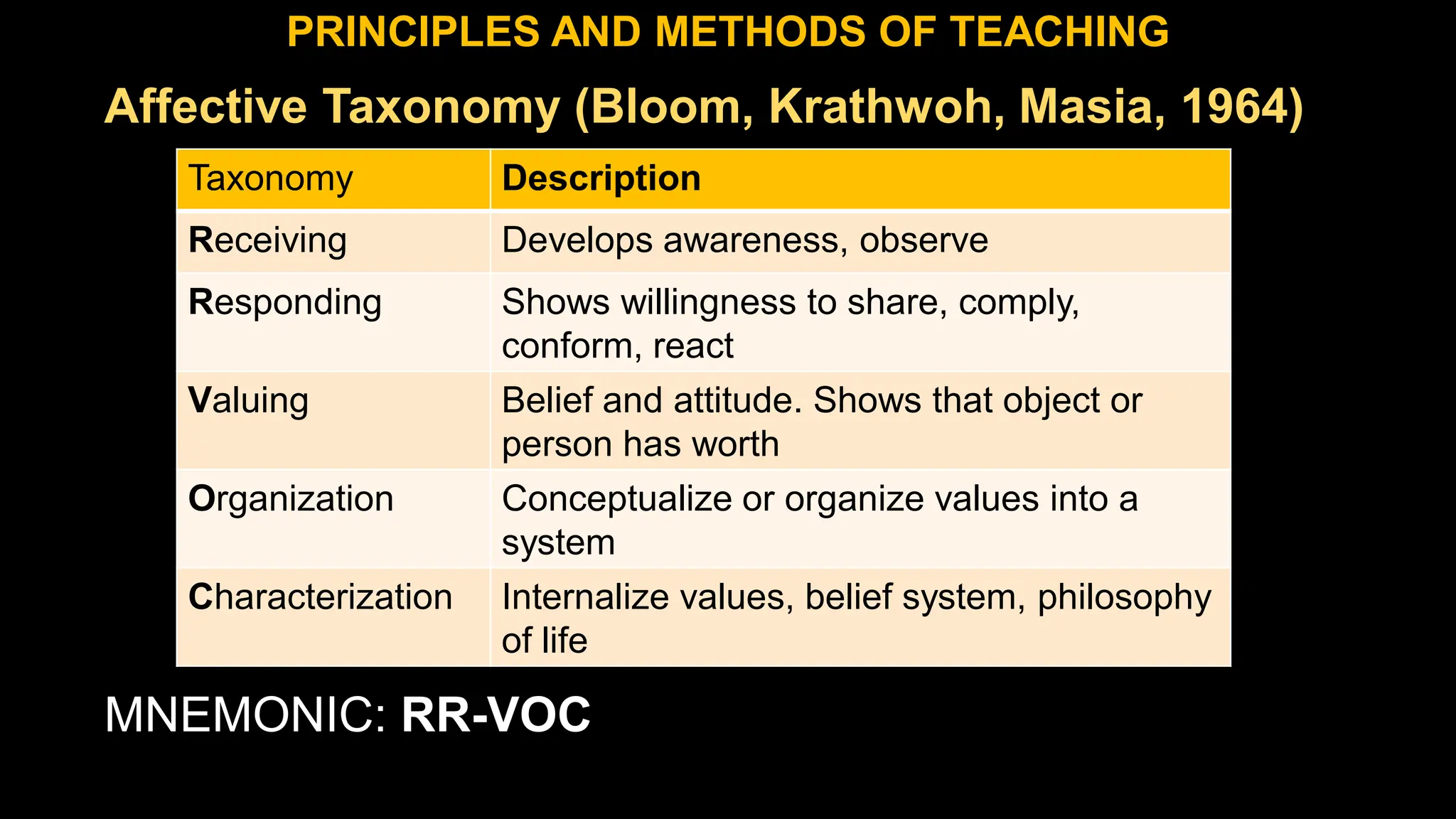
Affective Taxonomy (Bloom, Krathwoh, Masia, 1964)
MNEMONIC: RR-VOC
PRINCIPLES AND METHODS OF TEACHING
Taxonomy Description
Receiving Develops awareness, observe
Responding Shows willingness to share, comply,
conform, react
Valuing Belief and attitude. Shows that object or
person has worth
Organization Conceptualize or organize values into a
system
Characterization Internalize values, belief system, philosophy
of life
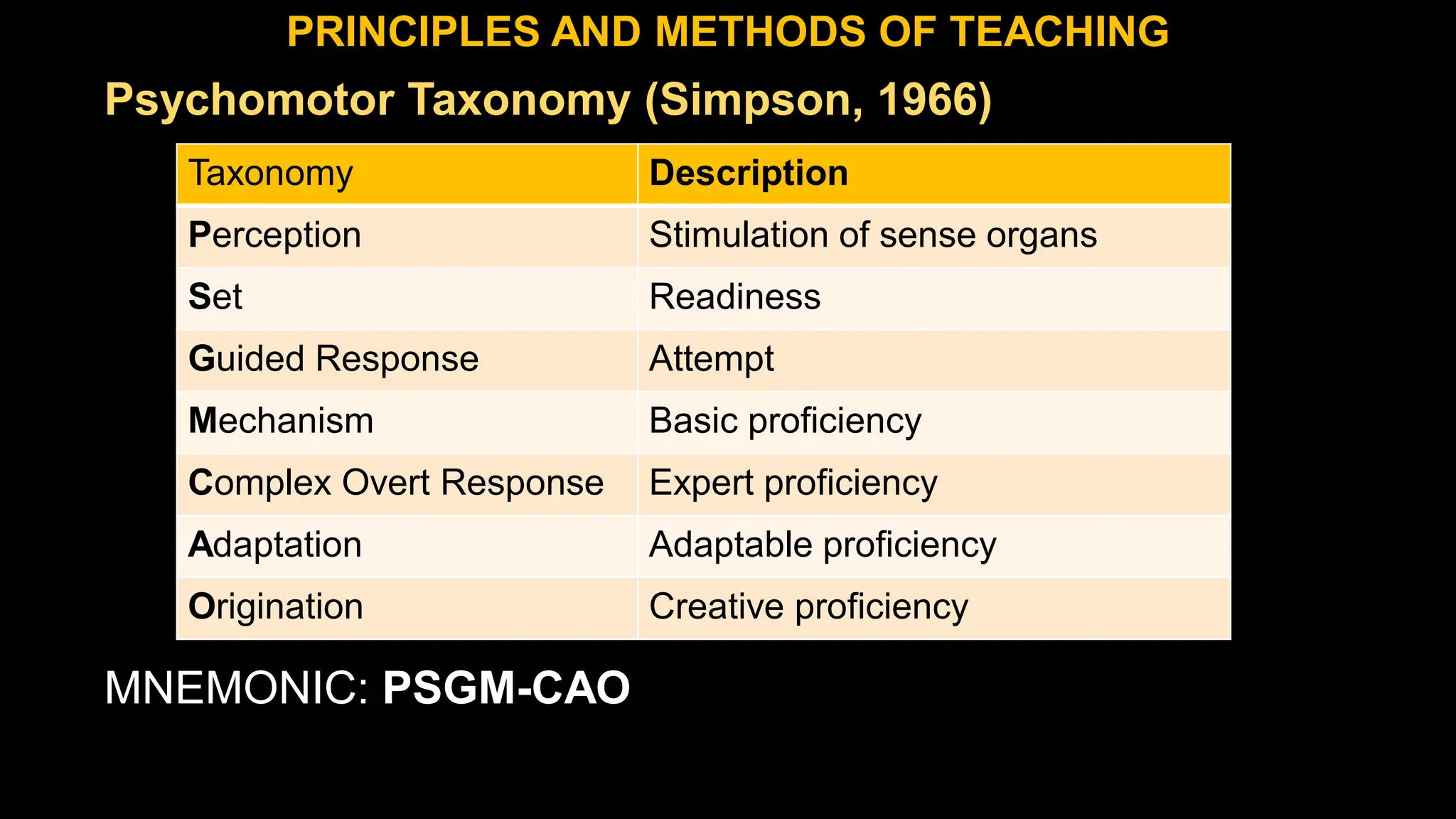
Psychomotor Taxonomy (Simpson, 1966)
MNEMONIC: PSGM-CAO
PRINCIPLES AND METHODS OF TEACHING
Taxonomy Description
Perception Stimulation of sense organs
Set Readiness
Guided Response Attempt
Mechanism Basic proficiency
Complex Overt Response Expert proficiency
Adaptation Adaptable proficiency
Origination Creative proficiency
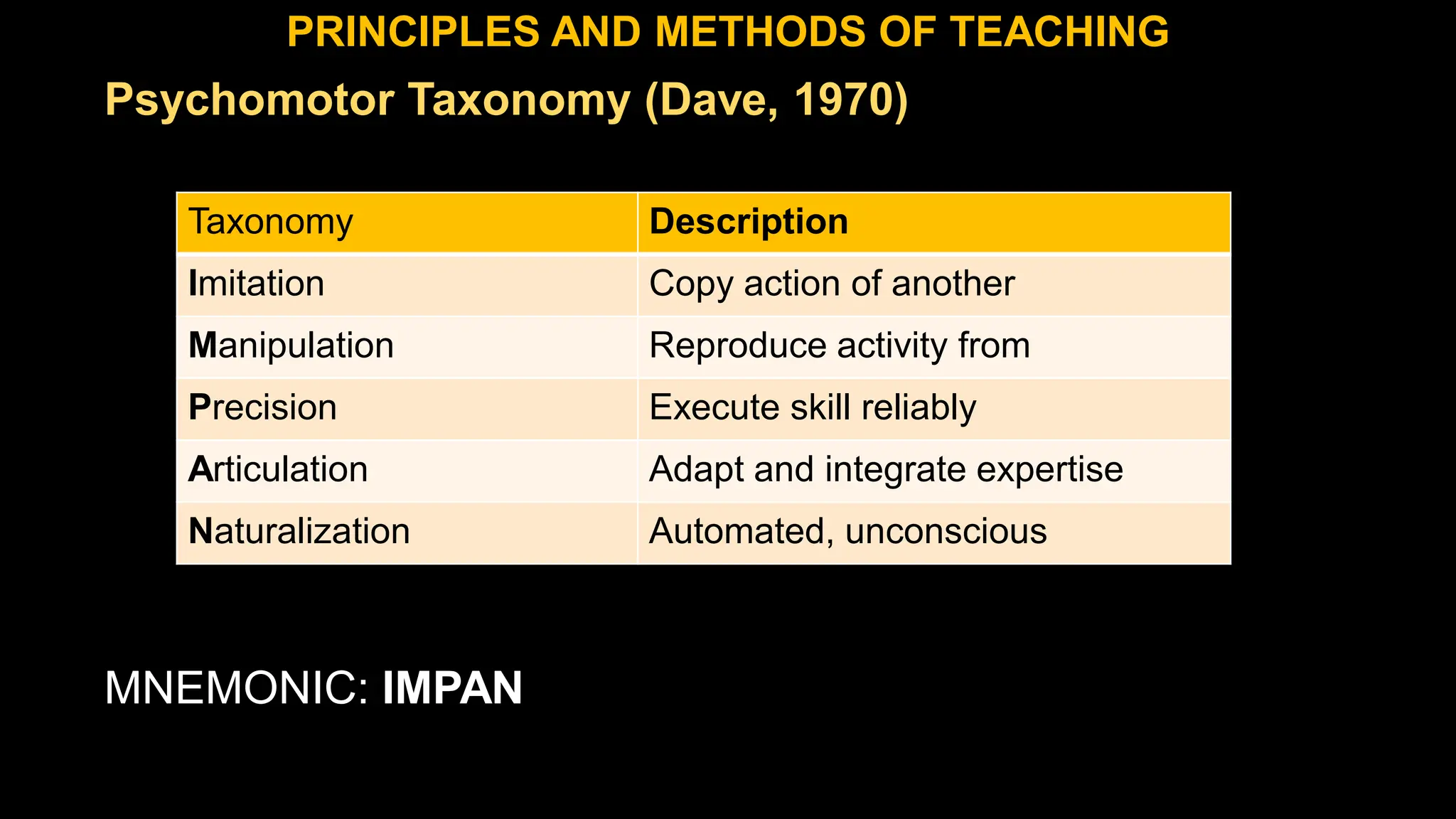
Psychomotor Taxonomy (Dave, 1970)
MNEMONIC: IMPAN
PRINCIPLES AND METHODS OF TEACHING
Taxonomy Description
Imitation Copy action of another
Manipulation Reproduce activity from
Precision Execute skill reliably
Articulation Adapt and integrate expertise
Naturalization Automated, unconscious
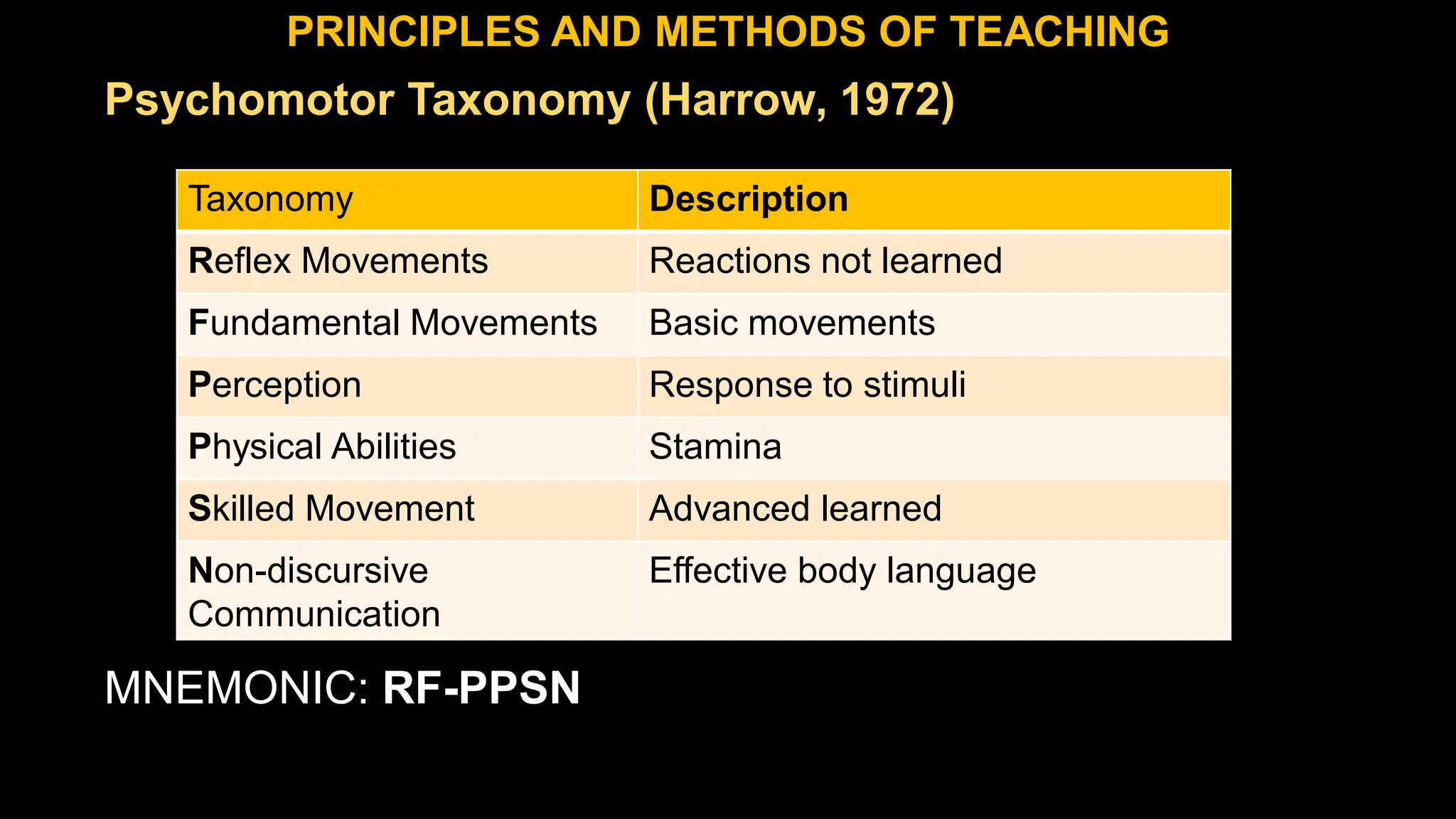
Psychomotor Taxonomy (Harrow, 1972)
MNEMONIC: RF-PPSN
PRINCIPLES AND METHODS OF TEACHING
Taxonomy Description
Reflex Movements Reactions not learned
Fundamental Movements Basic movements
Perception Response to stimuli
Physical Abilities Stamina
Skilled Movement Advanced learned
Non-discursive
Communication
Effective body language
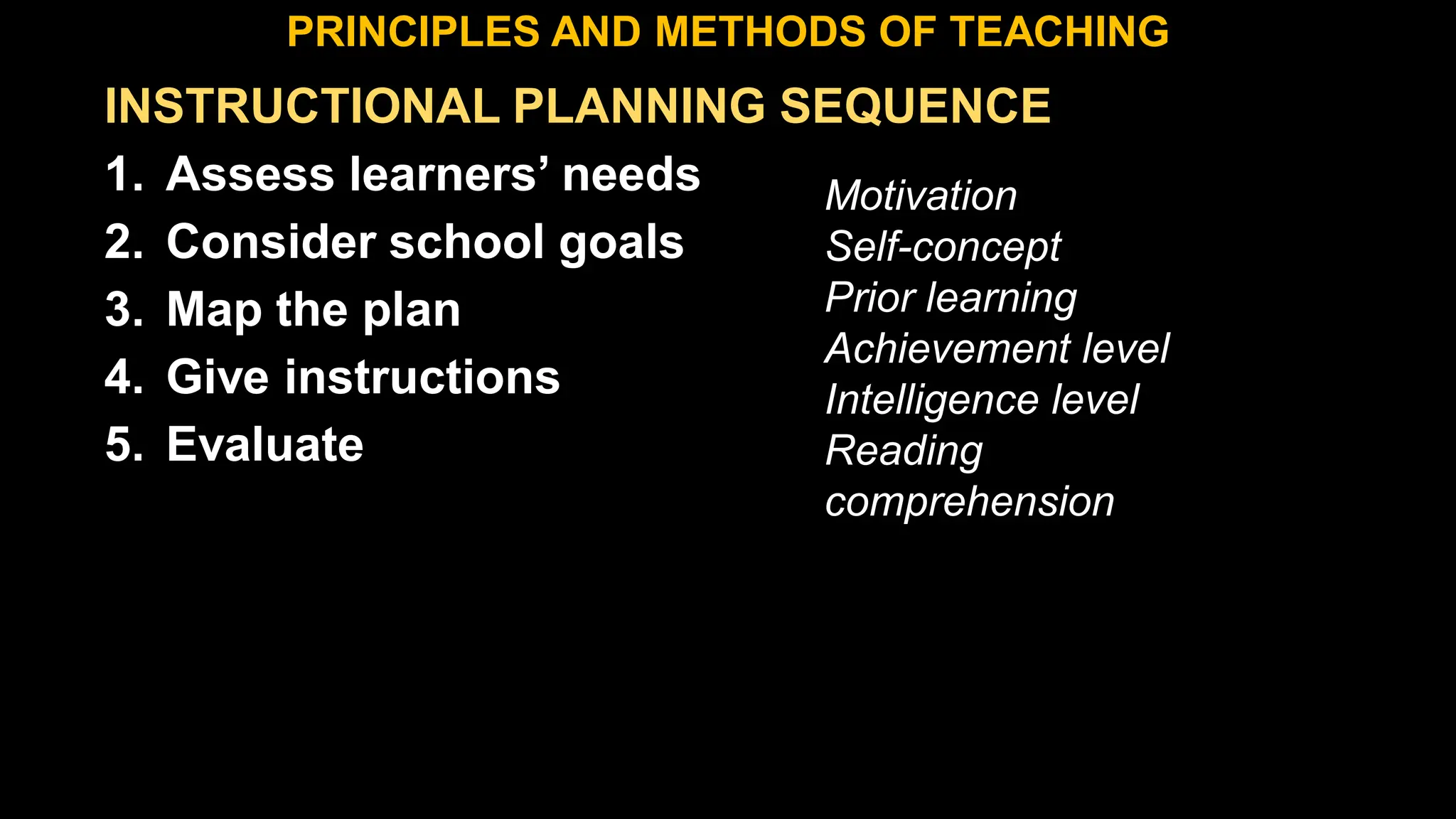
INSTRUCTIONAL PLANNING SEQUENCE
1. Assess learners’ needs
2. Consider school goals
3. Map the plan
4. Give instructions
5. Evaluate
PRINCIPLES AND METHODS OF TEACHING
Motivation
Self-concept
Prior learning
Achievement level
Intelligence level
Reading
comprehension
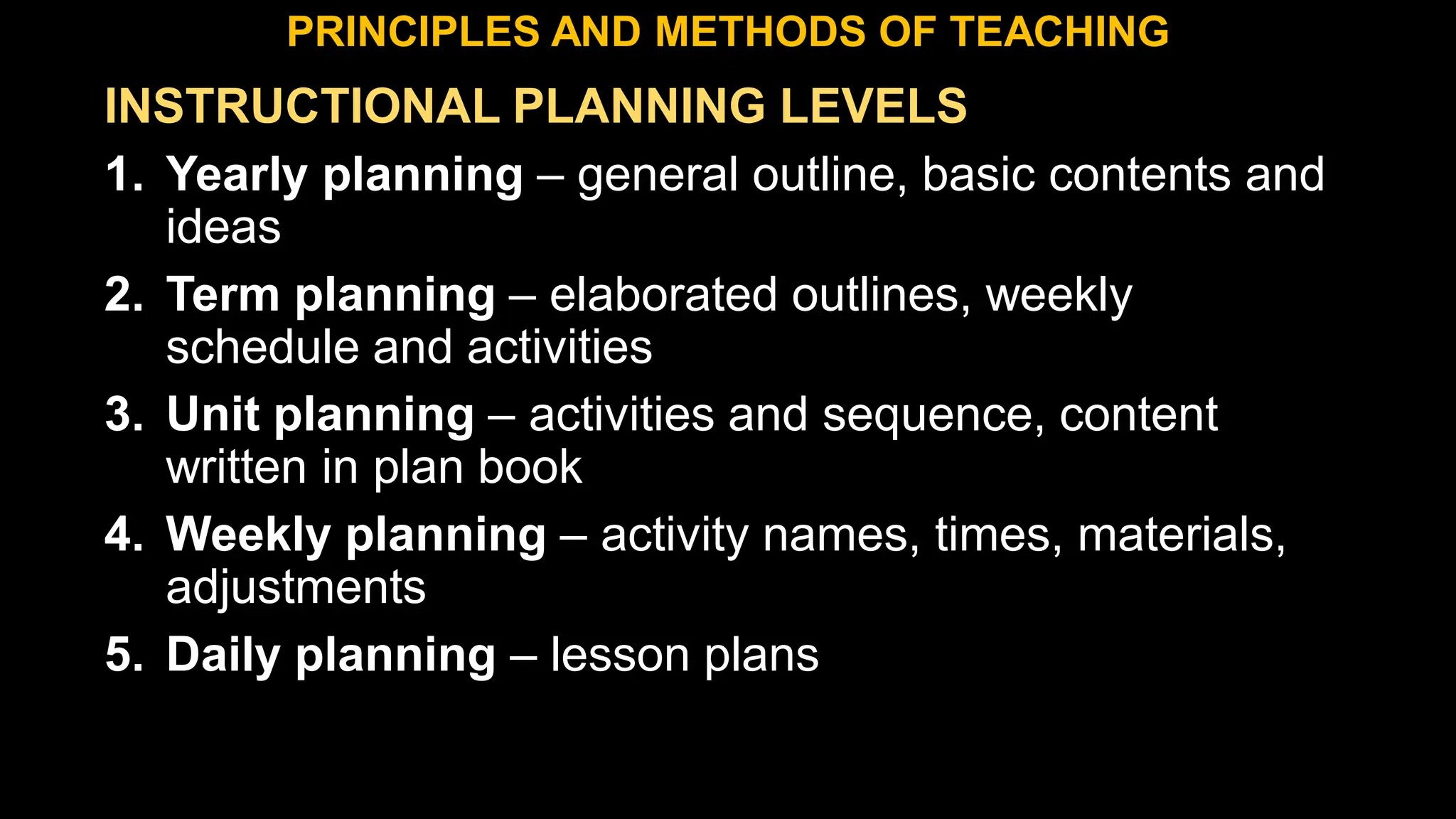
INSTRUCTIONAL PLANNING LEVELS
1. Yearly planning – general outline, basic contents and
ideas
2. Term planning – elaborated outlines, weekly
schedule and activities
3. Unit planning – activities and sequence, content
written in plan book
4. Weekly planning – activity names, times, materials,
adjustments
5. Daily planning – lesson plans
PRINCIPLES AND METHODS OF TEACHING
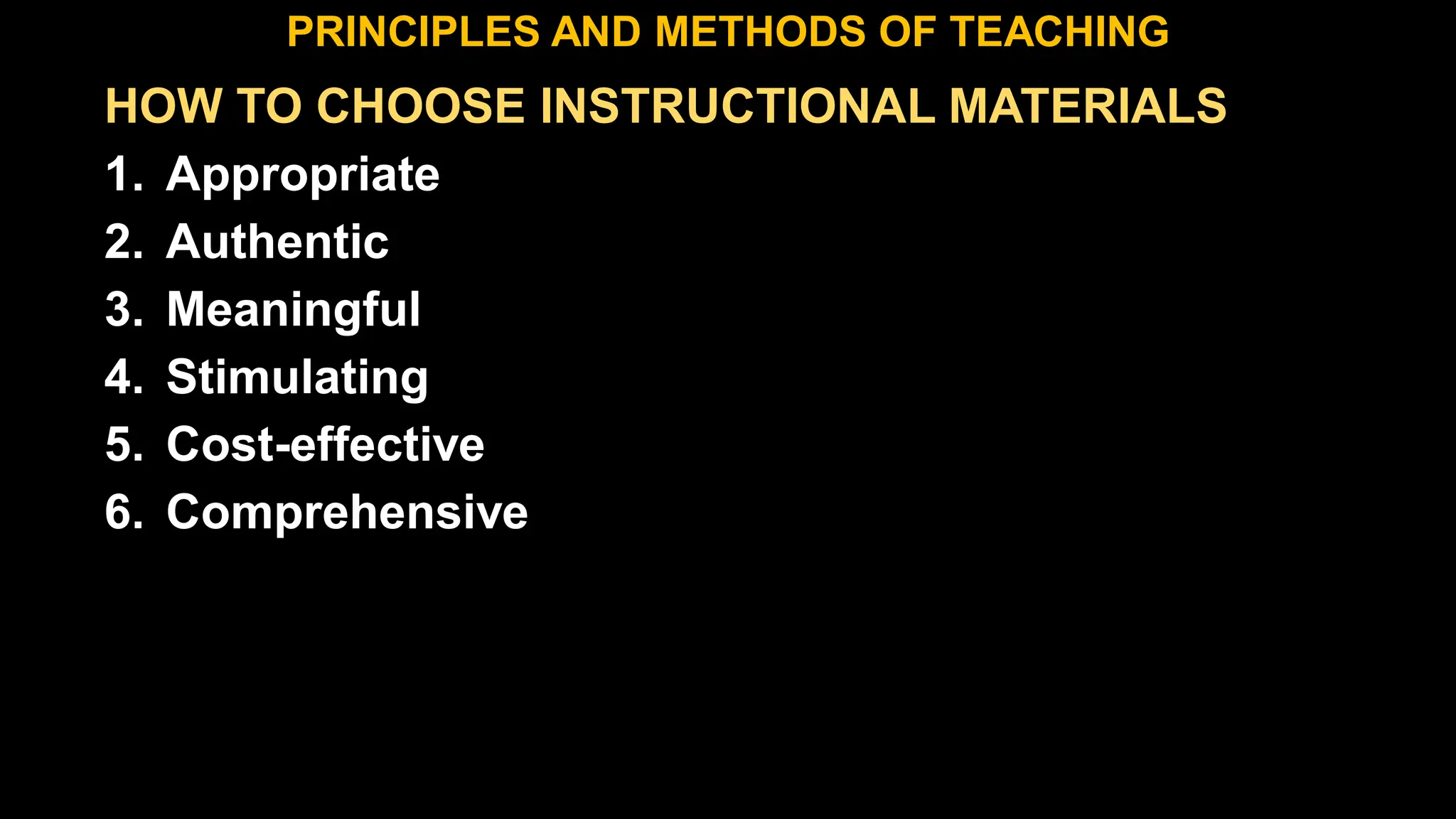
HOW TO CHOOSE INSTRUCTIONAL MATERIALS
1. Appropriate
2. Authentic
3. Meaningful
4. Stimulating
5. Cost-effective
6. Comprehensive
PRINCIPLES AND METHODS OF TEACHING
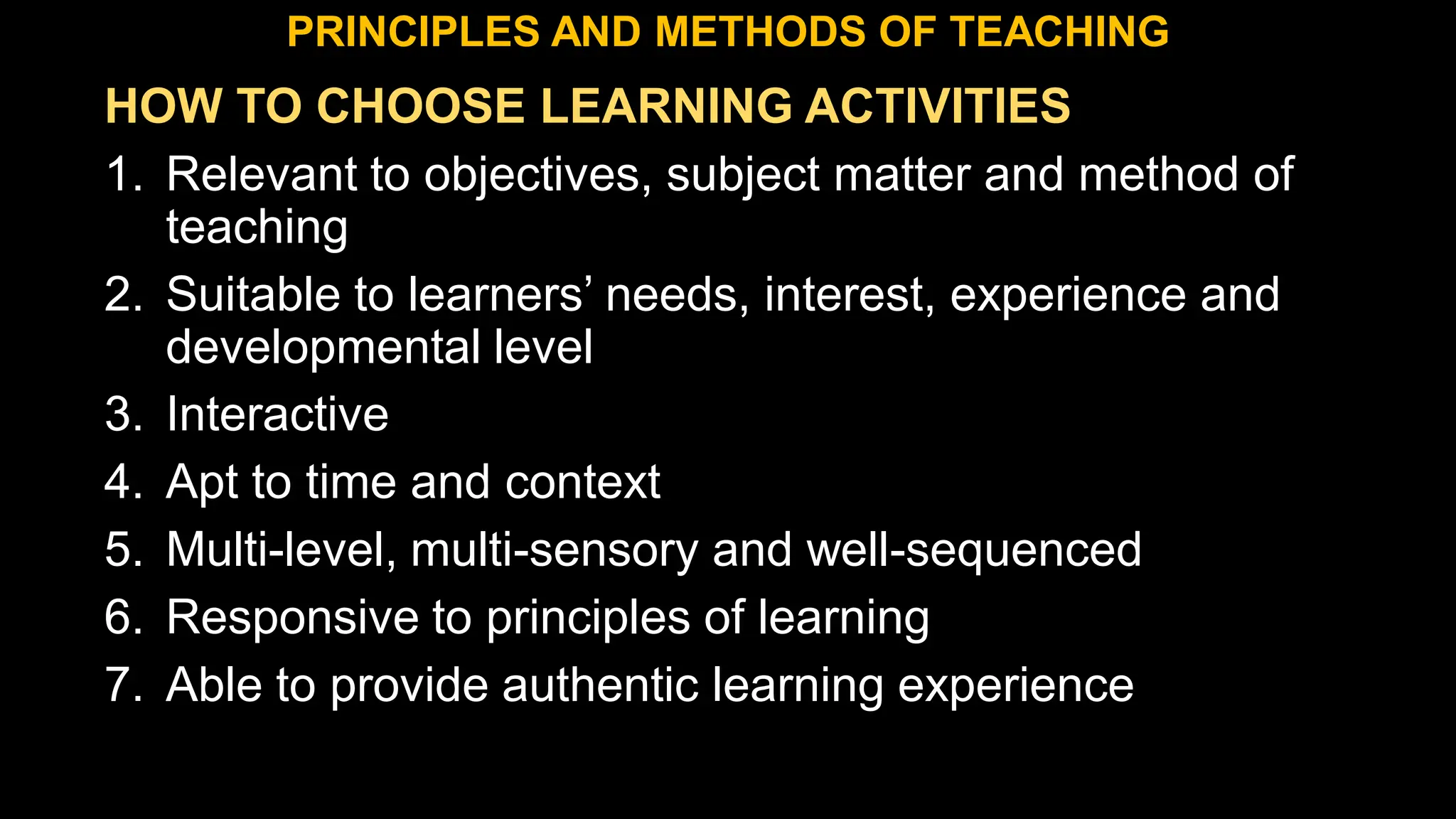
HOW TO CHOOSE LEARNING ACTIVITIES
1. Relevant to objectives, subject matter and method of
teaching
2. Suitable to learners’ needs, interest, experience and
developmental level
3. Interactive
4. Apt to time and context
5. Multi-level, multi-sensory and well-sequenced
6. Responsive to principles of learning
7. Able to provide authentic learning experience
PRINCIPLES AND METHODS OF TEACHING
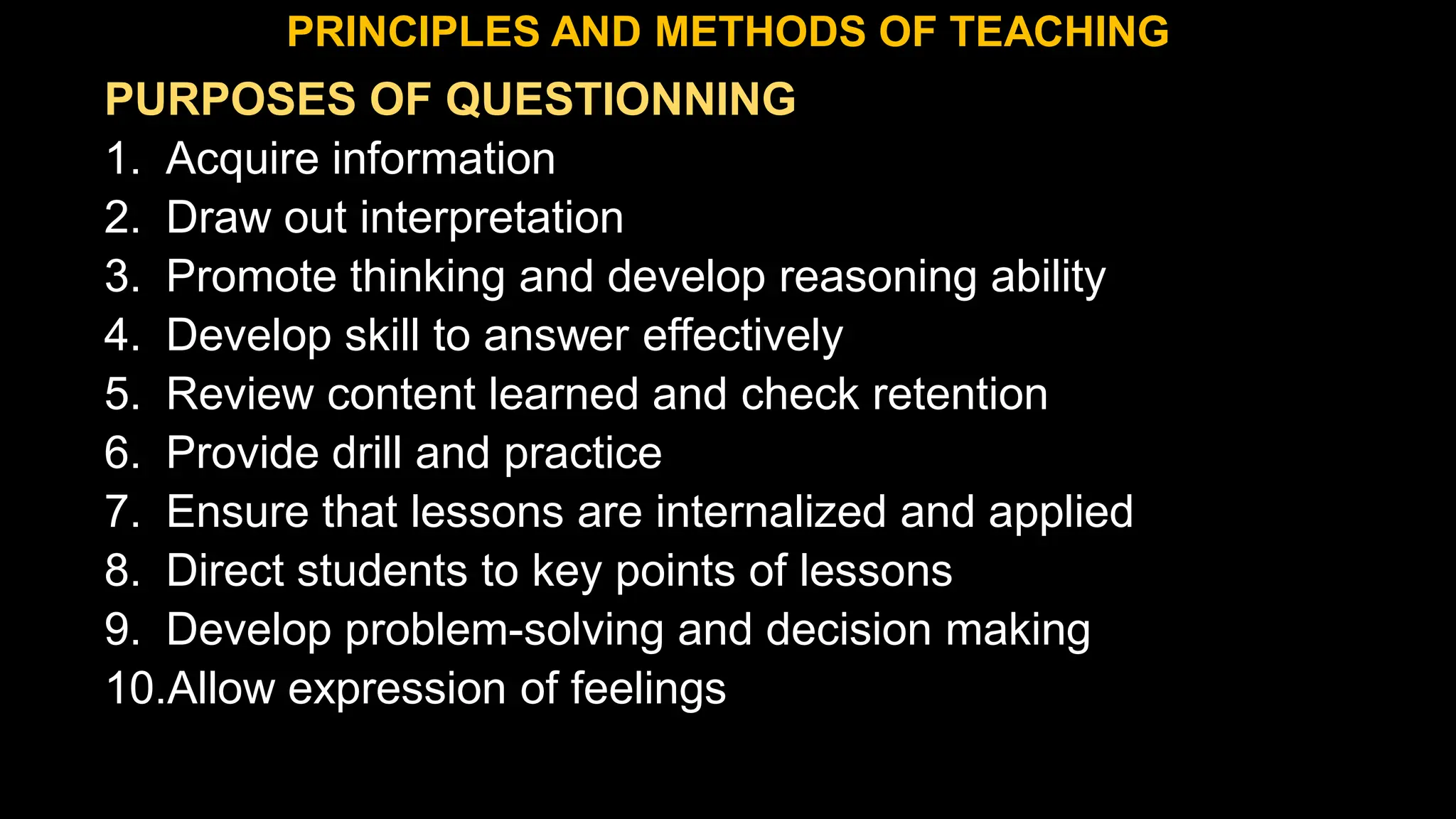
PURPOSES OF QUESTIONNING
1. Acquire information
2. Draw out interpretation
3. Promote thinking and develop reasoning ability
4. Develop skill to answer effectively
5. Review content learned and check retention
6. Provide drill and practice
7. Ensure that lessons are internalized and applied
8. Direct students to key points of lessons
9. Develop problem-solving and decision making
10.Allow expression of feelings
PRINCIPLES AND METHODS OF TEACHING
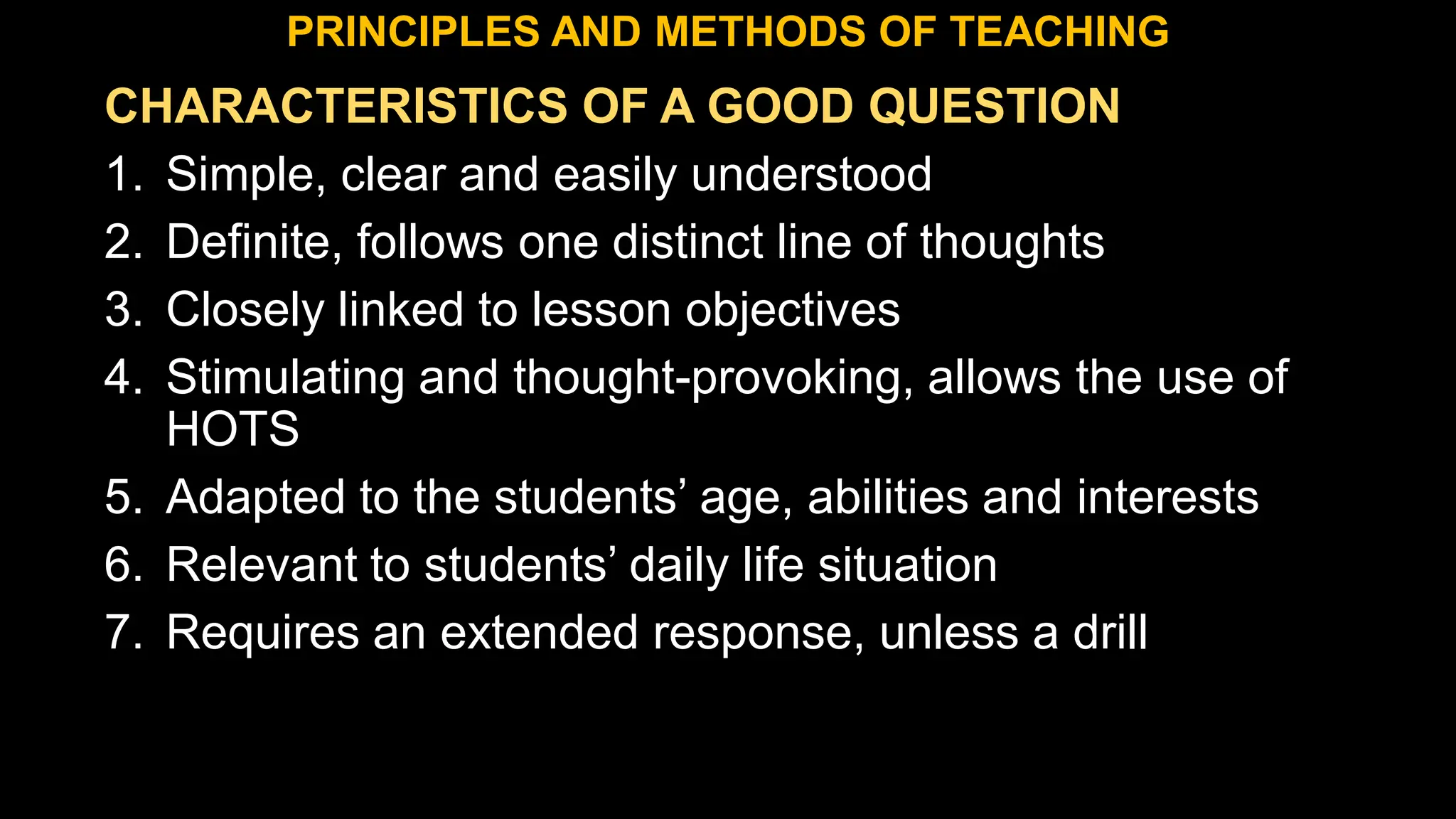
CHARACTERISTICS OF A GOOD QUESTION
1. Simple, clear and easily understood
2. Definite, follows one distinct line of thoughts
3. Closely linked to lesson objectives
4. Stimulating and thought-provoking, allows the use of
HOTS
5. Adapted to the students’ age, abilities and interests
6. Relevant to students’ daily life situation
7. Requires an extended response, unless a drill
PRINCIPLES AND METHODS OF TEACHING
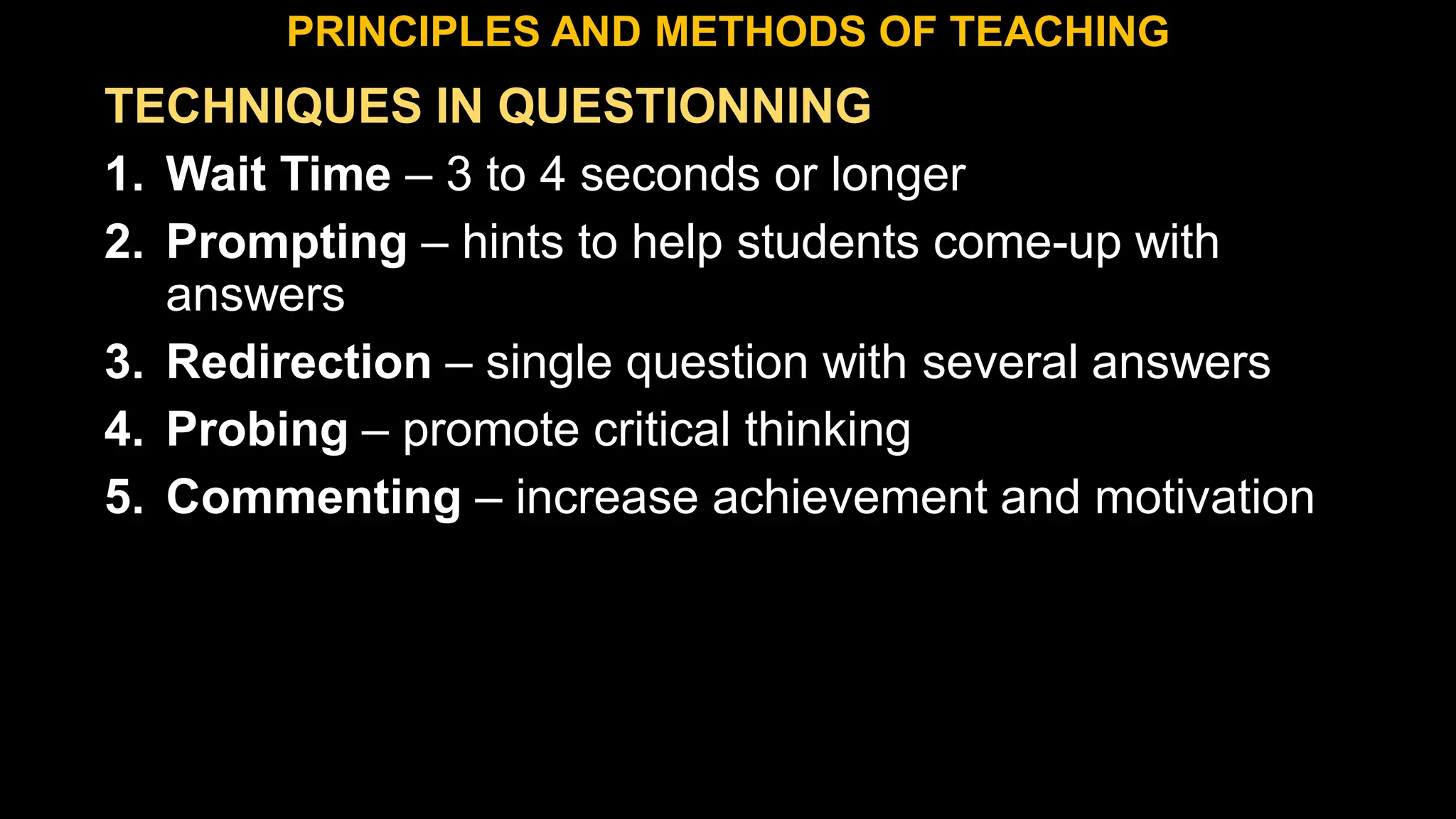
TECHNIQUES IN QUESTIONNING
1. Wait Time – 3 to 4 seconds or longer
2. Prompting – hints to help students come-up with
answers
3. Redirection – single question with several answers
4. Probing – promote critical thinking
5. Commenting – increase achievement and motivation
PRINCIPLES AND METHODS OF TEACHING
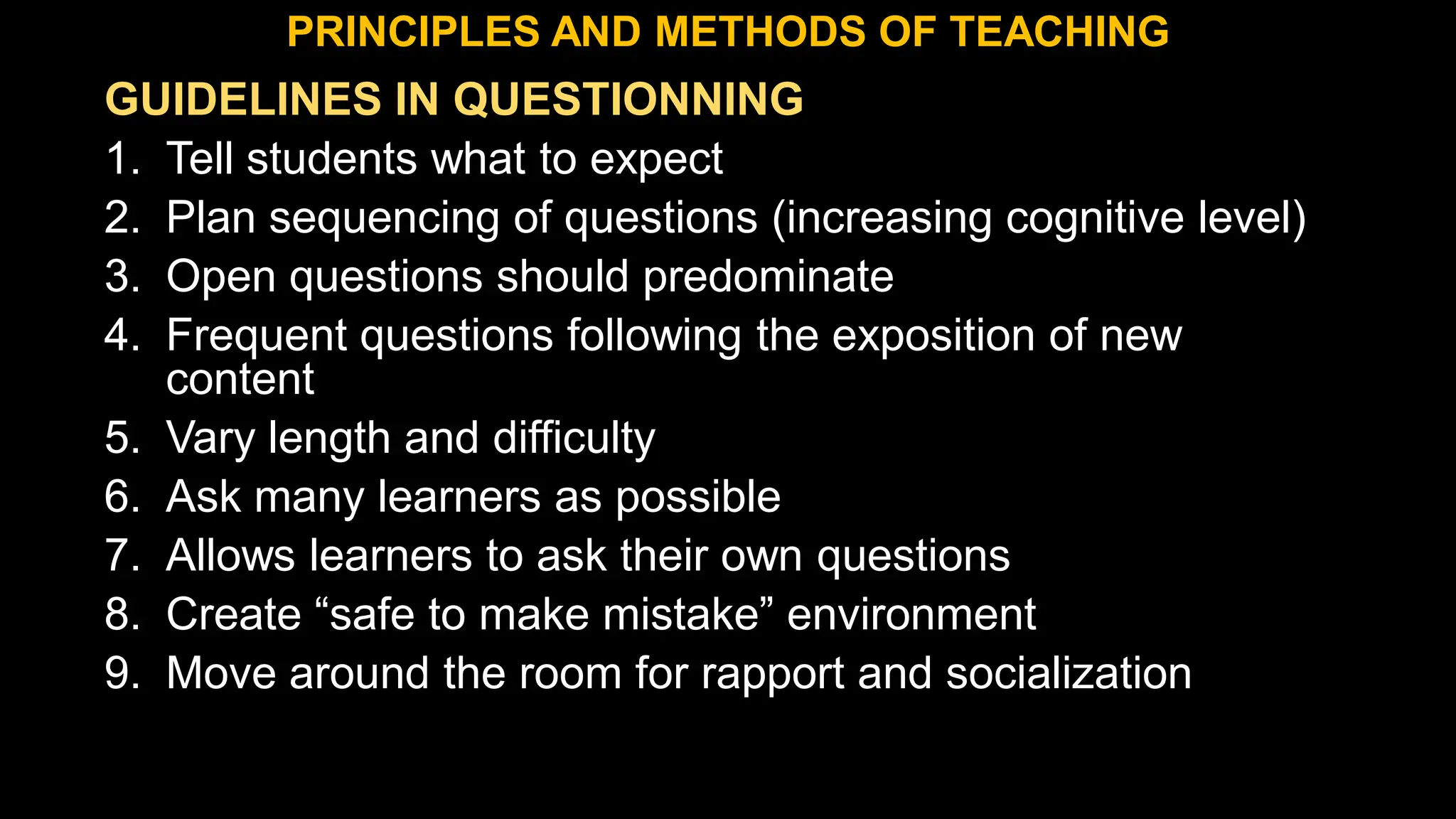
GUIDELINES IN QUESTIONNING
1. Tell students what to expect
2. Plan sequencing of questions (increasing cognitive level)
3. Open questions should predominate
4. Frequent questions following the exposition of new
content
5. Vary length and difficulty
6. Ask many learners as possible
7. Allows learners to ask their own questions
8. Create “safe to make mistake” environment
9. Move around the room for rapport and socialization
PRINCIPLES AND METHODS OF TEACHING
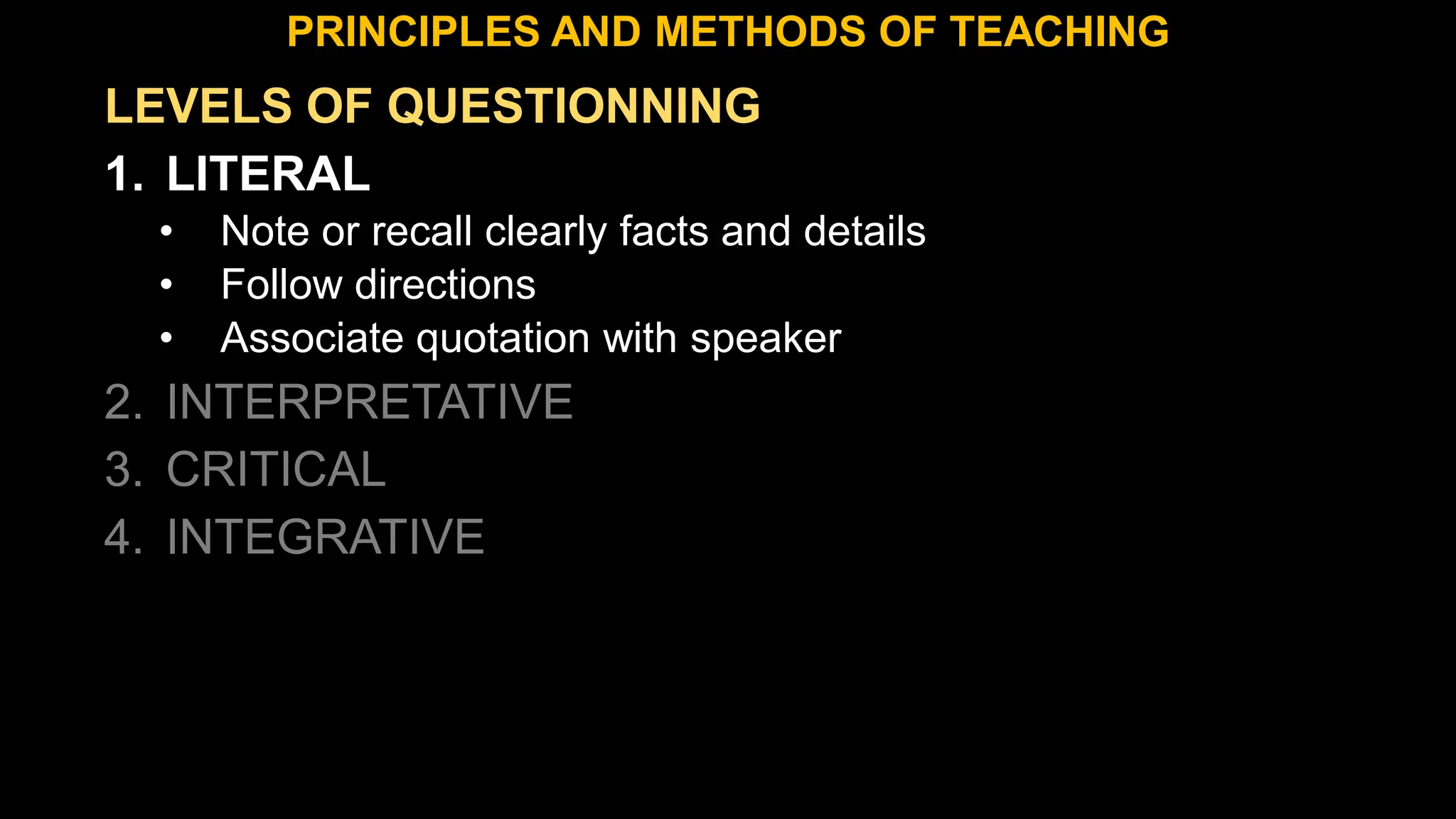
LEVELS OF QUESTIONNING
1. LITERAL
• Note or recall clearly facts and details
• Follow directions
• Associate quotation with speaker
2. INTERPRETATIVE
3. CRITICAL
4. INTEGRATIVE
PRINCIPLES AND METHODS OF TEACHING
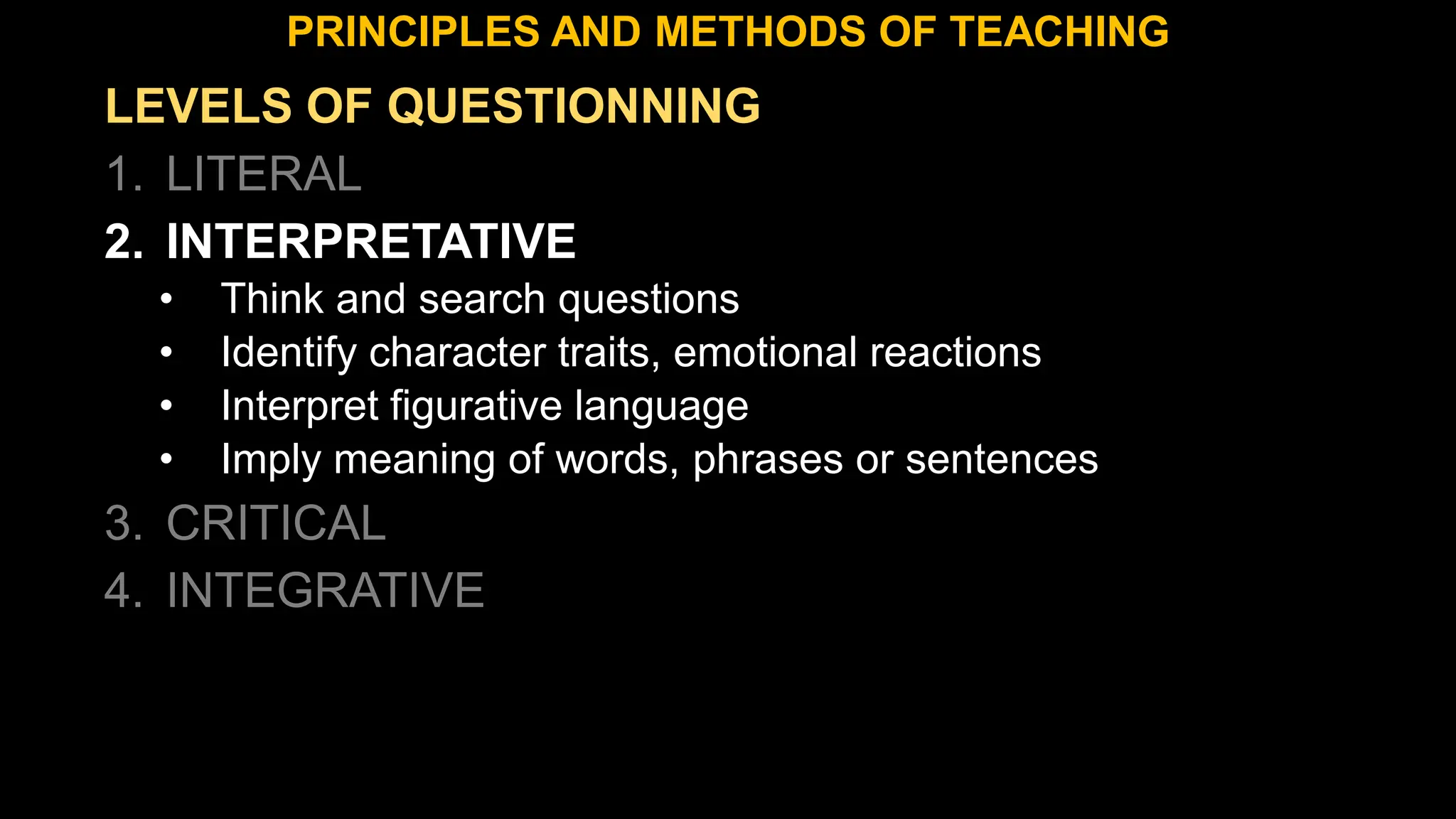
LEVELS OF QUESTIONNING
1. LITERAL
2. INTERPRETATIVE
• Think and search questions
• Identify character traits, emotional reactions
• Interpret figurative language
• Imply meaning of words, phrases or sentences
3. CRITICAL
4. INTEGRATIVE
PRINCIPLES AND METHODS OF TEACHING
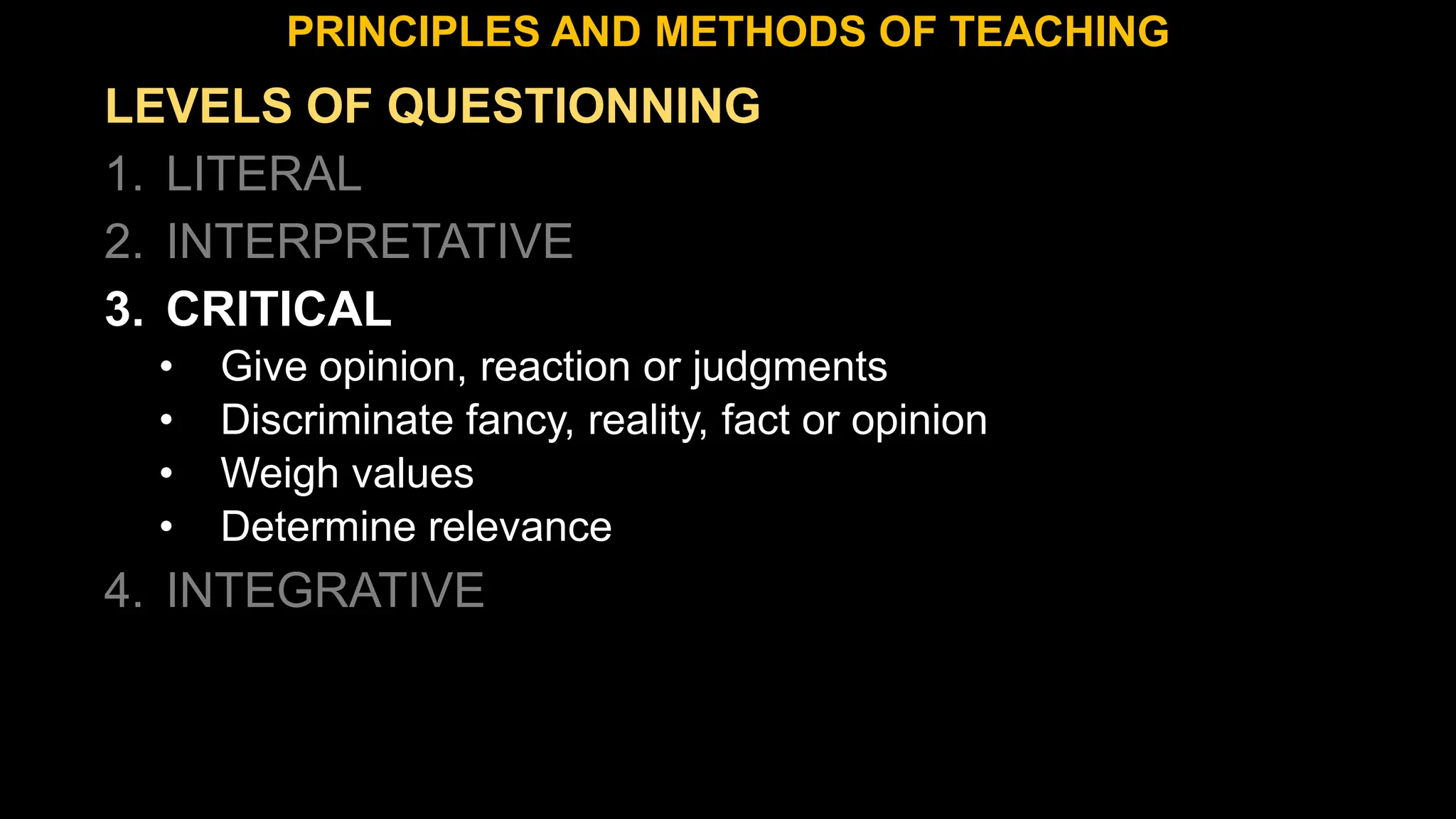
LEVELS OF QUESTIONNING
1. LITERAL
2. INTERPRETATIVE
3. CRITICAL
• Give opinion, reaction or judgments
• Discriminate fancy, reality, fact or opinion
• Weigh values
• Determine relevance
4. INTEGRATIVE
PRINCIPLES AND METHODS OF TEACHING
LEVELS OF QUESTIONNING
1. LITERAL
2. INTERPRETATIVE
3. CRITICAL
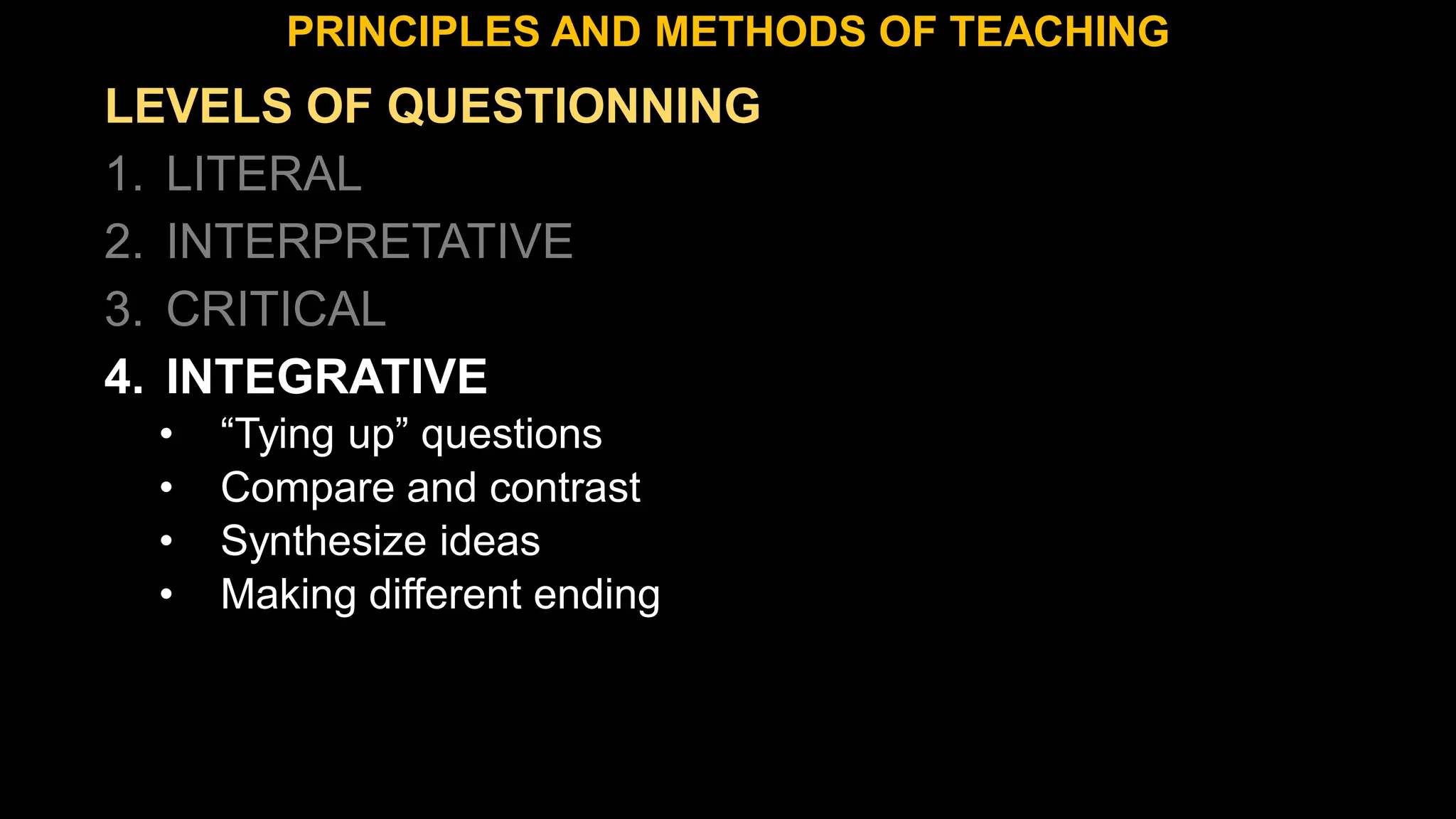
4. INTEGRATIVE
• “Tying up” questions
• Compare and contrast
• Synthesize ideas
• Making different ending
PRINCIPLES AND METHODS OF TEACHING
TYPES OF QUESTIONNING (Thinking Process)
1. LOW-LEVEL QUESTIONS
• Focus on facts
• Don’t test level of understanding or problem-solving
• Convergent questions
2. HIGH-LEVEL QUESTIONS
PRINCIPLES AND METHODS OF TEACHING
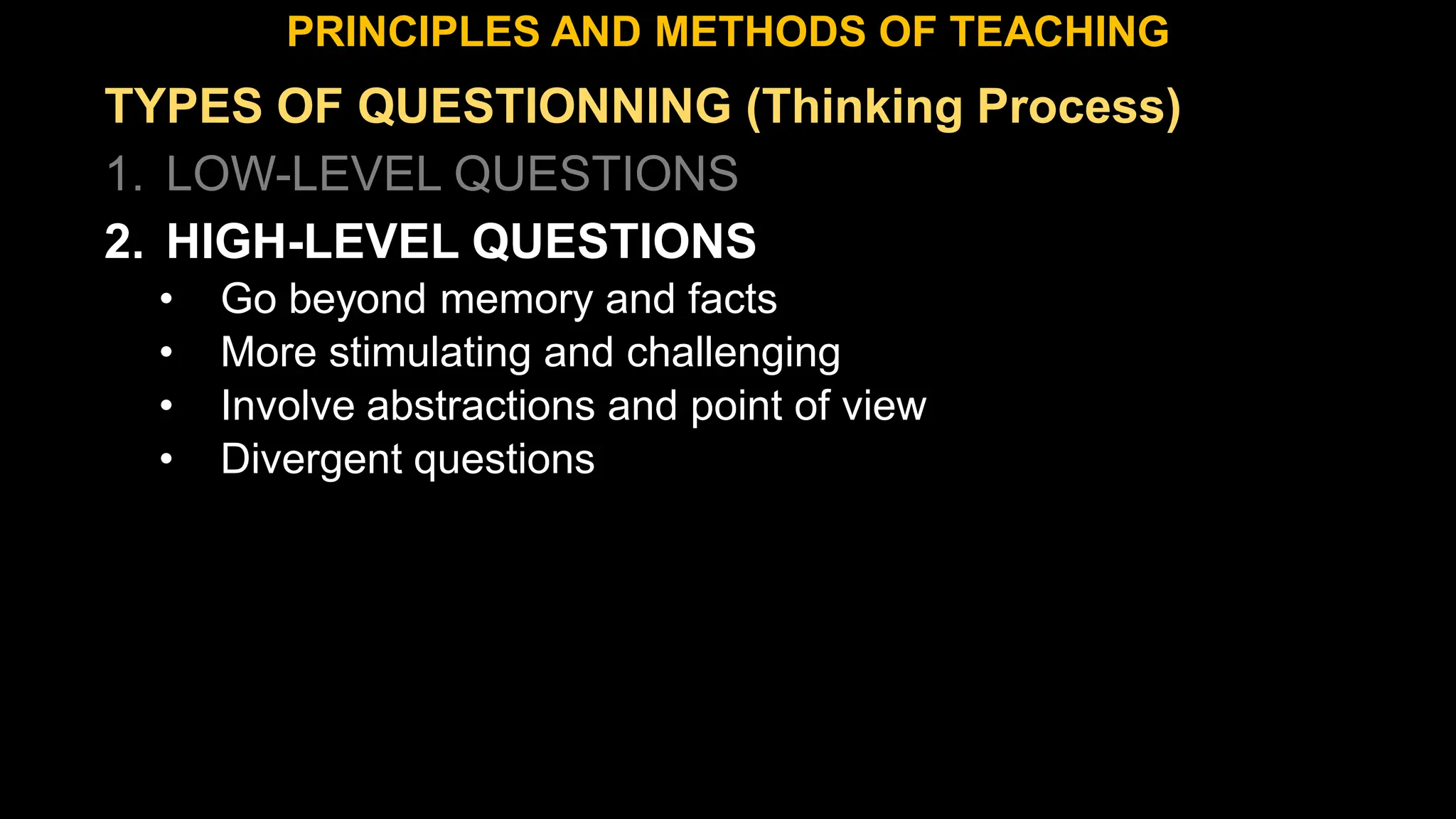
TYPES OF QUESTIONNING (Thinking Process)
1. LOW-LEVEL QUESTIONS
2. HIGH-LEVEL QUESTIONS
• Go beyond memory and facts
• More stimulating and challenging
• Involve abstractions and point of view
• Divergent questions
PRINCIPLES AND METHODS OF TEACHING
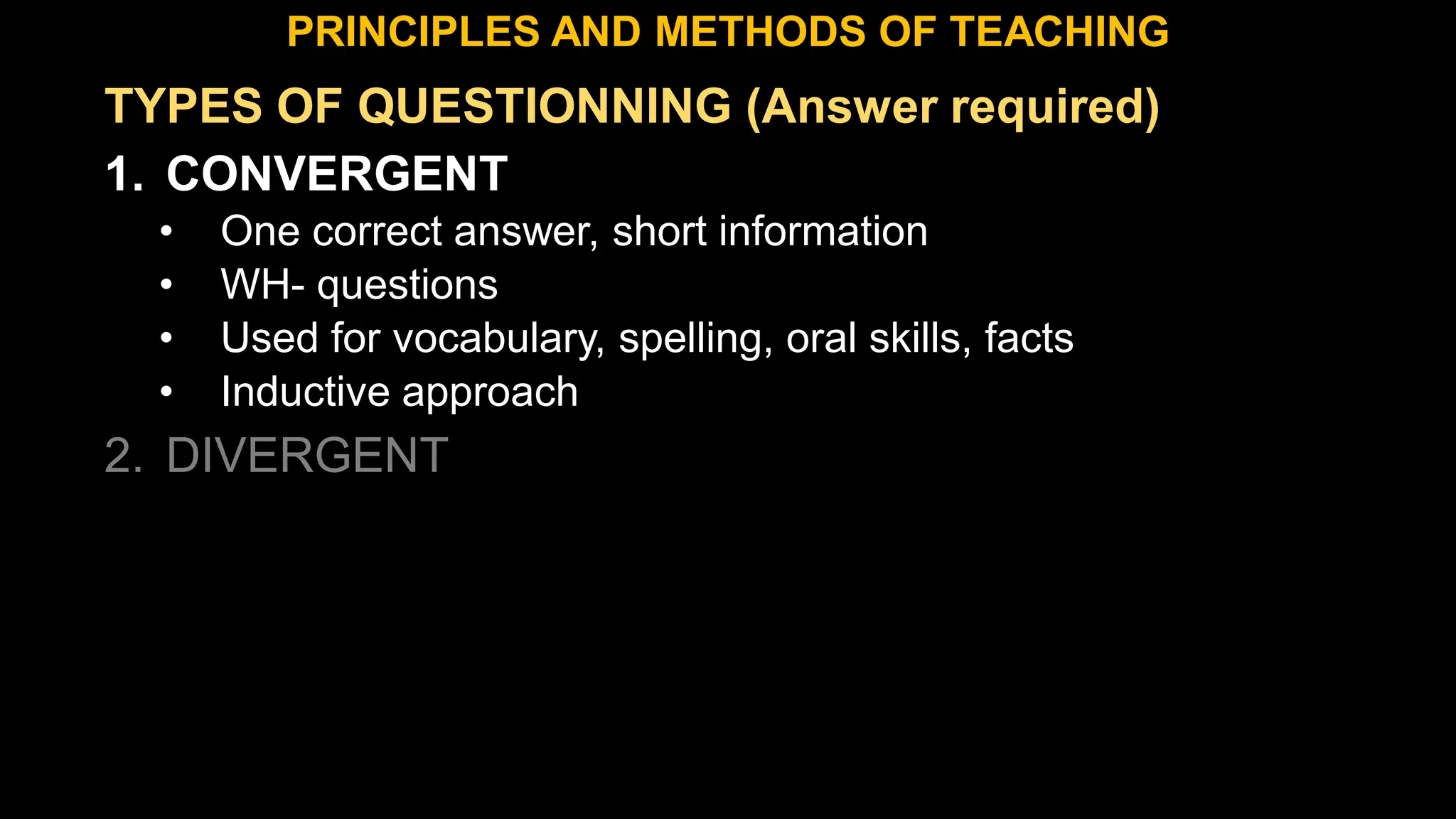
TYPES OF QUESTIONNING (Answer required)
1. CONVERGENT
• One correct answer, short information
• WH- questions
• Used for vocabulary, spelling, oral skills, facts
• Inductive approach
2. DIVERGENT
PRINCIPLES AND METHODS OF TEACHING
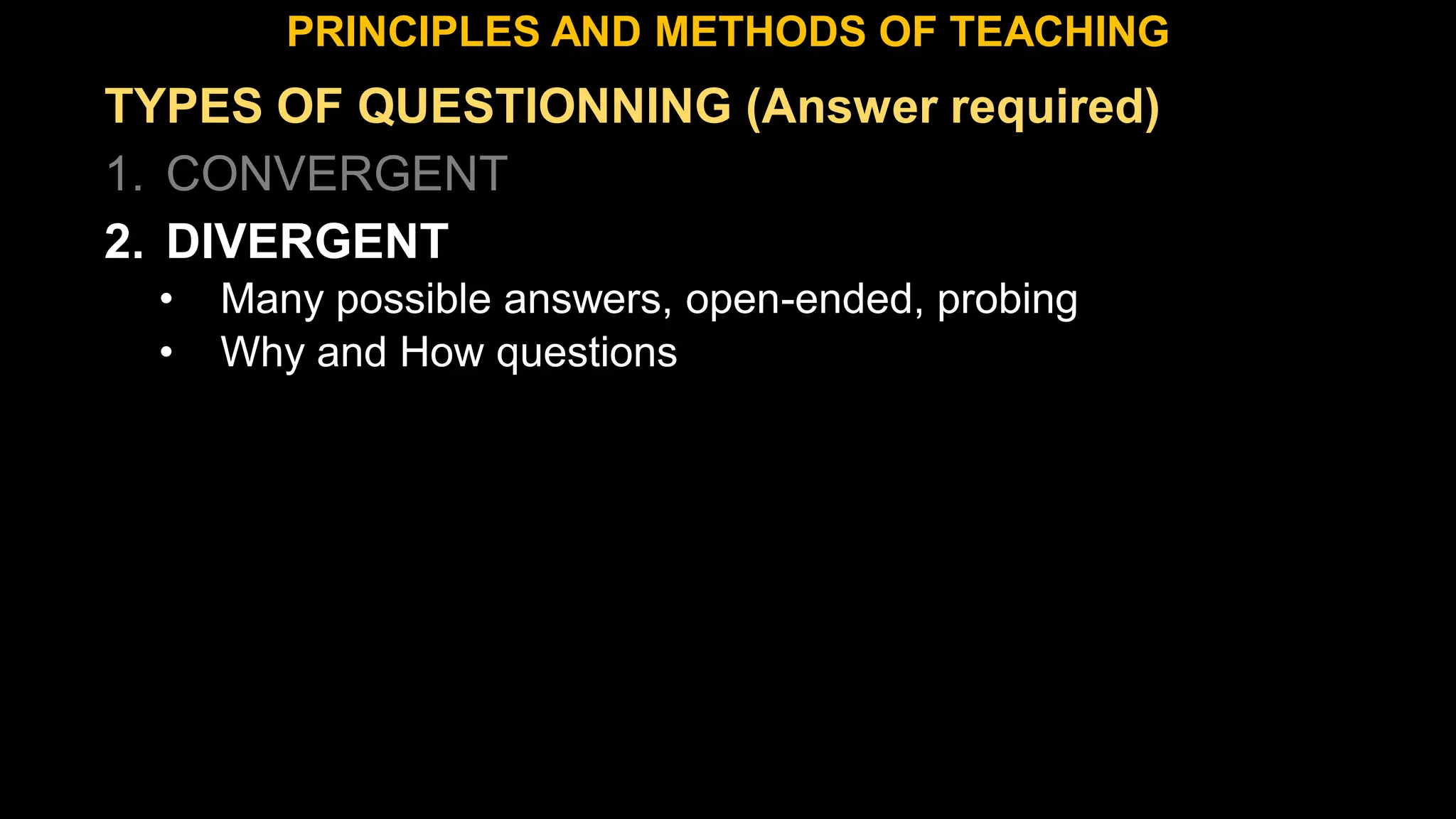
TYPES OF QUESTIONNING (Answer required)
1. CONVERGENT
2. DIVERGENT
• Many possible answers, open-ended, probing
• Why and How questions
PRINCIPLES AND METHODS OF TEACHING
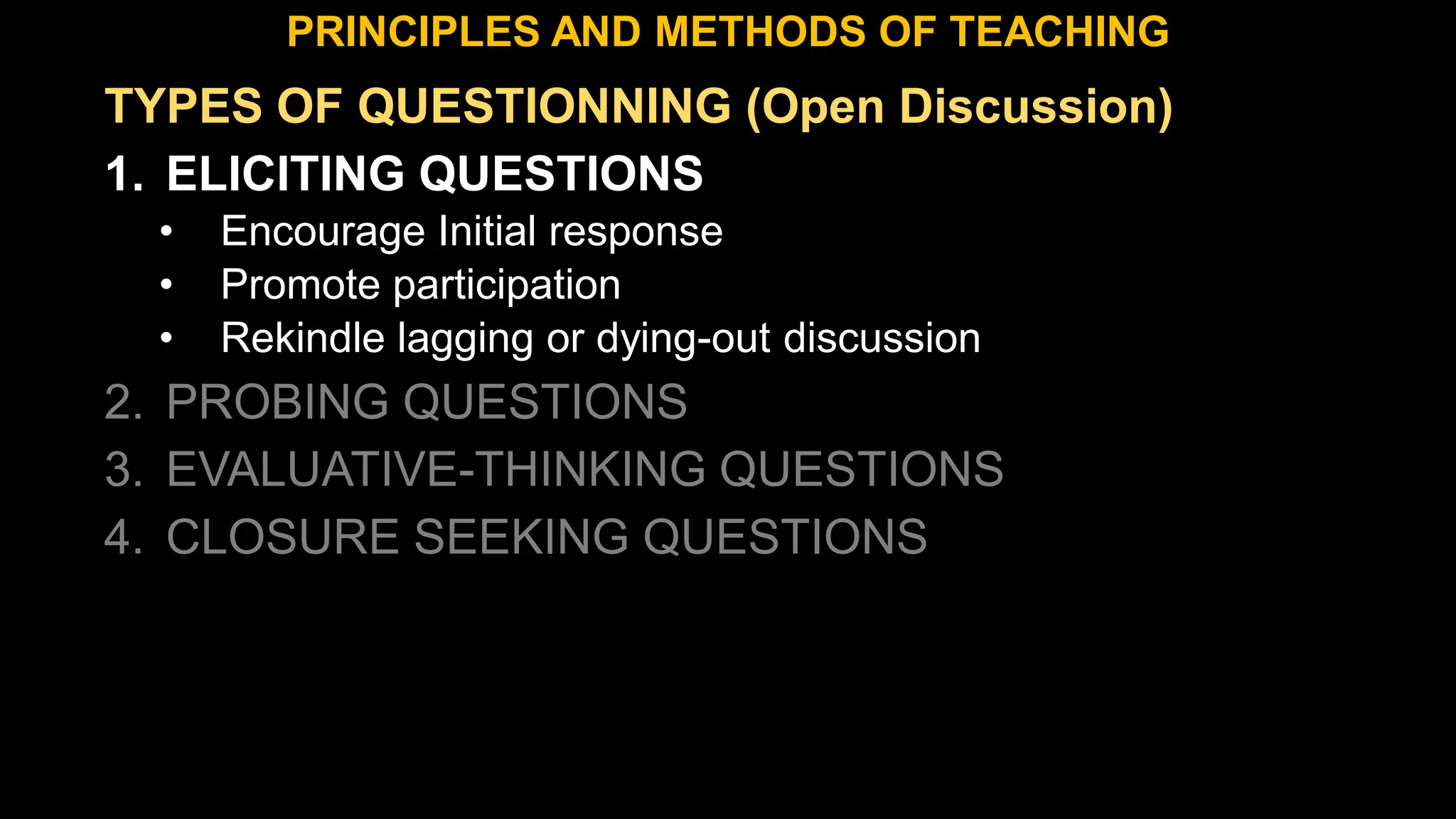
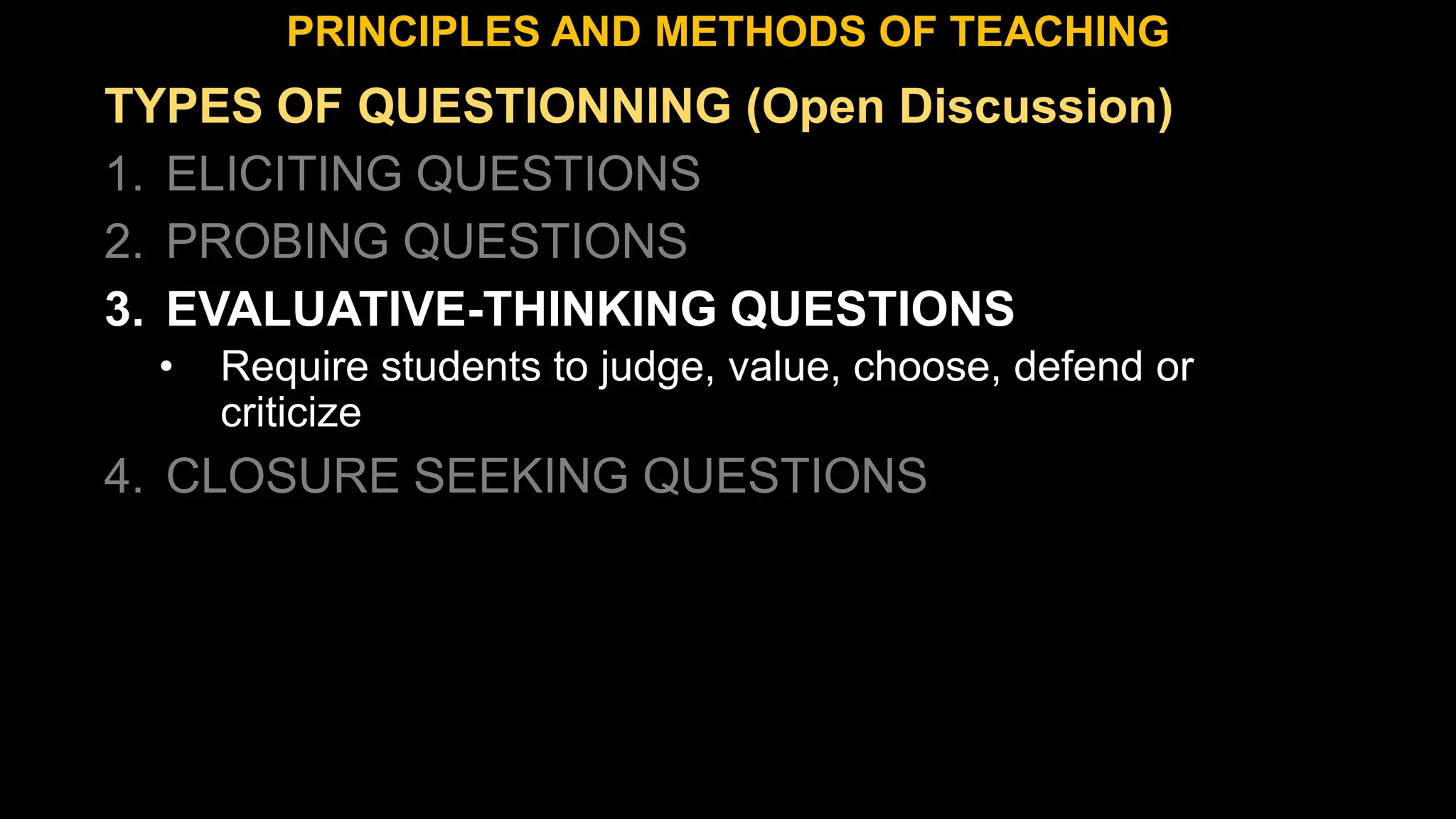
TYPES OF QUESTIONNING (Open Discussion)
1. ELICITING QUESTIONS
• Encourage Initial response
• Promote participation
• Rekindle lagging or dying-out discussion
2. PROBING QUESTIONS
3. EVALUATIVE-THINKING QUESTIONS
4. CLOSURE SEEKING QUESTIONS
PRINCIPLES AND METHODS OF TEACHING
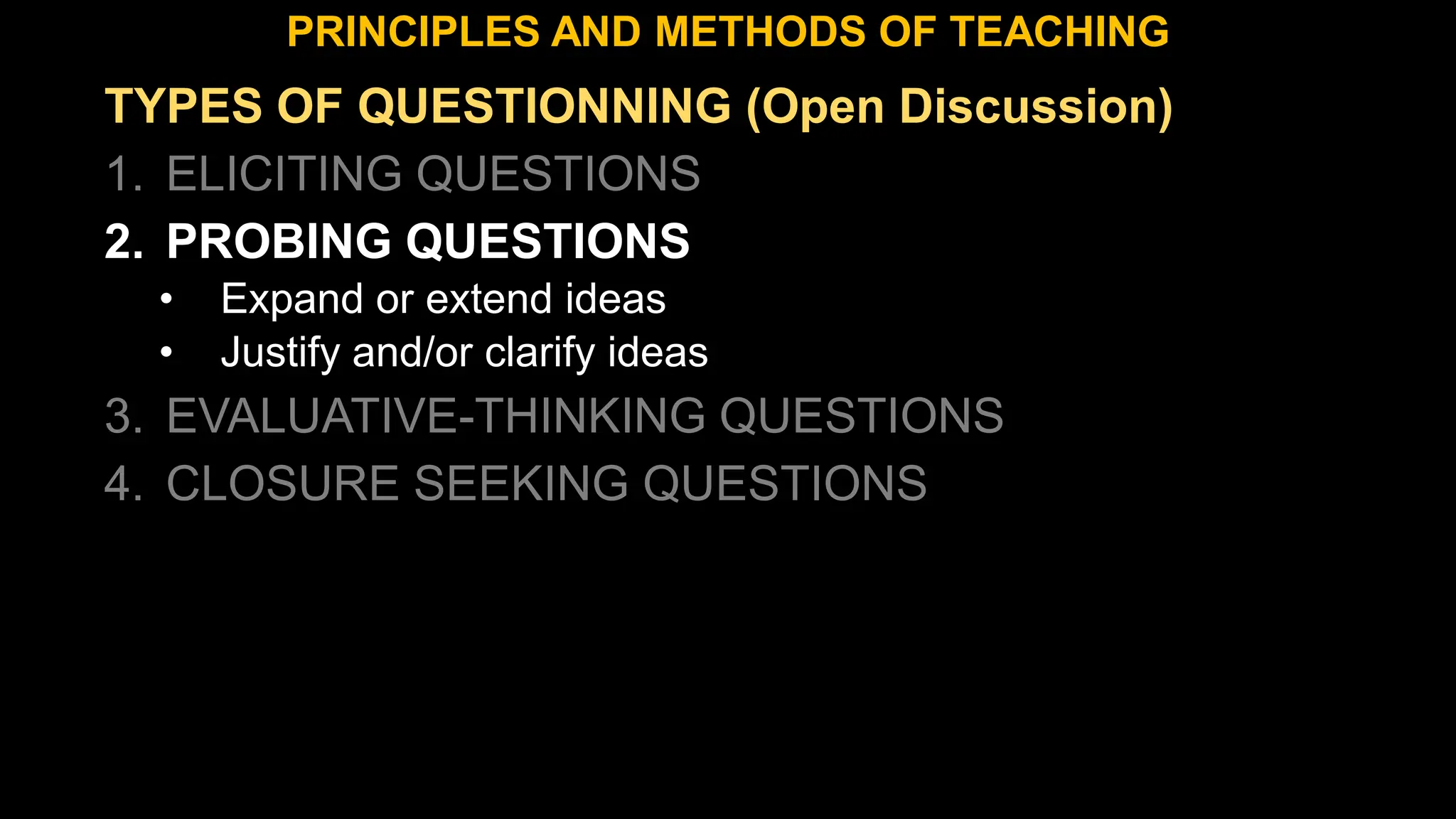
TYPES OF QUESTIONNING (Open Discussion)
1. ELICITING QUESTIONS
2. PROBING QUESTIONS
• Expand or extend ideas
• Justify and/or clarify ideas
3. EVALUATIVE-THINKING QUESTIONS
4. CLOSURE SEEKING QUESTIONS
PRINCIPLES AND METHODS OF TEACHING
TYPES OF QUESTIONNING (Open Discussion)
1. ELICITING QUESTIONS
2. PROBING QUESTIONS
3. EVALUATIVE-THINKING QUESTIONS
• Require students to judge, value, choose, defend or
criticize
4. CLOSURE SEEKING QUESTIONS
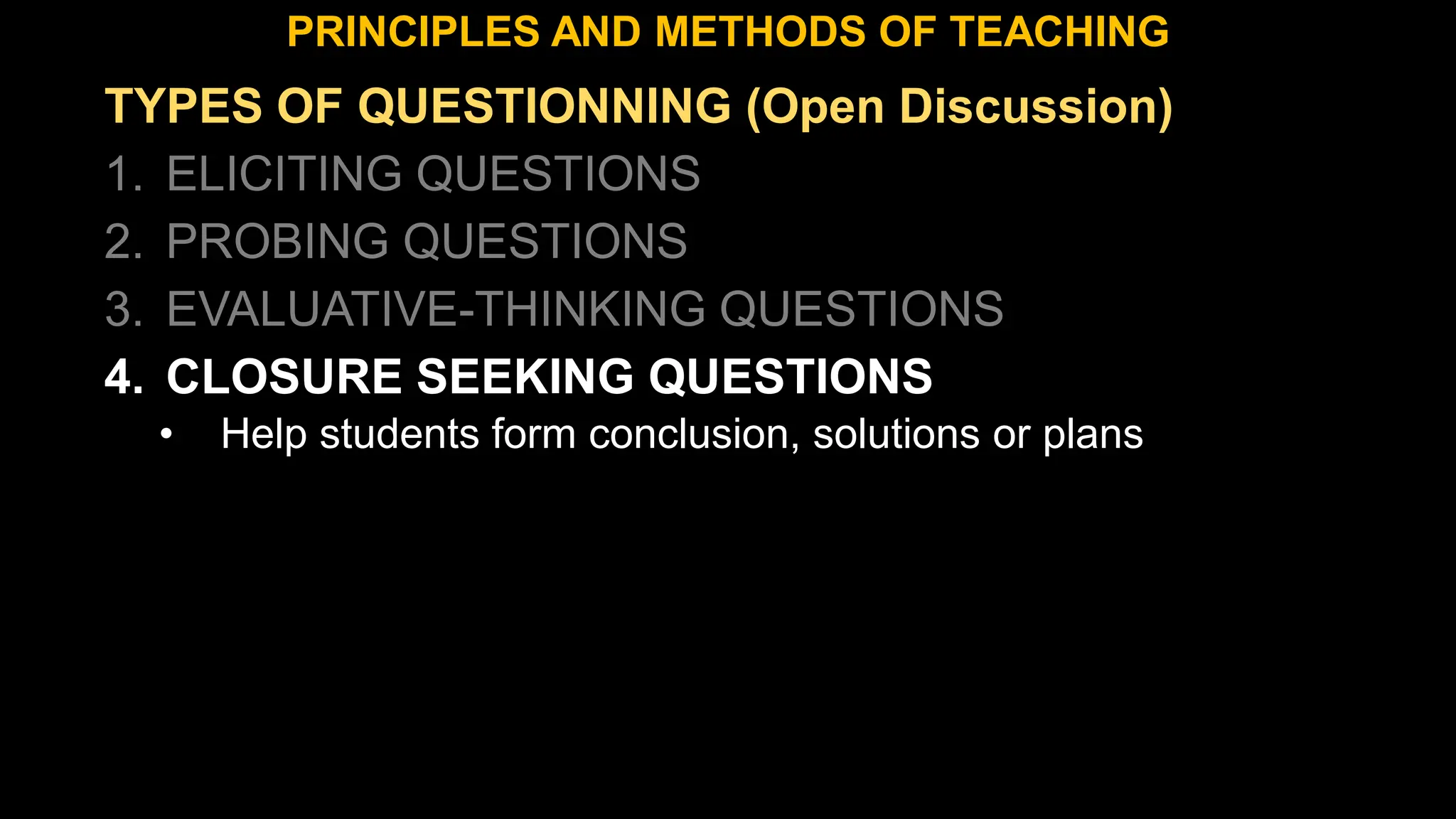
PRINCIPLES AND METHODS OF TEACHING
TYPES OF QUESTIONNING (Open Discussion)
1. ELICITING QUESTIONS
2. PROBING QUESTIONS
3. EVALUATIVE-THINKING QUESTIONS
4. CLOSURE SEEKING QUESTIONS
• Help students form conclusion, solutions or plans
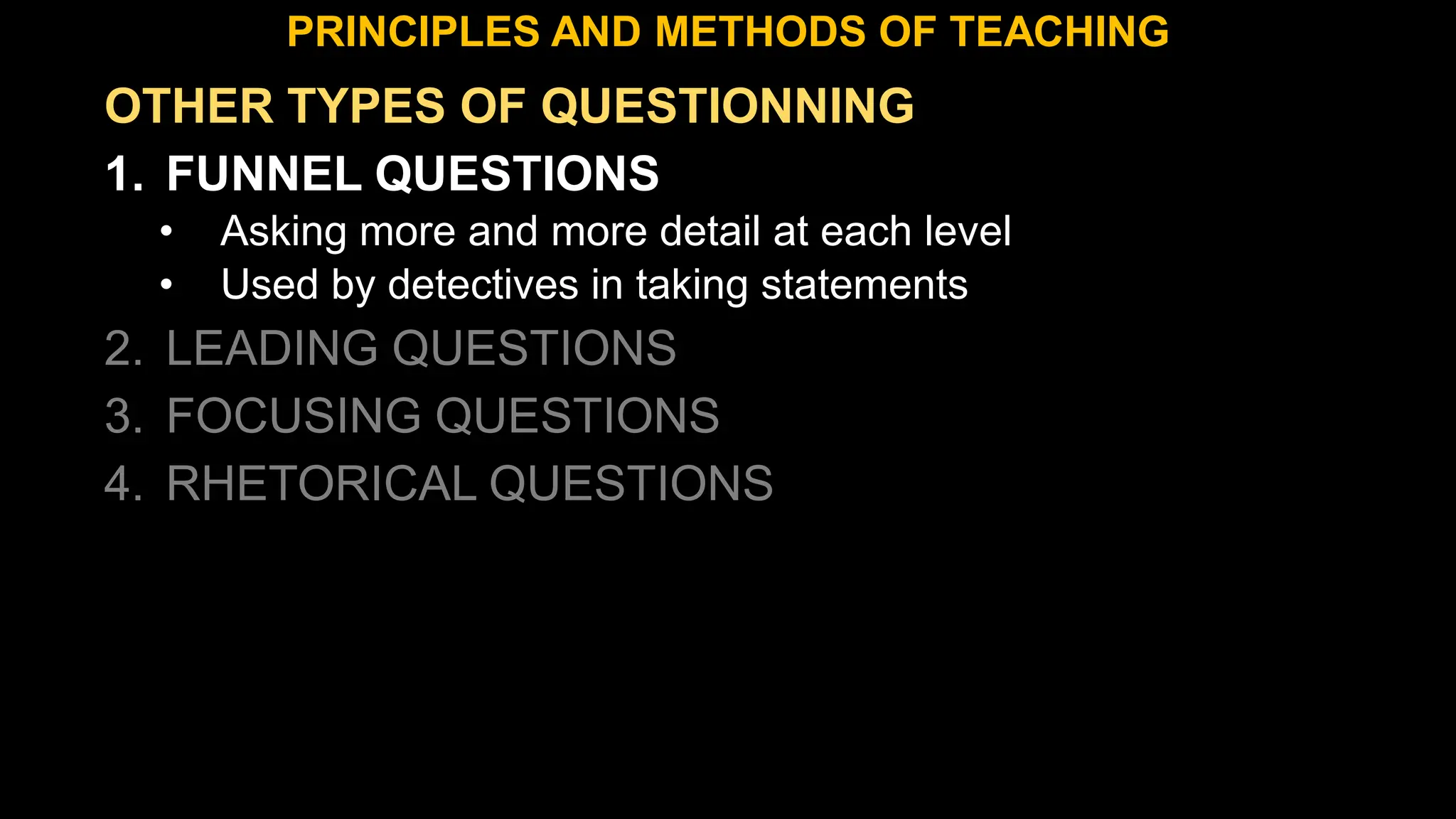
PRINCIPLES AND METHODS OF TEACHING
OTHER TYPES OF QUESTIONNING
1. FUNNEL QUESTIONS
• Asking more and more detail at each level
• Used by detectives in taking statements
2. LEADING QUESTIONS
3. FOCUSING QUESTIONS
4. RHETORICAL QUESTIONS
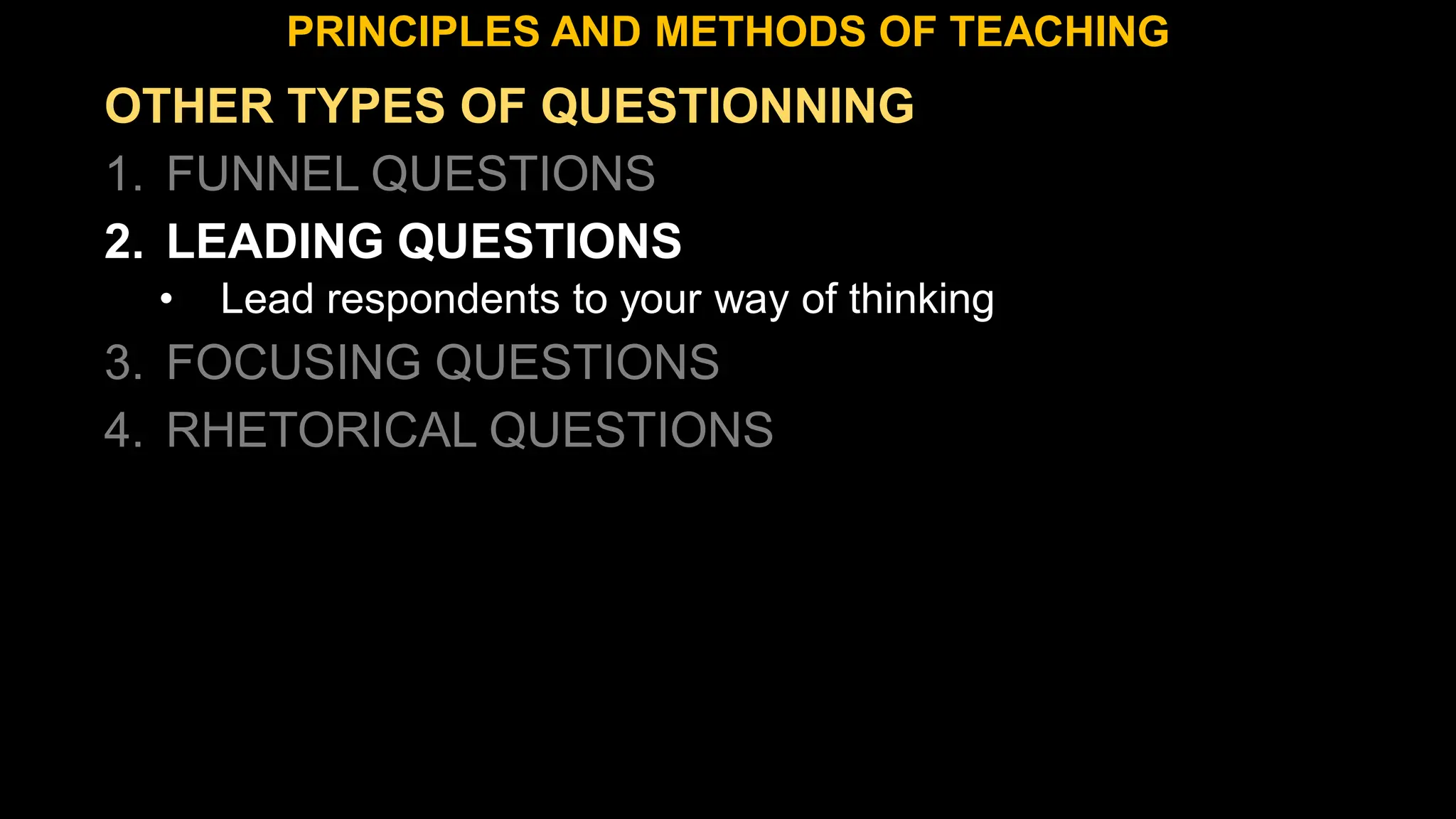
PRINCIPLES AND METHODS OF TEACHING
OTHER TYPES OF QUESTIONNING
1. FUNNEL QUESTIONS
2. LEADING QUESTIONS
• Lead respondents to your way of thinking
3. FOCUSING QUESTIONS
4. RHETORICAL QUESTIONS
PRINCIPLES AND METHODS OF TEACHING
OTHER TYPES OF QUESTIONNING
1. FUNNEL QUESTIONS
2. LEADING QUESTIONS
3. FOCUSING QUESTIONS
• Introduce a topic and indicates direction of discussion
• To refocus or sharpen discussion
4. RHETORICAL QUESTIONS
PRINCIPLES AND METHODS OF TEACHING
OTHER TYPES OF QUESTIONNING
1. FUNNEL QUESTIONS
2. LEADING QUESTIONS
3. FOCUSING QUESTIONS
4. RHETORICAL QUESTIONS
• Aren’t really questions at all
• Don’t expect an answer
• Statements phrased in question form
• Example: Isn’t John work so creative?
PRINCIPLES AND METHODS OF TEACHING
HANDLING ANSWERS
1. CORRECT
• Acknowledge and indicate why it is a good answer
2. INCORRECT
3. PARTLY CORRECT
4. GUESSES
PRINCIPLES AND METHODS OF TEACHING
HANDLING ANSWERS
1. CORRECT
2. INCORRECT
• Simplify or provide prompts
• Throw questions to the class for discussion
3. PARTLY CORRECT
4. GUESSES
PRINCIPLES AND METHODS OF TEACHING
HANDLING ANSWERS
1. CORRECT
2. INCORRECT
3. PARTLY CORRECT
• Acknowledge the parts which are correct
• Use prompts to deal with incorrect parts
4. GUESSES
PRINCIPLES AND METHODS OF TEACHING
HANDLING ANSWERS
1. CORRECT
2. INCORRECT
3. PARTLY CORRECT
4. GUESSES
• Accept all answers as being equal worth
• Collaborate to find the best answer.
PRINCIPLES AND METHODS OF TEACHING
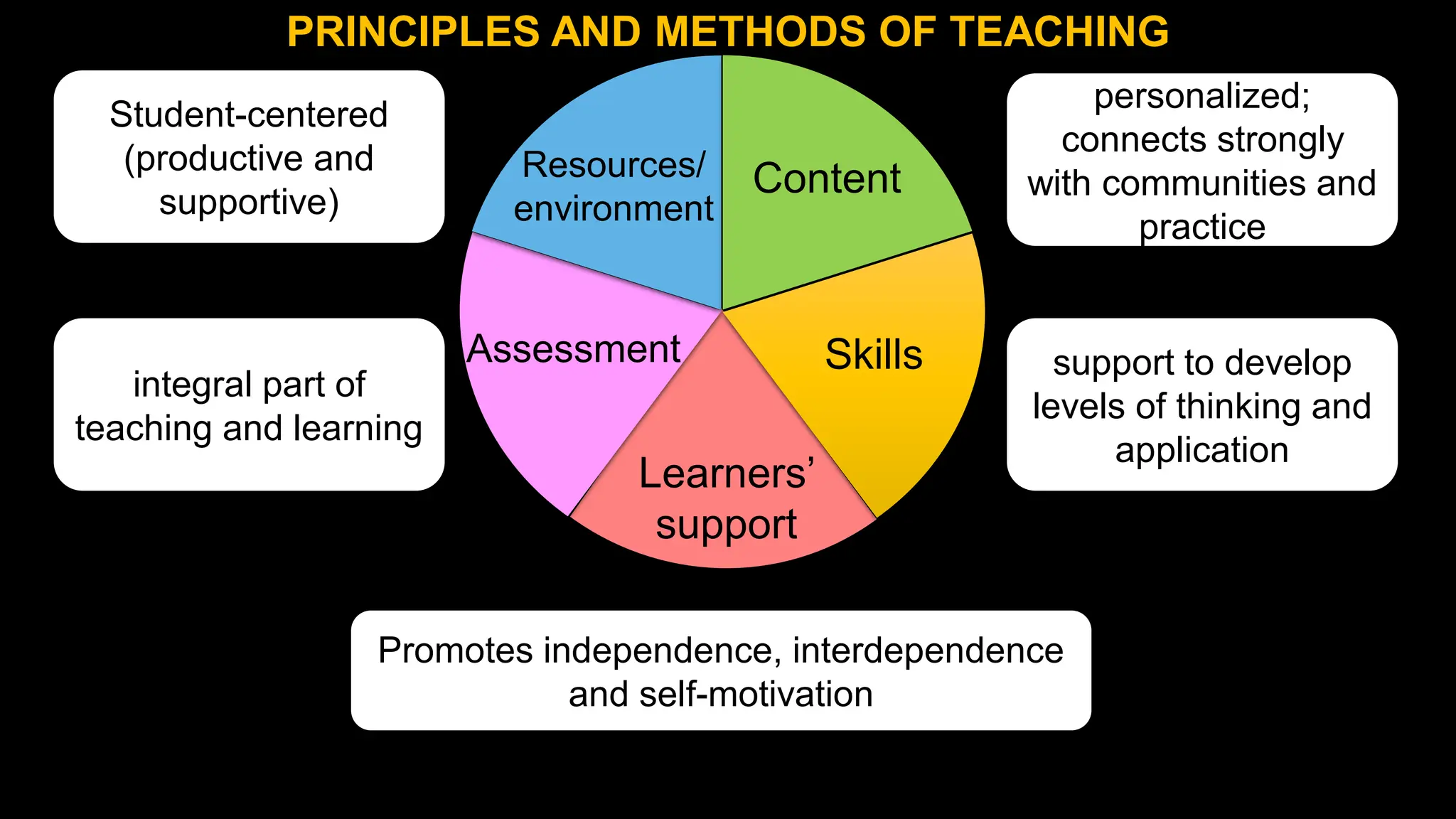
support to develop
levels of thinking and
application
personalized;
connects strongly
with communities and
practice
PRINCIPLES AND METHODS OF TEACHING
Promotes independence, interdependence
and self-motivation
integral part of
teaching and learning
Student-centered
(productive and
supportive)
Learners’
support
Resources/
environment
Assessment
Content
Skills
Classroom Management
Method to organize
 Classroom activities
 Instructions
 Physical structure
• To make effective use of time
• To create a happy and productive learning
environment
• To minimize behavior problems and disruptions
PRINCIPLES AND METHODS OF TEACHING
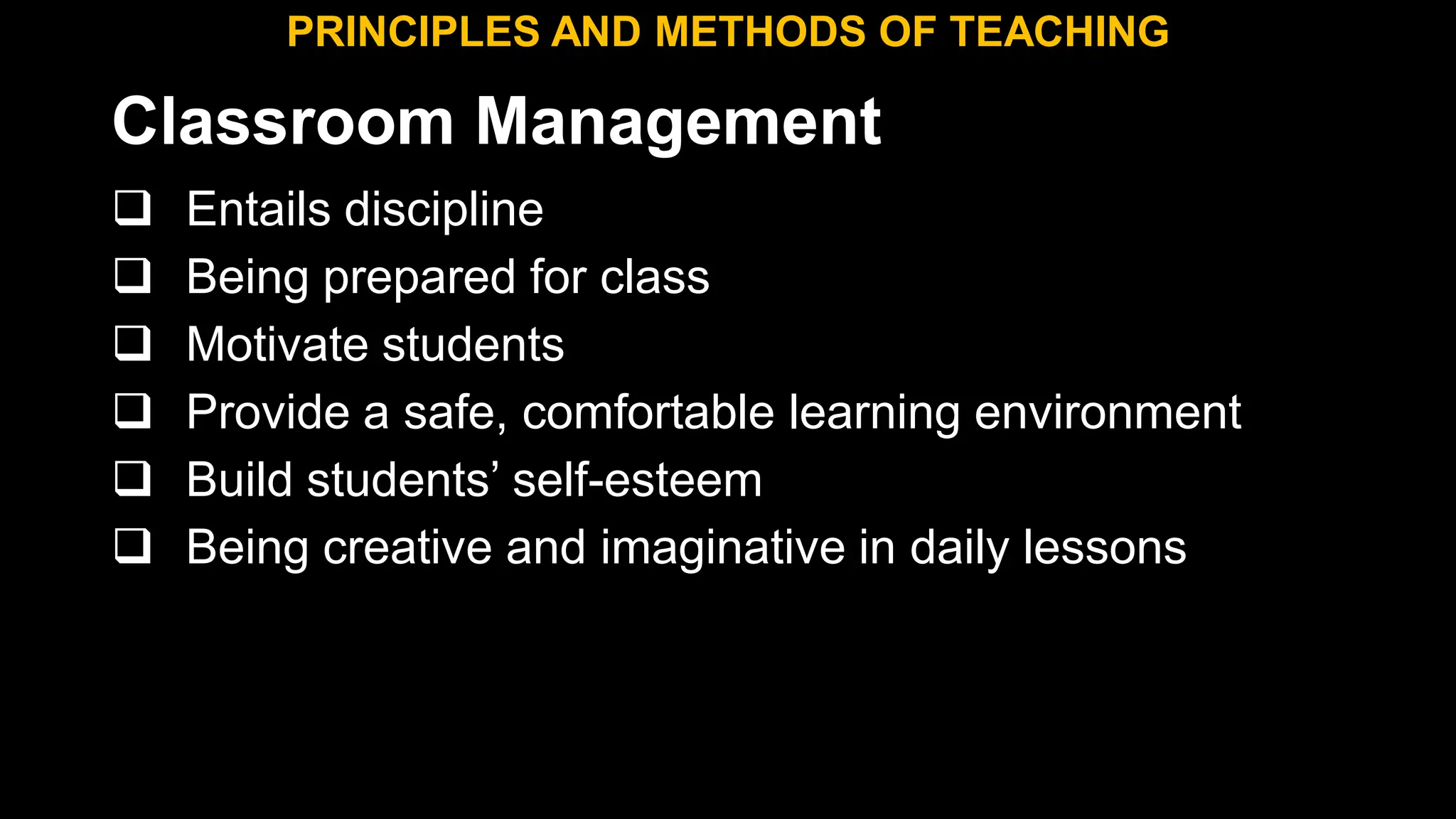
Classroom Management
 Entails discipline
 Being prepared for class
 Motivate students
 Provide a safe, comfortable learning environment
 Build students’ self-esteem
 Being creative and imaginative in daily lessons
PRINCIPLES AND METHODS OF TEACHING
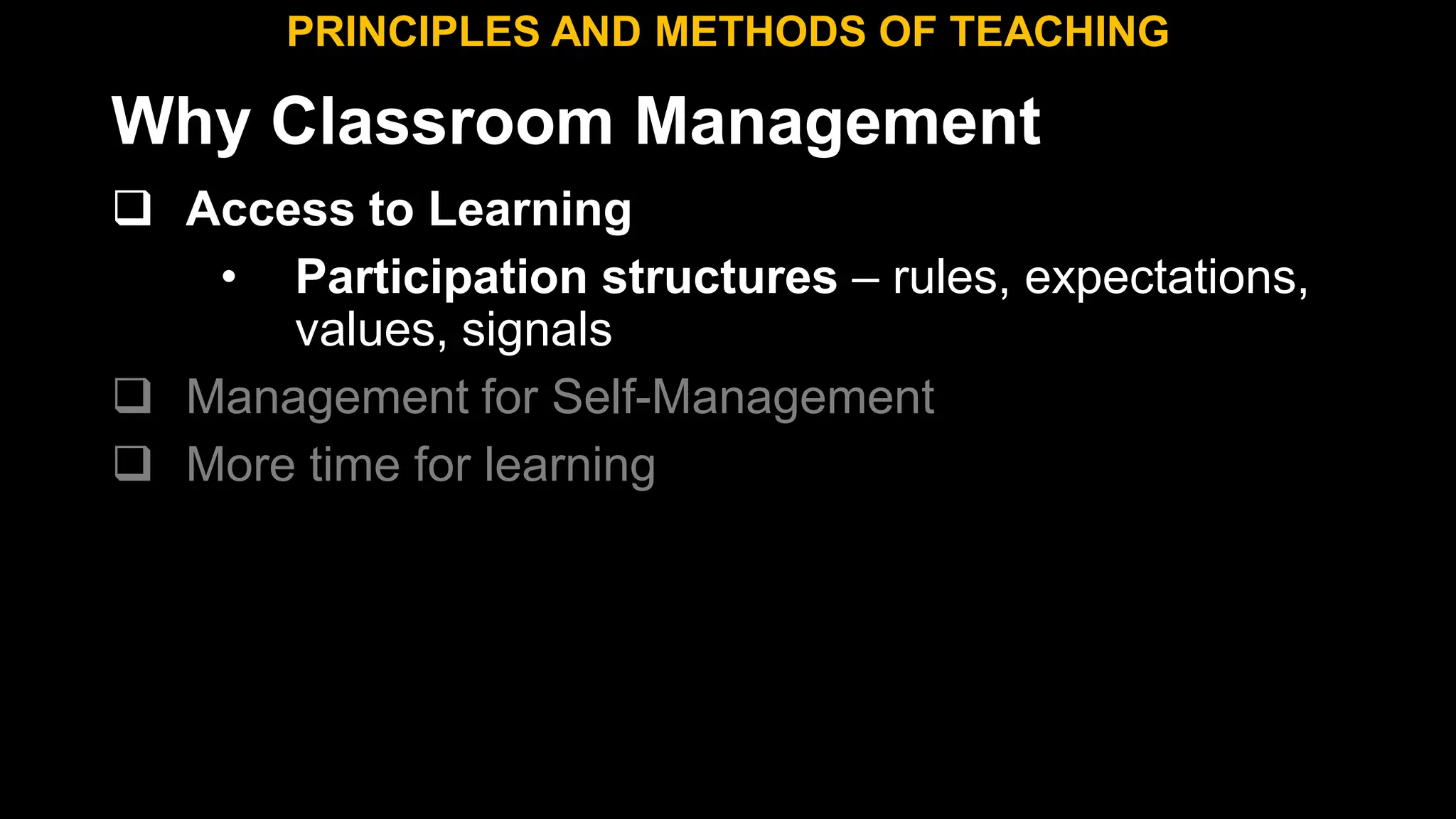
Why Classroom Management
 Access to Learning
• Participation structures – rules, expectations,
values, signals
 Management for Self-Management
 More time for learning
PRINCIPLES AND METHODS OF TEACHING
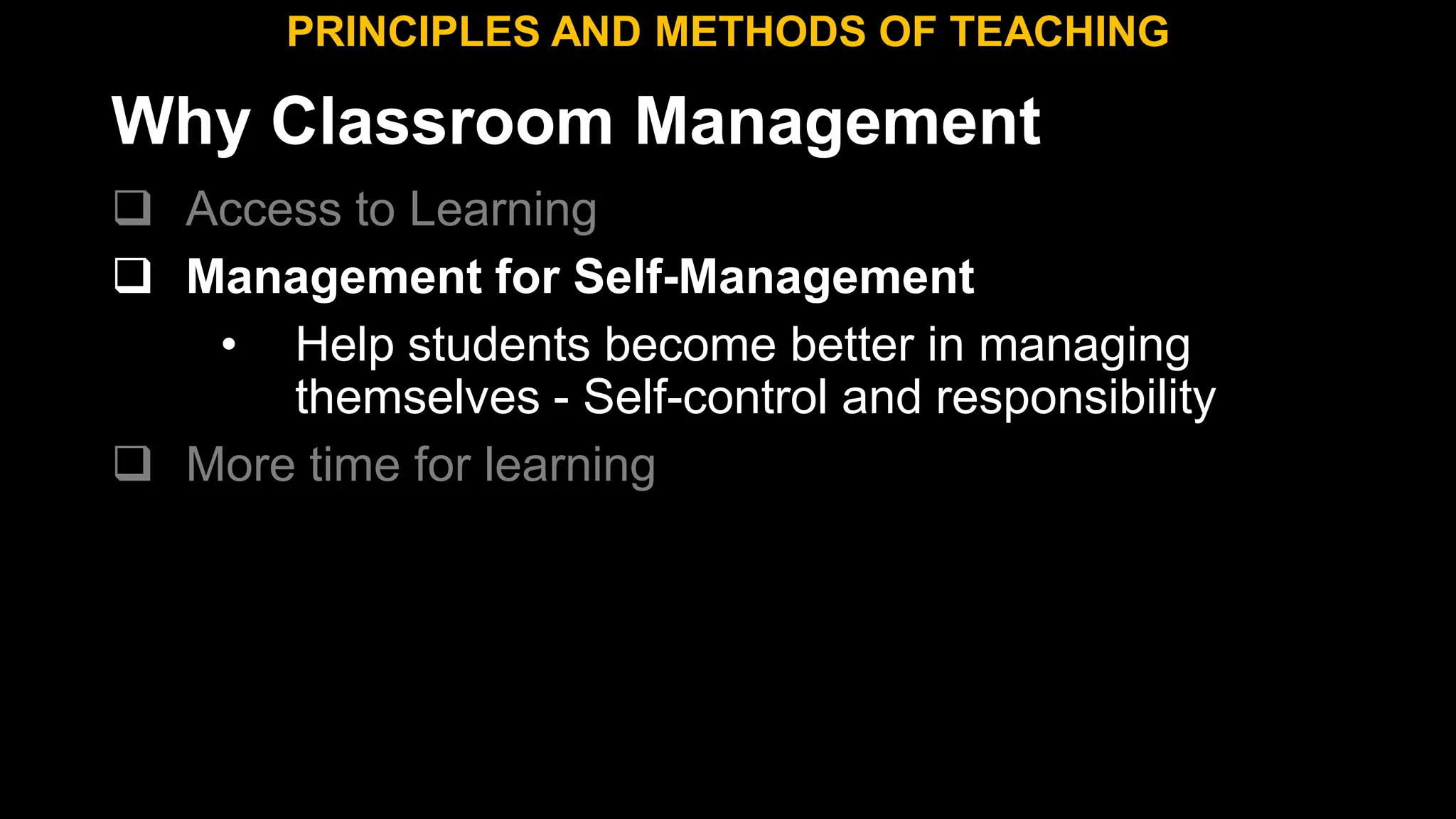
Why Classroom Management
 Access to Learning
 Management for Self-Management
• Help students become better in managing
themselves - Self-control and responsibility
 More time for learning
PRINCIPLES AND METHODS OF TEACHING
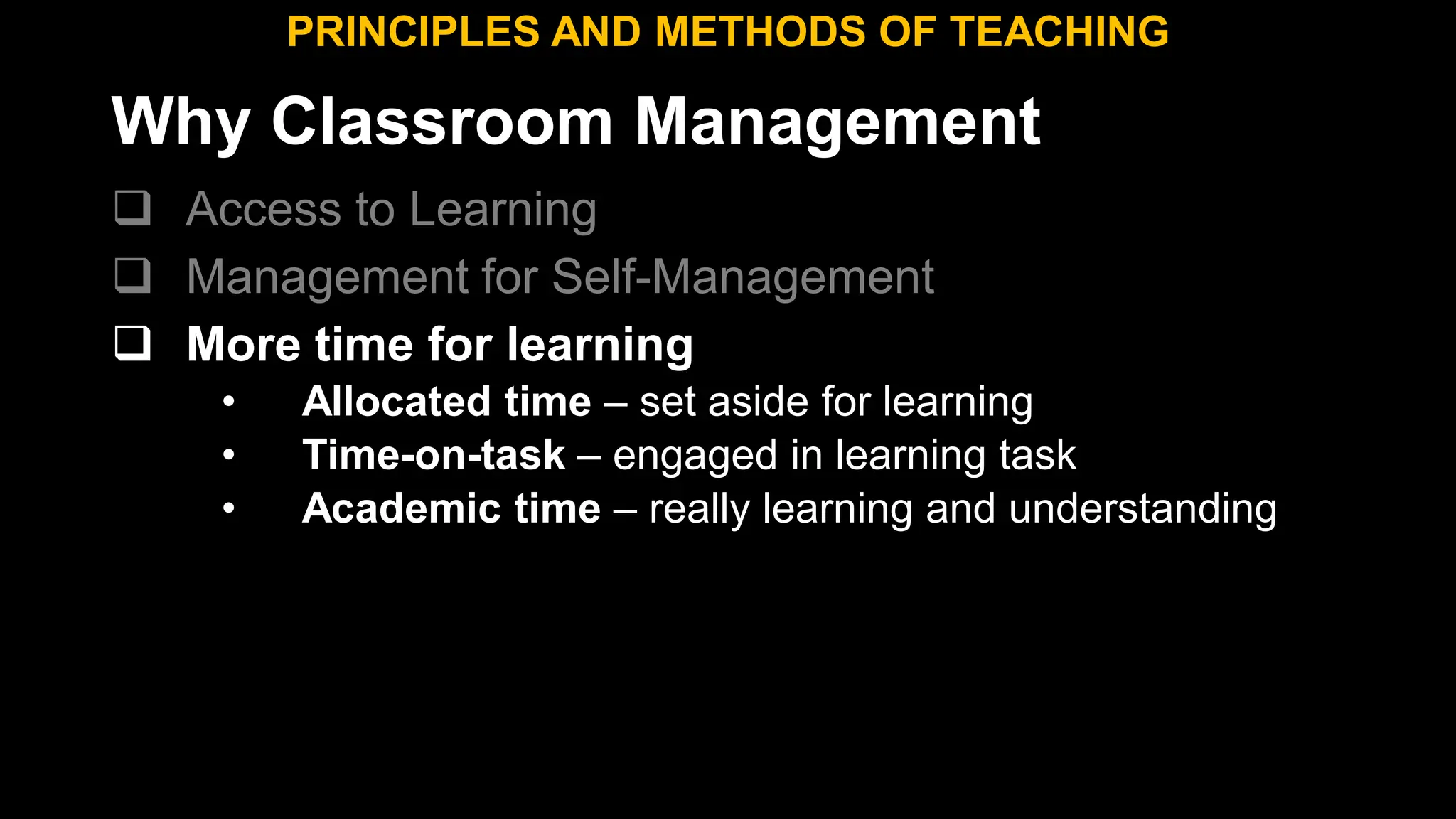
Why Classroom Management
 Access to Learning
 Management for Self-Management
 More time for learning
• Allocated time – set aside for learning
• Time-on-task – engaged in learning task
• Academic time – really learning and understanding
PRINCIPLES AND METHODS OF TEACHING
3Cs of Classroom Management
 Context
 Content
 Conduct
PRINCIPLES AND METHODS OF TEACHING
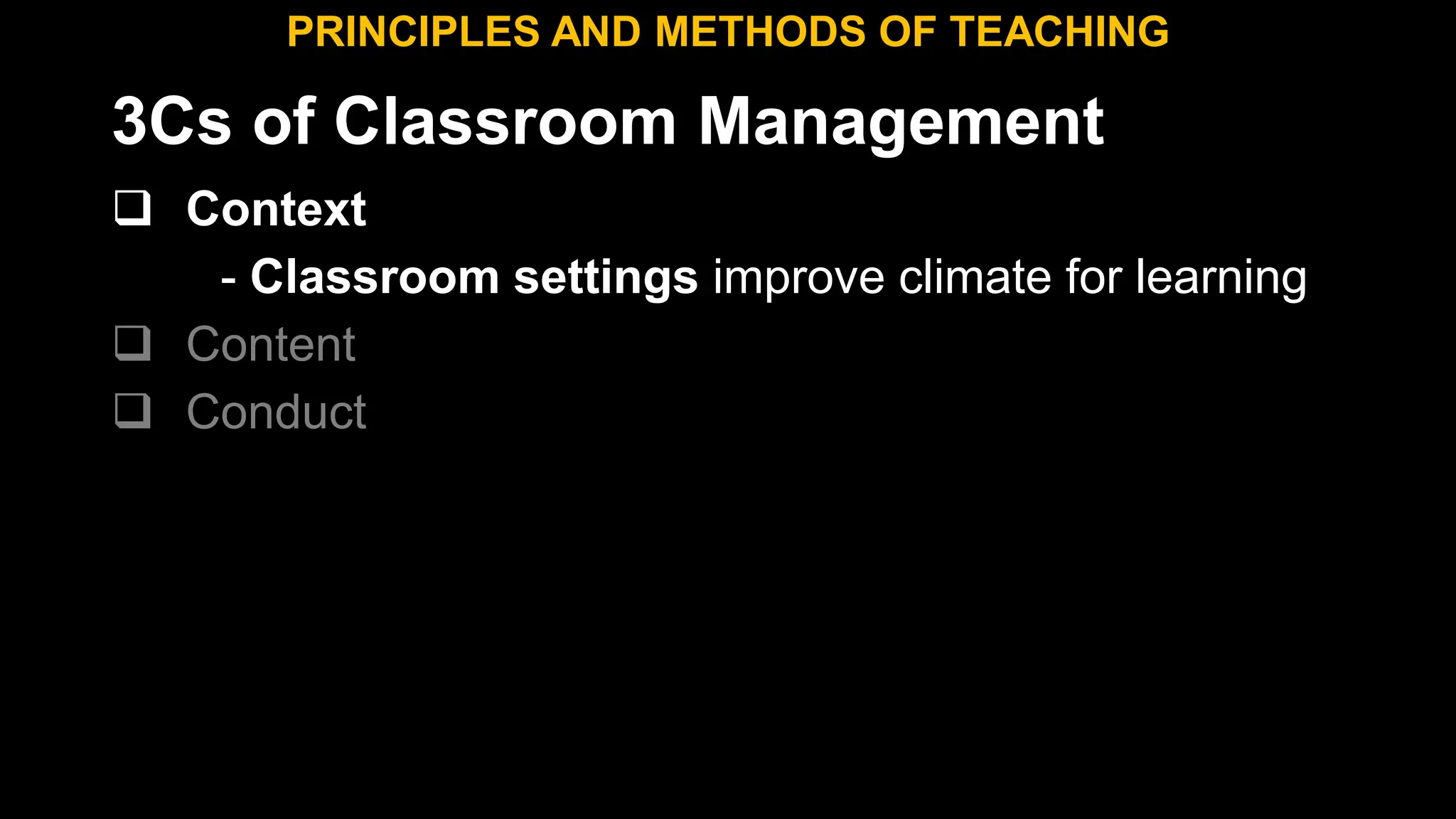
3Cs of Classroom Management
 Context
- Classroom settings improve climate for learning
 Content
 Conduct
PRINCIPLES AND METHODS OF TEACHING
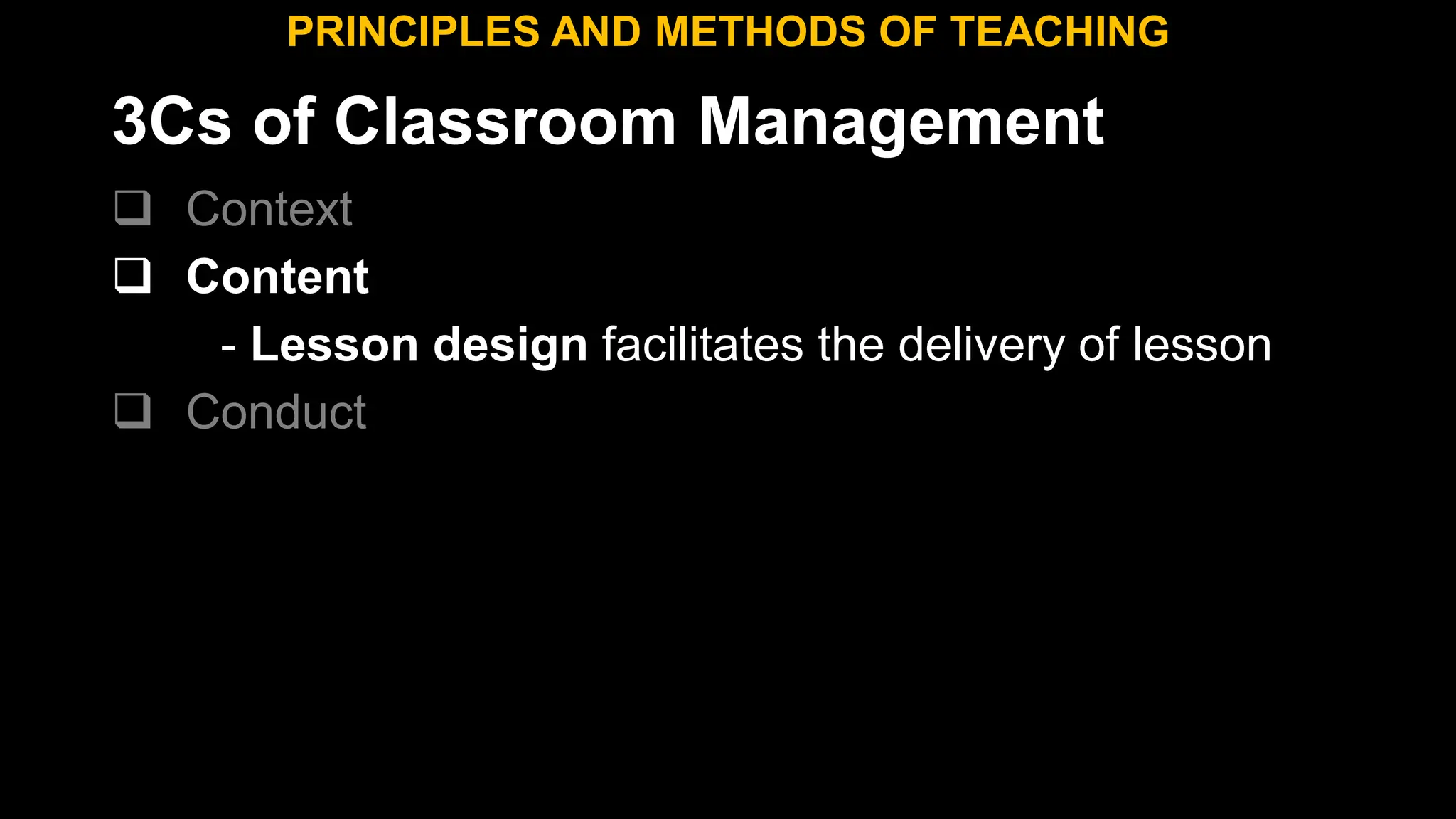
3Cs of Classroom Management
 Context
 Content
- Lesson design facilitates the delivery of lesson
 Conduct
PRINCIPLES AND METHODS OF TEACHING
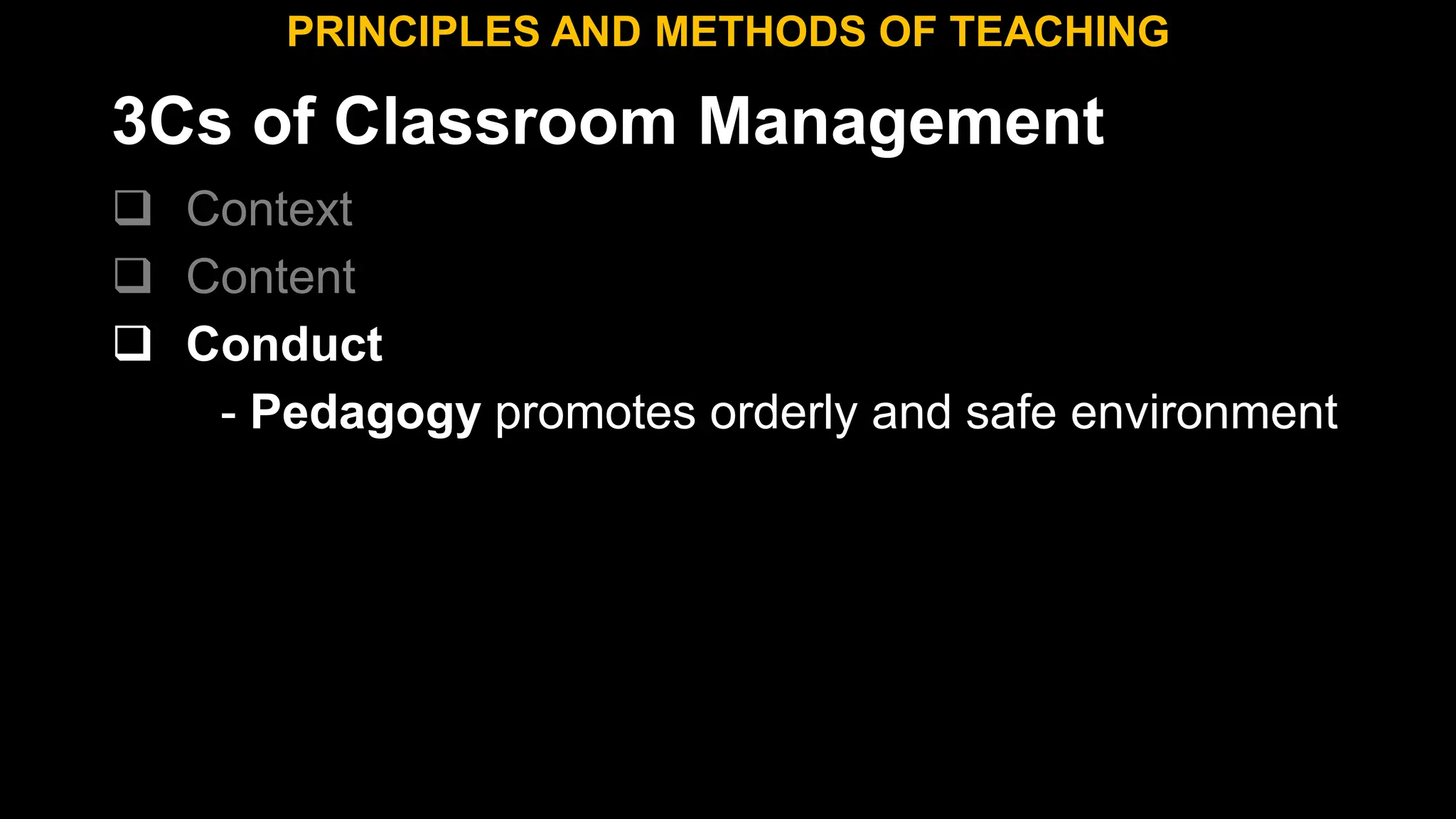
3Cs of Classroom Management
 Context
 Content
 Conduct
- Pedagogy promotes orderly and safe environment
PRINCIPLES AND METHODS OF TEACHING
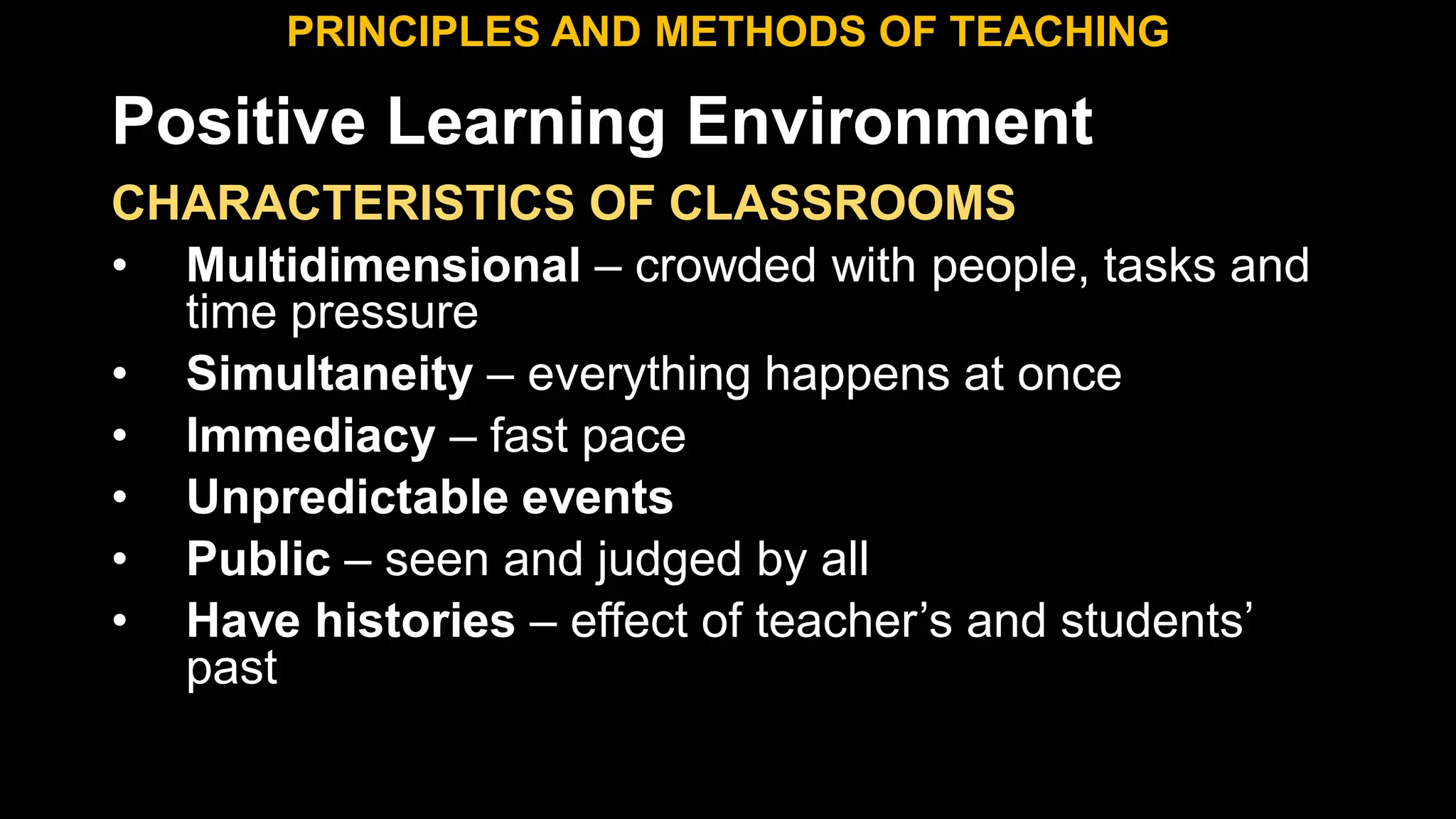
Positive Learning Environment
CHARACTERISTICS OF CLASSROOMS
• Multidimensional – crowded with people, tasks and
time pressure
• Simultaneity – everything happens at once
• Immediacy – fast pace
• Unpredictable events
• Public – seen and judged by all
• Have histories – effect of teacher’s and students’
past
PRINCIPLES AND METHODS OF TEACHING
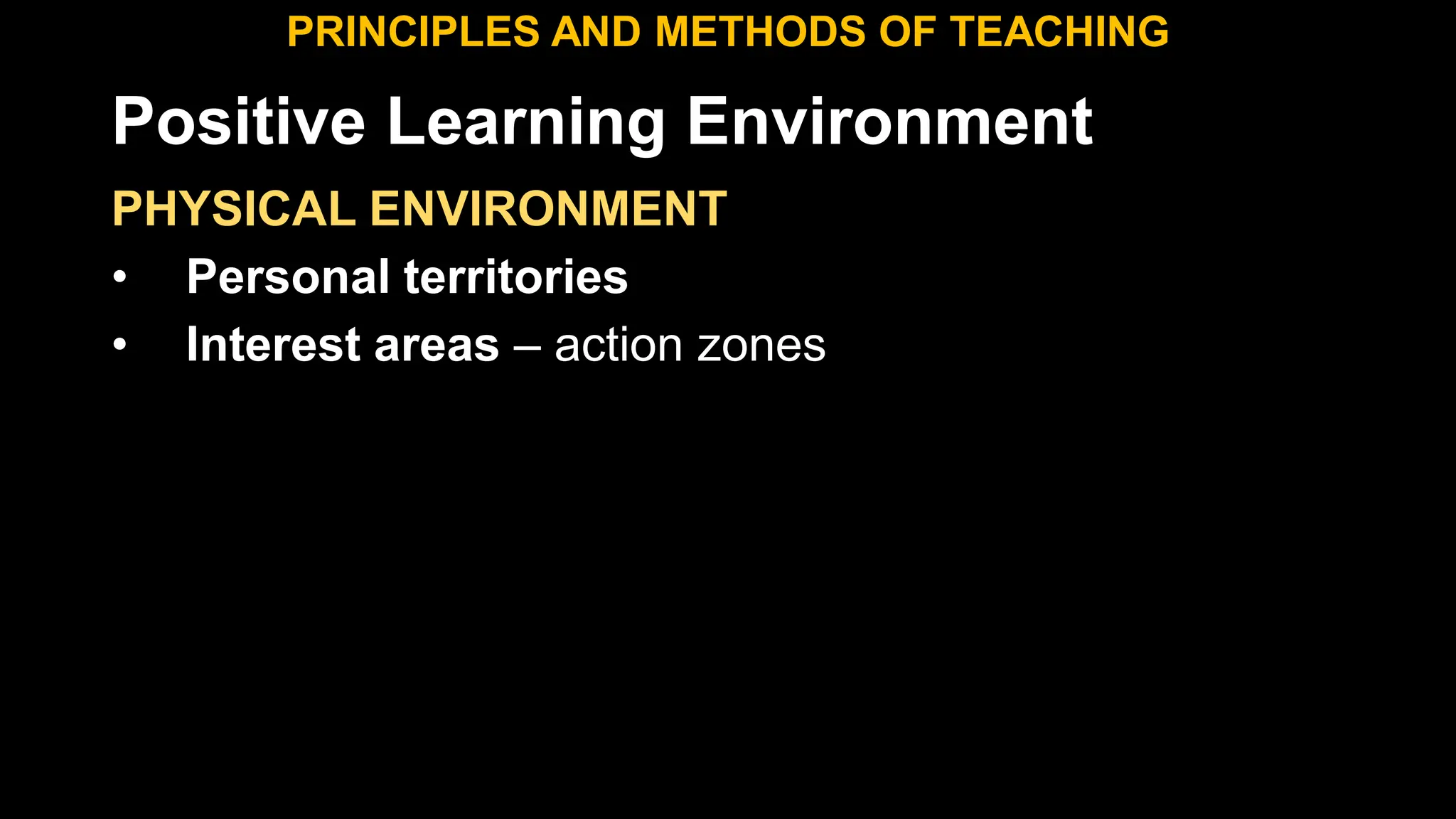
Positive Learning Environment
PHYSICAL ENVIRONMENT
• Personal territories
• Interest areas – action zones
PRINCIPLES AND METHODS OF TEACHING
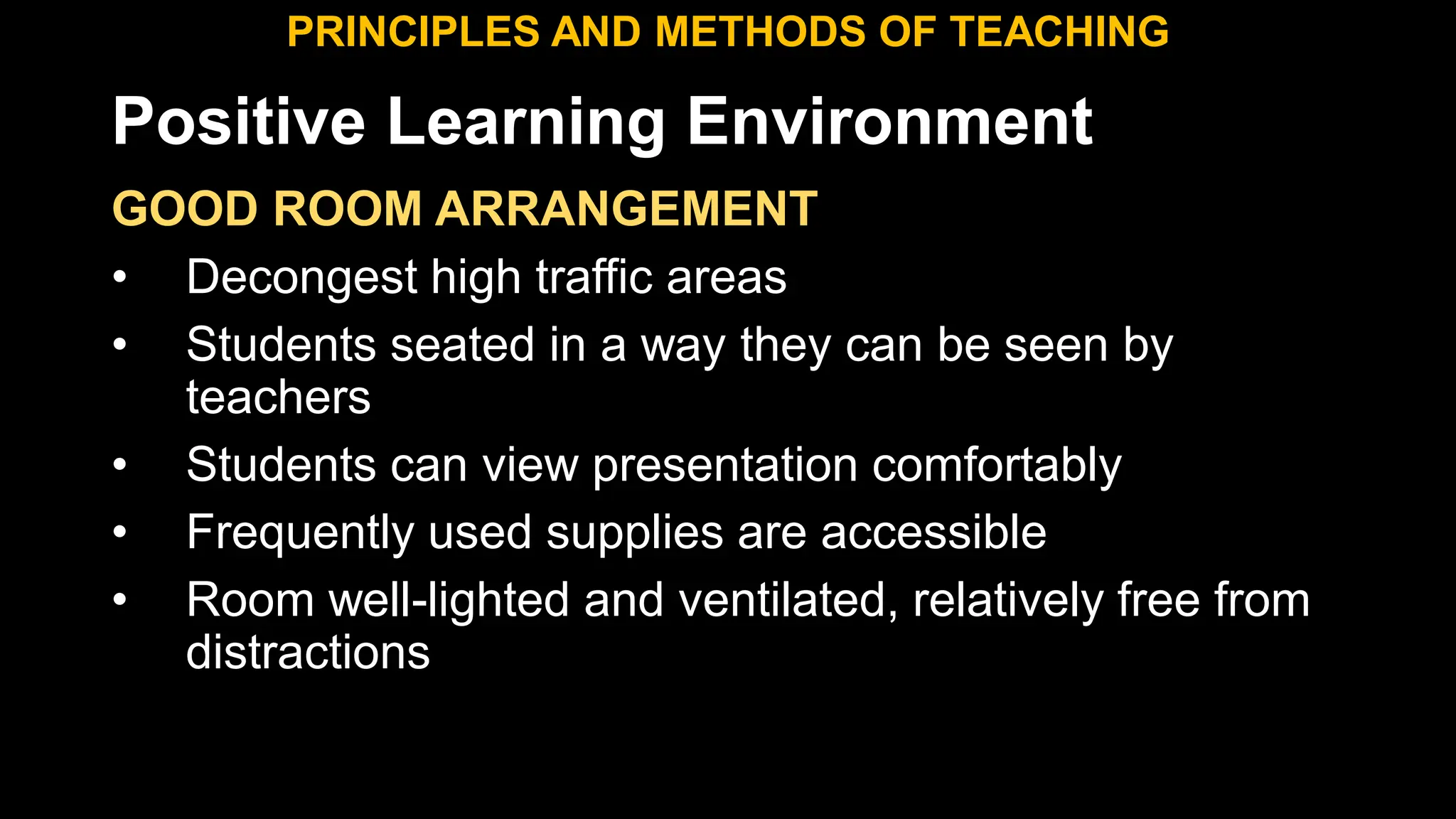
Positive Learning Environment
GOOD ROOM ARRANGEMENT
• Decongest high traffic areas
• Students seated in a way they can be seen by
teachers
• Students can view presentation comfortably
• Frequently used supplies are accessible
• Room well-lighted and ventilated, relatively free from
distractions
PRINCIPLES AND METHODS OF TEACHING
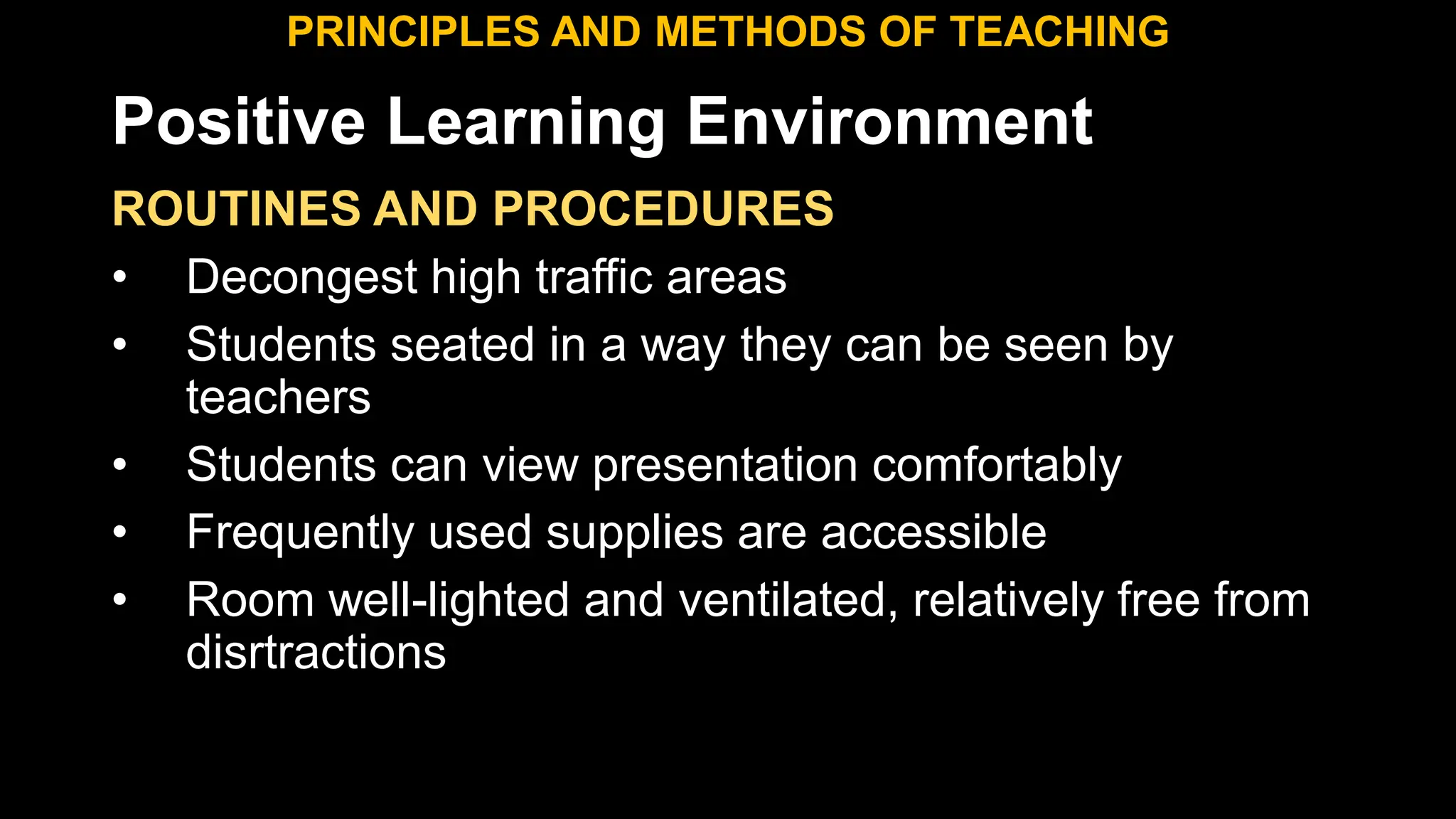
Positive Learning Environment
ROUTINES AND PROCEDURES
• Decongest high traffic areas
• Students seated in a way they can be seen by
teachers
• Students can view presentation comfortably
• Frequently used supplies are accessible
• Room well-lighted and ventilated, relatively free from
disrtractions
PRINCIPLES AND METHODS OF TEACHING
Positive Learning Environment
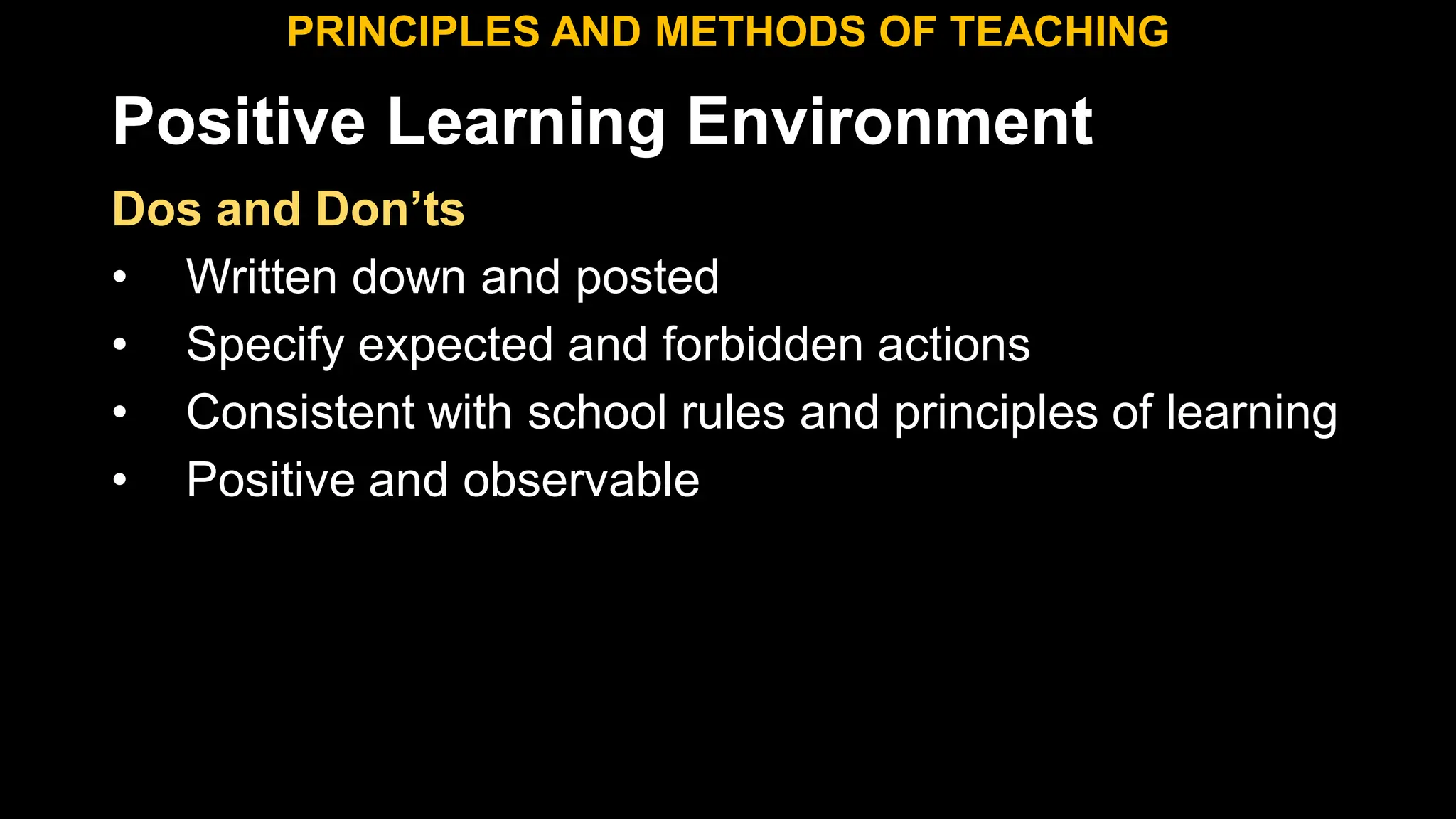
Dos and Don’ts
• Written down and posted
• Specify expected and forbidden actions
• Consistent with school rules and principles of learning
• Positive and observable
PRINCIPLES AND METHODS OF TEACHING
Positive Learning Environment
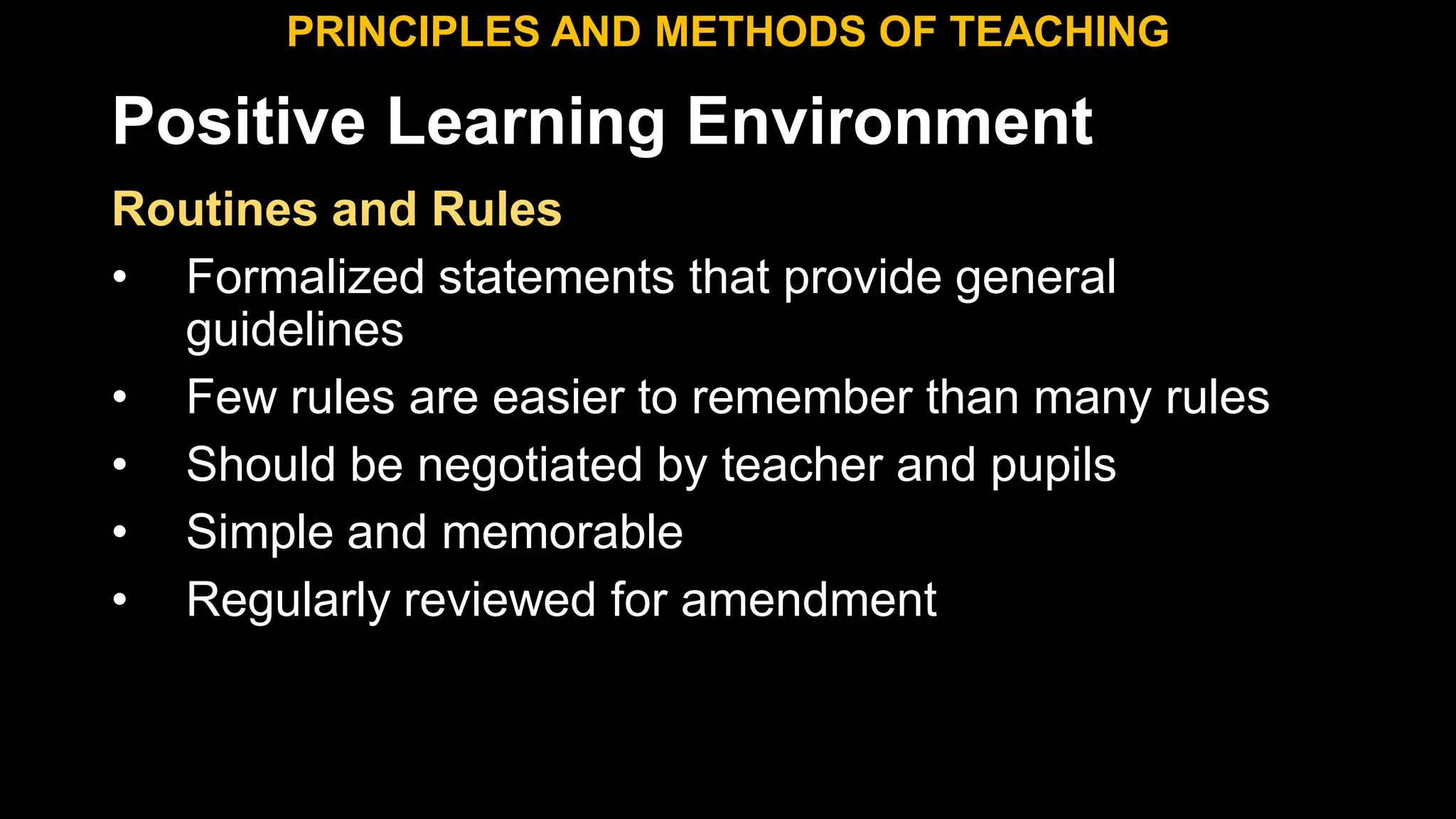
Routines and Rules
• Formalized statements that provide general
guidelines
• Few rules are easier to remember than many rules
• Should be negotiated by teacher and pupils
• Simple and memorable
• Regularly reviewed for amendment
PRINCIPLES AND METHODS OF TEACHING
Positive Learning Environment
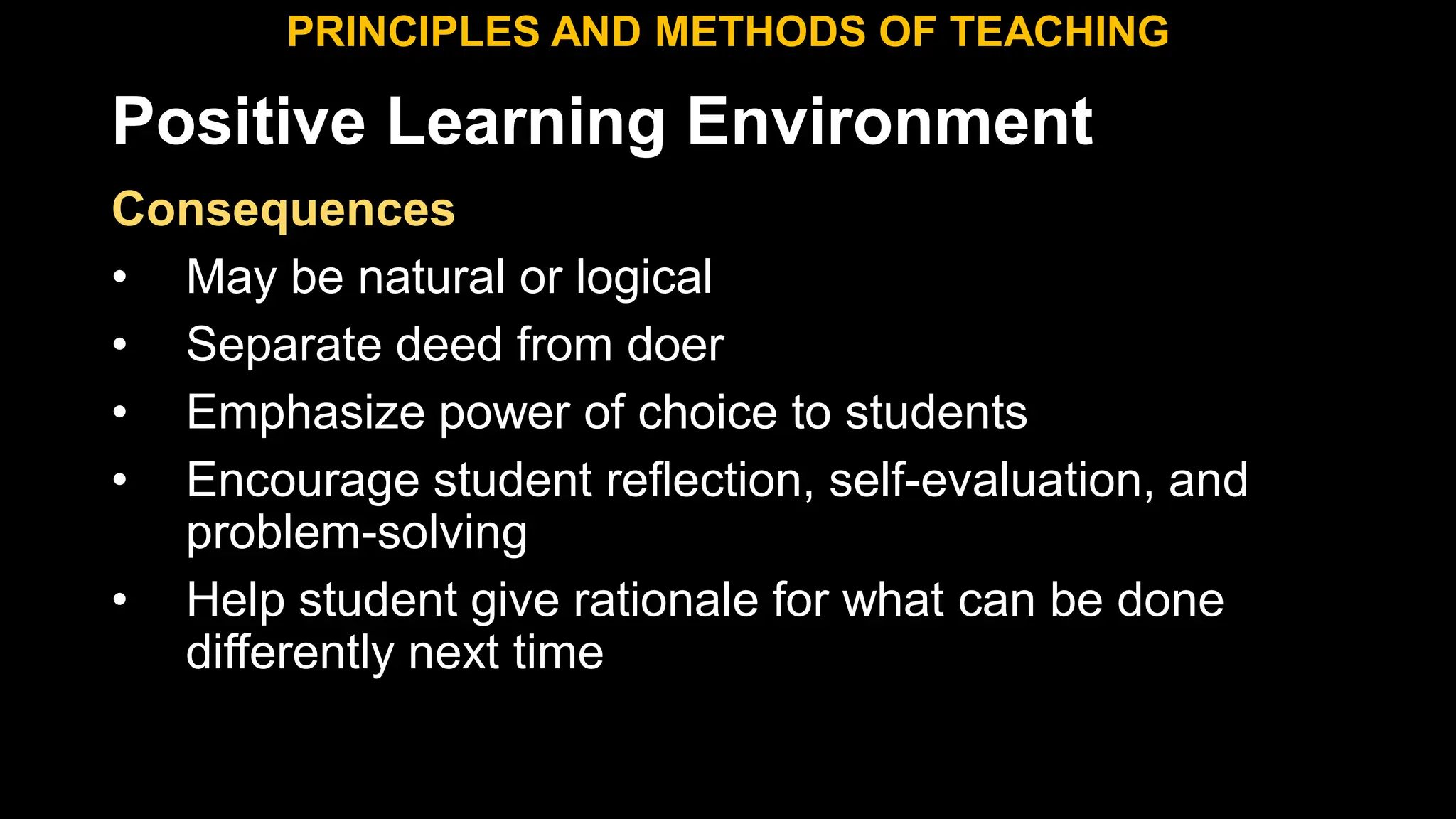
Consequences
• May be natural or logical
• Separate deed from doer
• Emphasize power of choice to students
• Encourage student reflection, self-evaluation, and
problem-solving
• Help student give rationale for what can be done
differently next time
PRINCIPLES AND METHODS OF TEACHING
Classroom Management Approaches
PRINCIPLES AND METHODS OF TEACHING
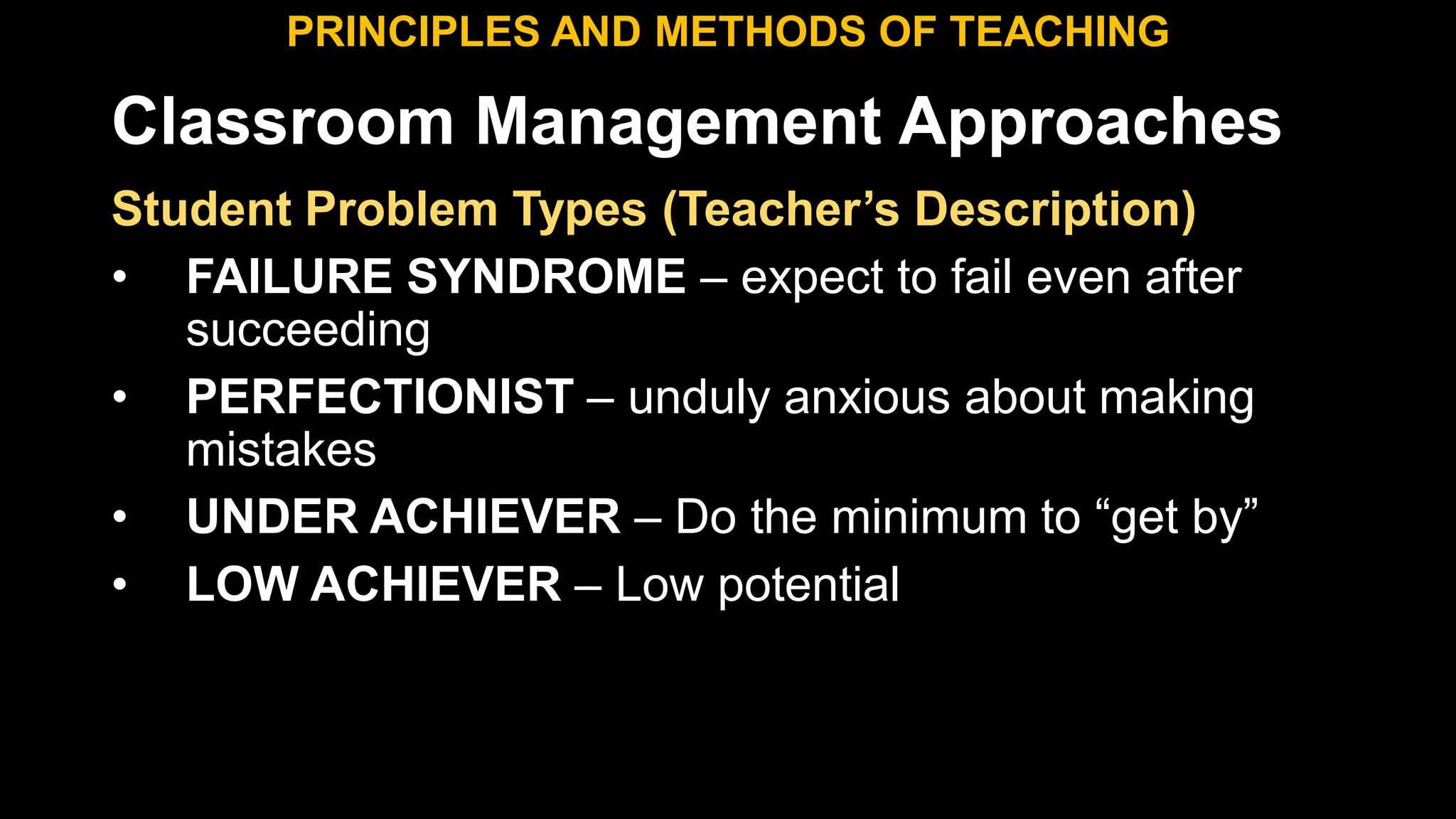
Student Problem Types (Teacher’s Description)
• FAILURE SYNDROME – expect to fail even after
succeeding
• PERFECTIONIST – unduly anxious about making
mistakes
• UNDER ACHIEVER – Do the minimum to “get by”
• LOW ACHIEVER – Low potential
Classroom Management Approaches
PRINCIPLES AND METHODS OF TEACHING
Student Problem Types (Teacher’s Description)
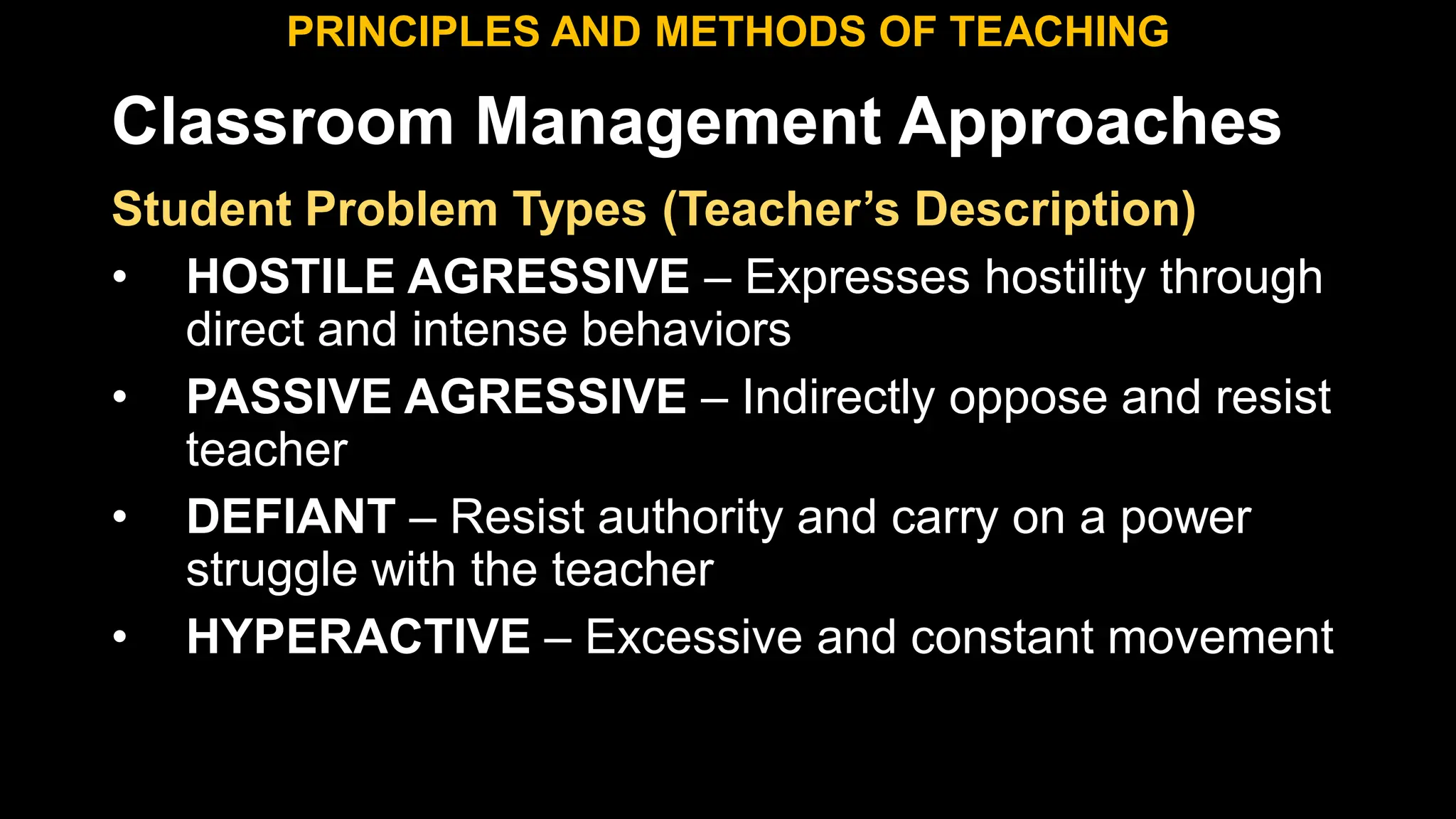
• HOSTILE AGRESSIVE – Expresses hostility through
direct and intense behaviors
• PASSIVE AGRESSIVE – Indirectly oppose and resist
teacher
• DEFIANT – Resist authority and carry on a power
struggle with the teacher
• HYPERACTIVE – Excessive and constant movement
Classroom Management Approaches
PRINCIPLES AND METHODS OF TEACHING
Assertive Approach
Teachers
• take charge of classroom immediately
• Are clear, firm, unhostile response to students’
misbehavior
Classroom Management Approaches
PRINCIPLES AND METHODS OF TEACHING
Business Academic Approach
Teachers
• focuses on business-like and orderly accomplishment of
academic work
• Communicates assignments and feedback
• High degree of “time on task” and “academic engaged
time”
Classroom Management Approaches
PRINCIPLES AND METHODS OF TEACHING
Behavioral Modification
Teachers
• assumes that behavior is shaped by environment
• Increase the occurrence of appropriate behavior through
rewards
• Reduce the likelihood of inappropriate behavior through
punishments
Classroom Management Approaches
PRINCIPLES AND METHODS OF TEACHING
Group Managerial Approach
Teachers
• Respond immediately to undesirable or inappropriate
behavior
• Prevention is better than cure
Classroom Management Approaches
PRINCIPLES AND METHODS OF TEACHING
Group Guidance Approach
• Discipline and classroom control are produced through
group atmosphere and enhanced through group rapport
Classroom Management Approaches
PRINCIPLES AND METHODS OF TEACHING
Acceptance Approach
• Allowing students to participate in decision and make
choices
• Attention seeking
• Power seeking
• Revenge seeking
• Withdrawal
Classroom Management Approaches
PRINCIPLES AND METHODS OF TEACHING
Success Approach
• Teachers are supportive so that students develop their
self-worth and success in life
Classroom Management Approaches
PRINCIPLES AND METHODS OF TEACHING
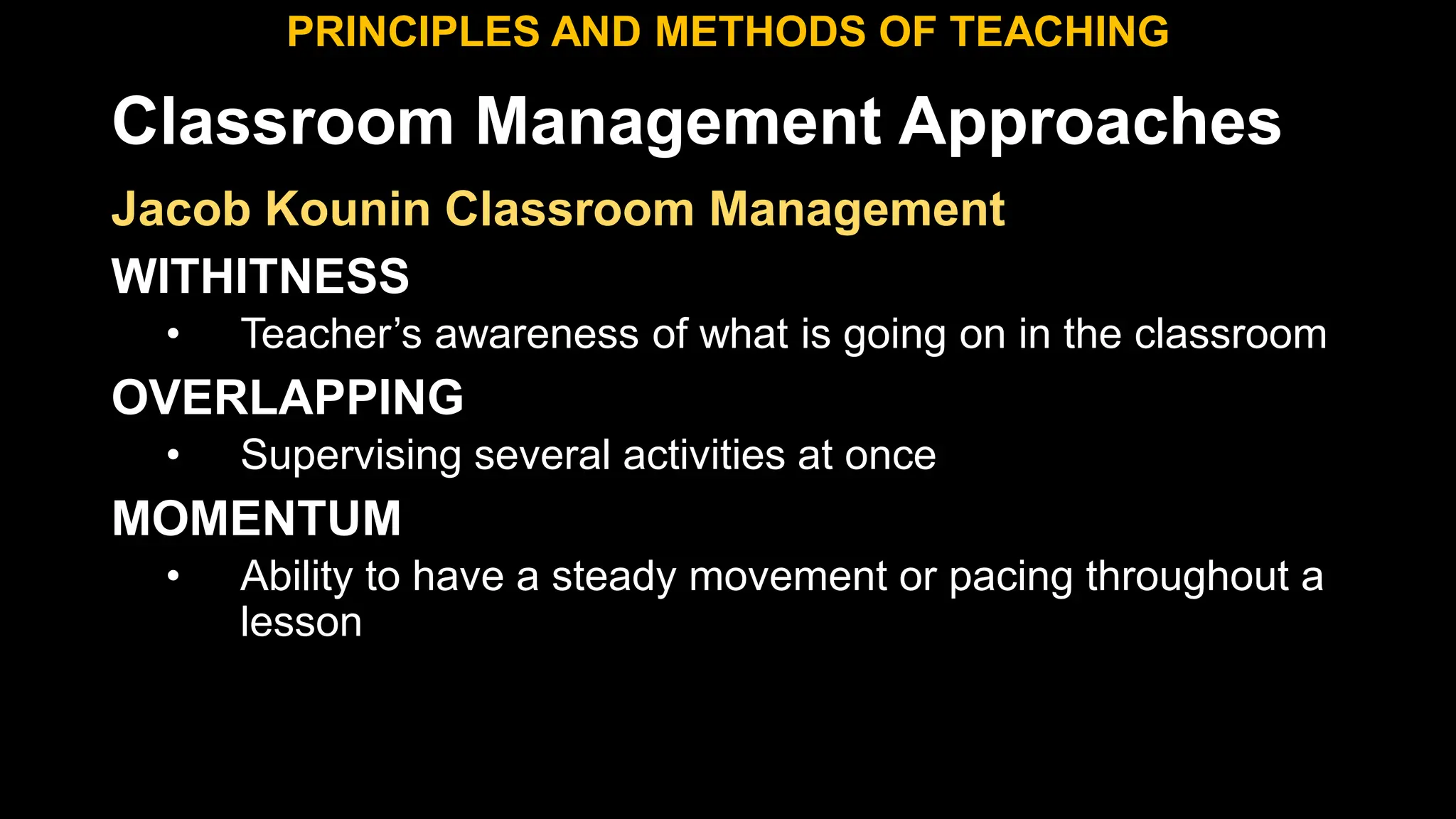
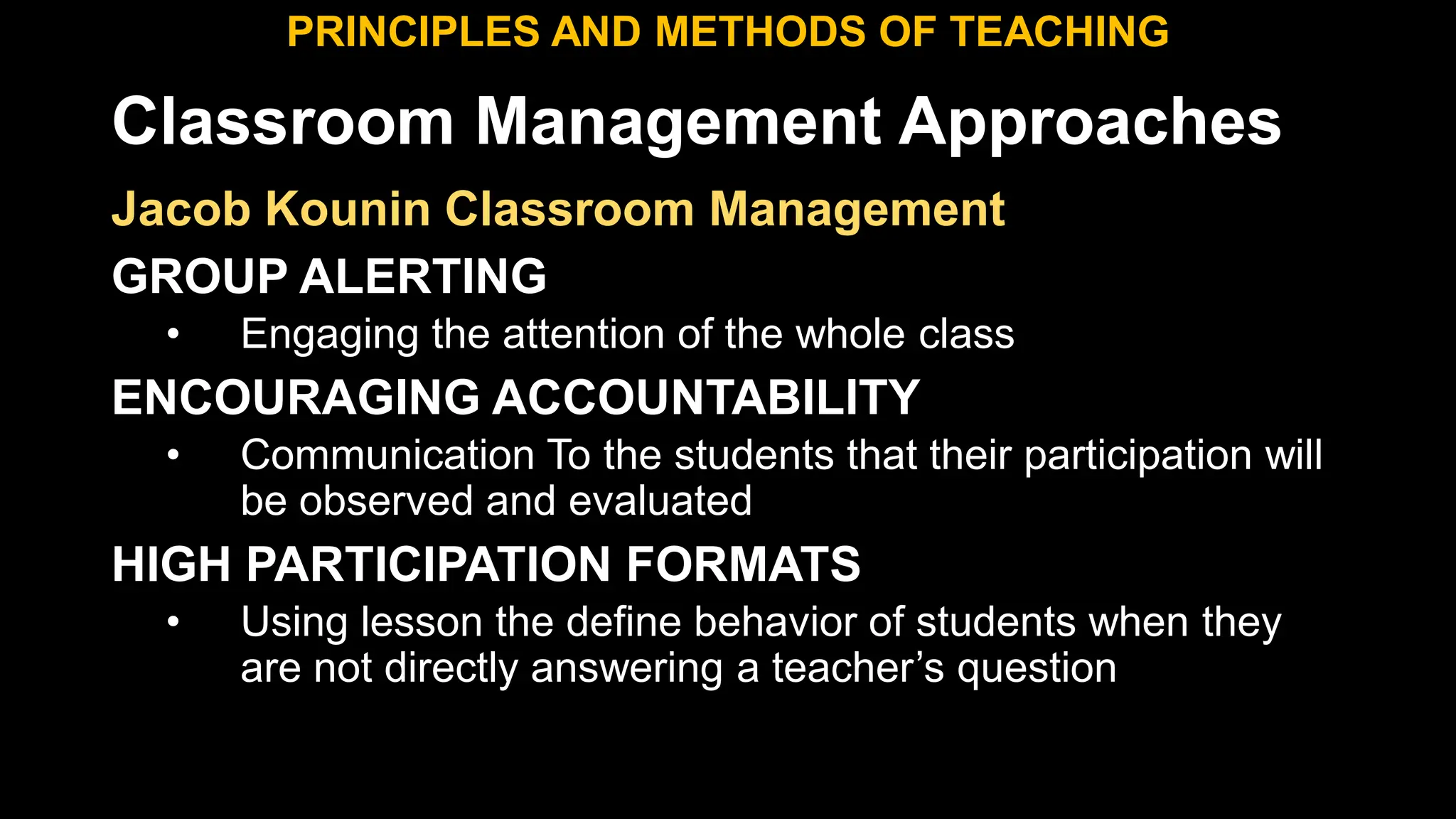
Jacob Kounin Classroom Management
WITHITNESS
• Teacher’s awareness of what is going on in the classroom
OVERLAPPING
• Supervising several activities at once
MOMENTUM
• Ability to have a steady movement or pacing throughout a
lesson
Classroom Management Approaches
PRINCIPLES AND METHODS OF TEACHING
Jacob Kounin Classroom Management
GROUP ALERTING
• Engaging the attention of the whole class
ENCOURAGING ACCOUNTABILITY
• Communication To the students that their participation will
be observed and evaluated
HIGH PARTICIPATION FORMATS
• Using lesson the define behavior of students when they
are not directly answering a teacher’s question
Classroom Management Approaches
PRINCIPLES AND METHODS OF TEACHING
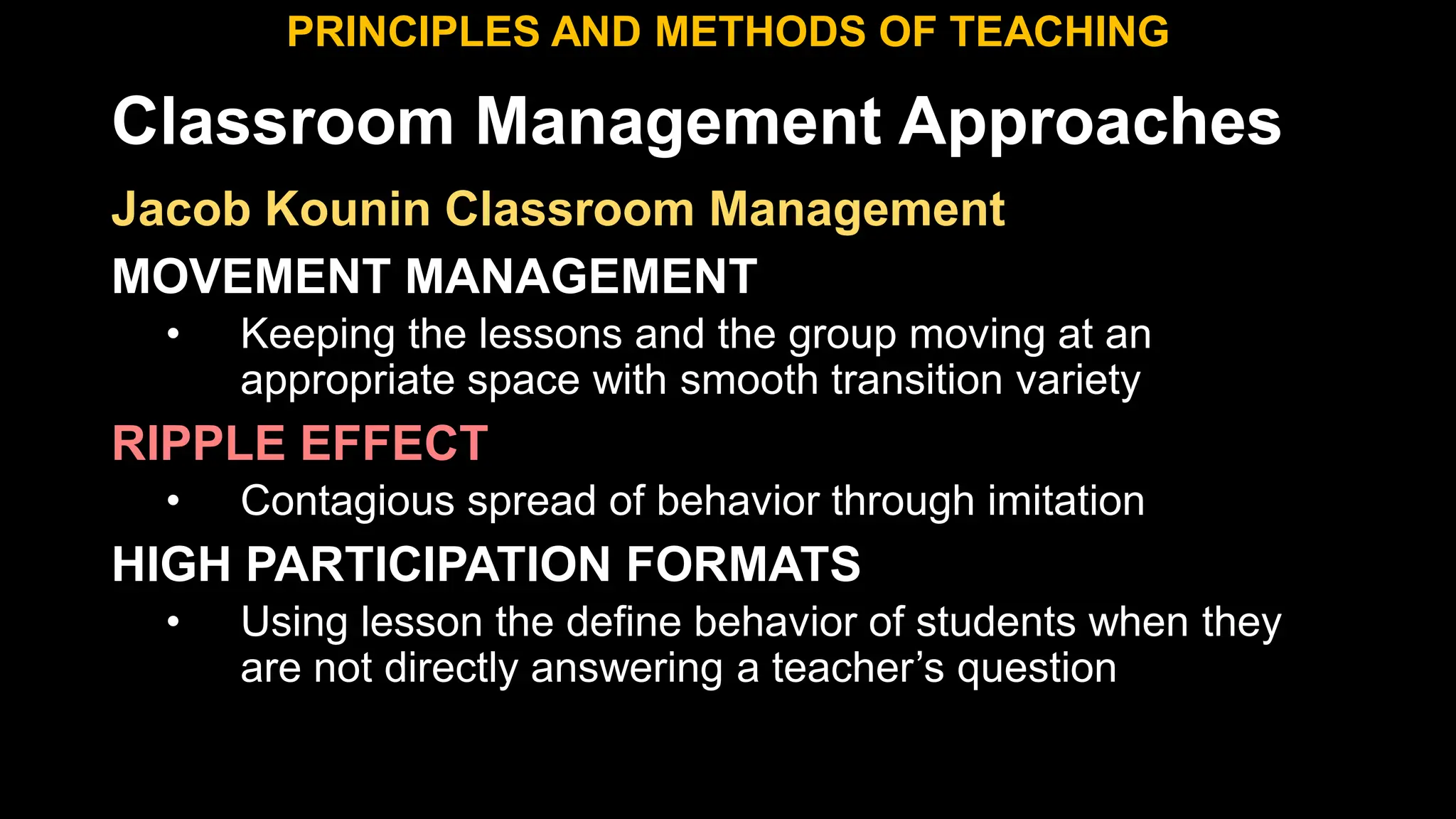
Jacob Kounin Classroom Management
MOVEMENT MANAGEMENT
• Keeping the lessons and the group moving at an
appropriate space with smooth transition variety
RIPPLE EFFECT
• Contagious spread of behavior through imitation
HIGH PARTICIPATION FORMATS
• Using lesson the define behavior of students when they
are not directly answering a teacher’s question
Classroom Management Approaches
PRINCIPLES AND METHODS OF TEACHING
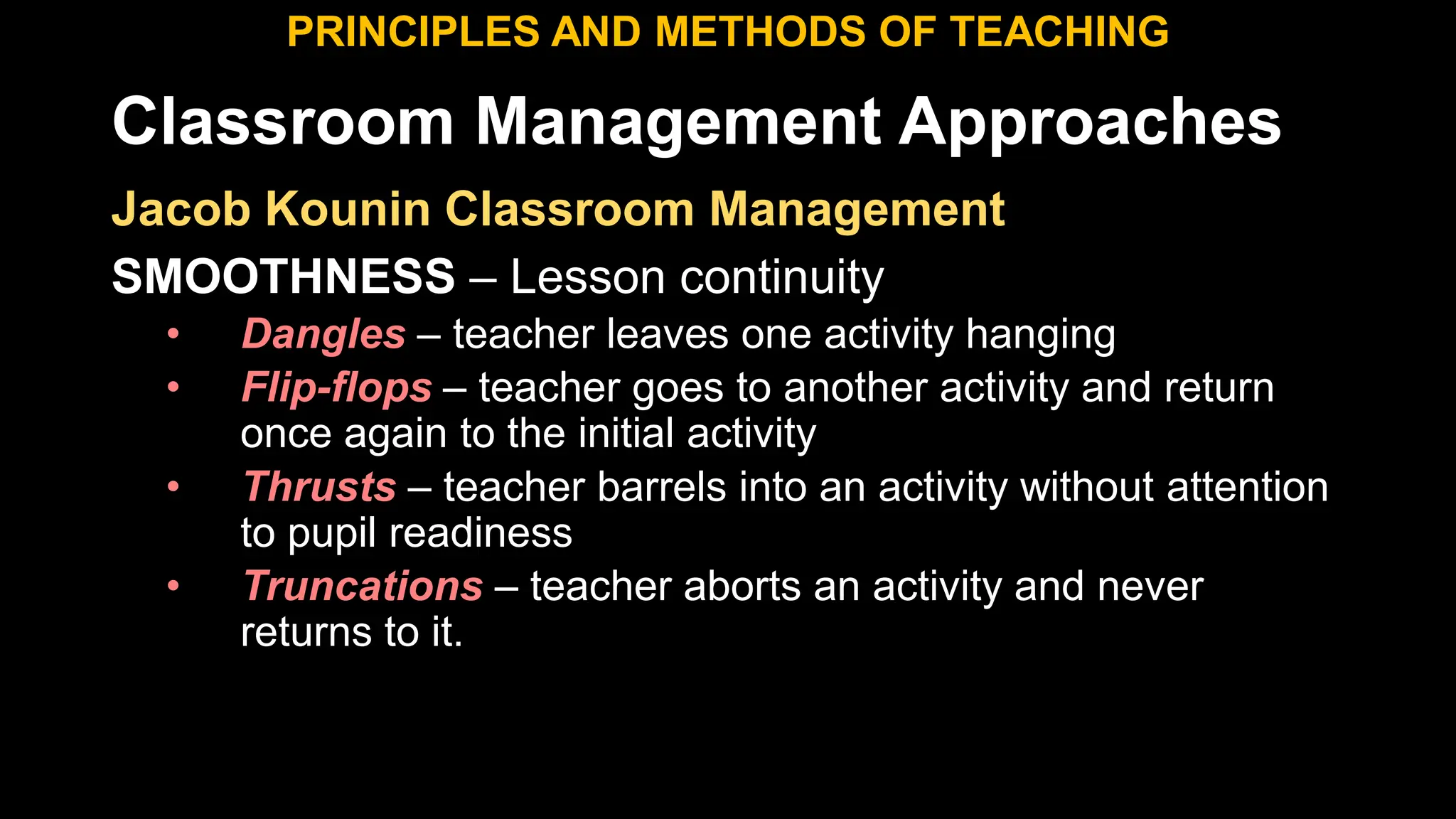
Jacob Kounin Classroom Management
SMOOTHNESS – Lesson continuity
• Dangles – teacher leaves one activity hanging
• Flip-flops – teacher goes to another activity and return
once again to the initial activity
• Thrusts – teacher barrels into an activity without attention
to pupil readiness
• Truncations – teacher aborts an activity and never
returns to it.
Classroom Management Approaches
PRINCIPLES AND METHODS OF TEACHING
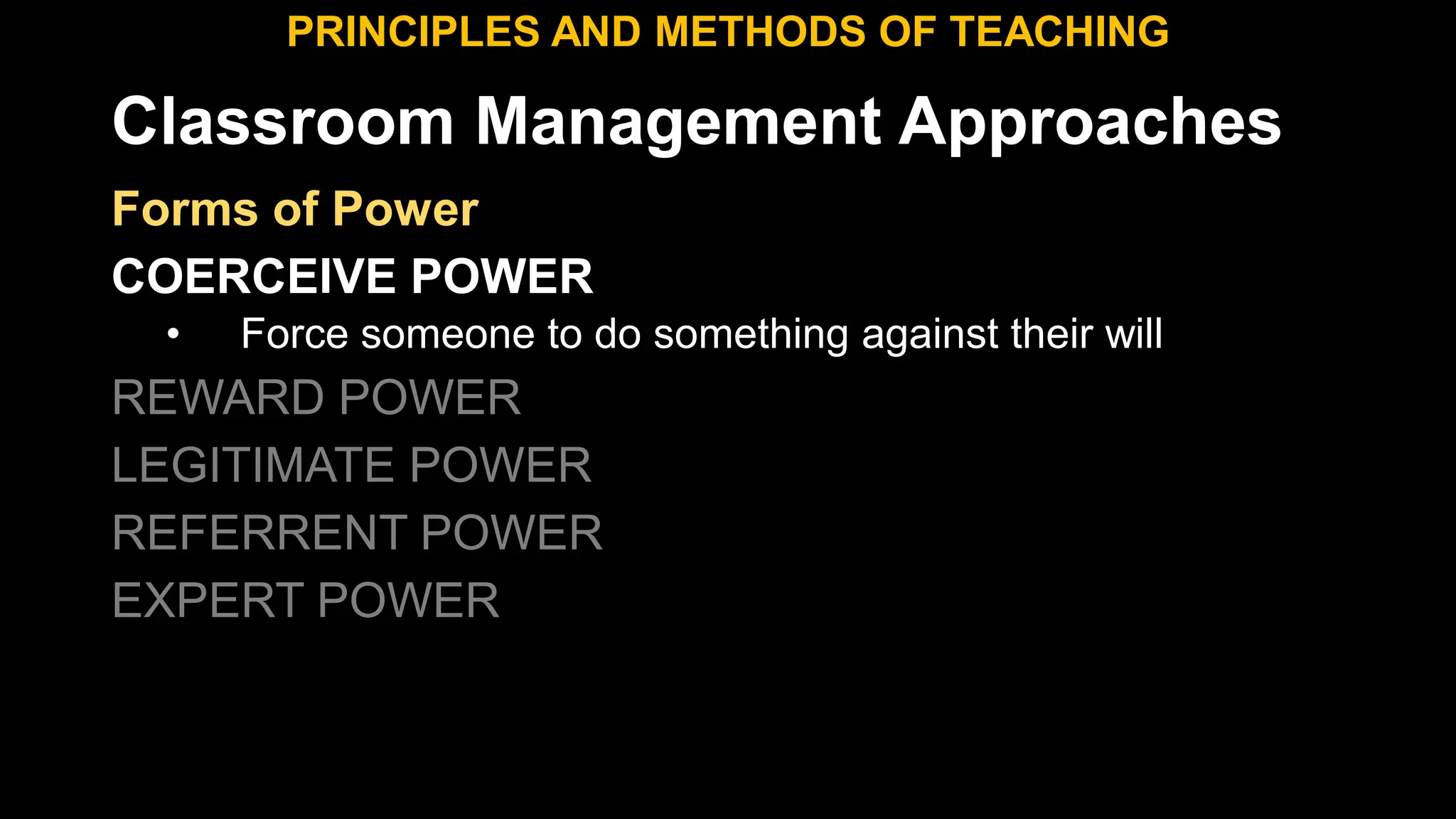
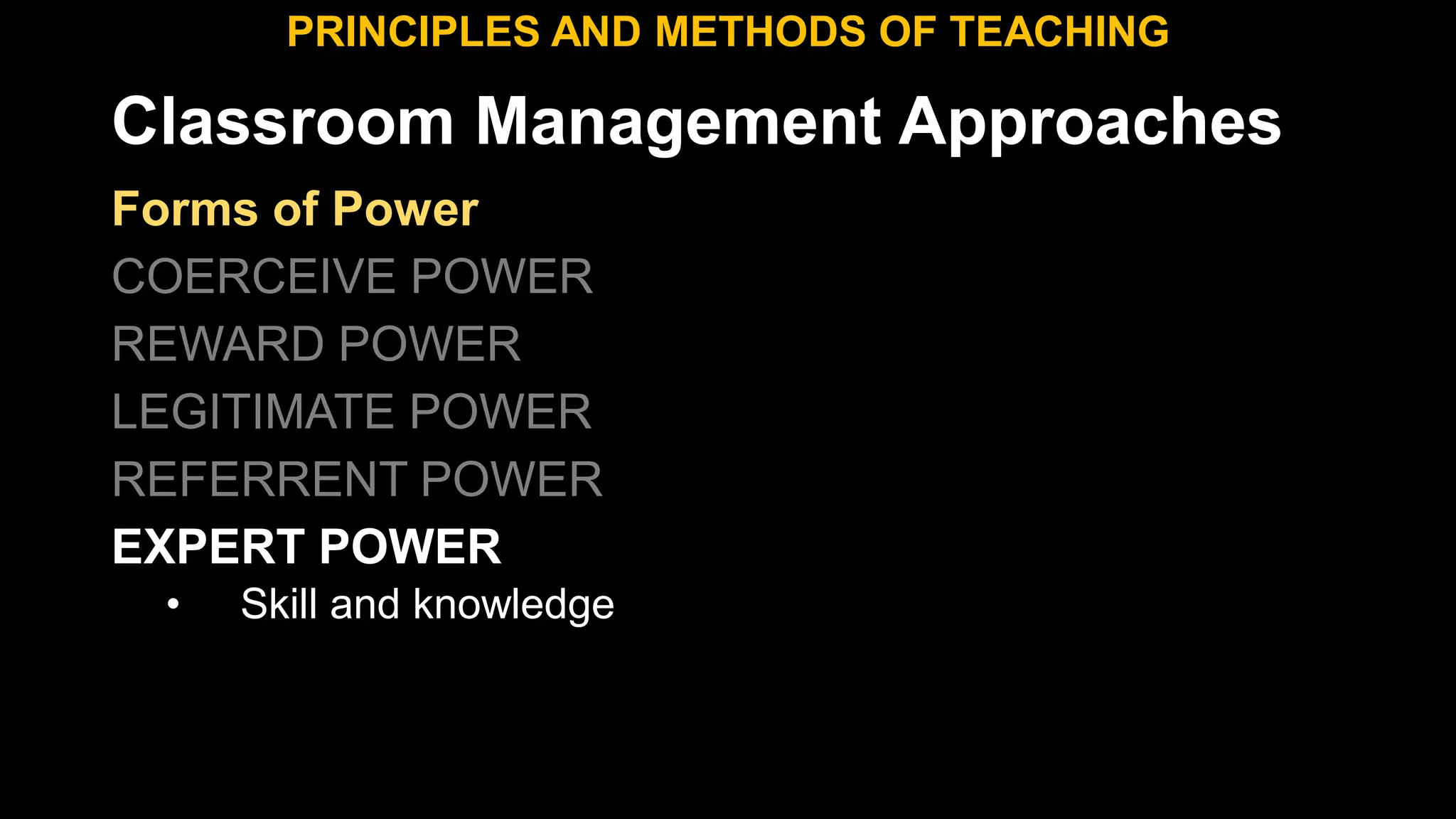
Forms of Power
COERCEIVE POWER
• Force someone to do something against their will
REWARD POWER
LEGITIMATE POWER
REFERRENT POWER
EXPERT POWER
Classroom Management Approaches
PRINCIPLES AND METHODS OF TEACHING
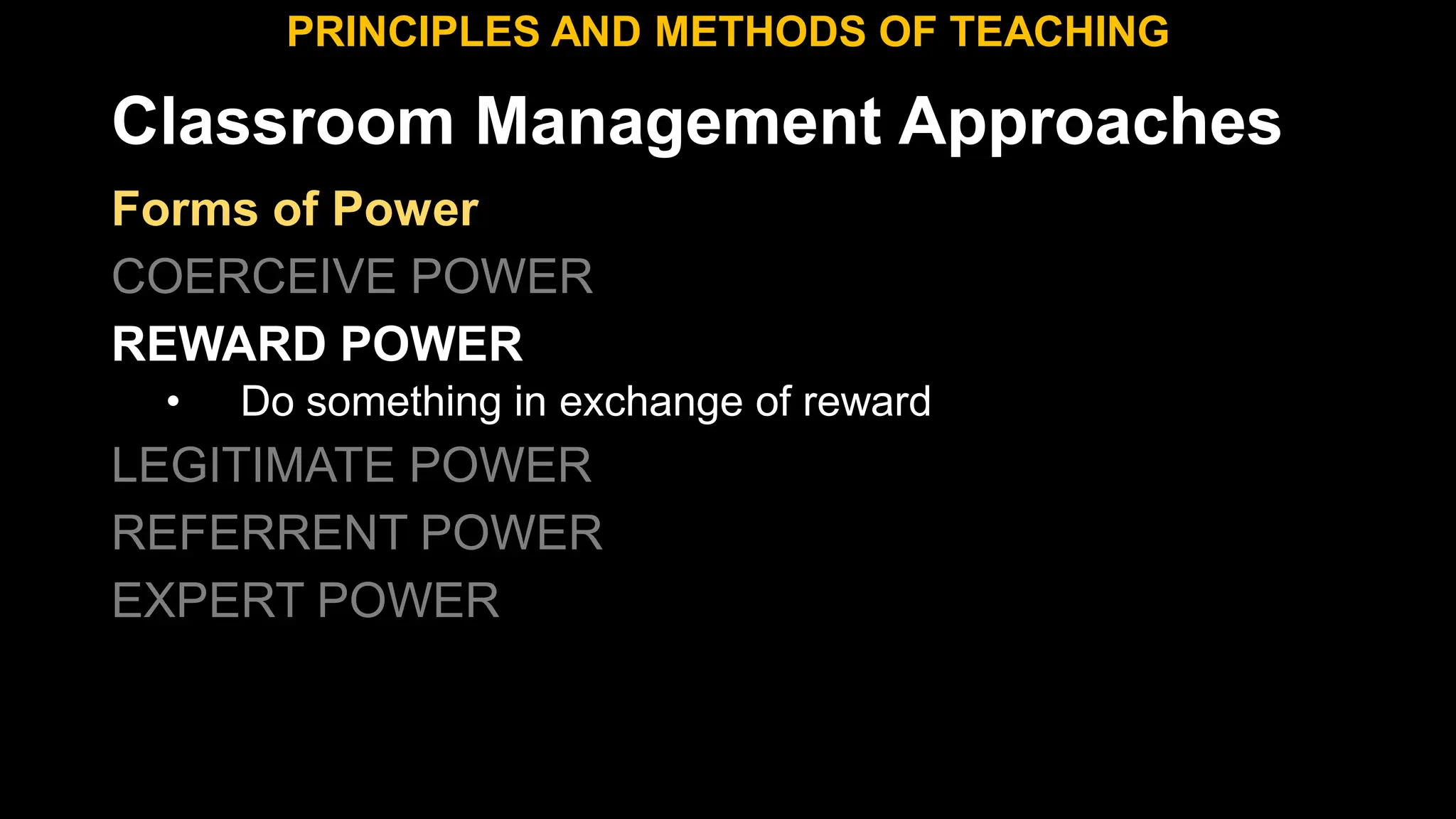
Forms of Power
COERCEIVE POWER
REWARD POWER
• Do something in exchange of reward
LEGITIMATE POWER
REFERRENT POWER
EXPERT POWER
Classroom Management Approaches
PRINCIPLES AND METHODS OF TEACHING
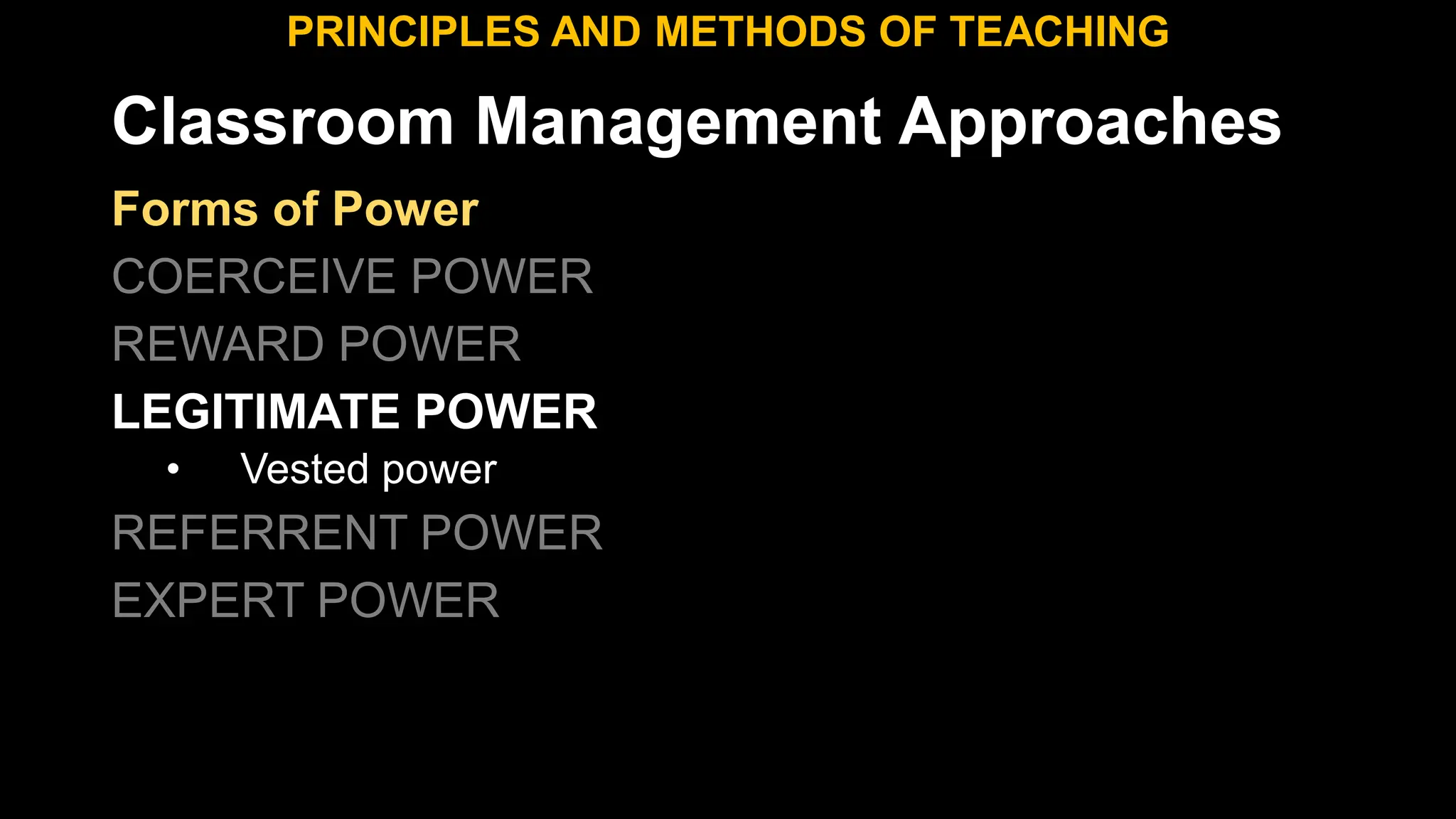
Forms of Power
COERCEIVE POWER
REWARD POWER
LEGITIMATE POWER
• Vested power
REFERRENT POWER
EXPERT POWER
Classroom Management Approaches
PRINCIPLES AND METHODS OF TEACHING
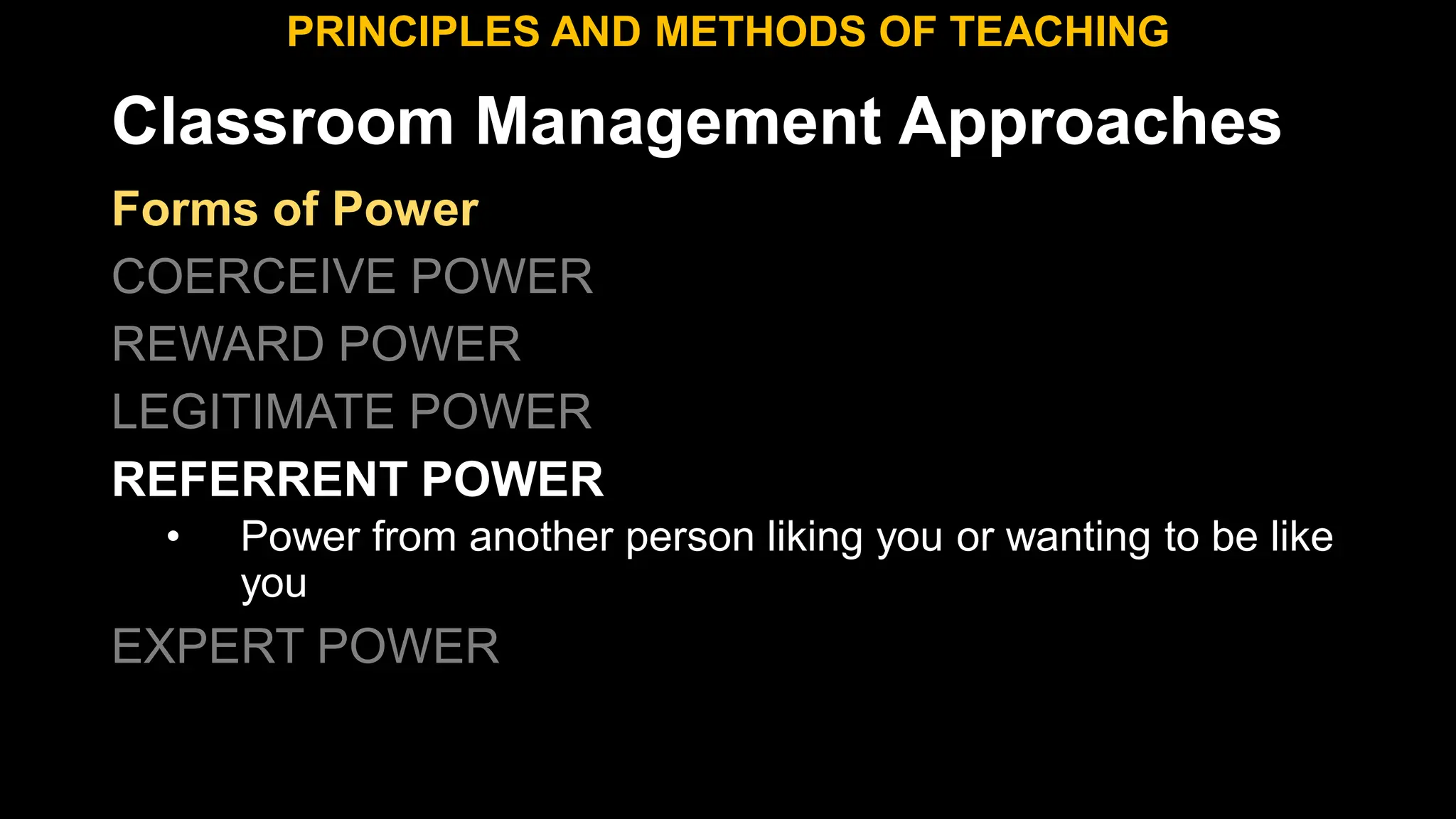
Forms of Power
COERCEIVE POWER
REWARD POWER
LEGITIMATE POWER
REFERRENT POWER
• Power from another person liking you or wanting to be like
you
EXPERT POWER
Classroom Management Approaches
PRINCIPLES AND METHODS OF TEACHING
Forms of Power
COERCEIVE POWER
REWARD POWER
LEGITIMATE POWER
REFERRENT POWER
EXPERT POWER
• Skill and knowledge
Classroom Management Approaches
PRINCIPLES AND METHODS OF TEACHING
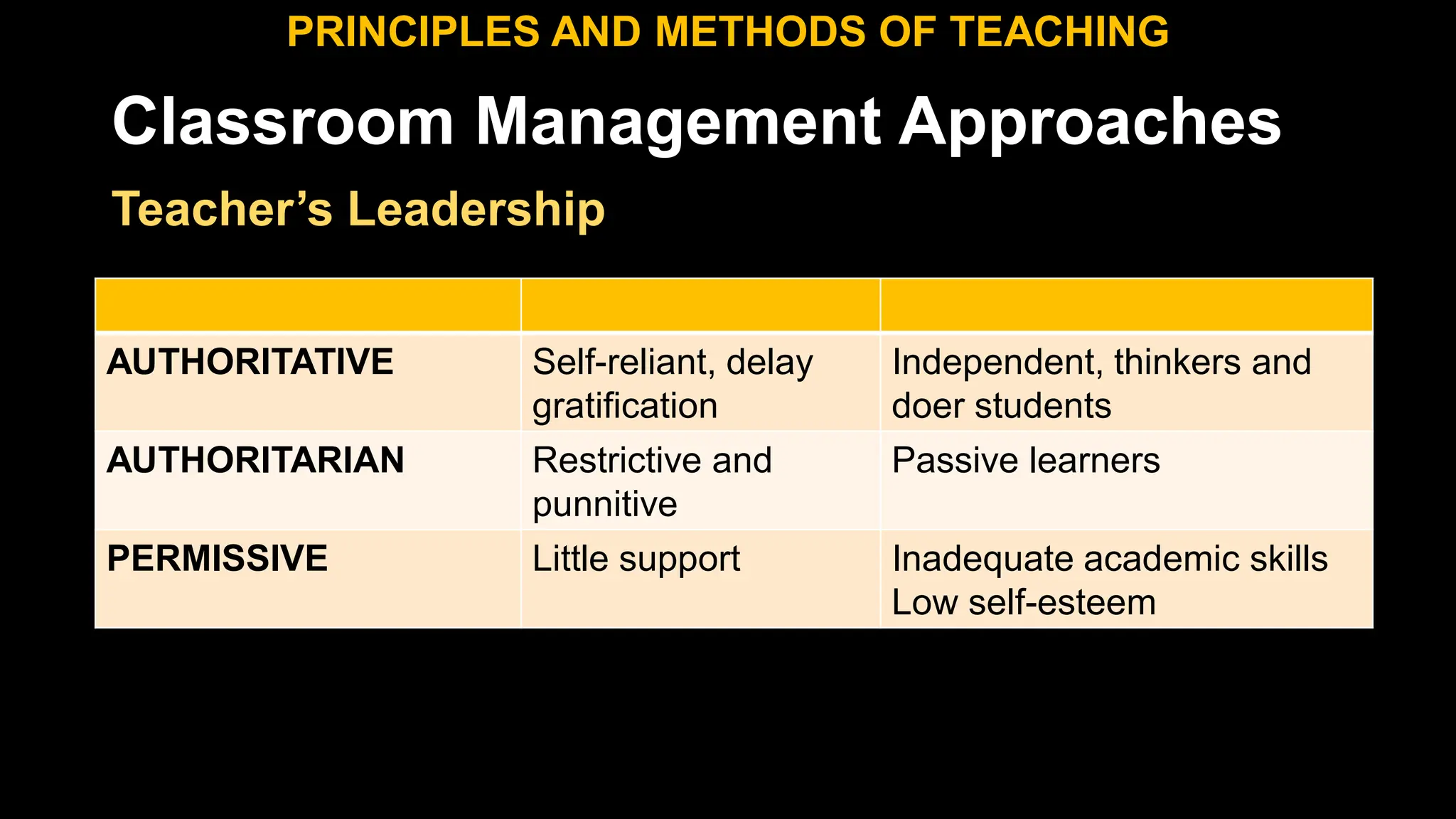
Teacher’s Leadership
AUTHORITATIVE Self-reliant, delay
gratification
Independent, thinkers and
doer students
AUTHORITARIAN Restrictive and
punnitive
Passive learners
PERMISSIVE Little support Inadequate academic skills
Low self-esteem
Classroom Management Approaches
PRINCIPLES AND METHODS OF TEACHING
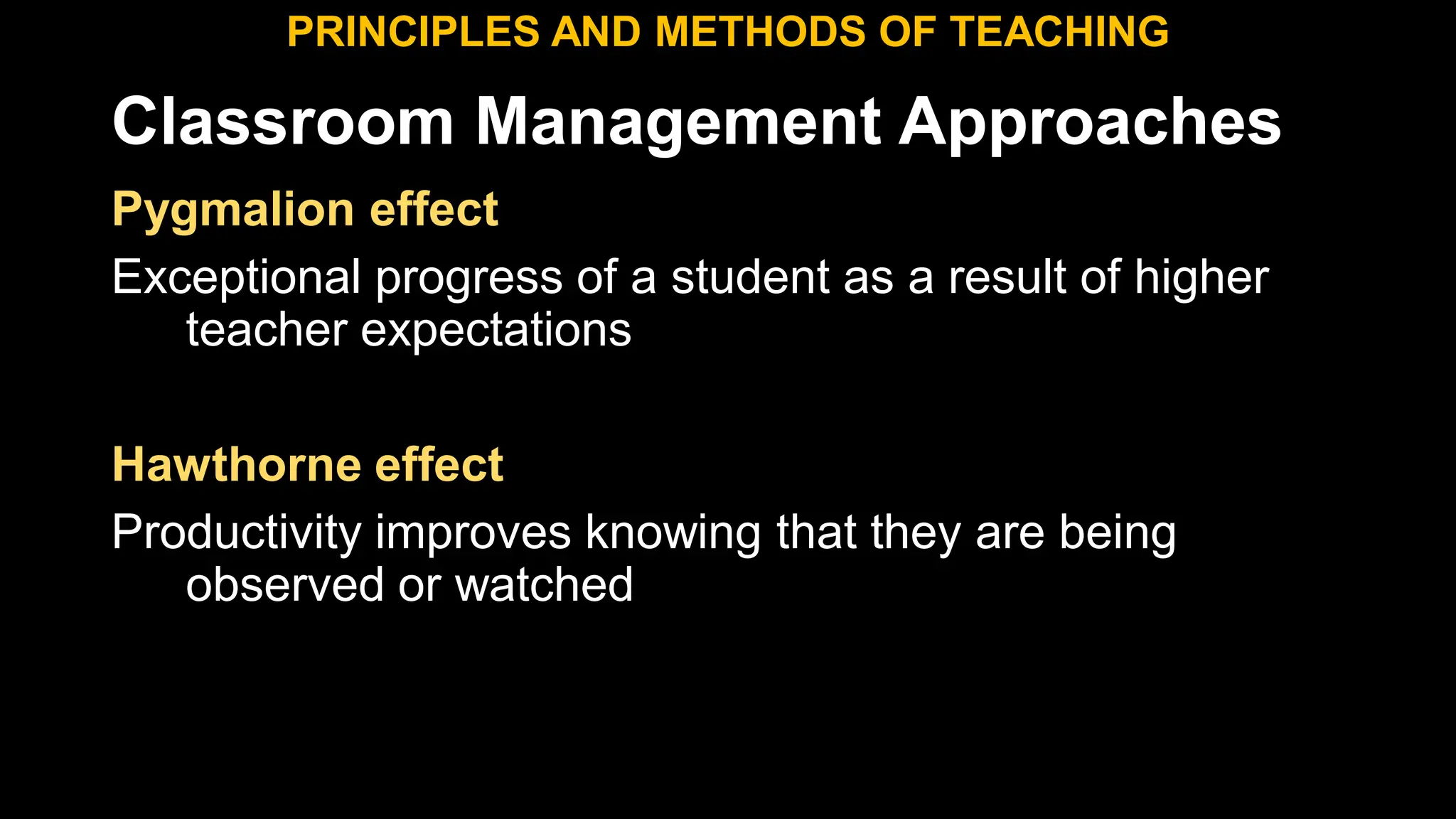
Pygmalion effect
Exceptional progress of a student as a result of higher
teacher expectations
Hawthorne effect
Productivity improves knowing that they are being
observed or watched
Classroom Management Approaches
PRINCIPLES AND METHODS OF TEACHING
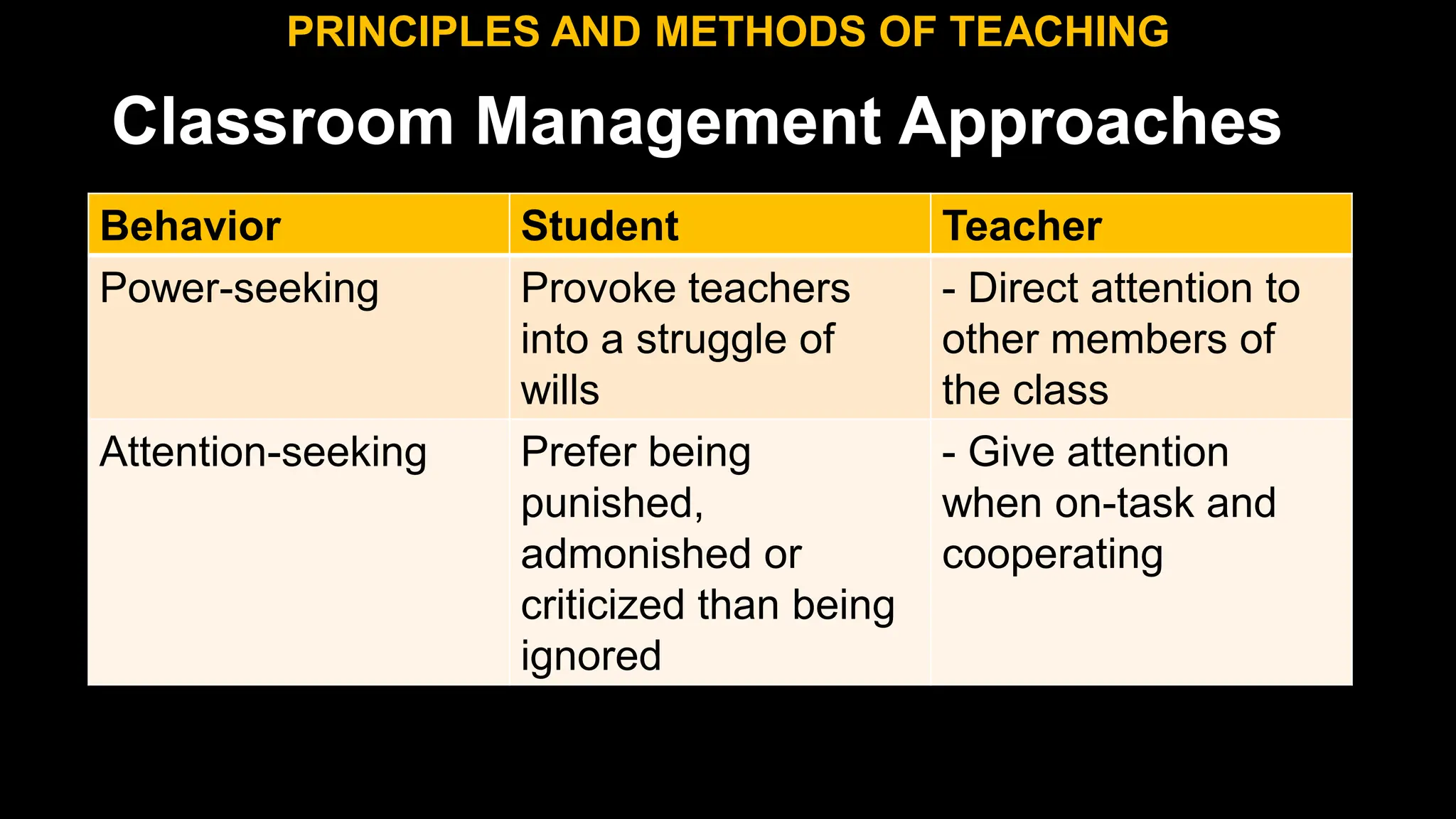
Behavior Student Teacher
Power-seeking Provoke teachers
into a struggle of
wills
- Direct attention to
other members of
the class
Attention-seeking Prefer being
punished,
admonished or
criticized than being
ignored
- Give attention
when on-task and
cooperating
Classroom Management Approaches
PRINCIPLES AND METHODS OF TEACHING
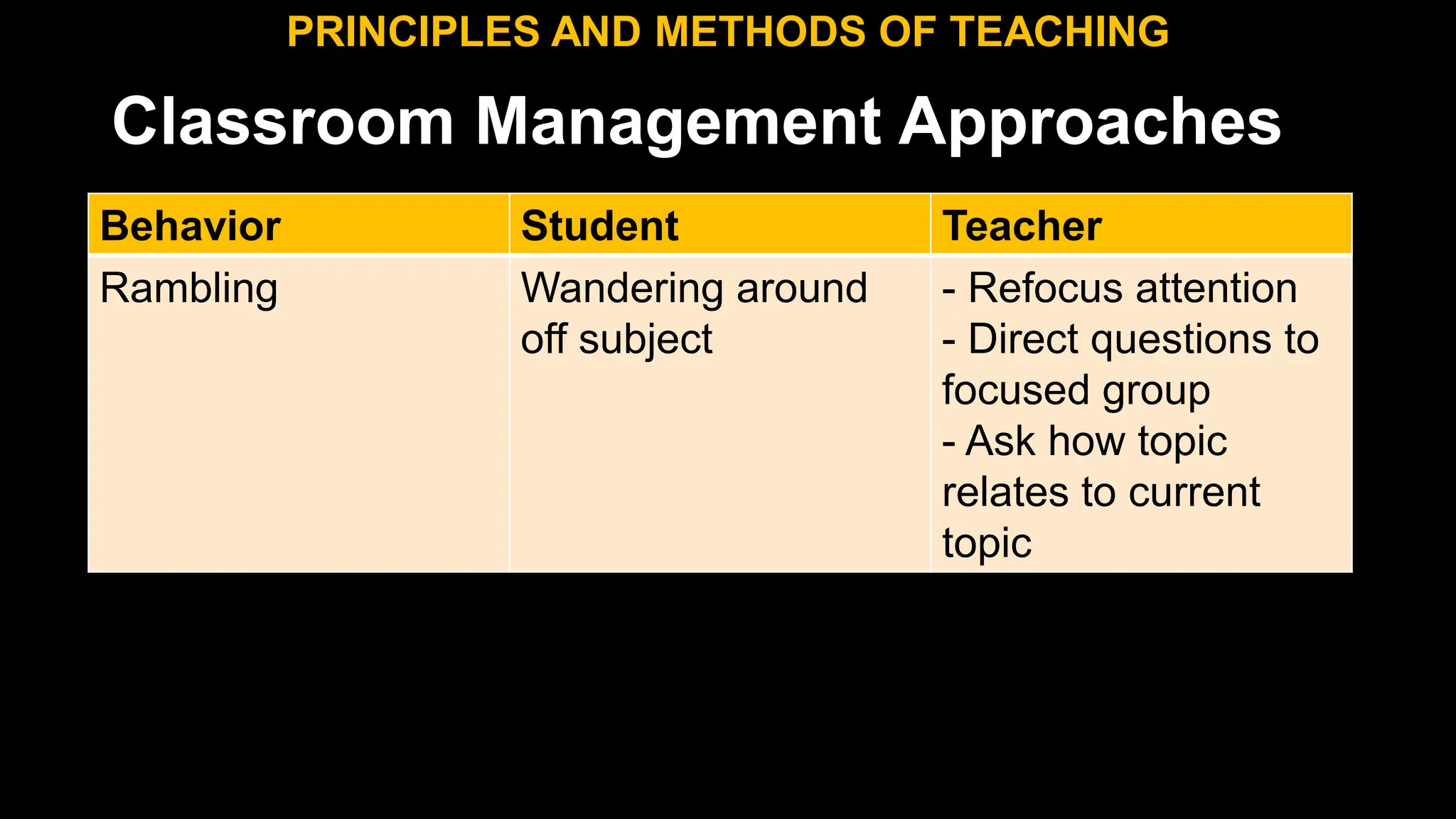
Behavior Student Teacher
Rambling Wandering around
off subject
- Refocus attention
- Direct questions to
focused group
- Ask how topic
relates to current
topic
Classroom Management Approaches
PRINCIPLES AND METHODS OF TEACHING
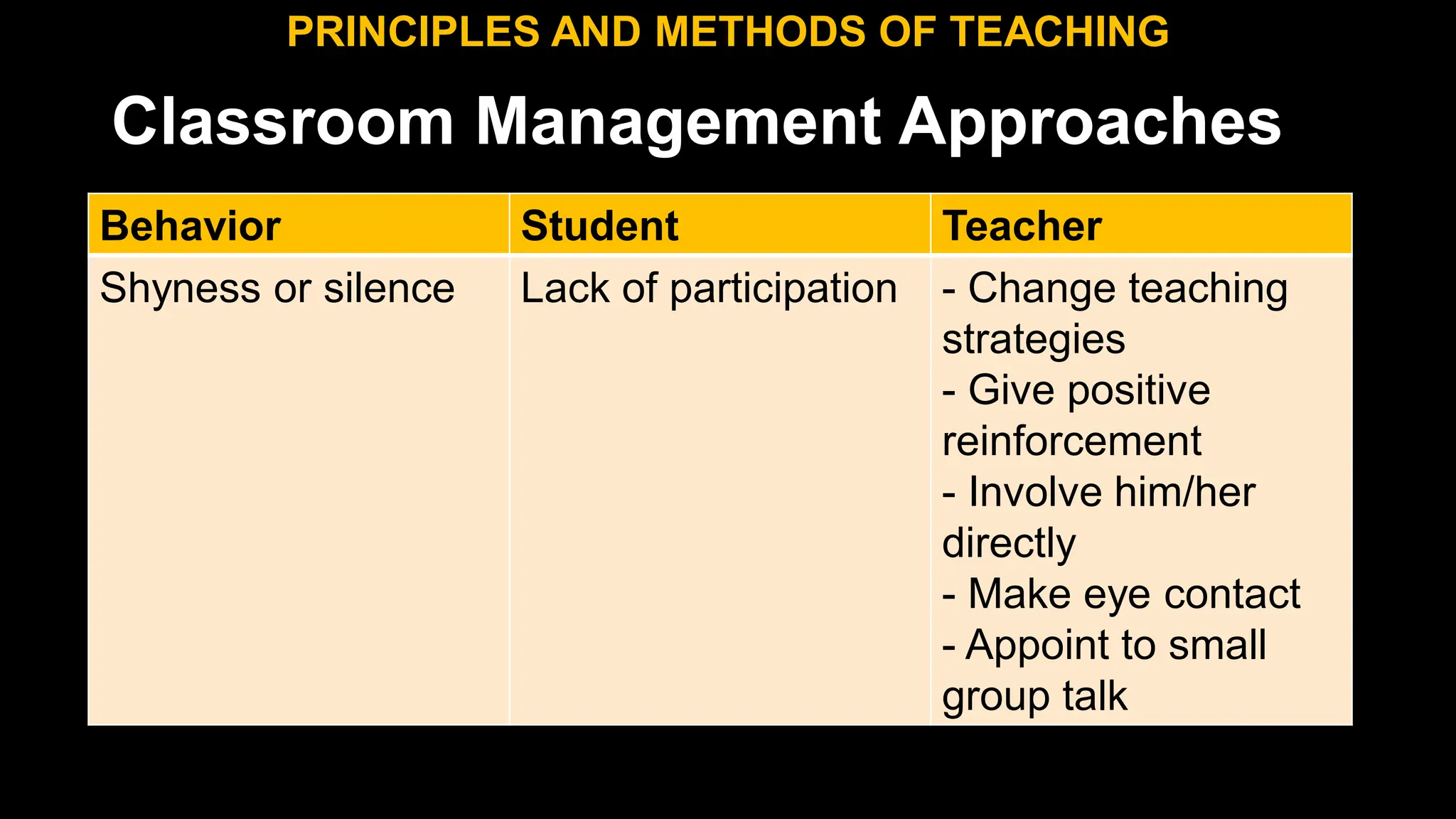
Behavior Student Teacher
Shyness or silence Lack of participation - Change teaching
strategies
- Give positive
reinforcement
- Involve him/her
directly
- Make eye contact
- Appoint to small
group talk
Classroom Management Approaches
PRINCIPLES AND METHODS OF TEACHING
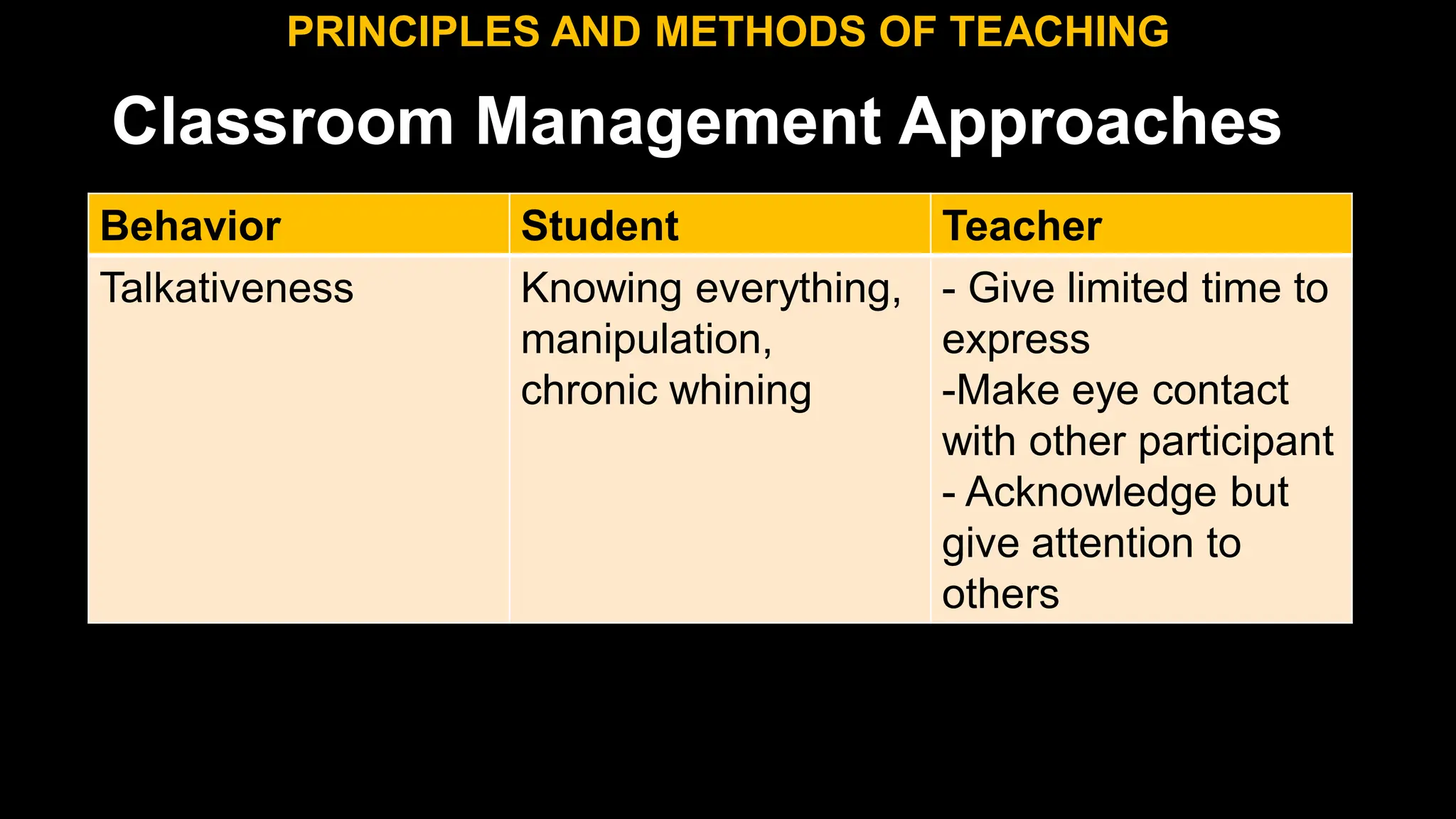
Behavior Student Teacher
Talkativeness Knowing everything,
manipulation,
chronic whining
- Give limited time to
express
-Make eye contact
with other participant
- Acknowledge but
give attention to
others
Classroom Management Approaches
PRINCIPLES AND METHODS OF TEACHING
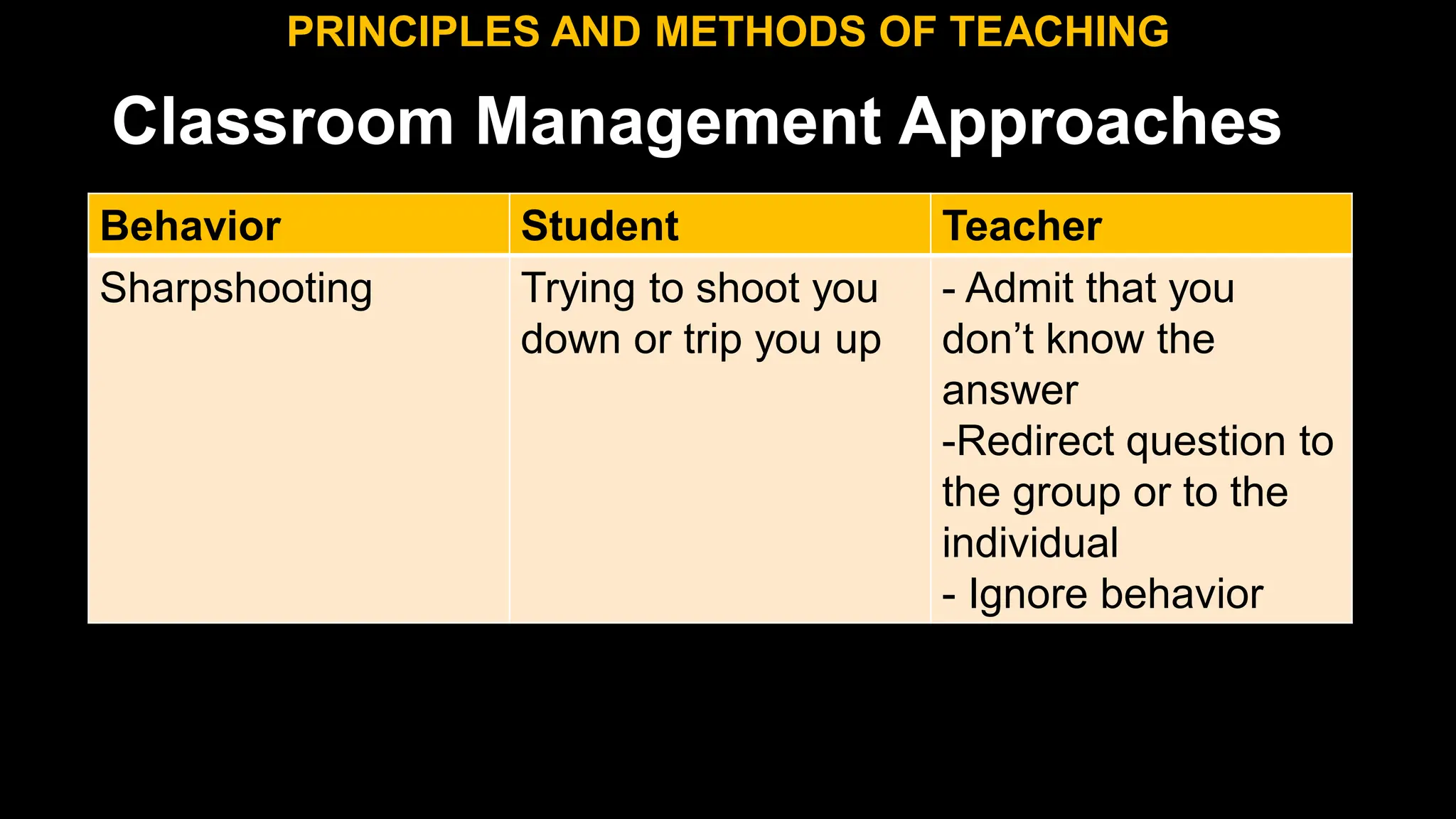
Behavior Student Teacher
Sharpshooting Trying to shoot you
down or trip you up
- Admit that you
don’t know the
answer
-Redirect question to
the group or to the
individual
- Ignore behavior
Classroom Management Approaches
PRINCIPLES AND METHODS OF TEACHING
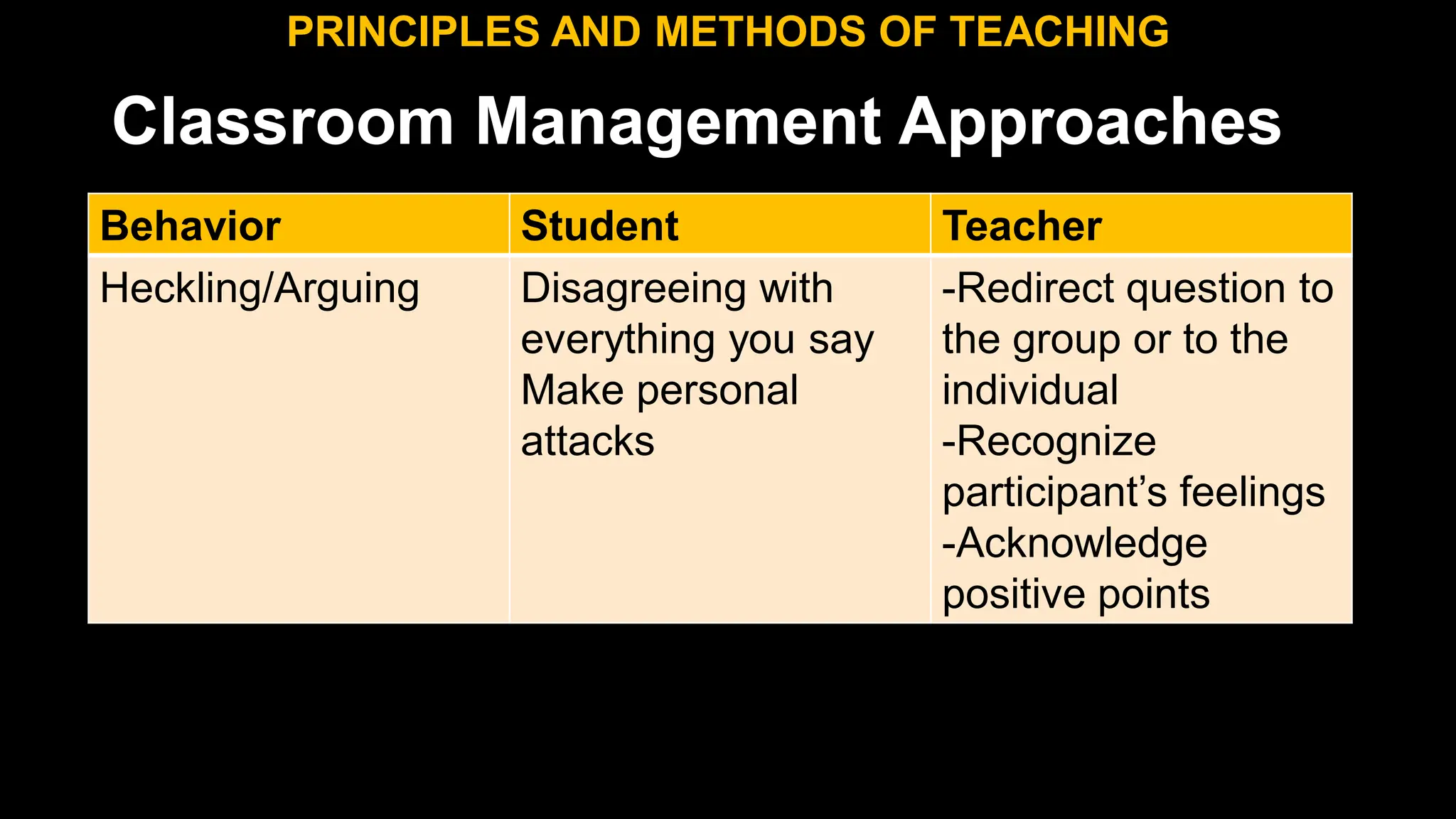
Behavior Student Teacher
Heckling/Arguing Disagreeing with
everything you say
Make personal
attacks
-Redirect question to
the group or to the
individual
-Recognize
participant’s feelings
-Acknowledge
positive points
Classroom Management Approaches
PRINCIPLES AND METHODS OF TEACHING
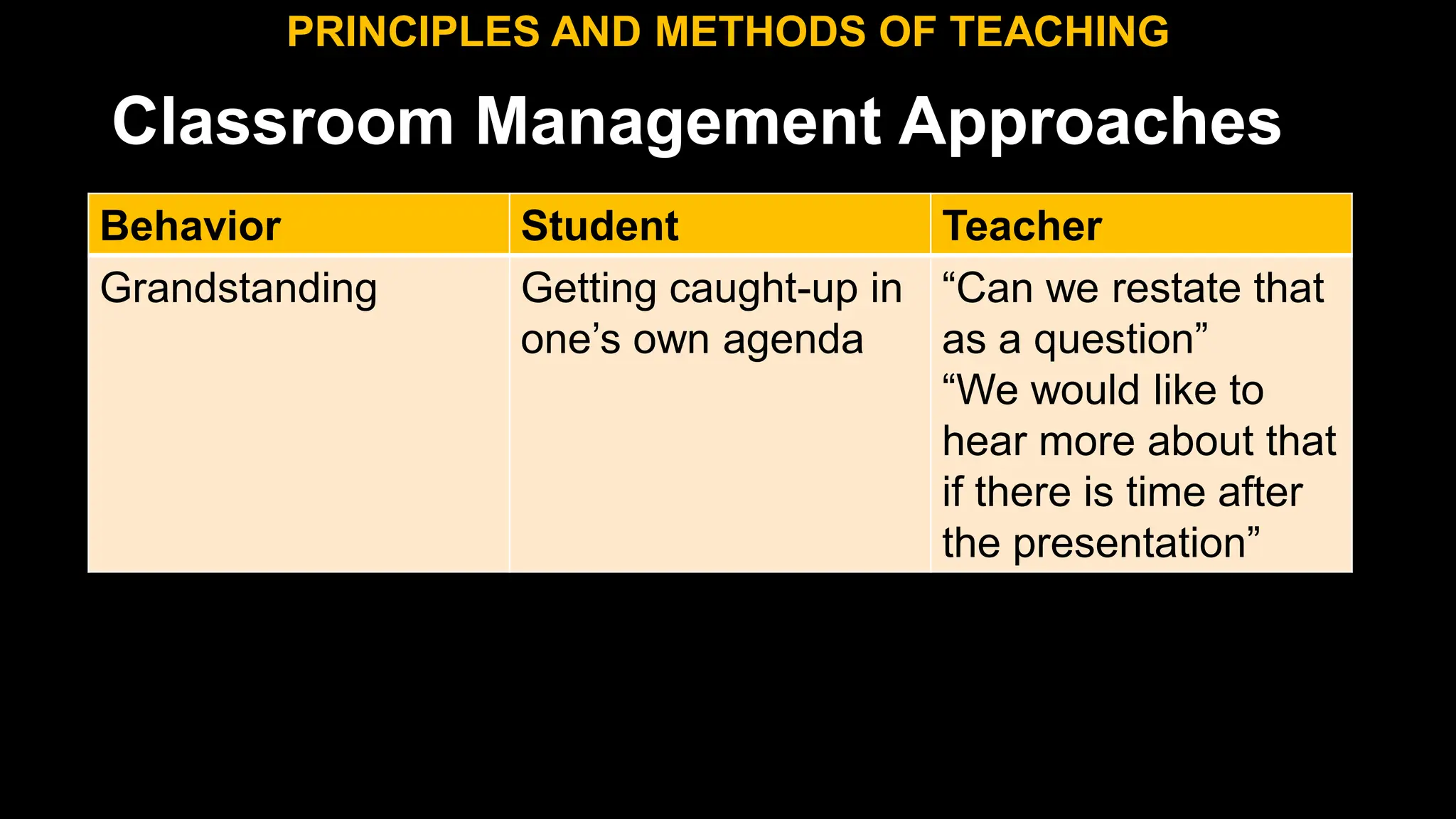
Behavior Student Teacher
Grandstanding Getting caught-up in
one’s own agenda
“Can we restate that
as a question”
“We would like to
hear more about that
if there is time after
the presentation”
Classroom Management Approaches
PRINCIPLES AND METHODS OF TEACHING
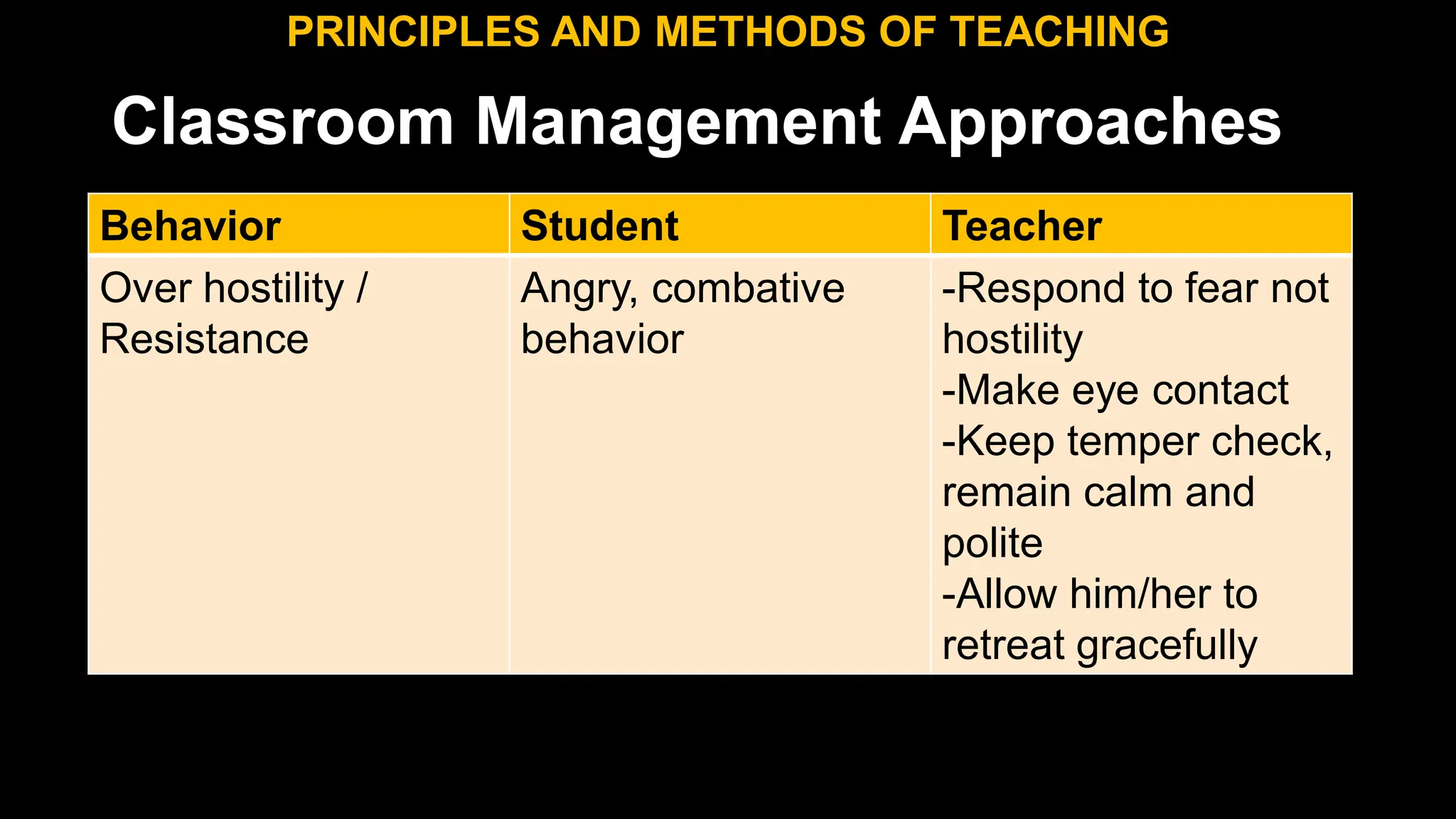
Behavior Student Teacher
Over hostility /
Resistance
Angry, combative
behavior
-Respond to fear not
hostility
-Make eye contact
-Keep temper check,
remain calm and
polite
-Allow him/her to
retreat gracefully
Classroom Management Approaches
PRINCIPLES AND METHODS OF TEACHING
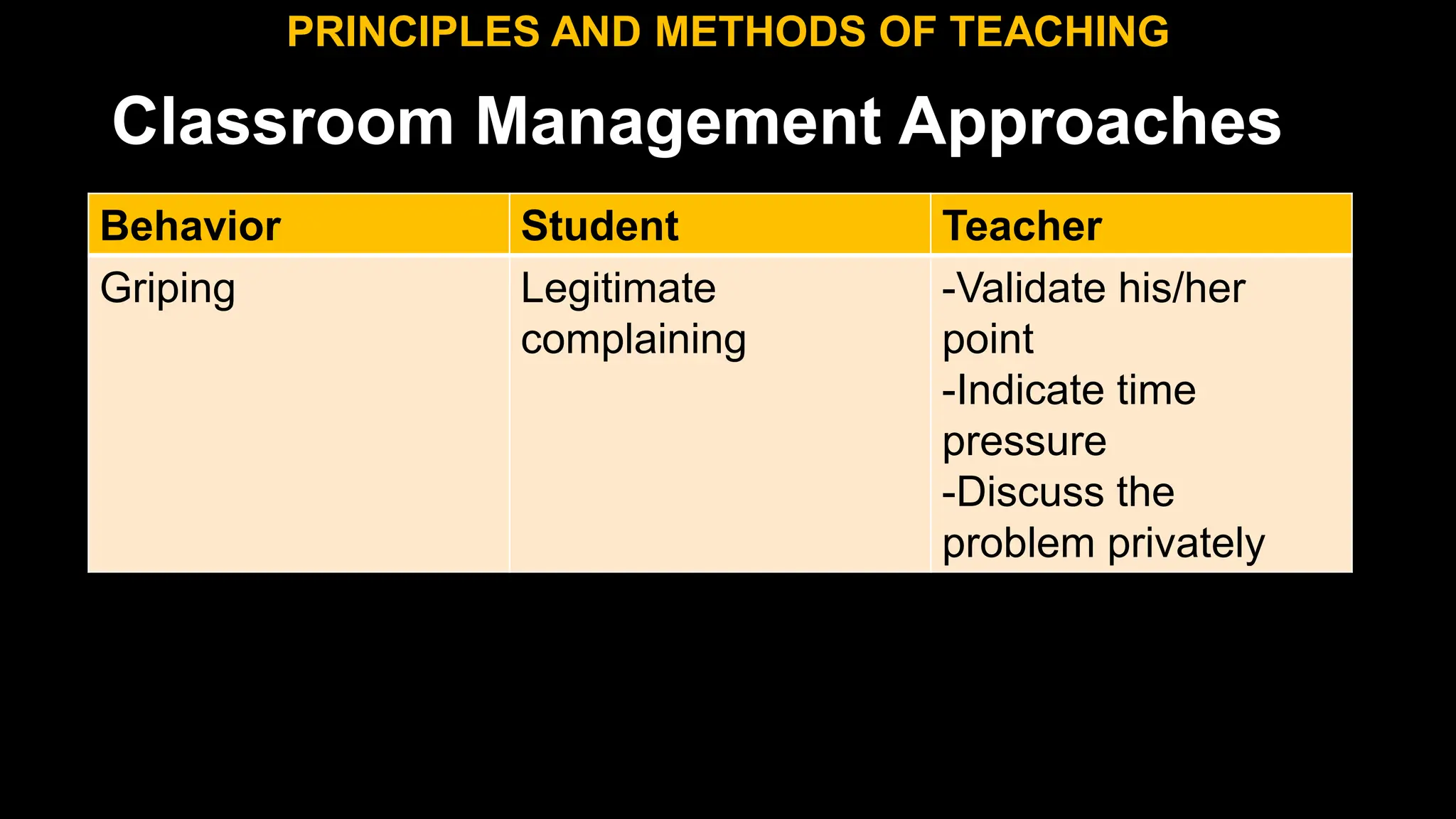
Behavior Student Teacher
Griping Legitimate
complaining
-Validate his/her
point
-Indicate time
pressure
-Discuss the
problem privately
Classroom Management Approaches
PRINCIPLES AND METHODS OF TEACHING
Behavior Student Teacher
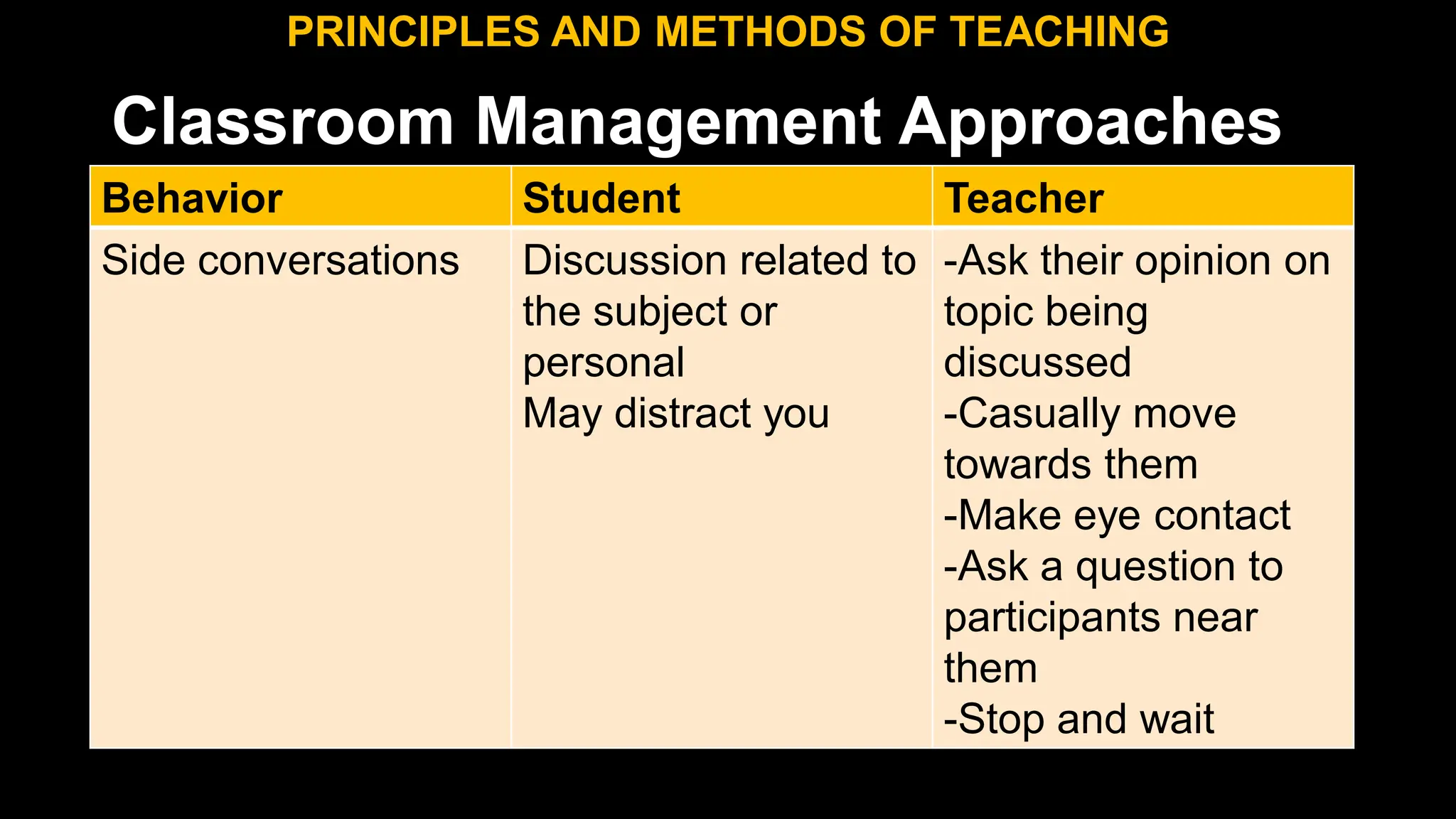
Side conversations Discussion related to
the subject or
personal
May distract you
-Ask their opinion on
topic being
discussed
-Casually move
towards them
-Make eye contact
-Ask a question to
participants near
them
-Stop and wait

Principles and Methods of Teaching-2022.pdf

  • 1.
    Principles and Methods ofTeaching Shela L. Caballero
  • 2.
    PRINCIPLES AND METHODSOF TEACHING Keys LET-sensitive Syllabus Drill Integrative interdisciplinary intradisciplinary
  • 3.
  • 4.
    PRINCIPLES AND METHODSOF TEACHING TEACHING APPROACHES TEACHING MODELS TEACHING METHODS TEACHING PRINCIPLES LEARNING PRINCIPLES INSTRUCTIONAL PLANNING PRINCIPLES IN DESIGNING IMs ART OF QUESTIONING IDEAL LEARNING ENVIRONMENT CLASSROOM MANAGEMENT CLASSROOM MANAGEMENT APPROACHES EDUCATIONAL TECHNOLOGY* CURRICULUM DEVELOPMENT*
  • 5.
    PRINCIPLES AND METHODSOF TEACHING TEACHING APPROACHES TEACHING MODELS TEACHING METHODS TEACHING PRINCIPLES LEARNING PRINCIPLES INSTRUCTIONAL PLANNING PRINCIPLES IN DESIGNING IMs ART OF QUESTIONING IDEAL LEARNING ENVIRONMENT CLASSROOM MANAGEMENT CLASSROOM MANAGEMENT APPROACHES EDUCATIONAL TECHNOLOGY* CURRICULUM DEVELOPMENT* Teaching
  • 6.
    PRINCIPLES AND METHODSOF TEACHING TEACHING APPROACHES TEACHING MODELS TEACHING METHODS TEACHING PRINCIPLES LEARNING PRINCIPLES INSTRUCTIONAL PLANNING PRINCIPLES IN DESIGNING IMs ART OF QUESTIONING IDEAL LEARNING ENVIRONMENT CLASSROOM MANAGEMENT CLASSROOM MANAGEMENT APPROACHES EDUCATIONAL TECHNOLOGY* CURRICULUM DEVELOPMENT* Learning
  • 7.
    PRINCIPLES AND METHODSOF TEACHING TEACHING APPROACHES TEACHING MODELS TEACHING METHODS TEACHING PRINCIPLES LEARNING PRINCIPLES INSTRUCTIONAL PLANNING PRINCIPLES IN DESIGNING IMs ART OF QUESTIONING IDEAL LEARNING ENVIRONMENT CLASSROOM MANAGEMENT CLASSROOM MANAGEMENT APPROACHES EDUCATIONAL TECHNOLOGY* CURRICULUM DEVELOPMENT* Environment
  • 8.
    PRINCIPLES AND METHODSOF TEACHING TEACHING APPROACHES TEACHING MODELS TEACHING METHODS TEACHING PRINCIPLES LEARNING PRINCIPLES INSTRUCTIONAL PLANNING PRINCIPLES IN DESIGNING IMs ART OF QUESTIONING IDEAL LEARNING ENVIRONMENT CLASSROOM MANAGEMENT CLASSROOM MANAGEMENT APPROACHES EDUCATIONAL TECHNOLOGY* CURRICULUM DEVELOPMENT*
  • 9.
    APPROACH MODELS METHODSDEVICE TECHNIQUE Viewpoint towards teaching Philosophy of teaching Guidelines or sets of strategies Fundamental framework of the approach Systematic step-by-step established procedure Manner of implementation or execution (Lesson Plan) Teaching-aid or tool to facilitate instruction Teacher’s personal art and skill of delivering PRINCIPLES AND METHODS OF TEACHING
  • 10.
    Teaching Approaches PRINCIPLES ANDMETHODS OF TEACHING Inductive Deductive Teacher-lead Student-lead Collaboration Inquiry-based Collaborative Cooperative Constructivist Integrative Reflective 2C-2I-1R RA 10533 “E-BEA”
  • 11.
    PRINCIPLES AND METHODSOF TEACHING Deductive Approach Teacher-centered From general rules toward specific examples Lecture Presentation-teaching Backward-design Deductive reasoning Advanced organizers
  • 12.
    Process of lessonplanning created by Grant Wiggins and Jay McTighe Used to introduce the Understanding by Design (1998) PRINCIPLES AND METHODS OF TEACHING Steps Traditional Backward Design 1 Goals and objectives Goals and objectives 2 Activities Assessments 3 Assessments Activities
  • 13.
    Starts with ageneral statement or hypothesis and examines the possibilities to reach a specific, logical conclusion. PRINCIPLES AND METHODS OF TEACHING
  • 14.
    Which of thefollowing best describes deductive reasoning? a. Using logic to draw conclusion based on accepted statements b. Accepting the meaning of a term without definition c. Defining mathematical terms to correspond with physical objects d. Inferring a general truth by examining a number of specific examples PRINCIPLES AND METHODS OF TEACHING
  • 15.
    Graphic Organizers Developed byDavid Ausbel Directs to what is important. Highlight relationships among ideas. PRINCIPLES AND METHODS OF TEACHING
  • 16.
    Subsumption Theory A learnerabsorbs new information by connecting it to existing concepts and ideas that they have already acquired. PRINCIPLES AND METHODS OF TEACHING
  • 17.
    Subsumption Theory Correlative New materialis an extension or elaborations of what is already known. Directs to what is important. PRINCIPLES AND METHODS OF TEACHING
  • 18.
    Subsumption Theory Derivative New materialor relationships can be derived from the existing structure. Highlight relationships among ideas. PRINCIPLES AND METHODS OF TEACHING
  • 19.
    Teaching Approaches PRINCIPLES ANDMETHODS OF TEACHING Inductive Deductive Teacher-lead Student-lead Collaboration 2C-2I-1R Inquiry-based Collaborative Cooperative Constructivist Integrative Reflective
  • 20.
    PRINCIPLES AND METHODSOF TEACHING Inductive Approach Student-centered From specific examples toward general rules Discovery learning Case-based learning Project/Problem-based learning Concept formation/attainment Inductive Reasoning
  • 21.
    Starts with observationand discerning a pattern to formulate a generalization and inference, explanation or theory. PRINCIPLES AND METHODS OF TEACHING
  • 22.
    Discovery Learning Proposed byJerome Bruner Students draw from own experience and existing knowledge. PRINCIPLES AND METHODS OF TEACHING
  • 23.
    Case-based Learning Students developskills in analytic thinking and reflective judgement by reading/discussing real-life scenarios. PRINCIPLES AND METHODS OF TEACHING
  • 24.
    Project-based Learning Students formulatequestions, investigate for answers, create new knowledge, and then communicate their learning to others. PRINCIPLES AND METHODS OF TEACHING
  • 25.
    Problem-based Learning Students gainlearning from complex, ill- structured, open-ended real-world problems. PRINCIPLES AND METHODS OF TEACHING
  • 26.
    PRINCIPLES AND METHODSOF TEACHING Chicharro et al., 2019
  • 27.
    Concept Formation Students forma clear understanding of a concept through studying small set of set of examples of the concept. PRINCIPLES AND METHODS OF TEACHING
  • 28.
    Concept Attainment Students compareand contrast examples that contain the attributes of the concept with examples that do not contain those attributes. PRINCIPLES AND METHODS OF TEACHING
  • 29.
    Teaching Approaches PRINCIPLES ANDMETHODS OF TEACHING Inductive Deductive Teacher-lead Student-lead Collaboration 2C-2I-1R Inquiry-based Collaborative Cooperative Constructivist Integrative Reflective
  • 30.
    PRINCIPLES AND METHODSOF TEACHING Learners think about the way they learn Reflective Approach Student-centered Metacognition Identify gaps in their learning and areas for improvement.
  • 31.
    PRINCIPLES AND METHODSOF TEACHING Metacognition Thinking about thinking Awareness of one's thought processes and an understanding of the patterns behind them.
  • 32.
    Teaching Approaches PRINCIPLES ANDMETHODS OF TEACHING Inductive Deductive Teacher-lead Student-lead Collaboration 2C-2I-1R Inquiry-based Collaborative Cooperative Constructivist Integrative Reflective
  • 33.
    PRINCIPLES AND METHODSOF TEACHING Integrative Approach Student-centered Making connections among concepts and experiences
  • 34.
  • 35.
    Teaching Approaches PRINCIPLES ANDMETHODS OF TEACHING Inductive Deductive Teacher-lead Student-lead Collaboration 2C-2I-1R Inquiry-based Collaborative Cooperative Constructivist Integrative Reflective
  • 36.
    PRINCIPLES AND METHODSOF TEACHING Constructivist Approach Student-centered Learners build the meaning and knowledge Scaffolding Experiential learning
  • 37.
    PRINCIPLES AND METHODSOF TEACHING Scaffolding Teacher models how to solve a problem Student solves a similar problem Proposed by Lev Vygotsky
  • 38.
  • 39.
    PRINCIPLES AND METHODSOF TEACHING Experiential Learning Proposed by David Kolb Concrete experience, reflective observation, abstract conceptualization and active experimentation form a four-stage process (or cycle) transformed into effective learning.
  • 40.
  • 41.
  • 42.
    Teaching Approaches PRINCIPLES ANDMETHODS OF TEACHING Inductive Deductive Teacher-lead Student-lead Collaboration 2C-2I-1R Inquiry-based Collaborative Cooperative Constructivist Integrative Reflective
  • 43.
    PRINCIPLES AND METHODSOF TEACHING Inquiry-based Approach Student-centered Learners actively discover information to support their investigations. 5Es
  • 44.
  • 45.
  • 46.
  • 47.
  • 48.
    Teaching Approaches PRINCIPLES ANDMETHODS OF TEACHING Inductive Deductive Teacher-lead Student-lead Collaboration 2C-2I-1R Inquiry-based Collaborative Cooperative Constructivist Integrative Reflective
  • 49.
    PRINCIPLES AND METHODSOF TEACHING Collaborative/Cooperative Approach Student-centered Learners work together in mixed ability Jigsaw Think-Pair-Share
  • 50.
  • 51.
  • 52.
  • 53.
    Teaching Models 1. Directinstruction 2. Indirect Instruction 3. Interactive Instruction 4. Experiential Learning 5. Independent Study PRINCIPLES AND METHODS OF TEACHING
  • 54.
    PRINCIPLES AND METHODSOF TEACHING TEACHING MODELS TEACHER’S ROLE Direct instruction Imparts knowledge Indirect instruction Sets up strategies Interactive instruction Organize and facilitates Experiential learning Facilitator Independent Study Coach
  • 55.
    PRINCIPLES AND METHODSOF TEACHING TEACHING MODELS TEACHER’S ROLE STRATEGIES Direct instruction Imparts knowledge Lecture Explicit Teaching Drill and Practice Demonstrations Guided Activities
  • 56.
    PRINCIPLES AND METHODSOF TEACHING TEACHING MODELS TEACHER’S ROLE STRATEGIES Indirect instruction Sets up strategies Students make meaning themselves Case studies Problem solving Inquiry activities Reading for meaning Concept mapping Concept attainment Concept formation
  • 57.
    PRINCIPLES AND METHODSOF TEACHING TEACHING MODELS TEACHER’S ROLE STRATEGIES Interactive instruction Organize and facilitates Students interact with each other and with the information and materials Debates Panel discussion Role playing Brainstorming Peer practice Laboratory groups Cooperative learning Problem solving Interviewing
  • 58.
    PRINCIPLES AND METHODSOF TEACHING TEACHING MODELS TEACHER’S ROLE STRATEGIES Experiential learning Facilitator Students are actively involved Field trips Experimenting Simulations Gamified activities Focus group discussions Field observations Role playing Model building Surveys
  • 59.
    PRINCIPLES AND METHODSOF TEACHING TEACHING MODELS TEACHER’S ROLE STRATEGIES Independent Study Coach Students interact with the content more CAI Homework Research Projects
  • 60.
    Teaching Principles •Acquire relevantknowledge about students • to decide on appropriate lesson objectives, pacing approach, etc. • to help explain and respond to students’ difficulties PRINCIPLES AND METHODS OF TEACHING
  • 61.
    Teaching Principles •Align 3components of instruction a. learning objectives b. instructional materials and activities c. assessment tools • opportunities for students to demonstrate gained knowledge and skills • opportunities for teachers to give significant and relevant feedback PRINCIPLES AND METHODS OF TEACHING
  • 62.
  • 63.
  • 64.
    Teaching Principles •Articulate learningobjectives and class rules for productive learning environment. •Know the subject matter. PRINCIPLES AND METHODS OF TEACHING
  • 65.
  • 66.
    Teaching Principles •Actively involvelearners considering their capabilities and learning styles. •Challenge learners to develop higher order thinking skills and to apply what they have learned. PRINCIPLES AND METHODS OF TEACHING
  • 67.
    Teaching Principles •Progressively refineteaching style based on reflection and feedback. •Establish and develop constructive and healthy relationship with learners. PRINCIPLES AND METHODS OF TEACHING
  • 68.
    Teaching Principles •Encourage “beyondthe classroom”. •Create and maintain a positive learning environment. PRINCIPLES AND METHODS OF TEACHING
  • 69.
    Learning Principles • Students’prior knowledge can help or hinder learning. • Students’ ways of organizing knowledge affects how they learn and apply what they know. PRINCIPLES AND METHODS OF TEACHING
  • 70.
    Learning Principles • Students’motivation determines, directs and sustains what they do to learn. • Students develop mastery when they: • acquire component skills • practice integration of knowledge • can determine when and how to apply knowledge PRINCIPLES AND METHODS OF TEACHING
  • 71.
    Learning Principles • Studentsfind significance in learning • Students become self-directed learners • Goal-directed practice and targeted feedback leads to quality learning. PRINCIPLES AND METHODS OF TEACHING
  • 72.
    Learning Principles What isa good feedback? • explicitly communicates students’ performance relative to specific target criterion • provides helpful information for students to meet those criteria • timely given that allows it to be useful and relevant PRINCIPLES AND METHODS OF TEACHING
  • 73.
    Instructional Planning Components ofa Lesson Plan 1. Objectives 2. Subject matter 3. Learning materials 4. Procedures 5. Assessments 6. Assignment PRINCIPLES AND METHODS OF TEACHING
  • 74.
    Instructional Planning: Objectives 2Views of Instructional Objectives 1. Very Specific Robert Mager, 1975 2. General to Specific Gronlund and Brookhart, 2009 PRINCIPLES AND METHODS OF TEACHING
  • 75.
    Instructional Planning: Objectives VerySpecific (Robert Mager, 1975) • Student behavior intended • Conditions under which behavior should occur or be tested • Degree of criteria PRINCIPLES AND METHODS OF TEACHING
  • 76.
    Instructional Planning: Objectives VerySpecific (Robert Mager, 1975) Eight-graders should be able to recite, with no more than three errors, ten consecutive lines of a poem from the unit. Objective is S.M.A.R.T PRINCIPLES AND METHODS OF TEACHING
  • 77.
    Instructional Planning: Objectives VerySpecific (Robert Mager, 1975) Eight-graders should be able to recite, with no more than three errors, ten consecutive lines of a poem from the unit. PRINCIPLES AND METHODS OF TEACHING
  • 78.
    Instructional Planning: Objectives Generalto Specific (Gronlund and Brookhart, 2009) • Terminal objective general and primary objective • Enroute or enabling objective that leads to the attainment of terminal behavior PRINCIPLES AND METHODS OF TEACHING
  • 79.
    Instructional Planning: Objectives Generalto Specific (Gronlund and Brookhart, 2009) Students demonstrate how to perform simple multiplication • Can define what multiplication means in his or her own words • Can define relevant terms such as multiplier and product PRINCIPLES AND METHODS OF TEACHING
  • 80.
    Instructional Planning: Objectives Domains 1.Cognitive – mental, thought, intellect 2. Affective – emotions feelings, values, attitude and beliefs 3. Behavior – reflexive behavior, motor, acts/skills PRINCIPLES AND METHODS OF TEACHING
  • 81.
    Instructional Planning: Objectives CognitiveTaxonomy (Bloom) PRINCIPLES AND METHODS OF TEACHING
  • 82.
    Cognitive Taxonomy (Anderson,Kratwohl et al, 2001) PRINCIPLES AND METHODS OF TEACHING Taxonomy Description Remember Recall and recognize Understand Interpret, exemplify, classify, summarize infer, compare, explain Apply Execute, implement Analyze Differentiate organize, attribute Evaluate Making judgments based on criteria Create Generate, plan, produce
  • 83.
    Affective Taxonomy (Bloom,Krathwoh, Masia, 1964) MNEMONIC: RR-VOC PRINCIPLES AND METHODS OF TEACHING Taxonomy Description Receiving Develops awareness, observe Responding Shows willingness to share, comply, conform, react Valuing Belief and attitude. Shows that object or person has worth Organization Conceptualize or organize values into a system Characterization Internalize values, belief system, philosophy of life
  • 84.
    Psychomotor Taxonomy (Simpson,1966) MNEMONIC: PSGM-CAO PRINCIPLES AND METHODS OF TEACHING Taxonomy Description Perception Stimulation of sense organs Set Readiness Guided Response Attempt Mechanism Basic proficiency Complex Overt Response Expert proficiency Adaptation Adaptable proficiency Origination Creative proficiency
  • 85.
    Psychomotor Taxonomy (Dave,1970) MNEMONIC: IMPAN PRINCIPLES AND METHODS OF TEACHING Taxonomy Description Imitation Copy action of another Manipulation Reproduce activity from Precision Execute skill reliably Articulation Adapt and integrate expertise Naturalization Automated, unconscious
  • 86.
    Psychomotor Taxonomy (Harrow,1972) MNEMONIC: RF-PPSN PRINCIPLES AND METHODS OF TEACHING Taxonomy Description Reflex Movements Reactions not learned Fundamental Movements Basic movements Perception Response to stimuli Physical Abilities Stamina Skilled Movement Advanced learned Non-discursive Communication Effective body language
  • 87.
    INSTRUCTIONAL PLANNING SEQUENCE 1.Assess learners’ needs 2. Consider school goals 3. Map the plan 4. Give instructions 5. Evaluate PRINCIPLES AND METHODS OF TEACHING Motivation Self-concept Prior learning Achievement level Intelligence level Reading comprehension
  • 88.
    INSTRUCTIONAL PLANNING LEVELS 1.Yearly planning – general outline, basic contents and ideas 2. Term planning – elaborated outlines, weekly schedule and activities 3. Unit planning – activities and sequence, content written in plan book 4. Weekly planning – activity names, times, materials, adjustments 5. Daily planning – lesson plans PRINCIPLES AND METHODS OF TEACHING
  • 89.
    HOW TO CHOOSEINSTRUCTIONAL MATERIALS 1. Appropriate 2. Authentic 3. Meaningful 4. Stimulating 5. Cost-effective 6. Comprehensive PRINCIPLES AND METHODS OF TEACHING
  • 90.
    HOW TO CHOOSELEARNING ACTIVITIES 1. Relevant to objectives, subject matter and method of teaching 2. Suitable to learners’ needs, interest, experience and developmental level 3. Interactive 4. Apt to time and context 5. Multi-level, multi-sensory and well-sequenced 6. Responsive to principles of learning 7. Able to provide authentic learning experience PRINCIPLES AND METHODS OF TEACHING
  • 91.
    PURPOSES OF QUESTIONNING 1.Acquire information 2. Draw out interpretation 3. Promote thinking and develop reasoning ability 4. Develop skill to answer effectively 5. Review content learned and check retention 6. Provide drill and practice 7. Ensure that lessons are internalized and applied 8. Direct students to key points of lessons 9. Develop problem-solving and decision making 10.Allow expression of feelings PRINCIPLES AND METHODS OF TEACHING
  • 92.
    CHARACTERISTICS OF AGOOD QUESTION 1. Simple, clear and easily understood 2. Definite, follows one distinct line of thoughts 3. Closely linked to lesson objectives 4. Stimulating and thought-provoking, allows the use of HOTS 5. Adapted to the students’ age, abilities and interests 6. Relevant to students’ daily life situation 7. Requires an extended response, unless a drill PRINCIPLES AND METHODS OF TEACHING
  • 93.
    TECHNIQUES IN QUESTIONNING 1.Wait Time – 3 to 4 seconds or longer 2. Prompting – hints to help students come-up with answers 3. Redirection – single question with several answers 4. Probing – promote critical thinking 5. Commenting – increase achievement and motivation PRINCIPLES AND METHODS OF TEACHING
  • 94.
    GUIDELINES IN QUESTIONNING 1.Tell students what to expect 2. Plan sequencing of questions (increasing cognitive level) 3. Open questions should predominate 4. Frequent questions following the exposition of new content 5. Vary length and difficulty 6. Ask many learners as possible 7. Allows learners to ask their own questions 8. Create “safe to make mistake” environment 9. Move around the room for rapport and socialization PRINCIPLES AND METHODS OF TEACHING
  • 95.
    LEVELS OF QUESTIONNING 1.LITERAL • Note or recall clearly facts and details • Follow directions • Associate quotation with speaker 2. INTERPRETATIVE 3. CRITICAL 4. INTEGRATIVE PRINCIPLES AND METHODS OF TEACHING
  • 96.
    LEVELS OF QUESTIONNING 1.LITERAL 2. INTERPRETATIVE • Think and search questions • Identify character traits, emotional reactions • Interpret figurative language • Imply meaning of words, phrases or sentences 3. CRITICAL 4. INTEGRATIVE PRINCIPLES AND METHODS OF TEACHING
  • 97.
    LEVELS OF QUESTIONNING 1.LITERAL 2. INTERPRETATIVE 3. CRITICAL • Give opinion, reaction or judgments • Discriminate fancy, reality, fact or opinion • Weigh values • Determine relevance 4. INTEGRATIVE PRINCIPLES AND METHODS OF TEACHING
  • 98.
    LEVELS OF QUESTIONNING 1.LITERAL 2. INTERPRETATIVE 3. CRITICAL 4. INTEGRATIVE • “Tying up” questions • Compare and contrast • Synthesize ideas • Making different ending PRINCIPLES AND METHODS OF TEACHING
  • 99.
    TYPES OF QUESTIONNING(Thinking Process) 1. LOW-LEVEL QUESTIONS • Focus on facts • Don’t test level of understanding or problem-solving • Convergent questions 2. HIGH-LEVEL QUESTIONS PRINCIPLES AND METHODS OF TEACHING
  • 100.
    TYPES OF QUESTIONNING(Thinking Process) 1. LOW-LEVEL QUESTIONS 2. HIGH-LEVEL QUESTIONS • Go beyond memory and facts • More stimulating and challenging • Involve abstractions and point of view • Divergent questions PRINCIPLES AND METHODS OF TEACHING
  • 101.
    TYPES OF QUESTIONNING(Answer required) 1. CONVERGENT • One correct answer, short information • WH- questions • Used for vocabulary, spelling, oral skills, facts • Inductive approach 2. DIVERGENT PRINCIPLES AND METHODS OF TEACHING
  • 102.
    TYPES OF QUESTIONNING(Answer required) 1. CONVERGENT 2. DIVERGENT • Many possible answers, open-ended, probing • Why and How questions PRINCIPLES AND METHODS OF TEACHING
  • 103.
    TYPES OF QUESTIONNING(Open Discussion) 1. ELICITING QUESTIONS • Encourage Initial response • Promote participation • Rekindle lagging or dying-out discussion 2. PROBING QUESTIONS 3. EVALUATIVE-THINKING QUESTIONS 4. CLOSURE SEEKING QUESTIONS PRINCIPLES AND METHODS OF TEACHING
  • 104.
    TYPES OF QUESTIONNING(Open Discussion) 1. ELICITING QUESTIONS 2. PROBING QUESTIONS • Expand or extend ideas • Justify and/or clarify ideas 3. EVALUATIVE-THINKING QUESTIONS 4. CLOSURE SEEKING QUESTIONS PRINCIPLES AND METHODS OF TEACHING
  • 105.
    TYPES OF QUESTIONNING(Open Discussion) 1. ELICITING QUESTIONS 2. PROBING QUESTIONS 3. EVALUATIVE-THINKING QUESTIONS • Require students to judge, value, choose, defend or criticize 4. CLOSURE SEEKING QUESTIONS PRINCIPLES AND METHODS OF TEACHING
  • 106.
    TYPES OF QUESTIONNING(Open Discussion) 1. ELICITING QUESTIONS 2. PROBING QUESTIONS 3. EVALUATIVE-THINKING QUESTIONS 4. CLOSURE SEEKING QUESTIONS • Help students form conclusion, solutions or plans PRINCIPLES AND METHODS OF TEACHING
  • 107.
    OTHER TYPES OFQUESTIONNING 1. FUNNEL QUESTIONS • Asking more and more detail at each level • Used by detectives in taking statements 2. LEADING QUESTIONS 3. FOCUSING QUESTIONS 4. RHETORICAL QUESTIONS PRINCIPLES AND METHODS OF TEACHING
  • 108.
    OTHER TYPES OFQUESTIONNING 1. FUNNEL QUESTIONS 2. LEADING QUESTIONS • Lead respondents to your way of thinking 3. FOCUSING QUESTIONS 4. RHETORICAL QUESTIONS PRINCIPLES AND METHODS OF TEACHING
  • 109.
    OTHER TYPES OFQUESTIONNING 1. FUNNEL QUESTIONS 2. LEADING QUESTIONS 3. FOCUSING QUESTIONS • Introduce a topic and indicates direction of discussion • To refocus or sharpen discussion 4. RHETORICAL QUESTIONS PRINCIPLES AND METHODS OF TEACHING
  • 110.
    OTHER TYPES OFQUESTIONNING 1. FUNNEL QUESTIONS 2. LEADING QUESTIONS 3. FOCUSING QUESTIONS 4. RHETORICAL QUESTIONS • Aren’t really questions at all • Don’t expect an answer • Statements phrased in question form • Example: Isn’t John work so creative? PRINCIPLES AND METHODS OF TEACHING
  • 111.
    HANDLING ANSWERS 1. CORRECT •Acknowledge and indicate why it is a good answer 2. INCORRECT 3. PARTLY CORRECT 4. GUESSES PRINCIPLES AND METHODS OF TEACHING
  • 112.
    HANDLING ANSWERS 1. CORRECT 2.INCORRECT • Simplify or provide prompts • Throw questions to the class for discussion 3. PARTLY CORRECT 4. GUESSES PRINCIPLES AND METHODS OF TEACHING
  • 113.
    HANDLING ANSWERS 1. CORRECT 2.INCORRECT 3. PARTLY CORRECT • Acknowledge the parts which are correct • Use prompts to deal with incorrect parts 4. GUESSES PRINCIPLES AND METHODS OF TEACHING
  • 114.
    HANDLING ANSWERS 1. CORRECT 2.INCORRECT 3. PARTLY CORRECT 4. GUESSES • Accept all answers as being equal worth • Collaborate to find the best answer. PRINCIPLES AND METHODS OF TEACHING
  • 115.
    support to develop levelsof thinking and application personalized; connects strongly with communities and practice PRINCIPLES AND METHODS OF TEACHING Promotes independence, interdependence and self-motivation integral part of teaching and learning Student-centered (productive and supportive) Learners’ support Resources/ environment Assessment Content Skills
  • 116.
    Classroom Management Method toorganize  Classroom activities  Instructions  Physical structure • To make effective use of time • To create a happy and productive learning environment • To minimize behavior problems and disruptions PRINCIPLES AND METHODS OF TEACHING
  • 117.
    Classroom Management  Entailsdiscipline  Being prepared for class  Motivate students  Provide a safe, comfortable learning environment  Build students’ self-esteem  Being creative and imaginative in daily lessons PRINCIPLES AND METHODS OF TEACHING
  • 118.
    Why Classroom Management Access to Learning • Participation structures – rules, expectations, values, signals  Management for Self-Management  More time for learning PRINCIPLES AND METHODS OF TEACHING
  • 119.
    Why Classroom Management Access to Learning  Management for Self-Management • Help students become better in managing themselves - Self-control and responsibility  More time for learning PRINCIPLES AND METHODS OF TEACHING
  • 120.
    Why Classroom Management Access to Learning  Management for Self-Management  More time for learning • Allocated time – set aside for learning • Time-on-task – engaged in learning task • Academic time – really learning and understanding PRINCIPLES AND METHODS OF TEACHING
  • 121.
    3Cs of ClassroomManagement  Context  Content  Conduct PRINCIPLES AND METHODS OF TEACHING
  • 122.
    3Cs of ClassroomManagement  Context - Classroom settings improve climate for learning  Content  Conduct PRINCIPLES AND METHODS OF TEACHING
  • 123.
    3Cs of ClassroomManagement  Context  Content - Lesson design facilitates the delivery of lesson  Conduct PRINCIPLES AND METHODS OF TEACHING
  • 124.
    3Cs of ClassroomManagement  Context  Content  Conduct - Pedagogy promotes orderly and safe environment PRINCIPLES AND METHODS OF TEACHING
  • 125.
    Positive Learning Environment CHARACTERISTICSOF CLASSROOMS • Multidimensional – crowded with people, tasks and time pressure • Simultaneity – everything happens at once • Immediacy – fast pace • Unpredictable events • Public – seen and judged by all • Have histories – effect of teacher’s and students’ past PRINCIPLES AND METHODS OF TEACHING
  • 126.
    Positive Learning Environment PHYSICALENVIRONMENT • Personal territories • Interest areas – action zones PRINCIPLES AND METHODS OF TEACHING
  • 127.
    Positive Learning Environment GOODROOM ARRANGEMENT • Decongest high traffic areas • Students seated in a way they can be seen by teachers • Students can view presentation comfortably • Frequently used supplies are accessible • Room well-lighted and ventilated, relatively free from distractions PRINCIPLES AND METHODS OF TEACHING
  • 128.
    Positive Learning Environment ROUTINESAND PROCEDURES • Decongest high traffic areas • Students seated in a way they can be seen by teachers • Students can view presentation comfortably • Frequently used supplies are accessible • Room well-lighted and ventilated, relatively free from disrtractions PRINCIPLES AND METHODS OF TEACHING
  • 129.
    Positive Learning Environment Dosand Don’ts • Written down and posted • Specify expected and forbidden actions • Consistent with school rules and principles of learning • Positive and observable PRINCIPLES AND METHODS OF TEACHING
  • 130.
    Positive Learning Environment Routinesand Rules • Formalized statements that provide general guidelines • Few rules are easier to remember than many rules • Should be negotiated by teacher and pupils • Simple and memorable • Regularly reviewed for amendment PRINCIPLES AND METHODS OF TEACHING
  • 131.
    Positive Learning Environment Consequences •May be natural or logical • Separate deed from doer • Emphasize power of choice to students • Encourage student reflection, self-evaluation, and problem-solving • Help student give rationale for what can be done differently next time PRINCIPLES AND METHODS OF TEACHING
  • 132.
    Classroom Management Approaches PRINCIPLESAND METHODS OF TEACHING Student Problem Types (Teacher’s Description) • FAILURE SYNDROME – expect to fail even after succeeding • PERFECTIONIST – unduly anxious about making mistakes • UNDER ACHIEVER – Do the minimum to “get by” • LOW ACHIEVER – Low potential
  • 133.
    Classroom Management Approaches PRINCIPLESAND METHODS OF TEACHING Student Problem Types (Teacher’s Description) • HOSTILE AGRESSIVE – Expresses hostility through direct and intense behaviors • PASSIVE AGRESSIVE – Indirectly oppose and resist teacher • DEFIANT – Resist authority and carry on a power struggle with the teacher • HYPERACTIVE – Excessive and constant movement
  • 134.
    Classroom Management Approaches PRINCIPLESAND METHODS OF TEACHING Assertive Approach Teachers • take charge of classroom immediately • Are clear, firm, unhostile response to students’ misbehavior
  • 135.
    Classroom Management Approaches PRINCIPLESAND METHODS OF TEACHING Business Academic Approach Teachers • focuses on business-like and orderly accomplishment of academic work • Communicates assignments and feedback • High degree of “time on task” and “academic engaged time”
  • 136.
    Classroom Management Approaches PRINCIPLESAND METHODS OF TEACHING Behavioral Modification Teachers • assumes that behavior is shaped by environment • Increase the occurrence of appropriate behavior through rewards • Reduce the likelihood of inappropriate behavior through punishments
  • 137.
    Classroom Management Approaches PRINCIPLESAND METHODS OF TEACHING Group Managerial Approach Teachers • Respond immediately to undesirable or inappropriate behavior • Prevention is better than cure
  • 138.
    Classroom Management Approaches PRINCIPLESAND METHODS OF TEACHING Group Guidance Approach • Discipline and classroom control are produced through group atmosphere and enhanced through group rapport
  • 139.
    Classroom Management Approaches PRINCIPLESAND METHODS OF TEACHING Acceptance Approach • Allowing students to participate in decision and make choices • Attention seeking • Power seeking • Revenge seeking • Withdrawal
  • 140.
    Classroom Management Approaches PRINCIPLESAND METHODS OF TEACHING Success Approach • Teachers are supportive so that students develop their self-worth and success in life
  • 141.
    Classroom Management Approaches PRINCIPLESAND METHODS OF TEACHING Jacob Kounin Classroom Management WITHITNESS • Teacher’s awareness of what is going on in the classroom OVERLAPPING • Supervising several activities at once MOMENTUM • Ability to have a steady movement or pacing throughout a lesson
  • 142.
    Classroom Management Approaches PRINCIPLESAND METHODS OF TEACHING Jacob Kounin Classroom Management GROUP ALERTING • Engaging the attention of the whole class ENCOURAGING ACCOUNTABILITY • Communication To the students that their participation will be observed and evaluated HIGH PARTICIPATION FORMATS • Using lesson the define behavior of students when they are not directly answering a teacher’s question
  • 143.
    Classroom Management Approaches PRINCIPLESAND METHODS OF TEACHING Jacob Kounin Classroom Management MOVEMENT MANAGEMENT • Keeping the lessons and the group moving at an appropriate space with smooth transition variety RIPPLE EFFECT • Contagious spread of behavior through imitation HIGH PARTICIPATION FORMATS • Using lesson the define behavior of students when they are not directly answering a teacher’s question
  • 144.
    Classroom Management Approaches PRINCIPLESAND METHODS OF TEACHING Jacob Kounin Classroom Management SMOOTHNESS – Lesson continuity • Dangles – teacher leaves one activity hanging • Flip-flops – teacher goes to another activity and return once again to the initial activity • Thrusts – teacher barrels into an activity without attention to pupil readiness • Truncations – teacher aborts an activity and never returns to it.
  • 145.
    Classroom Management Approaches PRINCIPLESAND METHODS OF TEACHING Forms of Power COERCEIVE POWER • Force someone to do something against their will REWARD POWER LEGITIMATE POWER REFERRENT POWER EXPERT POWER
  • 146.
    Classroom Management Approaches PRINCIPLESAND METHODS OF TEACHING Forms of Power COERCEIVE POWER REWARD POWER • Do something in exchange of reward LEGITIMATE POWER REFERRENT POWER EXPERT POWER
  • 147.
    Classroom Management Approaches PRINCIPLESAND METHODS OF TEACHING Forms of Power COERCEIVE POWER REWARD POWER LEGITIMATE POWER • Vested power REFERRENT POWER EXPERT POWER
  • 148.
    Classroom Management Approaches PRINCIPLESAND METHODS OF TEACHING Forms of Power COERCEIVE POWER REWARD POWER LEGITIMATE POWER REFERRENT POWER • Power from another person liking you or wanting to be like you EXPERT POWER
  • 149.
    Classroom Management Approaches PRINCIPLESAND METHODS OF TEACHING Forms of Power COERCEIVE POWER REWARD POWER LEGITIMATE POWER REFERRENT POWER EXPERT POWER • Skill and knowledge
  • 150.
    Classroom Management Approaches PRINCIPLESAND METHODS OF TEACHING Teacher’s Leadership AUTHORITATIVE Self-reliant, delay gratification Independent, thinkers and doer students AUTHORITARIAN Restrictive and punnitive Passive learners PERMISSIVE Little support Inadequate academic skills Low self-esteem
  • 151.
    Classroom Management Approaches PRINCIPLESAND METHODS OF TEACHING Pygmalion effect Exceptional progress of a student as a result of higher teacher expectations Hawthorne effect Productivity improves knowing that they are being observed or watched
  • 152.
    Classroom Management Approaches PRINCIPLESAND METHODS OF TEACHING Behavior Student Teacher Power-seeking Provoke teachers into a struggle of wills - Direct attention to other members of the class Attention-seeking Prefer being punished, admonished or criticized than being ignored - Give attention when on-task and cooperating
  • 153.
    Classroom Management Approaches PRINCIPLESAND METHODS OF TEACHING Behavior Student Teacher Rambling Wandering around off subject - Refocus attention - Direct questions to focused group - Ask how topic relates to current topic
  • 154.
    Classroom Management Approaches PRINCIPLESAND METHODS OF TEACHING Behavior Student Teacher Shyness or silence Lack of participation - Change teaching strategies - Give positive reinforcement - Involve him/her directly - Make eye contact - Appoint to small group talk
  • 155.
    Classroom Management Approaches PRINCIPLESAND METHODS OF TEACHING Behavior Student Teacher Talkativeness Knowing everything, manipulation, chronic whining - Give limited time to express -Make eye contact with other participant - Acknowledge but give attention to others
  • 156.
    Classroom Management Approaches PRINCIPLESAND METHODS OF TEACHING Behavior Student Teacher Sharpshooting Trying to shoot you down or trip you up - Admit that you don’t know the answer -Redirect question to the group or to the individual - Ignore behavior
  • 157.
    Classroom Management Approaches PRINCIPLESAND METHODS OF TEACHING Behavior Student Teacher Heckling/Arguing Disagreeing with everything you say Make personal attacks -Redirect question to the group or to the individual -Recognize participant’s feelings -Acknowledge positive points
  • 158.
    Classroom Management Approaches PRINCIPLESAND METHODS OF TEACHING Behavior Student Teacher Grandstanding Getting caught-up in one’s own agenda “Can we restate that as a question” “We would like to hear more about that if there is time after the presentation”
  • 159.
    Classroom Management Approaches PRINCIPLESAND METHODS OF TEACHING Behavior Student Teacher Over hostility / Resistance Angry, combative behavior -Respond to fear not hostility -Make eye contact -Keep temper check, remain calm and polite -Allow him/her to retreat gracefully
  • 160.
    Classroom Management Approaches PRINCIPLESAND METHODS OF TEACHING Behavior Student Teacher Griping Legitimate complaining -Validate his/her point -Indicate time pressure -Discuss the problem privately
  • 161.
    Classroom Management Approaches PRINCIPLESAND METHODS OF TEACHING Behavior Student Teacher Side conversations Discussion related to the subject or personal May distract you -Ask their opinion on topic being discussed -Casually move towards them -Make eye contact -Ask a question to participants near them -Stop and wait