


TEACHING READING
24/07/2015
santyna
srequejo@icpnachi.edu.pe
AIM:
to raise awareness of
techniques for successful
reading skills lessons
24/07/2015 santyna
◦HOW MANY DIFFERENT
TEXTS HAVE YOU READ SO
FAR TODAY?
◦WHICH ONES?
24/07/2015 santyna
24/07/2015 santyna
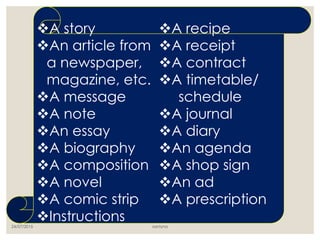
A story
An article from
a newspaper,
magazine, etc.
A message
A note
An essay
A biography
A composition
A novel
A comic strip
Instructions
A recipe
A receipt
A contract
A timetable/
schedule
A journal
A diary
An agenda
A shop sign
An ad
A prescription
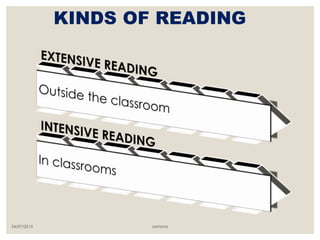
KINDS OF READING
24/07/2015 santyna
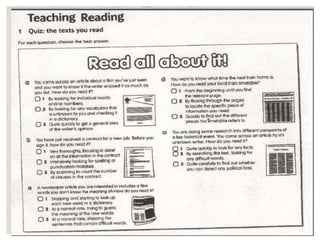
Quiz: The texts you read
Choose the best answer for each question.
Worksheet 1 - page 17
24/07/2015 santyna
24/07/2015 santyna
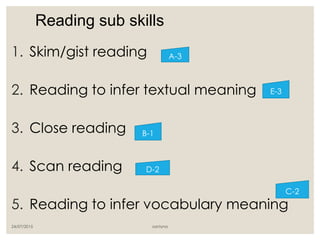
Reading sub skills
1. Skim/gist reading
2. Reading to infer textual meaning
3. Close reading
4. Scan reading
5. Reading to infer vocabulary meaning
24/07/2015 santyna
A-3
E-3
B-1
D-2
C-2
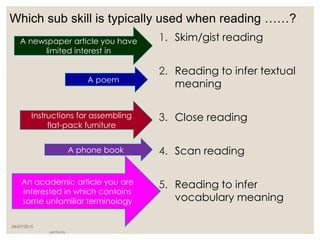
Which sub skill is typically used when reading ……?
1. Skim/gist reading
2. Reading to infer textual
meaning
3. Close reading
4. Scan reading
5. Reading to infer
vocabulary meaning
24/07/2015
santyna
A poem
A phone book
An academic article you are
interested in which contains
some unfamiliar terminology
Instructions for assembling
flat-pack furniture
A newspaper article you have
limited interest in
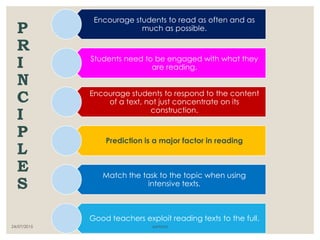
P
R
I
N
C
I
P
L
E
S
Encourage students to read as often and as
much as possible.
Students need to be engaged with what they
are reading.
Encourage students to respond to the content
of a text, not just concentrate on its
construction.
Prediction is a major factor in reading
Match the task to the topic when using
intensive texts.
Good teachers exploit reading texts to the full.
24/07/2015 santyna
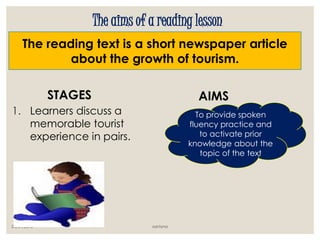
The aims of a reading lesson
1. Learners discuss a
memorable tourist
experience in pairs.
24/07/2015 santyna
To provide spoken
fluency practice and
to activate prior
knowledge about the
topic of the text
The reading text is a short newspaper article
about the growth of tourism.
STAGES AIMS
24/07/2015 santyna
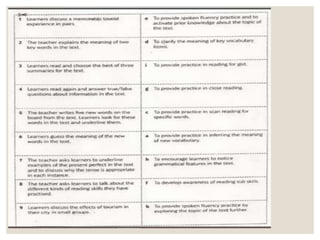
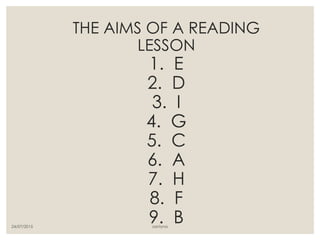
THE AIMS OF A READING
LESSON
1. E
2. D
3. I
4. G
5. C
6. A
7. H
8. F
9. B24/07/2015 santyna
IN ORDER TO “WORK” READINGS, WE NEED TO BE
FAMILIAR WITH THE FOLLOWING TEACHING READING
TECHNIQUES:
◦ Predicting.- to say what will happen after reading the
title or looking at the pictures in the reading exercise.
◦ Skimming.- reading rapidly for the main ideas.
◦ Scanning.- reading rapidly to find a specific piece of
information.
◦ Making inferences.- to form an opinion or guess that
something is true because of the information that you
have. This means that the information is never clearly
stated.
24/07/2015 santyna
◦ Analyzing vocabulary.-antonyms, contrasting,
pictures.
◦ Asking and answering comprehension questions.
◦ Summarizing.- to express the most important facts or
ideas about something in a short and clear form.
◦ Paraphrasing.-to repeat something written or spoken
using different words.
◦ Personalizing the reading to students’ experiences.
24/07/2015 santyna
1.-PRE-READING.-this is the phase when teachers
prepare students for the reading. You can have
students predict, make inferences, etc. so they will
be prepared for what they are going to read.
HOW TO “WORK” A READING IN
CLASS:
santyna24/07/2015
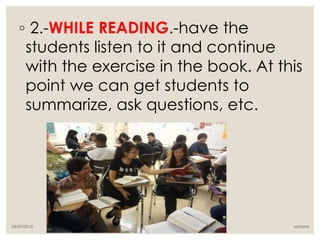
◦ 2.-WHILE READING.-have the
students listen to it and continue
with the exercise in the book. At this
point we can get students to
summarize, ask questions, etc.
24/07/2015 santyna
◦3.-POST-READING.-good opportunity
to personalize. You can have
students discuss questions in groups
too.
24/07/2015 santyna
24/07/2015 santyna
1) Jigsaw reading
2) Matching headlines
3) Predicting from phrases/pictures
4) Following instructions
5) And more…..
24/07/2015 santyna
TIPS
1. Teachers are responsible for READING FIRST or
USING THE AUDIO.
2. PREPARATION is essential for Reading
comprehension.
3. Texts should be leveled
4. If text is long, split it into 2,3,or any parts good for
your students
24/07/2015 santyna
Bibliography
Craig Thaine “Teacher
Training Essentials”
Jeremy Harmer “How to teach
English”
24/07/2015 santyna
24/07/2015 santyna

Teaching reading 2015

  • 1.
  • 2.
    AIM: to raise awarenessof techniques for successful reading skills lessons 24/07/2015 santyna
  • 3.
    ◦HOW MANY DIFFERENT TEXTSHAVE YOU READ SO FAR TODAY? ◦WHICH ONES? 24/07/2015 santyna
  • 4.
    24/07/2015 santyna A story Anarticle from a newspaper, magazine, etc. A message A note An essay A biography A composition A novel A comic strip Instructions A recipe A receipt A contract A timetable/ schedule A journal A diary An agenda A shop sign An ad A prescription
  • 5.
  • 6.
    Quiz: The textsyou read Choose the best answer for each question. Worksheet 1 - page 17 24/07/2015 santyna
  • 7.
  • 8.
    Reading sub skills 1.Skim/gist reading 2. Reading to infer textual meaning 3. Close reading 4. Scan reading 5. Reading to infer vocabulary meaning 24/07/2015 santyna A-3 E-3 B-1 D-2 C-2
  • 9.
    Which sub skillis typically used when reading ……? 1. Skim/gist reading 2. Reading to infer textual meaning 3. Close reading 4. Scan reading 5. Reading to infer vocabulary meaning 24/07/2015 santyna A poem A phone book An academic article you are interested in which contains some unfamiliar terminology Instructions for assembling flat-pack furniture A newspaper article you have limited interest in
  • 10.
    P R I N C I P L E S Encourage students toread as often and as much as possible. Students need to be engaged with what they are reading. Encourage students to respond to the content of a text, not just concentrate on its construction. Prediction is a major factor in reading Match the task to the topic when using intensive texts. Good teachers exploit reading texts to the full. 24/07/2015 santyna
  • 11.
    The aims ofa reading lesson 1. Learners discuss a memorable tourist experience in pairs. 24/07/2015 santyna To provide spoken fluency practice and to activate prior knowledge about the topic of the text The reading text is a short newspaper article about the growth of tourism. STAGES AIMS
  • 12.
  • 13.
    THE AIMS OFA READING LESSON 1. E 2. D 3. I 4. G 5. C 6. A 7. H 8. F 9. B24/07/2015 santyna
  • 14.
    IN ORDER TO“WORK” READINGS, WE NEED TO BE FAMILIAR WITH THE FOLLOWING TEACHING READING TECHNIQUES: ◦ Predicting.- to say what will happen after reading the title or looking at the pictures in the reading exercise. ◦ Skimming.- reading rapidly for the main ideas. ◦ Scanning.- reading rapidly to find a specific piece of information. ◦ Making inferences.- to form an opinion or guess that something is true because of the information that you have. This means that the information is never clearly stated. 24/07/2015 santyna
  • 15.
    ◦ Analyzing vocabulary.-antonyms,contrasting, pictures. ◦ Asking and answering comprehension questions. ◦ Summarizing.- to express the most important facts or ideas about something in a short and clear form. ◦ Paraphrasing.-to repeat something written or spoken using different words. ◦ Personalizing the reading to students’ experiences. 24/07/2015 santyna
  • 16.
    1.-PRE-READING.-this is thephase when teachers prepare students for the reading. You can have students predict, make inferences, etc. so they will be prepared for what they are going to read. HOW TO “WORK” A READING IN CLASS: santyna24/07/2015
  • 17.
    ◦ 2.-WHILE READING.-havethe students listen to it and continue with the exercise in the book. At this point we can get students to summarize, ask questions, etc. 24/07/2015 santyna
  • 18.
    ◦3.-POST-READING.-good opportunity to personalize.You can have students discuss questions in groups too. 24/07/2015 santyna
  • 19.
  • 20.
    1) Jigsaw reading 2)Matching headlines 3) Predicting from phrases/pictures 4) Following instructions 5) And more….. 24/07/2015 santyna
  • 21.
    TIPS 1. Teachers areresponsible for READING FIRST or USING THE AUDIO. 2. PREPARATION is essential for Reading comprehension. 3. Texts should be leveled 4. If text is long, split it into 2,3,or any parts good for your students 24/07/2015 santyna
  • 22.
    Bibliography Craig Thaine “Teacher TrainingEssentials” Jeremy Harmer “How to teach English” 24/07/2015 santyna
  • 23.

Editor's Notes

  • #7 Hand in the quiz and tell the participants to choose the best answer. Correct answers: a)3, b)1, c)2, d)2, e)3
  • #9 Now participants have to match the correct answers with the sub skills.
  • #10 Participants discuss which sub skill is appropriate for each activity.
  • #11 Invite participants to work in groups and talk about each principle.
  • #12 Trainees (in pairs) have to match the stages with the aims. Appendix ,page 108
  • #20 Group the participants so they can work with the stages. Group 1.- explain how to prepare students Group 2.-describe the reading task Group 3.- tell the class what students should do after reading