Communicative
Approach
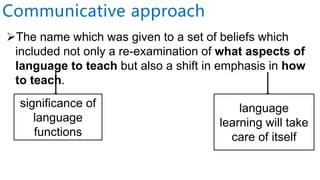
The name which was given to a set of beliefs which
included not only a re-examination of what aspects of
language to teach but also a shift in emphasis in how
to teach.
Communicative approach
significance of
language
functions
language
learning will take
care of itself
The origins of Communicative Language Teaching
can be found in changes in the British language
teaching traditions in the 1960s.
The group of experts saw the need to focus in
communicative proficiency rather than mastery of
structures.
 Christopher N. Candlin, D.A. Wilkins and Henry
Widdowson along with others promoted the CLT
approach.
Brief History
• Language is a system for the
expression of meaning.
• The primary function of language is for
interaction and communication.
• The structure of language reflects its
functional and communicative uses.
Theory of language
How is language viewed?
Language is for communication. Learners
need knowledge of forms and meanings and
functions. However, they must use this
knowledge and take into consideration the social
situation in order to convey their intended
meaning appropriately.
Notion of learning
 CLT involves a lot of experimentation
because students most likely do not know all
the answers, but they are challenged to do
the best with wat they know in order to make
a successful form of communication.
Notion of learning
 This type of learning is done collaboratively
with peers. It is believed that getting
feedback from peers and interacting with
other learners will increase their
understanding.
Notion of learning
 The lessons done in this activity
are supposed to be more natural
and discovery based rather than
predictable. It is thought that this
more natural approach is more
engaging than following a script
or reading a text.
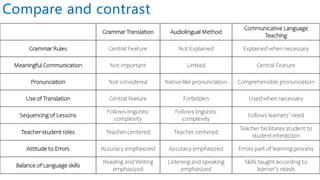
Grammar Translation Audiolingual Method
Communicative Language
Teaching
Grammar Rules Central Feature Not Explained Explained when necessary
Meaningful Communication Not important Limited Central Feature
Pronunciation Not considered Native-like pronunciation Comprehensible pronunciation
Use of Translation Central feature Forbidden Used when necessary
Sequencing of Lessons
Follows linguistic
complexity
Follows linguistic
complexity
Follows learners’ need
Teacher-student roles Teacher-centered Teacher-centered
Teacher facilitates student to
student interaction
Attitude to Errors Accuracy emphasized Accuracy emphasized Errors part of learning process
Balance of Language skills
Reading and Writing
emphasized
Listening and speaking
emphasized
Skills taught according to
learner’s needs
Compare and contrast
The goal of clt
• to enable students to
communicate in the target
language
• to develop “communicative
competence” (Hymes, 1972)
The role of the teacher
1. To facilitate the communication process
between all participants in the
classroom
2. To act as an independent participant
within the learning-teaching group.
(Richards J.C., Rodgers T.S)
Students are, above all, communicators.
They are actively engaged in negotiating
meanings – in trying to make themselves
understood and in understanding others –
even when their knowledge of the target
language is incomplete.
The role of the learner
What is the nature of student-teacher interaction?
What is the nature of student-student interaction?
Teachers
 Presenter of the lesson
 Facilitator of the activities
 Co-communicator
 Establishes situations that prompt
communication
Students interact a great deal with
one another.
What are some characteristics of the
teaching/learning process?
 Almost everything that is done is done with a
communicative intent
 Use of authentic materials
 Small numbers of students interacting are favored
in order to maximize the time allotted to each
students for communicating.
How are the feelings of the
students dealt with?
By learning to communicate, students will be
more motivated to study a foreign language.
Teachers give students an opportunity to
express their individuality.
Students security is enhanced.
What is the role of the
students’ native language?
Judicious use of the students‘ native
language is permitted in CLT. However,
whenever possible, the target language should
be used not only during communicative activities,
but also for explaining the activities to the
students or in assigning homework.
How is evaluation accomplished?
A teacher evaluates not only the
students’ accuracy but also their
fluency.
How does the teacher respond to
students errors?
Errors of form are tolerated during
fluency-based activities and are seen as
a natural outcome of the development
of communication skills.
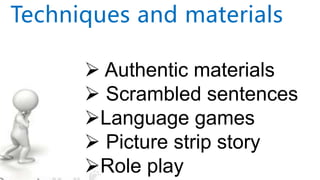
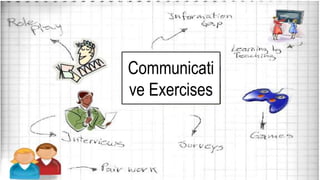
 Authentic materials
 Scrambled sentences
Language games
 Picture strip story
Role play
Techniques and materials
Communicati
ve Exercises
This approach helps teachers develop
students’ oral communication skills.
Students will lose fear of communicating in
a second language.
It can help promote confidence and security
in the classroom environment and in
everyday use.
conclusion
• Larsen-Freeman, D. (2000). Techniques and Principles in Language Teaching
(2nd Ed.). Oxford: Oxford University Press
• Richards, J. C. Rodgers, T. S. (1992). Approaches and Methods in Language
Teaching. New York: Cambridge University Press.
References:
Communicative approach.pptx

Communicative approach.pptx

  • 1.
  • 2.
    The name whichwas given to a set of beliefs which included not only a re-examination of what aspects of language to teach but also a shift in emphasis in how to teach. Communicative approach significance of language functions language learning will take care of itself
  • 3.
    The origins ofCommunicative Language Teaching can be found in changes in the British language teaching traditions in the 1960s. The group of experts saw the need to focus in communicative proficiency rather than mastery of structures.  Christopher N. Candlin, D.A. Wilkins and Henry Widdowson along with others promoted the CLT approach. Brief History
  • 4.
    • Language isa system for the expression of meaning. • The primary function of language is for interaction and communication. • The structure of language reflects its functional and communicative uses. Theory of language
  • 5.
    How is languageviewed? Language is for communication. Learners need knowledge of forms and meanings and functions. However, they must use this knowledge and take into consideration the social situation in order to convey their intended meaning appropriately.
  • 6.
    Notion of learning CLT involves a lot of experimentation because students most likely do not know all the answers, but they are challenged to do the best with wat they know in order to make a successful form of communication.
  • 7.
    Notion of learning This type of learning is done collaboratively with peers. It is believed that getting feedback from peers and interacting with other learners will increase their understanding.
  • 8.
    Notion of learning The lessons done in this activity are supposed to be more natural and discovery based rather than predictable. It is thought that this more natural approach is more engaging than following a script or reading a text.
  • 9.
    Grammar Translation AudiolingualMethod Communicative Language Teaching Grammar Rules Central Feature Not Explained Explained when necessary Meaningful Communication Not important Limited Central Feature Pronunciation Not considered Native-like pronunciation Comprehensible pronunciation Use of Translation Central feature Forbidden Used when necessary Sequencing of Lessons Follows linguistic complexity Follows linguistic complexity Follows learners’ need Teacher-student roles Teacher-centered Teacher-centered Teacher facilitates student to student interaction Attitude to Errors Accuracy emphasized Accuracy emphasized Errors part of learning process Balance of Language skills Reading and Writing emphasized Listening and speaking emphasized Skills taught according to learner’s needs Compare and contrast
  • 10.
    The goal ofclt • to enable students to communicate in the target language • to develop “communicative competence” (Hymes, 1972)
  • 11.
    The role ofthe teacher 1. To facilitate the communication process between all participants in the classroom 2. To act as an independent participant within the learning-teaching group. (Richards J.C., Rodgers T.S)
  • 12.
    Students are, aboveall, communicators. They are actively engaged in negotiating meanings – in trying to make themselves understood and in understanding others – even when their knowledge of the target language is incomplete. The role of the learner
  • 13.
    What is thenature of student-teacher interaction? What is the nature of student-student interaction? Teachers  Presenter of the lesson  Facilitator of the activities  Co-communicator  Establishes situations that prompt communication Students interact a great deal with one another.
  • 14.
    What are somecharacteristics of the teaching/learning process?  Almost everything that is done is done with a communicative intent  Use of authentic materials  Small numbers of students interacting are favored in order to maximize the time allotted to each students for communicating.
  • 15.
    How are thefeelings of the students dealt with? By learning to communicate, students will be more motivated to study a foreign language. Teachers give students an opportunity to express their individuality. Students security is enhanced.
  • 16.
    What is therole of the students’ native language? Judicious use of the students‘ native language is permitted in CLT. However, whenever possible, the target language should be used not only during communicative activities, but also for explaining the activities to the students or in assigning homework.
  • 17.
    How is evaluationaccomplished? A teacher evaluates not only the students’ accuracy but also their fluency.
  • 18.
    How does theteacher respond to students errors? Errors of form are tolerated during fluency-based activities and are seen as a natural outcome of the development of communication skills.
  • 19.
     Authentic materials Scrambled sentences Language games  Picture strip story Role play Techniques and materials
  • 20.
  • 21.
    This approach helpsteachers develop students’ oral communication skills. Students will lose fear of communicating in a second language. It can help promote confidence and security in the classroom environment and in everyday use. conclusion
  • 22.
    • Larsen-Freeman, D.(2000). Techniques and Principles in Language Teaching (2nd Ed.). Oxford: Oxford University Press • Richards, J. C. Rodgers, T. S. (1992). Approaches and Methods in Language Teaching. New York: Cambridge University Press. References:

Editor's Notes

  • #2 You may have noticed that the goal of most of the methods we have looked at so far is for students to learn to communicate in the target language. Educators began to question if they were going about meeting the goal in the right way. Some observed that students could produced sentences accurately in a lesson, but could not use them appropriately when genuinely communicating outside of the classroom. Other linguist noted that being able to communicate required more that mastering linguistic structures. Students may know the rules of linguistic usage but unable to use the language. It become clear that communication required that students perform certain functions as well, such as promising, inviting and declining invitations within a social context. In short, being able to communicate required more than linguistic competence, it required communicative competence.
  • #3 The “what to teach” aspect stressed the significance of language functions rather than focusing solely on grammar and vocabulary. A guiding principle was to train students to use these language forms appropriately in a variety of contexts and for a variety of purposes. The “how to teach aspect” is closely related to the idea that ‘language learning will take care of itself’ and that plentiful exposure to language in use and plenty of opportunities to use it are vitally important for a student’s development of knowledge and skill.
  • #4 Back then, the Situational language Teaching approach was the norm. It consisted of internalizing the structures of a language. Mostly, learning grammar rules without vocabulary development.
  • #5 Grammatical competence – (Chomsky calls it linguistic competence; Hymes pertains to a “formally possible) the grammatical and lexical capacity Sociolinguistic competence – understanding the social context in which communication takes place, including role relationships and the communicative purpose for their interaction Discourse competence – interpretation of individual message elements in terms of their interconnectedness and of how meaning is represented in relationship to the entire discourse or text Strategic competence – coping strategies that communicators employ to initiate, terminate, maintain, repair and redirect information
  • #8 At times, fluency may have to take on more importance than accuracy in order to keep learners meaningfully engaged in language use.
  • #9 At times, fluency may have to take on more importance than accuracy in order to keep learners meaningfully engaged in language use.
  • #10 At times, fluency may have to take on more importance than accuracy in order to keep learners meaningfully engaged in language use.
  • #12 To do this students need knowledge of the linguistic forms, meanings, and functions. They need to know that many different forms can be used to perform a function and also that a single form can often serve a variety of functions. They must be able to choose from among these the most appropriate form, given the social contex t and the roles of the interlocutors. They must also be able to manage the process of negotiating meaning with their interlocutors. Cornmunicarion is a process; knowledge of the forms of language is insufficient.
  • #14 In this role, one of his major responsibilities is to establish situation likely to promote communication. During the activities he acts as an adviser, answering student’s questions and monitoring their performance. He might make note of their errors to be worked on at a later time during more accuracy-based activities. At other times he might be a ‘co-communicator’ engaging in the communicative activity along with students (Littlewood 1981). Alos, since the teacher’s role is less dominant than in a teacher-centered method, students are seen as more responsible managers of their own learning.
  • #17 The students use the language a great deal through communicative activities such as games, role plays and problem solving tasks. Give students an opportunity to develop strategies for understanding language as it is actually used
  • #18 1. By learning to communicate, students will be more motivated to study a foreign language since they will feel they are learning to do something useful with the language. 2. Teachers give students an opportunity to express their individuality by having them share their ideas and opinions on a regular basis. 3. Students security is enhanced by the many opportunities for cooperative interactions with their fellow students and the teacher.
  • #21 A teacher can informally evaluate his students' performance in his role as an adviser or co-communicator. For more formal evaluation, a teacher is likely to use an integrative test which has a real communicative function. In order to assess students' writing skill, for instance, a teacher might ask them to write a letter to a friend.
  • #22 Students can have limited linguistic knowledge and still be successful communicators. The teacher may note the errors during fluency activities and return to them later with an accuracy-based activity.