IELTS
INTERNATIONAL ENGLISHLANGUAGE TESTING
SYSTEM
Workshop Format
 Overview
- Structure
- Scoring
- Help
- Q & A
 Speaking and Listening
 Writing
 Reading
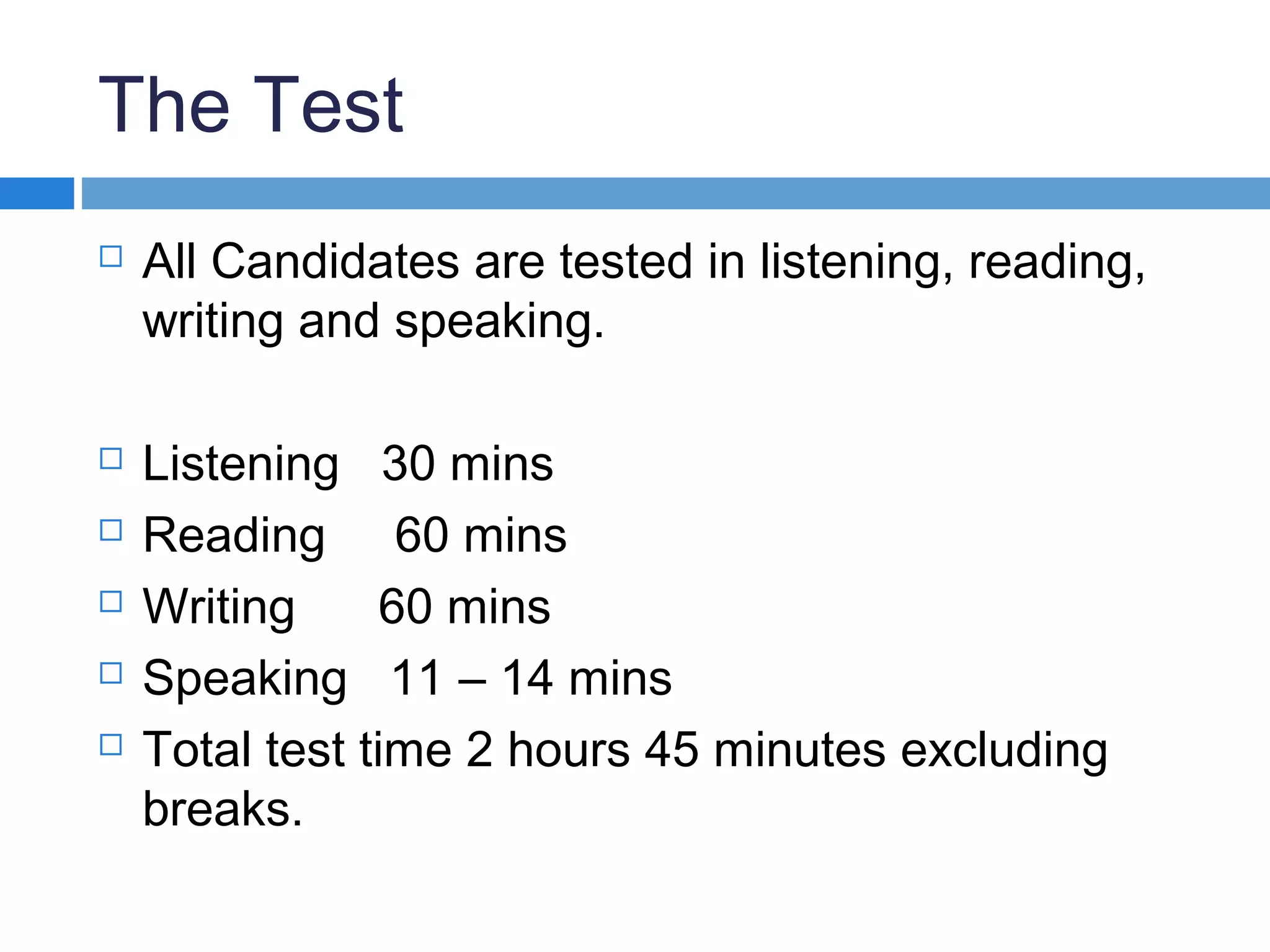
The Test
 All Candidates are tested in listening, reading,
writing and speaking.
 Listening 30 mins
 Reading 60 mins
 Writing 60 mins
 Speaking 11 – 14 mins
 Total test time 2 hours 45 minutes excluding
breaks.
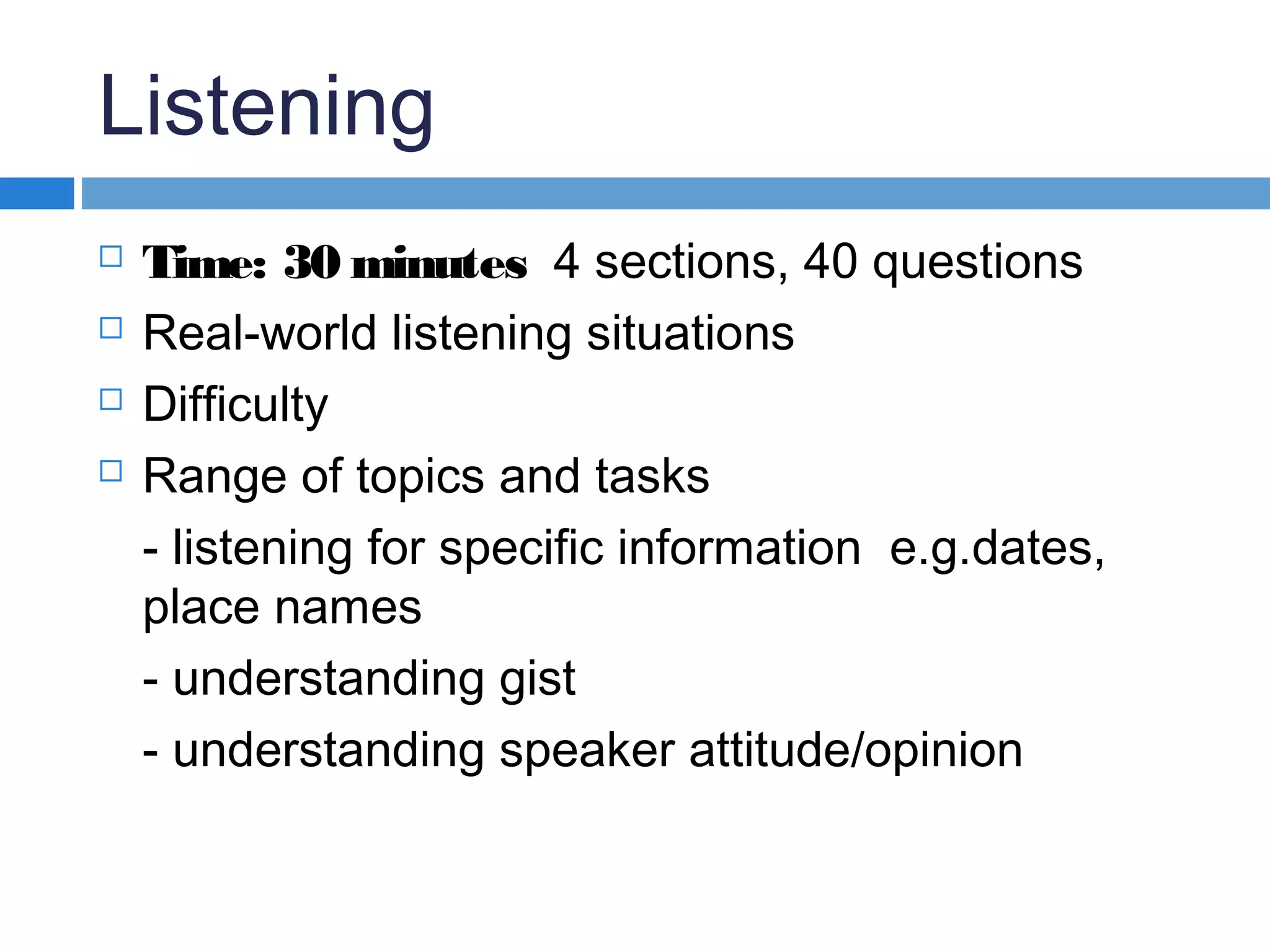
Listening
 Time: 30 minutes 4 sections, 40 questions
 Real-world listening situations
 Difficulty
 Range of topics and tasks
- listening for specific information e.g.dates,
place names
- understanding gist
- understanding speaker attitude/opinion
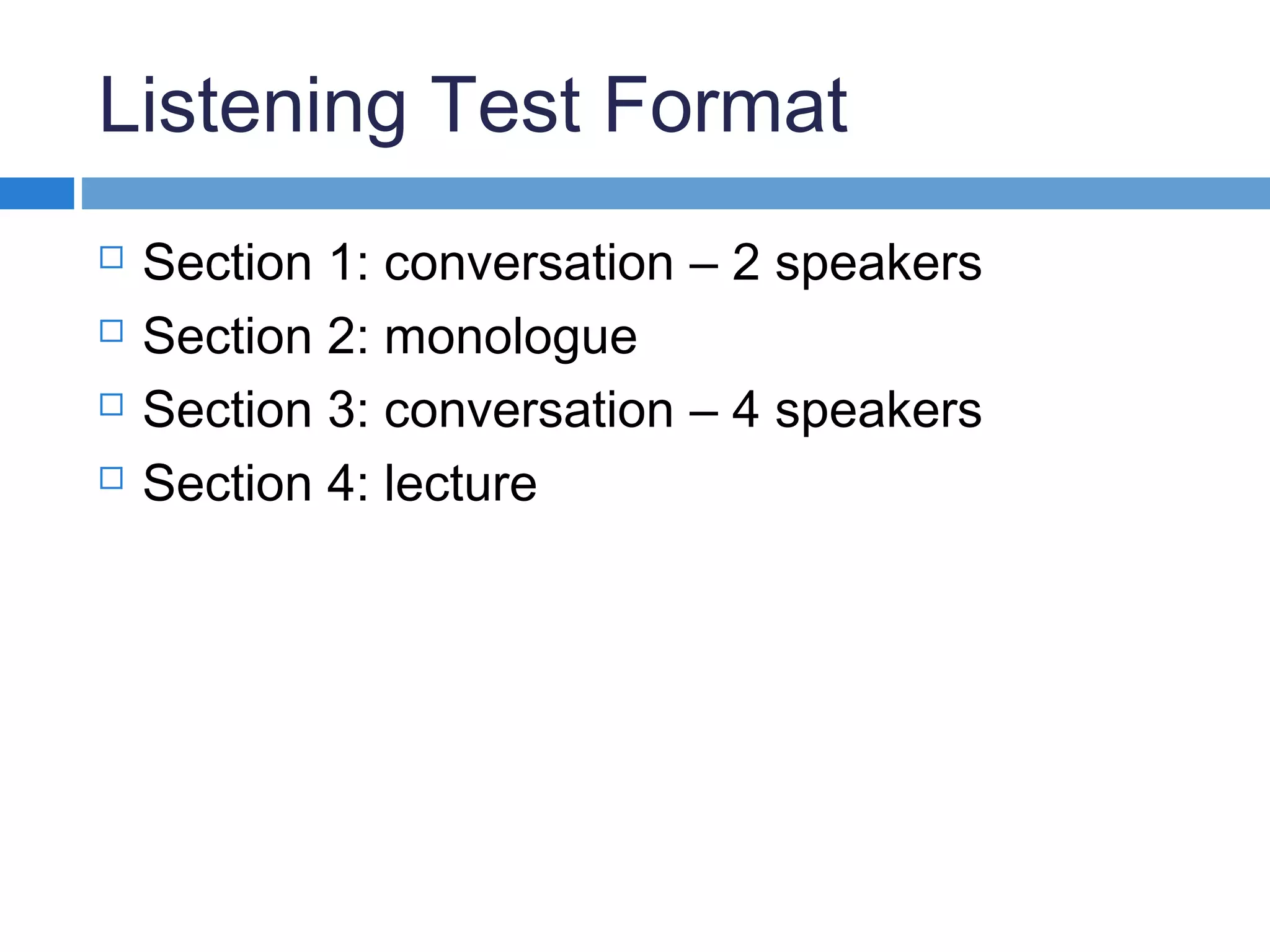
Listening Test Format
 Section 1: conversation – 2 speakers
 Section 2: monologue
 Section 3: conversation – 4 speakers
 Section 4: lecture
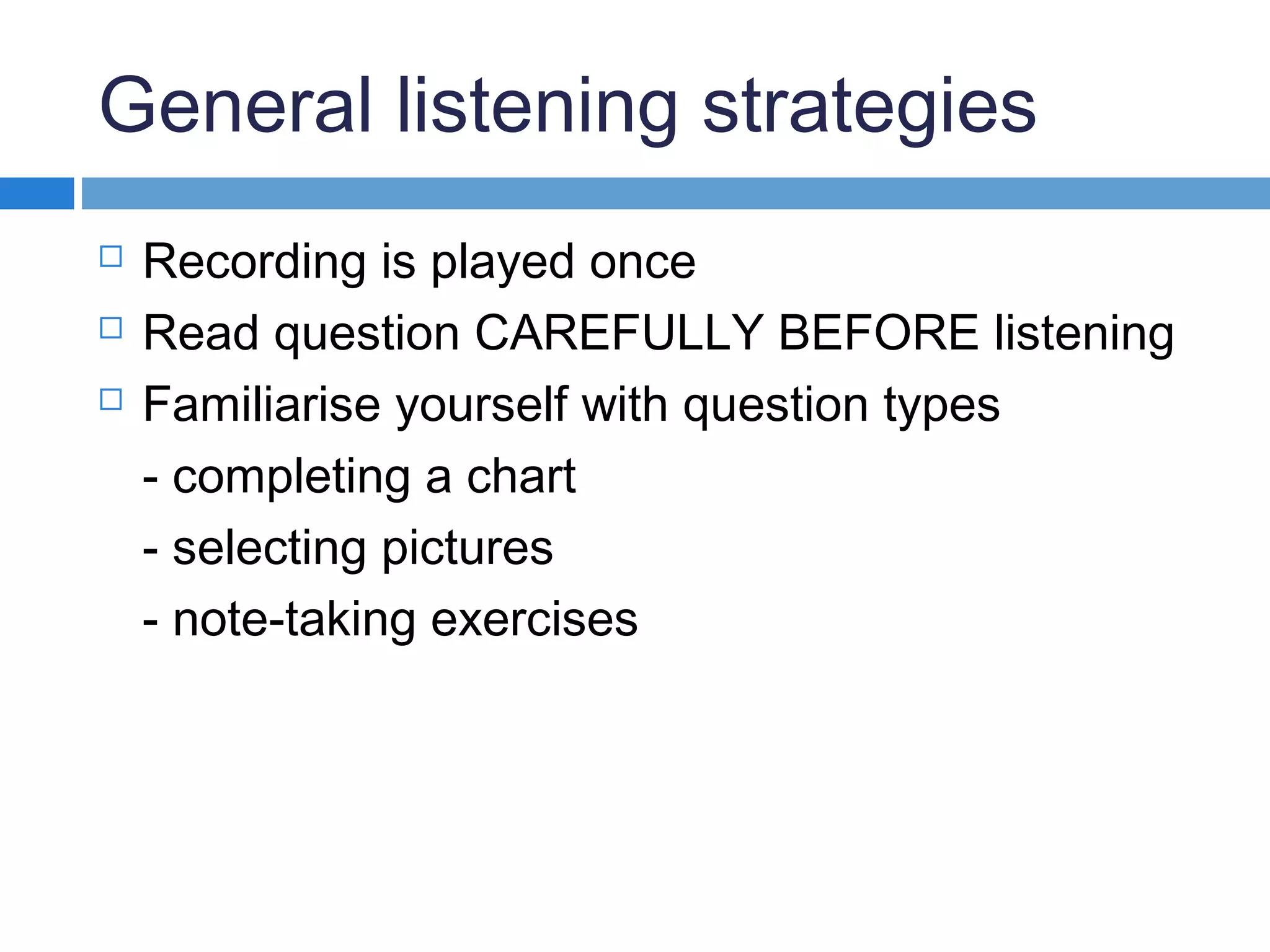
General listening strategies
 Recording is played once
 Read question CAREFULLY BEFORE listening
 Familiarise yourself with question types
- completing a chart
- selecting pictures
- note-taking exercises
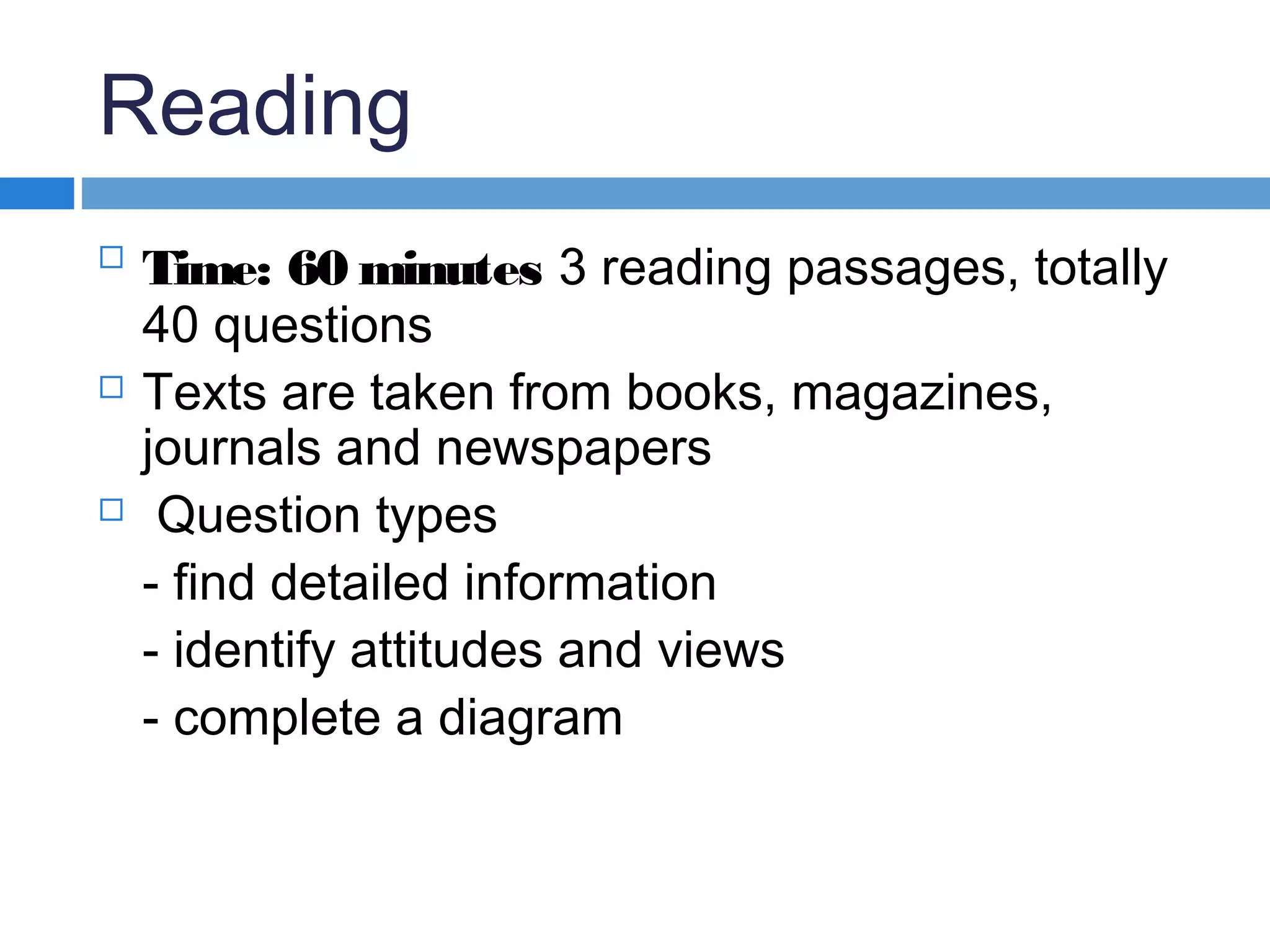
Reading

Time: 60 minutes 3 reading passages, totally
40 questions
 Texts are taken from books, magazines,
journals and newspapers
 Question types
- find detailed information
- identify attitudes and views
- complete a diagram
General Reading Strategies
 Identify reading skills being tested
 Practise these skills
Writing
 Time: 60 minutes 2 tasks
 Task 1(20mins): descriptive report of a table or
diagram, 150 words
 Task 2(40 mins):250 word essay in response
to an opinion or a problem.
 Discuss issues, construct an argument and
use the appropriate tone and register.
General Writing Strategies
 Read the question carefully
 Familiarise yourself with descriptions of data –
in newspapers, textbooks
 Practise formulating your own ideas on topics
Speaking
 Time: 10 – 15 minutes
 Face to face interview between one candidate
and one examiner.
 Part 1(4-5mins): Introduction and interview
 Part 2(1-3 mins incl. prep): Individual talk
 Part 3(4-5 mins): Discussion topics
Speaking
 Speak fluently and link ideas coherently
 Demonstrate a range of appropriate
vocabulary
 Use accurate grammar and appropriate
register
 Speak so that a listener can understand
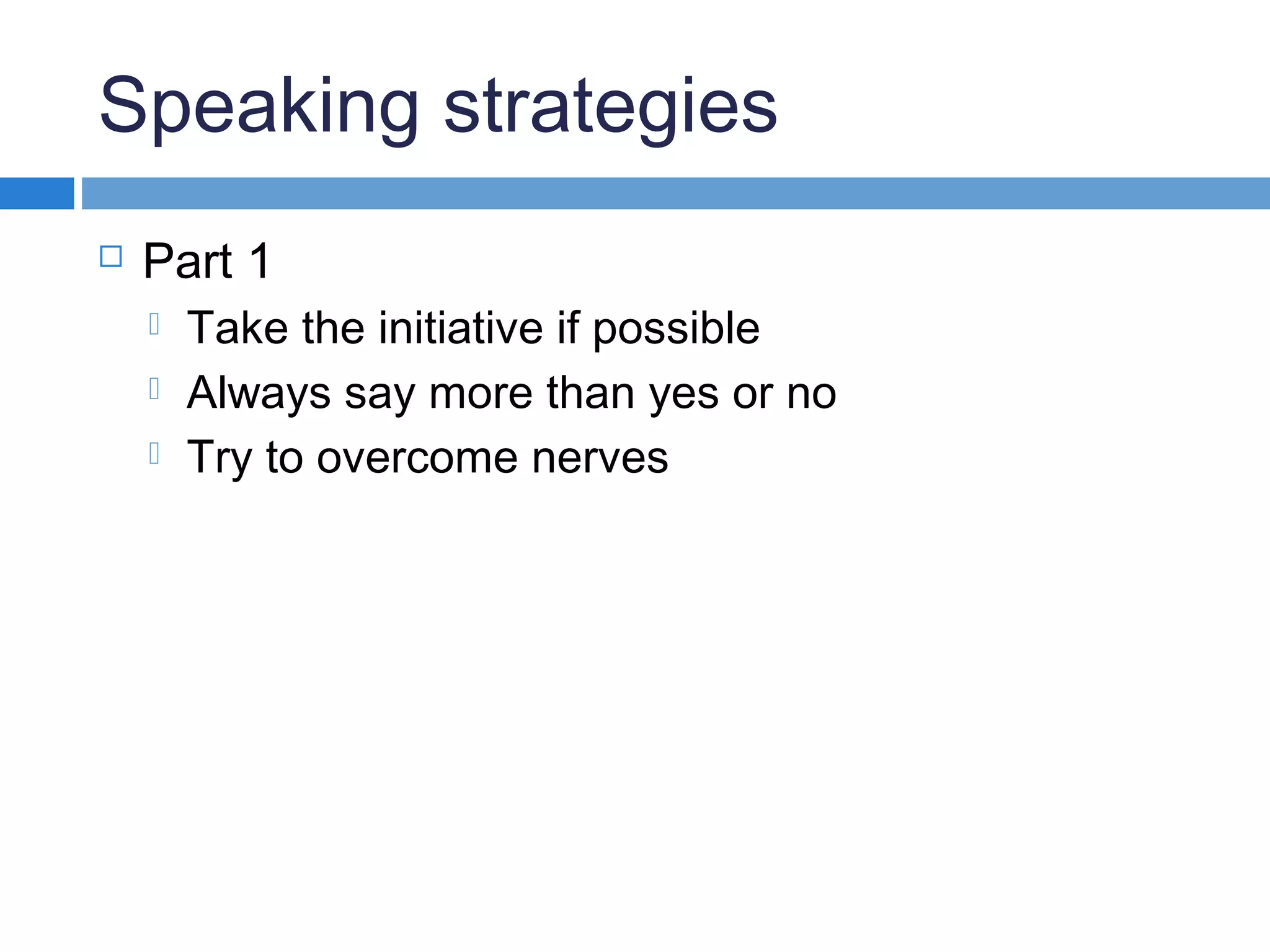
Speaking strategies
 Part 1
 Take the initiative if possible
 Always say more than yes or no
 Try to overcome nerves
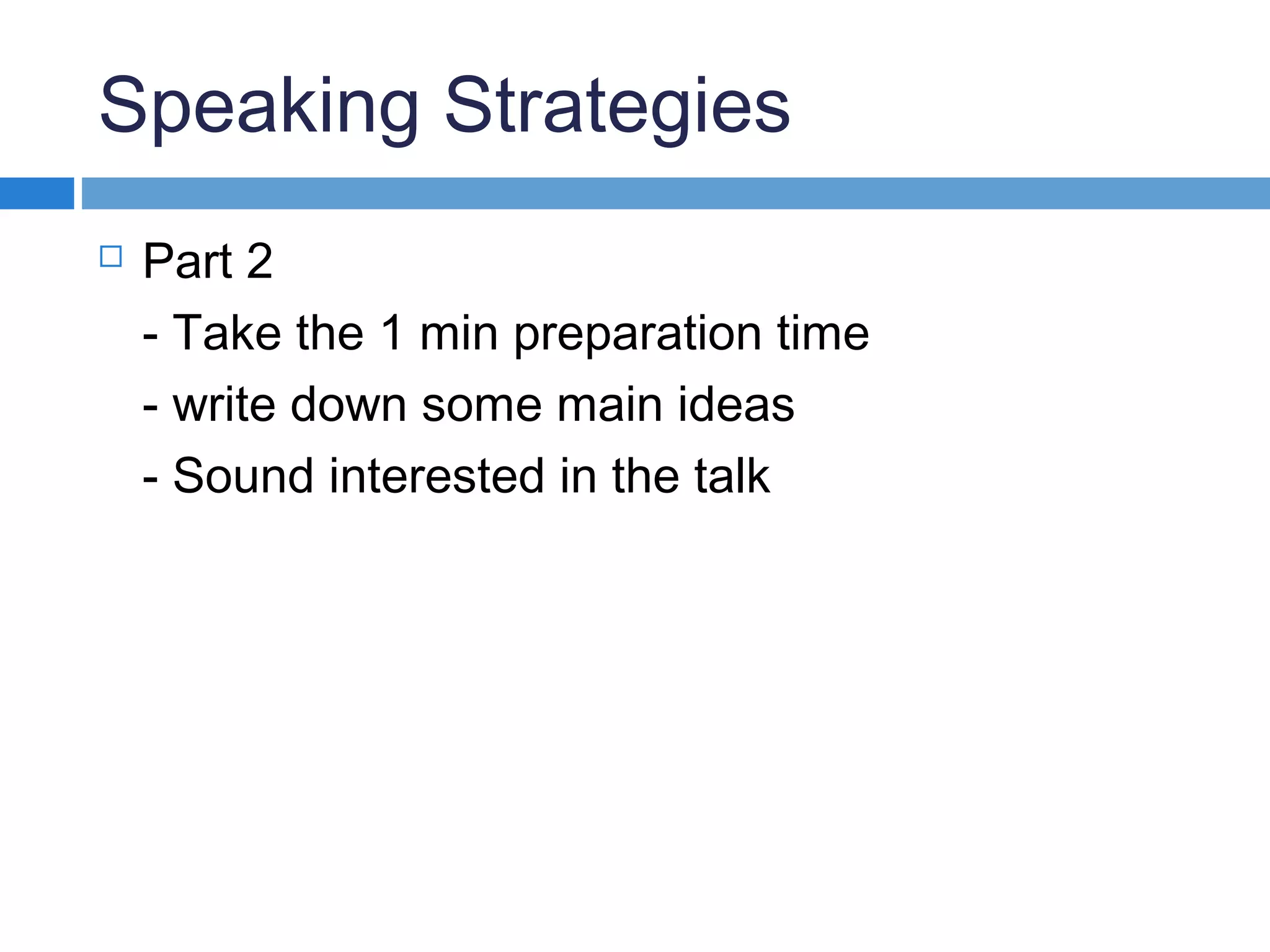
Speaking Strategies
 Part 2
- Take the 1 min preparation time
- write down some main ideas
- Sound interested in the talk
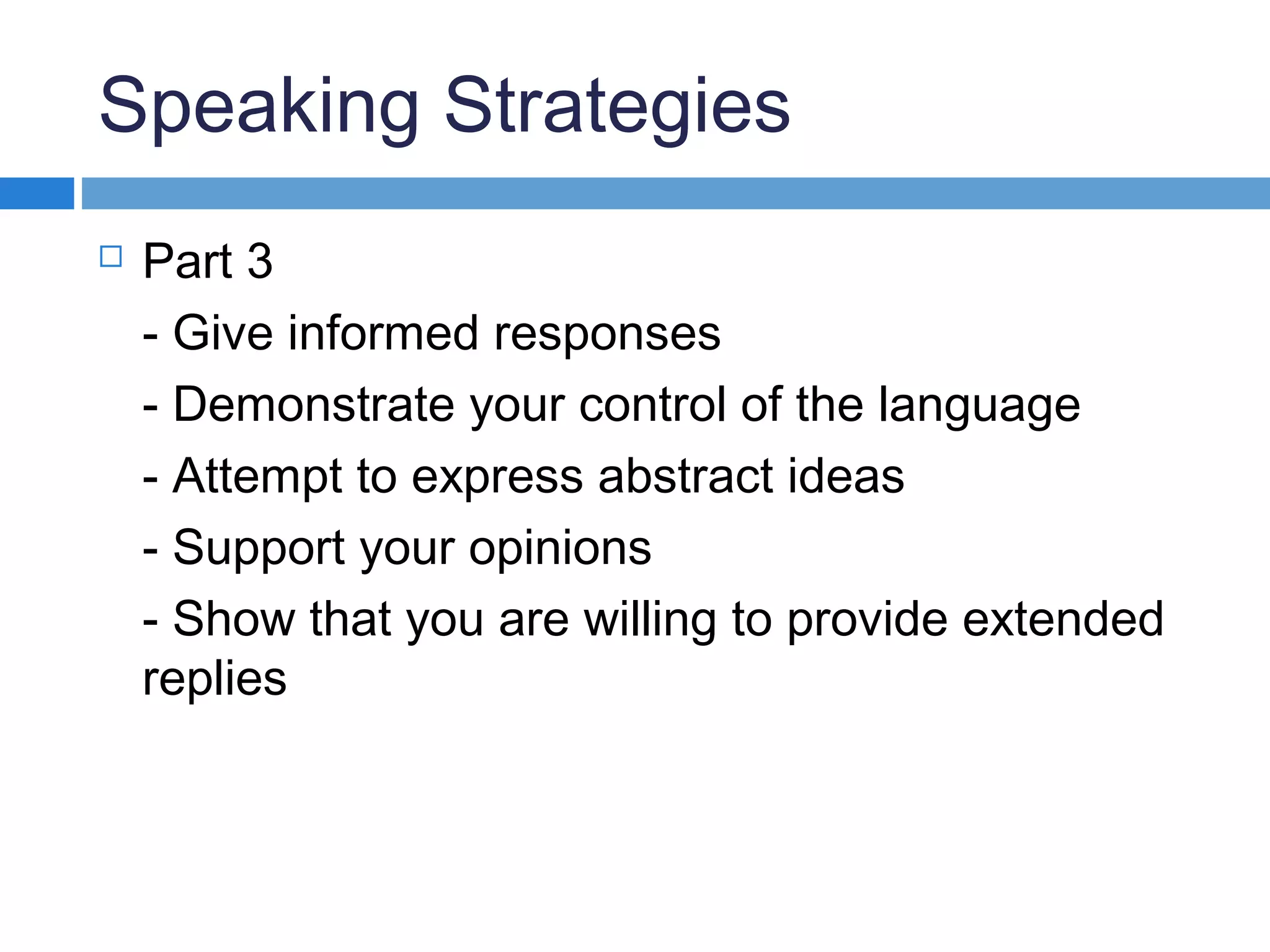
Speaking Strategies
 Part 3
- Give informed responses
- Demonstrate your control of the language
- Attempt to express abstract ideas
- Support your opinions
- Show that you are willing to provide extended
replies
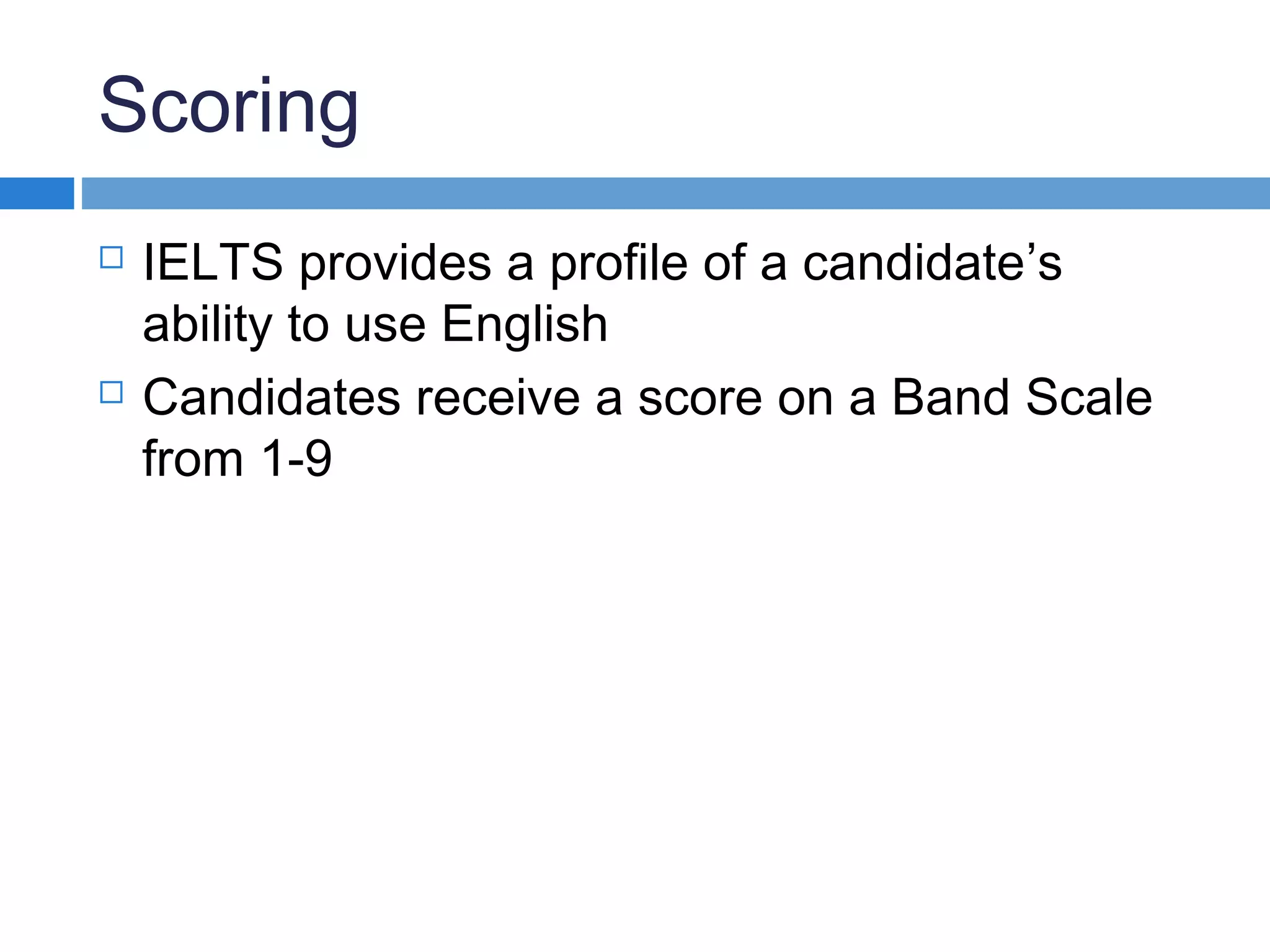
Scoring
 IELTS provides a profile of a candidate’s
ability to use English
 Candidates receive a score on a Band Scale
from 1-9
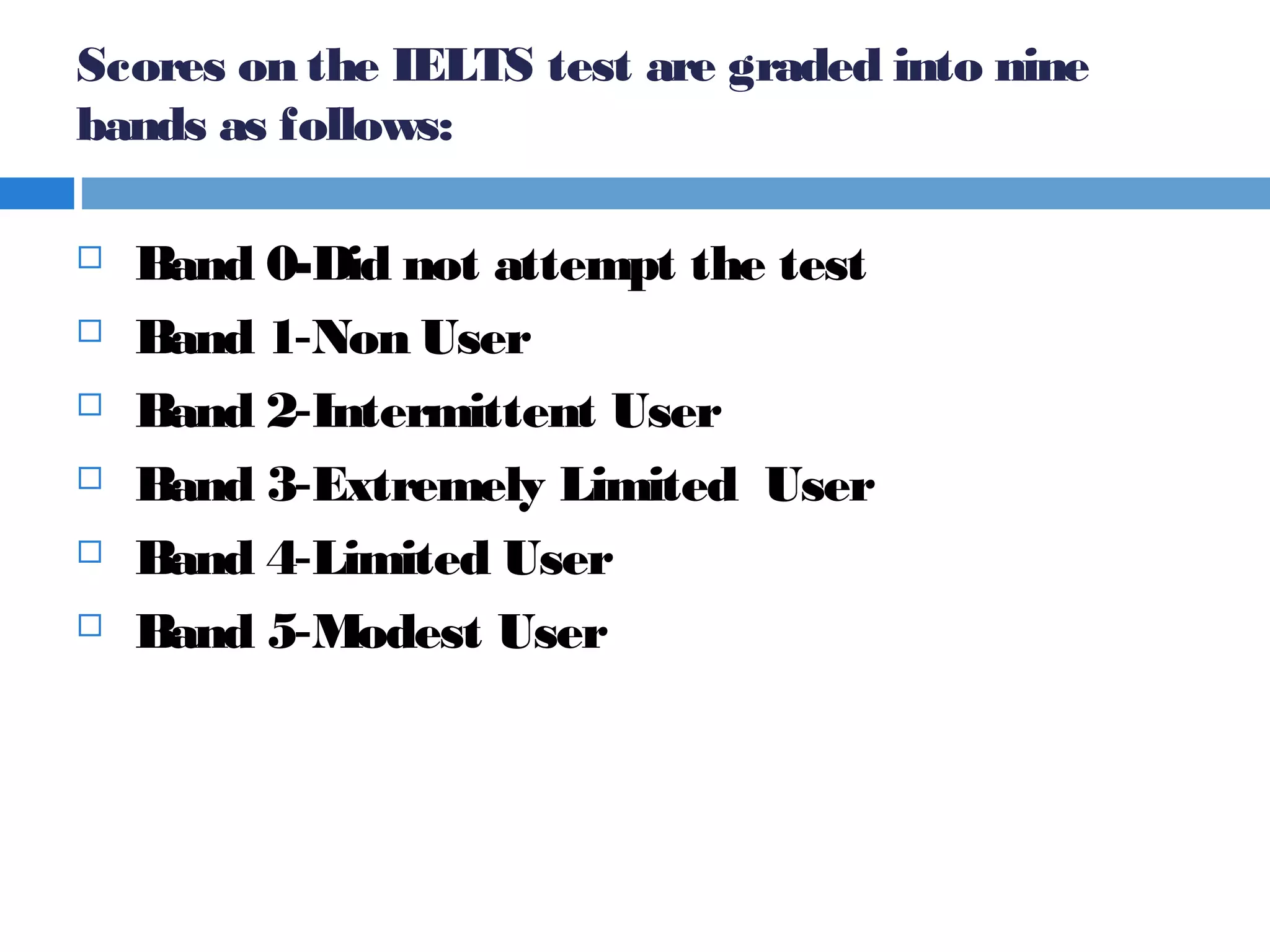
Scores on the IELTS test are graded into nine
bands as follows:
 Band 0-Did not attempt the test  
 Band 1-Non User  
  Band 2-Intermittent User  
 Band 3-Extremely Limited User 
 Band 4-Limited User  
 Band 5-Modest User  
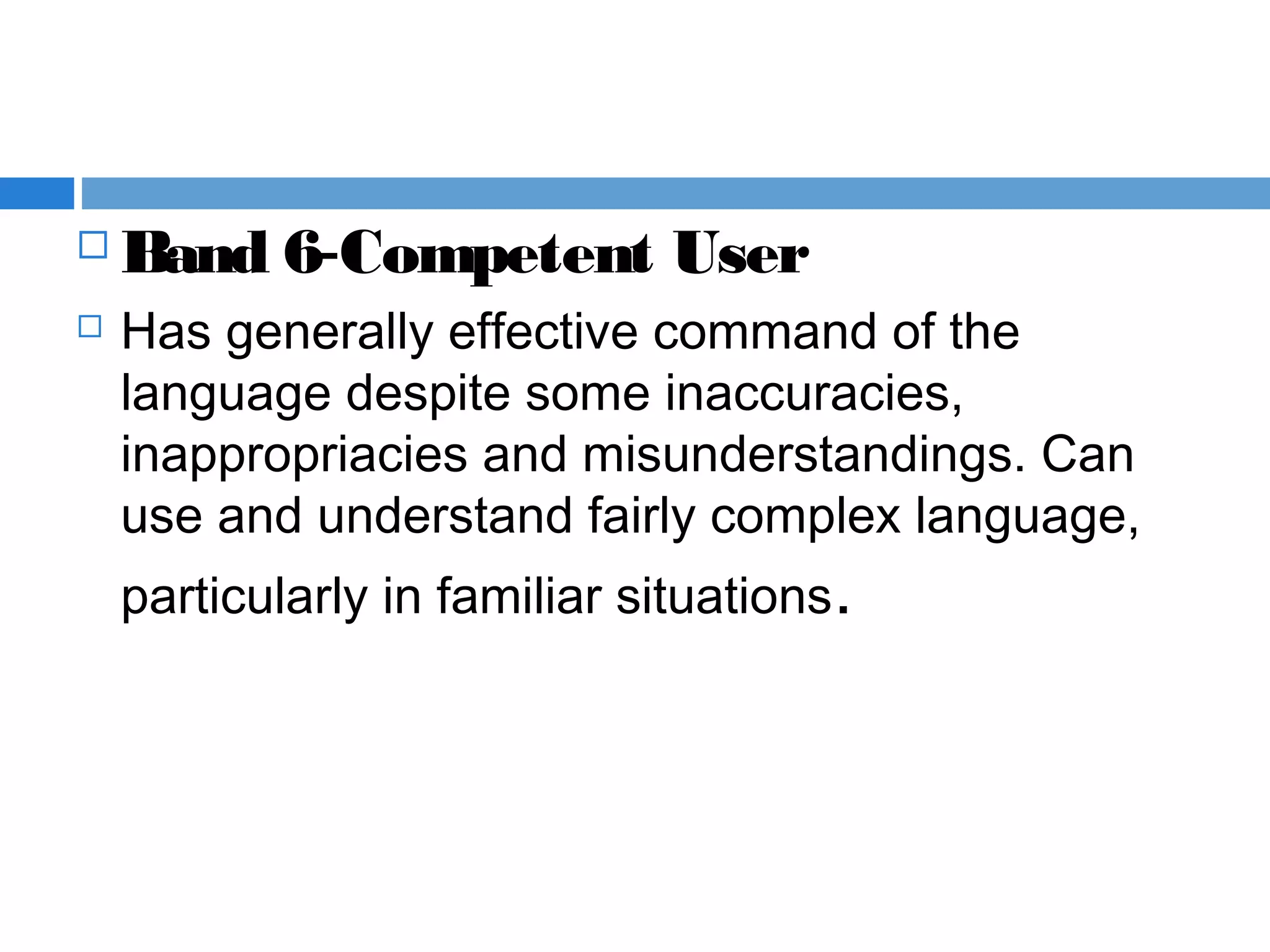
 Band 6-Competent User  
 Has generally effective command of the
language despite some inaccuracies,
inappropriacies and misunderstandings. Can
use and understand fairly complex language,
particularly in familiar situations.
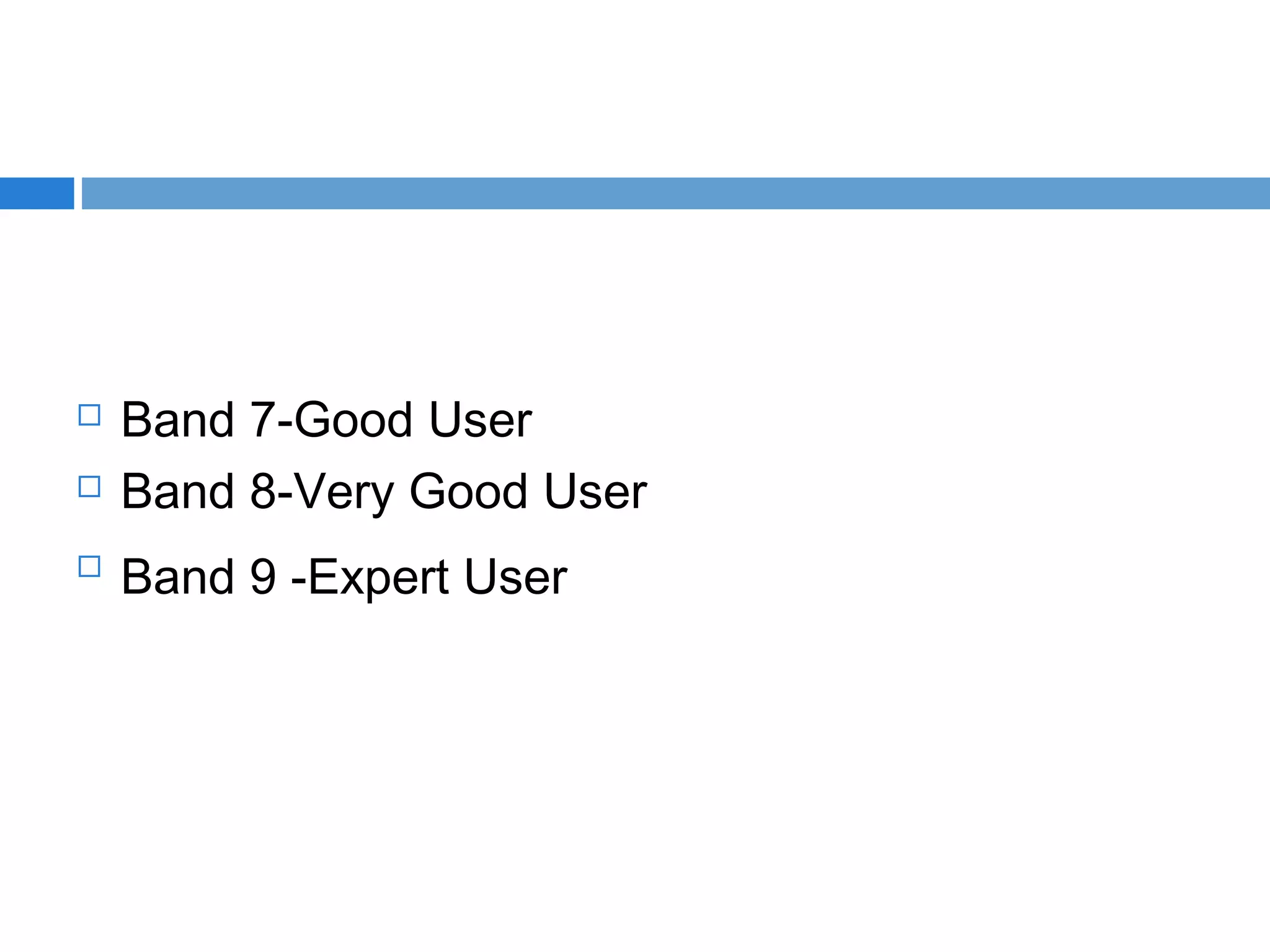
 Band 7-Good User  
 Band 8-Very Good User  

Band 9 -Expert User  
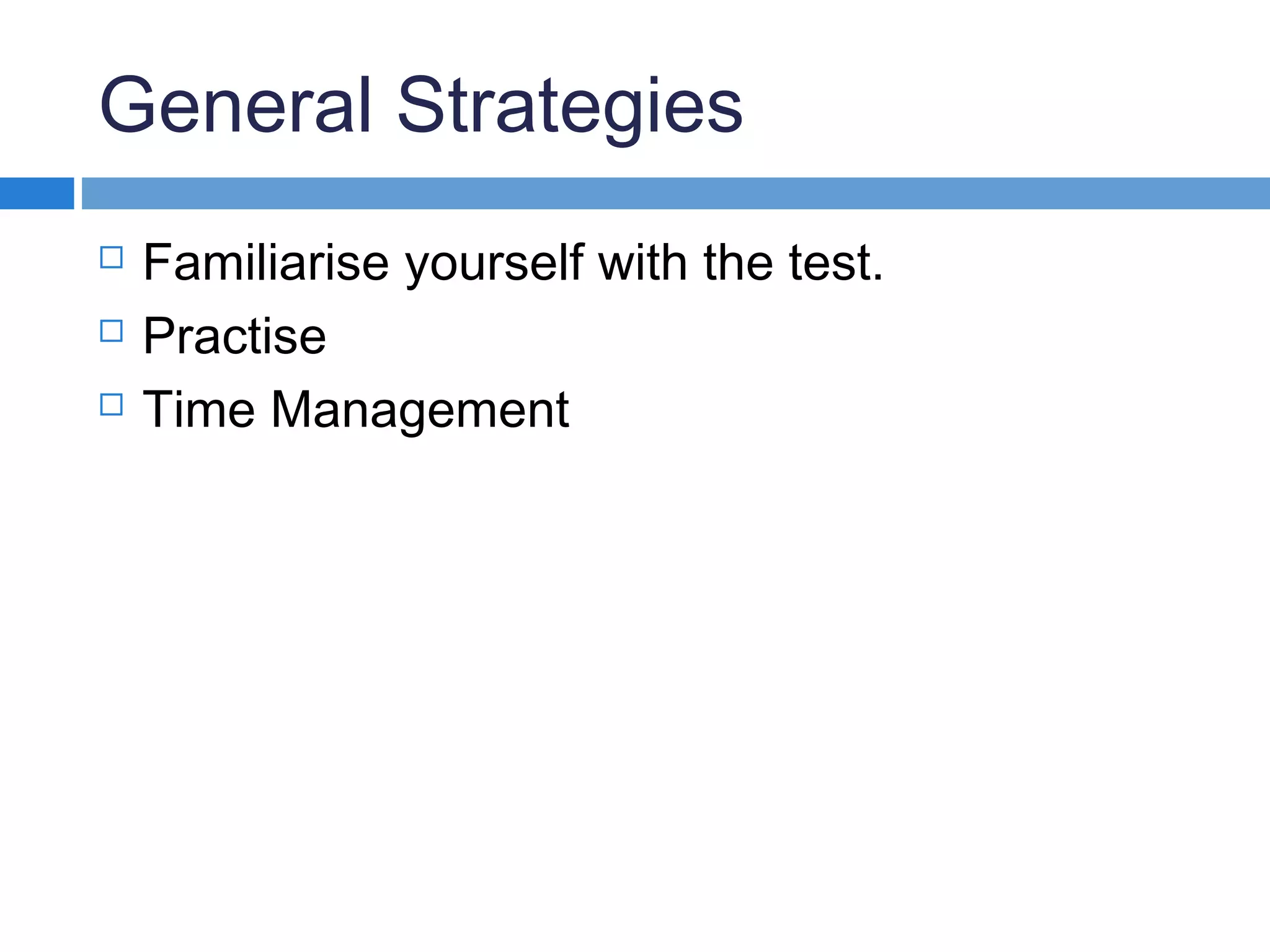
General Strategies
 Familiarise yourself with the test.
 Practise
 Time Management
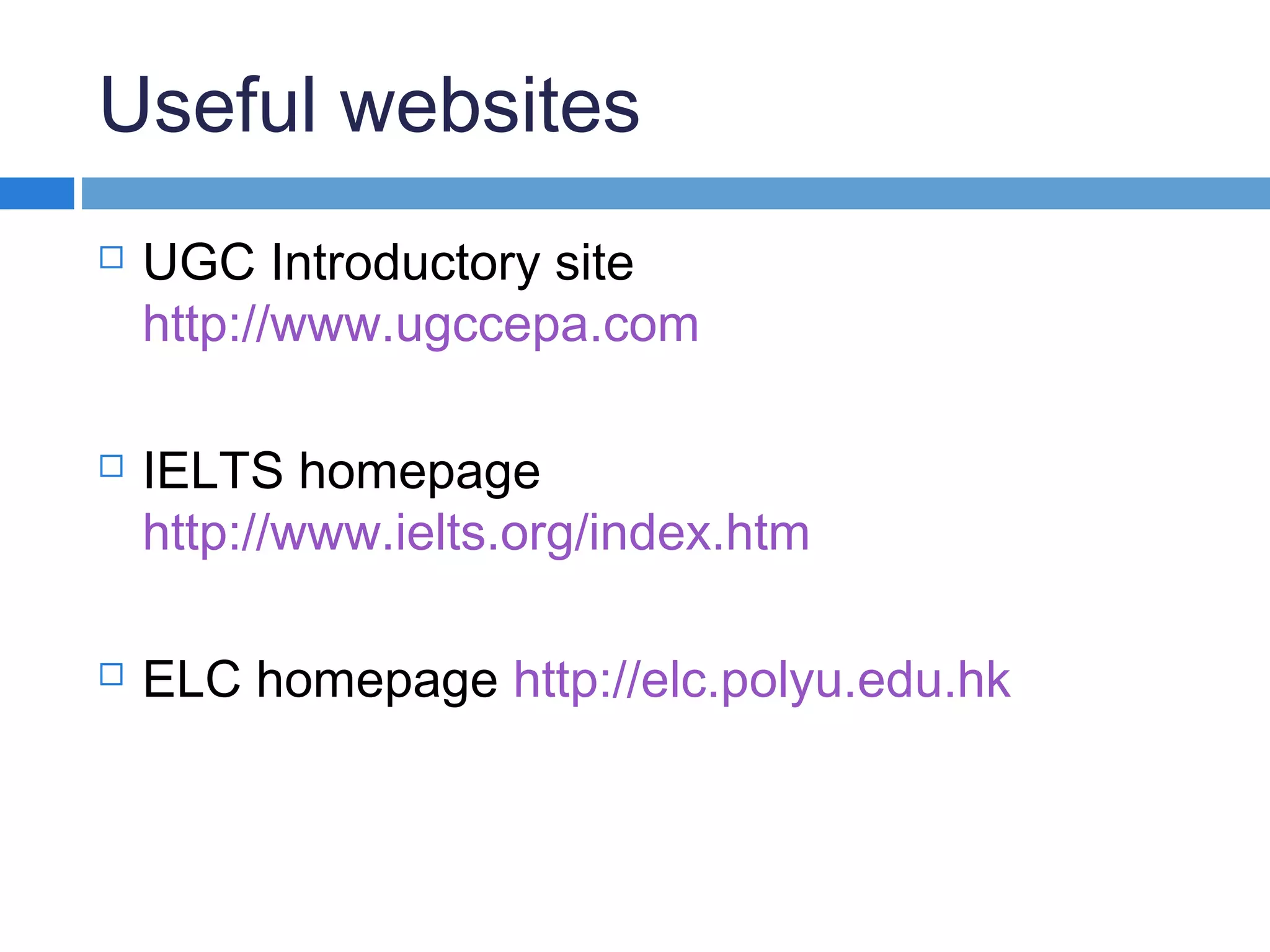
Useful websites
 UGC Introductory site
http://www.ugccepa.com
 IELTS homepage
http://www.ielts.org/index.htm
 ELC homepage http://elc.polyu.edu.hk

Introduction to the IELTS

  • 1.
  • 2.
    Workshop Format  Overview -Structure - Scoring - Help - Q & A  Speaking and Listening  Writing  Reading
  • 3.
    The Test  AllCandidates are tested in listening, reading, writing and speaking.  Listening 30 mins  Reading 60 mins  Writing 60 mins  Speaking 11 – 14 mins  Total test time 2 hours 45 minutes excluding breaks.
  • 4.
    Listening  Time: 30minutes 4 sections, 40 questions  Real-world listening situations  Difficulty  Range of topics and tasks - listening for specific information e.g.dates, place names - understanding gist - understanding speaker attitude/opinion
  • 5.
    Listening Test Format Section 1: conversation – 2 speakers  Section 2: monologue  Section 3: conversation – 4 speakers  Section 4: lecture
  • 6.
    General listening strategies Recording is played once  Read question CAREFULLY BEFORE listening  Familiarise yourself with question types - completing a chart - selecting pictures - note-taking exercises
  • 7.
    Reading  Time: 60 minutes3 reading passages, totally 40 questions  Texts are taken from books, magazines, journals and newspapers  Question types - find detailed information - identify attitudes and views - complete a diagram
  • 8.
    General Reading Strategies Identify reading skills being tested  Practise these skills
  • 9.
    Writing  Time: 60minutes 2 tasks  Task 1(20mins): descriptive report of a table or diagram, 150 words  Task 2(40 mins):250 word essay in response to an opinion or a problem.  Discuss issues, construct an argument and use the appropriate tone and register.
  • 10.
    General Writing Strategies Read the question carefully  Familiarise yourself with descriptions of data – in newspapers, textbooks  Practise formulating your own ideas on topics
  • 11.
    Speaking  Time: 10– 15 minutes  Face to face interview between one candidate and one examiner.  Part 1(4-5mins): Introduction and interview  Part 2(1-3 mins incl. prep): Individual talk  Part 3(4-5 mins): Discussion topics
  • 12.
    Speaking  Speak fluentlyand link ideas coherently  Demonstrate a range of appropriate vocabulary  Use accurate grammar and appropriate register  Speak so that a listener can understand
  • 13.
    Speaking strategies  Part1  Take the initiative if possible  Always say more than yes or no  Try to overcome nerves
  • 14.
    Speaking Strategies  Part2 - Take the 1 min preparation time - write down some main ideas - Sound interested in the talk
  • 15.
    Speaking Strategies  Part3 - Give informed responses - Demonstrate your control of the language - Attempt to express abstract ideas - Support your opinions - Show that you are willing to provide extended replies
  • 16.
    Scoring  IELTS providesa profile of a candidate’s ability to use English  Candidates receive a score on a Band Scale from 1-9
  • 17.
    Scores on theIELTS test are graded into nine bands as follows:  Band 0-Did not attempt the test    Band 1-Non User     Band 2-Intermittent User    Band 3-Extremely Limited User   Band 4-Limited User    Band 5-Modest User  
  • 18.
     Band 6-CompetentUser    Has generally effective command of the language despite some inaccuracies, inappropriacies and misunderstandings. Can use and understand fairly complex language, particularly in familiar situations.
  • 19.
     Band 7-GoodUser    Band 8-Very Good User    Band 9 -Expert User  
  • 20.
    General Strategies  Familiariseyourself with the test.  Practise  Time Management
  • 21.
    Useful websites  UGCIntroductory site http://www.ugccepa.com  IELTS homepage http://www.ielts.org/index.htm  ELC homepage http://elc.polyu.edu.hk