The future of libraries (and us)
Northern Sydney District Teacher Librarian
Association
2
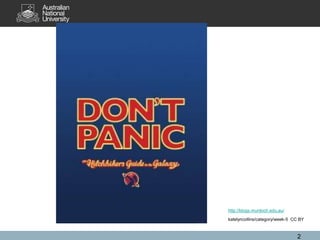
http://blogs.murdoch.edu.au/
katelyncollins/category/week-5 CC BY
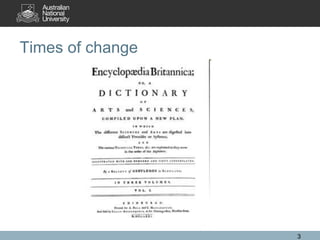
Times of change
3
Winds of change
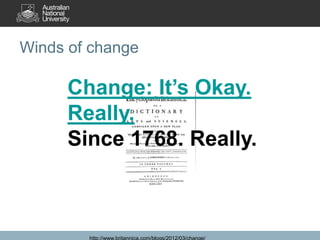
http://www.britannica.com/blogs/2012/03/change/
Change: It’s Okay.
Really.
Since 1768. Really.
5
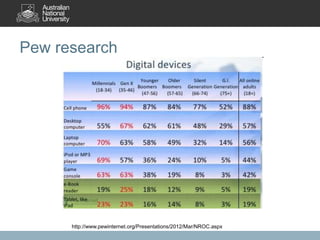
Pew research
http://www.pewinternet.org/Presentations/2012/Mar/NROC.aspx
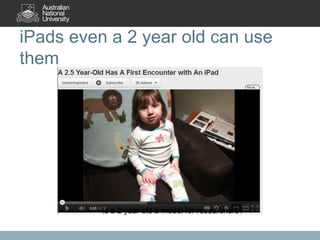
iPads even a 2 year old can use
them
Is a 2 year old a model for researchers?
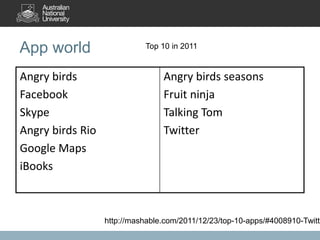
App world
Angry birds
Facebook
Skype
Angry birds Rio
Google Maps
iBooks
Angry birds seasons
Fruit ninja
Talking Tom
Twitter
http://mashable.com/2011/12/23/top-10-apps/#4008910-Twitte
Top 10 in 2011
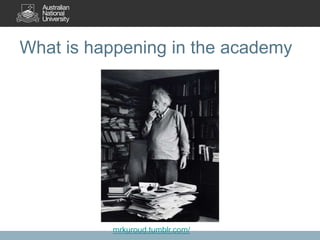
What is happening in the academy
mrkuroud.tumblr.com/
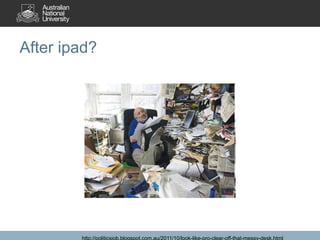
After ipad?
http://politicsjob.blogspot.com.au/2011/10/look-like-pro-clear-off-that-messy-desk.html
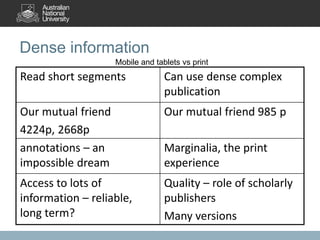
Dense information
Read short segments Can use dense complex
publication
Our mutual friend
4224p, 2668p
Our mutual friend 985 p
annotations – an
impossible dream
Marginalia, the print
experience
Access to lots of
information – reliable,
long term?
Quality – role of scholarly
publishers
Many versions
Mobile and tablets vs print
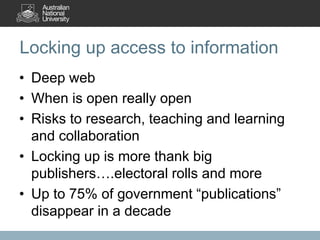
Locking up access to information
• Deep web
• When is open really open
• Risks to research, teaching and learning
and collaboration
• Locking up is more thank big
publishers….electoral rolls and more
• Up to 75% of government “publications”
disappear in a decade
Debates
• Joseph Konrath “Amazon will destroy you”
• Emma Wright. “The future of the book
business”
– Publishing quality
– Reading (esp children)
– Market and value
• Neil Gaiman - publishers must be like
dandelions
Remembering and knowing
• Students operate in print and e environments
• Garland study
– Small differences but
– More repetition required for digital texts to impart the
same information
– Book readers digest material more easily
(Szalavitz, Maria “Do e-books make it harder to
remember what you just read?”)
Game changes
• Google
• What is a publication? What is Data?
• Open access
15
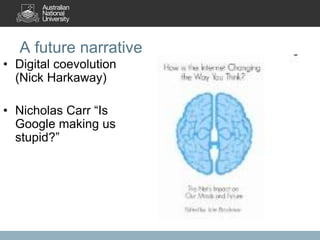
A future narrative
• Digital coevolution
(Nick Harkaway)
• Nicholas Carr “Is
Google making us
stupid?”
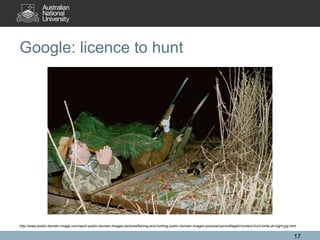
Google: licence to hunt
17
http://www.public-domain-image.com/sport-public-domain-images-pictures/fishing-and-hunting-public-domain-images-pictures/camouflaged-hunters-hunt-birds-at-night.jpg.html
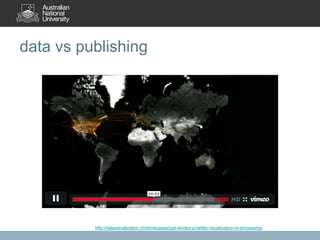
data vs publishing
http://datavisualization.ch/showcases/just-landed-a-twitter-visualization-in-processing/
19
20
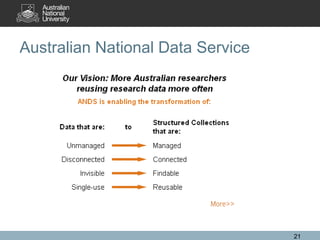
Australian National Data Service
21
22
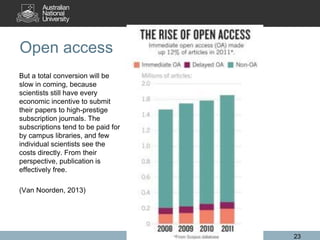
Open access
But a total conversion will be
slow in coming, because
scientists still have every
economic incentive to submit
their papers to high-prestige
subscription journals. The
subscriptions tend to be paid for
by campus libraries, and few
individual scientists see the
costs directly. From their
perspective, publication is
effectively free.
(Van Noorden, 2013)
23
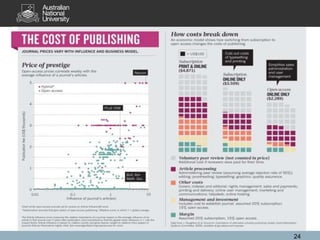
24
Government informaiton
• President Obama’s Executive Order
directs government-held data be made
more accessible to the public and to
entrepreneurs and others as fuel for
innovation and economic growth. (9 May
2013)
25
Libraries
26
27
Selected National Statistics 2010-2011
• 1,491 public library service points
• Over 182 million items were lent to more
than 10 million members of Australia’s
public libraries.
• Over 114 million customer visits annually,
or more than 9 million per month
(State Library of Queensland, 2012)
28
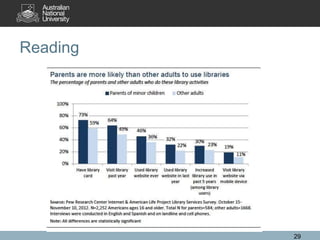
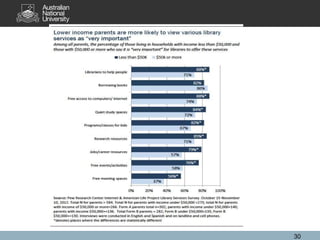
Reading
29
30
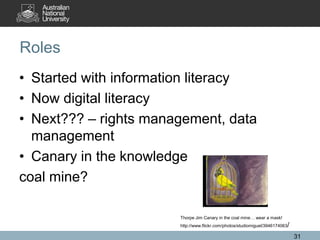
Roles
• Started with information literacy
• Now digital literacy
• Next??? – rights management, data
management
• Canary in the knowledge
coal mine?
31
Thorpe Jim Canary in the coal mine… wear a mask!
http://www.flickr.com/photos/studiomiguel/3946174063/
• Will a design for a 2 year old suit
academic publishing?
• Is the battle for quality worth fighting for?
• Collaboration a new alternative?
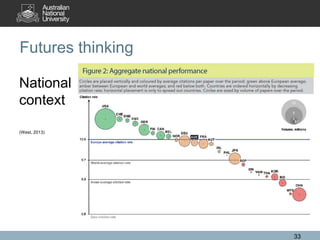
Futures thinking
National
context
(West, 2013)
33
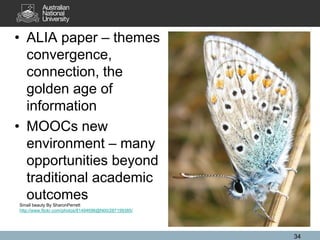
• ALIA paper – themes
convergence,
connection, the
golden age of
information
• MOOCs new
environment – many
opportunities beyond
traditional academic
outcomes
34
Small beauty By SharonPerrett
http://www.flickr.com/photos/81494696@N00/287199385/
But
• In the UK
– 293 libraries (258 buildings and 35 mobiles)
are currently under threat or have been
closed/left council control since 1/4/13 out of
c.4265 in the UK.
– 78 libraries and 14 mobiles (est.) were lost in
2012/13
– 201 library service points were lost 2011/12
35
• Are we “run over by technology”?
• Sir Bruce Williams Boyer lecture 1982
• What must we do to demonstrate value?
• Elliot – collection value, public libraries
contingent valuation
36
… the electronic screen lends the text within
its frame the eternally pristine appearance of
a newly cut page, and this produces in me a
distancing feeling that, like Brecht’s dramatic
techniques, allows me a freer reading,
uncluttered by the sense of labouring under
previous perusals by myself and others.
Alberto Manguel cited in Barmé
Either you print things out, and find yourself
oppressed by piles of documents you’ll
never read, or you read online, but as soon
as you click onto the next page you forget
what you’ve just read, the very thing that has
brought you to the page now on your screen
Alberto Manguel cited in Barmé
References
• ALIA (2013) Library and information services: the future of the profession themes and
scenarios 2025, Discussion paper. Canberra: ALIA http://aliafutures.wikispaces.com/
• Barmé, G. R. (2011) “Slow reading and fast reference, East Asian history 37.
http://www.eastasianhistory.org/37/barme
• Boston College, Daniel R. Coquillette Rare Book Room (2010) Recent additions to
the collection – Fall 2010: An illustrated guide to the exhibit.
http://www.bc.edu/content/dam/files/schools/law_sites/library/pdf/RBR_items/pdf/F10
RecentAcqsExhibitHandout.pdf
• Britannica Editors (2012) Change: It’s Okay. Really. Encyclopaedia Britannica Blog.
http://www.britannica.com/blogs/2012/03/change/
• Brockman, J. ed. (2012) How is the Internet changing the way you think? Allen &
Unwin. (also see review by Appleyard at
http://www.newstatesman.com/books/2012/01/appleyard-internet-book)
• Elliott, V. (2010) ‘Why then we rack the value’ Building Value Frameworks for
Academic Libraries, presentation to CAUL.
http://www.caul.edu.au/content/upload/files/best-practice/caul20101elliott-value.pdf
• Gainman, N. (2013) Keynote presentation to London Book Fair’s Digital Minds
Conference. http://www.sfsignal.com/archives/2013/05/video-neil-gaimans-keynote-
at-the-2013-london-book-fairs-digital-minds-conference/
• Harkaway, N. (2012) ... everything looks like a nail... Futurebook blog.
http://www.futurebook.net/content/everything-looks-nail
• Intel (2012) What happens in an Internet minute?
http://www.intel.com/content/www/us/en/communications/internet-minute-
infographic.html
• Konrath, J. (2012) Amazon Will Destroy You, blog.
• http://jakonrath.blogspot.com.au/2012/02/amazon-will-destroy-you.html
• Murphy, S. (2012) Top 10 Apps Downloaded in 2011, Mashable.
http://mashable.com/2011/12/23/top-10-apps/#4008910-Twitter
• Miller, C. et al (2013) http://libraries.pewinternet.org/2013/05/01/parents-children-
libraries-and-reading/
• Plato's Phaedrus from Plato in Twelve Volumes, Vol. 9, translated by H.N. Fowler. Ca
mbridge, MA, Harvard University Press; London, William Heinemann Ltd. 1925.
• Rainie, L. (2012) The Shifting Education Landscape: Networked Learning, Pew
Research. http://www.pewinternet.org/Presentations/2012/Mar/NROC.aspx
• Samtani, H. (2013) “Librarians Take Aim at Pew Study on Parents and Libraries”
School Library Journal http://www.thedigitalshift.com/2013/05/research/librarians-
take-aim-at-pew-study/
• State Library of Queensland (2912) Australian public libraries statistical report 2010-
2011. Brisbane: the Library.
http://www.nsla.org.au/sites/www.nsla.org.au/files/publications/Aust_Pub_Lib_Stats_
2010-11.pdf
• Szalavitz, M. (2012) Do E-Books Make It Harder to Remember What You Just Read?
TimeHealthland. http://healthland.time.com/2012/03/14/do-e-books-impair-memory/
• telstarlogistics (2010) A 2.5 Year-Old Has A First Encounter with An iPad, YouTube.
http://www.youtube.com/watch?v=pT4EbM7dCMs
• Tenopir, C. (2013) Scholarly Reading in a Digital Age: Some things change, some
stay the same. Presentation given at ANU.
41
• Van Noorden, R. (2013) “Open access: The true cost of science publishing” Nature
27 March 2013 Corrected: 5 April 2013 http://www.nature.com/news/open-access-
the-true-cost-of-science-publishing-1.12676
• West, M. (2013) Benchmarking Australian science performance. Canberra: Office of
the Chief Scientist. http://www.chiefscientist.gov.au/wp-content/uploads/OPS6-Paper-
for-print.pdf
• Wikipedia (2012) “Is Google making us stupid?”.
http://en.wikipedia.org/wiki/Is_Google_Making_Us_Stupid%3F
• Wright, E. (2010) The Future of the Book Business: A Classicist’s View, Futurebook
blog. http://www.futurebook.net/content/future-book-business-classicist’s-view
42

Presentation to Northern Sydney District Teacher Librarian Association

  • 1.
    The future oflibraries (and us) Northern Sydney District Teacher Librarian Association
  • 2.
  • 3.
  • 4.
  • 5.
  • 6.
  • 7.
    iPads even a2 year old can use them Is a 2 year old a model for researchers?
  • 8.
    App world Angry birds Facebook Skype Angrybirds Rio Google Maps iBooks Angry birds seasons Fruit ninja Talking Tom Twitter http://mashable.com/2011/12/23/top-10-apps/#4008910-Twitte Top 10 in 2011
  • 9.
    What is happeningin the academy mrkuroud.tumblr.com/
  • 10.
  • 11.
    Dense information Read shortsegments Can use dense complex publication Our mutual friend 4224p, 2668p Our mutual friend 985 p annotations – an impossible dream Marginalia, the print experience Access to lots of information – reliable, long term? Quality – role of scholarly publishers Many versions Mobile and tablets vs print
  • 12.
    Locking up accessto information • Deep web • When is open really open • Risks to research, teaching and learning and collaboration • Locking up is more thank big publishers….electoral rolls and more • Up to 75% of government “publications” disappear in a decade
  • 13.
    Debates • Joseph Konrath“Amazon will destroy you” • Emma Wright. “The future of the book business” – Publishing quality – Reading (esp children) – Market and value • Neil Gaiman - publishers must be like dandelions
  • 14.
    Remembering and knowing •Students operate in print and e environments • Garland study – Small differences but – More repetition required for digital texts to impart the same information – Book readers digest material more easily (Szalavitz, Maria “Do e-books make it harder to remember what you just read?”)
  • 15.
    Game changes • Google •What is a publication? What is Data? • Open access 15
  • 16.
    A future narrative •Digital coevolution (Nick Harkaway) • Nicholas Carr “Is Google making us stupid?”
  • 17.
    Google: licence tohunt 17 http://www.public-domain-image.com/sport-public-domain-images-pictures/fishing-and-hunting-public-domain-images-pictures/camouflaged-hunters-hunt-birds-at-night.jpg.html
  • 18.
  • 19.
  • 20.
  • 21.
  • 22.
  • 23.
    Open access But atotal conversion will be slow in coming, because scientists still have every economic incentive to submit their papers to high-prestige subscription journals. The subscriptions tend to be paid for by campus libraries, and few individual scientists see the costs directly. From their perspective, publication is effectively free. (Van Noorden, 2013) 23
  • 24.
  • 25.
    Government informaiton • PresidentObama’s Executive Order directs government-held data be made more accessible to the public and to entrepreneurs and others as fuel for innovation and economic growth. (9 May 2013) 25
  • 26.
  • 27.
  • 28.
    Selected National Statistics2010-2011 • 1,491 public library service points • Over 182 million items were lent to more than 10 million members of Australia’s public libraries. • Over 114 million customer visits annually, or more than 9 million per month (State Library of Queensland, 2012) 28
  • 29.
  • 30.
  • 31.
    Roles • Started withinformation literacy • Now digital literacy • Next??? – rights management, data management • Canary in the knowledge coal mine? 31 Thorpe Jim Canary in the coal mine… wear a mask! http://www.flickr.com/photos/studiomiguel/3946174063/
  • 32.
    • Will adesign for a 2 year old suit academic publishing? • Is the battle for quality worth fighting for? • Collaboration a new alternative?
  • 33.
  • 34.
    • ALIA paper– themes convergence, connection, the golden age of information • MOOCs new environment – many opportunities beyond traditional academic outcomes 34 Small beauty By SharonPerrett http://www.flickr.com/photos/81494696@N00/287199385/
  • 35.
    But • In theUK – 293 libraries (258 buildings and 35 mobiles) are currently under threat or have been closed/left council control since 1/4/13 out of c.4265 in the UK. – 78 libraries and 14 mobiles (est.) were lost in 2012/13 – 201 library service points were lost 2011/12 35
  • 36.
    • Are we“run over by technology”? • Sir Bruce Williams Boyer lecture 1982 • What must we do to demonstrate value? • Elliot – collection value, public libraries contingent valuation 36
  • 37.
    … the electronicscreen lends the text within its frame the eternally pristine appearance of a newly cut page, and this produces in me a distancing feeling that, like Brecht’s dramatic techniques, allows me a freer reading, uncluttered by the sense of labouring under previous perusals by myself and others. Alberto Manguel cited in Barmé
  • 38.
    Either you printthings out, and find yourself oppressed by piles of documents you’ll never read, or you read online, but as soon as you click onto the next page you forget what you’ve just read, the very thing that has brought you to the page now on your screen Alberto Manguel cited in Barmé
  • 39.
    References • ALIA (2013)Library and information services: the future of the profession themes and scenarios 2025, Discussion paper. Canberra: ALIA http://aliafutures.wikispaces.com/ • Barmé, G. R. (2011) “Slow reading and fast reference, East Asian history 37. http://www.eastasianhistory.org/37/barme • Boston College, Daniel R. Coquillette Rare Book Room (2010) Recent additions to the collection – Fall 2010: An illustrated guide to the exhibit. http://www.bc.edu/content/dam/files/schools/law_sites/library/pdf/RBR_items/pdf/F10 RecentAcqsExhibitHandout.pdf • Britannica Editors (2012) Change: It’s Okay. Really. Encyclopaedia Britannica Blog. http://www.britannica.com/blogs/2012/03/change/ • Brockman, J. ed. (2012) How is the Internet changing the way you think? Allen & Unwin. (also see review by Appleyard at http://www.newstatesman.com/books/2012/01/appleyard-internet-book) • Elliott, V. (2010) ‘Why then we rack the value’ Building Value Frameworks for Academic Libraries, presentation to CAUL. http://www.caul.edu.au/content/upload/files/best-practice/caul20101elliott-value.pdf
  • 40.
    • Gainman, N.(2013) Keynote presentation to London Book Fair’s Digital Minds Conference. http://www.sfsignal.com/archives/2013/05/video-neil-gaimans-keynote- at-the-2013-london-book-fairs-digital-minds-conference/ • Harkaway, N. (2012) ... everything looks like a nail... Futurebook blog. http://www.futurebook.net/content/everything-looks-nail • Intel (2012) What happens in an Internet minute? http://www.intel.com/content/www/us/en/communications/internet-minute- infographic.html • Konrath, J. (2012) Amazon Will Destroy You, blog. • http://jakonrath.blogspot.com.au/2012/02/amazon-will-destroy-you.html • Murphy, S. (2012) Top 10 Apps Downloaded in 2011, Mashable. http://mashable.com/2011/12/23/top-10-apps/#4008910-Twitter • Miller, C. et al (2013) http://libraries.pewinternet.org/2013/05/01/parents-children- libraries-and-reading/ • Plato's Phaedrus from Plato in Twelve Volumes, Vol. 9, translated by H.N. Fowler. Ca mbridge, MA, Harvard University Press; London, William Heinemann Ltd. 1925.
  • 41.
    • Rainie, L.(2012) The Shifting Education Landscape: Networked Learning, Pew Research. http://www.pewinternet.org/Presentations/2012/Mar/NROC.aspx • Samtani, H. (2013) “Librarians Take Aim at Pew Study on Parents and Libraries” School Library Journal http://www.thedigitalshift.com/2013/05/research/librarians- take-aim-at-pew-study/ • State Library of Queensland (2912) Australian public libraries statistical report 2010- 2011. Brisbane: the Library. http://www.nsla.org.au/sites/www.nsla.org.au/files/publications/Aust_Pub_Lib_Stats_ 2010-11.pdf • Szalavitz, M. (2012) Do E-Books Make It Harder to Remember What You Just Read? TimeHealthland. http://healthland.time.com/2012/03/14/do-e-books-impair-memory/ • telstarlogistics (2010) A 2.5 Year-Old Has A First Encounter with An iPad, YouTube. http://www.youtube.com/watch?v=pT4EbM7dCMs • Tenopir, C. (2013) Scholarly Reading in a Digital Age: Some things change, some stay the same. Presentation given at ANU. 41
  • 42.
    • Van Noorden,R. (2013) “Open access: The true cost of science publishing” Nature 27 March 2013 Corrected: 5 April 2013 http://www.nature.com/news/open-access- the-true-cost-of-science-publishing-1.12676 • West, M. (2013) Benchmarking Australian science performance. Canberra: Office of the Chief Scientist. http://www.chiefscientist.gov.au/wp-content/uploads/OPS6-Paper- for-print.pdf • Wikipedia (2012) “Is Google making us stupid?”. http://en.wikipedia.org/wiki/Is_Google_Making_Us_Stupid%3F • Wright, E. (2010) The Future of the Book Business: A Classicist’s View, Futurebook blog. http://www.futurebook.net/content/future-book-business-classicist’s-view 42

Editor's Notes

  • #4 Britannica Editors - March 13, 2012 For 244 years, the thick volumes of the Encyclopaedia Britannica have stood on the shelves of homes, libraries, and businesses everywhere, a source of enlightenment as well as comfort to their owners and users around the world.They’ve always been there. Year after year. Since 1768. Every. Single. Day.But not forever.Today we’ve announced that we will discontinue the 32-volume printed edition of the Encyclopaedia Britannica when our current inventory is gone.A momentous event? In some ways, yes; the set is, after all, nearly a quarter of a millennium old. But in a larger sense this is just another historical data point in the evolution of human knowledge.For one thing, the encyclopedia will live on—in bigger, more numerous, and more vibrant digital forms. And just as important, we the publishers are poised, in the digital era, to serve knowledge and learning in new ways that go way beyond reference works. In fact, we already do.
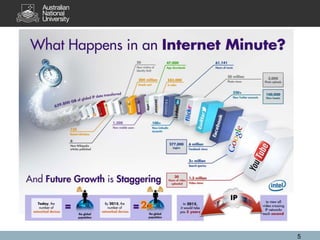
  • #6 http://www.intel.com/content/www/us/en/communications/internet-minute-infographic.html
  • #18 http://www.public-domain-image.com/sport-public-domain-images-pictures/fishing-and-hunting-public-domain-images-pictures/camouflaged-hunters-hunt-birds-at-night.jpg.html
  • #19 http://datavisualization.ch/showcases/just-landed-a-twitter-visualization-in-processing/ http://www.flickr.com/photos/blprnt/sets/72157627854698933/?page=2http://datavisualization.ch/showcases/obama-one-people/http://mashable.com/2010/07/21/twitter-moods-map/http://www.youtube.com/watch?v=XhmeEEnGjAE
  • #20 http://www.flickr.com/photos/blprnt/6281316931/in/set-72157627854698933/
  • #21 http://mashable.com/2010/07/21/twitter-moods-map/
  • #24 http://www.nature.com/news/open-access-the-true-cost-of-science-publishing-1.12676
  • #26 http://www.whitehouse.gov/blog/2013/05/09/landmark-steps-liberate-open-data
  • #30 http://libraries.pewinternet.org/2013/05/01/parents-children-libraries-and-reading/
  • #36 http://www.publiclibrariesnews.com/2010/11/let-cilip-know-of-cuts-in-your-library-service.html
  • #37 Sir Bruce Williams Boyer lecture 1982 – title of his 4th lecture