The Future: Frankenbooks, SocialCollaboration and Learning on SteroidsStephen Abram, MLSEmerging Technology Forum @ GeelongMay 17, 2011
EconomicChange and ChallengesThese slides are available at Stephen’s Lighthouse blog
We Only Get So Many Once-in-a-Lifetime Chances To Do Great Things
WelcomeQuestions for Today:Is this the end of libraries as we know them?Whither learning, community, support?What is actually changing?Do people still value the book?  Where is all this change taking us?What is the role for librarians and all types of libraries in our info-future?
What Colour is the Sky?
So, what exactly is changing? In a word:Everything connected to your world!BooksMediaMobilityCollectionsLibraries
What has changed? Libraries at the heart of the campus
 Students are focused at the lesson and event (essay, test, exam) level
 Libraries at the heart of the community is no longer just physical
 Libraries as whole school partners
 Physical access and basic reading evolves to intellectual access with new competenciesSkip to the End: Why listen to me?School libraries raise standardized test scores 15-25%!
 School library / Public library partnerships increase scores 5% plus!
 Libraries and information content and technology leadership are critical to Higher Ed
 Communities with libraries as an investment receive very high ROI – average 650%!
 There are more libraries than McDonalds & Starbucks combined with better distribution and staffing models for government servicesGrocery Stores
Grocery Stores
Grocery Stores
Cookbooks, Chefs . . .
Meals
Chefs, counsellors, teachers, magiciansLibrarians play a vital role in building the critical connections between information , knowledge and learning.
Very Big SecretThe Elephant in the Room
Change can happen very fast
Sensemaking
5 Things have Changed .  . A LOT! Cardholders, Users, Members, Patrons, Clients, Customers, Learners, Students, Scholars, Researchers, Teachers, ProfessorsBooks & Media & CollectionsMobilityLearning & ResearchGovernmentThe History of Unintended Consequences & Unpredictability
“Strategy is a Choice. . .To be a victim and feel these changes are fated and blamestormORCreate the future we need and take collective responsibility for the conversation and development of the future.”Find Reasons not Excuses.
As technology advances
Emboldened Librarians hold the key
The nasty facts about Google &  Bing and  consumer search:SEOContent FarmsAdvertiser drivenGeotaggingGOOG
News Flash  “The Internet and technology have now progressed to their infancy”
My son: Zachary
News FlashNews FlashTech Shift Happens
Culture
People
People are ChangingDemographic– Millennials, Boomers, Seniors
Overall IQ Increases
Increased educational attainment & engagement
eBooks outsell hard cover books & paperbacks
Reading is UP, way up.
Some libraries are crediting most cardholder growth to e-book accessibility
Personal device proliferation
Some sectors are very tech-dominated (oil, farming, cattle, trucking, mining, forestry, …)NextGen DifferencesIncrease in IQ - 15-20 Points
Brain & Developmental Changes
Eye Movement Changes
Massive Behavioural Changes
Major Decline in Crime Rates – down 65%
But still a 70%  behavior overlap with Boomers (see my book chapter)People Have ChangedTwitter & Facebook are dominated by the middle-aged
Gaming too. . . Mothers in their 30’s
Social networks fastest growing populations are seniors and will be more international and less urban and English.
eBook reader usage is largely middle-aged.
Mobile data usage is growing beyond youth very quickly, workplace use is huge We often believe a lot that isn’t true.What We Never Really Knew Before (US/Canada)27% of our users are under 18.
59% are female.
29% are college students.
5% are professors and 6% are teachers.
On any given day, 35% of our users are there for the very first time!
Only 29% found the databases via the library website.
59% found what they were looking for on their first search.
72% trusted our content more than Google.
But, 81% still use Google.2010 Eduventures Research on Investments58% of instructors believe that technology in courses positively impacts student engagement.
71% of instructors that rated student engagement levels as “high” as a result of using technology in courses.
71% of students who are employed full-time and 77% of students who are employed part-time prefer more technology-based tools in the classroom.
79% of instructors and 86 percent of students have seen the average level of engagement improve over the last year as they have increased their use of digital educational tools.
87% of students believe online libraries and databases have had the most significant impact on their overall learning.
62% identify blogs, wikis, and other online authoring tools while 59% identify YouTube and recorded lectures.
E-books and e-textbooks impact overall learning among 50% of students surveyed, while 42% of students identify online portals.
44% of instructors believe that online libraries and databases will have the greatest impact on student engagement.
32% of instructors identify e-textbooks and 30% identify interactive homework solutions as having the potential to improve engagement and learning outcomes. (e-readers was 11%)
49% of students believe that online libraries and databases will have the greatest impact on student engagement.
Students are more optimistic about the potential for technology.Have Students Changed?
YES (duh!)
So how must library and educator strategies change?
Discovery & Ideas
Has the future changed?Has our future changed?
COWS, etc.
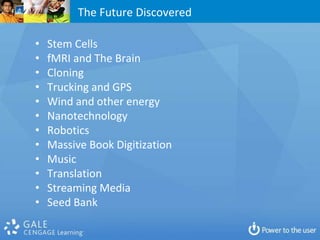
The Future DiscoveredStem Cells
fMRI and The Brain
Cloning
Trucking and GPS
Wind and other energy
Nanotechnology
Robotics
Massive Book Digitization
Music
Translation
Streaming Media
Seed Bank
A 1965 iPhone
Can libraries keep up with change?Can you recall buying a 45?Can you recall dials on TVs?Can you recall dialling?
Formats have died before.
Books
We have a shallow understanding of the Codex – the book format(s)Transition from scrolls – illumination – codex – and beyond
How would you enhance the book without the compromises of the 1500’s?
What does all this mean?The Article level universe
The Chapter and Paragraph Universe
Integrated with Visuals – graphics and charts
Integrated with ‘video’
Integrated with Sound and Speech
Integrated with social web
Integrated with interaction and not just interactivity
How would you enhance a book?
Borders Kobo, B&N Nook, Amazon Kindle, Apple iPad, Sony, etc.   . . .
Mobility
BroadbandYou must clearly understand the latest US FCC  Whitespace Broadband Decision – THIS IS TRANSFORMATIONAL and going global
Net neutrality, kill switches . . .
Local wired, mobile access ‘everywhere’ to the home and workplace on a personal basis
Geo-awareness: GIS, GPS, GEO-IP, etc.
Wireless as a business strategy (Starbucks)
Mobile dominates the largest generationWhat changes with personal devices?
Device Issues
The Physical Act of Reading
The new bibliography and collection developmentKNOWLEDGE PORTALSKNOWLEDGE,LEARNING,INFORMATION &RESEARCHCOMMONS
Emerging Tech that Drives Users to the LibraryContent Farms, Mills (Demand Media, AOL, etc.)
Encyclopedia.com
HighBeam & Questia
WorldCat
AccessMyLibrary iPhone App for public, school and higher ed – iPhone, iPad, iTouch and Droid!
Geo-IP features and measures
Watch for more . . .Trans-Literacy:   Move beyond reading & PC skills News literacy
Technology literacy
Information literacy
Media literacy
Adaptive literacy
Research literacy
Academic literacy

Geelong staffevent