Is the iPad killing academic
         publishing?
       Roxanne Missingham
Contents
• Times of change
• The word as a radical tool
• Scholarly communication
  – The scholars desk
  – Dense information
  – Locking up academic publishing
  – App world
• A future narrative
Winds of change
Winds of change

Change: It’s Okay. Really
Since 1768. Really.
Pew research


http://www.pewinternet.org/Presentations/2012/Mar/NROC.aspx
Print – not dead yet
iPads even a 2 year old can use
             them


     Is a 2 year old a model for researchers?
Words: radical and transformative
• For this invention will produce
  forgetfulness in the minds of those
  who learn to use it, because they will
  not practice their memory. Their trust
  in writing, produced by external
  characters which are no part of
  themselves, will discourage the use of
  their own memory within them. You
  have invented an elixir not of memory,
  but of reminding …
What does this mean for scholarly
    communication mean?


        mrkuroud.tumblr.com/
After ipad?
Dense information
          Mobile and tablets vs print


Read short segments Can use dense
                    complex publication
Our mutual friend           Our mutual friend
4224p, 2668p                985 p
annotations – an            Marginalia, the print
impossible dream            experience
Access to lots of           Quality – role of
information –               scholarly publishers
reliable, long term?        Many versions
http://www.bc.edu/content/dam/files/schools/law_sites/library/pdf/RBR_items/pdf/F10RecentAcqsExhibitHandout.pdf
Locking up access to information
• Deep web
• When is open really open
• Risks to research, teaching and learning
  and collaboration
• Locking up is more thank big
  publishers….electoral rolls and more
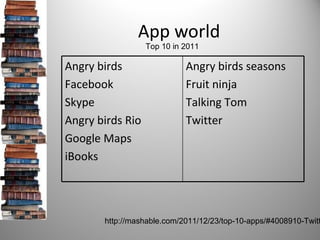
App world
                  Top 10 in 2011

Angry birds                 Angry birds seasons
Facebook                    Fruit ninja
Skype                       Talking Tom
Angry birds Rio             Twitter
Google Maps
iBooks


       http://mashable.com/2011/12/23/top-10-apps/#4008910-Twitt
Debates
• Joseph Konrath “Amazon will destroy
  you”

• Emma Wright. “The future of the book
  business”
  – Publishing quality
  – Reading (esp children)
  – Market and value
Remembering and knowing
• Students operate in print and e environments

• Garland study
   – Small differences but
   – More repetition required for digital texts to impart
     the same information
   – Book readers digest material more easily


(Szalavitz, Maria “Do e-books make it harder to
   remember what you just read?”)
A future narrative
• Digital coevolution
  (Nick Harkaway)
• Academic
  scholarship and
  publishing
data vs publishing
http://datavisualization.ch/showcases/just-lan
http://www.flickr.com/photos/blprnt/sets/72

  http://datavisualization.ch/showcases/obam
http://mashable.com/2010/07/21/twitter-mo
• Will a design for a 2 year old suit
  academic publishing?
• Is the battle for quality worth fighting
  for?
• Is closed collaboration the alternative?
• Message in a bottle…..
… the electronic screen lends the text
within its frame the eternally pristine
appearance of a newly cut page, and this
produces in me a distancing feeling that,
like Brecht’s dramatic techniques, allows
me a freer reading, uncluttered by the
sense of labouring under previous
perusals by myself and others.
Alberto Manguel cited in Barmé
Either you print things out, and find
yourself oppressed by piles of documents
you’ll never read, or you read online, but
as soon as you click onto the next page
you forget what you’ve just read, the very
thing that has brought you to the page
now on your screen
Alberto Manguel cited in Barmé
Comments….
References
•   Barmé, G. R. (2011) “Slow reading and fast reference, East Asian history 37.
    http://www.eastasianhistory.org/37/barme
•   Boston College, Daniel R. Coquillette Rare Book Room (2010) Recent additions
    to the collection – Fall 2010: An illustrated guide to the exhibit.
    http://www.bc.edu/content/dam/files/schools/law_sites/library/pdf/RBR_items/pdf/F

•   Britannica Editors (2012) Change: It’s Okay. Really. Encyclopaedia Britannica
    Blog. http://www.britannica.com/blogs/2012/03/change/
•   Brockman, J. ed. (2012) How is the Internet changing the way you think? Allen
    & Unwin. (also see review by Appleyard at
    http://www.newstatesman.com/books/2012/01/appleyard-internet-book)
•   Elliott, V. (2010) ‘Why then we rack the value’ Building Value Frameworks for
    Academic Libraries, presentation to CAUL.
    http://www.caul.edu.au/content/upload/files/best-practice/caul20101elliott-value.pdf

•   Harkaway, N. (2012) ... everything looks like a nail... Futurebook blog.
    http://www.futurebook.net/content/everything-looks-nail
•   Konrath, J. (2012) Amazon Will Destroy You, blog.
•   http://jakonrath.blogspot.com.au/2012/02/amazon-will-destroy-you.html
•   Murphy, S. (2012) Top 10 Apps Downloaded in 2011, Mashable.
    http://mashable.com/2011/12/23/top-10-apps/#4008910-Twitter
•   Plato's Phaedrus from Plato in Twelve Volumes, Vol. 9, translated by Harold N. F
    owler. Cambridge, MA, Harvard University Press; London, William Heinemann L
    td. 1925.
•   Rainie, L. (2012) The Shifting Education Landscape: Networked Learning, Pew
    Research. http://www.pewinternet.org/Presentations/2012/Mar/NROC.aspx
•   Szalavitz, M. (2012) Do E-Books Make It Harder to Remember What You Just
    Read? TimeHealthland.
    http://healthland.time.com/2012/03/14/do-e-books-impair-memory/
•   telstarlogistics (2010) A 2.5 Year-Old Has A First Encounter with An iPad,
    YouTube. http://www.youtube.com/watch?v=pT4EbM7dCMs
•   Wright, E. (2010) The Future of the Book Business: A Classicist’s View,
    Futurebook blog.
    http://www.futurebook.net/content/future-book-business-classicist’s-view

Ipad

  • 1.
    Is the iPadkilling academic publishing? Roxanne Missingham
  • 2.
    Contents • Times ofchange • The word as a radical tool • Scholarly communication – The scholars desk – Dense information – Locking up academic publishing – App world • A future narrative
  • 3.
  • 4.
    Winds of change Change:It’s Okay. Really Since 1768. Really.
  • 5.
  • 6.
    Print – notdead yet
  • 8.
    iPads even a2 year old can use them Is a 2 year old a model for researchers?
  • 9.
    Words: radical andtransformative • For this invention will produce forgetfulness in the minds of those who learn to use it, because they will not practice their memory. Their trust in writing, produced by external characters which are no part of themselves, will discourage the use of their own memory within them. You have invented an elixir not of memory, but of reminding …
  • 10.
    What does thismean for scholarly communication mean? mrkuroud.tumblr.com/
  • 11.
  • 12.
    Dense information Mobile and tablets vs print Read short segments Can use dense complex publication Our mutual friend Our mutual friend 4224p, 2668p 985 p annotations – an Marginalia, the print impossible dream experience Access to lots of Quality – role of information – scholarly publishers reliable, long term? Many versions
  • 13.
  • 14.
    Locking up accessto information • Deep web • When is open really open • Risks to research, teaching and learning and collaboration • Locking up is more thank big publishers….electoral rolls and more
  • 16.
    App world Top 10 in 2011 Angry birds Angry birds seasons Facebook Fruit ninja Skype Talking Tom Angry birds Rio Twitter Google Maps iBooks http://mashable.com/2011/12/23/top-10-apps/#4008910-Twitt
  • 17.
    Debates • Joseph Konrath“Amazon will destroy you” • Emma Wright. “The future of the book business” – Publishing quality – Reading (esp children) – Market and value
  • 18.
    Remembering and knowing •Students operate in print and e environments • Garland study – Small differences but – More repetition required for digital texts to impart the same information – Book readers digest material more easily (Szalavitz, Maria “Do e-books make it harder to remember what you just read?”)
  • 19.
    A future narrative •Digital coevolution (Nick Harkaway) • Academic scholarship and publishing
  • 20.
    data vs publishing http://datavisualization.ch/showcases/just-lan http://www.flickr.com/photos/blprnt/sets/72 http://datavisualization.ch/showcases/obam http://mashable.com/2010/07/21/twitter-mo
  • 21.
    • Will adesign for a 2 year old suit academic publishing? • Is the battle for quality worth fighting for? • Is closed collaboration the alternative? • Message in a bottle…..
  • 22.
    … the electronicscreen lends the text within its frame the eternally pristine appearance of a newly cut page, and this produces in me a distancing feeling that, like Brecht’s dramatic techniques, allows me a freer reading, uncluttered by the sense of labouring under previous perusals by myself and others. Alberto Manguel cited in Barmé
  • 23.
    Either you printthings out, and find yourself oppressed by piles of documents you’ll never read, or you read online, but as soon as you click onto the next page you forget what you’ve just read, the very thing that has brought you to the page now on your screen Alberto Manguel cited in Barmé
  • 24.
  • 25.
    References • Barmé, G. R. (2011) “Slow reading and fast reference, East Asian history 37. http://www.eastasianhistory.org/37/barme • Boston College, Daniel R. Coquillette Rare Book Room (2010) Recent additions to the collection – Fall 2010: An illustrated guide to the exhibit. http://www.bc.edu/content/dam/files/schools/law_sites/library/pdf/RBR_items/pdf/F • Britannica Editors (2012) Change: It’s Okay. Really. Encyclopaedia Britannica Blog. http://www.britannica.com/blogs/2012/03/change/ • Brockman, J. ed. (2012) How is the Internet changing the way you think? Allen & Unwin. (also see review by Appleyard at http://www.newstatesman.com/books/2012/01/appleyard-internet-book) • Elliott, V. (2010) ‘Why then we rack the value’ Building Value Frameworks for Academic Libraries, presentation to CAUL. http://www.caul.edu.au/content/upload/files/best-practice/caul20101elliott-value.pdf • Harkaway, N. (2012) ... everything looks like a nail... Futurebook blog. http://www.futurebook.net/content/everything-looks-nail
  • 26.
    Konrath, J. (2012) Amazon Will Destroy You, blog. • http://jakonrath.blogspot.com.au/2012/02/amazon-will-destroy-you.html • Murphy, S. (2012) Top 10 Apps Downloaded in 2011, Mashable. http://mashable.com/2011/12/23/top-10-apps/#4008910-Twitter • Plato's Phaedrus from Plato in Twelve Volumes, Vol. 9, translated by Harold N. F owler. Cambridge, MA, Harvard University Press; London, William Heinemann L td. 1925. • Rainie, L. (2012) The Shifting Education Landscape: Networked Learning, Pew Research. http://www.pewinternet.org/Presentations/2012/Mar/NROC.aspx • Szalavitz, M. (2012) Do E-Books Make It Harder to Remember What You Just Read? TimeHealthland. http://healthland.time.com/2012/03/14/do-e-books-impair-memory/ • telstarlogistics (2010) A 2.5 Year-Old Has A First Encounter with An iPad, YouTube. http://www.youtube.com/watch?v=pT4EbM7dCMs • Wright, E. (2010) The Future of the Book Business: A Classicist’s View, Futurebook blog. http://www.futurebook.net/content/future-book-business-classicist’s-view

Editor's Notes

  • #4 Britannica Editors - March 13, 2012 For 244 years, the thick volumes of the Encyclopaedia Britannica have stood on the shelves of homes, libraries, and businesses everywhere, a source of enlightenment as well as comfort to their owners and users around the world. They’ve always been there. Year after year. Since 1768. Every. Single. Day. But not forever. Today we’ve announced that we will discontinue the 32-volume printed edition of the Encyclopaedia Britannica when our current inventory is gone. A momentous event? In some ways, yes; the set is, after all, nearly a quarter of a millennium old. But in a larger sense this is just another historical data point in the evolution of human knowledge. For one thing, the encyclopedia will live on—in bigger, more numerous, and more vibrant digital forms. And just as important, we the publishers are poised, in the digital era, to serve knowledge and learning in new ways that go way beyond reference works. In fact, we already do.
  • #5 Britannica Editors - March 13, 2012 For 244 years, the thick volumes of the Encyclopaedia Britannica have stood on the shelves of homes, libraries, and businesses everywhere, a source of enlightenment as well as comfort to their owners and users around the world. They’ve always been there. Year after year. Since 1768. Every. Single. Day. But not forever. Today we’ve announced that we will discontinue the 32-volume printed edition of the Encyclopaedia Britannica when our current inventory is gone. A momentous event? In some ways, yes; the set is, after all, nearly a quarter of a millennium old. But in a larger sense this is just another historical data point in the evolution of human knowledge. For one thing, the encyclopedia will live on—in bigger, more numerous, and more vibrant digital forms. And just as important, we the publishers are poised, in the digital era, to serve knowledge and learning in new ways that go way beyond reference works. In fact, we already do.
  • #9 http://www.youtube.com/watch?v=pT4EbM7dCMs
  • #10 Gleick2 and Powers3 remind us that eminent Greek philosophers foresaw a great decline with the introduction of the alphabet. Plato records Socrates conversation with Phaedrus4 which includes the following: For this invention will produce forgetfulness in the minds of those who learn to use it, because they will not practice their memory. Their trust in writing, produced by external characters which are no part of themselves, will discourage the use of their own memory within them. You have invented an elixir not of memory, but of reminding; and you offer your pupils the appearance of wisdom, not true wisdom, for they will read many things without instruction and will therefore seem to know many things, when they are for the most part ignorant and hard to get along with, since they are not wise, but only appear wise... He who thinks, then, that he has left behind him any art in writing, and he who receives it in the belief that anything in writing will be clear and certain, would be an utterly simple person, and in truth ignorant of the prophecy of Ammon, if he thinks written words are of any use except to remind him who knows the matter about which they are written. Writing, Phaedrus, has this strange quality, and is very like painting; for the creatures of painting stand like living beings, but if one asks them a question, they preserve a solemn silence. And so it is with written words; you might think they spoke as if they had intelligence, but if you question them, wishing to know about their sayings, they always say only one and the same thing. And every word, when once it is written, is bandied about, alike among those who understand and those who have no interest Plato's Phaedrus from Plato in Twelve Volumes, Vol. 9, translated by Harold N. Fowler. Cambridge, MA, Harvard University Press; London, William Heinemann Ltd. 1925.
  • #14 Doomesday book
  • #20 http://www.newstatesman.com/books/2012/01/appleyard-internet-book One thing the luminaries mostly agree on is that the technological revolution of the late 20th century is the biggest upheaval since Gutenberg, and that growing up in a information-surfing culture is affecting us on a personal and social level. Given that I read this book on a train on my Kindle, while opposite me a stressed mother entertained her toddler - who could not yet talk - by letting the child play Angry Birds on her iPhone, I find it hard to disagree. Yet the very obviousness of this point exposes a limitation of the collection format: by half­way through, I was sighing repeatedly: "Oh, not bloody Gutenberg again !" The overlap makes this book one to dip into rather than read at one sitting, but it's bursting with quotable phrases. Here is the writer Paul Kedrosky wondering whether he could give up the internet. "Could I quit? At some level, it seems a silly question, like asking how I feel about taking a breathing hiatus or if on Tuesdays I would give up gravity." He is one of the minority who are relatively untroubled by the netpocalypse, wondering whether he really had more BDTs (big deep thoughts) before he spent all day connected, or whether his memory is playing tricks on him. It is largely the dissenters from hand-wringing who are more intriguing. June Cohen argues that "the rise of social media is really a reprise" - a return to a storytelling culture. And the psychologist and writer Steven Pinker believes that "the most interesting trend in the development of the internet is not how it is changing people's ways of thinking but how it is adapting to the way people think". He argues that the web took off because of the graphical user interface that made engaging with it more intuitive. Now we are developing interfaces based on speech, movement and even thought. Ultimately, many of the contributors conclude that we don't know how the internet is changing our brains because we don't know how anything changes the hefty lumps of fat and water in our skulls: they are still so poorly understood. Or, as Emily Dickinson put it in the poem that gave Appleyard his title: "The Brain - is wider than the Sky -/For - put them side by side -/The one the other will contain/With ease - and You - beside".
  • #21 http://www.youtube.com/watch?v=XhmeEEnGjAE