Elevating the Teaching
Profession in North Carolina
PEPSC Draft Model
March 2022
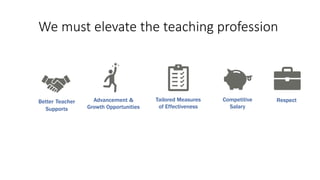
We must elevate the teaching profession
Better Teacher
Supports
Advancement &
Growth Opportunities
Tailored Measures
of Effectiveness
Competitive
Salary
Respect
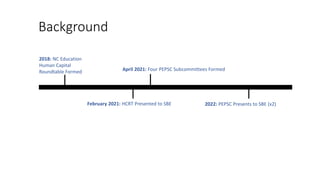
Background
2018: NC Education
Human Capital
Roundtable Formed
February 2021: HCRT Presented to SBE
April 2021: Four PEPSC Subcommittees Formed
2022: PEPSC Presents to SBE (x2)
4
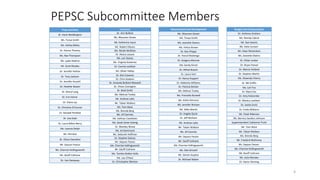
PEPSC Subcommittee Members
Prep and Entry
Dr. Hank Weddington
Ms. Tonya Smith
Ms. Ashley Bailey
Dr. Donna Thomas
Ms. Rae Thompson
Ms. Lydia Hedrick
Mr. Scott Rhodes
Dr. Jennifer Hefner
Dr. Tony Jackson
Dr. Jennifer Russell
Dr. Heather Bower
Dr. Sheryl Long
Dr. Erin Horne
Dr. Diana Lys
Dr. Christina O'Connor
Dr. Randall Penfield
Dr. Lisa Eads
Dr. Laura Bilbro-Berry
Ms. Leanna Delph
Mr. Phil Kirk
Dr. Olivia Oxendine
Mr. Dayson Pasion
Ms. Charrise Hollingsworth
Mr. Geoff Coltrane
Dr. Van Dempsey
Licensure
Dr. Ann Bullock
Ms. Maureen Stover
Ms. Katherine Joyce
Mr. Robert Ellyson
Ms. Nicole McGhee
Dr. Alvera Lesane
Ms. Lori Stacey
Ms. Virginia Gutierrez
Dr. Connie Locklear
Mr. Oliver Holley
Dr. Kim Creamer
Dr. Chris Godwin
Dr. Amanda Bulliard Maxwell
Dr. Vivian Covington
Dr. Brad Smith
Ms. Melissa Tooley
Mr. Andrew Lakis
Mr. Tabari Wallace
Mr. Tom West
Ms. Brenda Berg
Ms. Jill Camnitz
Ms. Kathryn Castelloes
Ms. Sarah Greer Koenig
Dr. Westley Wood
Ms. AJ Hammond
Ms. Deborah Hoffman
Dr. Stephen Gainey
Mr. Dayson Pasion
Ms. Charrise Hollingsworth
Mr. Geoff Coltrane
Ms. Tamika Walker Kelly
Ms. Lee O'Neal
Dr. Christopher Blanton
Advancement and Development
Ms. Maureen Stover
Ms. Tonya Smith
Ms. Jeanette Owens
Ms. Felicia Brown
Dr. Don Phipps
Dr. Pascal Mubenga
Dr. Gregory Monroe
Ms. Sandy Kinzel
Dr. Alfred Bryant
Dr. Laura Hart
Dr. Nancy Ruppert
Dr. Nakeisha Williams
Dr. Patricia Bricker
Ms. Melissa Tooley
Ms. Francelia Burwell
Ms. Kisha Clemons
Ms. Jennifer Brinson
Mr. Mike Martin
Dr. Angela Quick
Dr. Jeff McDaris
Mr. Andrew Lakis
Mr. Tabari Wallace
Ms. Jill Camnitz
Mr. Dayson Pasion
Mr. Geoff Coltrane
Ms. Charrise Hollingsworth
Ms. Dee Grissett
Mr. Steven Gupton
Dr. Michael Maher
Budget and Compensation
Dr. Anthony Graham
Ms. Wendy Cabral
Mr. Dan Swartz
Ms. Katie Sunseri
Mr. Dean Richardson
Ms. Jeanette Owens
Dr. Ethan Lenker
Dr. Bryan Hassel
Dr. Marcie Holland
Dr. Stephen Martin
Ms. Shawnda Cherry
Dr. Bill Griffin
Ms. Lori Fox
Dr. Myra Cox
Dr. Amy Holcombe
Dr. Monica Lambert
Dr. Jackie Ennis
Dr. Ereka Williams
Mr. Chad Aldeman
Ms. Bernice Sanders Johnson
Superintendent Catherine Truitt
Mr. Tom West
Mr. Tabari Wallace
Ms. Brenda Berg
Mr. Freebird McKinney
Mr. Dayson Pasion
Ms. Charrise Hollingsworth
Mr. Geoff Coltrane
Mr. Julio Morales
Dr. Aaron Fleming
5
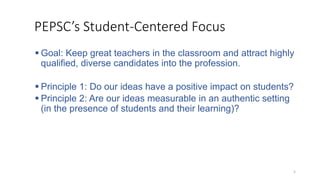
PEPSC’s Student-Centered Focus
 Goal: Keep great teachers in the classroom and attract highly
qualified, diverse candidates into the profession.
 Principle 1: Do our ideas have a positive impact on students?
 Principle 2: Are our ideas measurable in an authentic setting
(in the presence of students and their learning)?
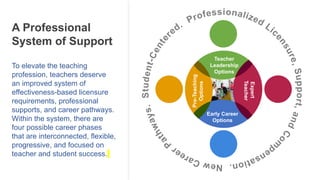
A Professional
System of Support
To elevate the teaching
profession, teachers deserve
an improved system of
effectiveness-based licensure
requirements, professional
supports, and career pathways.
Within the system, there are
four possible career phases
that are interconnected, flexible,
progressive, and focused on
teacher and student success.
Pre-Teaching
Options
Expert
Teacher
Early Career
Options
Teacher
Leadership
Options
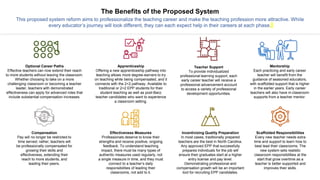
The Benefits of the Proposed System
This proposed system reform aims to professionalize the teaching career and make the teaching profession more attractive. While
every educator’s journey will look different, they can each expect help in their careers at each phase.
Apprenticeship
Offering a new apprenticeship pathway into
teaching allows more degree-earners to try
on teaching while being compensated, and it
connects with the 2+2 pathway. Available to
traditional or 2+2 EPP students for their
student teaching as well as post-Bacc
teacher candidates who want to experience
a classroom setting.
Teacher Support
To provide individualized
professional learning support, each
early career teacher will receive a
professional advancement account
to access a variety of professional
development opportunities.
Mentorship
Each practicing and early career
teacher will benefit from the
guidance of seasoned educators,
with scaffolded support that is higher
in the earlier years. Early career
teachers will also have in-classroom
supports from a teacher mentor.
Compensation
Pay will no longer be restricted to
time served; rather, teachers will
be professionally compensated for
growing their skills and
effectiveness, extending their
reach to more students, and
leading their peers.
Effectiveness Measures
Professionals deserve to know their
strengths and receive positive, ongoing
feedback. To understand teaching
impact, there must be many types of
authentic measures used regularly, not
a single measure in time, and they must
connect to a teacher’s daily
responsibilities of leading their
classrooms, not add to it.
Incentivizing Quality Preparation
In most cases, traditionally prepared
teachers are the best in North Carolina.
Any approved EPP that successfully
prepares individuals for the job will
ensure their graduates start at a higher
entry license and pay level.
Demonstrating professional and
compensation growth will be an important
tool for recruiting EPP candidates.
Scaffolded Responsibilities
Every new teacher needs extra
time and support to learn how to
best lead their classrooms. The
new system sets realistic
classroom responsibilities at the
start that grow overtime as a
teacher is better supported and
improves their skills.
Optional Career Paths
Effective teachers can now extend their reach
to more students without leaving the classroom.
Whether choosing to take on a more
challenging classroom or becoming a teacher
leader, teachers with demonstrated
effectiveness can apply for advanced roles that
include substantial compensation increases.
Teacher Leader Options
Expert Teacher
Early Career Options
License 4
License 3
2+2
Pre-Teaching Options
Post-
Bacc
EPP
Apprentice
Traditional
EPP
License 1
License 2
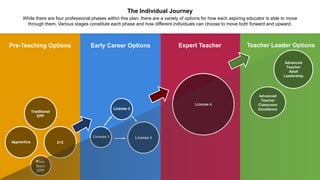
The Individual Journey
While there are four professional phases within this plan, there are a variety of options for how each aspiring educator is able to move
through them. Various stages constitute each phase and how different individuals can choose to move both forward and upward.
Advanced
Teacher
Classroom
Excellence
Advanced
Teacher
Adult
Leadership
Pre-Teaching Paths
I’m Santiago. I earned a
bachelor’s degree in biology
but working in a lab wasn’t
right for me. I decided to take
a teaching apprenticeship so I
could learn classroom
pedagogy on the job before
becoming a teacher of
record.
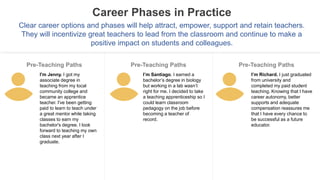
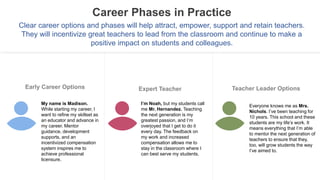
Career Phases in Practice
Clear career options and phases will help attract, empower, support and retain teachers.
They will incentivize great teachers to lead from the classroom and continue to make a
positive impact on students and colleagues.
Pre-Teaching Paths
I'm Jenny. I got my
associate degree in
teaching from my local
community college and
became an apprentice
teacher. I've been getting
paid to learn to teach under
a great mentor while taking
classes to earn my
bachelor's degree. I look
forward to teaching my own
class next year after I
graduate.
Pre-Teaching Paths
I’m Richard. I just graduated
from university and
completed my paid student
teaching. Knowing that I have
career autonomy, better
supports and adequate
compensation reassures me
that I have every chance to
be successful as a future
educator.
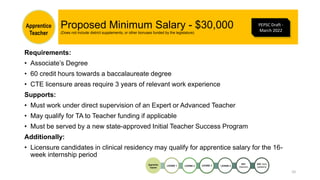
Proposed Minimum Salary - $30,000
(Does not include district supplements, or other bonuses funded by the legislature)
Requirements:
• Associate’s Degree
• 60 credit hours towards a baccalaureate degree
• CTE licensure areas require 3 years of relevant work experience
Supports:
• Must work under direct supervision of an Expert or Advanced Teacher
• May qualify for TA to Teacher funding if applicable
• Must be served by a new state-approved Initial Teacher Success Program
Additionally:
• Licensure candidates in clinical residency may qualify for apprentice salary for the 16-
week internship period
10
Apprentice
Teacher
Apprentice
Teacher
LICENSE 1: LICENSE 2: LICENSE 3:
ADV:
Classroom
ADV: Adult
Leadership
LICENSE 4:
PEPSC Draft -
March 2022
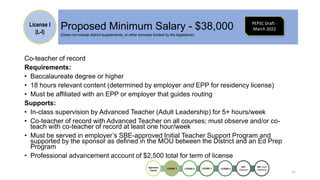
Proposed Minimum Salary - $38,000
(Does not include district supplements, or other bonuses funded by the legislature)
Co-teacher of record
Requirements:
• Baccalaureate degree or higher
• 18 hours relevant content (determined by employer and EPP for residency license)
• Must be affiliated with an EPP or employer that guides routing
Supports:
• In-class supervision by Advanced Teacher (Adult Leadership) for 5+ hours/week
• Co-teacher of record with Advanced Teacher on all courses; must observe and/or co-
teach with co-teacher of record at least one hour/week
• Must be served in employer’s SBE-approved Initial Teacher Support Program and
supported by the sponsor as defined in the MOU between the District and an Ed Prep
Program
• Professional advancement account of $2,500 total for term of license
11
License I
(L-I)
Apprentice
Teacher
LICENSE 1: LICENSE 2: LICENSE 3:
ADV:
Classroom
ADV: Adult
Leadership
LICENSE 4:
PEPSC Draft -
March 2022
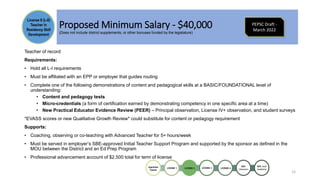
Proposed Minimum Salary - $40,000
(Does not include district supplements, or other bonuses funded by the legislature)
Teacher of record
Requirements:
• Hold all L-I requirements
• Must be affiliated with an EPP or employer that guides routing
• Complete one of the following demonstrations of content and pedagogical skills at a BASIC/FOUNDATIONAL level of
understanding:
• Content and pedagogy tests
• Micro-credentials (a form of certification earned by demonstrating competency in one specific area at a time)
• New Practical Educator Evidence Review (PEER) – Principal observation, License IV+ observation, and student surveys
*EVASS scores or new Qualitative Growth Review* could substitute for content or pedagogy requirement
Supports:
• Coaching, observing or co-teaching with Advanced Teacher for 5+ hours/week
• Must be served in employer’s SBE-approved Initial Teacher Support Program and supported by the sponsor as defined in the
MOU between the District and an Ed Prep Program
• Professional advancement account of $2,500 total for term of license
12
License II (L-II)
Teacher in
Residency Skill
Development
Apprentice
Teacher
LICENSE 1: LICENSE 2: LICENSE 3:
ADV:
Classroom
ADV: Adult
Leadership
LICENSE 4:
PEPSC Draft -
March 2022
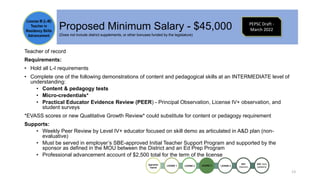
Proposed Minimum Salary - $45,000
(Does not include district supplements, or other bonuses funded by the legislature)
Teacher of record
Requirements:
• Hold all L-I requirements
• Complete one of the following demonstrations of content and pedagogical skills at an INTERMEDIATE level of
understanding:
• Content & pedagogy tests
• Micro-credentials*
• Practical Educator Evidence Review (PEER) - Principal Observation, License IV+ observation, and
student surveys
*EVASS scores or new Qualitative Growth Review* could substitute for content or pedagogy requirement
Supports:
• Weekly Peer Review by Level IV+ educator focused on skill demo as articulated in A&D plan (non-
evaluative)
• Must be served in employer’s SBE-approved Initial Teacher Support Program and supported by the
sponsor as defined in the MOU between the District and an Ed Prep Program
• Professional advancement account of $2,500 total for the term of the license
13
License III (L-III)
Teacher in
Residency Skills
Advancement
Apprentice
Teacher
LICENSE 1: LICENSE 2: LICENSE 3:
ADV:
Classroom
ADV: Adult
Leadership
LICENSE 4:
PEPSC Draft -
March 2022
Early Career Options Expert Teacher Teacher Leader Options
My name is Madison.
While starting my career, I
want to refine my skillset as
an educator and advance in
my career. Mentor
guidance, development
supports, and an
incentivized compensation
system inspires me to
achieve professional
licensure.
I’m Noah, but my students call
me Mr. Hernandez. Teaching
the next generation is my
greatest passion, and I’m
overjoyed that I get to do it
every day. The feedback on
my work and increased
compensation allows me to
stay in the classroom where I
can best serve my students.
Everyone knows me as Mrs.
Nichols. I’ve been teaching for
10 years. This school and these
students are my life’s work. It
means everything that I’m able
to mentor the next generation of
teachers to ensure that they,
too, will grow students the way
I’ve aimed to.
Career Phases in Practice
Clear career options and phases will help attract, empower, support and retain teachers.
They will incentivize great teachers to lead from the classroom and continue to make a
positive impact on students and colleagues.
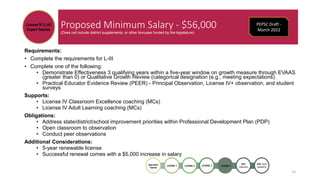
Proposed Minimum Salary - $56,000
(Does not include district supplements, or other bonuses funded by the legislature)
Requirements:
• Complete the requirements for L-III
• Complete one of the following:
• Demonstrate Effectiveness 3 qualifying years within a five-year window on growth measure through EVAAS
(greater than 0) or Qualitative Growth Review (categorical designation (e.g., meeting expectations)
• Practical Educator Evidence Review (PEER) - Principal Observation, License IV+ observation, and student
surveys
Supports:
• License IV Classroom Excellence coaching (MCs)
• License IV Adult Learning coaching (MCs)
Obligations:
• Address state/district/school improvement priorities within Professional Development Plan (PDP)
• Open classroom to observation
• Conduct peer observations
Additional Considerations:
• 5-year renewable license
• Successful renewal comes with a $5,000 increase in salary
15
License IV (L-IV)
Expert Teacher
Apprentice
Teacher
LICENSE 1: LICENSE 2: LICENSE 3:
ADV:
Classroom
ADV: Adult
Leadership
LICENSE 4:
PEPSC Draft -
March 2022
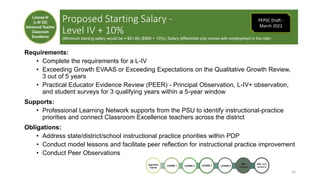
Proposed Starting Salary -
Level IV + 10%
(Minimum starting salary would be ≈ $61.6K ($56K + 10%); Salary differential only comes with employment in the role)
Requirements:
• Complete the requirements for a L-IV
• Exceeding Growth EVAAS or Exceeding Expectations on the Qualitative Growth Review,
3 out of 5 years
• Practical Educator Evidence Review (PEER) - Principal Observation, L-IV+ observation,
and student surveys for 3 qualifying years within a 5-year window
Supports:
• Professional Learning Network supports from the PSU to identify instructional-practice
priorities and connect Classroom Excellence teachers across the district
Obligations:
• Address state/district/school instructional practice priorities within PDP
• Conduct model lessons and facilitate peer reflection for instructional practice improvement
• Conduct Peer Observations
16
License IV
(L-IV CE)
Advanced Teacher
Classroom
Excellence
Apprentice
Teacher
LICENSE 1: LICENSE 2: LICENSE 3:
ADV:
Classroom
ADV: Adult
Leadership
LICENSE 4:
PEPSC Draft -
March 2022
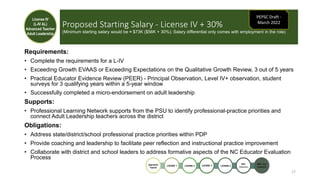
Proposed Starting Salary - License IV + 30%
(Minimum starting salary would be ≈ $73K ($56K + 30%); Salary differential only comes with employment in the role)
Requirements:
• Complete the requirements for a L-IV
• Exceeding Growth EVAAS or Exceeding Expectations on the Qualitative Growth Review, 3 out of 5 years
• Practical Educator Evidence Review (PEER) - Principal Observation, Level IV+ observation, student
surveys for 3 qualifying years within a 5-year window
• Successfully completed a micro-endorsement on adult leadership
Supports:
• Professional Learning Network supports from the PSU to identify professional-practice priorities and
connect Adult Leadership teachers across the district
Obligations:
• Address state/district/school professional practice priorities within PDP
• Provide coaching and leadership to facilitate peer reflection and instructional practice improvement
• Collaborate with district and school leaders to address formative aspects of the NC Educator Evaluation
Process
17
License IV
(L-IV AL)
Advanced Teacher
Adult Leadership
Apprentice
Teacher
LICENSE 1: LICENSE 2: LICENSE 3:
ADV:
Classroom
ADV: Adult
Leadership
LICENSE 4:
PEPSC Draft -
March 2022
Now vs. Future
■ Now: Teacher licensure is based on inputs.
■ Future: An outcome-driven model is a more direct measure of teacher
preparation and effectiveness than a solely input-driven model.
■ Now: Licensure exams are the only way to measure skills and abilities.
■ Future: Teachers demonstrate skills, competencies and effectiveness through a
menu of options that sustain the rigor and quality of the profession, while
providing flexibility.
■ Now: Teaching is an undervalued profession.
■ Future: Teachers are regarded as professionals and provided competitive
salaries, professional support, and advancement opportunities.
Myth vs. Fact
■ Myth: The primary issue contributing to the teacher shortage is teacher pay.
■ Fact: While compensation is a major factor contributing to teacher shortage, it is
not the only factor.
■ Myth: The draft model will lower standards for teachers entering the profession.
■ Fact: The contrary is true. The draft model holds all teachers to a higher standard,
requiring them to demonstrate effectiveness to advance in the profession.
■ Myth: The draft plan will shortchange teachers with a master’s degree.
■ Fact: Separate bonuses and local supplements would still apply on top of the new
base minimum pay levels proposed. Additional pay for certain degrees or national
certification are still up to the legislature.
Myth vs. Fact
■ Myth: The draft plan discourages teachers to be traditionally prepared.
■ Fact: The contrary is true. State data shows most traditional EPP prepared
students become our highest quality teachers. The draft plan continues to require
similar rules for future teachers to choose traditional or alternative preparation
program support, but incentivizes teachers to utilize the best routes so they may
enter the profession at a higher initial license and pay level.
Defining success
• Recruit and retain high-quality teachers
• Teachers are more robustly supported
• Teachers have opportunities to advance/lead within the classroom
• Compensation strategy that grows as teachers expand their career
• Student, workforce and economic success!
Next steps
■ April 2022: Bi-monthly updates to State Board of Education on
subcommittee progress
■ Summer 2022: Submit final PEPSC solution to State Board of
Education
■ 2023: PEPSC solution converted to legislation for General
Assembly action

TeacherLicensure.pptx

  • 1.
    Elevating the Teaching Professionin North Carolina PEPSC Draft Model March 2022
  • 2.
    We must elevatethe teaching profession Better Teacher Supports Advancement & Growth Opportunities Tailored Measures of Effectiveness Competitive Salary Respect
  • 3.
    Background 2018: NC Education HumanCapital Roundtable Formed February 2021: HCRT Presented to SBE April 2021: Four PEPSC Subcommittees Formed 2022: PEPSC Presents to SBE (x2)
  • 4.
    4 PEPSC Subcommittee Members Prepand Entry Dr. Hank Weddington Ms. Tonya Smith Ms. Ashley Bailey Dr. Donna Thomas Ms. Rae Thompson Ms. Lydia Hedrick Mr. Scott Rhodes Dr. Jennifer Hefner Dr. Tony Jackson Dr. Jennifer Russell Dr. Heather Bower Dr. Sheryl Long Dr. Erin Horne Dr. Diana Lys Dr. Christina O'Connor Dr. Randall Penfield Dr. Lisa Eads Dr. Laura Bilbro-Berry Ms. Leanna Delph Mr. Phil Kirk Dr. Olivia Oxendine Mr. Dayson Pasion Ms. Charrise Hollingsworth Mr. Geoff Coltrane Dr. Van Dempsey Licensure Dr. Ann Bullock Ms. Maureen Stover Ms. Katherine Joyce Mr. Robert Ellyson Ms. Nicole McGhee Dr. Alvera Lesane Ms. Lori Stacey Ms. Virginia Gutierrez Dr. Connie Locklear Mr. Oliver Holley Dr. Kim Creamer Dr. Chris Godwin Dr. Amanda Bulliard Maxwell Dr. Vivian Covington Dr. Brad Smith Ms. Melissa Tooley Mr. Andrew Lakis Mr. Tabari Wallace Mr. Tom West Ms. Brenda Berg Ms. Jill Camnitz Ms. Kathryn Castelloes Ms. Sarah Greer Koenig Dr. Westley Wood Ms. AJ Hammond Ms. Deborah Hoffman Dr. Stephen Gainey Mr. Dayson Pasion Ms. Charrise Hollingsworth Mr. Geoff Coltrane Ms. Tamika Walker Kelly Ms. Lee O'Neal Dr. Christopher Blanton Advancement and Development Ms. Maureen Stover Ms. Tonya Smith Ms. Jeanette Owens Ms. Felicia Brown Dr. Don Phipps Dr. Pascal Mubenga Dr. Gregory Monroe Ms. Sandy Kinzel Dr. Alfred Bryant Dr. Laura Hart Dr. Nancy Ruppert Dr. Nakeisha Williams Dr. Patricia Bricker Ms. Melissa Tooley Ms. Francelia Burwell Ms. Kisha Clemons Ms. Jennifer Brinson Mr. Mike Martin Dr. Angela Quick Dr. Jeff McDaris Mr. Andrew Lakis Mr. Tabari Wallace Ms. Jill Camnitz Mr. Dayson Pasion Mr. Geoff Coltrane Ms. Charrise Hollingsworth Ms. Dee Grissett Mr. Steven Gupton Dr. Michael Maher Budget and Compensation Dr. Anthony Graham Ms. Wendy Cabral Mr. Dan Swartz Ms. Katie Sunseri Mr. Dean Richardson Ms. Jeanette Owens Dr. Ethan Lenker Dr. Bryan Hassel Dr. Marcie Holland Dr. Stephen Martin Ms. Shawnda Cherry Dr. Bill Griffin Ms. Lori Fox Dr. Myra Cox Dr. Amy Holcombe Dr. Monica Lambert Dr. Jackie Ennis Dr. Ereka Williams Mr. Chad Aldeman Ms. Bernice Sanders Johnson Superintendent Catherine Truitt Mr. Tom West Mr. Tabari Wallace Ms. Brenda Berg Mr. Freebird McKinney Mr. Dayson Pasion Ms. Charrise Hollingsworth Mr. Geoff Coltrane Mr. Julio Morales Dr. Aaron Fleming
  • 5.
    5 PEPSC’s Student-Centered Focus Goal: Keep great teachers in the classroom and attract highly qualified, diverse candidates into the profession.  Principle 1: Do our ideas have a positive impact on students?  Principle 2: Are our ideas measurable in an authentic setting (in the presence of students and their learning)?
  • 6.
    A Professional System ofSupport To elevate the teaching profession, teachers deserve an improved system of effectiveness-based licensure requirements, professional supports, and career pathways. Within the system, there are four possible career phases that are interconnected, flexible, progressive, and focused on teacher and student success. Pre-Teaching Options Expert Teacher Early Career Options Teacher Leadership Options
  • 7.
    The Benefits ofthe Proposed System This proposed system reform aims to professionalize the teaching career and make the teaching profession more attractive. While every educator’s journey will look different, they can each expect help in their careers at each phase. Apprenticeship Offering a new apprenticeship pathway into teaching allows more degree-earners to try on teaching while being compensated, and it connects with the 2+2 pathway. Available to traditional or 2+2 EPP students for their student teaching as well as post-Bacc teacher candidates who want to experience a classroom setting. Teacher Support To provide individualized professional learning support, each early career teacher will receive a professional advancement account to access a variety of professional development opportunities. Mentorship Each practicing and early career teacher will benefit from the guidance of seasoned educators, with scaffolded support that is higher in the earlier years. Early career teachers will also have in-classroom supports from a teacher mentor. Compensation Pay will no longer be restricted to time served; rather, teachers will be professionally compensated for growing their skills and effectiveness, extending their reach to more students, and leading their peers. Effectiveness Measures Professionals deserve to know their strengths and receive positive, ongoing feedback. To understand teaching impact, there must be many types of authentic measures used regularly, not a single measure in time, and they must connect to a teacher’s daily responsibilities of leading their classrooms, not add to it. Incentivizing Quality Preparation In most cases, traditionally prepared teachers are the best in North Carolina. Any approved EPP that successfully prepares individuals for the job will ensure their graduates start at a higher entry license and pay level. Demonstrating professional and compensation growth will be an important tool for recruiting EPP candidates. Scaffolded Responsibilities Every new teacher needs extra time and support to learn how to best lead their classrooms. The new system sets realistic classroom responsibilities at the start that grow overtime as a teacher is better supported and improves their skills. Optional Career Paths Effective teachers can now extend their reach to more students without leaving the classroom. Whether choosing to take on a more challenging classroom or becoming a teacher leader, teachers with demonstrated effectiveness can apply for advanced roles that include substantial compensation increases.
  • 8.
    Teacher Leader Options ExpertTeacher Early Career Options License 4 License 3 2+2 Pre-Teaching Options Post- Bacc EPP Apprentice Traditional EPP License 1 License 2 The Individual Journey While there are four professional phases within this plan, there are a variety of options for how each aspiring educator is able to move through them. Various stages constitute each phase and how different individuals can choose to move both forward and upward. Advanced Teacher Classroom Excellence Advanced Teacher Adult Leadership
  • 9.
    Pre-Teaching Paths I’m Santiago.I earned a bachelor’s degree in biology but working in a lab wasn’t right for me. I decided to take a teaching apprenticeship so I could learn classroom pedagogy on the job before becoming a teacher of record. Career Phases in Practice Clear career options and phases will help attract, empower, support and retain teachers. They will incentivize great teachers to lead from the classroom and continue to make a positive impact on students and colleagues. Pre-Teaching Paths I'm Jenny. I got my associate degree in teaching from my local community college and became an apprentice teacher. I've been getting paid to learn to teach under a great mentor while taking classes to earn my bachelor's degree. I look forward to teaching my own class next year after I graduate. Pre-Teaching Paths I’m Richard. I just graduated from university and completed my paid student teaching. Knowing that I have career autonomy, better supports and adequate compensation reassures me that I have every chance to be successful as a future educator.
  • 10.
    Proposed Minimum Salary- $30,000 (Does not include district supplements, or other bonuses funded by the legislature) Requirements: • Associate’s Degree • 60 credit hours towards a baccalaureate degree • CTE licensure areas require 3 years of relevant work experience Supports: • Must work under direct supervision of an Expert or Advanced Teacher • May qualify for TA to Teacher funding if applicable • Must be served by a new state-approved Initial Teacher Success Program Additionally: • Licensure candidates in clinical residency may qualify for apprentice salary for the 16- week internship period 10 Apprentice Teacher Apprentice Teacher LICENSE 1: LICENSE 2: LICENSE 3: ADV: Classroom ADV: Adult Leadership LICENSE 4: PEPSC Draft - March 2022
  • 11.
    Proposed Minimum Salary- $38,000 (Does not include district supplements, or other bonuses funded by the legislature) Co-teacher of record Requirements: • Baccalaureate degree or higher • 18 hours relevant content (determined by employer and EPP for residency license) • Must be affiliated with an EPP or employer that guides routing Supports: • In-class supervision by Advanced Teacher (Adult Leadership) for 5+ hours/week • Co-teacher of record with Advanced Teacher on all courses; must observe and/or co- teach with co-teacher of record at least one hour/week • Must be served in employer’s SBE-approved Initial Teacher Support Program and supported by the sponsor as defined in the MOU between the District and an Ed Prep Program • Professional advancement account of $2,500 total for term of license 11 License I (L-I) Apprentice Teacher LICENSE 1: LICENSE 2: LICENSE 3: ADV: Classroom ADV: Adult Leadership LICENSE 4: PEPSC Draft - March 2022
  • 12.
    Proposed Minimum Salary- $40,000 (Does not include district supplements, or other bonuses funded by the legislature) Teacher of record Requirements: • Hold all L-I requirements • Must be affiliated with an EPP or employer that guides routing • Complete one of the following demonstrations of content and pedagogical skills at a BASIC/FOUNDATIONAL level of understanding: • Content and pedagogy tests • Micro-credentials (a form of certification earned by demonstrating competency in one specific area at a time) • New Practical Educator Evidence Review (PEER) – Principal observation, License IV+ observation, and student surveys *EVASS scores or new Qualitative Growth Review* could substitute for content or pedagogy requirement Supports: • Coaching, observing or co-teaching with Advanced Teacher for 5+ hours/week • Must be served in employer’s SBE-approved Initial Teacher Support Program and supported by the sponsor as defined in the MOU between the District and an Ed Prep Program • Professional advancement account of $2,500 total for term of license 12 License II (L-II) Teacher in Residency Skill Development Apprentice Teacher LICENSE 1: LICENSE 2: LICENSE 3: ADV: Classroom ADV: Adult Leadership LICENSE 4: PEPSC Draft - March 2022
  • 13.
    Proposed Minimum Salary- $45,000 (Does not include district supplements, or other bonuses funded by the legislature) Teacher of record Requirements: • Hold all L-I requirements • Complete one of the following demonstrations of content and pedagogical skills at an INTERMEDIATE level of understanding: • Content & pedagogy tests • Micro-credentials* • Practical Educator Evidence Review (PEER) - Principal Observation, License IV+ observation, and student surveys *EVASS scores or new Qualitative Growth Review* could substitute for content or pedagogy requirement Supports: • Weekly Peer Review by Level IV+ educator focused on skill demo as articulated in A&D plan (non- evaluative) • Must be served in employer’s SBE-approved Initial Teacher Support Program and supported by the sponsor as defined in the MOU between the District and an Ed Prep Program • Professional advancement account of $2,500 total for the term of the license 13 License III (L-III) Teacher in Residency Skills Advancement Apprentice Teacher LICENSE 1: LICENSE 2: LICENSE 3: ADV: Classroom ADV: Adult Leadership LICENSE 4: PEPSC Draft - March 2022
  • 14.
    Early Career OptionsExpert Teacher Teacher Leader Options My name is Madison. While starting my career, I want to refine my skillset as an educator and advance in my career. Mentor guidance, development supports, and an incentivized compensation system inspires me to achieve professional licensure. I’m Noah, but my students call me Mr. Hernandez. Teaching the next generation is my greatest passion, and I’m overjoyed that I get to do it every day. The feedback on my work and increased compensation allows me to stay in the classroom where I can best serve my students. Everyone knows me as Mrs. Nichols. I’ve been teaching for 10 years. This school and these students are my life’s work. It means everything that I’m able to mentor the next generation of teachers to ensure that they, too, will grow students the way I’ve aimed to. Career Phases in Practice Clear career options and phases will help attract, empower, support and retain teachers. They will incentivize great teachers to lead from the classroom and continue to make a positive impact on students and colleagues.
  • 15.
    Proposed Minimum Salary- $56,000 (Does not include district supplements, or other bonuses funded by the legislature) Requirements: • Complete the requirements for L-III • Complete one of the following: • Demonstrate Effectiveness 3 qualifying years within a five-year window on growth measure through EVAAS (greater than 0) or Qualitative Growth Review (categorical designation (e.g., meeting expectations) • Practical Educator Evidence Review (PEER) - Principal Observation, License IV+ observation, and student surveys Supports: • License IV Classroom Excellence coaching (MCs) • License IV Adult Learning coaching (MCs) Obligations: • Address state/district/school improvement priorities within Professional Development Plan (PDP) • Open classroom to observation • Conduct peer observations Additional Considerations: • 5-year renewable license • Successful renewal comes with a $5,000 increase in salary 15 License IV (L-IV) Expert Teacher Apprentice Teacher LICENSE 1: LICENSE 2: LICENSE 3: ADV: Classroom ADV: Adult Leadership LICENSE 4: PEPSC Draft - March 2022
  • 16.
    Proposed Starting Salary- Level IV + 10% (Minimum starting salary would be ≈ $61.6K ($56K + 10%); Salary differential only comes with employment in the role) Requirements: • Complete the requirements for a L-IV • Exceeding Growth EVAAS or Exceeding Expectations on the Qualitative Growth Review, 3 out of 5 years • Practical Educator Evidence Review (PEER) - Principal Observation, L-IV+ observation, and student surveys for 3 qualifying years within a 5-year window Supports: • Professional Learning Network supports from the PSU to identify instructional-practice priorities and connect Classroom Excellence teachers across the district Obligations: • Address state/district/school instructional practice priorities within PDP • Conduct model lessons and facilitate peer reflection for instructional practice improvement • Conduct Peer Observations 16 License IV (L-IV CE) Advanced Teacher Classroom Excellence Apprentice Teacher LICENSE 1: LICENSE 2: LICENSE 3: ADV: Classroom ADV: Adult Leadership LICENSE 4: PEPSC Draft - March 2022
  • 17.
    Proposed Starting Salary- License IV + 30% (Minimum starting salary would be ≈ $73K ($56K + 30%); Salary differential only comes with employment in the role) Requirements: • Complete the requirements for a L-IV • Exceeding Growth EVAAS or Exceeding Expectations on the Qualitative Growth Review, 3 out of 5 years • Practical Educator Evidence Review (PEER) - Principal Observation, Level IV+ observation, student surveys for 3 qualifying years within a 5-year window • Successfully completed a micro-endorsement on adult leadership Supports: • Professional Learning Network supports from the PSU to identify professional-practice priorities and connect Adult Leadership teachers across the district Obligations: • Address state/district/school professional practice priorities within PDP • Provide coaching and leadership to facilitate peer reflection and instructional practice improvement • Collaborate with district and school leaders to address formative aspects of the NC Educator Evaluation Process 17 License IV (L-IV AL) Advanced Teacher Adult Leadership Apprentice Teacher LICENSE 1: LICENSE 2: LICENSE 3: ADV: Classroom ADV: Adult Leadership LICENSE 4: PEPSC Draft - March 2022
  • 18.
    Now vs. Future ■Now: Teacher licensure is based on inputs. ■ Future: An outcome-driven model is a more direct measure of teacher preparation and effectiveness than a solely input-driven model. ■ Now: Licensure exams are the only way to measure skills and abilities. ■ Future: Teachers demonstrate skills, competencies and effectiveness through a menu of options that sustain the rigor and quality of the profession, while providing flexibility. ■ Now: Teaching is an undervalued profession. ■ Future: Teachers are regarded as professionals and provided competitive salaries, professional support, and advancement opportunities.
  • 19.
    Myth vs. Fact ■Myth: The primary issue contributing to the teacher shortage is teacher pay. ■ Fact: While compensation is a major factor contributing to teacher shortage, it is not the only factor. ■ Myth: The draft model will lower standards for teachers entering the profession. ■ Fact: The contrary is true. The draft model holds all teachers to a higher standard, requiring them to demonstrate effectiveness to advance in the profession. ■ Myth: The draft plan will shortchange teachers with a master’s degree. ■ Fact: Separate bonuses and local supplements would still apply on top of the new base minimum pay levels proposed. Additional pay for certain degrees or national certification are still up to the legislature.
  • 20.
    Myth vs. Fact ■Myth: The draft plan discourages teachers to be traditionally prepared. ■ Fact: The contrary is true. State data shows most traditional EPP prepared students become our highest quality teachers. The draft plan continues to require similar rules for future teachers to choose traditional or alternative preparation program support, but incentivizes teachers to utilize the best routes so they may enter the profession at a higher initial license and pay level.
  • 21.
    Defining success • Recruitand retain high-quality teachers • Teachers are more robustly supported • Teachers have opportunities to advance/lead within the classroom • Compensation strategy that grows as teachers expand their career • Student, workforce and economic success!
  • 22.
    Next steps ■ April2022: Bi-monthly updates to State Board of Education on subcommittee progress ■ Summer 2022: Submit final PEPSC solution to State Board of Education ■ 2023: PEPSC solution converted to legislation for General Assembly action

Editor's Notes

  • #3 • Elevate the teaching profession, making it a more attractive career choice. • Keep high-quality teachers in the classroom, while letting them advance professionally. • Attract and retain highly qualified candidates in the profession to ensure a quality education for all students. • Providing better teacher supports, advancement opportunities, tailoring measures of effectiveness to the teacher rather than one-size-fits-all approach
  • #4 2018: NC Education Human Capital Roundtable formed to examine and address the need for a new approach to the teaching profession. OPTIONAL TALKING PT: Was made up of representatives from The U of NC System, NC Independent Colleges & Universities, the NC DPI, the NC State Board of Education and PEPSC. Early 2021: HCRT presented its vision to NC State Board of Education in early 2021. Late 2021: PEPSC subcommittees were formed. At the direction of the State Board, the Roundtable’s vision was passed to PEPSC to be shaped into a legislative and operational proposal. Exploring policy changes for a new approach to teacher licensure, supports, compensation and professional career paths in NC. Goal: Elevate teaching profession by attracting highly qualified, diverse candidates, and keeping great teachers in the classroom. 2022: PEPSC presented strawman to SBE on March 16. Taking feedback to incorporate into final proposal presented in Summer 2022. Spring 2022 and Summer 2022
  • #5 The transition from the human capital roundtable to PEPSC engaged a wide variety of stakeholders in the process - superintendents K-12 Public and Private University faculty PEPSC representation NC Board of education NCAE Research experts DPI Governor’s advisors Business
  • #6 PEPSC and the subcommittees are guided by making decisions on what is best for student learning and providing a great teacher that is qualified, supported and rewarded in every classroom.
  • #7 The task ahead is to build a professional system of support for teachers, centered around what students need to be successful. PEPSC’s plan is to lay out the highly specific policy and operational elements needed to do this. The vision is to keep making improvements to the plan to build an improved system of effectiveness-based licensure requirements, professional supports, and career pathways.
  • #8 The draft plan that is undergoing another round of feedback and adjustments in subcommittees includes these key benefits and enhancements: Career paths with options and flexibility New apprenticeship option to be paid while learning to teach and get your degree Enhanced supports to access PD and have onsite colleagues to turn too Mentors assigned to all new teachers is first 3 to 5 years Compensation that increases with skills and responsibilities A profession built on feedback, growth, effectiveness and impact – rather than on time served Incentivizing the best preparation routes so more teachers will be highly qualified And finally... Making sure that responsibilities are scaffolded so new teachers are not placed in the hardest classrooms and mentors have the time needed to coach peers
  • #9 The draft plan and the vision overall is to build career phases, with options, autonomy and flexibility, but anchored by rigorous expectations for meeting students’ needs
  • #11 TA salary range for reference is 21-33k
  • #17 Tom No GPA requirement Needed here
  • #19 MISCONCEPTIONS: Lowering standards Licensure exams are only effective way to (base system solely on EVAAS) Primary issue to shortage is teacher pay Proposal will short change teachers who earned master’s degree EPP (prep programs) making sure that all the fears from schools of ed are dispelled Advanced teaching roles AND residency roles Merit/Performance pay Inputs are good, too, we can’t just focus on outputs (clarification: the outputs measure the inputs!)
  • #20 MISCONCEPTIONS: Lowering standards Licensure exams are only effective way to (base system solely on EVAAS) Primary issue to shortage is teacher pay Proposal will short change teachers who earned master’s degree EPP (prep programs) making sure that all the fears from schools of ed are dispelled Advanced teaching roles AND residency roles Merit/Performance pay Inputs are good, too, we can’t just focus on outputs (clarification: the outputs measure the inputs!)
  • #21 MISCONCEPTIONS: Lowering standards Licensure exams are only effective way to (base system solely on EVAAS) Primary issue to shortage is teacher pay Proposal will short change teachers who earned master’s degree EPP (prep programs) making sure that all the fears from schools of ed are dispelled Advanced teaching roles AND residency roles Merit/Performance pay Inputs are good, too, we can’t just focus on outputs (clarification: the outputs measure the inputs!)
  • #22 Patrick We believe our vision is a template for success. North Carolinians will win if state leaders consider, review and build on this vision because The idea clears the way for a better, more diverse, more equitably distributed teacher workforce—and can help restore the respect the profession deserves  The public would be assured that licensed teachers are demonstrating increased mastery in skills, knowledge, and instructional capabilities more than ever before The idea may entice early career educators and those interested in making a career switch to your state because NC would be the first in the nation to innovate in this way. This would be an investment in our teachers and your students—but also an investment for North Carolina’s workforce and economy as a whole—as teaching is the profession that makes all other professions possible We have prepared some handouts for the board that outline further reasons and rationale for our ideas.