30 teaching tips
Penny Ur
15th Anglo Congress 2019
Lesson planning
2
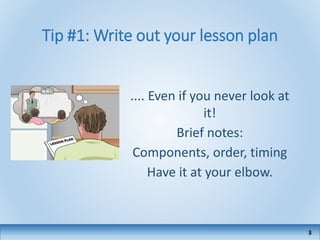
Tip #1: Write out your lesson plan
.... Even if you never look at
it!
Brief notes:
Components, order, timing
Have it at your elbow.
3
Tip # 2: Include a reserve
Add to your plan something you’ll add if you
have extra time...
...And
Something you’ll leave out if you are short of
time!
4
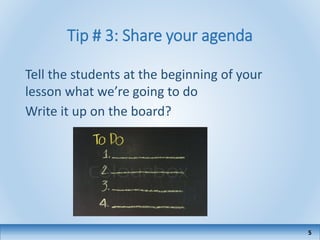
Tip # 3: Share your agenda
Tell the students at the beginning of your
lesson what we’re going to do
Write it up on the board?
5
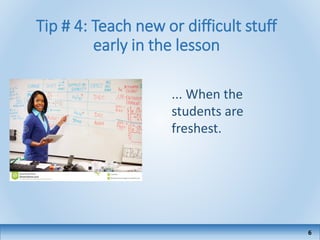
Tip # 4: Teach new or difficult stuff
early in the lesson
6
... When the
students are
freshest.
Tip # 5: End with something nice
Finish the lesson with a smile!
Summarize, demonstrating what they’ve achieved
Congratulate / approve what they’ve done
Tell a short story/joke (relevant to topic!)
Play a quick game
Sing a song
7
Homework
8
Tip # 6: Don’t give homework at the
end of the lesson!
9
You may not have time to explain properly.
Students may not have time to write it down.
Students may not have time to ask questions.

Putting it at the end conveys the message that
it’s not so important.
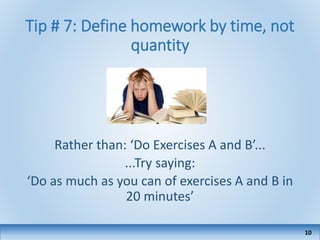
Tip # 7: Define homework by time, not
quantity
Rather than: ‘Do Exercises A and B’...
...Try saying:
‘Do as much as you can of exercises A and B in
20 minutes’
10
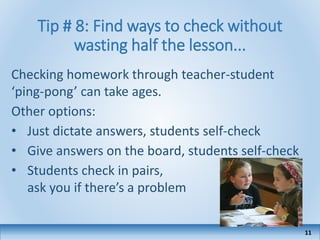
Tip # 8: Find ways to check without
wasting half the lesson...
Checking homework through teacher-student
‘ping-pong’ can take ages.
Other options:
• Just dictate answers, students self-check
• Give answers on the board, students self-check
• Students check in pairs,
ask you if there’s a problem
11
Questioning
12
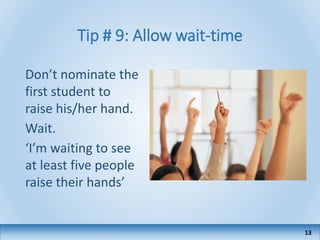
Tip # 9: Allow wait-time
Don’t nominate the
first student to
raise his/her hand.
Wait.
‘I’m waiting to see
at least five people
raise their hands’
13
Tip # 10: ‘Echo’ responses
Repeat students’ responses...
• To make sure everyone hears them
• To confirm
• For the sake of the repetition
• To correct
• As an indirect compliment to the student
14
Tip # 11 : Make questions ‘open-
ended’ as often as you can
Closed-ended: What is the opposite of ‘wide’?
Open-ended: How many things can you think
of that can be wide or narrow ?
15
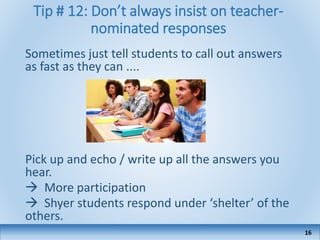
Tip # 12: Don’t always insist on teacher-
nominated responses
Sometimes just tell students to call out answers
as fast as they can ....
Pick up and echo / write up all the answers you
hear.
 More participation
 Shyer students respond under ‘shelter’ of the
others.
16
Correcting mistakes
17
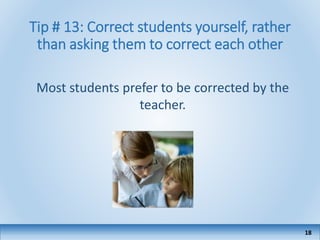
Tip # 13: Correct students yourself, rather
than asking them to correct each other
18
Most students prefer to be corrected by the
teacher.
Tip # 14: Draw attention to correct
answers
Don’t take the right answers for granted.
Give credit, and get other students to notice as
well:
By ‘echoing’
By saying the student’s name in your response
By complimenting and praising.
19
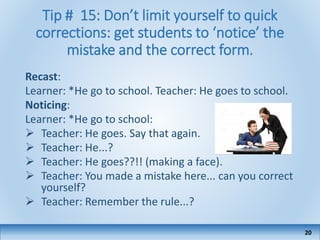
Tip # 15: Don’t limit yourself to quick
corrections: get students to ‘notice’ the
mistake and the correct form.
Recast:
Learner: *He go to school. Teacher: He goes to school.
Noticing:
Learner: *He go to school:
 Teacher: He goes. Say that again.
 Teacher: He...?
 Teacher: He goes??!! (making a face).
 Teacher: You made a mistake here... can you correct
yourself?
 Teacher: Remember the rule...?
20
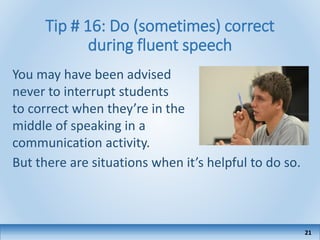
Tip # 16: Do (sometimes) correct
during fluent speech
You may have been advised
never to interrupt students
to correct when they’re in the
middle of speaking in a
communication activity.
But there are situations when it’s helpful to do so.
21
‘Student orientation’
22
Tip # 17: Elicit expectations or
requests from the beginning
What do you want from this
course?
What do you expect?
What do you particularly dislike
doing in English lessons?
Any special requests to help you
learn better?
23
Tip # 18: Share goals
Goals of the course as a whole
Objectives of a particular activity
Why you’re giving this homework
What you hope they’ll gain from ...
24
Tip # 19: Get periodic feedback
Don’t wait until the end of the
course.
Ask them to tell you
• What has helped them learn?
• What hasn’t helped them?
• Any particular suggestions for you (the
teacher)?
• What can he/she (the learner) do more, or
better?
25
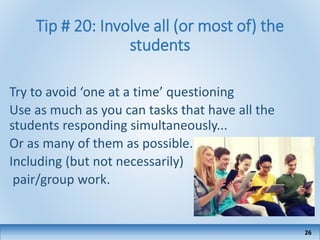
Tip # 20: Involve all (or most of) the
students
Try to avoid ‘one at a time’ questioning
Use as much as you can tasks that have all the
students responding simultaneously...
Or as many of them as possible.
Including (but not necessarily)
pair/group work.
26
Options that involve all, or many,
students
Free-response brainstorm
Responding by quick written notes
Responding by a signal
‘Mingling’
3-4 students write simultaneously on the
board
Pair or group work
27
Acquiring vocabulary
28
Tip #21: Devote a quarter of your class
time to vocabulary work
It’s worth it!
Vocabulary: the key to proficiency
In most cases, they won’t just ‘pick it up’
Need for focused presentation + review.
29
Some ideas
Identifying / teaching selected new items in a
text
‘Word of the day’
New words you’ve learnt recently
Dictations
Vocabulary notebooks
Combining vocabulary with skills work
30
It helps to vary genres of reading texts
If your textbook only uses very limited types
of texts …
Information?
Stories?
Dialogues?
Find more!
For example:
31
Genres of written texts 1: Prose
articles and reports
stories
reviews
explanations
email correspondence
instructions, directions
encyclopedia entries
32
Genres of written texts 2: Information
display
infographics
data display diagrams (graphs, flow-charts etc.)
lists
syllabuses
itineraries
bibliographies
programs
recipes
menus
33
Genres of written texts 3: Short
quotations
proverbs
short emails
slogans
clichés, popular sayings
newspaper headings
street signs
dictionary entries
‘one-liners’
SMS messages
34
Teacher talk
35
Tip # 23: Teacher talk is a good thing!
1. It’s students’ best source of
‘comprehensible input’
2. A teacher’s job is to teach:
teaching involves (among
other things)‘telling’.
Of course students also need to be activated, or
they won’t learn...
But lowering ‘ttt’ is not a value in itself.
36
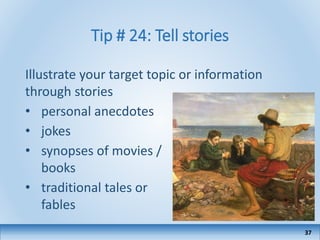
Tip # 24: Tell stories
Illustrate your target topic or information
through stories
• personal anecdotes
• jokes
• synopses of movies /
books
• traditional tales or
fables
37
Group work
38
Tip # 25: Group work is not
necessarily a ‘good thing’
It’s good if you want students to have
opportunities to speak.
It’s good as a change from teacher-led or
individual work.
BUT
Not all students like it
And
39
Group work may result in:
• slower process;
• some students doing nothing;
• ‘sharing of ignorance’;
• discipline problems.
If you choose to do it, make sure it’s worth the
investment, and leads to good learning.
40
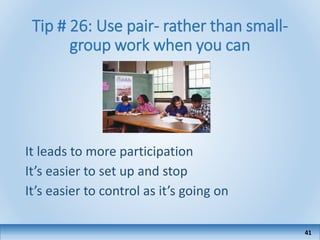
Tip # 26: Use pair- rather than small-
group work when you can
It leads to more participation
It’s easier to set up and stop
It’s easier to control as it’s going on
41
Tip # 27: For group work, first give the
instructions, then get students into groups.
If you put them into groups first, they’ll pay less
attention to instructions.
Give instructions, and when you’re sure they’ve
got it put them into groups, and let them start
work.
42
Tip # 28: Tell students in advance how
the group work will end.
Tell them before they start…
Timing? (‘You have ten minutes’)
Buzzer or bell? (‘This buzzer / bell will
sound at the end’)
Work completion? (‘We’ll stop when
the first group finishes’)
43
Tip #29: Base group speaking activities
on tasks, not topics
Topic based: Talk about …
Task based: Achieve an outcome (decision,
solution, list, drawing…)
44
Examples of tasks
• Try to think of as many uses as you can for a pen [or
tin can, or sheet of paper…]
• Find as many things as you can that you have in
common with your partner
• Decide on order of priority of a set of qualities (e.g.
qualities of a parent, or teacher, or politician)
• Brainstorm as many solutions to a given dilemma as
possible
• Decide on a set of reforms you would introduce to
improve your institution.
• Plan an event (a party, a sports competition, a
wedding…)
45
Tip #30: Never say never
There are few, if any, rules that should always
be observed in the classroom.
Good teaching depends on:
• Knowing what principles and practical
strategies are likely to enhance learning;
• Knowing when to abandon any particular
one of these in specific circumstances.
46
Thank you for your attention
pennyur@gmail.com
47

PENNY-UR-CONCURRENT-SESSION.pdf

  • 1.
    30 teaching tips PennyUr 15th Anglo Congress 2019
  • 2.
  • 3.
    Tip #1: Writeout your lesson plan .... Even if you never look at it! Brief notes: Components, order, timing Have it at your elbow. 3
  • 4.
    Tip # 2:Include a reserve Add to your plan something you’ll add if you have extra time... ...And Something you’ll leave out if you are short of time! 4
  • 5.
    Tip # 3:Share your agenda Tell the students at the beginning of your lesson what we’re going to do Write it up on the board? 5
  • 6.
    Tip # 4:Teach new or difficult stuff early in the lesson 6 ... When the students are freshest.
  • 7.
    Tip # 5:End with something nice Finish the lesson with a smile! Summarize, demonstrating what they’ve achieved Congratulate / approve what they’ve done Tell a short story/joke (relevant to topic!) Play a quick game Sing a song 7
  • 8.
  • 9.
    Tip # 6:Don’t give homework at the end of the lesson! 9 You may not have time to explain properly. Students may not have time to write it down. Students may not have time to ask questions. Putting it at the end conveys the message that it’s not so important.
  • 10.
    Tip # 7:Define homework by time, not quantity Rather than: ‘Do Exercises A and B’... ...Try saying: ‘Do as much as you can of exercises A and B in 20 minutes’ 10
  • 11.
    Tip # 8:Find ways to check without wasting half the lesson... Checking homework through teacher-student ‘ping-pong’ can take ages. Other options: • Just dictate answers, students self-check • Give answers on the board, students self-check • Students check in pairs, ask you if there’s a problem 11
  • 12.
  • 13.
    Tip # 9:Allow wait-time Don’t nominate the first student to raise his/her hand. Wait. ‘I’m waiting to see at least five people raise their hands’ 13
  • 14.
    Tip # 10:‘Echo’ responses Repeat students’ responses... • To make sure everyone hears them • To confirm • For the sake of the repetition • To correct • As an indirect compliment to the student 14
  • 15.
    Tip # 11: Make questions ‘open- ended’ as often as you can Closed-ended: What is the opposite of ‘wide’? Open-ended: How many things can you think of that can be wide or narrow ? 15
  • 16.
    Tip # 12:Don’t always insist on teacher- nominated responses Sometimes just tell students to call out answers as fast as they can .... Pick up and echo / write up all the answers you hear.  More participation  Shyer students respond under ‘shelter’ of the others. 16
  • 17.
  • 18.
    Tip # 13:Correct students yourself, rather than asking them to correct each other 18 Most students prefer to be corrected by the teacher.
  • 19.
    Tip # 14:Draw attention to correct answers Don’t take the right answers for granted. Give credit, and get other students to notice as well: By ‘echoing’ By saying the student’s name in your response By complimenting and praising. 19
  • 20.
    Tip # 15:Don’t limit yourself to quick corrections: get students to ‘notice’ the mistake and the correct form. Recast: Learner: *He go to school. Teacher: He goes to school. Noticing: Learner: *He go to school:  Teacher: He goes. Say that again.  Teacher: He...?  Teacher: He goes??!! (making a face).  Teacher: You made a mistake here... can you correct yourself?  Teacher: Remember the rule...? 20
  • 21.
    Tip # 16:Do (sometimes) correct during fluent speech You may have been advised never to interrupt students to correct when they’re in the middle of speaking in a communication activity. But there are situations when it’s helpful to do so. 21
  • 22.
  • 23.
    Tip # 17:Elicit expectations or requests from the beginning What do you want from this course? What do you expect? What do you particularly dislike doing in English lessons? Any special requests to help you learn better? 23
  • 24.
    Tip # 18:Share goals Goals of the course as a whole Objectives of a particular activity Why you’re giving this homework What you hope they’ll gain from ... 24
  • 25.
    Tip # 19:Get periodic feedback Don’t wait until the end of the course. Ask them to tell you • What has helped them learn? • What hasn’t helped them? • Any particular suggestions for you (the teacher)? • What can he/she (the learner) do more, or better? 25
  • 26.
    Tip # 20:Involve all (or most of) the students Try to avoid ‘one at a time’ questioning Use as much as you can tasks that have all the students responding simultaneously... Or as many of them as possible. Including (but not necessarily) pair/group work. 26
  • 27.
    Options that involveall, or many, students Free-response brainstorm Responding by quick written notes Responding by a signal ‘Mingling’ 3-4 students write simultaneously on the board Pair or group work 27
  • 28.
  • 29.
    Tip #21: Devotea quarter of your class time to vocabulary work It’s worth it! Vocabulary: the key to proficiency In most cases, they won’t just ‘pick it up’ Need for focused presentation + review. 29
  • 30.
    Some ideas Identifying /teaching selected new items in a text ‘Word of the day’ New words you’ve learnt recently Dictations Vocabulary notebooks Combining vocabulary with skills work 30
  • 31.
    It helps tovary genres of reading texts If your textbook only uses very limited types of texts … Information? Stories? Dialogues? Find more! For example: 31
  • 32.
    Genres of writtentexts 1: Prose articles and reports stories reviews explanations email correspondence instructions, directions encyclopedia entries 32
  • 33.
    Genres of writtentexts 2: Information display infographics data display diagrams (graphs, flow-charts etc.) lists syllabuses itineraries bibliographies programs recipes menus 33
  • 34.
    Genres of writtentexts 3: Short quotations proverbs short emails slogans clichés, popular sayings newspaper headings street signs dictionary entries ‘one-liners’ SMS messages 34
  • 35.
  • 36.
    Tip # 23:Teacher talk is a good thing! 1. It’s students’ best source of ‘comprehensible input’ 2. A teacher’s job is to teach: teaching involves (among other things)‘telling’. Of course students also need to be activated, or they won’t learn... But lowering ‘ttt’ is not a value in itself. 36
  • 37.
    Tip # 24:Tell stories Illustrate your target topic or information through stories • personal anecdotes • jokes • synopses of movies / books • traditional tales or fables 37
  • 38.
  • 39.
    Tip # 25:Group work is not necessarily a ‘good thing’ It’s good if you want students to have opportunities to speak. It’s good as a change from teacher-led or individual work. BUT Not all students like it And 39
  • 40.
    Group work mayresult in: • slower process; • some students doing nothing; • ‘sharing of ignorance’; • discipline problems. If you choose to do it, make sure it’s worth the investment, and leads to good learning. 40
  • 41.
    Tip # 26:Use pair- rather than small- group work when you can It leads to more participation It’s easier to set up and stop It’s easier to control as it’s going on 41
  • 42.
    Tip # 27:For group work, first give the instructions, then get students into groups. If you put them into groups first, they’ll pay less attention to instructions. Give instructions, and when you’re sure they’ve got it put them into groups, and let them start work. 42
  • 43.
    Tip # 28:Tell students in advance how the group work will end. Tell them before they start… Timing? (‘You have ten minutes’) Buzzer or bell? (‘This buzzer / bell will sound at the end’) Work completion? (‘We’ll stop when the first group finishes’) 43
  • 44.
    Tip #29: Basegroup speaking activities on tasks, not topics Topic based: Talk about … Task based: Achieve an outcome (decision, solution, list, drawing…) 44
  • 45.
    Examples of tasks •Try to think of as many uses as you can for a pen [or tin can, or sheet of paper…] • Find as many things as you can that you have in common with your partner • Decide on order of priority of a set of qualities (e.g. qualities of a parent, or teacher, or politician) • Brainstorm as many solutions to a given dilemma as possible • Decide on a set of reforms you would introduce to improve your institution. • Plan an event (a party, a sports competition, a wedding…) 45
  • 46.
    Tip #30: Neversay never There are few, if any, rules that should always be observed in the classroom. Good teaching depends on: • Knowing what principles and practical strategies are likely to enhance learning; • Knowing when to abandon any particular one of these in specific circumstances. 46
  • 47.
    Thank you foryour attention pennyur@gmail.com 47