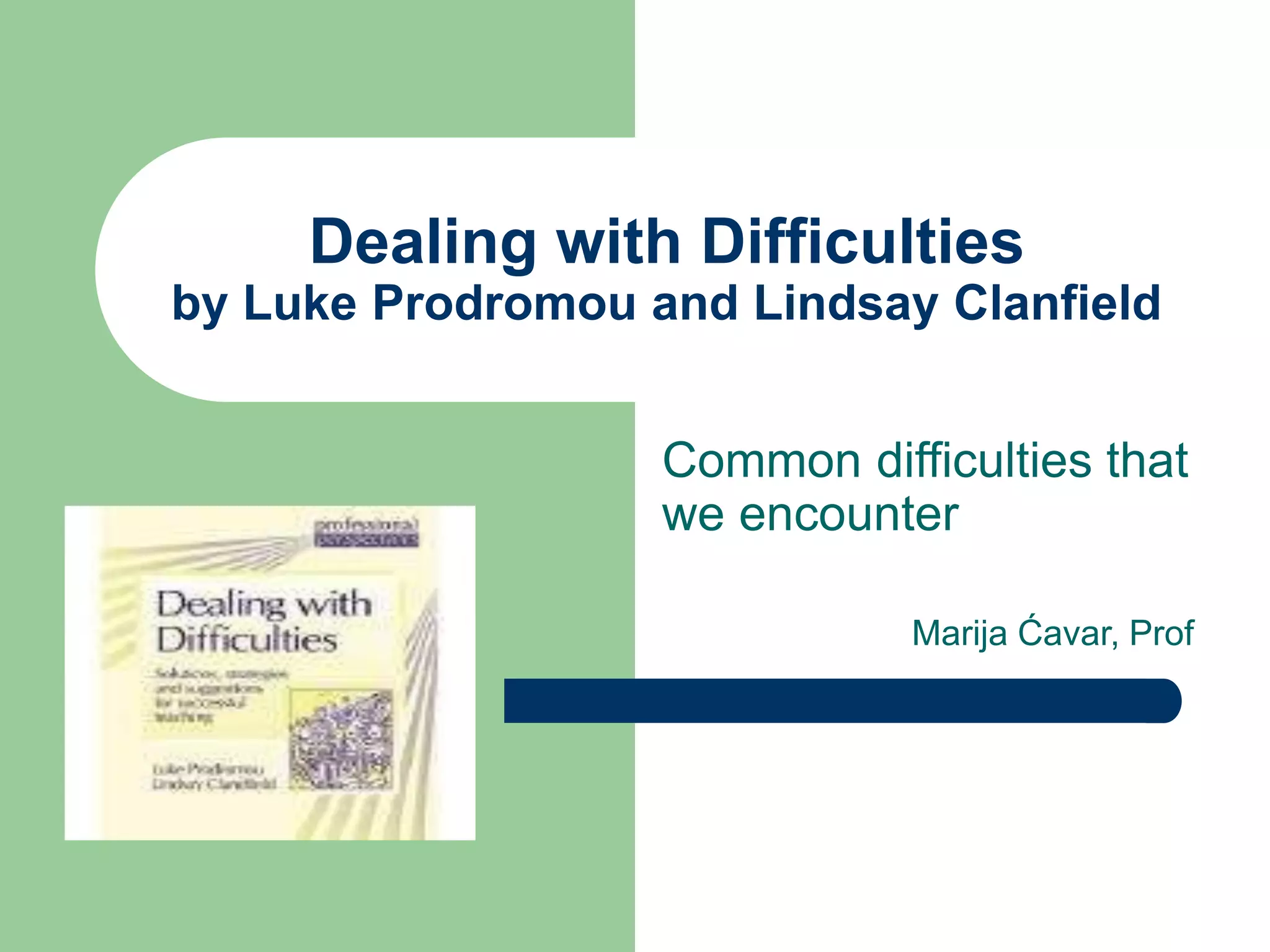
Dealing with Difficulties
by Luke Prodromou and Lindsay Clanfield
Common difficulties that
we encounter
Marija Ćavar, Prof
New teaching strategies, latest research into language
learning….but….
 Bread-and-butter issues are rarely mentioned
 Teachers and students both lack motivation
What are These………
1. Large Classes and
Classroom Management
2. Discipline Problems
3. Mixed-level Classes
4. Homework
5. Teaching Exam Classes
6. Professional Development
1
Large Classes
1.1 Managing Big Numbers
1.2 Starting Right
1.3 Handling Latecomers
1.4 Engaging Students with the Materials
1.5 Moving Students Around
1.6 Drilling
1.7 Speaking
1.8 Finishing Right
1.1 Managing Big Numbers
 Knowing, and using, student’s
names
 Using the space to your
advantage
 Checking and cross-checking
 Making eye contact
 Using the board effectively
 Being organized and prepared
 Having routines
 Activities:
The Attention getter
Group Leaders
The board plan
Which answers are different?
Think, Pair, Share
Check, Cross-check
Listen and Stand
1.2 Starting Right
Starting a lesson is a
crucial phase of any
lesson.
Rapport is the positive
relationship we try to
build and without which
little can happen
 Activities:
Entry Music
Who’s Here?
Split Jokes
Name Circle
Back-to-back
Face-to-face
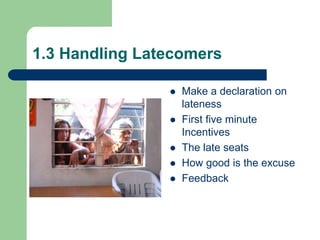
1.3 Handling Latecomers
 Make a declaration on
lateness
 First five minute
Incentives
 The late seats
 How good is the excuse
 Feedback
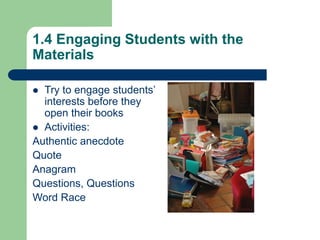
1.4 Engaging Students with the
Materials
 Try to engage students’
interests before they
open their books
 Activities:
Authentic anecdote
Quote
Anagram
Questions, Questions
Word Race
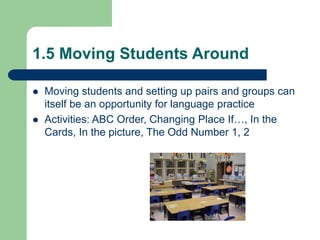
1.5 Moving Students Around
 Moving students and setting up pairs and groups can
itself be an opportunity for language practice
 Activities: ABC Order, Changing Place If…, In the
Cards, In the picture, The Odd Number 1, 2
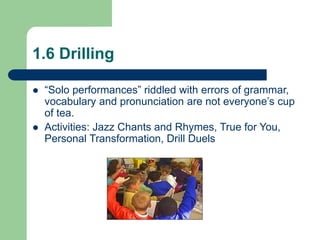
1.6 Drilling
 “Solo performances” riddled with errors of grammar,
vocabulary and pronunciation are not everyone’s cup
of tea.
 Activities: Jazz Chants and Rhymes, True for You,
Personal Transformation, Drill Duels
1.7 Speaking
 Speaking activities are
fluency-based, which
means that you may
want to save the
correction of any
spoken errors until after
the activity is finished, if
you correct at all.
ACTIVITIES
 Anchors
 Who Am I?
 Make Your Own Questionnaire
 Thirty students, Thirty
Questions
 Tongue-tied
 Backs Turned
 The Best Memory
 Ping pong speaking
 Half a Minute
 Why?
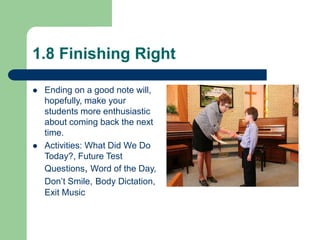
1.8 Finishing Right
 Ending on a good note will,
hopefully, make your
students more enthusiastic
about coming back the next
time.
 Activities: What Did We Do
Today?, Future Test
Questions, Word of the Day,
Don’t Smile, Body Dictation,
Exit Music
2
Discipline Problems (Overt or Covert)
2.1.Diffusing Discipline
2.2 Rules and Regulations
2.3 Raising Awareness
2.4 Building Good Behavior
2.4 Discipline Friendly Tasks
2.5 An Element of Surprise
Both forms of indiscipline
 Overt:
 shouting
 asking to leave the room repeatedly
 rude remarks, swearing
 chewing gum
 refusing to do homework or set
work
 fighting others
 scribbling on books
 questioning the usefulness of task
or the tteacher’s competence
 Covert:
 not paying attention
 arriving late
 missing lessons
 talking when meant to be writing
 clicking pens or dropping things
 sighing noisily
 leaning back in/rocking chairs
 looking out of the window or across
the room
 packing up early as if to leave
 keeping books closed
 asking to change the activity , for
example to song
2.1 Diffusing Discipline
The best attention getter is the sheer force of your
personality, your presence.
The First Encounter (scan, wait, prepare)
Further Encounter
Feeling Good, Working Better
A Rewarding System
Sanctions
***Always use WE instead of I
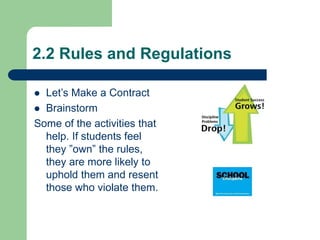
2.2 Rules and Regulations
 Let’s Make a Contract
 Brainstorm
Some of the activities that
help. If students feel
they ”own” the rules,
they are more likely to
uphold them and resent
those who violate them.
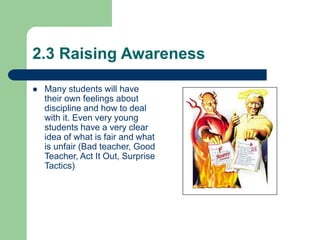
2.3 Raising Awareness
 Many students will have
their own feelings about
discipline and how to deal
with it. Even very young
students have a very clear
idea of what is fair and what
is unfair (Bad teacher, Good
Teacher, Act It Out, Surprise
Tactics)
2.4 Building Good Behaviour
 Maslow’s scheme (students
need to feel safe, comfortable
with a feeling they belong to a
group)
 Activities:
 Class Helpers (The
Timekeeper, The Boardkeeper,
The Messenger, The
Attendance Taker)
 A Suitable Model
 A Quiet Word After Class
 Invisible Body
2.5 An Element of Surprise
 Qualities of a good teacher:
1.Friendly
2. Explains well
3. Has a sense of humour
4. Is patient
5. Is kind
6. Knows the subject
7. Believes in students
8. Is interesting
9. Talks about other things
10.Is enthusiastic
BAD STUDENT-GOOD
TEACHER
 ACTIVITES.
 Catch Them Being Bad
 What Happened in the Class
 Be My Guest
 Team Teaching
3
Mixed-level Classes
3.1 Different Level, Different Task
3.2 Extending Class
3.3 Catering for Learner Style
3.4 One Teacher, One Class
3.5 One Class, Not Several
3.1 Different Level, Different Task
 Mixed-level classes are also,
and among other things, the
result of:
The different learning styles of
students
The pace at which they each learn
Their level and kind of motivation
Their personal interests
Their background knowledge
Any social problems that they may
be facing
 Activities:
 Truth or lie?
 Mixed ability, Mixed-up
Sentences
 Jigsaw pictures
 Books Open, Books
Closed
 Complete the Story, etc
furthermore…
 3.3 Extending Class
“The quick students finish
early and then disrupt
the class because they
are bored”.
Activities: Give Them the
Slip, Choose Two,
Class Mascot
 3.4 Catering for Learner
Styles
Different people learn
things in different ways.
Visual, auditory and
kinesthetic activities
(Timelines,
Spidergrams, Choose
Your words, Draw Your
Picture, Mime Scenes)
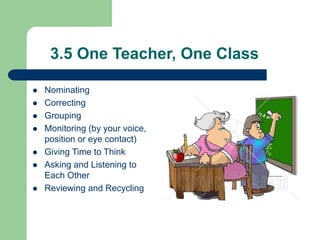
3.5 One Teacher, One Class
 Nominating
 Correcting
 Grouping
 Monitoring (by your voice,
position or eye contact)
 Giving Time to Think
 Asking and Listening to
Each Other
 Reviewing and Recycling
4
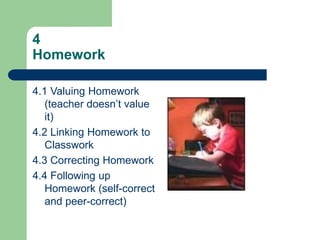
Homework
4.1 Valuing Homework
(teacher doesn’t value
it)
4.2 Linking Homework to
Classwork
4.3 Correcting Homework
4.4 Following up
Homework (self-correct
and peer-correct)
4.1 Valuing Homework
“I suspect my students don’t do their homework
because they think it’s boring and useless”.
 Homework is seen as a punishment or irrelevant
 …as a mechanical (easy to copy)
 …boring (too difficult or too easy)
 …covered in corrections or just given a mark, both of
which may low student’s self-esteem
 Students don’t have enough time to do it
 Activities (Homework Survey, Homework Log, Check
After, Check Before)
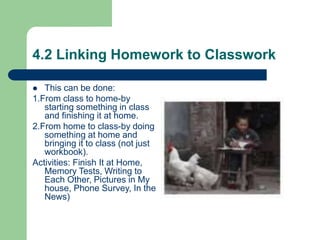
4.2 Linking Homework to Classwork
 This can be done:
1.From class to home-by
starting something in class
and finishing it at home.
2.From home to class-by doing
something at home and
bringing it to class (not just
workbook).
Activities: Finish It at Home,
Memory Tests, Writing to
Each Other, Pictures in My
house, Phone Survey, In the
News)
4.3 Correcting Homework
Positive Comments:
o A lovely piece of work
o I especially like the way you…
o The…was especially good
o You’ve made a lot of progress in
this area
o You’re using the language we’ve
learnt in class very well
In-deed-of Improvement Comments
o -I think you need to work on…
o -There are very few mistakes in this
homework, but the
vocabulary/grammar is very simple.
At your level I think you can use
more complex structures/words.
Responding-to-the-content Comments:
o Is this a true story? Amazing!
o What a frightening/funny/exciting
experience
o What happened at the end?
o I agree/disagree.
…correcting code (don’t use correction as a display
of teacher power-let the students have the
power…and the glory)
 Only a sample, the important
thing is to consistent
 ^ =something missing
 #= number or agreement
 WO =word order
 WW wrong order
 VF wrong verb form
 WF= wrong form
 T= tense
 Prep preposition
 Art=article
 ?= what do you mean?
 Sp=spelling
 P=punctuation
 Ǿ=not necessary
 NA=not appropriate in this
context
 [ = start a new paragraph
NB if you insist on accuracy on
all times then you will be
forever trapped in correcting
all deviant language
(accuracy vs. fluency)
5
Teaching Exam Classes
5.1 Making the Most of It
5.2 Teaching Not Testing
5.3 Testing without Tears
We often prize grammar
and vocabulary over
everything else and test
items throughout the
year instead of teaching
skills.
Testing vs. Teaching
…is product-oriented
…is failure-oriented
…is stressful
…is individualistic
…is competitive
…works with one right answer
…withdraws support
…is context-less
…is monotonous
…is culture-bound
…uses closed-ended exercises
…is teacher controlled
…is judgmental
…measures success in marks
…is process-oriented
…is success oriented
…is relaxing
…is group-oriented
…is collaborative
…accepts more than one answer
…provides support
…is context-sensitive
…is varied
…is culture-sensitive
…uses open-ended tasks
…allows learner-control
…raises self esteem
…measures success in many ways
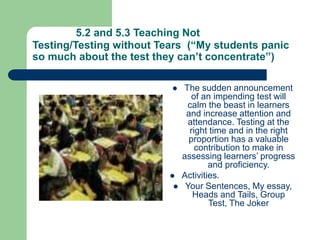
5.2 and 5.3 Teaching Not
Testing/Testing without Tears (“My students panic
so much about the test they can’t concentrate”)
 The sudden announcement
of an impending test will
calm the beast in learners
and increase attention and
attendance. Testing at the
right time and in the right
proportion has a valuable
contribution to make in
assessing learners’ progress
and proficiency.
 Activities.
 Your Sentences, My essay,
Heads and Tails, Group
Test, The Joker
6
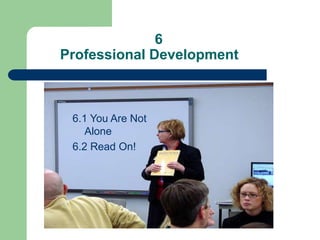
Professional Development
6.1 You Are Not
Alone
6.2 Read On!
6.1 You Are Not Alone
 Discuss the Problem in the Staffroom
 Arrange a Teacher Meeting
 Set Up a Workshop
 Set Up a Swap Shop
 Organize a Teacher Development Group
 Ask a Colleague to Watch You Teach
 Watch a Colleague Teach
 Exchange Classes
 Get the Management on Your Side
 Get the Parents on Your Side
 Get the School on Your Side
6.2. Read On
 Being more professional and more enthusiastic is
the best remedy for any problem we may encounter
in the class.
Closure
Thank You for Your Time!

Dealing with Difficulties.ppt

  • 1.
    Dealing with Difficulties byLuke Prodromou and Lindsay Clanfield Common difficulties that we encounter Marija Ćavar, Prof
  • 2.
    New teaching strategies,latest research into language learning….but….  Bread-and-butter issues are rarely mentioned  Teachers and students both lack motivation
  • 3.
    What are These……… 1.Large Classes and Classroom Management 2. Discipline Problems 3. Mixed-level Classes 4. Homework 5. Teaching Exam Classes 6. Professional Development
  • 4.
    1 Large Classes 1.1 ManagingBig Numbers 1.2 Starting Right 1.3 Handling Latecomers 1.4 Engaging Students with the Materials 1.5 Moving Students Around 1.6 Drilling 1.7 Speaking 1.8 Finishing Right
  • 5.
    1.1 Managing BigNumbers  Knowing, and using, student’s names  Using the space to your advantage  Checking and cross-checking  Making eye contact  Using the board effectively  Being organized and prepared  Having routines  Activities: The Attention getter Group Leaders The board plan Which answers are different? Think, Pair, Share Check, Cross-check Listen and Stand
  • 6.
    1.2 Starting Right Startinga lesson is a crucial phase of any lesson. Rapport is the positive relationship we try to build and without which little can happen  Activities: Entry Music Who’s Here? Split Jokes Name Circle Back-to-back Face-to-face
  • 7.
    1.3 Handling Latecomers Make a declaration on lateness  First five minute Incentives  The late seats  How good is the excuse  Feedback
  • 8.
    1.4 Engaging Studentswith the Materials  Try to engage students’ interests before they open their books  Activities: Authentic anecdote Quote Anagram Questions, Questions Word Race
  • 9.
    1.5 Moving StudentsAround  Moving students and setting up pairs and groups can itself be an opportunity for language practice  Activities: ABC Order, Changing Place If…, In the Cards, In the picture, The Odd Number 1, 2
  • 10.
    1.6 Drilling  “Soloperformances” riddled with errors of grammar, vocabulary and pronunciation are not everyone’s cup of tea.  Activities: Jazz Chants and Rhymes, True for You, Personal Transformation, Drill Duels
  • 11.
    1.7 Speaking  Speakingactivities are fluency-based, which means that you may want to save the correction of any spoken errors until after the activity is finished, if you correct at all. ACTIVITIES  Anchors  Who Am I?  Make Your Own Questionnaire  Thirty students, Thirty Questions  Tongue-tied  Backs Turned  The Best Memory  Ping pong speaking  Half a Minute  Why?
  • 12.
    1.8 Finishing Right Ending on a good note will, hopefully, make your students more enthusiastic about coming back the next time.  Activities: What Did We Do Today?, Future Test Questions, Word of the Day, Don’t Smile, Body Dictation, Exit Music
  • 13.
    2 Discipline Problems (Overtor Covert) 2.1.Diffusing Discipline 2.2 Rules and Regulations 2.3 Raising Awareness 2.4 Building Good Behavior 2.4 Discipline Friendly Tasks 2.5 An Element of Surprise
  • 14.
    Both forms ofindiscipline  Overt:  shouting  asking to leave the room repeatedly  rude remarks, swearing  chewing gum  refusing to do homework or set work  fighting others  scribbling on books  questioning the usefulness of task or the tteacher’s competence  Covert:  not paying attention  arriving late  missing lessons  talking when meant to be writing  clicking pens or dropping things  sighing noisily  leaning back in/rocking chairs  looking out of the window or across the room  packing up early as if to leave  keeping books closed  asking to change the activity , for example to song
  • 15.
    2.1 Diffusing Discipline Thebest attention getter is the sheer force of your personality, your presence. The First Encounter (scan, wait, prepare) Further Encounter Feeling Good, Working Better A Rewarding System Sanctions ***Always use WE instead of I
  • 16.
    2.2 Rules andRegulations  Let’s Make a Contract  Brainstorm Some of the activities that help. If students feel they ”own” the rules, they are more likely to uphold them and resent those who violate them.
  • 17.
    2.3 Raising Awareness Many students will have their own feelings about discipline and how to deal with it. Even very young students have a very clear idea of what is fair and what is unfair (Bad teacher, Good Teacher, Act It Out, Surprise Tactics)
  • 18.
    2.4 Building GoodBehaviour  Maslow’s scheme (students need to feel safe, comfortable with a feeling they belong to a group)  Activities:  Class Helpers (The Timekeeper, The Boardkeeper, The Messenger, The Attendance Taker)  A Suitable Model  A Quiet Word After Class  Invisible Body
  • 19.
    2.5 An Elementof Surprise  Qualities of a good teacher: 1.Friendly 2. Explains well 3. Has a sense of humour 4. Is patient 5. Is kind 6. Knows the subject 7. Believes in students 8. Is interesting 9. Talks about other things 10.Is enthusiastic BAD STUDENT-GOOD TEACHER  ACTIVITES.  Catch Them Being Bad  What Happened in the Class  Be My Guest  Team Teaching
  • 20.
    3 Mixed-level Classes 3.1 DifferentLevel, Different Task 3.2 Extending Class 3.3 Catering for Learner Style 3.4 One Teacher, One Class 3.5 One Class, Not Several
  • 21.
    3.1 Different Level,Different Task  Mixed-level classes are also, and among other things, the result of: The different learning styles of students The pace at which they each learn Their level and kind of motivation Their personal interests Their background knowledge Any social problems that they may be facing  Activities:  Truth or lie?  Mixed ability, Mixed-up Sentences  Jigsaw pictures  Books Open, Books Closed  Complete the Story, etc
  • 22.
    furthermore…  3.3 ExtendingClass “The quick students finish early and then disrupt the class because they are bored”. Activities: Give Them the Slip, Choose Two, Class Mascot  3.4 Catering for Learner Styles Different people learn things in different ways. Visual, auditory and kinesthetic activities (Timelines, Spidergrams, Choose Your words, Draw Your Picture, Mime Scenes)
  • 23.
    3.5 One Teacher,One Class  Nominating  Correcting  Grouping  Monitoring (by your voice, position or eye contact)  Giving Time to Think  Asking and Listening to Each Other  Reviewing and Recycling
  • 24.
    4 Homework 4.1 Valuing Homework (teacherdoesn’t value it) 4.2 Linking Homework to Classwork 4.3 Correcting Homework 4.4 Following up Homework (self-correct and peer-correct)
  • 25.
    4.1 Valuing Homework “Isuspect my students don’t do their homework because they think it’s boring and useless”.  Homework is seen as a punishment or irrelevant  …as a mechanical (easy to copy)  …boring (too difficult or too easy)  …covered in corrections or just given a mark, both of which may low student’s self-esteem  Students don’t have enough time to do it  Activities (Homework Survey, Homework Log, Check After, Check Before)
  • 26.
    4.2 Linking Homeworkto Classwork  This can be done: 1.From class to home-by starting something in class and finishing it at home. 2.From home to class-by doing something at home and bringing it to class (not just workbook). Activities: Finish It at Home, Memory Tests, Writing to Each Other, Pictures in My house, Phone Survey, In the News)
  • 27.
    4.3 Correcting Homework PositiveComments: o A lovely piece of work o I especially like the way you… o The…was especially good o You’ve made a lot of progress in this area o You’re using the language we’ve learnt in class very well In-deed-of Improvement Comments o -I think you need to work on… o -There are very few mistakes in this homework, but the vocabulary/grammar is very simple. At your level I think you can use more complex structures/words. Responding-to-the-content Comments: o Is this a true story? Amazing! o What a frightening/funny/exciting experience o What happened at the end? o I agree/disagree.
  • 28.
    …correcting code (don’tuse correction as a display of teacher power-let the students have the power…and the glory)  Only a sample, the important thing is to consistent  ^ =something missing  #= number or agreement  WO =word order  WW wrong order  VF wrong verb form  WF= wrong form  T= tense  Prep preposition  Art=article  ?= what do you mean?  Sp=spelling  P=punctuation  Ǿ=not necessary  NA=not appropriate in this context  [ = start a new paragraph NB if you insist on accuracy on all times then you will be forever trapped in correcting all deviant language (accuracy vs. fluency)
  • 29.
    5 Teaching Exam Classes 5.1Making the Most of It 5.2 Teaching Not Testing 5.3 Testing without Tears We often prize grammar and vocabulary over everything else and test items throughout the year instead of teaching skills.
  • 30.
    Testing vs. Teaching …isproduct-oriented …is failure-oriented …is stressful …is individualistic …is competitive …works with one right answer …withdraws support …is context-less …is monotonous …is culture-bound …uses closed-ended exercises …is teacher controlled …is judgmental …measures success in marks …is process-oriented …is success oriented …is relaxing …is group-oriented …is collaborative …accepts more than one answer …provides support …is context-sensitive …is varied …is culture-sensitive …uses open-ended tasks …allows learner-control …raises self esteem …measures success in many ways
  • 31.
    5.2 and 5.3Teaching Not Testing/Testing without Tears (“My students panic so much about the test they can’t concentrate”)  The sudden announcement of an impending test will calm the beast in learners and increase attention and attendance. Testing at the right time and in the right proportion has a valuable contribution to make in assessing learners’ progress and proficiency.  Activities.  Your Sentences, My essay, Heads and Tails, Group Test, The Joker
  • 32.
    6 Professional Development 6.1 YouAre Not Alone 6.2 Read On!
  • 33.
    6.1 You AreNot Alone  Discuss the Problem in the Staffroom  Arrange a Teacher Meeting  Set Up a Workshop  Set Up a Swap Shop  Organize a Teacher Development Group  Ask a Colleague to Watch You Teach  Watch a Colleague Teach  Exchange Classes  Get the Management on Your Side  Get the Parents on Your Side  Get the School on Your Side
  • 34.
    6.2. Read On Being more professional and more enthusiastic is the best remedy for any problem we may encounter in the class.
  • 35.