UNDERTHEGUIDENCE OF,
Mrs.S.S.MUTHA
M.Pharmacy
Presentedby,
Mr.Pravin J. Kshatriya
M.Pharm 1
ST
YEAR
DEPARTMENT OF PHARMACEUTICS
DEFINITION
MECHANISM OF DRUG ABSORPTION THROUGH SKIN
FUNDAMENTALS OF SKIN PERMEATION
FACTORSAFFECTING TRANSDERMALPERMEABILITY
PERMEATION ENHANCERS
TYPES
DEVELOPING TECHNOLOGY
ADVANTAGES
DISADVANTAGES
EVALUATION PARAMETERS
CONCLUSION
REFERENCES
CONTENTS :-
Transdermal therapeutic are defined as self
contained discrete dosage form which when applied
to the intact skin deliver the drugs, through the skin,
at a controlled rate to the systemic circulation.
(or)
Transdermal drug delivery system (TDDS) are
systems that utilize skin as a site for continuous drug
administration into the systemic circulation.
DEFINITION:-
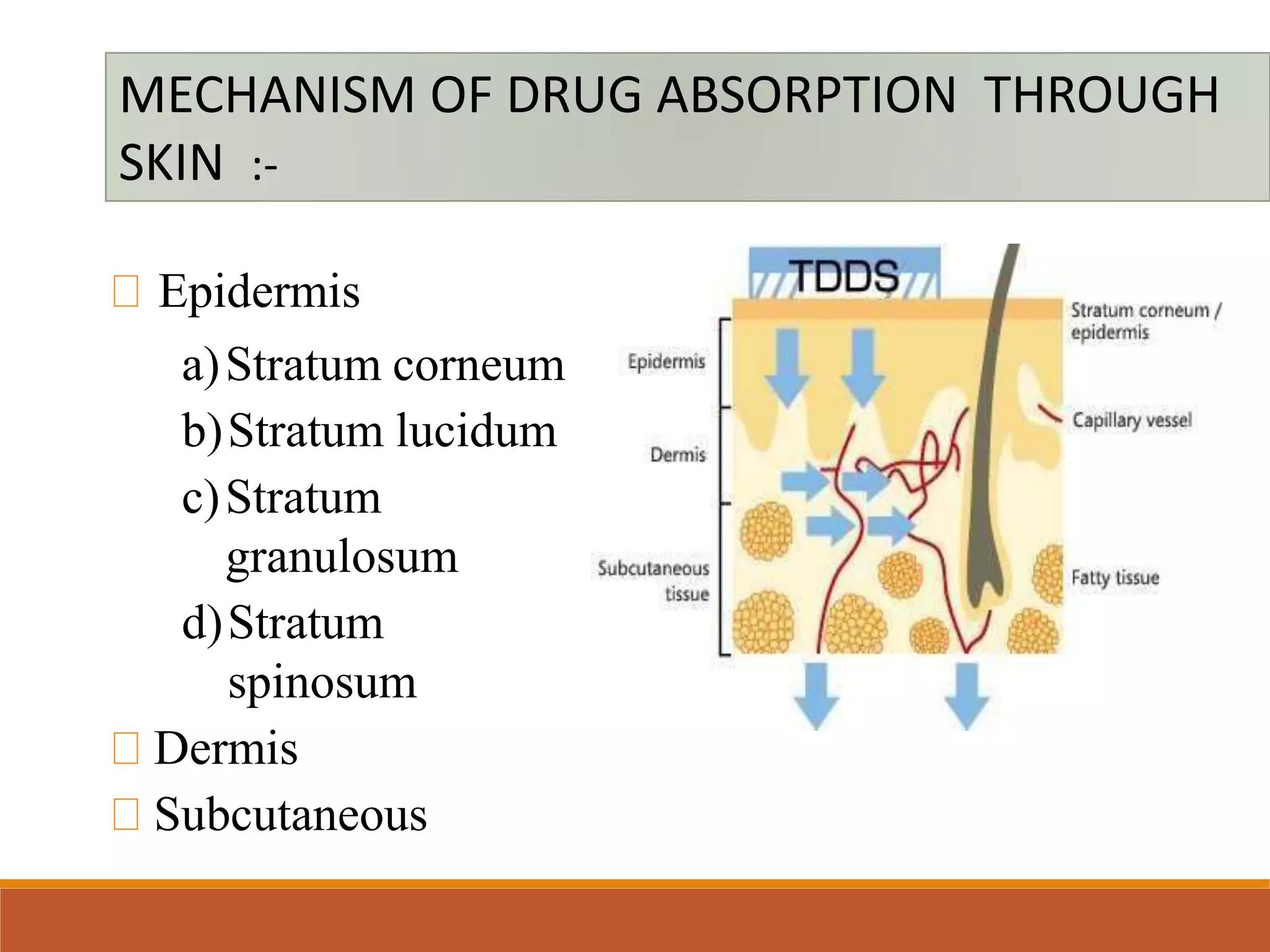
Epidermis
a)Stratum corneum
b)Stratum lucidum
c)Stratum
granulosum
d)Stratum
spinosum
Dermis
Subcutaneous
MECHANISM OF DRUG ABSORPTION THROUGH
SKIN :-
a) Transfollicular route
Transfollicular route is the shortest pathway that drug has to follow
to reach the systemic circulation that provides a large area for
diffusion of drugs.
b) Transcellular route
Drug delivering through this route passes from corneocytes which
has highly hydrated keratin creating hydrophilic pathway.
The drug passes through the corneocytes of stratum corneum.
c) Intercellular route
In intercellular pathway the drug diffuses through the
continuous lipid matrix present between the cells.
PATHWAYS OF DRUG ABSORPTION THROUGH THE
SKIN :-
The principle transport mechanism across mammalian
skin is by passive diffusion. The factors influencing and
having differences in transdermal permeability of the
stratum corneum.
 Lipid solubility:
At higher concentrations, the rate of penetration of the
alcohols is greatly increased, and does not follow the
pattern of absorption from weak solution.
But, high concentrations may damage the stratum
corneum
impairing its 'barrier' properties. Drugs possessing both
water and lipid.
FACTORS AFFECTING TRANSDERMAL PERMEABILITY :-
 Partition coefficient:-
solubility are favorably absorbed through the skin.
Transdermal permeability coefficient shows a linear
dependency on partition coefficient. A lipid/water partition
of 1 or greater is generally required for optimal transdermal
permeability.
 pH condition:
The extent of dissociation in case of ionic drugs and their
transdermal permeability depends on pH condition of the
skin surface as well as the drug delivery system. Incase of
ephedrine and scopolamine, the transdermal flux of the
drug increases with increasing pH upto 1.2 approximately
1.2 higher than their respective pKa values.
7
These are compounds which promote skin
permeability by altering the skin as a barrier to the
flux of a desired penetrant.
These may conveniently be classified below
i. Solvents eg, water, alkyl esters
ii. Surfactants eg, tween , span , SLS.
iii. Miscellaneous chemicals eg, phospholipid ,
PERMEATION ENHANCERS :-
There are four main types of
TDDS
1) Single-layer Drug-in-
Adhesive
2) Multi-layer Drug-in-
Adhesive
3) Drug Reservoir-in-
Adhesive
4) Drug Matrix-in-Adhesive
TYPES:-
The Single-layer Drug-in-Adhesive system is
characterized by the inclusion of the drug directly
within the skin-contacting adhesive.
In this transdermal system design, the adhesive not
only serves to affix the system to the skin, but also
serves as the formulation foundation, containing the
drug and all the excipients under a single backing
film.
The rate of release of drug from this type of system
is dependent on the diffusion across the skin.
1) SINGLE-LAYER DRUG-IN-ADHESIVE:-
CONTD…
The Multi-layer Drug-in-Adhesive is similar to the
Single- layer Drug-in-Adhesive in that the drug is
incorporated directly into the adhesive.
However, the multi-layer encompasses either the
addition of a membrane between two distinct drug-in-
adhesive layers or the addition of multiple drug-in-
adhesive layers under a single backing film.
2) MULTI-LAYER DRUG-IN-ADHESIVE:-
CONDT…
The Reservoir transdermal system design is
characterized by the inclusion of a liquid
compartment containing a drug solution or
suspension separated from the release liner by a
semi-permeable membrane and adhesive.
The adhesive component of the product
responsible for skin adhesion can either be
incorporated as a continuous layer between the
membrane and the release liner or in a
concentric configuration around the membrane.
3) DRUG RESERVOIR-IN-ADHESIVE:-
CONTD…
The Matrix system design is characterized by the
inclusion of a semisolid matrix containing a drug
solution or suspension which is in direct contact with
the release liner.
The component responsible for skin adhesion is
incorporated in an overlay and forms a concentric
configuration around the semisolid matrix.
DRUG MATRIX-IN-ADHESIVE:-
Structure- Based
• Microneedles
• Macroflux
• Metered-dose
Transdermal Spray
Electrically -
Based
• Iontophoresis
• Ultrasound
• Photomechanical
• Waves
• Electroporation
• Electro Osmosis
Velocity -Based
• Power Jet
• Needle Free
Injections
Others
• Transfersomes
• Medicated Tattoos
• SkinAbrasion
• Heat
• Laser Radiation
• Magnetophoresis
11
RECENT TECHNIQUES FOR ENHANCING
TRANSDERMAL DRUG DELIVERY:-
Avoidance of significant presystemic
metabolism and the need therefore a lower daily
dose.
Recent inter & intra patient variability.
Drug input can be terminated simply by removal of
patch.
Drug levels can be maintained in the systemic
circulation, with in the therapeutic window for a
prolonged period of time.
Self administration is possible.
ADVANTAGES:-
DISADVANTAGES:-
 It is limited only to potent drug molecule.
 Drugs must not be locally irritating or sensitizing.
 Drug or drug formulation may cause skin
irritation or sensitization.
 Drugs with short biological half life that are subject
to large first pass metabolism.
 Cannot develop TDDS for drug of large molecular
size
Physicochemical evaluation
 Thickness of the patch
 Weight uniformity
 Drug content determination
 Content uniformity
 Folding endurance
 Flatness
 Moisture content
 Moisture uptake
 Water vapour permeability (WVP) evaluation
 Tensile strength
 Evaluation of adhesive
a) Shear adhesion test
b) Peel adhesion test
c) Tack properties
i. Thumb tack test
ii. Rolling ball test
iii. Quick stick (Peel tack test) test
iv. Probe tack test
Physicochemical evaluation
 Thickness of the patch
 Weight uniformity
 Drug content determination
 Content uniformity
 Folding endurance
 Flatness
 Moisture content
 Moisture uptake
 Water vapour permeability (WVP) evaluation
 Tensile strength
 Evaluation of adhesive
a) Shear adhesion test
b) Peel adhesion test
c) Tack properties
i. Thumb tack test
ii. Rolling ball test
iii. Quick stick (Peel tack test) test
iv. Probe tack test
Physicochemical evaluation
 Thickness of the patch: *
 The thickness of the drug loaded patch is measured in different
points by using a digital
micrometer, dial gauge, screw gauge.
 Weight uniformity: *
The prepared patches are to be dried at 60°c for 4 hrs before
testing. Individually weighing 10 randomly selected patches a
specified area of patch is to be cut in different parts of the patch and
weigh in digital balance.
In-vitro drug release
studies
In-vitro skin
permeation studies
In – vitroevaluation
1. In vitro drug release studies:-
A number of mathematical model is describe the drug dissolution
kinetics from controlled release drug delivery system e.g., Higuchi
model, First order, Zero order and Peppas & Korsenmeyer model.
The dissolution data is fitted to these models and obtained the
release mechanism of the drug. There are various methods
available for determination of drug release rate of TDDS.
In–vitro evaluation
2. In vitro skin permeation studies:
The transdermal system is applied to the hydrophilic side
of the membrane (donor compartment) and then mounted
in the diffusion cell with lipophilic side in contact with
receptor fluid (receptor compartment, usually temprature
32±5°C for membrane ) in vertical diffusion cell such as
Franz diffusion cell or Keshary-chien (K-C) diffusion cell
and is continuously stirred at a constant rate.
The samples are withdrawn at different time intervals
and diluted appropriately then absorbance is
determined spectrophotometrically.
Then the amount of drug permeated per cm2 at each
Franz diffusion cell:
In –vivoevaluation
 Animal models:
 In-vivo animals models are preferred because
considerable time and resources are required to carry
out studies in humans. Some of the species are used :
mouse, rat, guinea pig, rabbit, rat, cat, dog, pig, house,
monkey small hairy animals (e.g. rat, rabbit) or rhesus
monkey is most reliable.
 The application site is generally the abdomen which are
the least hairy site on the animals body. The compound
is applied after light clipper showing of the site.
Transdermal drug delivery technologies are
becoming one of the fastest growing sectors within
the pharmaceutical industry.
Advance in drug delivery systems having
increasingly brought about rate controlled delivery
with fewer side effects as well as increased efficacy
and constant drug delivery.
CONCLUSION:-
Miller MA, Pisani E. The cost of unsafe injections. Bull World
Health Organisation. 1999;77: pg no:808-811.
Ramteke K.H., Dhole S.N., Patil S.V. Journal of Advanced
Scientific Research, 2012, vol:3(1), Pg no:22-35.
Richard.H.Guy, Jonathan Hardgraft.Transdermal Drug
Delivery, second edition, Revised and expanded. India Special
edition,2012,vol123,page no: 1-143,361-367.
Dipen Patel, Sunita A. Chaudhary, Bhavesh Parmar, Nikunj
Bhura, Vol. 1 No. 4, 2012 ,Pg no:78-87.
REFERENCES
THANKS…

Transdermal drug delivery system

  • 1.
    UNDERTHEGUIDENCE OF, Mrs.S.S.MUTHA M.Pharmacy Presentedby, Mr.Pravin J.Kshatriya M.Pharm 1 ST YEAR DEPARTMENT OF PHARMACEUTICS
  • 2.
    DEFINITION MECHANISM OF DRUGABSORPTION THROUGH SKIN FUNDAMENTALS OF SKIN PERMEATION FACTORSAFFECTING TRANSDERMALPERMEABILITY PERMEATION ENHANCERS TYPES DEVELOPING TECHNOLOGY ADVANTAGES DISADVANTAGES EVALUATION PARAMETERS CONCLUSION REFERENCES CONTENTS :-
  • 3.
    Transdermal therapeutic aredefined as self contained discrete dosage form which when applied to the intact skin deliver the drugs, through the skin, at a controlled rate to the systemic circulation. (or) Transdermal drug delivery system (TDDS) are systems that utilize skin as a site for continuous drug administration into the systemic circulation. DEFINITION:-
  • 4.
  • 5.
    a) Transfollicular route Transfollicularroute is the shortest pathway that drug has to follow to reach the systemic circulation that provides a large area for diffusion of drugs. b) Transcellular route Drug delivering through this route passes from corneocytes which has highly hydrated keratin creating hydrophilic pathway. The drug passes through the corneocytes of stratum corneum. c) Intercellular route In intercellular pathway the drug diffuses through the continuous lipid matrix present between the cells. PATHWAYS OF DRUG ABSORPTION THROUGH THE SKIN :-
  • 6.
    The principle transportmechanism across mammalian skin is by passive diffusion. The factors influencing and having differences in transdermal permeability of the stratum corneum.  Lipid solubility: At higher concentrations, the rate of penetration of the alcohols is greatly increased, and does not follow the pattern of absorption from weak solution. But, high concentrations may damage the stratum corneum impairing its 'barrier' properties. Drugs possessing both water and lipid. FACTORS AFFECTING TRANSDERMAL PERMEABILITY :-
  • 7.
     Partition coefficient:- solubilityare favorably absorbed through the skin. Transdermal permeability coefficient shows a linear dependency on partition coefficient. A lipid/water partition of 1 or greater is generally required for optimal transdermal permeability.  pH condition: The extent of dissociation in case of ionic drugs and their transdermal permeability depends on pH condition of the skin surface as well as the drug delivery system. Incase of ephedrine and scopolamine, the transdermal flux of the drug increases with increasing pH upto 1.2 approximately 1.2 higher than their respective pKa values. 7
  • 8.
    These are compoundswhich promote skin permeability by altering the skin as a barrier to the flux of a desired penetrant. These may conveniently be classified below i. Solvents eg, water, alkyl esters ii. Surfactants eg, tween , span , SLS. iii. Miscellaneous chemicals eg, phospholipid , PERMEATION ENHANCERS :-
  • 9.
    There are fourmain types of TDDS 1) Single-layer Drug-in- Adhesive 2) Multi-layer Drug-in- Adhesive 3) Drug Reservoir-in- Adhesive 4) Drug Matrix-in-Adhesive TYPES:-
  • 10.
    The Single-layer Drug-in-Adhesivesystem is characterized by the inclusion of the drug directly within the skin-contacting adhesive. In this transdermal system design, the adhesive not only serves to affix the system to the skin, but also serves as the formulation foundation, containing the drug and all the excipients under a single backing film. The rate of release of drug from this type of system is dependent on the diffusion across the skin. 1) SINGLE-LAYER DRUG-IN-ADHESIVE:-
  • 11.
  • 12.
    The Multi-layer Drug-in-Adhesiveis similar to the Single- layer Drug-in-Adhesive in that the drug is incorporated directly into the adhesive. However, the multi-layer encompasses either the addition of a membrane between two distinct drug-in- adhesive layers or the addition of multiple drug-in- adhesive layers under a single backing film. 2) MULTI-LAYER DRUG-IN-ADHESIVE:-
  • 13.
  • 14.
    The Reservoir transdermalsystem design is characterized by the inclusion of a liquid compartment containing a drug solution or suspension separated from the release liner by a semi-permeable membrane and adhesive. The adhesive component of the product responsible for skin adhesion can either be incorporated as a continuous layer between the membrane and the release liner or in a concentric configuration around the membrane. 3) DRUG RESERVOIR-IN-ADHESIVE:-
  • 15.
  • 16.
    The Matrix systemdesign is characterized by the inclusion of a semisolid matrix containing a drug solution or suspension which is in direct contact with the release liner. The component responsible for skin adhesion is incorporated in an overlay and forms a concentric configuration around the semisolid matrix. DRUG MATRIX-IN-ADHESIVE:-
  • 17.
    Structure- Based • Microneedles •Macroflux • Metered-dose Transdermal Spray Electrically - Based • Iontophoresis • Ultrasound • Photomechanical • Waves • Electroporation • Electro Osmosis Velocity -Based • Power Jet • Needle Free Injections Others • Transfersomes • Medicated Tattoos • SkinAbrasion • Heat • Laser Radiation • Magnetophoresis 11 RECENT TECHNIQUES FOR ENHANCING TRANSDERMAL DRUG DELIVERY:-
  • 18.
    Avoidance of significantpresystemic metabolism and the need therefore a lower daily dose. Recent inter & intra patient variability. Drug input can be terminated simply by removal of patch. Drug levels can be maintained in the systemic circulation, with in the therapeutic window for a prolonged period of time. Self administration is possible. ADVANTAGES:-
  • 19.
    DISADVANTAGES:-  It islimited only to potent drug molecule.  Drugs must not be locally irritating or sensitizing.  Drug or drug formulation may cause skin irritation or sensitization.  Drugs with short biological half life that are subject to large first pass metabolism.  Cannot develop TDDS for drug of large molecular size
  • 21.
    Physicochemical evaluation  Thicknessof the patch  Weight uniformity  Drug content determination  Content uniformity  Folding endurance  Flatness  Moisture content  Moisture uptake  Water vapour permeability (WVP) evaluation  Tensile strength  Evaluation of adhesive a) Shear adhesion test b) Peel adhesion test c) Tack properties i. Thumb tack test ii. Rolling ball test iii. Quick stick (Peel tack test) test iv. Probe tack test
  • 22.
    Physicochemical evaluation  Thicknessof the patch  Weight uniformity  Drug content determination  Content uniformity  Folding endurance  Flatness  Moisture content  Moisture uptake  Water vapour permeability (WVP) evaluation  Tensile strength  Evaluation of adhesive a) Shear adhesion test b) Peel adhesion test c) Tack properties i. Thumb tack test ii. Rolling ball test iii. Quick stick (Peel tack test) test iv. Probe tack test
  • 23.
    Physicochemical evaluation  Thicknessof the patch: *  The thickness of the drug loaded patch is measured in different points by using a digital micrometer, dial gauge, screw gauge.  Weight uniformity: * The prepared patches are to be dried at 60°c for 4 hrs before testing. Individually weighing 10 randomly selected patches a specified area of patch is to be cut in different parts of the patch and weigh in digital balance.
  • 24.
    In-vitro drug release studies In-vitroskin permeation studies In – vitroevaluation
  • 25.
    1. In vitrodrug release studies:- A number of mathematical model is describe the drug dissolution kinetics from controlled release drug delivery system e.g., Higuchi model, First order, Zero order and Peppas & Korsenmeyer model. The dissolution data is fitted to these models and obtained the release mechanism of the drug. There are various methods available for determination of drug release rate of TDDS. In–vitro evaluation
  • 26.
    2. In vitroskin permeation studies: The transdermal system is applied to the hydrophilic side of the membrane (donor compartment) and then mounted in the diffusion cell with lipophilic side in contact with receptor fluid (receptor compartment, usually temprature 32±5°C for membrane ) in vertical diffusion cell such as Franz diffusion cell or Keshary-chien (K-C) diffusion cell and is continuously stirred at a constant rate. The samples are withdrawn at different time intervals and diluted appropriately then absorbance is determined spectrophotometrically. Then the amount of drug permeated per cm2 at each
  • 27.
  • 28.
    In –vivoevaluation  Animalmodels:  In-vivo animals models are preferred because considerable time and resources are required to carry out studies in humans. Some of the species are used : mouse, rat, guinea pig, rabbit, rat, cat, dog, pig, house, monkey small hairy animals (e.g. rat, rabbit) or rhesus monkey is most reliable.  The application site is generally the abdomen which are the least hairy site on the animals body. The compound is applied after light clipper showing of the site.
  • 29.
    Transdermal drug deliverytechnologies are becoming one of the fastest growing sectors within the pharmaceutical industry. Advance in drug delivery systems having increasingly brought about rate controlled delivery with fewer side effects as well as increased efficacy and constant drug delivery. CONCLUSION:-
  • 30.
    Miller MA, PisaniE. The cost of unsafe injections. Bull World Health Organisation. 1999;77: pg no:808-811. Ramteke K.H., Dhole S.N., Patil S.V. Journal of Advanced Scientific Research, 2012, vol:3(1), Pg no:22-35. Richard.H.Guy, Jonathan Hardgraft.Transdermal Drug Delivery, second edition, Revised and expanded. India Special edition,2012,vol123,page no: 1-143,361-367. Dipen Patel, Sunita A. Chaudhary, Bhavesh Parmar, Nikunj Bhura, Vol. 1 No. 4, 2012 ,Pg no:78-87. REFERENCES
  • 31.