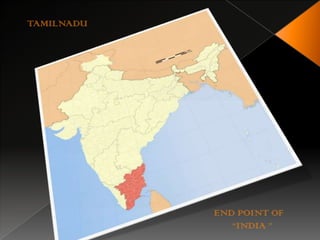
TAMILNADUEND POINT OF        “INDIA ”
TAMILNADU PROFILEJimi  GandhiSem:- 02 The embrace of ancient Dravidian culture, Tamil Nadu is the southern-most state of India. It is a beautiful state nestled in the southern Indian peninsula, on the shores of the Bay of Bengal and the deep blue Indian Ocean. The state extends from the Coromandel Coast in the east to the forested Western Ghats in the west.
 The state lies at the southern tip of India, surrounded by Pondicherry, Kerala, Andhra Pradesh and Karnataka. It is the second most industrialized state in the country after Gujarat.
 The arrogance of the state is the language Tamil itself. Scholars recognize Tamil to be one of India's two languages of antiquity. The cultural ambiance of the state has given it a separate position on the cultural map of the country.
 This land has a vibrant culture, a rich tapestry of history, a nature's Paradise of extended beaches, clear skies and many more to rediscover…Feel and touch this spectacular land with passion. HISTORYJimi  GandhiSem:- 02 Tamil Nadu has a glorious history and great civilization that flourished in the region during the Sangam Age with developments in the fields like art, literature and occultism. The subsequent periods were associated with Pallava, Pandya, Chola, Vijayanagara and then came the British.
 The British established their first trade centre in the Madras State at Peddapali (now Nizampatnam) in 1611 and then at Masulipatnam. In 1639, they were permitted to make more settlements in the region and as an outcome the Fort St. George was founded (present Chennai). By 1801, the whole of the territory from the northern Circars to Cape Comorin (with the exception of certain French and Danish settlements) were controlled by the British.
 After India got her independence in 1947, Madras Presidency became Madras State, comprising of present day Tamil Nadu, coastal Andhra Pradesh, northern Kerala, and the southwest coast of Karnataka. The state was later divided on the basis of linguistic lines. Under the States Reorganization Act, 1956, Madras State lost its western coastal districts. The Bellary and South Kanara districts were given to Mysore state, and Kerala was formed from the Malabar district, the former princely states of Travancore and Cochin. Finally, in 1968, when the Central Government imposed Hindi as the national language, the state of Madras was renamed as Tamil Nadu.  MILESTONESJimi  GandhiSem:- 02Pre-Historic Period30,000 BC        : Paleolithic industries in north Tamil Nadu.8000-3000 BC : Pre-pottery microlithic industries.3000-1000 BC : Neolithic and fine microlithic industries.
Pre-Sangam Period1000-300 BC  : Megalithic age.600 BC           : Tamil Brahmi prevalent as the Tamil script.250 BC           : Asoka's inscription recording the four kingdoms (Chera,   		           Cholas, Pandya and  Satyaputra) of the ancient Tamil  		           country.200 BC           : Elara, a Tamil prince and contemporary of Dutte Gamini, rules 	             	            Lanka. MILESTONES  Continue….Jimi  GandhiSem:- 02British Rule1892 -  British Government passes the Indian Councils Act.1909 -  'Minto-Morley Reforms'. Madras Legistlative Council formed.1921 -  First regional elections held in Madras. Justice party forms government.1927 -  Madras Congress passes a resolution for 'Full Independence'.1928 -  Simon Commission visits Madras. mass protests results in several deaths.1937 -  Congress party under C. Rajagopalachari wins provincial elections and forms            government in Madras.1938 -  E.V. Ramasamy Naicker organises a separatist agitation demanding Dravidanadu            consisting of Tamil Nadu, Karnataka, Andhra Pradesh and Kerala.1941 -  Indian Muslim League holds its congress in Madras. Muhammad Ali Jinnah delivers            keynote speech.1944 -  E.V. Ramasamy Naicker and C. N. Annadurai organises Dravidar Kazhagam.MILESTONES  Continue….Jimi  GandhiSem:- 02Post-independence Period1947 -  Madras Presidency, comprising of Tamil Nadu and parts of                    	Andhra Pradesh and Karnataka established.1953 -  Madras state comes into being along linguistic lines.1968 -  Widespread agitations in response to the Federal 	Government's 	directive of Hindi being the National Language.1969 - Madras state is renamed as Tamil Nadu (Land of the Tamils).GEOGRAPHYJimi  GandhiSem:- 02Tamil Nadu is located in the southernmost tip of the Indian Peninsula bordered by Kerala to the west, Karnataka to the northwest, Andhra Pradesh to the north and Bay of Bengal to the east. The total area covered by the state is 130058 sq. kms of which 22933.79 sq. kms is under forests..
The state has been divided into 5 major physiographic divisions - the Kurinji or mountainous region, the Mullai or forest region, the Palai or arid region, the Marudham or the fertile plains and the Neidhal or coastal region. The Eastern and Western Ghats meet in this state and run along it’s eastern and western boarders
The hills of the Western Ghats have dense forests as compared to Eastern Ghats. This region receives maximum rainfall and hence favours plantations of tea, coffee and spices. However, the upper reaches of the Eastern Ghats are not without their share of beauty and Yercaud in the Shevaroy hills is famous for its fruit orchards and banana and coffee plantations. The most arid and desert like-area is in the Tirunelveli district and is known as Palai.CLIMATEJimi  GandhiSem:- 02 The state of Tamil Nadu is located in the southeastern part of Indian peninsula between 8° 5' and 13° 35' North latitude and 76° 15' and 80° 20' East longitude. Hence the climate is tropical with little variation in temperatures during winter and summer. Summer season is felt between April and June when temperature reaches*40°C  40°C.
 November – February are the months when Tamil Nadu experiences winter but temperature doesn't drop below 20 °C. But though these months are pleasant, Tamilnadu's Climate has another distinct feature that is it experiences winter rainfall, between the time period of October-December .Heavy rainfall accompanied by thunder and lightning occurs during this time. The best season to visit the state is between October and March. CONNECTIVITY Jimi  GandhiSem:- 02Tamil Nadu is well connected by air, rail and road. The major cities like Chennai, Coimbatore, Tiruchi and Madurai are connected to other parts of the country.By Air :The Anna International Airport in Chennai is located 16 kms away from the centre . Regular and weekly flights are available to/from Sri Lanka, Maldives, Singapore, Saudi Arabia, Dubai, Jakarta England and Germany. Major cities of the country are also connected by domestic flights.By Rail :Chennai, the capital city of Tamil Nadu is well connected by network of rails. Chennai has two railway stations, one is Egmore station and the other is Chennai Central. Express and super fast trains are available to/from important parts of the country.By Road :The bus terminals in Chennai are on either side of Prakasham Road in George Town near the High Court building. There are regular buses available from Chennai to neighboring states. Ferry service is also available in Chennai. NATURAL RESOURCES Jimi  GandhiSem:- 02Forests : 
Tamil Nadu has a wealth of flora and fauna and some of its major wildlife sanctuaries like Mudumalai and Anaimalai (Indira Gandhi W.S) are situated in the hills of the Western Ghats which is the habitat of elephants, tigers, bisons and a variety of monkey and deer.
Of the 3000 and more plant species found in Tamil Nadu, a majority are found in the mixed deciduous forests of this region. One of the most noteworthy flowers is the Kurinji of Kodaikanal which blooms once in 12 years. Cinchona from which quinine - a drug for treating malaria - is extracted and eucalyptus grow abundantly in the Nilgiris.
Forests of medicinal herbs are found in Palani hills and Courtallam. Palmyrah trees grow by the thousands in Tirunelveli and its products are used as raw materials for several cottage industries. Rubber is the main plantation crop in Kanyakumari and the more exotic sandalwood grows, though not in very large numbers, in the Javadhu hills of Vellore district.
The forest areas of Tiruvannamalai and Tirunelveli districts of the state are being regenerated and protected by the state forest Department. These forests not only provide large economy to the state but also the local livelihood.Jimi  GandhiSem:- 02Rivers : 
Tamil Nadu is blessed with a number of rivers of which Cauveri is the most important. This perennial river of the state originates in Coorg in the neighboring Karnataka state. The fertile Coromandel plains are irrigated by the Kaveri and its delta in Thanjavur - Nagapattinam region is known as the granary of Tamil Nadu. The other rivers in the state are the Palar, Pennar, Vaigai and Tamiraparani.
Mineral Deposits :  The state is rich in mineral resources. The major mineral resources include Lignite, Vermiculite, Garnet, Zircon, Graphite, Ilmenite, Rutile, Monazite and Magnesite etc. Jimi  GandhiSem:- 02FACTS AND FIGURES………..
GOVERNMENT  BODYJimi  GandhiSem:- 02Government & AdministrationTamil Nadu’s legislature was bicameral till 1986 but later on it was replaced by a unicameral legislature with 234 members in the legislative assembly. Like all other states of India, the head of the state is the Governor, appointed by the President of India. His or her post is largely ceremonial. The Chief Minister is the head of government and is vested with most of the executive powers.Tamil Nadu has 39 seats in the Lok Sabha, the lower house of Parliament. The major administrative units in the state include 30 districts, 7 municipal corporations, 152 municipalities, 561 town panchayats and 12,618 village panchayats. Tamil Nadu is a prosperous state performing stable governance over decades. With the advancement of computer and information technology, the state has initiated e-Governance in the sectors like legislature, judiciary, or administration for improving internal efficiency in public services.Chief Ministers of Tamil Nadu since 19201.	Thiru A Subbarayalu                		17-12-1920 to 11-07-19212. 	Thiru Panagal Raja                     		11-07-1921 to 03-12-19263. 	Dr. P Subbarayan			04-12-1926 to 27-10-19304. 	Thiru P Munuswamy Naidu		27-10-1930 to 04-11-19325. 	Thiru Ramakrishna Ranga Rao,Raja of Bobbili	05-11-1932 to 04-04-19366. 	Thiru P T Rajan			04-04-1936 to 24-08-19367. 	Thiru Ramakrishna Ranga Rao,Raja of Bobbili	24-08-1936 to 01-04-19378.	Thiru Kurma Venkata Reddy Naidu		01-04-1937 to 14-07-19379. 	Thiru C Rajagopalachari			14-07-1937 to 29-10-193910. 	Thiru Tanguturi Prakasam			30-04-1946 to 23-03-194711. 	Thiru O P Ramaswamy Reddiyar		23-03-1947  to 06-04-194912. 	Thiru P S  Kumaraswamy Raja		06-04-1949  to 09-04-195213. 	Thiru C  Rajagopalachari			10-04-1952  to 13-04-195414. 	Thiru K Kamaraj			13-04-1954  to 02-10-196315. 	Thiru M Bakthavatsalam			02-10-1963  to 06-03-196716. 	Dr. C.N. Annadurai			06-03-1967  to 03-02-196917. 	Dr. Kalaignar M Karunanidhi  		10-02-1969 to  04-01-1971,    15-03-1971 to  31-01-197618. 	Dr. M G Ramachandran			30-06-1977 to 17-02-1980,      09-06-1980 to 15-11-1984,					10-02-1985 to 24-12-198719. 	Thirumathi Janaki Ramachandran		07-01-1988 to  30-01-198820. 	Dr. Kalaignar M Karunanidhi		27-01-1989 to 30-01-199121. 	Dr. Selvi J Jayalalithaa			24-06-1991 to 12-05-199622. 	Dr. Kalaignar M Karunanidhi		13-05-1996 to  13-05-200123. 	Dr. Selvi J Jayalalithaa			14-05-2001 to  21-09-200124. 	Thiru O. Panneerselvam			21-09-2001 to  01-03-200225. 	Dr. Selvi J Jayalalithaa 			02-03-2002 to  12-05-200626. 	Dr. Kalaignar M. Karunanidhi		13-05-2006 onwardsJimi  GandhiSem:- 02
Jimi  GandhiSem:- 02Present Govt. & AdministrationGovernor -His Excellency Thiru Surjit Singh BarnalaChief Minister                        - Dr. Kalaignar M KarunanidhiChief Justice, High Court of Madras           - 	Thiru Ajit Prakash ShahChief Secretary to Govt.      -Thiru L K Tripathy IAS				Secretariat, Chennai - 600 009Phone : 25671555 (O), 24794585 (R)Fax : 25672304E-Mail : cs@tn.gov.in
POLITICAL OVERVIEW  Jimi  GandhiSem:- 02 Tamil Nadu had taken active participation in the pre-independencepolitics of the nation. The budding desire for independence had generated numerous volunteers in the state who sacrificed their lives in the service of the nation. Several political leaders of the statefought against the British and French colonial power, notable among them are Tiruppur Kumaran, Aurobindo Ghosh (Pondicherry) and poet Subramanya Bharathi. Finally India got her freedom in 1947 and Tamil Nadu got the separate status of a state in the Indian Union.
The political scenario of Tamil Nadu was dominated by the Congress Party after 1947 which gave way to the Dravidian populist mobilization in the 1960s. Since 1967, the regional political parties took active participation in the state politics. The state has been under the control of either Dravida Munnetra Kazhagam (DMK) or All India Anna Dravida Munnetra Kazhagam (AIADMK). Mr. M. Karunanidhi is the party leader of DMK "since 1967" and the oldest politician in the country whose history begins right before from the country's independencePOLITICAL  OVERVIEW  Continue….Jimi  GandhiSem:- 02 M. G. Ramachandran, popularly known as MGR, "became the   Chief Minister of the state in 1977" and remained in the power until his death. After his death then the party was taken over by Ms. J. Jayalalitha
 This is a general overview of the political scenario of the state and how Tamil Nadu is marching towards a developed and prosperous state in the nation offering stable and well administration to the public.LIST OF LOK SABHA CONSTITUENCIES…… Jimi  GandhiSem:- 02
Jimi  GandhiSem:- 02ECONOMY  AND  INDUSTRYEconomy : At a GlanceTamil Nadu is one of the most industrialized states in the country; at present it is the fifth largest economy in India. The State Domestic Product at current prices is about US$ 36.78 billion and current exports are around US$ 5.5 billion. There has been visible change in the overall economic and industrial climate in the state. The state’s economy largely depends on industries and agriculture. The shares of economic activity in the state are given below.Economic ActivityManufacturing - 34% Services - 45% Agriculture - 21%
Jimi  GandhiSem:- 02Investor ProfileGovt. - 55.1% Foreign - 14.9% Indian - 29.9%Investment StrengthsBusiness-savvy state government; responsive local administration; good railways, ports and telecom network; adequate road connectivity; availability of low cost labour through out the state.State Priority AreasElectronics, software, auto components, pharmaceuticals, leather
Jimi  GandhiSem:- 02Industry : An OverviewTamil Nadu is one of the most industrialized states of the country owing to its geographical position and resources. The state boasts many heavy engineering and vehicle manufacturing companies like Ford, Caterpillar, Hyundai, BMW and Mitsubishi, MRF, TI cycles of India, Ashok Leyland, Royal Enfield, Mahindra & Mahindra, TAFE Tractors and TVS etc. These heavy vehicle and engineering industries are located in and around Chennai city. The state is also known for its textile industries. A large number of textile mills and engineering industries are present around Coimbatore City. The textile industry adds huge revenue to the country’s economy by providing direct employment to an estimated 35 million people, and thereby contributing 4% of GDP and 35% of Gross Export Earnings. Tirupur (Coimbatoredistrict) is the largest exporter of garments in the country and hence called as the “Textile valley of India”.
Jimi  GandhiSem:- 02Tamil Nadu also leads the country in manufacturing as well as supplying electrical and electronic goods and equipments. Companies like Nokia, Flextronics, Motorola, Foxconn, Samsung, Cisco and Dell have their bases in Chennai owing to its transport facilities and human resources. These companies manufacture circuit boards and cellular phone handsets. One of the global electrical equipmentmanufacturing public sector company BHEL has manufacturing unit at Tiruchirapalli and Ranipet.Tamil Nadu has significant amount of mineral deposits such as Lignite (87% contribution to the national share), Vermiculite (66%), Garnet (42%), Zircon (38%), Graphite (33%), Ilmenite (28%), Rutile (27%), Monazite (25%), Magnesite (17%). India's leading steel producer SAIL has asteel plant in Salem, Tamil Nadu. Hence Tamil Nadu has several mineral based industries in various parts of the state. Jimi  GandhiSem:- 02Tamil Nadu is a leading contributor in the IT and BPO sector. Chennai is the second leading software exporter in India, after Bangalore. India's largest IT Park is housed at Chennai. Software exports from Companies such as HCL, Wipro, TCS, Satyam, Infosys, Cognizant Technology Solutions, Acme Technology Pvt Ltd, Covansys, Ford Information Technology, Xansa, Verizon, iSoft, iNautix, Electronic Data Systems, Bally and many others have offices in Chennai. Infosys Technologies has set up India's largest software development centre to house 25,000 software professionals at an estimated investment of Rs.12, 500 million ($270 million) in Chennai. India's largest IT park is housed at Chennai, jointly made by Ascendas India Ltd, a Singapore-based company engaged in providing business space solutions, and Tamil Nadu Industrial Development Corporation (TIDCO). INDUSTRIAL POLICYJimi  GandhiSem:- 02ObjectivesThe Government of Tamil Nadu has a liberal industrial policy. Coinciding with the new economic and industrial policy of the Government of India, the state Government too has come up with its own policy, which outlines its main objectives and the strategies to achieve them. A New National Industrial Policy and a New Trade Policy have been announced. It is necessary to take advantage of the new spirit introduced and to create a congenial atmosphere for stimulating the rapid growth of the State's economy. A new industrial policy for Tamil Nadu is the logical outcome of these newly emerging economic factors.Indian Industry grew by an annual average of 8.5 percent in the Seventh Plan period. In Tamil Nadu this growth rate was 5.7 percent. The share of the secondary sector in State Domestic Product in Tamil Nadu in the Eighties had remained static at 33 per cent, similar was the case with the per capita income which remained static at the national average. Unemployment had risen over the years and the number of educated unemployed on the live rolls of the Employment Exchanges had increased from 5.58 lakhs in 1980 to 18.01 lakhs in 1991. Jimi  GandhiSem:- 02Central investment in Tamil Nadu had declined from 10 per cent in 1969 to 5.21 percent in 1990-9. The lack of new mother industries has been a cause of serious concern.The full utilization of surface irrigation potential and the rapid exploitation of ground water resources have imposed constraints on accelerated development of agricultural production.Against this background, Tamil Nadu has to provide for rapid industrial development. The Government of Tamil Nadu stands committed to ensuring that Tamil Nadu forges ahead among the industrialized States in India.
Jimi  GandhiSem:- 02Tamil Nadu has the following advantages for rapid industrial growth A highly trained labour force with a good record of industrial    relations.
 A huge pool of managerial talent.
 A strong and well diversified manufacturing base.
 A good functioning infrastructure including a well developed road transportation network.
 An extensive rail network.
 Efficient ports at Madras and Tuticorin.
 Well developed social infrastructure.
 Vast deposits of lignite which can act as the prime catalyst for new growth.
 A comfortable energy situation and a forecast of continued availability of reliable power supply.
 Peaceful living conditions in a harmonious society.
 A substantial export base.Jimi  GandhiSem:- 02Major IndustriesThe important sectors of industries in which Tamil Nadu has traditional strength are as below :Established IndustriesEmerging IndustriesMineral based industriesElectronicsEngineeringSoftwareLeatherConsumer durablesPharmaceuticalsBiotech ProductsCotton textiles & HosieryFood ProcessingReady-made garment industriesRubber and plastic productsWood ProductsTourismAgrobased industriesHotelsChemical based industriesFinancial Services
Jimi  GandhiSem:- 02Thrust Areas for further industrial GrowthLeatherTextiles and HosieriesElectronics and softwareAuto componentsDrugs and PharmaceuticalsPetro chemicals including downstream projects in Manali and ThanjavurIndustrial Alcohol based Organic ChemicalsAgro based industries and food processing industriesSalt and marine based industriesGems and JewelleryEngineering goodsSea FoodExport Oriented Units
AGRICULTURE Jimi  GandhiSem:- 02Tamil Nadu is the second biggest producer of rice and is the home land of Dr. M.S. Swami Nathan, known as the "Father of the Green Revolution" in India. The state is historically known for it’s agriculture from ancient times.The major food crops grown in the state include rice, jowar, ragi, bajra, maize and pulses. Cotton, sugarcane, coconut, tea and coffee are also grown and considered as cash crops. Some farmer produce horticultural products like bananas and mangoes.Paddy is grown in large excess because rice is the main staple food of the state. There are three crops based on duration. The first one is the ‘Kuruvali’ (the short term crop) with duration of three and a half to four months from June to July to Oct - Nov. The second crop is called the ‘Thaladi’ that grown in 5 to 6 months Oct - Nov to Feb - March. Third is 'Samba'and has a duration of almost 6 months from Aug to January. The major source of irrigation is the rivers, tanks and wells. CULTURAL SPIRIT Jimi  GandhiSem:- 02Tamil Nadu finds a prime position on the cultural map of the country. The state’s contribution to literature, music, arts of Indian classical culture is praiseworthy. Dance, music, art and crafts and celebration of various festivals form important parts of Tamil culture. The various fairs and festivals are celebrated with great enthusiasm. Tamil people have their own living style which is reflected in their food, costumes, language and folk art and culture. Let’s find more about the cultural heritages of the state.LITRETUREJimi  GandhiSem:- 02Tamil literature has a rich and long literarytradition that is more than 2000 years old. The documents recovered from various places, have revealed the existence of this language even before this period. The main contribution has been made by Tamil people from Tamil Nadu but the name of some European authors can not be neglected while describing the development of Tamil literary history. Tamil literature saw a significant progress during late nineteenth century when works of religious and philosophical nature were written in a style that made it easier for the common people to enjoy. The contemporary Tamil literature is very rich with the development of prose, poetry, short stories and novels. The popularity of Tamil Cinema has also provided opportunities for modern Tamil poets to emerge. FAIR  AND  FESTIVALJimi  GandhiSem:- 02PongalIn Tamil Nadu Makar Sankranti becomes Pongal. It is a celebration of the harvest, which is observed for three days in January. Bhogi Pongal, Surya Pongal and Mattu Pongal, are the three days of Pongal festivities on successive days. In certain parts cattle races still enliventhe village festivities. Pongal is a colourful and traditional festival with many a ceremony devoted to various deities.
ChithiraiThis is celebrated in the month of April as Tamil New Year. The festival starts in the month ofApril-May and ends on the tenth day. It is celebrated with great enthusiasm at Meenakshi temple, Madurai (500 kms from Chennai). The festival witnesses the marriage of Meenakshi (Parvati) and Sundareshwara (Lord Shiva) that attracts large crowds from all over the state and also from the whole country FAIR  AND FESTIVAL S Continue….Jimi  GandhiSem:- 02Adi PerukkuThis is a unique festival that is celebrated all over the state by offering sweets and different kinds of rice preparations to different rivers to mark the onset of the monsoon.
Navaratri GolluThe festival of Navratri Gollu in Tamil Nadu lasts for nine nights. According to the Hindu calendar Navratri celebration begins from the first day of the bright fortnight of Ashwin. This festival is fully dedicated to Goddess Durga and her nine forms. These nine days are celebrated in all over the state with an ardent zeal and enthusiasm. FAIR  AND FESTIVAL S Continue….Jimi  GandhiSem:- 02KarthigaiIn the month of Nov/Dec people decorate their homes with lights to celebrate the birth of Murugan, son of Lord Shiva. This festival is particularly celebrated in Thiruvannamalai, one of the pancha bootha kshetras and also an Agni (fire) Kheshtra. On Karthigai Deepam day, a huge vessel is filled with oil and gigantic wicks are lit on top of the hill.Apart from these regional festivals the state also celebrates all important national festivals like Diwali, Holi, Christmas, Eid, Muhharam etc.DANCE AND MUSICJimi  GandhiSem:- 02Tamil Nadu has three modes of entertainment viz. Iyal (Literature), Isai (Music) and Nadagam (Drama) had their roots in the rural folk theatre like Therukoothu. Several forms of individual and group dances exist in the state from ancient time. These dances have classical and sheer entertainment value. The celebrated forms of village classical dances include Karagaattam, Kummi, Mayil Attam, Kolaattam, Oyil Kummi, Kavadi Aattam, Poikkal Kudirai Aattam, Kai Silambu Attam, Kazhai Kothu, Bagavatha Nadanam, Devaraattam, and Snake Dance etc.Music in Tamil Nadu can be broadly classified into three categories Contemporary/ Modern Songs
Folk Songs
Carnatic MusicThe first category refers to filmy songs or the sound tracks which are extracted from movies or albums. These music forms are based on modern track and lyric. All Tamil people are fond of films, also their songs.
DANCE AND MUSIC  Continue….Jimi  GandhiSem:- 02The second is the folk songs which is a reflection of the rich tradition of Tamil Nadu. Tamil folk music has a special attraction owing to its vivacious presentation. Most of the folk music andsongs are associated with the rural milieu. Folk music remains a major source of inspiration for the more popular film music. Popular contemporary folk-musicologists like Vijayalakshmi Navaneethakrishnan and Pushpavanam Kuppuswamy are reviving this traditional music to their best form.
Carnatic music referred to as “classical music” in South India. This traditional music form includes Hindu devotional songs which are enjoyed by people of all ages and sections of the society. One of the greatest composers of South IndianCarnatic music was Thyagaraja, who is regarded by many as a saint. Muthuswami Deekshithar and Shyama Sastri are other two composers who constitute the three pillars of Carnatic musicin Tamil Nadu. The popular classical dance amongst Tamils is Bharat Natyam. The dance is performed individually or in group on a stage with orchestra and song.ART AND CRAFTJimi  GandhiSem:- 02PaintingTanjore is famous for its paintings made on different objects. Artisansuse wood, glass, mica, ivory and walls to paint using attractive colours. Jewels, drapery and architectural elements like finely executed pillars, rich canopies, garlands of ropes and chandeliers are slightly raised by the use of special plaster, covered with pure gold leaf and embedded with semi-precious stone of different colors. Painting on ivory, mica, and the more difficult genre of glass paintings, were all introduced in the 18th century. Religious paintings are highly decorative and flat while paintings of portraits are conventionalized with an element of reality. Thanks to the artists for their lively and beautiful creation.ART AND  CRAFT  Continue….Metal-wareIn India, Brass and Copper are used for making various usable objects since ancient time. Tamil Nadu is no exception to this. It has a richtradition of making metal objects which are used for both religious and secular purposes. A wide variety of objects include standing lamps, aarathi (votive lamps), deepalakshmis, hand lamps and chain lamps. Shallow dishes in circular, hexagonal, octagonal and oval shapes are widely used in Tamil Nadu and are made out of bronze or sheet brass. The popular Thanjavur plates are characterized by designs of deities, birds, flowers, and geometric patterns beaten out from the back of copper and silver sheets and subsequently encrusted on a brass tray, kudam or panchpaathra. Metal toys are also popular and are sold at various gift outlets in various towns and cities of the state.WoodworksTamil Nadu is famous for its artistically created baskets and fiber products which are of great demand both in India and abroad. While palm has become a major source of raw material for basketry and related products, bamboo, cane, grasses, reeds and fibres are also used in making baskets, ropes, mats and many other items. The places famous for these arts are Dharampuri, Salem, Coimbatore, South Arcot and Tiruchirapalli districts.Jimi  GandhiSem:- 02
AET AND CRAFT  Continue….Jimi  GandhiSem:- 02Stone CarvingStone carving is a popular form of art continued to exist over centuries. The craftsmen apply their creativity in making sculptors of various forms and structures. Granite and marble carving are confined to the areas around Mamallapuram and Chingleput. The famous sculptors here belong to the Vishwakarma or Kammaalar community. A subsidiary form of carving is soapstone or maakal carving, found in the region between Pondicherry and Cuddalore and around Salem. These sculptors are sold at high prices in national and international markets.

Tamilnadu profile

  • 1.
  • 2.
    TAMILNADU PROFILEJimi GandhiSem:- 02 The embrace of ancient Dravidian culture, Tamil Nadu is the southern-most state of India. It is a beautiful state nestled in the southern Indian peninsula, on the shores of the Bay of Bengal and the deep blue Indian Ocean. The state extends from the Coromandel Coast in the east to the forested Western Ghats in the west.
  • 3.
    The statelies at the southern tip of India, surrounded by Pondicherry, Kerala, Andhra Pradesh and Karnataka. It is the second most industrialized state in the country after Gujarat.
  • 4.
    The arroganceof the state is the language Tamil itself. Scholars recognize Tamil to be one of India's two languages of antiquity. The cultural ambiance of the state has given it a separate position on the cultural map of the country.
  • 5.
    This landhas a vibrant culture, a rich tapestry of history, a nature's Paradise of extended beaches, clear skies and many more to rediscover…Feel and touch this spectacular land with passion. HISTORYJimi GandhiSem:- 02 Tamil Nadu has a glorious history and great civilization that flourished in the region during the Sangam Age with developments in the fields like art, literature and occultism. The subsequent periods were associated with Pallava, Pandya, Chola, Vijayanagara and then came the British.
  • 6.
    The Britishestablished their first trade centre in the Madras State at Peddapali (now Nizampatnam) in 1611 and then at Masulipatnam. In 1639, they were permitted to make more settlements in the region and as an outcome the Fort St. George was founded (present Chennai). By 1801, the whole of the territory from the northern Circars to Cape Comorin (with the exception of certain French and Danish settlements) were controlled by the British.
  • 7.
    After Indiagot her independence in 1947, Madras Presidency became Madras State, comprising of present day Tamil Nadu, coastal Andhra Pradesh, northern Kerala, and the southwest coast of Karnataka. The state was later divided on the basis of linguistic lines. Under the States Reorganization Act, 1956, Madras State lost its western coastal districts. The Bellary and South Kanara districts were given to Mysore state, and Kerala was formed from the Malabar district, the former princely states of Travancore and Cochin. Finally, in 1968, when the Central Government imposed Hindi as the national language, the state of Madras was renamed as Tamil Nadu. MILESTONESJimi GandhiSem:- 02Pre-Historic Period30,000 BC : Paleolithic industries in north Tamil Nadu.8000-3000 BC : Pre-pottery microlithic industries.3000-1000 BC : Neolithic and fine microlithic industries.
  • 8.
    Pre-Sangam Period1000-300 BC : Megalithic age.600 BC : Tamil Brahmi prevalent as the Tamil script.250 BC : Asoka's inscription recording the four kingdoms (Chera, Cholas, Pandya and  Satyaputra) of the ancient Tamil country.200 BC : Elara, a Tamil prince and contemporary of Dutte Gamini, rules Lanka. MILESTONES Continue….Jimi GandhiSem:- 02British Rule1892 -  British Government passes the Indian Councils Act.1909 -  'Minto-Morley Reforms'. Madras Legistlative Council formed.1921 -  First regional elections held in Madras. Justice party forms government.1927 -  Madras Congress passes a resolution for 'Full Independence'.1928 -  Simon Commission visits Madras. mass protests results in several deaths.1937 -  Congress party under C. Rajagopalachari wins provincial elections and forms            government in Madras.1938 - E.V. Ramasamy Naicker organises a separatist agitation demanding Dravidanadu            consisting of Tamil Nadu, Karnataka, Andhra Pradesh and Kerala.1941 -  Indian Muslim League holds its congress in Madras. Muhammad Ali Jinnah delivers            keynote speech.1944 -  E.V. Ramasamy Naicker and C. N. Annadurai organises Dravidar Kazhagam.MILESTONES Continue….Jimi GandhiSem:- 02Post-independence Period1947 -  Madras Presidency, comprising of Tamil Nadu and parts of Andhra Pradesh and Karnataka established.1953 -  Madras state comes into being along linguistic lines.1968 -  Widespread agitations in response to the Federal Government's directive of Hindi being the National Language.1969 - Madras state is renamed as Tamil Nadu (Land of the Tamils).GEOGRAPHYJimi GandhiSem:- 02Tamil Nadu is located in the southernmost tip of the Indian Peninsula bordered by Kerala to the west, Karnataka to the northwest, Andhra Pradesh to the north and Bay of Bengal to the east. The total area covered by the state is 130058 sq. kms of which 22933.79 sq. kms is under forests..
  • 9.
    The state hasbeen divided into 5 major physiographic divisions - the Kurinji or mountainous region, the Mullai or forest region, the Palai or arid region, the Marudham or the fertile plains and the Neidhal or coastal region. The Eastern and Western Ghats meet in this state and run along it’s eastern and western boarders
  • 10.
    The hills ofthe Western Ghats have dense forests as compared to Eastern Ghats. This region receives maximum rainfall and hence favours plantations of tea, coffee and spices. However, the upper reaches of the Eastern Ghats are not without their share of beauty and Yercaud in the Shevaroy hills is famous for its fruit orchards and banana and coffee plantations. The most arid and desert like-area is in the Tirunelveli district and is known as Palai.CLIMATEJimi GandhiSem:- 02 The state of Tamil Nadu is located in the southeastern part of Indian peninsula between 8° 5' and 13° 35' North latitude and 76° 15' and 80° 20' East longitude. Hence the climate is tropical with little variation in temperatures during winter and summer. Summer season is felt between April and June when temperature reaches*40°C 40°C.
  • 11.
    November –February are the months when Tamil Nadu experiences winter but temperature doesn't drop below 20 °C. But though these months are pleasant, Tamilnadu's Climate has another distinct feature that is it experiences winter rainfall, between the time period of October-December .Heavy rainfall accompanied by thunder and lightning occurs during this time. The best season to visit the state is between October and March. CONNECTIVITY Jimi GandhiSem:- 02Tamil Nadu is well connected by air, rail and road. The major cities like Chennai, Coimbatore, Tiruchi and Madurai are connected to other parts of the country.By Air :The Anna International Airport in Chennai is located 16 kms away from the centre . Regular and weekly flights are available to/from Sri Lanka, Maldives, Singapore, Saudi Arabia, Dubai, Jakarta England and Germany. Major cities of the country are also connected by domestic flights.By Rail :Chennai, the capital city of Tamil Nadu is well connected by network of rails. Chennai has two railway stations, one is Egmore station and the other is Chennai Central. Express and super fast trains are available to/from important parts of the country.By Road :The bus terminals in Chennai are on either side of Prakasham Road in George Town near the High Court building. There are regular buses available from Chennai to neighboring states. Ferry service is also available in Chennai. NATURAL RESOURCES Jimi GandhiSem:- 02Forests : 
  • 12.
    Tamil Nadu hasa wealth of flora and fauna and some of its major wildlife sanctuaries like Mudumalai and Anaimalai (Indira Gandhi W.S) are situated in the hills of the Western Ghats which is the habitat of elephants, tigers, bisons and a variety of monkey and deer.
  • 13.
    Of the 3000and more plant species found in Tamil Nadu, a majority are found in the mixed deciduous forests of this region. One of the most noteworthy flowers is the Kurinji of Kodaikanal which blooms once in 12 years. Cinchona from which quinine - a drug for treating malaria - is extracted and eucalyptus grow abundantly in the Nilgiris.
  • 14.
    Forests of medicinalherbs are found in Palani hills and Courtallam. Palmyrah trees grow by the thousands in Tirunelveli and its products are used as raw materials for several cottage industries. Rubber is the main plantation crop in Kanyakumari and the more exotic sandalwood grows, though not in very large numbers, in the Javadhu hills of Vellore district.
  • 15.
    The forest areasof Tiruvannamalai and Tirunelveli districts of the state are being regenerated and protected by the state forest Department. These forests not only provide large economy to the state but also the local livelihood.Jimi GandhiSem:- 02Rivers : 
  • 16.
    Tamil Nadu isblessed with a number of rivers of which Cauveri is the most important. This perennial river of the state originates in Coorg in the neighboring Karnataka state. The fertile Coromandel plains are irrigated by the Kaveri and its delta in Thanjavur - Nagapattinam region is known as the granary of Tamil Nadu. The other rivers in the state are the Palar, Pennar, Vaigai and Tamiraparani.
  • 17.
    Mineral Deposits : The state is rich in mineral resources. The major mineral resources include Lignite, Vermiculite, Garnet, Zircon, Graphite, Ilmenite, Rutile, Monazite and Magnesite etc. Jimi GandhiSem:- 02FACTS AND FIGURES………..
  • 18.
    GOVERNMENT BODYJimi GandhiSem:- 02Government & AdministrationTamil Nadu’s legislature was bicameral till 1986 but later on it was replaced by a unicameral legislature with 234 members in the legislative assembly. Like all other states of India, the head of the state is the Governor, appointed by the President of India. His or her post is largely ceremonial. The Chief Minister is the head of government and is vested with most of the executive powers.Tamil Nadu has 39 seats in the Lok Sabha, the lower house of Parliament. The major administrative units in the state include 30 districts, 7 municipal corporations, 152 municipalities, 561 town panchayats and 12,618 village panchayats. Tamil Nadu is a prosperous state performing stable governance over decades. With the advancement of computer and information technology, the state has initiated e-Governance in the sectors like legislature, judiciary, or administration for improving internal efficiency in public services.Chief Ministers of Tamil Nadu since 19201. Thiru A Subbarayalu 17-12-1920 to 11-07-19212. Thiru Panagal Raja 11-07-1921 to 03-12-19263. Dr. P Subbarayan 04-12-1926 to 27-10-19304. Thiru P Munuswamy Naidu 27-10-1930 to 04-11-19325. Thiru Ramakrishna Ranga Rao,Raja of Bobbili 05-11-1932 to 04-04-19366. Thiru P T Rajan 04-04-1936 to 24-08-19367. Thiru Ramakrishna Ranga Rao,Raja of Bobbili 24-08-1936 to 01-04-19378. Thiru Kurma Venkata Reddy Naidu 01-04-1937 to 14-07-19379. Thiru C Rajagopalachari 14-07-1937 to 29-10-193910. Thiru Tanguturi Prakasam 30-04-1946 to 23-03-194711. Thiru O P Ramaswamy Reddiyar 23-03-1947  to 06-04-194912. Thiru P S  Kumaraswamy Raja 06-04-1949  to 09-04-195213. Thiru C  Rajagopalachari 10-04-1952  to 13-04-195414. Thiru K Kamaraj 13-04-1954  to 02-10-196315. Thiru M Bakthavatsalam 02-10-1963  to 06-03-196716. Dr. C.N. Annadurai 06-03-1967  to 03-02-196917. Dr. Kalaignar M Karunanidhi 10-02-1969 to  04-01-1971, 15-03-1971 to  31-01-197618. Dr. M G Ramachandran 30-06-1977 to 17-02-1980, 09-06-1980 to 15-11-1984, 10-02-1985 to 24-12-198719. Thirumathi Janaki Ramachandran 07-01-1988 to  30-01-198820. Dr. Kalaignar M Karunanidhi 27-01-1989 to 30-01-199121. Dr. Selvi J Jayalalithaa 24-06-1991 to 12-05-199622. Dr. Kalaignar M Karunanidhi 13-05-1996 to  13-05-200123. Dr. Selvi J Jayalalithaa 14-05-2001 to  21-09-200124. Thiru O. Panneerselvam 21-09-2001 to  01-03-200225.  Dr. Selvi J Jayalalithaa  02-03-2002 to  12-05-200626. Dr. Kalaignar M. Karunanidhi 13-05-2006 onwardsJimi GandhiSem:- 02
  • 19.
    Jimi GandhiSem:-02Present Govt. & AdministrationGovernor -His Excellency Thiru Surjit Singh BarnalaChief Minister - Dr. Kalaignar M KarunanidhiChief Justice, High Court of Madras -  Thiru Ajit Prakash ShahChief Secretary to Govt. -Thiru L K Tripathy IAS Secretariat, Chennai - 600 009Phone : 25671555 (O), 24794585 (R)Fax : 25672304E-Mail : cs@tn.gov.in
  • 20.
    POLITICAL OVERVIEW Jimi GandhiSem:- 02 Tamil Nadu had taken active participation in the pre-independencepolitics of the nation. The budding desire for independence had generated numerous volunteers in the state who sacrificed their lives in the service of the nation. Several political leaders of the statefought against the British and French colonial power, notable among them are Tiruppur Kumaran, Aurobindo Ghosh (Pondicherry) and poet Subramanya Bharathi. Finally India got her freedom in 1947 and Tamil Nadu got the separate status of a state in the Indian Union.
  • 21.
    The political scenarioof Tamil Nadu was dominated by the Congress Party after 1947 which gave way to the Dravidian populist mobilization in the 1960s. Since 1967, the regional political parties took active participation in the state politics. The state has been under the control of either Dravida Munnetra Kazhagam (DMK) or All India Anna Dravida Munnetra Kazhagam (AIADMK). Mr. M. Karunanidhi is the party leader of DMK "since 1967" and the oldest politician in the country whose history begins right before from the country's independencePOLITICAL OVERVIEW Continue….Jimi GandhiSem:- 02 M. G. Ramachandran, popularly known as MGR, "became the Chief Minister of the state in 1977" and remained in the power until his death. After his death then the party was taken over by Ms. J. Jayalalitha
  • 22.
    This isa general overview of the political scenario of the state and how Tamil Nadu is marching towards a developed and prosperous state in the nation offering stable and well administration to the public.LIST OF LOK SABHA CONSTITUENCIES…… Jimi GandhiSem:- 02
  • 23.
    Jimi GandhiSem:-02ECONOMY AND INDUSTRYEconomy : At a GlanceTamil Nadu is one of the most industrialized states in the country; at present it is the fifth largest economy in India. The State Domestic Product at current prices is about US$ 36.78 billion and current exports are around US$ 5.5 billion. There has been visible change in the overall economic and industrial climate in the state. The state’s economy largely depends on industries and agriculture. The shares of economic activity in the state are given below.Economic ActivityManufacturing - 34% Services - 45% Agriculture - 21%
  • 24.
    Jimi GandhiSem:-02Investor ProfileGovt. - 55.1% Foreign - 14.9% Indian - 29.9%Investment StrengthsBusiness-savvy state government; responsive local administration; good railways, ports and telecom network; adequate road connectivity; availability of low cost labour through out the state.State Priority AreasElectronics, software, auto components, pharmaceuticals, leather
  • 25.
    Jimi GandhiSem:-02Industry : An OverviewTamil Nadu is one of the most industrialized states of the country owing to its geographical position and resources. The state boasts many heavy engineering and vehicle manufacturing companies like Ford, Caterpillar, Hyundai, BMW and Mitsubishi, MRF, TI cycles of India, Ashok Leyland, Royal Enfield, Mahindra & Mahindra, TAFE Tractors and TVS etc. These heavy vehicle and engineering industries are located in and around Chennai city. The state is also known for its textile industries. A large number of textile mills and engineering industries are present around Coimbatore City. The textile industry adds huge revenue to the country’s economy by providing direct employment to an estimated 35 million people, and thereby contributing 4% of GDP and 35% of Gross Export Earnings. Tirupur (Coimbatoredistrict) is the largest exporter of garments in the country and hence called as the “Textile valley of India”.
  • 26.
    Jimi GandhiSem:-02Tamil Nadu also leads the country in manufacturing as well as supplying electrical and electronic goods and equipments. Companies like Nokia, Flextronics, Motorola, Foxconn, Samsung, Cisco and Dell have their bases in Chennai owing to its transport facilities and human resources. These companies manufacture circuit boards and cellular phone handsets. One of the global electrical equipmentmanufacturing public sector company BHEL has manufacturing unit at Tiruchirapalli and Ranipet.Tamil Nadu has significant amount of mineral deposits such as Lignite (87% contribution to the national share), Vermiculite (66%), Garnet (42%), Zircon (38%), Graphite (33%), Ilmenite (28%), Rutile (27%), Monazite (25%), Magnesite (17%). India's leading steel producer SAIL has asteel plant in Salem, Tamil Nadu. Hence Tamil Nadu has several mineral based industries in various parts of the state. Jimi GandhiSem:- 02Tamil Nadu is a leading contributor in the IT and BPO sector. Chennai is the second leading software exporter in India, after Bangalore. India's largest IT Park is housed at Chennai. Software exports from Companies such as HCL, Wipro, TCS, Satyam, Infosys, Cognizant Technology Solutions, Acme Technology Pvt Ltd, Covansys, Ford Information Technology, Xansa, Verizon, iSoft, iNautix, Electronic Data Systems, Bally and many others have offices in Chennai. Infosys Technologies has set up India's largest software development centre to house 25,000 software professionals at an estimated investment of Rs.12, 500 million ($270 million) in Chennai. India's largest IT park is housed at Chennai, jointly made by Ascendas India Ltd, a Singapore-based company engaged in providing business space solutions, and Tamil Nadu Industrial Development Corporation (TIDCO). INDUSTRIAL POLICYJimi GandhiSem:- 02ObjectivesThe Government of Tamil Nadu has a liberal industrial policy. Coinciding with the new economic and industrial policy of the Government of India, the state Government too has come up with its own policy, which outlines its main objectives and the strategies to achieve them. A New National Industrial Policy and a New Trade Policy have been announced. It is necessary to take advantage of the new spirit introduced and to create a congenial atmosphere for stimulating the rapid growth of the State's economy. A new industrial policy for Tamil Nadu is the logical outcome of these newly emerging economic factors.Indian Industry grew by an annual average of 8.5 percent in the Seventh Plan period. In Tamil Nadu this growth rate was 5.7 percent. The share of the secondary sector in State Domestic Product in Tamil Nadu in the Eighties had remained static at 33 per cent, similar was the case with the per capita income which remained static at the national average. Unemployment had risen over the years and the number of educated unemployed on the live rolls of the Employment Exchanges had increased from 5.58 lakhs in 1980 to 18.01 lakhs in 1991. Jimi GandhiSem:- 02Central investment in Tamil Nadu had declined from 10 per cent in 1969 to 5.21 percent in 1990-9. The lack of new mother industries has been a cause of serious concern.The full utilization of surface irrigation potential and the rapid exploitation of ground water resources have imposed constraints on accelerated development of agricultural production.Against this background, Tamil Nadu has to provide for rapid industrial development. The Government of Tamil Nadu stands committed to ensuring that Tamil Nadu forges ahead among the industrialized States in India.
  • 27.
    Jimi GandhiSem:-02Tamil Nadu has the following advantages for rapid industrial growth A highly trained labour force with a good record of industrial relations.
  • 28.
    A hugepool of managerial talent.
  • 29.
    A strongand well diversified manufacturing base.
  • 30.
    A goodfunctioning infrastructure including a well developed road transportation network.
  • 31.
    An extensiverail network.
  • 32.
    Efficient portsat Madras and Tuticorin.
  • 33.
    Well developedsocial infrastructure.
  • 34.
    Vast depositsof lignite which can act as the prime catalyst for new growth.
  • 35.
    A comfortableenergy situation and a forecast of continued availability of reliable power supply.
  • 36.
    Peaceful livingconditions in a harmonious society.
  • 37.
    A substantialexport base.Jimi GandhiSem:- 02Major IndustriesThe important sectors of industries in which Tamil Nadu has traditional strength are as below :Established IndustriesEmerging IndustriesMineral based industriesElectronicsEngineeringSoftwareLeatherConsumer durablesPharmaceuticalsBiotech ProductsCotton textiles & HosieryFood ProcessingReady-made garment industriesRubber and plastic productsWood ProductsTourismAgrobased industriesHotelsChemical based industriesFinancial Services
  • 38.
    Jimi GandhiSem:-02Thrust Areas for further industrial GrowthLeatherTextiles and HosieriesElectronics and softwareAuto componentsDrugs and PharmaceuticalsPetro chemicals including downstream projects in Manali and ThanjavurIndustrial Alcohol based Organic ChemicalsAgro based industries and food processing industriesSalt and marine based industriesGems and JewelleryEngineering goodsSea FoodExport Oriented Units
  • 39.
    AGRICULTURE Jimi GandhiSem:- 02Tamil Nadu is the second biggest producer of rice and is the home land of Dr. M.S. Swami Nathan, known as the "Father of the Green Revolution" in India. The state is historically known for it’s agriculture from ancient times.The major food crops grown in the state include rice, jowar, ragi, bajra, maize and pulses. Cotton, sugarcane, coconut, tea and coffee are also grown and considered as cash crops. Some farmer produce horticultural products like bananas and mangoes.Paddy is grown in large excess because rice is the main staple food of the state. There are three crops based on duration. The first one is the ‘Kuruvali’ (the short term crop) with duration of three and a half to four months from June to July to Oct - Nov. The second crop is called the ‘Thaladi’ that grown in 5 to 6 months Oct - Nov to Feb - March. Third is 'Samba'and has a duration of almost 6 months from Aug to January. The major source of irrigation is the rivers, tanks and wells. CULTURAL SPIRIT Jimi GandhiSem:- 02Tamil Nadu finds a prime position on the cultural map of the country. The state’s contribution to literature, music, arts of Indian classical culture is praiseworthy. Dance, music, art and crafts and celebration of various festivals form important parts of Tamil culture. The various fairs and festivals are celebrated with great enthusiasm. Tamil people have their own living style which is reflected in their food, costumes, language and folk art and culture. Let’s find more about the cultural heritages of the state.LITRETUREJimi GandhiSem:- 02Tamil literature has a rich and long literarytradition that is more than 2000 years old. The documents recovered from various places, have revealed the existence of this language even before this period. The main contribution has been made by Tamil people from Tamil Nadu but the name of some European authors can not be neglected while describing the development of Tamil literary history. Tamil literature saw a significant progress during late nineteenth century when works of religious and philosophical nature were written in a style that made it easier for the common people to enjoy. The contemporary Tamil literature is very rich with the development of prose, poetry, short stories and novels. The popularity of Tamil Cinema has also provided opportunities for modern Tamil poets to emerge. FAIR AND FESTIVALJimi GandhiSem:- 02PongalIn Tamil Nadu Makar Sankranti becomes Pongal. It is a celebration of the harvest, which is observed for three days in January. Bhogi Pongal, Surya Pongal and Mattu Pongal, are the three days of Pongal festivities on successive days. In certain parts cattle races still enliventhe village festivities. Pongal is a colourful and traditional festival with many a ceremony devoted to various deities.
  • 40.
    ChithiraiThis is celebratedin the month of April as Tamil New Year. The festival starts in the month ofApril-May and ends on the tenth day. It is celebrated with great enthusiasm at Meenakshi temple, Madurai (500 kms from Chennai). The festival witnesses the marriage of Meenakshi (Parvati) and Sundareshwara (Lord Shiva) that attracts large crowds from all over the state and also from the whole country FAIR AND FESTIVAL S Continue….Jimi GandhiSem:- 02Adi PerukkuThis is a unique festival that is celebrated all over the state by offering sweets and different kinds of rice preparations to different rivers to mark the onset of the monsoon.
  • 41.
    Navaratri GolluThe festivalof Navratri Gollu in Tamil Nadu lasts for nine nights. According to the Hindu calendar Navratri celebration begins from the first day of the bright fortnight of Ashwin. This festival is fully dedicated to Goddess Durga and her nine forms. These nine days are celebrated in all over the state with an ardent zeal and enthusiasm. FAIR AND FESTIVAL S Continue….Jimi GandhiSem:- 02KarthigaiIn the month of Nov/Dec people decorate their homes with lights to celebrate the birth of Murugan, son of Lord Shiva. This festival is particularly celebrated in Thiruvannamalai, one of the pancha bootha kshetras and also an Agni (fire) Kheshtra. On Karthigai Deepam day, a huge vessel is filled with oil and gigantic wicks are lit on top of the hill.Apart from these regional festivals the state also celebrates all important national festivals like Diwali, Holi, Christmas, Eid, Muhharam etc.DANCE AND MUSICJimi GandhiSem:- 02Tamil Nadu has three modes of entertainment viz. Iyal (Literature), Isai (Music) and Nadagam (Drama) had their roots in the rural folk theatre like Therukoothu. Several forms of individual and group dances exist in the state from ancient time. These dances have classical and sheer entertainment value. The celebrated forms of village classical dances include Karagaattam, Kummi, Mayil Attam, Kolaattam, Oyil Kummi, Kavadi Aattam, Poikkal Kudirai Aattam, Kai Silambu Attam, Kazhai Kothu, Bagavatha Nadanam, Devaraattam, and Snake Dance etc.Music in Tamil Nadu can be broadly classified into three categories Contemporary/ Modern Songs
  • 42.
  • 43.
    Carnatic MusicThe firstcategory refers to filmy songs or the sound tracks which are extracted from movies or albums. These music forms are based on modern track and lyric. All Tamil people are fond of films, also their songs.
  • 44.
    DANCE AND MUSIC Continue….Jimi GandhiSem:- 02The second is the folk songs which is a reflection of the rich tradition of Tamil Nadu. Tamil folk music has a special attraction owing to its vivacious presentation. Most of the folk music andsongs are associated with the rural milieu. Folk music remains a major source of inspiration for the more popular film music. Popular contemporary folk-musicologists like Vijayalakshmi Navaneethakrishnan and Pushpavanam Kuppuswamy are reviving this traditional music to their best form.
  • 45.
    Carnatic music referred toas “classical music” in South India. This traditional music form includes Hindu devotional songs which are enjoyed by people of all ages and sections of the society. One of the greatest composers of South IndianCarnatic music was Thyagaraja, who is regarded by many as a saint. Muthuswami Deekshithar and Shyama Sastri are other two composers who constitute the three pillars of Carnatic musicin Tamil Nadu. The popular classical dance amongst Tamils is Bharat Natyam. The dance is performed individually or in group on a stage with orchestra and song.ART AND CRAFTJimi GandhiSem:- 02PaintingTanjore is famous for its paintings made on different objects. Artisansuse wood, glass, mica, ivory and walls to paint using attractive colours. Jewels, drapery and architectural elements like finely executed pillars, rich canopies, garlands of ropes and chandeliers are slightly raised by the use of special plaster, covered with pure gold leaf and embedded with semi-precious stone of different colors. Painting on ivory, mica, and the more difficult genre of glass paintings, were all introduced in the 18th century. Religious paintings are highly decorative and flat while paintings of portraits are conventionalized with an element of reality. Thanks to the artists for their lively and beautiful creation.ART AND CRAFT Continue….Metal-wareIn India, Brass and Copper are used for making various usable objects since ancient time. Tamil Nadu is no exception to this. It has a richtradition of making metal objects which are used for both religious and secular purposes. A wide variety of objects include standing lamps, aarathi (votive lamps), deepalakshmis, hand lamps and chain lamps. Shallow dishes in circular, hexagonal, octagonal and oval shapes are widely used in Tamil Nadu and are made out of bronze or sheet brass. The popular Thanjavur plates are characterized by designs of deities, birds, flowers, and geometric patterns beaten out from the back of copper and silver sheets and subsequently encrusted on a brass tray, kudam or panchpaathra. Metal toys are also popular and are sold at various gift outlets in various towns and cities of the state.WoodworksTamil Nadu is famous for its artistically created baskets and fiber products which are of great demand both in India and abroad. While palm has become a major source of raw material for basketry and related products, bamboo, cane, grasses, reeds and fibres are also used in making baskets, ropes, mats and many other items. The places famous for these arts are Dharampuri, Salem, Coimbatore, South Arcot and Tiruchirapalli districts.Jimi GandhiSem:- 02
  • 46.
    AET AND CRAFT Continue….Jimi GandhiSem:- 02Stone CarvingStone carving is a popular form of art continued to exist over centuries. The craftsmen apply their creativity in making sculptors of various forms and structures. Granite and marble carving are confined to the areas around Mamallapuram and Chingleput. The famous sculptors here belong to the Vishwakarma or Kammaalar community. A subsidiary form of carving is soapstone or maakal carving, found in the region between Pondicherry and Cuddalore and around Salem. These sculptors are sold at high prices in national and international markets.