AP Biology
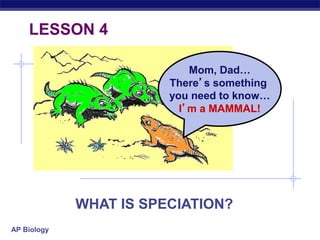
Mom, Dad…
There’s something
you need to know…
I’m a MAMMAL!
LESSON 4
WHAT IS SPECIATION?
AP Biology
So…what is a species?
 defined by Ernst Mayr (Evolutionary Biologist)
 A population whose members can interbreed & produce
viable, fertile offspring
 Being reproductively compatible is a key component
Western Meadowlark
Sturnella magna
Eastern Meadowlark
Sturnella neglecta
Distinct species:
songs & behaviors are different
enough to prevent interbreeding
AP Biology
Speciation
 Occurs when a group within a species
separates from other members of its
species and develops its own
characteristics.
AP Biology
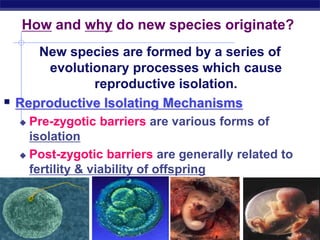
How and why do new species originate?
New species are formed by a series of
evolutionary processes which cause
reproductive isolation.
 Reproductive Isolating Mechanisms
 Pre-zygotic barriers are various forms of
isolation
 Post-zygotic barriers are generally related to
fertility & viability of offspring
AP Biology
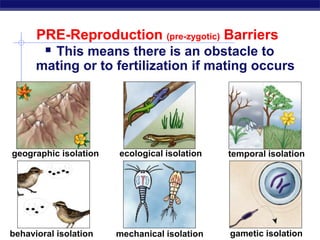
 This means there is an obstacle to
mating or to fertilization if mating occurs
PRE-Reproduction (pre-zygotic) Barriers
behavioral isolation
geographic isolation ecological isolation temporal isolation
mechanical isolation gametic isolation
AP Biology
1. Geographic isolation
 New species occur in different areas
 physical barrier separated ancestor species
Harris’s antelope
squirrel inhabits the
canyon’s south rim
(L). Just a few miles
away on the north
rim (R) lives the
closely related white-
tailed antelope
squirrel
Ammospermophilus spp
AP Biology
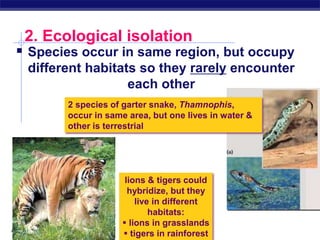
2. Ecological isolation
 Species occur in same region, but occupy
different habitats so they rarely encounter
each other
2 species of garter snake, Thamnophis,
occur in same area, but one lives in water &
other is terrestrial
lions & tigers could
hybridize, but they
live in different
habitats:
 lions in grasslands
 tigers in rainforest
AP Biology
3. Temporal “time” isolation
 Species that breed during different times of
day, different seasons, or different years
cannot mix gametes.
Eastern spotted skunk (L) &
Western spotted skunk (R)
overlap in range but eastern
mates in late winter &
western mates in late
summer
AP Biology
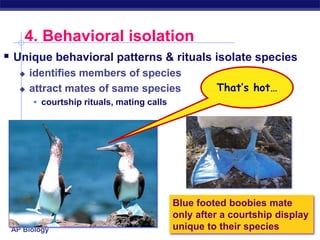
4. Behavioral isolation
 Unique behavioral patterns & rituals isolate species
 identifies members of species
 attract mates of same species
 courtship rituals, mating calls
Blue footed boobies mate
only after a courtship display
unique to their species
That’s hot…
AP Biology
AP Biology
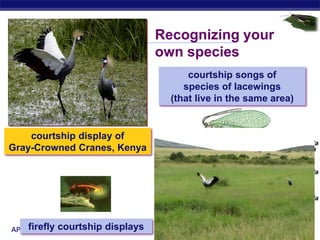
firefly courtship displays
courtship display of
Gray-Crowned Cranes, Kenya
courtship songs of
species of lacewings
(that live in the same area)
Recognizing your
own species
AP Biology
5. Mechanical isolation
 Morphological differences can prevent
successful mating
Even in closely related
species of plants, the
flowers often have distinct
appearances that attract
different pollinators.
These 2 species of monkey
flower differ greatly in
shape & color, therefore
cross-pollination does not
happen.
Plants
AP Biology
Mechanical isolation
 For many insects, male & female sex organs
of closely related species do not fit together,
preventing sperm transfer
 lack of “fit” between sexual organs:
hard to imagine for us… but a big issue for insects with
different shaped genitals!
Damsel fly penises
Animals
Get that thing
away from me!
AP Biology
6. Gametic isolation
 Sperm of one species may not be able to
fertilize eggs of another species
 biochemical barrier: sperm cannot penetrate egg
 receptor recognition: lock & key between egg & sperm
 chemical incompatibility
 sperm cannot survive in female reproductive tract
Sea urchins release sperm
& eggs into surrounding
waters where they fuse &
form zygotes.
Gametes of different
species are unable to fuse.
AP Biology
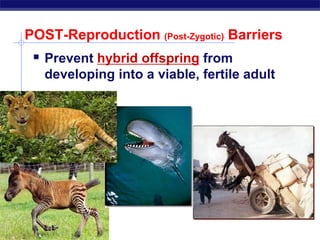
POST-Reproduction (Post-Zygotic) Barriers
 Prevent hybrid offspring from
developing into a viable, fertile adult
AP Biology
Post Zygotic: Reduced hybrid viability
 Genes of different parent species may
interact & impair the hybrid’s development
Species of salamander
genus, Ensatina, may
interbreed, but most
hybrids do not complete
development & those
that do are frail.
AP Biology
Mules are vigorous,
but sterile
Post Zygotic: Reduced hybrid fertility
 Even if hybrids are vigorous they may be sterile
 chromosomes of parents may differ in number or
structure & meiosis in hybrids may fail to produce
normal gametes
Donkeys have 62
chromosomes
(31 pairs)
Horses have 64
chromosomes
(32 pairs) Mules have 63 chromosomes!
AP Biology
Post Zygotic: Hybrid breakdown
 Hybrids may be fertile & viable in first
generation, but when they mate offspring
are feeble or sterile
In strains of cultivated rice,
hybrids are vigorous but
plants in next generation are
small & sterile.
AP Biology
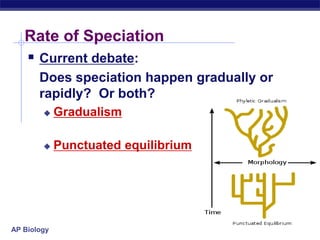
Rate of Speciation
 Current debate:
Does speciation happen gradually or
rapidly? Or both?
 Gradualism
 Punctuated equilibrium
AP Biology
Gradualism
 Gradual divergence
over long spans of
time
 assume that big
changes occur as
the accumulation
of many small ones
AP Biology
Punctuated Equilibrium
 Rate of speciation is
not constant
 rapid bursts of
change
 long periods of little
or no change
 species undergo
rapid change when
they 1st bud from
parent population Time
AP Biology
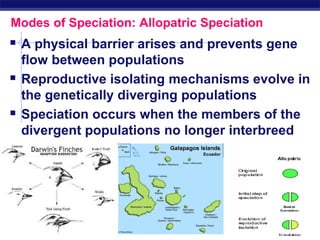
Modes of Speciation: Allopatric Speciation
 A physical barrier arises and prevents gene
flow between populations
 Reproductive isolating mechanisms evolve in
the genetically diverging populations
 Speciation occurs when the members of the
divergent populations no longer interbreed
AP Biology
Modes of Speciation: Sympatric Speciation
 A new species may form within the home
range of an existing species
(there is no physical barrier)
 May be:
 Temporal
 Mechanical
 Behavioral
AP Biology
Modes of Speciation: Parapatric Speciation
Daughter species form a
small proportion of
individuals along a
common border between
2 populations.
Hybrid Zone is formed
BULLOCK’S
ORIOLE
BALTIMORE
ORIOLE
HYBRID ZONE
Figure 18.10
AP Biology
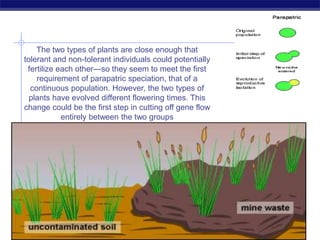
The two types of plants are close enough that
tolerant and non-tolerant individuals could potentially
fertilize each other—so they seem to meet the first
requirement of parapatric speciation, that of a
continuous population. However, the two types of
plants have evolved different flowering times. This
change could be the first step in cutting off gene flow
entirely between the two groups
AP Biology

Speciation.ppt

  • 1.
    AP Biology Mom, Dad… There’ssomething you need to know… I’m a MAMMAL! LESSON 4 WHAT IS SPECIATION?
  • 2.
    AP Biology So…what isa species?  defined by Ernst Mayr (Evolutionary Biologist)  A population whose members can interbreed & produce viable, fertile offspring  Being reproductively compatible is a key component Western Meadowlark Sturnella magna Eastern Meadowlark Sturnella neglecta Distinct species: songs & behaviors are different enough to prevent interbreeding
  • 3.
    AP Biology Speciation  Occurswhen a group within a species separates from other members of its species and develops its own characteristics.
  • 4.
    AP Biology How andwhy do new species originate? New species are formed by a series of evolutionary processes which cause reproductive isolation.  Reproductive Isolating Mechanisms  Pre-zygotic barriers are various forms of isolation  Post-zygotic barriers are generally related to fertility & viability of offspring
  • 5.
    AP Biology  Thismeans there is an obstacle to mating or to fertilization if mating occurs PRE-Reproduction (pre-zygotic) Barriers behavioral isolation geographic isolation ecological isolation temporal isolation mechanical isolation gametic isolation
  • 6.
    AP Biology 1. Geographicisolation  New species occur in different areas  physical barrier separated ancestor species Harris’s antelope squirrel inhabits the canyon’s south rim (L). Just a few miles away on the north rim (R) lives the closely related white- tailed antelope squirrel Ammospermophilus spp
  • 7.
    AP Biology 2. Ecologicalisolation  Species occur in same region, but occupy different habitats so they rarely encounter each other 2 species of garter snake, Thamnophis, occur in same area, but one lives in water & other is terrestrial lions & tigers could hybridize, but they live in different habitats:  lions in grasslands  tigers in rainforest
  • 8.
    AP Biology 3. Temporal“time” isolation  Species that breed during different times of day, different seasons, or different years cannot mix gametes. Eastern spotted skunk (L) & Western spotted skunk (R) overlap in range but eastern mates in late winter & western mates in late summer
  • 9.
    AP Biology 4. Behavioralisolation  Unique behavioral patterns & rituals isolate species  identifies members of species  attract mates of same species  courtship rituals, mating calls Blue footed boobies mate only after a courtship display unique to their species That’s hot…
  • 10.
  • 11.
    AP Biology firefly courtshipdisplays courtship display of Gray-Crowned Cranes, Kenya courtship songs of species of lacewings (that live in the same area) Recognizing your own species
  • 12.
    AP Biology 5. Mechanicalisolation  Morphological differences can prevent successful mating Even in closely related species of plants, the flowers often have distinct appearances that attract different pollinators. These 2 species of monkey flower differ greatly in shape & color, therefore cross-pollination does not happen. Plants
  • 13.
    AP Biology Mechanical isolation For many insects, male & female sex organs of closely related species do not fit together, preventing sperm transfer  lack of “fit” between sexual organs: hard to imagine for us… but a big issue for insects with different shaped genitals! Damsel fly penises Animals Get that thing away from me!
  • 14.
    AP Biology 6. Gameticisolation  Sperm of one species may not be able to fertilize eggs of another species  biochemical barrier: sperm cannot penetrate egg  receptor recognition: lock & key between egg & sperm  chemical incompatibility  sperm cannot survive in female reproductive tract Sea urchins release sperm & eggs into surrounding waters where they fuse & form zygotes. Gametes of different species are unable to fuse.
  • 15.
    AP Biology POST-Reproduction (Post-Zygotic)Barriers  Prevent hybrid offspring from developing into a viable, fertile adult
  • 16.
    AP Biology Post Zygotic:Reduced hybrid viability  Genes of different parent species may interact & impair the hybrid’s development Species of salamander genus, Ensatina, may interbreed, but most hybrids do not complete development & those that do are frail.
  • 17.
    AP Biology Mules arevigorous, but sterile Post Zygotic: Reduced hybrid fertility  Even if hybrids are vigorous they may be sterile  chromosomes of parents may differ in number or structure & meiosis in hybrids may fail to produce normal gametes Donkeys have 62 chromosomes (31 pairs) Horses have 64 chromosomes (32 pairs) Mules have 63 chromosomes!
  • 18.
    AP Biology Post Zygotic:Hybrid breakdown  Hybrids may be fertile & viable in first generation, but when they mate offspring are feeble or sterile In strains of cultivated rice, hybrids are vigorous but plants in next generation are small & sterile.
  • 19.
    AP Biology Rate ofSpeciation  Current debate: Does speciation happen gradually or rapidly? Or both?  Gradualism  Punctuated equilibrium
  • 20.
    AP Biology Gradualism  Gradualdivergence over long spans of time  assume that big changes occur as the accumulation of many small ones
  • 21.
    AP Biology Punctuated Equilibrium Rate of speciation is not constant  rapid bursts of change  long periods of little or no change  species undergo rapid change when they 1st bud from parent population Time
  • 22.
    AP Biology Modes ofSpeciation: Allopatric Speciation  A physical barrier arises and prevents gene flow between populations  Reproductive isolating mechanisms evolve in the genetically diverging populations  Speciation occurs when the members of the divergent populations no longer interbreed
  • 23.
    AP Biology Modes ofSpeciation: Sympatric Speciation  A new species may form within the home range of an existing species (there is no physical barrier)  May be:  Temporal  Mechanical  Behavioral
  • 24.
    AP Biology Modes ofSpeciation: Parapatric Speciation Daughter species form a small proportion of individuals along a common border between 2 populations. Hybrid Zone is formed BULLOCK’S ORIOLE BALTIMORE ORIOLE HYBRID ZONE Figure 18.10
  • 25.
    AP Biology The twotypes of plants are close enough that tolerant and non-tolerant individuals could potentially fertilize each other—so they seem to meet the first requirement of parapatric speciation, that of a continuous population. However, the two types of plants have evolved different flowering times. This change could be the first step in cutting off gene flow entirely between the two groups
  • 26.

Editor's Notes

  • #3 Humans are so diverse but considered one species, whereas these Meadowlarks look so similar but are considered different species. Meadowlarks Similar body & colorations, but are distinct biological species because their songs & other behaviors are different enough to prevent interbreeding
  • #10 The most comedic species of the Galapagos Islands is the Blue Footed Booby, what a ridiculous outfit and expression! Their name is in fact taken from the Spanish 'bobo' which means clown. The Blue Footed Boobies above display part of their humorous courtship ritual whereby they raise their feet one at a time and then swivel their heads away from the prospective mate looking to the sky. Other interesting Booby features are the highly evolved airbag systems in their skulls which allow them to dive bomb into the sea for fish from great height, and the egg and hatchling nesting boundaries they make which are rings of Boobie poop. They aren't the only Booby on the island — there are also Masked and Red Footed Boobies about.
  • #13 The most comedic species of the Galapagos Islands is the Blue Footed Booby, what a ridiculous outfit and expression! Their name is in fact taken from the Spanish 'bobo' which means clown. The Blue Footed Boobies above display part of their humorous courtship ritual whereby they raise their feet one at a time and then swivel their heads away from the prospective mate looking to the sky. Other interesting Booby features are the highly evolved airbag systems in their skulls which allow them to dive bomb into the sea for fish from great height, and the egg and hatchling nesting boundaries they make which are rings of Boobie poop. They aren't the only Booby on the island — there are also Masked and Red Footed Boobies about.
  • #14 The selection is intense because it directly affects offspring production -- it is affecting sex itself
  • #18 What’s wrong with having 63 chromosomes? Odd number! Cannot pair up in meiosis.
  • #23 A physical barrier such as mountain range or a water way, makes it impossible for them to breed with one another. Each species develops differently based on the demands of their unique habitat or the genetic characteristics of the group that are passed on to offspring.