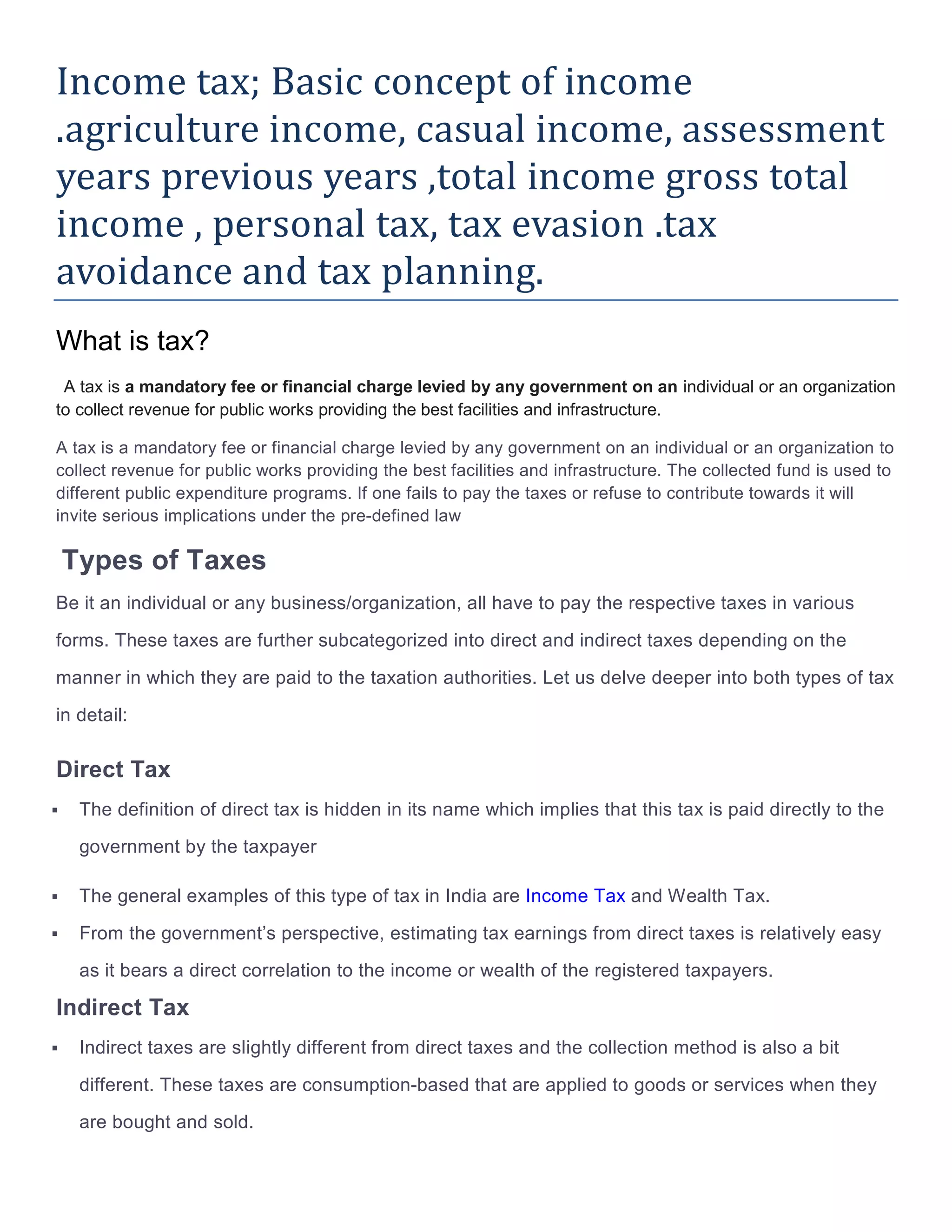
Income tax; Basic concept of income
.agriculture income, casual income, assessment
years previous years ,total income gross total
income , personal tax, tax evasion .tax
avoidance and tax planning.
What is tax?
A tax is a mandatory fee or financial charge levied by any government on an individual or an organization
to collect revenue for public works providing the best facilities and infrastructure.
A tax is a mandatory fee or financial charge levied by any government on an individual or an organization to
collect revenue for public works providing the best facilities and infrastructure. The collected fund is used to
different public expenditure programs. If one fails to pay the taxes or refuse to contribute towards it will
invite serious implications under the pre-defined law
Types of Taxes
Be it an individual or any business/organization, all have to pay the respective taxes in various
forms. These taxes are further subcategorized into direct and indirect taxes depending on the
manner in which they are paid to the taxation authorities. Let us delve deeper into both types of tax
in detail:
Direct Tax
 The definition of direct tax is hidden in its name which implies that this tax is paid directly to the
government by the taxpayer
 The general examples of this type of tax in India are Income Tax and Wealth Tax.
 From the government’s perspective, estimating tax earnings from direct taxes is relatively easy
as it bears a direct correlation to the income or wealth of the registered taxpayers.
Indirect Tax
 Indirect taxes are slightly different from direct taxes and the collection method is also a bit
different. These taxes are consumption-based that are applied to goods or services when they
are bought and sold.
 The indirect tax payment is received by the government from the seller of goods/services.
 The seller, in turn, passes the tax on to the end-user i.e. buyer of the good/service.
 Thus the name indirect tax as the end-user of the good/service does not pay the tax directly to
the government.
 Some general examples of indirect tax include sales tax, Goods and Services Tax (GST), Value
Added Tax (VAT), etc.
1. Direct Tax
Direct tax is tax that are to be paid directly to the government by the individual or legal entity. Direct
taxes are overlooked by the Central Board of Direct Taxes (CBDT). Direct taxes cannot be
transferred to any other individual or legal entity.
Sub-categories of Direct Taxes
The following are the sub-categories of direct taxes:
1. Income tax: This is the tax that is levied on the annual income or the profits which is directly paid to the
government. Everyone who earns any kind of income is liable to pay income tax. For individuals below 60
years of age, the tax exemption limit is Rs.2.5 lakh per annum. For individuals between the age of 60 and
80, the tax exemption limit is Rs.3 lakh. For individuals above the age of tax exemption limit is Rs.5 lakh.
There are different tax slabs for different income amounts.
Apart from individuals, legal entities are also liable to pay taxes. These include all Artificial Judicial
Persons, Hindu Undivided Family (HUF), Body of Individuals (BOI), Association of Persons (AOP),
companies, local firms, and local authorities.
2. Capital gains: Capital gains tax is levied on the sale of a property or money received through an
investment. It could be from either short-term or long-term capital gains from an investment. This includes all
exchanges made in kind that is weighed against its value.
3. Securities transaction Tax: STT is levied on stock market and securities trading. The tax is levied on the
price of the share as well as securities traded on the ISE (Indian Stock Exchange).
4. Prerequisite Tax: These are taxes that are levied on the different benefits and perks that are provided by a
company to its employees. The purpose of the benefits and perks, whether it is official or personal, is to be
defined.
5. Corporate tax: The income tax paid by a company is defined as the corporate tax. It is based on the
different slabs that the revenue falls under. The sub-categories of corporate taxes are as follows:
 Dividend distribution tax ( DDT): This tax is levied on the dividends that companies pay to the investors.
It applies to the net or gross income that an investor receives from the investment.
 Fringe benefit tax (FBT): This is tax levied on the fringe benefits that an employee receives from the
company. This include expenses related to accommodation, transportation, leave travel allowance,
entertainment, retirement fund contribution by the employee, employee welfare, Employee Stock
Ownership Plan (ESOP), etc.
 Minimum Alternative Tax (MAT): Companies pay the IT Department through MAT which is governed by
Section 115JA of the IT Act. Companies that are exempt from MAT are those that are in the power and
infrastructure sectors
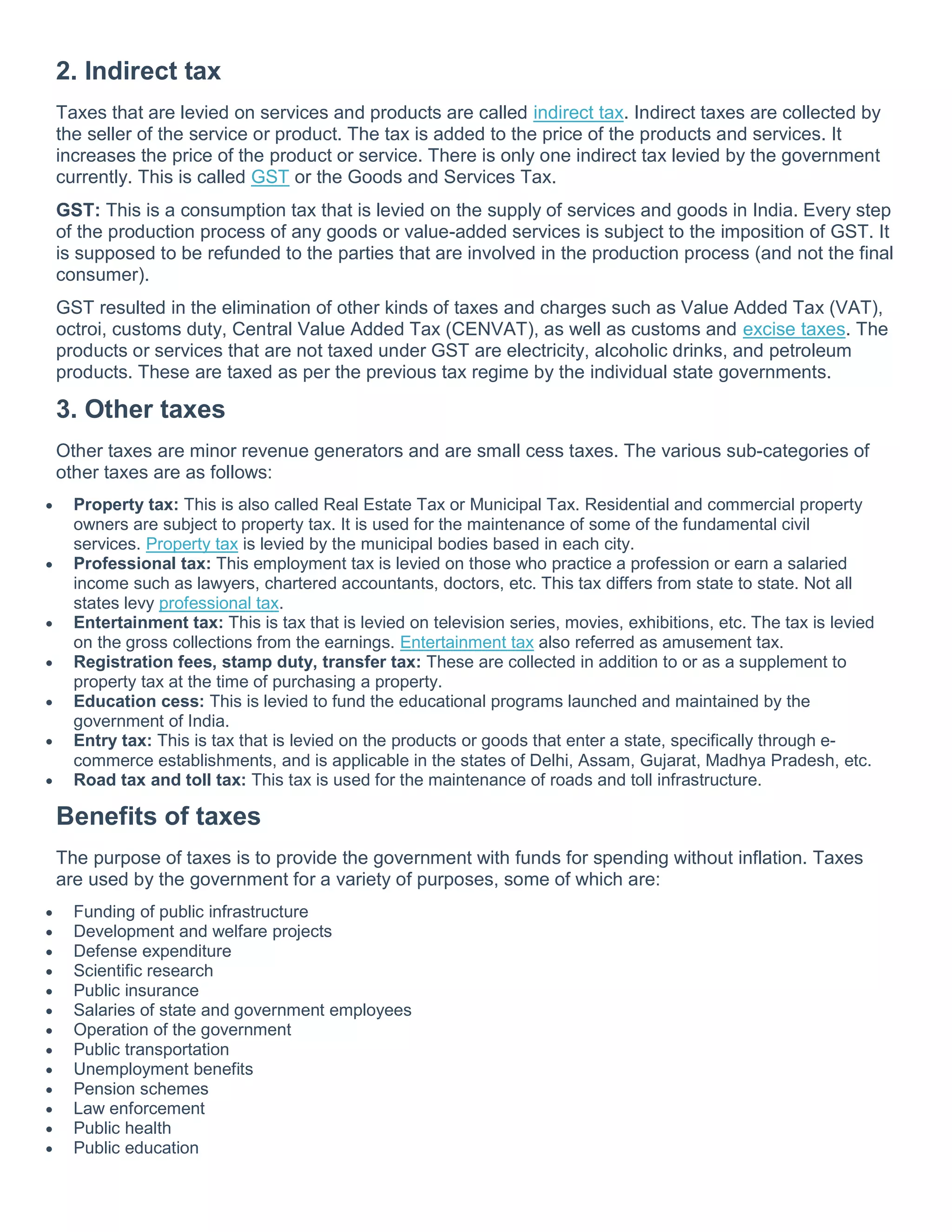
2. Indirect tax
Taxes that are levied on services and products are called indirect tax. Indirect taxes are collected by
the seller of the service or product. The tax is added to the price of the products and services. It
increases the price of the product or service. There is only one indirect tax levied by the government
currently. This is called GST or the Goods and Services Tax.
GST: This is a consumption tax that is levied on the supply of services and goods in India. Every step
of the production process of any goods or value-added services is subject to the imposition of GST. It
is supposed to be refunded to the parties that are involved in the production process (and not the final
consumer).
GST resulted in the elimination of other kinds of taxes and charges such as Value Added Tax (VAT),
octroi, customs duty, Central Value Added Tax (CENVAT), as well as customs and excise taxes. The
products or services that are not taxed under GST are electricity, alcoholic drinks, and petroleum
products. These are taxed as per the previous tax regime by the individual state governments.
3. Other taxes
Other taxes are minor revenue generators and are small cess taxes. The various sub-categories of
other taxes are as follows:
 Property tax: This is also called Real Estate Tax or Municipal Tax. Residential and commercial property
owners are subject to property tax. It is used for the maintenance of some of the fundamental civil
services. Property tax is levied by the municipal bodies based in each city.
 Professional tax: This employment tax is levied on those who practice a profession or earn a salaried
income such as lawyers, chartered accountants, doctors, etc. This tax differs from state to state. Not all
states levy professional tax.
 Entertainment tax: This is tax that is levied on television series, movies, exhibitions, etc. The tax is levied
on the gross collections from the earnings. Entertainment tax also referred as amusement tax.
 Registration fees, stamp duty, transfer tax: These are collected in addition to or as a supplement to
property tax at the time of purchasing a property.
 Education cess: This is levied to fund the educational programs launched and maintained by the
government of India.
 Entry tax: This is tax that is levied on the products or goods that enter a state, specifically through e-
commerce establishments, and is applicable in the states of Delhi, Assam, Gujarat, Madhya Pradesh, etc.
 Road tax and toll tax: This tax is used for the maintenance of roads and toll infrastructure.
Benefits of taxes
The purpose of taxes is to provide the government with funds for spending without inflation. Taxes
are used by the government for a variety of purposes, some of which are:
 Funding of public infrastructure
 Development and welfare projects
 Defense expenditure
 Scientific research
 Public insurance
 Salaries of state and government employees
 Operation of the government
 Public transportation
 Unemployment benefits
 Pension schemes
 Law enforcement
 Public health
 Public education
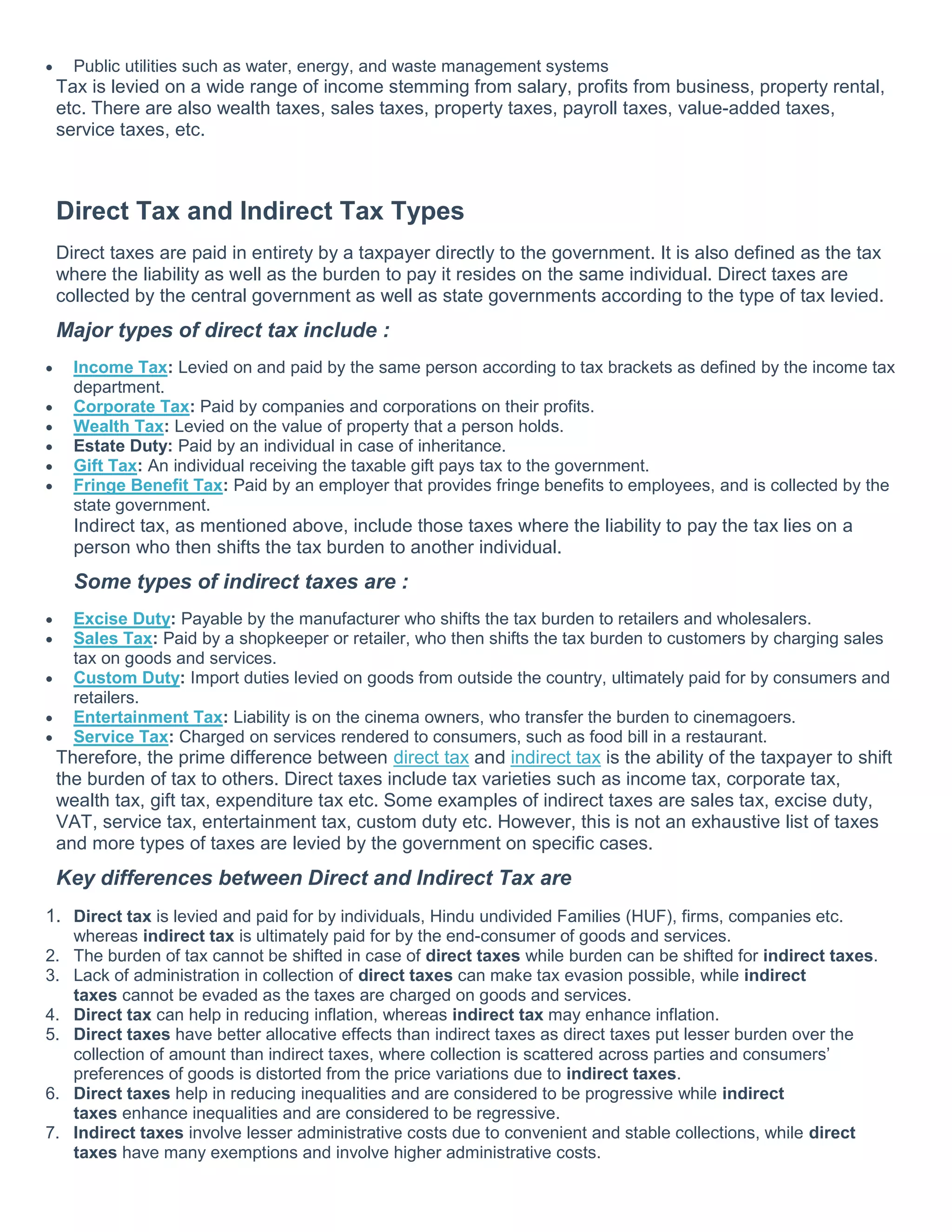
 Public utilities such as water, energy, and waste management systems
Tax is levied on a wide range of income stemming from salary, profits from business, property rental,
etc. There are also wealth taxes, sales taxes, property taxes, payroll taxes, value-added taxes,
service taxes, etc.
Direct Tax and Indirect Tax Types
Direct taxes are paid in entirety by a taxpayer directly to the government. It is also defined as the tax
where the liability as well as the burden to pay it resides on the same individual. Direct taxes are
collected by the central government as well as state governments according to the type of tax levied.
Major types of direct tax include :
 Income Tax: Levied on and paid by the same person according to tax brackets as defined by the income tax
department.
 Corporate Tax: Paid by companies and corporations on their profits.
 Wealth Tax: Levied on the value of property that a person holds.
 Estate Duty: Paid by an individual in case of inheritance.
 Gift Tax: An individual receiving the taxable gift pays tax to the government.
 Fringe Benefit Tax: Paid by an employer that provides fringe benefits to employees, and is collected by the
state government.
Indirect tax, as mentioned above, include those taxes where the liability to pay the tax lies on a
person who then shifts the tax burden to another individual.
Some types of indirect taxes are :
 Excise Duty: Payable by the manufacturer who shifts the tax burden to retailers and wholesalers.
 Sales Tax: Paid by a shopkeeper or retailer, who then shifts the tax burden to customers by charging sales
tax on goods and services.
 Custom Duty: Import duties levied on goods from outside the country, ultimately paid for by consumers and
retailers.
 Entertainment Tax: Liability is on the cinema owners, who transfer the burden to cinemagoers.
 Service Tax: Charged on services rendered to consumers, such as food bill in a restaurant.
Therefore, the prime difference between direct tax and indirect tax is the ability of the taxpayer to shift
the burden of tax to others. Direct taxes include tax varieties such as income tax, corporate tax,
wealth tax, gift tax, expenditure tax etc. Some examples of indirect taxes are sales tax, excise duty,
VAT, service tax, entertainment tax, custom duty etc. However, this is not an exhaustive list of taxes
and more types of taxes are levied by the government on specific cases.
Key differences between Direct and Indirect Tax are
1. Direct tax is levied and paid for by individuals, Hindu undivided Families (HUF), firms, companies etc.
whereas indirect tax is ultimately paid for by the end-consumer of goods and services.
2. The burden of tax cannot be shifted in case of direct taxes while burden can be shifted for indirect taxes.
3. Lack of administration in collection of direct taxes can make tax evasion possible, while indirect
taxes cannot be evaded as the taxes are charged on goods and services.
4. Direct tax can help in reducing inflation, whereas indirect tax may enhance inflation.
5. Direct taxes have better allocative effects than indirect taxes as direct taxes put lesser burden over the
collection of amount than indirect taxes, where collection is scattered across parties and consumers’
preferences of goods is distorted from the price variations due to indirect taxes.
6. Direct taxes help in reducing inequalities and are considered to be progressive while indirect
taxes enhance inequalities and are considered to be regressive.
7. Indirect taxes involve lesser administrative costs due to convenient and stable collections, while direct
taxes have many exemptions and involve higher administrative costs.
8. Indirect taxes are oriented more towards growth as they discourage consumption and help enhance
savings. Direct taxes, on the other hand, reduce savings and discourage investments.
9. Indirect taxes have a wider coverage as all members of the society are taxed through the sale of goods and
services, while direct taxes are collected only from people in respective tax brackets.
10. Additional indirect taxes levied on harmful commodities such as cigarettes, alcohol etc. dissuades over-
consumption, thereby helping the country in a social context.
Direct and indirect taxes are defined according to the ability of the end taxpayer to shift the burden of
taxes to someone else. Direct taxes allow the government to collect taxes directly from consumers
and is a progressive type of tax, which also allows for cooling down of inflationary pressure on the
economy. Indirect taxes allow the government to expect stable and assured returns and brings into its
fold almost every member of the society – something which the direct tax has been unable to do.
Both direct and indirect taxes are important for the country as they are intricately linked with the
overall economy. As such, collection of these taxes is important for the government as well as the
well-being of the country. Both direct taxes and indirect taxes are collected by the central and
respective state governments according to the type of tax levied.
What is Agricultural Income?
In India, agricultural income refers to income earned or revenue derived from sources that include
farming land, buildings on or identified with an agricultural land and commercial produce from a
horticultural land. Agricultural income is defined under section 2(1A) of the Income Tax Act, 1961.
According to this Section, agricultural income generally means: (a) Any rent or revenue derived from
land which is situated in India and is used for agricultural purposes. (b) Any income derived from such
land by agriculture operations including processing of agricultural produce so as to render it fit for the
market or sale of such produce. (c) Any income attributable to a farm house subject to satisfaction of
certain conditions specified in this regard in section 2(1A). (d) Any income derived from saplings or
seedlings grown in a nursery shall be deemed to be agricultural income
Examples of Agricultural Income
The following are some of the examples of agricultural income:
 Income derived from sale of replanted trees.
 Income from sale of seeds.
 Rent received for agricultural land.
 Income from growing flowers and creepers.
 Profits received from a partner from a firm engaged in agricultural produce or activities.
 Interest on capital that a partner from a firm, engaged in agricultural operations, receives.
Examples of Non-Agricultural Income
The following are some of the examples of non-agricultural income:
 Income from poultry farming.
 Income from bee hiving.
 Any dividend that an organization pays from its agriculture income.
 Income from the sale of spontaneously grown trees.
 Income from dairy farming.
 Income from salt produced after the land has flooded with sea water.
 Purchase of standing crop.
 Royalty income from mines.
 Income from butter and cheese making.
 Receipts from TV serial shooting in farm house.
What is casual income?
Income received from winning lotteries, crosswords, puzzles, card games, horse race, gambling, betting or any
other games is known as casual income. Casual Income is taxed at a flat rate of 30%. No expenditure is allowed
as a deduction from casual income. Also the benefit of basic exemption limit is not available for casual income.
TDS @ 30% is deducted u/s 194B in case of winnings from lotteries if the amount exceeds Rs. 10,000/-.
TDS @ 30% is deducted u/s 194BB in case of income received from race horses.
Comparison Chart
BASIS FOR
COMPARISON
PREVIOUS YEAR ASSESSMENT YEAR
Meaning Previous Year is the
financial year, in
which the assessee
earns income.
Assessment Year is the financial
year, in which the income of the
assessee earned during the
previous year is evaluated and
taxed.
What is it? The year to which
income belongs.
The year in which income tax
liability for the previous year
arises.
Term Its term is 12 m or - Its term is 12 months.
Key Differences Between Previous Year and Assessment Year
The main differences between previous year and assessment year are given
hereunder:
1. Previous Year can be understood as the financial year in which the assessee
makes money. On the other hand, Assessment Year refers to the period of
twelve months, starting on the 1st of April. It is the financial year, in which the
income earned in the previous year is taxable.
2. Previous Year is the year concerning the income on which tax is levied. As
against, Assessment Year is the year in which income relating to the previous
year is assessed for the purpose of taxation.
3. Normally, the previous year is a period of 12 months, but it can be shorter than
that. Conversely, the assessment year is always a period of 12 months.
Comparison Table Between Gross Total Income and Total Income (in Tabular Form)
Parameter of
Comparison
Gross Total Income Total Income
Meaning
Refers to income earned by an individual,
or an entity from all the heads, before
taxes or, other deductions are implied.
Total income is the income estimated after
deductions under section 80 from Gross Total
income have been subtracted.
Represents
Represents revenue generated, or income
earned before the taxes and other
deductions have been made.
On the other hand, total income represents the
income on which tax liability is determined.
Importance
It is the aggregate of the incomes earned
by all the heads, it denotes the deductions
that are to be made.
Whereas, in the case of total income, it is
necessary to calculate total income to ascertain
an individual’s tax liability as per his, or her
income.
Formula
Gross total income = Total income (sum of
all heads) + the deductions under Section
80 from Gross Total Income.
Total Income = Gross Total Income – Deductions
under Section 80 from Gross Total Income.
Tax Tax is not levied on gross total income. Tax is levied on the total income.
What is Gross Total Income?
Gross total income is the summation of income from all the heads, it is commonly earned by
an individual through paychecks before tax and other deductions. It is only after clubbing of
income, that the set-off and carry forward of losses take place.
Important calculations to be made to achieve gross total income are:
1. Identification of residential status such as resident, or non-resident which is again sub-
categorized into resident and ordinarily resident, or resident but non-ordinarily resident.
2. Income classification: It determines which income belongs to which group.
3. Calculation of income from each head.
4. Clubbing of income: Clubbing of income is done to prevent the avoidance of tax, under
clubbing the income of minors, as well as the spouse of the assessor, is added to the
total income.
5. Set-off or carry forward of losses: There may be losses incurred under one head which
is set-off against profit from some other source, under the same head.
What is Total Income?
Total income is the income, or earnings derived after subtracting the deductions under section
80C to 80U. To reach total income one has to obtain a gross total income of the assessee
(the person who is liable to pay tax).
Important calculations to be made to achieve total income are:
1. Deductions from the gross total income: Only after the calculation of the gross total
income of the assessee, the deductions under section 80 that are allowed from the
gross total income. The deductions are only made if the gross total income is of positive
figure. Moreover, there are certain provisions under which deductions are made,
namely, deductions concerning investments such as life insurance, deductions
concerning certain incomes such as earnings from cooperative society, and other
deductions.
2. Rebate, if any
3. Advance tax, as well as TDS
Main Differences Between Gross Total Income and Total Income
1. Gross total income and total income are of distinct meanings, where the former denotes
the sum of the incomes from the heads, or sources of income, while the latter denotes
the total income after subtracting the deductions according to Section 80 of gross total
income.
2. Deductions are not made while calculating gross total income, whereas, on the other
hand, deductions play an important role while calculating total income, as it is the only
difference between gross total income and total income.
3. Tax is levied on total income, whereas in the case of total income it is not levied.
4. Gross total income is the aggregate income of all the incomes from distinct heads, or
sources, while on the other hand, total income is the income that we obtain after
deductions under section 80C to 80U.
5. The tax liability is calculated based on total income, and not gross total income.
Tax evasion .tax avoidance and tax planning.
Tax Evasion: Tax Evasion is an illegal way to minimize tax liability through fraudulent
techniques like deliberate under-statement of taxable income or inflating expenses. It is
an unlawful attempt to reduce one’s tax burden. Tax Evasion is done with a motive of
showing fewer profits in order to avoid tax burden. It involves illegal practices such as
making false statements, hiding relevant documents, not maintaining complete records
of the transactions, concealment of income, overstatement of tax credit or presenting
personal expenses as business expenses. Tax evasion is a crime for which the
assesse could be punished under the law.
Tax Planning: Tax planning is process of analyzing one’s financial situation in the
most efficient manner. Through tax planning one can reduce one’s tax liability. It
involves planning one’s income in a legal manner to avail various exemptions and
deductions. Under Section 80C, one can avail tax deduction if specific investments are
made for a specific period up to a limit of Rs 1, 50,000. The most popular ways of
saving tax are investing in PPF accounts, National Saving Certificate, Fixed Deposit,
Mutual Funds and Provident Funds. Tax planning involves applying various
advantageous provisions which are legal and entitles the assesse to avail the benefit of
deductions, credits, concessions, rebates and exemptions. Or we can say that Tax
planning is an art in which there is a logical planning of one’s financial affairs in such a
manner that benefits the assesse with all the eligible provisions of the taxation law. Tax
planning is an honest approach of applying the provisions which comes within the
framework of taxation law.
Tax Avoidance: Tax avoidance is an act of using legal methods to minimize tax
liability. In other words, it is an act of using tax regime in a single territory for one’s
personal benefits to decrease one’s tax burden. Although Tax avoidance is a legal
method, it is not advisable as it could be used for one’s own advantage to reduce the
amount of tax that is payable. Tax avoidance is an activity of taking unfair advantage of
the shortcomings in the tax rules by finding new ways to avoid the payment of taxes
that are within the limits of the law. Tax avoidance can be done by adjusting the
accounts in such a manner that there will be no violation of tax rules. Tax avoidance is
lawful but in some cases it could come in the category of crime.
Features and differences between Tax evasion, Tax avoidance and Tax Planning:
1. Nature: Tax planning and Tax avoidance is legal whereas Tax evasion is illegal
2. Attributes: Tax planning is moral. Tax avoidance is immoral. Tax evasion is illegal
and objectionable.
3. Motive: Tax planning is the method of saving tax .However tax avoidance is
dodging of tax. Tax evasion is an act of concealing tax.
4. Consequences: Tax avoidance leads to the deferment of tax liability. Tax evasion
leads to penalty or imprisonment.
5. Objective: The objective of Tax avoidance is to reduce tax liability by applying the
script of law whereas Tax evasion is done to reduce tax liability by exercising unfair
means. Tax planning is done to reduce the liability of tax by applying the provision and
moral of law.
6. Permissible: Tax planning and Tax avoidance are permissible whereas Tax
evasion is not permissible.
 Tax liability of an individual can be reduced through 3 different methods- Tax Planning,
Tax avoidance and Tax evasion. All the methods are different and interchangeable.
 Tax planning and Tax avoidance are the legal ways to reduce tax liabilities but Tax
avoidance is not advisable as it manipulates the law for one’s own benefit. Whereas
tax planning is an ideal method.

What is income tax?

  • 1.
    Income tax; Basicconcept of income .agriculture income, casual income, assessment years previous years ,total income gross total income , personal tax, tax evasion .tax avoidance and tax planning. What is tax? A tax is a mandatory fee or financial charge levied by any government on an individual or an organization to collect revenue for public works providing the best facilities and infrastructure. A tax is a mandatory fee or financial charge levied by any government on an individual or an organization to collect revenue for public works providing the best facilities and infrastructure. The collected fund is used to different public expenditure programs. If one fails to pay the taxes or refuse to contribute towards it will invite serious implications under the pre-defined law Types of Taxes Be it an individual or any business/organization, all have to pay the respective taxes in various forms. These taxes are further subcategorized into direct and indirect taxes depending on the manner in which they are paid to the taxation authorities. Let us delve deeper into both types of tax in detail: Direct Tax  The definition of direct tax is hidden in its name which implies that this tax is paid directly to the government by the taxpayer  The general examples of this type of tax in India are Income Tax and Wealth Tax.  From the government’s perspective, estimating tax earnings from direct taxes is relatively easy as it bears a direct correlation to the income or wealth of the registered taxpayers. Indirect Tax  Indirect taxes are slightly different from direct taxes and the collection method is also a bit different. These taxes are consumption-based that are applied to goods or services when they are bought and sold.
  • 2.
     The indirecttax payment is received by the government from the seller of goods/services.  The seller, in turn, passes the tax on to the end-user i.e. buyer of the good/service.  Thus the name indirect tax as the end-user of the good/service does not pay the tax directly to the government.  Some general examples of indirect tax include sales tax, Goods and Services Tax (GST), Value Added Tax (VAT), etc. 1. Direct Tax Direct tax is tax that are to be paid directly to the government by the individual or legal entity. Direct taxes are overlooked by the Central Board of Direct Taxes (CBDT). Direct taxes cannot be transferred to any other individual or legal entity. Sub-categories of Direct Taxes The following are the sub-categories of direct taxes: 1. Income tax: This is the tax that is levied on the annual income or the profits which is directly paid to the government. Everyone who earns any kind of income is liable to pay income tax. For individuals below 60 years of age, the tax exemption limit is Rs.2.5 lakh per annum. For individuals between the age of 60 and 80, the tax exemption limit is Rs.3 lakh. For individuals above the age of tax exemption limit is Rs.5 lakh. There are different tax slabs for different income amounts. Apart from individuals, legal entities are also liable to pay taxes. These include all Artificial Judicial Persons, Hindu Undivided Family (HUF), Body of Individuals (BOI), Association of Persons (AOP), companies, local firms, and local authorities. 2. Capital gains: Capital gains tax is levied on the sale of a property or money received through an investment. It could be from either short-term or long-term capital gains from an investment. This includes all exchanges made in kind that is weighed against its value. 3. Securities transaction Tax: STT is levied on stock market and securities trading. The tax is levied on the price of the share as well as securities traded on the ISE (Indian Stock Exchange). 4. Prerequisite Tax: These are taxes that are levied on the different benefits and perks that are provided by a company to its employees. The purpose of the benefits and perks, whether it is official or personal, is to be defined. 5. Corporate tax: The income tax paid by a company is defined as the corporate tax. It is based on the different slabs that the revenue falls under. The sub-categories of corporate taxes are as follows:  Dividend distribution tax ( DDT): This tax is levied on the dividends that companies pay to the investors. It applies to the net or gross income that an investor receives from the investment.  Fringe benefit tax (FBT): This is tax levied on the fringe benefits that an employee receives from the company. This include expenses related to accommodation, transportation, leave travel allowance, entertainment, retirement fund contribution by the employee, employee welfare, Employee Stock Ownership Plan (ESOP), etc.  Minimum Alternative Tax (MAT): Companies pay the IT Department through MAT which is governed by Section 115JA of the IT Act. Companies that are exempt from MAT are those that are in the power and infrastructure sectors
  • 3.
    2. Indirect tax Taxesthat are levied on services and products are called indirect tax. Indirect taxes are collected by the seller of the service or product. The tax is added to the price of the products and services. It increases the price of the product or service. There is only one indirect tax levied by the government currently. This is called GST or the Goods and Services Tax. GST: This is a consumption tax that is levied on the supply of services and goods in India. Every step of the production process of any goods or value-added services is subject to the imposition of GST. It is supposed to be refunded to the parties that are involved in the production process (and not the final consumer). GST resulted in the elimination of other kinds of taxes and charges such as Value Added Tax (VAT), octroi, customs duty, Central Value Added Tax (CENVAT), as well as customs and excise taxes. The products or services that are not taxed under GST are electricity, alcoholic drinks, and petroleum products. These are taxed as per the previous tax regime by the individual state governments. 3. Other taxes Other taxes are minor revenue generators and are small cess taxes. The various sub-categories of other taxes are as follows:  Property tax: This is also called Real Estate Tax or Municipal Tax. Residential and commercial property owners are subject to property tax. It is used for the maintenance of some of the fundamental civil services. Property tax is levied by the municipal bodies based in each city.  Professional tax: This employment tax is levied on those who practice a profession or earn a salaried income such as lawyers, chartered accountants, doctors, etc. This tax differs from state to state. Not all states levy professional tax.  Entertainment tax: This is tax that is levied on television series, movies, exhibitions, etc. The tax is levied on the gross collections from the earnings. Entertainment tax also referred as amusement tax.  Registration fees, stamp duty, transfer tax: These are collected in addition to or as a supplement to property tax at the time of purchasing a property.  Education cess: This is levied to fund the educational programs launched and maintained by the government of India.  Entry tax: This is tax that is levied on the products or goods that enter a state, specifically through e- commerce establishments, and is applicable in the states of Delhi, Assam, Gujarat, Madhya Pradesh, etc.  Road tax and toll tax: This tax is used for the maintenance of roads and toll infrastructure. Benefits of taxes The purpose of taxes is to provide the government with funds for spending without inflation. Taxes are used by the government for a variety of purposes, some of which are:  Funding of public infrastructure  Development and welfare projects  Defense expenditure  Scientific research  Public insurance  Salaries of state and government employees  Operation of the government  Public transportation  Unemployment benefits  Pension schemes  Law enforcement  Public health  Public education
  • 4.
     Public utilitiessuch as water, energy, and waste management systems Tax is levied on a wide range of income stemming from salary, profits from business, property rental, etc. There are also wealth taxes, sales taxes, property taxes, payroll taxes, value-added taxes, service taxes, etc. Direct Tax and Indirect Tax Types Direct taxes are paid in entirety by a taxpayer directly to the government. It is also defined as the tax where the liability as well as the burden to pay it resides on the same individual. Direct taxes are collected by the central government as well as state governments according to the type of tax levied. Major types of direct tax include :  Income Tax: Levied on and paid by the same person according to tax brackets as defined by the income tax department.  Corporate Tax: Paid by companies and corporations on their profits.  Wealth Tax: Levied on the value of property that a person holds.  Estate Duty: Paid by an individual in case of inheritance.  Gift Tax: An individual receiving the taxable gift pays tax to the government.  Fringe Benefit Tax: Paid by an employer that provides fringe benefits to employees, and is collected by the state government. Indirect tax, as mentioned above, include those taxes where the liability to pay the tax lies on a person who then shifts the tax burden to another individual. Some types of indirect taxes are :  Excise Duty: Payable by the manufacturer who shifts the tax burden to retailers and wholesalers.  Sales Tax: Paid by a shopkeeper or retailer, who then shifts the tax burden to customers by charging sales tax on goods and services.  Custom Duty: Import duties levied on goods from outside the country, ultimately paid for by consumers and retailers.  Entertainment Tax: Liability is on the cinema owners, who transfer the burden to cinemagoers.  Service Tax: Charged on services rendered to consumers, such as food bill in a restaurant. Therefore, the prime difference between direct tax and indirect tax is the ability of the taxpayer to shift the burden of tax to others. Direct taxes include tax varieties such as income tax, corporate tax, wealth tax, gift tax, expenditure tax etc. Some examples of indirect taxes are sales tax, excise duty, VAT, service tax, entertainment tax, custom duty etc. However, this is not an exhaustive list of taxes and more types of taxes are levied by the government on specific cases. Key differences between Direct and Indirect Tax are 1. Direct tax is levied and paid for by individuals, Hindu undivided Families (HUF), firms, companies etc. whereas indirect tax is ultimately paid for by the end-consumer of goods and services. 2. The burden of tax cannot be shifted in case of direct taxes while burden can be shifted for indirect taxes. 3. Lack of administration in collection of direct taxes can make tax evasion possible, while indirect taxes cannot be evaded as the taxes are charged on goods and services. 4. Direct tax can help in reducing inflation, whereas indirect tax may enhance inflation. 5. Direct taxes have better allocative effects than indirect taxes as direct taxes put lesser burden over the collection of amount than indirect taxes, where collection is scattered across parties and consumers’ preferences of goods is distorted from the price variations due to indirect taxes. 6. Direct taxes help in reducing inequalities and are considered to be progressive while indirect taxes enhance inequalities and are considered to be regressive. 7. Indirect taxes involve lesser administrative costs due to convenient and stable collections, while direct taxes have many exemptions and involve higher administrative costs.
  • 5.
    8. Indirect taxesare oriented more towards growth as they discourage consumption and help enhance savings. Direct taxes, on the other hand, reduce savings and discourage investments. 9. Indirect taxes have a wider coverage as all members of the society are taxed through the sale of goods and services, while direct taxes are collected only from people in respective tax brackets. 10. Additional indirect taxes levied on harmful commodities such as cigarettes, alcohol etc. dissuades over- consumption, thereby helping the country in a social context. Direct and indirect taxes are defined according to the ability of the end taxpayer to shift the burden of taxes to someone else. Direct taxes allow the government to collect taxes directly from consumers and is a progressive type of tax, which also allows for cooling down of inflationary pressure on the economy. Indirect taxes allow the government to expect stable and assured returns and brings into its fold almost every member of the society – something which the direct tax has been unable to do. Both direct and indirect taxes are important for the country as they are intricately linked with the overall economy. As such, collection of these taxes is important for the government as well as the well-being of the country. Both direct taxes and indirect taxes are collected by the central and respective state governments according to the type of tax levied. What is Agricultural Income? In India, agricultural income refers to income earned or revenue derived from sources that include farming land, buildings on or identified with an agricultural land and commercial produce from a horticultural land. Agricultural income is defined under section 2(1A) of the Income Tax Act, 1961. According to this Section, agricultural income generally means: (a) Any rent or revenue derived from land which is situated in India and is used for agricultural purposes. (b) Any income derived from such land by agriculture operations including processing of agricultural produce so as to render it fit for the market or sale of such produce. (c) Any income attributable to a farm house subject to satisfaction of certain conditions specified in this regard in section 2(1A). (d) Any income derived from saplings or seedlings grown in a nursery shall be deemed to be agricultural income Examples of Agricultural Income The following are some of the examples of agricultural income:  Income derived from sale of replanted trees.  Income from sale of seeds.  Rent received for agricultural land.  Income from growing flowers and creepers.  Profits received from a partner from a firm engaged in agricultural produce or activities.  Interest on capital that a partner from a firm, engaged in agricultural operations, receives. Examples of Non-Agricultural Income The following are some of the examples of non-agricultural income:  Income from poultry farming.
  • 6.
     Income frombee hiving.  Any dividend that an organization pays from its agriculture income.  Income from the sale of spontaneously grown trees.  Income from dairy farming.  Income from salt produced after the land has flooded with sea water.  Purchase of standing crop.  Royalty income from mines.  Income from butter and cheese making.  Receipts from TV serial shooting in farm house. What is casual income? Income received from winning lotteries, crosswords, puzzles, card games, horse race, gambling, betting or any other games is known as casual income. Casual Income is taxed at a flat rate of 30%. No expenditure is allowed as a deduction from casual income. Also the benefit of basic exemption limit is not available for casual income. TDS @ 30% is deducted u/s 194B in case of winnings from lotteries if the amount exceeds Rs. 10,000/-. TDS @ 30% is deducted u/s 194BB in case of income received from race horses. Comparison Chart BASIS FOR COMPARISON PREVIOUS YEAR ASSESSMENT YEAR Meaning Previous Year is the financial year, in which the assessee earns income. Assessment Year is the financial year, in which the income of the assessee earned during the previous year is evaluated and taxed. What is it? The year to which income belongs. The year in which income tax liability for the previous year arises. Term Its term is 12 m or - Its term is 12 months.
  • 7.
    Key Differences BetweenPrevious Year and Assessment Year The main differences between previous year and assessment year are given hereunder: 1. Previous Year can be understood as the financial year in which the assessee makes money. On the other hand, Assessment Year refers to the period of twelve months, starting on the 1st of April. It is the financial year, in which the income earned in the previous year is taxable. 2. Previous Year is the year concerning the income on which tax is levied. As against, Assessment Year is the year in which income relating to the previous year is assessed for the purpose of taxation. 3. Normally, the previous year is a period of 12 months, but it can be shorter than that. Conversely, the assessment year is always a period of 12 months. Comparison Table Between Gross Total Income and Total Income (in Tabular Form) Parameter of Comparison Gross Total Income Total Income Meaning Refers to income earned by an individual, or an entity from all the heads, before taxes or, other deductions are implied. Total income is the income estimated after deductions under section 80 from Gross Total income have been subtracted. Represents Represents revenue generated, or income earned before the taxes and other deductions have been made. On the other hand, total income represents the income on which tax liability is determined. Importance It is the aggregate of the incomes earned by all the heads, it denotes the deductions that are to be made. Whereas, in the case of total income, it is necessary to calculate total income to ascertain an individual’s tax liability as per his, or her income. Formula Gross total income = Total income (sum of all heads) + the deductions under Section 80 from Gross Total Income. Total Income = Gross Total Income – Deductions under Section 80 from Gross Total Income. Tax Tax is not levied on gross total income. Tax is levied on the total income.
  • 8.
    What is GrossTotal Income? Gross total income is the summation of income from all the heads, it is commonly earned by an individual through paychecks before tax and other deductions. It is only after clubbing of income, that the set-off and carry forward of losses take place. Important calculations to be made to achieve gross total income are: 1. Identification of residential status such as resident, or non-resident which is again sub- categorized into resident and ordinarily resident, or resident but non-ordinarily resident. 2. Income classification: It determines which income belongs to which group. 3. Calculation of income from each head. 4. Clubbing of income: Clubbing of income is done to prevent the avoidance of tax, under clubbing the income of minors, as well as the spouse of the assessor, is added to the total income. 5. Set-off or carry forward of losses: There may be losses incurred under one head which is set-off against profit from some other source, under the same head. What is Total Income? Total income is the income, or earnings derived after subtracting the deductions under section 80C to 80U. To reach total income one has to obtain a gross total income of the assessee (the person who is liable to pay tax). Important calculations to be made to achieve total income are: 1. Deductions from the gross total income: Only after the calculation of the gross total income of the assessee, the deductions under section 80 that are allowed from the gross total income. The deductions are only made if the gross total income is of positive figure. Moreover, there are certain provisions under which deductions are made, namely, deductions concerning investments such as life insurance, deductions concerning certain incomes such as earnings from cooperative society, and other deductions. 2. Rebate, if any 3. Advance tax, as well as TDS Main Differences Between Gross Total Income and Total Income 1. Gross total income and total income are of distinct meanings, where the former denotes the sum of the incomes from the heads, or sources of income, while the latter denotes the total income after subtracting the deductions according to Section 80 of gross total income. 2. Deductions are not made while calculating gross total income, whereas, on the other hand, deductions play an important role while calculating total income, as it is the only difference between gross total income and total income.
  • 9.
    3. Tax islevied on total income, whereas in the case of total income it is not levied. 4. Gross total income is the aggregate income of all the incomes from distinct heads, or sources, while on the other hand, total income is the income that we obtain after deductions under section 80C to 80U. 5. The tax liability is calculated based on total income, and not gross total income. Tax evasion .tax avoidance and tax planning. Tax Evasion: Tax Evasion is an illegal way to minimize tax liability through fraudulent techniques like deliberate under-statement of taxable income or inflating expenses. It is an unlawful attempt to reduce one’s tax burden. Tax Evasion is done with a motive of showing fewer profits in order to avoid tax burden. It involves illegal practices such as making false statements, hiding relevant documents, not maintaining complete records of the transactions, concealment of income, overstatement of tax credit or presenting personal expenses as business expenses. Tax evasion is a crime for which the assesse could be punished under the law. Tax Planning: Tax planning is process of analyzing one’s financial situation in the most efficient manner. Through tax planning one can reduce one’s tax liability. It involves planning one’s income in a legal manner to avail various exemptions and deductions. Under Section 80C, one can avail tax deduction if specific investments are made for a specific period up to a limit of Rs 1, 50,000. The most popular ways of saving tax are investing in PPF accounts, National Saving Certificate, Fixed Deposit, Mutual Funds and Provident Funds. Tax planning involves applying various advantageous provisions which are legal and entitles the assesse to avail the benefit of deductions, credits, concessions, rebates and exemptions. Or we can say that Tax planning is an art in which there is a logical planning of one’s financial affairs in such a manner that benefits the assesse with all the eligible provisions of the taxation law. Tax planning is an honest approach of applying the provisions which comes within the framework of taxation law. Tax Avoidance: Tax avoidance is an act of using legal methods to minimize tax liability. In other words, it is an act of using tax regime in a single territory for one’s personal benefits to decrease one’s tax burden. Although Tax avoidance is a legal method, it is not advisable as it could be used for one’s own advantage to reduce the amount of tax that is payable. Tax avoidance is an activity of taking unfair advantage of the shortcomings in the tax rules by finding new ways to avoid the payment of taxes that are within the limits of the law. Tax avoidance can be done by adjusting the accounts in such a manner that there will be no violation of tax rules. Tax avoidance is lawful but in some cases it could come in the category of crime. Features and differences between Tax evasion, Tax avoidance and Tax Planning: 1. Nature: Tax planning and Tax avoidance is legal whereas Tax evasion is illegal
  • 10.
    2. Attributes: Taxplanning is moral. Tax avoidance is immoral. Tax evasion is illegal and objectionable. 3. Motive: Tax planning is the method of saving tax .However tax avoidance is dodging of tax. Tax evasion is an act of concealing tax. 4. Consequences: Tax avoidance leads to the deferment of tax liability. Tax evasion leads to penalty or imprisonment. 5. Objective: The objective of Tax avoidance is to reduce tax liability by applying the script of law whereas Tax evasion is done to reduce tax liability by exercising unfair means. Tax planning is done to reduce the liability of tax by applying the provision and moral of law. 6. Permissible: Tax planning and Tax avoidance are permissible whereas Tax evasion is not permissible.  Tax liability of an individual can be reduced through 3 different methods- Tax Planning, Tax avoidance and Tax evasion. All the methods are different and interchangeable.  Tax planning and Tax avoidance are the legal ways to reduce tax liabilities but Tax avoidance is not advisable as it manipulates the law for one’s own benefit. Whereas tax planning is an ideal method.