AGENDA FOR TODAY’SSESSION
Definition of Tax
Meaning of Tax
Objective of Tax
Difference between Tax and Duty
Charge and Fee
Classification Of Tax
Differences between Direct Tax and Indirect Tax
3.
AGENDA FOR TODAY’SSESSION
Tax on Income
Tax on Capital (Tax on land, land transfer, motor vehicle
Value Added Tax ( VAT )
Custom Duty, Excise Duty
Impact of Direct Tax and Indirect Tax on Economy
Canons of Taxation.
4.
DEFINITION OF TAX
Derived from Latin word “Taxare” meaning to estimate.
Prof. Seligman : “A compulsory contribution from person to the government to
defray the expenses incurred in the common interest of all without reference to
special benefit conferred”.
It is a type of levy or financial charge or fee imposed by government on legal
entities or individuals.
It is not voluntary payment or donation but and enforced contribution imposed
by the government.
5.
FEATURES OF TAX.
Enforced contribution not voluntary payment or donation.
Payable with money.
Levied on person or property.
Proportionate in character.
Levied as per prevailing laws.
No corresponding benefits.
Spent on common interest of people.
Paid at regular intervals.
Failing to pay Tax are subject to punishment by law ( Sec 118 )
Imposed as legal offence not as penalty.
6.
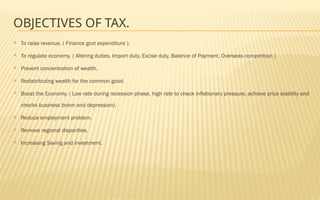
OBJECTIVES OF TAX.
To raise revenue. ( Finance govt expenditure ).
To regulate economy. ( Altering duties, Import duty, Excise duty, Balance of Payment, Overseas competition )
Prevent concentration of wealth.
Redistributing wealth for the common good.
Boost the Economy. ( Low rate during recession phase, high rate to check inflationary pressure, achieve price stability and
checks business boom and depression).
Reduce employment problem.
Remove regional disparities.
Increasing Saving and investment.
7.
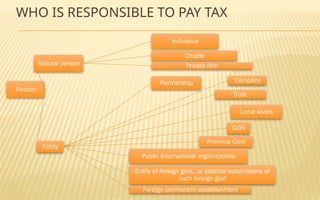
WHO IS RESPONSIBLETO PAY TAX
Person
Natural person
Individual
Couple
Private firm
Entity
Partnership
Trust
Company
Local levels
GON
Province Govt
Public International organizations
Entity of foreign govt., or political subdivisions of
such foreign govt
Foreign permanent establishment
8.
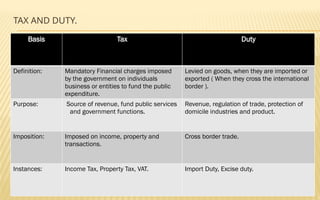
TAX AND DUTY.
BasisTax Duty
Definition: Mandatory Financial charges imposed
by the government on individuals
business or entities to fund the public
expenditure.
Levied on goods, when they are imported or
exported ( When they cross the international
border ).
Purpose: Source of revenue, fund public services
and government functions.
Revenue, regulation of trade, protection of
domicile industries and product.
Imposition: Imposed on income, property and
transactions.
Cross border trade.
Instances: Income Tax, Property Tax, VAT. Import Duty, Excise duty.
9.
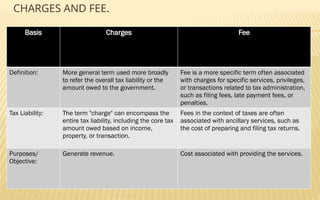
CHARGES AND FEE.
BasisCharges Fee
Definition: More general term used more broadly
to refer the overall tax liability or the
amount owed to the government.
Fee is a more specific term often associated
with charges for specific services, privileges,
or transactions related to tax administration,
such as filing fees, late payment fees, or
penalties.
Tax Liability: The term "charge" can encompass the
entire tax liability, including the core tax
amount owed based on income,
property, or transaction.
Fees in the context of taxes are often
associated with ancillary services, such as
the cost of preparing and filing tax returns.
Purposes/
Objective:
Generate revenue. Cost associated with providing the services.
10.
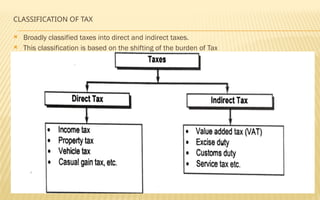
CLASSIFICATION OF TAX
Broadly classified taxes into direct and indirect taxes.
This classification is based on the shifting of the burden of Tax
11.
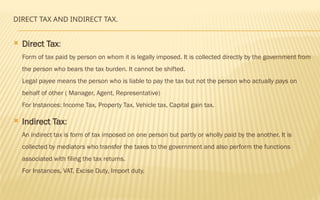
DIRECT TAX ANDINDIRECT TAX.
Direct Tax:
Form of tax paid by person on whom it is legally imposed. It is collected directly by the government from
the person who bears the tax burden. It cannot be shifted.
Legal payee means the person who is liable to pay the tax but not the person who actually pays on
behalf of other ( Manager, Agent, Representative)
For Instances: Income Tax, Property Tax, Vehicle tax, Capital gain tax.
Indirect Tax:
An indirect tax is form of tax imposed on one person but partly or wholly paid by the another. It is
collected by mediators who transfer the taxes to the government and also perform the functions
associated with filing the tax returns.
For Instances, VAT, Excise Duty, Import duty.
12.
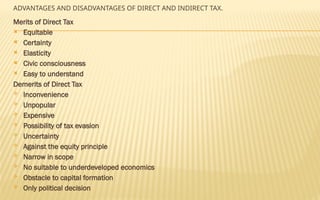
ADVANTAGES AND DISADVANTAGESOF DIRECT AND INDIRECT TAX.
Merits of Direct Tax
Equitable
Certainty
Elasticity
Civic consciousness
Easy to understand
Demerits of Direct Tax
Inconvenience
Unpopular
Expensive
Possibility of tax evasion
Uncertainty
Against the equity principle
Narrow in scope
No suitable to underdeveloped economics
Obstacle to capital formation
Only political decision
13.
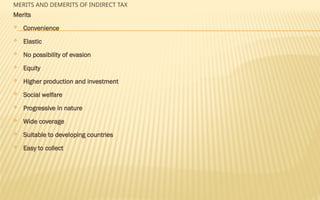
MERITS AND DEMERITSOF INDIRECT TAX
Merits
Convenience
Elastic
No possibility of evasion
Equity
Higher production and investment
Social welfare
Progressive in nature
Wide coverage
Suitable to developing countries
Easy to collect
14.
DEMERITS OF INDIRECTTAX
Uncertainty
No civil consciousness
Discourage saving
Inflationary
More uneconomical
Inequitable
No direct link with the government
15.
TAX ON INCOME:
Income:
Increase in economic benefits in the form of inflows, enhancement
of assets or decrease in liabilities that result in increase in equity,
other than those resulting to contributions from equity
participants.
Revenue:
Gross receipt from the disposal of goods and services.
Gain:
Gross receipt less total outflows to acquire it.
Revenue + Gains – Allowable Expenses = Income.
16.
TAX ON CAPITAL:
Tax on Land
Tax on NBCA ( Non Business Chargeable Assets )
Tax on Vehicle
Tax on Capital Gain
Tax on Windfall Gain
17.
VALUE ADDED TAX( VAT )
It is Indirect Tax, improved and modified form of sales tax.
It is levied on value added of goods and services at each
stage in the process of production and distribution chain.
Although VAT is eventually borne by the final consumer, it
is collected at each stage of production and distribution
chain.
Types of VAT:
i. Consumption type
ii. Income Type
iii. Gross National Product type ( GNP ).
18.
CUSTOM DUTY, EXCISEDUTY.
Import duty/Custom duty is a tariff levied on goods
when they are brought into a country. It is a financial
charge imposed by the government on imported
products.
Import duties serve various purposes, including revenue
generation, protection of domestic industries, trade
regulation, and correction of trade imbalances.
Excise duty, also known as excise tax, is a type of indirect
tax imposed by the government on the production, sale,
or consumption of certain goods within the country.
Excise duties are often considered "sin taxes" because
they are frequently applied to goods that are deemed
19.
CANONS OF TAXATION.
Basic principles of taxation upon which a good tax system
is built.
Canon of Equality.
Canon of Certainty. ( Time , Method, Amount, Place )
Canon of Convenience.
Canon of Economy.
Canon of Productivity.
Canon of Elasticity.
Canon of Diversity
RELATION OF INCOMETAX WITH OTHER LAWS
A. Income tax Act and constitution ( Article 15 )
B. Income tax act and Finance Act
C. Income Tax Act and Income Tax rules
D. Income Tax Act and provisional Tax realization Act
E. Income Tax Act and Legal Precedents established by court