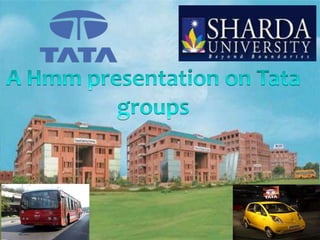
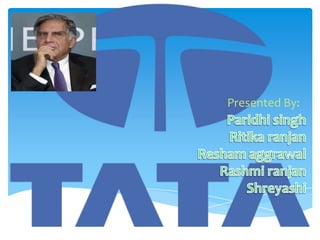
Presented By:
contents

Introduction
History of company
Different groups of tata
TATA ACQUISITION AND TARGETS
AWARDS AND RECOGNATION
CONTROVERCIES AND CRITICISM
OFFICES AND DEVLOPMENT CENTERS
INTRODUCTION


Tata Group is an Indian multinational conglomerate
company headquartered in Mumbai, Maharashtra,
India.
Tata Group operates more than 80 companies
ranging from software and automobiles to steel,
consumer goods and telecommunications. With
above 424,365 employees across India, it is the
nation's largest private employer.
Continue……..


The 2009, annual survey by the Reputation Institute
ranked Tata Group as the 11th most reputable
company in the world.
The group takes the name of its founder, Jamsedji
Tata, a member of whose family has almost invariably
been the chairman of the group. The current
chairman of the Tata group is Ratan Tata, who took
over from J. R. D. Tata in 1991.
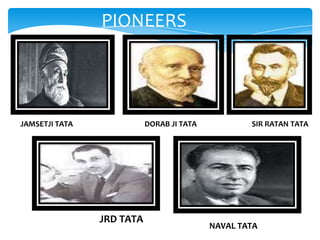
PIONEERS


JAMSETJI TATA              DORAB JI TATA           SIR RATAN TATA


                JRD TATA
                                           NAVAL TATA
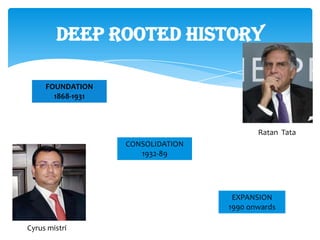
Deep rooted history

     FOUNDATION
       1868-1931


                                          Ratan Tata
                   CONSOLIDATION
                      1932-89


                                    EXPANSION
                                   1990 onwards

Cyrus mistri
HISTORY


The beginnings of the Tata Group can be traced back to
1868, when Jamsetji Nusserwanji Tata established a trading
company dealing in cotton in Bombay (now Mumbai), British
India.
This was followed by the installation of Empress Mills in Nagpur
in 1877. Taj Mahal Hotel in Bombay (now Mumbai) was opened
for business in 1903.
Sir Dorab Tata, the eldest son of Jamsetji became the chairman
of the group after his fathers death in 1904. Under him, the
group ventured into steel production (1905) and hydroelectric
power generation(1910).
Cont………


After the death of Dorab Tata in 1934, Nowroji Saklatwala
headed the group till 1938. He was succeeded by Jahangir
Ratanji Dadabhoy Tata.
 The group expanded significantly under him with the
establishment of Tata Chemicals (1939), Tata Motors and
Tata Industries (both 1945), Voltas (1954), Tata Tea (1962),
Tata Consultancy Services (1968) and Titan Industries
(1984).
 Ratan Tata, the incumbent chairman of the group
succeeded JRD Tata in 1991.
Different groups of tata


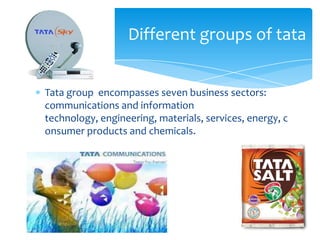
Tata group encompasses seven business sectors:
communications and information
technology, engineering, materials, services, energy, c
onsumer products and chemicals.
TATA GROUP


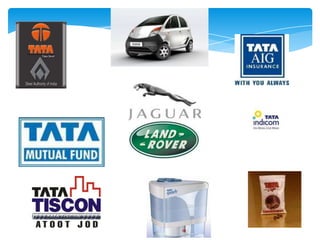
    Tata group has spread itself in various sectors:- they
    are
   ENGINEERING:- Tata products, Voltas consumer
    electronic co.
   ENERGY AND POWER.
   CHEMICALS:- Rallis India, Tata Pigments.
   SERVICES:- The Indian hotels co., Tata Asset
    management.
   COMSUMER PRODUCTS:- Tata Salt, Tata sky.


   INFORMATION SYSTEM: - Nelco, TCS.


   PHILANTHROPHY & NATION BUILDING: - TATA
    Memorial Hospitals, Indian Institute Of Sciences.
   AUTOMOBLIE SECTOR: -TATA MOTORS
Strategies of TATA


The TATA group restructuring involved various
steps such as building Tata Brand, Reviving its
managerial recruitment and retaining practices
(through,reviving TAS), changing the portfolio of
business lines, and most importantly making the
group more cohesive and controllable.
Cond……


• An increased complexity in the cross holdings
  among group companies is a classic counter
  takeover defense strategy.

• As we see that TATA group companies have
  increased their investment in other group
  companies at a rapid pace compared to the slow
  rise in their dividend payments.
Cond……


An increase in the cross holding structure of group
companies combined structure s provided a
mechanism for the TATA group to control firms
within the group without necessarily having
significant equity investment. We found that the
group has indeed achieved higher control.
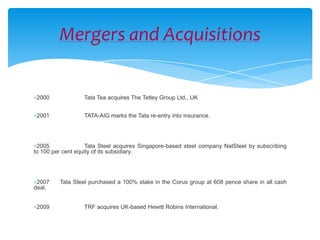
Mergers and Acquisitions


 2000             Tata Tea acquires The Tetley Group Ltd., UK


 2001             TATA-AIG marks the Tata re-entry into insurance.


 2005               Tata Steel acquires Singapore-based steel company NatSteel by subscribing
to 100 per cent equity of its subsidiary.


 2007    Tata Steel purchased a 100% stake in the Corus group at 608 pence share in all cash
deal.


 2009             TRF acquires UK-based Hewitt Robins International.
2008: Jaguar and land rover Brands
February 2000 – Tetley Tea Company, $407 million
March 2004 – Daewoo Commercial Vehicle Company, $102 million
August 2004 – NatSteel's Steel business, $292 million
November 2004 – Tyco Global Network, $130 million
July 2005 – Teleglobe International Holdings, $239 million
October 2005 – Good Earth Corporation
December 2005 – Millennium Steel, Thailand, $167 million
December 2005 – Brunner Mond Chemicals, $120 million
June 2006 – Eight O'Clock Coffee, $220 million
November 2006 – Ritz Carlton Boston, $170 million
Jan 2007 – Corus Group, $12 billion
March 2007 – PT Kaltim Prima Coal (KPC) (Bumi Resources), $1.1 billion
April 2007 – Campton Place Hotel, San Francisco, $60 million
January 2008 – Imacid Chemical Company, Morocco[12]
February 2008 – General Chemical Industrial Products, $1 billion
March 2008 – Jaguar Cars and Land Rover, $2.3 billion
March 2008 – Serviplem SA, Spain
April 2008 – Comoplesa Lebrero SA, Spain
May 2008 – Piaggio Aero Industries S.p.A., Italy
June 2008 – China Enterprise Communications, China
June 2008 – Neotel, South Africa
October 2008 – Miljo Grenland / Innovasjon, Norway
AWARDS AND RECOGNATION


 On the occasion of India's 50th Republic Day on 26
January 2000, Ratan Tata was honored with the
Padma Bhushan.
In February 2004, Ratan Tata was conferred the title
of honorary economic advisor to Hangzhou city in the
Zhejiang province of China.
He was listed among the 25 most powerful people in
business named by Fortune magazine in November
2007.
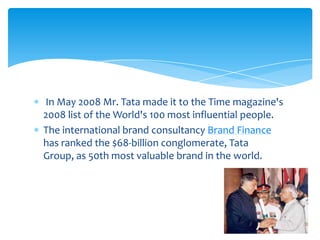
In May 2008 Mr. Tata made it to the Time magazine's
2008 list of the World's 100 most influential people.
The international brand consultancy Brand Finance
has ranked the $68-billion conglomerate, Tata
Group, as 50th most valuable brand in the world.
TATA Innovation


   Tata looks at innovation as a strategic approach to global growth and
    has adopted a three-pronged strategy to encourage it.

   The three key drivers are better communication and recognition of
    innovative ideas and efforts; facilities for learning from other companies;
    and support for collaborative research and partnerships with academic
    institutions.

   Communication and recognition a number of initiatives have been
    launched to spread the message of innovation and recognise
    innovators:Tata Group Innovation Forum (TGIF):

   The role of TGIF members is to assist their companies in experimenting
    with ideas, propagate the relevant ones and spread them through the
    enterprise
Philanthropy


The Tata Group has helped establish and finance
numerous quality research, educational and cultural
institutes in India.The Tata Group was awarded the
Carnegie Medal of Philanthropy in 2007 in recognition
of the group's long history of philanthropic
activities.Some of the institutes established by the
Tata Group are:
Tata Institute of Fundamental Research
Tata Institute of Social Sciences
Indian Institute of Science
National Centre for Performing Arts
Tata Management Training Centre
Tata Memorial Hospital
Tata Football Academy
Tata Cricket Academy
Tata Trusts, a group of philanthropic organisations run by the head of the
business conglomerate Tata Sons[17]
The JRD Tata Ecotechnology Centre
The Energy and Resources Institute (earlier known as Tata Energy and
Research Institute) – a non governmental research institute.
The Tata Group has donated a Rs. 220 crore
($50 million) to the prestigious Harvard Business
School (HBS) to build an academic and a residential
building on the institute’s campus in Boston,
Massachusetts. The new building will be called the
Tata Hall and used for the institute’s executive
education programmes.[18] The amount is the largest
from an international donor in the business school's
102-year-old existence.
CONTROVERCIES AND CRITICISM


Apart from success there are also some controvercies
associated with tata groups some are:
Kalinganagar CONTROVERCIES,
Orissa Dow Chemicals,
Land acquisition in Singur ,
Dhamra Port
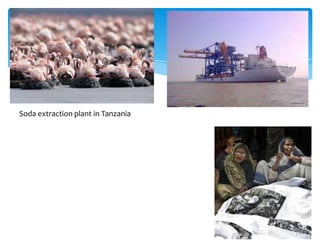
Soda extraction plant in Tanzania
Singur controversy


Tata Nano Singur Controversy refers to the
controversy generated by land acquisition of the
proposed Nano factory of Tata Motors at [Singur] in
Hooghly district, West Bengal, India.
Kalinagar controversy


On 2 January 2006, policemen at
Kalinganagar, Orissa, opened fire at a crowd of tribal
villagers. The villagers were protesting the
construction of a compound wall on land historically
owned by them, for a Tata steel plant. Some of the
corpses were returned to the families in a mutilated
condition. When pushed for comment, TATA officials
said the incident was unfortunate but that it would
continue with its plans to set up the plant.
Orissa Dow Chemicals,


In November 2006, survivors of the Bhopal gas disaster
were outraged by Ratan Tata’s offer to bail out Union
Carbide and facilitate investments by Carbide’s new owner
Dow Chemical. Tata had proposed leading a charitable
effort to clean-up the toxic wastes abandoned by Carbide
in Bhopal. At a time when the Government of India has
held Dow Chemical liable for the clean-up and requested
Rs. 100 crores from the American MNC, survivor’s groups
felt that Tata’s offer was aimed at frustrating legal efforts
to hold the company liable, and motivated by a desire to
facilitate Dow’s investments in India.[27]
Dhamra Port


The Dhamra port, a venture between Tata Steel and Larsen &
Toubro, has come in for criticism for its proximity to the
Gahirmatha Sanctuary and Bhitarkanika National Park, from
Indian and international organisations, including Greenpeace..
TATA officials have denied that the port poses an ecological
threat, and stated that mitigation measures are being employed
with the advice of the IUCN. On the other hand, conservation
organisations, including Greenpeace, have pointed out that no
proper Environment Impact Analysis has been done for the
project, which has undergone changes in size and specifications
since it was first proposed and that the port could interfere with
mass nesting at the Gahirmtha beaches and the ecology of the
Bitharkanika mangrove forest.
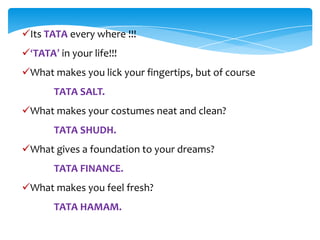
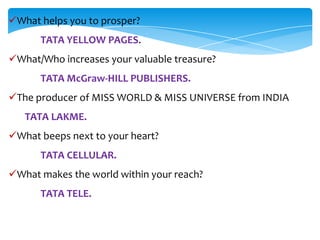
Soda extraction plant in Tanzania


Tata group, along with a Tanzanian company, joined forces to build a soda
ash extraction plant in Tanzania.[40] The Tanzanian government is all for the
project.[40] On the other hand, environmental activists are opposing the
plant because it would be near Lake Natron, and it could possibly affect the
lake's ecosystem and its neighbouring dwellers.[41]
Tata was planning to change the site of the plant so it would be built 32 km
from the lake, but the opposition still thinks it would negatively disturb the
environment.[41] It could also jeopardise the Lesser Flamingo birds
there, which are already endangered. Lake Natron is where two thirds of
Lesser Flamingos reproduce.[42] Producing soda ash involves drawing out
salt water from the lake, and then disposing the water back to the lake. This
process could interrupt the chemical make up of the lake.[40] Twenty-two
African nations are against the creation of the project and have signed a
petition to stop its construction.[40]
Soda extraction plant in Tanzania
Type           Private
Industry       Conglomerate
Founded        1868
Founder(s)     Jamsetji Tata
Headquarters   Mumbai, Maharashtra, India
Area served    Worldwide
               Ratan Tata
               (chairman)
Key people
               Cyrus Pallonji Mistry
               (Deputy Chairman)[1]
               Automotive, steel, IT services, electricity generation,
Products       chemicals, beverages, telecom, hotels, financial services,
               consumer goods, retailing, engineering goods
Revenue        US$ 83.3 billion (2010-11)[2]
Profit         US$ 5.8 billion (2010-11)[2]
Total assets   US$ 68.9 billion (2010-11)[2]
Owner(s)       Tata Sons
Employees      424,365 (2010-11)[2]
Subsidiaries   List of subsidiaries
Its TATA every where !!!
‘TATA’ in your life!!!
What makes you lick your fingertips, but of course
       TATA SALT.
What makes your costumes neat and clean?
       TATA SHUDH.
What gives a foundation to your dreams?
       TATA FINANCE.
What makes you feel fresh?
       TATA HAMAM.
What helps you to prosper?
      TATA YELLOW PAGES.
What/Who increases your valuable treasure?
      TATA McGraw-HILL PUBLISHERS.
The producer of MISS WORLD & MISS UNIVERSE from INDIA
   TATA LAKME.
What beeps next to your heart?
      TATA CELLULAR.
What makes the world within your reach?
      TATA TELE.
What makes you more relaxed other than your wife/spouse?
      TAJ RESORTS.
What keeps you on the move?
      TATA ENGINEERING & LOCOMOTIVE.
What protects you from disease?
      TATA PHARMA.
What makes you punctual?
      TITAN.
Who gives you a roof over your head?
      TATA HOUSING.
tata ppt

tata ppt

  • 2.
  • 3.
    contents Introduction History of company Differentgroups of tata TATA ACQUISITION AND TARGETS AWARDS AND RECOGNATION CONTROVERCIES AND CRITICISM OFFICES AND DEVLOPMENT CENTERS
  • 4.
    INTRODUCTION Tata Group isan Indian multinational conglomerate company headquartered in Mumbai, Maharashtra, India. Tata Group operates more than 80 companies ranging from software and automobiles to steel, consumer goods and telecommunications. With above 424,365 employees across India, it is the nation's largest private employer.
  • 5.
    Continue…….. The 2009, annualsurvey by the Reputation Institute ranked Tata Group as the 11th most reputable company in the world. The group takes the name of its founder, Jamsedji Tata, a member of whose family has almost invariably been the chairman of the group. The current chairman of the Tata group is Ratan Tata, who took over from J. R. D. Tata in 1991.
  • 6.
    PIONEERS JAMSETJI TATA DORAB JI TATA SIR RATAN TATA JRD TATA NAVAL TATA
  • 7.
    Deep rooted history FOUNDATION 1868-1931 Ratan Tata CONSOLIDATION 1932-89 EXPANSION 1990 onwards Cyrus mistri
  • 8.
    HISTORY The beginnings ofthe Tata Group can be traced back to 1868, when Jamsetji Nusserwanji Tata established a trading company dealing in cotton in Bombay (now Mumbai), British India. This was followed by the installation of Empress Mills in Nagpur in 1877. Taj Mahal Hotel in Bombay (now Mumbai) was opened for business in 1903. Sir Dorab Tata, the eldest son of Jamsetji became the chairman of the group after his fathers death in 1904. Under him, the group ventured into steel production (1905) and hydroelectric power generation(1910).
  • 9.
    Cont……… After the deathof Dorab Tata in 1934, Nowroji Saklatwala headed the group till 1938. He was succeeded by Jahangir Ratanji Dadabhoy Tata. The group expanded significantly under him with the establishment of Tata Chemicals (1939), Tata Motors and Tata Industries (both 1945), Voltas (1954), Tata Tea (1962), Tata Consultancy Services (1968) and Titan Industries (1984). Ratan Tata, the incumbent chairman of the group succeeded JRD Tata in 1991.
  • 10.
    Different groups oftata Tata group encompasses seven business sectors: communications and information technology, engineering, materials, services, energy, c onsumer products and chemicals.
  • 11.
    TATA GROUP Tata group has spread itself in various sectors:- they are  ENGINEERING:- Tata products, Voltas consumer electronic co.  ENERGY AND POWER.  CHEMICALS:- Rallis India, Tata Pigments.  SERVICES:- The Indian hotels co., Tata Asset management.
  • 12.
    COMSUMER PRODUCTS:- Tata Salt, Tata sky.  INFORMATION SYSTEM: - Nelco, TCS.  PHILANTHROPHY & NATION BUILDING: - TATA Memorial Hospitals, Indian Institute Of Sciences.  AUTOMOBLIE SECTOR: -TATA MOTORS
  • 14.
    Strategies of TATA TheTATA group restructuring involved various steps such as building Tata Brand, Reviving its managerial recruitment and retaining practices (through,reviving TAS), changing the portfolio of business lines, and most importantly making the group more cohesive and controllable.
  • 15.
    Cond…… • An increasedcomplexity in the cross holdings among group companies is a classic counter takeover defense strategy. • As we see that TATA group companies have increased their investment in other group companies at a rapid pace compared to the slow rise in their dividend payments.
  • 16.
    Cond…… An increase inthe cross holding structure of group companies combined structure s provided a mechanism for the TATA group to control firms within the group without necessarily having significant equity investment. We found that the group has indeed achieved higher control.
  • 17.
    Mergers and Acquisitions 2000 Tata Tea acquires The Tetley Group Ltd., UK 2001 TATA-AIG marks the Tata re-entry into insurance. 2005 Tata Steel acquires Singapore-based steel company NatSteel by subscribing to 100 per cent equity of its subsidiary. 2007 Tata Steel purchased a 100% stake in the Corus group at 608 pence share in all cash deal. 2009 TRF acquires UK-based Hewitt Robins International.
  • 18.
    2008: Jaguar andland rover Brands February 2000 – Tetley Tea Company, $407 million March 2004 – Daewoo Commercial Vehicle Company, $102 million August 2004 – NatSteel's Steel business, $292 million November 2004 – Tyco Global Network, $130 million July 2005 – Teleglobe International Holdings, $239 million October 2005 – Good Earth Corporation December 2005 – Millennium Steel, Thailand, $167 million December 2005 – Brunner Mond Chemicals, $120 million June 2006 – Eight O'Clock Coffee, $220 million November 2006 – Ritz Carlton Boston, $170 million Jan 2007 – Corus Group, $12 billion March 2007 – PT Kaltim Prima Coal (KPC) (Bumi Resources), $1.1 billion April 2007 – Campton Place Hotel, San Francisco, $60 million January 2008 – Imacid Chemical Company, Morocco[12] February 2008 – General Chemical Industrial Products, $1 billion March 2008 – Jaguar Cars and Land Rover, $2.3 billion March 2008 – Serviplem SA, Spain April 2008 – Comoplesa Lebrero SA, Spain May 2008 – Piaggio Aero Industries S.p.A., Italy June 2008 – China Enterprise Communications, China June 2008 – Neotel, South Africa October 2008 – Miljo Grenland / Innovasjon, Norway
  • 19.
    AWARDS AND RECOGNATION On the occasion of India's 50th Republic Day on 26 January 2000, Ratan Tata was honored with the Padma Bhushan. In February 2004, Ratan Tata was conferred the title of honorary economic advisor to Hangzhou city in the Zhejiang province of China. He was listed among the 25 most powerful people in business named by Fortune magazine in November 2007.
  • 20.
    In May 2008Mr. Tata made it to the Time magazine's 2008 list of the World's 100 most influential people. The international brand consultancy Brand Finance has ranked the $68-billion conglomerate, Tata Group, as 50th most valuable brand in the world.
  • 21.
    TATA Innovation  Tata looks at innovation as a strategic approach to global growth and has adopted a three-pronged strategy to encourage it.  The three key drivers are better communication and recognition of innovative ideas and efforts; facilities for learning from other companies; and support for collaborative research and partnerships with academic institutions.  Communication and recognition a number of initiatives have been launched to spread the message of innovation and recognise innovators:Tata Group Innovation Forum (TGIF):  The role of TGIF members is to assist their companies in experimenting with ideas, propagate the relevant ones and spread them through the enterprise
  • 22.
    Philanthropy The Tata Grouphas helped establish and finance numerous quality research, educational and cultural institutes in India.The Tata Group was awarded the Carnegie Medal of Philanthropy in 2007 in recognition of the group's long history of philanthropic activities.Some of the institutes established by the Tata Group are:
  • 23.
    Tata Institute ofFundamental Research Tata Institute of Social Sciences Indian Institute of Science National Centre for Performing Arts Tata Management Training Centre Tata Memorial Hospital Tata Football Academy Tata Cricket Academy Tata Trusts, a group of philanthropic organisations run by the head of the business conglomerate Tata Sons[17] The JRD Tata Ecotechnology Centre The Energy and Resources Institute (earlier known as Tata Energy and Research Institute) – a non governmental research institute.
  • 24.
    The Tata Grouphas donated a Rs. 220 crore ($50 million) to the prestigious Harvard Business School (HBS) to build an academic and a residential building on the institute’s campus in Boston, Massachusetts. The new building will be called the Tata Hall and used for the institute’s executive education programmes.[18] The amount is the largest from an international donor in the business school's 102-year-old existence.
  • 25.
    CONTROVERCIES AND CRITICISM Apartfrom success there are also some controvercies associated with tata groups some are: Kalinganagar CONTROVERCIES, Orissa Dow Chemicals, Land acquisition in Singur , Dhamra Port Soda extraction plant in Tanzania
  • 26.
    Singur controversy Tata NanoSingur Controversy refers to the controversy generated by land acquisition of the proposed Nano factory of Tata Motors at [Singur] in Hooghly district, West Bengal, India.
  • 27.
    Kalinagar controversy On 2January 2006, policemen at Kalinganagar, Orissa, opened fire at a crowd of tribal villagers. The villagers were protesting the construction of a compound wall on land historically owned by them, for a Tata steel plant. Some of the corpses were returned to the families in a mutilated condition. When pushed for comment, TATA officials said the incident was unfortunate but that it would continue with its plans to set up the plant.
  • 28.
    Orissa Dow Chemicals, InNovember 2006, survivors of the Bhopal gas disaster were outraged by Ratan Tata’s offer to bail out Union Carbide and facilitate investments by Carbide’s new owner Dow Chemical. Tata had proposed leading a charitable effort to clean-up the toxic wastes abandoned by Carbide in Bhopal. At a time when the Government of India has held Dow Chemical liable for the clean-up and requested Rs. 100 crores from the American MNC, survivor’s groups felt that Tata’s offer was aimed at frustrating legal efforts to hold the company liable, and motivated by a desire to facilitate Dow’s investments in India.[27]
  • 29.
    Dhamra Port The Dhamraport, a venture between Tata Steel and Larsen & Toubro, has come in for criticism for its proximity to the Gahirmatha Sanctuary and Bhitarkanika National Park, from Indian and international organisations, including Greenpeace.. TATA officials have denied that the port poses an ecological threat, and stated that mitigation measures are being employed with the advice of the IUCN. On the other hand, conservation organisations, including Greenpeace, have pointed out that no proper Environment Impact Analysis has been done for the project, which has undergone changes in size and specifications since it was first proposed and that the port could interfere with mass nesting at the Gahirmtha beaches and the ecology of the Bitharkanika mangrove forest.
  • 30.
    Soda extraction plantin Tanzania Tata group, along with a Tanzanian company, joined forces to build a soda ash extraction plant in Tanzania.[40] The Tanzanian government is all for the project.[40] On the other hand, environmental activists are opposing the plant because it would be near Lake Natron, and it could possibly affect the lake's ecosystem and its neighbouring dwellers.[41] Tata was planning to change the site of the plant so it would be built 32 km from the lake, but the opposition still thinks it would negatively disturb the environment.[41] It could also jeopardise the Lesser Flamingo birds there, which are already endangered. Lake Natron is where two thirds of Lesser Flamingos reproduce.[42] Producing soda ash involves drawing out salt water from the lake, and then disposing the water back to the lake. This process could interrupt the chemical make up of the lake.[40] Twenty-two African nations are against the creation of the project and have signed a petition to stop its construction.[40]
  • 31.
  • 32.
    Type Private Industry Conglomerate Founded 1868 Founder(s) Jamsetji Tata Headquarters Mumbai, Maharashtra, India Area served Worldwide Ratan Tata (chairman) Key people Cyrus Pallonji Mistry (Deputy Chairman)[1] Automotive, steel, IT services, electricity generation, Products chemicals, beverages, telecom, hotels, financial services, consumer goods, retailing, engineering goods Revenue US$ 83.3 billion (2010-11)[2] Profit US$ 5.8 billion (2010-11)[2] Total assets US$ 68.9 billion (2010-11)[2] Owner(s) Tata Sons Employees 424,365 (2010-11)[2] Subsidiaries List of subsidiaries
  • 33.
    Its TATA everywhere !!! ‘TATA’ in your life!!! What makes you lick your fingertips, but of course TATA SALT. What makes your costumes neat and clean? TATA SHUDH. What gives a foundation to your dreams? TATA FINANCE. What makes you feel fresh? TATA HAMAM.
  • 34.
    What helps youto prosper? TATA YELLOW PAGES. What/Who increases your valuable treasure? TATA McGraw-HILL PUBLISHERS. The producer of MISS WORLD & MISS UNIVERSE from INDIA TATA LAKME. What beeps next to your heart? TATA CELLULAR. What makes the world within your reach? TATA TELE.
  • 35.
    What makes youmore relaxed other than your wife/spouse? TAJ RESORTS. What keeps you on the move? TATA ENGINEERING & LOCOMOTIVE. What protects you from disease? TATA PHARMA. What makes you punctual? TITAN. Who gives you a roof over your head? TATA HOUSING.