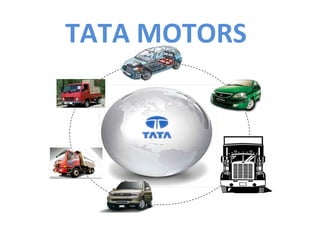
TATA MOTORS
Global Footprint Malaysia* Thailand  Bangladesh * Nepal, Sri Lanka  Kenya* Russia* Ukraine*  U.K. Italy  Senegal  Afghanistan  Uzbekistan  Brazil  South Africa* Egypt  Saudi Arabia  Iraq, Iran  China  South Korea*  LATAM  West Africa  North Africa  West Europe Central Asia  East Asia  South Asia  South East Asia  West Asia  East Africa  South Africa  * Assembly Operations also OTHER COLLABORATIONS/M&A & JVs Tata Daewoo Commercial Vehicle Hispano in Spain & Marcopolo In Brazil JV with Jardine Matheson for ConcordeMotors Technology Tie Ups at Spain,Italy
Product Range
Technological Resources R & D establishments at Jamshedpur, Pune & Lucknow – over 1400 engineers. India’s only certified crash test facility for cars and hemi anechoic chamber for testing of noise and vibration. Tata Motors European Technical Centre (TMETC) set up in 2005 – primarily involved in design engineering and development of products, supporting Tata Motors skill sets. Tata Daewoo Commercial Vehicle Co. has its R&D facility in Gunsan, South Korea. Hispano Carrocera has its R&D facility at Zaragoza in Spain.
Organizational Resources Process Approach – EPM (derived from APQC processes and TBEM model.
The Enterprise Process Model
Sound leadership – JRD, Sumant Moolgaokar, Ratan Tata Ethical business practices – guided by the Tata Code of Conduct Successful handling of integration issues – Tata Daewoo, Jaguar – Land Rover Reputation and recognition – Tata brand. CSR initiatives  Adaptability to the changing business dynamics.
Financial Resources Stable cash flows for the past five years Cash rich corporate parent – Tata Sons Strong reputation – access to capital markets
Value Chain & Value System Suppliers , Contractors Strategic Alliances Transporters, Convoy Drivers Association Dealer Network, Marketing Research Firms, Vehicle Financing Regional Warehouses, Dealer Workshops, Distributors, TASS Inbound  Logistics Operations Marketing Service Outbound  Logistics SAP , VCM SAP , CRM - DMS
Inbound Logistics Long term contract with service provider’s – transporters and agents. Personnel at regional offices for over seeing the smooth transit of goods. Transparency and monitoring through deployment of IT – all transactions through SAP. DTL supplies for critical high value items. Efficient storage facilities – easy storage and retrieval.
Operations Capital Equipment Manufacturing division – tooling development capabilities of global standard. Apprentice Trainee Course – ensuring stable source of skilled manpower. Kaizen & TPM team – continuous drive to improve efficiencies. Automated manufacturing processes. Distributed manufacturing – Assembly units at South Africa, Thailand, Bangladesh, Brazil etc. Maintenance – technical competence. Capacity Utilization – Mercedes Benz cars make use of Tata Motors paint shop facilities.
Outbound Logistics Stockyards, all across the country. Long term contracts with transporter’s – higher volume of business to transporters ensures competitive price. Regional Sales Office and Vehicle Dispatch Section linked through SAP. Efficient security system for prevention of any kind of pilferage.
Marketing & Sales Structured approach to understanding the requirements of individual customers – QFD’s conducted at regular intervals. Clear identification of product requirements, leading to development of innovative products – Tata 207 DI, Tata Ace Pan India presence and global footprint. Independent teams for addressing the requirements of institutional customers – Defense, State Transport Units Helping to augment the scarce resources – Fiat selling vehicles through Tata dealerships, in return Tata has access to Fiat’s technology and unutilized capacity. Quick assessment of the changing market dynamics and consumer preferences – Tata 407 LCV  Large network of dealers – use of technology : DMS.
Service Easy availability of spare parts. Efficient collection of data from field and communication to the respective plants. Pan India presence, as well as global presence. Large network of workshops – Dealer workshops and TASS. Training facilities – for dealer end and TASS personnel.
Procurement E procurement initiative. Global Sourcing Team – China , a key destination for sourcing essential items like tires, power steering units etc., Steel procured from Belarus Long term relationships with a stable and loyal pool of suppliers. Technology driven procurement – SAP and VCM. Strategic subsidiaries & JV’s – TACO group of companies , Tata Cummins Centralized Strategic Sourcing for key components – FIP’s, Steel etc. Group resources – Tata Steel and Tata International . Localized supplier base at mfg. locations – low inventory levels.
Technology Development Approximately 2% of the annual profits of the company invested in research and development. Knowledge portal – helps employees keep abreast with the latest technologies. Extensive prototype building and testing facilities. Strategic partnerships – MDI (France), Fiat etc. Formal benchmarking process. “ Technology Day” organized across all plant locations.
Human Resource Vast pool of technically competent engineers and managers. Focus on development of technical capabilities – Technical Training Center’s, Alliance with technical Institutes Focus on development of managerial capabilities – MTC’s , TMTC, executive training programs at premier business schools Career advancement schemes – ESS, FTSS
Firm Infrastructure Multi – Location facilities Strong leadership – under the aegis of Tata Sons  Best in class prototype building facilities Technology – SAP Large product portfolio
Dynamic Capabilities NPI Process – reduced time to market
Leveraging the resources How did TATA create initial resource complement to overcome the disadvantage of being newcomers in passenger car business?  STRATEGY INSTITUTIONS Government support (10Year Plan) New institutions for trade promotion, technology up-gradation, quality enhancement ( ACMA :  Automotive Component Manufacturers Association ,  SIAM :  Society of Indian Automobile Manufacturers  ) R&D Acquisitions Strategic partnerships Joint ventures Intensive management development
Key Strategies International strategy based on the  competitive advantage : New product (eg. Tata Nano, the cheapest car in the World). Acquisitions (eg. Land Rover and Jaguar brands from Ford Motors). Partnership with established companies (eg. Alliance with Fiat since 2006) to enhance the product portfolio and knowledge exchange. Facilities for learning from other companies. Developing programmes for intensive management development. Consolidate position in India by  exploiting opportunities : New mobility of young Indians. Government’s substantial road-building program GDP growth
Optimize the value chain using  distributed  Manufacturing The power of IT has been extensively leveraged  State-of-the-art CAD and CAM services integrated design across multiple disciplines  IT helped the company shrink the design cycle time BSM tools from BMC Software played a key role   TML decided to adopt IT service management concepts outlined in the ISO 20000:05 international standards, as well as best practices outlined in the IT Infrastructure Library® (ITIL®) Version 3  Process Benchmarking
Process Benchmarking service-oriented management architecture that treated services as assets and managed them on a life cycle basis. In-house manufacturing capability with CNC manufacturing operations have implemented Six-sigma, Kaizen & TPM .
Strategic Benchmarking
Objective:  Innovation across the value chain leading to affordable products that can grow the market Product innovation needs to be complemented with innovation in other parts of the value chain Co- location of suppliers On- line bidding by suppliers Reduction in the number of suppliers Partnerships with vendors Dedicated “Suvidha” service network in small towns Strategic Benchmarking
The sole winner of the JRD QV Award 2005 was the commercial vehicle business unit, or CVBU, of Tata Motors   PCBU's business excellence initiative has come into its own. Serious Adoption Award in 2004  Active Promotion Award in 2005 Tata Motors have crossed the level of 60% to win the JRD-QV award in 2001, 2004 & 2005 respectively   Achievements
Stretch and Leverage Vision : “best in the manner in which we operate, best in the products we deliver, and best in our value system and ethics”  Engineering, construction and automotive solutions  R&D focus on environment-friendly technologies in emissions and alternative fuels Maintain cost competitiveness through continuous improvements in control over key inputs and enhanced asset utilization  Best in class human capital that are constantly in touch with the industry, competitors, customers and the suppliers
Stretch and Leverage contd.. Tata – Nano: The innovative small car for the urban middle class  Fulfill the requirements of its customer value proposition Deliberately created a young team with good leadership capabilities who think differently Excellence in outsourcing Reconceived its supplier strategy - 85% of the Nano’s components Fewer supplier (<60%)
Stretch and Leverage contd.. Acquisition : Land Rover and Jaguar for $2.3 billion  -  Complementing Resources - Blending & Balancing High Replacement cost Complimentary to Tata Motor in the upstream business Access to global markets  Transfer of knowledge, technology from high end market
Stretch and Leverage contd.. Overall .. Strong product development capability  Manufacture products or deliver services of highest quality at lowest prices  Sufficiently widespread distribution and service network  working around offering more affordable, more value-oriented products
Technological Framework Attribute: Innovation around cost  “ globally recognized” technological capabilities '50s and '60s technical collaboration with Mercedes Benz to design and manufacture its chosen line of projects  Strong R&D at ERC Possess capability to develop and test durability, engine performance, emission, safety, design and style, noise, hydraulics, tracks, and instrumentation.  Opportunity to experiment and learn from mistake
Technology Capability Hierarchy
Achievements The company has the only world-class crash facility in Asia outside Korea and Japan  Developed an A-ECU (Electronic Control Unit) and low-cost accessories that would effectively manage critical engine and vehicle systems without calling for a full-fledged and expensive conventional ECU  Striding towards new emission standards  Equipping vehicles of the future with technologies for improving communication, navigation and entertainment- OneCat conceptual car with fiber glass powered by air and emission free.
Diversification 1977– First CV from Pune plant. 1983– First HCV rolled out. 1986– First LCV (Tata 407) launched followed by Tata 608. 1991– First passenger car Tata Sierra launched. 1992– Tata Estate launched. 1994– Launch of Tata Sumo.
Diversification 1995– Mercedes Benz car E220 launched 1997– Tata Sierra Turbo launched. 1998– India’s first SUV launched. 1998– India’s first indigenous Passenger Car Indica launched.  2001– Second Generation Indica v2 launched. 2008– Launch of Suma Grande 2008– Launch of Nano at ninth Auto Expo
But, the war is on… Maruti Vs Tata Motors
The Preparations… Proper utilization of assets Motivating people to work hard Selective hiring Job fitting Training program Better working environment
To create….
HR Philosophy Caring, show respect, compassion and humanity for colleagues Work cohesively with colleagues across the group Encourages self-sufficiency Employees' relatives at Pune have been encouraged to form various industrial co-operatives The Tata Motors Grihini Social Welfare Society caters to employees' women dependents'
HR Policies Executive Selection Scheme (ESS) - fast track programme for accelerated growth In-house vocational training and apprenticeship programme trains the technicians Rotational assignments and cross-functional mobility allow employees to grow
All said and done…a new strategy is required… The Blue Ocean Strategy
Blue Ocean Strategy Red Ocean Blue Ocean Compete in the existing market place Create unconsolidated market space Beat the competition Make the competition irrelevant Exploit existing demand Create and capture new demand Make the value cost trade off Break the value-cost trade off Differentiation or Low cast Differentiation and Low Cost
Focus on the non-customers
Corporate strategy, parenting and synergies To buy premium vehicle brands such as Land Rover and Jaguar bolster Tata Motors’ image as a global company and increase its global reach and scale Overall, the Tata group has spent around $15.5 billion in acquiring foreign companies  The Tata name is a unique asset representing leadership with trust  Leveraging this asset to enhance group synergy and becoming globally competitive
Corporate strategy, parenting and synergies  contd..  synergy developed as a result of the strengths of domestic and foreign market share, congregating under the umbrella of Tata group The Tata Group as a whole has over 20 publicly listed enterprises and operates in more than 80 countries world-wide - lots of experience and resources to draw from for research and development purposes   Strong corporate governance based on “rich legacy of fair, ethical, and transparent governance practices”  to ensure that its employees act ethically and the business continues to run smoothly
Corporate Advantages from Diversified Business Sharing of Activities/Resource Tata Steel Tata  Motor TCS Tata Cummins Sharing of Skills/Core Competence Tata Steel Core  Competence Tata Cummins TAML TACO
Thank you

Tata Motors

  • 1.
  • 2.
    Global Footprint Malaysia*Thailand Bangladesh * Nepal, Sri Lanka Kenya* Russia* Ukraine* U.K. Italy Senegal Afghanistan Uzbekistan Brazil South Africa* Egypt Saudi Arabia Iraq, Iran China South Korea* LATAM West Africa North Africa West Europe Central Asia East Asia South Asia South East Asia West Asia East Africa South Africa * Assembly Operations also OTHER COLLABORATIONS/M&A & JVs Tata Daewoo Commercial Vehicle Hispano in Spain & Marcopolo In Brazil JV with Jardine Matheson for ConcordeMotors Technology Tie Ups at Spain,Italy
  • 3.
  • 4.
    Technological Resources R& D establishments at Jamshedpur, Pune & Lucknow – over 1400 engineers. India’s only certified crash test facility for cars and hemi anechoic chamber for testing of noise and vibration. Tata Motors European Technical Centre (TMETC) set up in 2005 – primarily involved in design engineering and development of products, supporting Tata Motors skill sets. Tata Daewoo Commercial Vehicle Co. has its R&D facility in Gunsan, South Korea. Hispano Carrocera has its R&D facility at Zaragoza in Spain.
  • 5.
    Organizational Resources ProcessApproach – EPM (derived from APQC processes and TBEM model.
  • 6.
  • 7.
    Sound leadership –JRD, Sumant Moolgaokar, Ratan Tata Ethical business practices – guided by the Tata Code of Conduct Successful handling of integration issues – Tata Daewoo, Jaguar – Land Rover Reputation and recognition – Tata brand. CSR initiatives Adaptability to the changing business dynamics.
  • 8.
    Financial Resources Stablecash flows for the past five years Cash rich corporate parent – Tata Sons Strong reputation – access to capital markets
  • 9.
    Value Chain &Value System Suppliers , Contractors Strategic Alliances Transporters, Convoy Drivers Association Dealer Network, Marketing Research Firms, Vehicle Financing Regional Warehouses, Dealer Workshops, Distributors, TASS Inbound Logistics Operations Marketing Service Outbound Logistics SAP , VCM SAP , CRM - DMS
  • 10.
    Inbound Logistics Longterm contract with service provider’s – transporters and agents. Personnel at regional offices for over seeing the smooth transit of goods. Transparency and monitoring through deployment of IT – all transactions through SAP. DTL supplies for critical high value items. Efficient storage facilities – easy storage and retrieval.
  • 11.
    Operations Capital EquipmentManufacturing division – tooling development capabilities of global standard. Apprentice Trainee Course – ensuring stable source of skilled manpower. Kaizen & TPM team – continuous drive to improve efficiencies. Automated manufacturing processes. Distributed manufacturing – Assembly units at South Africa, Thailand, Bangladesh, Brazil etc. Maintenance – technical competence. Capacity Utilization – Mercedes Benz cars make use of Tata Motors paint shop facilities.
  • 12.
    Outbound Logistics Stockyards,all across the country. Long term contracts with transporter’s – higher volume of business to transporters ensures competitive price. Regional Sales Office and Vehicle Dispatch Section linked through SAP. Efficient security system for prevention of any kind of pilferage.
  • 13.
    Marketing & SalesStructured approach to understanding the requirements of individual customers – QFD’s conducted at regular intervals. Clear identification of product requirements, leading to development of innovative products – Tata 207 DI, Tata Ace Pan India presence and global footprint. Independent teams for addressing the requirements of institutional customers – Defense, State Transport Units Helping to augment the scarce resources – Fiat selling vehicles through Tata dealerships, in return Tata has access to Fiat’s technology and unutilized capacity. Quick assessment of the changing market dynamics and consumer preferences – Tata 407 LCV Large network of dealers – use of technology : DMS.
  • 14.
    Service Easy availabilityof spare parts. Efficient collection of data from field and communication to the respective plants. Pan India presence, as well as global presence. Large network of workshops – Dealer workshops and TASS. Training facilities – for dealer end and TASS personnel.
  • 15.
    Procurement E procurementinitiative. Global Sourcing Team – China , a key destination for sourcing essential items like tires, power steering units etc., Steel procured from Belarus Long term relationships with a stable and loyal pool of suppliers. Technology driven procurement – SAP and VCM. Strategic subsidiaries & JV’s – TACO group of companies , Tata Cummins Centralized Strategic Sourcing for key components – FIP’s, Steel etc. Group resources – Tata Steel and Tata International . Localized supplier base at mfg. locations – low inventory levels.
  • 16.
    Technology Development Approximately2% of the annual profits of the company invested in research and development. Knowledge portal – helps employees keep abreast with the latest technologies. Extensive prototype building and testing facilities. Strategic partnerships – MDI (France), Fiat etc. Formal benchmarking process. “ Technology Day” organized across all plant locations.
  • 17.
    Human Resource Vastpool of technically competent engineers and managers. Focus on development of technical capabilities – Technical Training Center’s, Alliance with technical Institutes Focus on development of managerial capabilities – MTC’s , TMTC, executive training programs at premier business schools Career advancement schemes – ESS, FTSS
  • 18.
    Firm Infrastructure Multi– Location facilities Strong leadership – under the aegis of Tata Sons Best in class prototype building facilities Technology – SAP Large product portfolio
  • 19.
    Dynamic Capabilities NPIProcess – reduced time to market
  • 20.
    Leveraging the resourcesHow did TATA create initial resource complement to overcome the disadvantage of being newcomers in passenger car business? STRATEGY INSTITUTIONS Government support (10Year Plan) New institutions for trade promotion, technology up-gradation, quality enhancement ( ACMA : Automotive Component Manufacturers Association , SIAM : Society of Indian Automobile Manufacturers ) R&D Acquisitions Strategic partnerships Joint ventures Intensive management development
  • 21.
    Key Strategies Internationalstrategy based on the competitive advantage : New product (eg. Tata Nano, the cheapest car in the World). Acquisitions (eg. Land Rover and Jaguar brands from Ford Motors). Partnership with established companies (eg. Alliance with Fiat since 2006) to enhance the product portfolio and knowledge exchange. Facilities for learning from other companies. Developing programmes for intensive management development. Consolidate position in India by exploiting opportunities : New mobility of young Indians. Government’s substantial road-building program GDP growth
  • 22.
    Optimize the valuechain using distributed Manufacturing The power of IT has been extensively leveraged State-of-the-art CAD and CAM services integrated design across multiple disciplines IT helped the company shrink the design cycle time BSM tools from BMC Software played a key role TML decided to adopt IT service management concepts outlined in the ISO 20000:05 international standards, as well as best practices outlined in the IT Infrastructure Library® (ITIL®) Version 3 Process Benchmarking
  • 23.
    Process Benchmarking service-orientedmanagement architecture that treated services as assets and managed them on a life cycle basis. In-house manufacturing capability with CNC manufacturing operations have implemented Six-sigma, Kaizen & TPM .
  • 24.
  • 25.
    Objective: Innovationacross the value chain leading to affordable products that can grow the market Product innovation needs to be complemented with innovation in other parts of the value chain Co- location of suppliers On- line bidding by suppliers Reduction in the number of suppliers Partnerships with vendors Dedicated “Suvidha” service network in small towns Strategic Benchmarking
  • 26.
    The sole winnerof the JRD QV Award 2005 was the commercial vehicle business unit, or CVBU, of Tata Motors PCBU's business excellence initiative has come into its own. Serious Adoption Award in 2004 Active Promotion Award in 2005 Tata Motors have crossed the level of 60% to win the JRD-QV award in 2001, 2004 & 2005 respectively Achievements
  • 27.
    Stretch and LeverageVision : “best in the manner in which we operate, best in the products we deliver, and best in our value system and ethics” Engineering, construction and automotive solutions R&D focus on environment-friendly technologies in emissions and alternative fuels Maintain cost competitiveness through continuous improvements in control over key inputs and enhanced asset utilization Best in class human capital that are constantly in touch with the industry, competitors, customers and the suppliers
  • 28.
    Stretch and Leveragecontd.. Tata – Nano: The innovative small car for the urban middle class Fulfill the requirements of its customer value proposition Deliberately created a young team with good leadership capabilities who think differently Excellence in outsourcing Reconceived its supplier strategy - 85% of the Nano’s components Fewer supplier (<60%)
  • 29.
    Stretch and Leveragecontd.. Acquisition : Land Rover and Jaguar for $2.3 billion - Complementing Resources - Blending & Balancing High Replacement cost Complimentary to Tata Motor in the upstream business Access to global markets Transfer of knowledge, technology from high end market
  • 30.
    Stretch and Leveragecontd.. Overall .. Strong product development capability Manufacture products or deliver services of highest quality at lowest prices Sufficiently widespread distribution and service network working around offering more affordable, more value-oriented products
  • 31.
    Technological Framework Attribute:Innovation around cost “ globally recognized” technological capabilities '50s and '60s technical collaboration with Mercedes Benz to design and manufacture its chosen line of projects Strong R&D at ERC Possess capability to develop and test durability, engine performance, emission, safety, design and style, noise, hydraulics, tracks, and instrumentation. Opportunity to experiment and learn from mistake
  • 32.
  • 33.
    Achievements The companyhas the only world-class crash facility in Asia outside Korea and Japan Developed an A-ECU (Electronic Control Unit) and low-cost accessories that would effectively manage critical engine and vehicle systems without calling for a full-fledged and expensive conventional ECU Striding towards new emission standards Equipping vehicles of the future with technologies for improving communication, navigation and entertainment- OneCat conceptual car with fiber glass powered by air and emission free.
  • 34.
    Diversification 1977– FirstCV from Pune plant. 1983– First HCV rolled out. 1986– First LCV (Tata 407) launched followed by Tata 608. 1991– First passenger car Tata Sierra launched. 1992– Tata Estate launched. 1994– Launch of Tata Sumo.
  • 35.
    Diversification 1995– MercedesBenz car E220 launched 1997– Tata Sierra Turbo launched. 1998– India’s first SUV launched. 1998– India’s first indigenous Passenger Car Indica launched. 2001– Second Generation Indica v2 launched. 2008– Launch of Suma Grande 2008– Launch of Nano at ninth Auto Expo
  • 36.
    But, the waris on… Maruti Vs Tata Motors
  • 37.
    The Preparations… Properutilization of assets Motivating people to work hard Selective hiring Job fitting Training program Better working environment
  • 38.
  • 39.
    HR Philosophy Caring,show respect, compassion and humanity for colleagues Work cohesively with colleagues across the group Encourages self-sufficiency Employees' relatives at Pune have been encouraged to form various industrial co-operatives The Tata Motors Grihini Social Welfare Society caters to employees' women dependents'
  • 40.
    HR Policies ExecutiveSelection Scheme (ESS) - fast track programme for accelerated growth In-house vocational training and apprenticeship programme trains the technicians Rotational assignments and cross-functional mobility allow employees to grow
  • 41.
    All said anddone…a new strategy is required… The Blue Ocean Strategy
  • 42.
    Blue Ocean StrategyRed Ocean Blue Ocean Compete in the existing market place Create unconsolidated market space Beat the competition Make the competition irrelevant Exploit existing demand Create and capture new demand Make the value cost trade off Break the value-cost trade off Differentiation or Low cast Differentiation and Low Cost
  • 43.
    Focus on thenon-customers
  • 44.
    Corporate strategy, parentingand synergies To buy premium vehicle brands such as Land Rover and Jaguar bolster Tata Motors’ image as a global company and increase its global reach and scale Overall, the Tata group has spent around $15.5 billion in acquiring foreign companies The Tata name is a unique asset representing leadership with trust Leveraging this asset to enhance group synergy and becoming globally competitive
  • 45.
    Corporate strategy, parentingand synergies contd.. synergy developed as a result of the strengths of domestic and foreign market share, congregating under the umbrella of Tata group The Tata Group as a whole has over 20 publicly listed enterprises and operates in more than 80 countries world-wide - lots of experience and resources to draw from for research and development purposes Strong corporate governance based on “rich legacy of fair, ethical, and transparent governance practices” to ensure that its employees act ethically and the business continues to run smoothly
  • 46.
    Corporate Advantages fromDiversified Business Sharing of Activities/Resource Tata Steel Tata Motor TCS Tata Cummins Sharing of Skills/Core Competence Tata Steel Core Competence Tata Cummins TAML TACO
  • 47.