OPERATION DECISION
LONG RANGE CAPACITY PLANNING
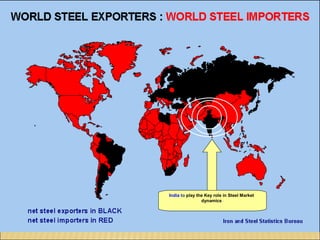
India to play the Key role in Steel Market
dynamics
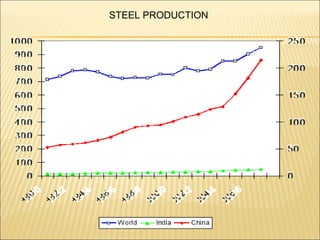
STEEL PRODUCTION
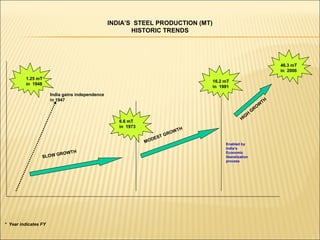
INDIA’S STEEL PRODUCTION (MT)
HISTORIC TRENDS
* Year indicates FY
SLOW GROWTH
MODEST GROWTH
HIG
H
GRO
W
TH
Enabled by
India’s
Economic
liberalization
process
India gains independence
in 1947
6.6 mT
in 1973
16.2 mT
in 1991
1.25 mT
in 1948
46.3 mT
in 2006
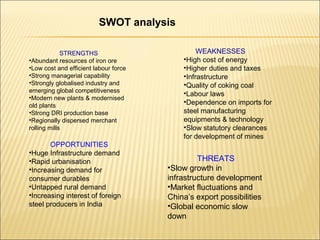
STRENGTHS
•Abundant resources of iron ore
•Low cost and efficient labour force
•Strong managerial capability
•Strongly globalised industry and
emerging global competitiveness
•Modern new plants & modernised
old plants
•Strong DRI production base
•Regionally dispersed merchant
rolling mills
WEAKNESSES
•High cost of energy
•Higher duties and taxes
•Infrastructure
•Quality of coking coal
•Labour laws
•Dependence on imports for
steel manufacturing
equipments & technology
•Slow statutory clearances
for development of mines
OPPORTUNITIES
•Huge Infrastructure demand
•Rapid urbanisation
•Increasing demand for
consumer durables
•Untapped rural demand
•Increasing interest of foreign
steel producers in India
THREATS
•Slow growth in
infrastructure development
•Market fluctuations and
China’s export possibilities
•Global economic slow
down
SWOT analysis
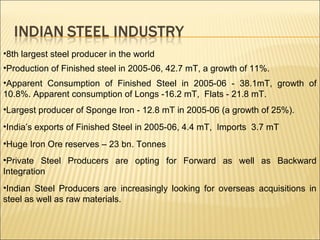
•8th largest steel producer in the world
•Production of Finished steel in 2005-06, 42.7 mT, a growth of 11%.
•Apparent Consumption of Finished Steel in 2005-06 - 38.1mT, growth of
10.8%. Apparent consumption of Longs -16.2 mT, Flats - 21.8 mT.
•Largest producer of Sponge Iron - 12.8 mT in 2005-06 (a growth of 25%).
•India’s exports of Finished Steel in 2005-06, 4.4 mT, Imports 3.7 mT
•Huge Iron Ore reserves – 23 bn. Tonnes
•Private Steel Producers are opting for Forward as well as Backward
Integration
•Indian Steel Producers are increasingly looking for overseas acquisitions in
steel as well as raw materials.
MAJOR PLAYERS OF STEEL INDUSTRY IN INDIA
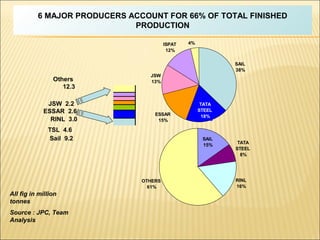
JSW 2.2
Sail 9.2
Source : JPC, Team
Analysis
TATA
STEEL
8%
RINL
16%
SAIL
15%
OTHERS
61%
SAIL
38%
JSW
13%
ISPAT
12%
OTHERS
4%
TATA
STEEL
18%ESSAR
15%
TSL 4.6
RINL 3.0
ESSAR 2.6
Others
12.3
All fig in million
tonnes
6 MAJOR PRODUCERS ACCOUNT FOR 66% OF TOTAL FINISHED
PRODUCTION
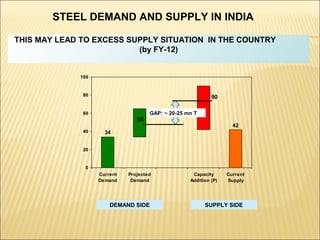
STEEL DEMAND AND SUPPLY IN INDIA
42
34
0
20
40
60
80
100
Current
Demand
Projected
Demand
Capacity
Addition (P)
Current
Supply
GAP: ~ 20-25 mn T
DEMAND SIDE SUPPLY SIDE
65
90
THIS MAY LEAD TO EXCESS SUPPLY SITUATION IN THE COUNTRY
(by FY-12)
Growth in key sectors will drive the steel demandGrowth in key sectors will drive the steel demand
•Infrastructure development
•Housing and urban development
•High degree of urbanizations
•High demand in the auto sector
•Capacity building in steel making
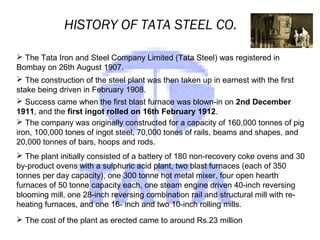
HISTORY OF TATA STEEL CO.
 The Tata Iron and Steel Company Limited (Tata Steel) was registered in
Bombay on 26th August 1907.
 The construction of the steel plant was then taken up in earnest with the first
stake being driven in February 1908.
 Success came when the first blast furnace was blown-in on 2nd December
1911, and the first ingot rolled on 16th February 1912.
 The company was originally constructed for a capacity of 160,000 tonnes of pig
iron, 100,000 tones of ingot steel, 70,000 tones of rails, beams and shapes, and
20,000 tonnes of bars, hoops and rods.
 The plant initially consisted of a battery of 180 non-recovery coke ovens and 30
by-product ovens with a sulphuric acid plant, two blast furnaces (each of 350
tonnes per day capacity), one 300 tonne hot metal mixer, four open hearth
furnaces of 50 tonne capacity each, one steam engine driven 40-inch reversing
blooming mill, one 28-inch reversing combination rail and structural mill with re-
heating furnaces, and one 16- inch and two 10-inch rolling mills.
 The cost of the plant as erected came to around Rs.23 million
INTRODUCTION OF TATA STEEL
 Tata Steel is the world's 6th largest steel company .
 It was Asia's first steel company and remains India's largest integrated private
sector steel manufacturer.
 Tata Steel is the world's second most geographically diversified steel
producer, with operations in 24 countries and commercial presence in over 50
countries.
 Tata Steel is the largest producer of long steel products in Thailand, with a
manufacturing capacity of 1.7 MT.
 It was ranked three times as the "World's Best Steel Maker", by World Steel
Dynamics .
 Tata Steel has been conferred the Prime Minister of India's Trophy for the
Best Integrated Steel Plant five times.
 It has been awarded Asia's Most Admired Knowledge Enterprise award in
2003 and 2004.
Major product produced by tata steel co.
 Hot and cold rolled coils and sheets,
 Galvanised sheets,
 Tubes,
 Wire rods,
 construction rebars, rings and bearings.
Decommoditise steel- the Company has introduced several
branded steel products, such as:-
• Tata Steelium (the world's first branded Cold Rolled Steel),
• Tata Shaktee (Galvanised Corrugated Sheets),
• Tata Tiscon (rebars),
• Tata Pipes,
• Tata Bearings,
• Tata Structura,
• Tata Agrico (hand tools and implements) and
• Tata Wiron (galvanised wire products).
Social organization of tata steel
‘Towards improving the quality of life of the people’
"The company shall have among its objectives the promotion and growth of the
national economy through increased productivity, effective utilisation of materials
and manpower resources and continued applications of modern scientific and
managerial techniques in keeping with the national aspirations, and the company
shall be mindful of its social and moral responsibilities to the consumers,
employees, shareholders and the local community", - is what was included by Tata
Steel in its Articles of Association .
• Tata Steel spends 5-7 per cent of its profit after tax on several CSR initiatives.
Social welfare organisation:-
The Tata Steel Rural Development Society, Tribal Cultural Society, Tata Steel
Foundation for Family Initiatives, National Association for the Blind, Shishu Niketan,
School of Hope, Centre for Hearing Impaired Children and the Indian Red Cross
Society, East Singhbhum.
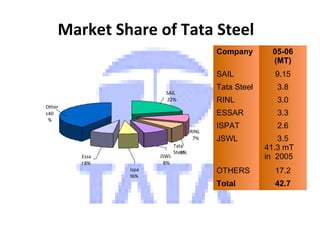
Company 05-06
(MT)
SAIL 9.15
Tata Steel 3.8
RINL 3.0
ESSAR 3.3
ISPAT 2.6
JSWL 3.5
41.3 mT
in 2005
OTHERS 17.2
Total 42.7
22%
RINL
9%
8%
6%
SAIL
Other
s40
%
7%
Tata
Steel
Essa
r
Ispa
t
JSWL
8%
Market Share of Tata Steel
o “Capacity refers to an upper limit on the load that an
operating unit can handle. The operating unit can be
a plant, department, machine or a store.”
o In general, production capacity is the maximum
production rate of an organization (or maximum
conversion rate of a production system).
o Sustainable practical capacity is the greatest level of
output that a plant can maintain:
o within the framework of a realistic work schedule
o taking account of normal downtime
o assuming sufficient availability of inputs to operate the
machinery and equipment in place
 Output rate capacity - for a single product or
a few homogeneous products
 Aggregate capacity - using a common unit of
output
 Input rate capacity - for service operations
 Percentage utilization of capacity - relate
output measures to inputs available
•Estimate future capacity requirements
•Evaluate existing capacity and facilities and identity gap
•Identify alternatives for meeting requirements
•Conduct financial analyses of each alternative
•Assess key qualitative issues for each alternative
•Select one alternative to pursue
•Implement the selected alternative
•Monitor results.
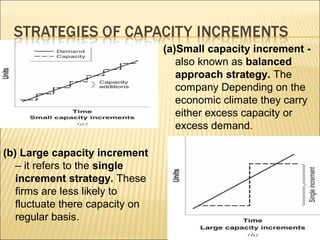
(a)Small capacity increment -
also known as balanced
approach strategy. The
company Depending on the
economic climate they carry
either excess capacity or
excess demand.
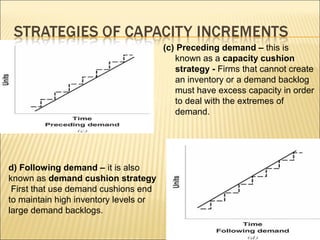
(b) Large capacity increment
– it refers to the single
increment strategy. These
firms are less likely to
fluctuate there capacity on
regular basis.
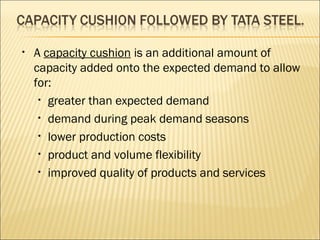
(c) Preceding demand – this is
known as a capacity cushion
strategy - Firms that cannot create
an inventory or a demand backlog
must have excess capacity in order
to deal with the extremes of
demand.
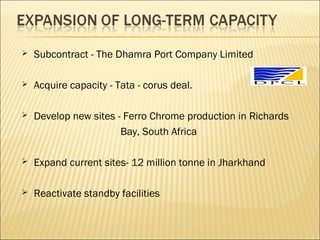
d) Following demand – it is also
known as demand cushion strategy
First that use demand cushions end
to maintain high inventory levels or
large demand backlogs.
• A capacity cushion is an additional amount of
capacity added onto the expected demand to allow
for:
• greater than expected demand
• demand during peak demand seasons
• lower production costs
• product and volume flexibility
• improved quality of products and services
 Subcontract - The Dhamra Port Company Limited
 Acquire capacity - Tata - corus deal.
 Develop new sites - Ferro Chrome production in Richards
Bay, South Africa
 Expand current sites- 12 million tonne in Jharkhand
 Reactivate standby facilities
• Sell off existing facilities
• Mothball facilities
• Develop and phase in new
products/services
Source:- south western college
publishing (link)
• Impacts ability to meet future demands
• Affects operating costs
• Major determinant of initial costs
• Involves long-term commitment
• Affects competitiveness
• Affects ease of management
• Globalization adds complexity
• Impacts long range planning
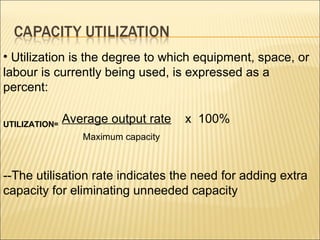
• Utilization is the degree to which equipment, space, or
labour is currently being used, is expressed as a
percent:
UTILIZATION=
Average output rate x 100%
Maximum capacity
--The utilisation rate indicates the need for adding extra
capacity for eliminating unneeded capacity
Objective: -
 To have modern and efficient steel industry of
world standards, catering to diversified steel
demand.
 To achieve global competitiveness in cost,
quality, product-mix, efficiency and
productivity
 To attain Finished Steel production of 110
mTpa by 2019-20
•Demand Side
– Strengthening of delivery chain
– Interface between producers, designers of steel intensive
products, fabricators and ultimate user
– Creating awareness about cost-effective and technically
efficient end-use of steel
•Supply side
– Enhanced and easy access to critical inputs – iron ore &
coking coal
– Expansion and improvement in quality of infrastructure
– Well developed financial market
– Increased focus on R&D, training of manpower and
integrated information services
•Facilitate Rural Consumption
•Increased usage in Bridges, Crash Barriers, Flyovers and
Building Constructions
•Closer interaction between Large Producers and
Architects/ Engineers/ Students
Focus on infrastructure:
•Planned additional 75 MTPA of steel implies 300MT of additional traffic.
•Railways :
Participation by Steel Industry in the creation of railway infrastructure.
•Roads:
Road network to be expanded; national highway development
•Ports:
Steel producers would be encouraged to develop port and berth facilities.
Technology plays as “Mother Board” for the
capacity planning.
By sanjay singh (vice President, Tata Steel)
 Well organised distribution network throughout the country
 Superior product quality
 Savings through better yield
 Better value for your products
 Deliver superior value to your customers on a consistent
basis and by design
 Opportunity to differentiate your product on the basis of raw
material source
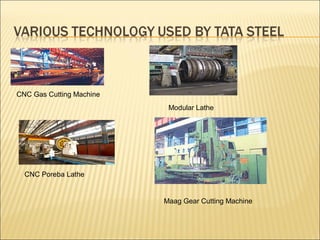
CNC Gas Cutting Machine
Modular Lathe
CNC Poreba Lathe
Maag Gear Cutting Machine
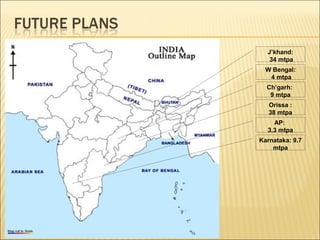
J’khand:
34 mtpa
W Bengal:
4 mtpa
Ch’garh:
9 mtpa
Orissa :
38 mtpa
AP:
3.3 mtpa
Karnataka: 9.7
mtpa
Tata Steel-ppt

Tata Steel-ppt

  • 1.
  • 2.
    India to playthe Key role in Steel Market dynamics
  • 3.
  • 4.
    INDIA’S STEEL PRODUCTION(MT) HISTORIC TRENDS * Year indicates FY SLOW GROWTH MODEST GROWTH HIG H GRO W TH Enabled by India’s Economic liberalization process India gains independence in 1947 6.6 mT in 1973 16.2 mT in 1991 1.25 mT in 1948 46.3 mT in 2006
  • 5.
    STRENGTHS •Abundant resources ofiron ore •Low cost and efficient labour force •Strong managerial capability •Strongly globalised industry and emerging global competitiveness •Modern new plants & modernised old plants •Strong DRI production base •Regionally dispersed merchant rolling mills WEAKNESSES •High cost of energy •Higher duties and taxes •Infrastructure •Quality of coking coal •Labour laws •Dependence on imports for steel manufacturing equipments & technology •Slow statutory clearances for development of mines OPPORTUNITIES •Huge Infrastructure demand •Rapid urbanisation •Increasing demand for consumer durables •Untapped rural demand •Increasing interest of foreign steel producers in India THREATS •Slow growth in infrastructure development •Market fluctuations and China’s export possibilities •Global economic slow down SWOT analysis
  • 6.
    •8th largest steelproducer in the world •Production of Finished steel in 2005-06, 42.7 mT, a growth of 11%. •Apparent Consumption of Finished Steel in 2005-06 - 38.1mT, growth of 10.8%. Apparent consumption of Longs -16.2 mT, Flats - 21.8 mT. •Largest producer of Sponge Iron - 12.8 mT in 2005-06 (a growth of 25%). •India’s exports of Finished Steel in 2005-06, 4.4 mT, Imports 3.7 mT •Huge Iron Ore reserves – 23 bn. Tonnes •Private Steel Producers are opting for Forward as well as Backward Integration •Indian Steel Producers are increasingly looking for overseas acquisitions in steel as well as raw materials.
  • 7.
    MAJOR PLAYERS OFSTEEL INDUSTRY IN INDIA
  • 8.
    JSW 2.2 Sail 9.2 Source: JPC, Team Analysis TATA STEEL 8% RINL 16% SAIL 15% OTHERS 61% SAIL 38% JSW 13% ISPAT 12% OTHERS 4% TATA STEEL 18%ESSAR 15% TSL 4.6 RINL 3.0 ESSAR 2.6 Others 12.3 All fig in million tonnes 6 MAJOR PRODUCERS ACCOUNT FOR 66% OF TOTAL FINISHED PRODUCTION
  • 9.
    STEEL DEMAND ANDSUPPLY IN INDIA 42 34 0 20 40 60 80 100 Current Demand Projected Demand Capacity Addition (P) Current Supply GAP: ~ 20-25 mn T DEMAND SIDE SUPPLY SIDE 65 90 THIS MAY LEAD TO EXCESS SUPPLY SITUATION IN THE COUNTRY (by FY-12)
  • 10.
    Growth in keysectors will drive the steel demandGrowth in key sectors will drive the steel demand •Infrastructure development •Housing and urban development •High degree of urbanizations •High demand in the auto sector •Capacity building in steel making
  • 12.
    HISTORY OF TATASTEEL CO.  The Tata Iron and Steel Company Limited (Tata Steel) was registered in Bombay on 26th August 1907.  The construction of the steel plant was then taken up in earnest with the first stake being driven in February 1908.  Success came when the first blast furnace was blown-in on 2nd December 1911, and the first ingot rolled on 16th February 1912.  The company was originally constructed for a capacity of 160,000 tonnes of pig iron, 100,000 tones of ingot steel, 70,000 tones of rails, beams and shapes, and 20,000 tonnes of bars, hoops and rods.  The plant initially consisted of a battery of 180 non-recovery coke ovens and 30 by-product ovens with a sulphuric acid plant, two blast furnaces (each of 350 tonnes per day capacity), one 300 tonne hot metal mixer, four open hearth furnaces of 50 tonne capacity each, one steam engine driven 40-inch reversing blooming mill, one 28-inch reversing combination rail and structural mill with re- heating furnaces, and one 16- inch and two 10-inch rolling mills.  The cost of the plant as erected came to around Rs.23 million
  • 13.
    INTRODUCTION OF TATASTEEL  Tata Steel is the world's 6th largest steel company .  It was Asia's first steel company and remains India's largest integrated private sector steel manufacturer.  Tata Steel is the world's second most geographically diversified steel producer, with operations in 24 countries and commercial presence in over 50 countries.  Tata Steel is the largest producer of long steel products in Thailand, with a manufacturing capacity of 1.7 MT.  It was ranked three times as the "World's Best Steel Maker", by World Steel Dynamics .  Tata Steel has been conferred the Prime Minister of India's Trophy for the Best Integrated Steel Plant five times.  It has been awarded Asia's Most Admired Knowledge Enterprise award in 2003 and 2004.
  • 14.
    Major product producedby tata steel co.  Hot and cold rolled coils and sheets,  Galvanised sheets,  Tubes,  Wire rods,  construction rebars, rings and bearings. Decommoditise steel- the Company has introduced several branded steel products, such as:- • Tata Steelium (the world's first branded Cold Rolled Steel), • Tata Shaktee (Galvanised Corrugated Sheets), • Tata Tiscon (rebars), • Tata Pipes, • Tata Bearings, • Tata Structura, • Tata Agrico (hand tools and implements) and • Tata Wiron (galvanised wire products).
  • 15.
    Social organization oftata steel ‘Towards improving the quality of life of the people’ "The company shall have among its objectives the promotion and growth of the national economy through increased productivity, effective utilisation of materials and manpower resources and continued applications of modern scientific and managerial techniques in keeping with the national aspirations, and the company shall be mindful of its social and moral responsibilities to the consumers, employees, shareholders and the local community", - is what was included by Tata Steel in its Articles of Association . • Tata Steel spends 5-7 per cent of its profit after tax on several CSR initiatives. Social welfare organisation:- The Tata Steel Rural Development Society, Tribal Cultural Society, Tata Steel Foundation for Family Initiatives, National Association for the Blind, Shishu Niketan, School of Hope, Centre for Hearing Impaired Children and the Indian Red Cross Society, East Singhbhum.
  • 16.
    Company 05-06 (MT) SAIL 9.15 TataSteel 3.8 RINL 3.0 ESSAR 3.3 ISPAT 2.6 JSWL 3.5 41.3 mT in 2005 OTHERS 17.2 Total 42.7 22% RINL 9% 8% 6% SAIL Other s40 % 7% Tata Steel Essa r Ispa t JSWL 8% Market Share of Tata Steel
  • 18.
    o “Capacity refersto an upper limit on the load that an operating unit can handle. The operating unit can be a plant, department, machine or a store.” o In general, production capacity is the maximum production rate of an organization (or maximum conversion rate of a production system). o Sustainable practical capacity is the greatest level of output that a plant can maintain: o within the framework of a realistic work schedule o taking account of normal downtime o assuming sufficient availability of inputs to operate the machinery and equipment in place
  • 19.
     Output ratecapacity - for a single product or a few homogeneous products  Aggregate capacity - using a common unit of output  Input rate capacity - for service operations  Percentage utilization of capacity - relate output measures to inputs available
  • 20.
    •Estimate future capacityrequirements •Evaluate existing capacity and facilities and identity gap •Identify alternatives for meeting requirements •Conduct financial analyses of each alternative •Assess key qualitative issues for each alternative •Select one alternative to pursue •Implement the selected alternative •Monitor results.
  • 21.
    (a)Small capacity increment- also known as balanced approach strategy. The company Depending on the economic climate they carry either excess capacity or excess demand. (b) Large capacity increment – it refers to the single increment strategy. These firms are less likely to fluctuate there capacity on regular basis.
  • 22.
    (c) Preceding demand– this is known as a capacity cushion strategy - Firms that cannot create an inventory or a demand backlog must have excess capacity in order to deal with the extremes of demand. d) Following demand – it is also known as demand cushion strategy First that use demand cushions end to maintain high inventory levels or large demand backlogs.
  • 23.
    • A capacitycushion is an additional amount of capacity added onto the expected demand to allow for: • greater than expected demand • demand during peak demand seasons • lower production costs • product and volume flexibility • improved quality of products and services
  • 24.
     Subcontract -The Dhamra Port Company Limited  Acquire capacity - Tata - corus deal.  Develop new sites - Ferro Chrome production in Richards Bay, South Africa  Expand current sites- 12 million tonne in Jharkhand  Reactivate standby facilities
  • 25.
    • Sell offexisting facilities • Mothball facilities • Develop and phase in new products/services Source:- south western college publishing (link)
  • 27.
    • Impacts abilityto meet future demands • Affects operating costs • Major determinant of initial costs • Involves long-term commitment • Affects competitiveness • Affects ease of management • Globalization adds complexity • Impacts long range planning
  • 28.
    • Utilization isthe degree to which equipment, space, or labour is currently being used, is expressed as a percent: UTILIZATION= Average output rate x 100% Maximum capacity --The utilisation rate indicates the need for adding extra capacity for eliminating unneeded capacity
  • 29.
    Objective: -  Tohave modern and efficient steel industry of world standards, catering to diversified steel demand.  To achieve global competitiveness in cost, quality, product-mix, efficiency and productivity  To attain Finished Steel production of 110 mTpa by 2019-20
  • 30.
    •Demand Side – Strengtheningof delivery chain – Interface between producers, designers of steel intensive products, fabricators and ultimate user – Creating awareness about cost-effective and technically efficient end-use of steel •Supply side – Enhanced and easy access to critical inputs – iron ore & coking coal – Expansion and improvement in quality of infrastructure – Well developed financial market – Increased focus on R&D, training of manpower and integrated information services
  • 31.
    •Facilitate Rural Consumption •Increasedusage in Bridges, Crash Barriers, Flyovers and Building Constructions •Closer interaction between Large Producers and Architects/ Engineers/ Students Focus on infrastructure: •Planned additional 75 MTPA of steel implies 300MT of additional traffic. •Railways : Participation by Steel Industry in the creation of railway infrastructure. •Roads: Road network to be expanded; national highway development •Ports: Steel producers would be encouraged to develop port and berth facilities.
  • 32.
    Technology plays as“Mother Board” for the capacity planning. By sanjay singh (vice President, Tata Steel)  Well organised distribution network throughout the country  Superior product quality  Savings through better yield  Better value for your products  Deliver superior value to your customers on a consistent basis and by design  Opportunity to differentiate your product on the basis of raw material source
  • 33.
    CNC Gas CuttingMachine Modular Lathe CNC Poreba Lathe Maag Gear Cutting Machine
  • 34.
    J’khand: 34 mtpa W Bengal: 4mtpa Ch’garh: 9 mtpa Orissa : 38 mtpa AP: 3.3 mtpa Karnataka: 9.7 mtpa