A shy, reclusive 51 year old, with little to show on his 
business report card, 
took charge of India's largest business house in 1991 and 
nineteen years on, he succeeded in building a proud 
legacy……….. 
Delhi University 
MCA-1 Batch(2014)
RATAN TATA – A TRUE LEADER
A LOOK AT HIS QUALITIES 
 True visionary 
 Initiator 
 A man of values 
 Good at handling human relations 
 Firm and determined leader 
 Creative and innovative 
 A good strategist 
 Risk taker
TRUE VISIONARY 
 It is Ratan Tata’s path breaking vision that has led Tata 
Group to become one of India’s largest conglomerates 
with 98 operating companies spread across 56 countries. 
 At Rs. 3.46 lakh crore, the Tata Group revenue is 40 times 
the 1991 level (60% of which comes from overseas), while 
its net profit has gone up four times. 
 The Tata Group today includes India's largest private 
steel company, the biggest auto manufacturer and the 
largest IT outsourcing firm.
INITIATOR 
 He successfully introduced the first indigenously 
developed passenger car Indica in India in 1998. It 
became the no. 1 car in its segment in two years. 
 Tata Tea, now Tata Global Beverages, acquired the 
Tetley group in 2000, the world's second largest 
manufacturer of tea. 
 Tata Global Beverages formed a joint venture with 
Starbucks i.e. Tata Starbucks Ltd, and helped Starbucks 
launch themselves in India by opening their first store in 
Mumbai.
A MAN OF VALUES 
 The leadership qualities of Ratan Tata are coupled with 
his commitment to social service, justice and 
responsibility. 
 He holds the chairmanship of the Tata Trusts and is 
known to promote financial transparency and intense 
vetting for grants for projects that claim to help the needy. 
 He is known to be an industrious man with global 
aspirations, and commitment to quality work that gives 
real value of money as is amply demonstrated by his 
interest in frugal engineering ventures like Tata Indica and 
Tata Nano.
GOOD AT HANDLING HUMAN RELATIONS 
 He is a man who is known to give great importance to 
Human Relations. 
 Ratan Tata working style is that of working together with all 
officers by using unity of command and unity of 
direction. 
 The Tata group instituted an eight hour workday before 
nearly any other company in the world. 
 He expanded CEO’s concept of community philanthropy 
to be included in the workplace, as evidenced by the Tata 
Group’s steadfast commitment to social service. (Jaago Re 
campaign)
FIRM DETERMINATION 
 Ratan Tata was appointed the director-in-charge of 
National Radio and Electronics Company (NELCO). The 
company held barely 2% of the market share which 
ultimately led to its collapse. 
 Later again, he was given charge of the Empress Mills 
in 1977 which was in bad shape. Due to a weak 
economy and a prolonged workers’ strike, the 
Empress Mills floundered and was finally closed. 
 These two 'failures' haunted Ratan for decades. His 
track record was held suspect even when he took 
charge in 1991 but he never looked back, and ultimately 
proved his critics wrong.
CREATIVE AND INNOVATIVE 
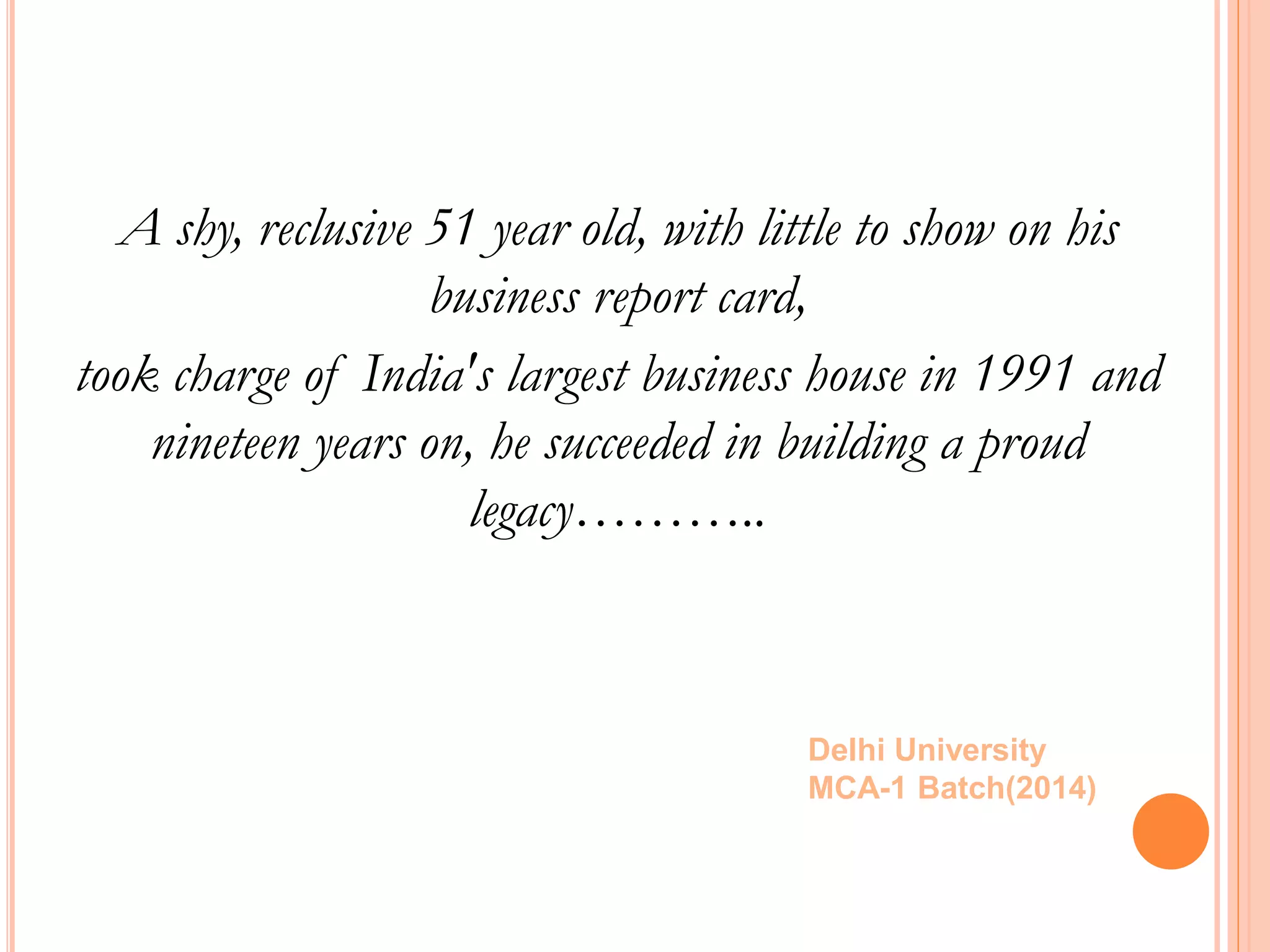
 Ratan Tata used his excellent 
innovative vision in Titan Edge 
watches which developed the 
thinnest watch in the world and 
in Nano, the cheapest car in the 
world. 
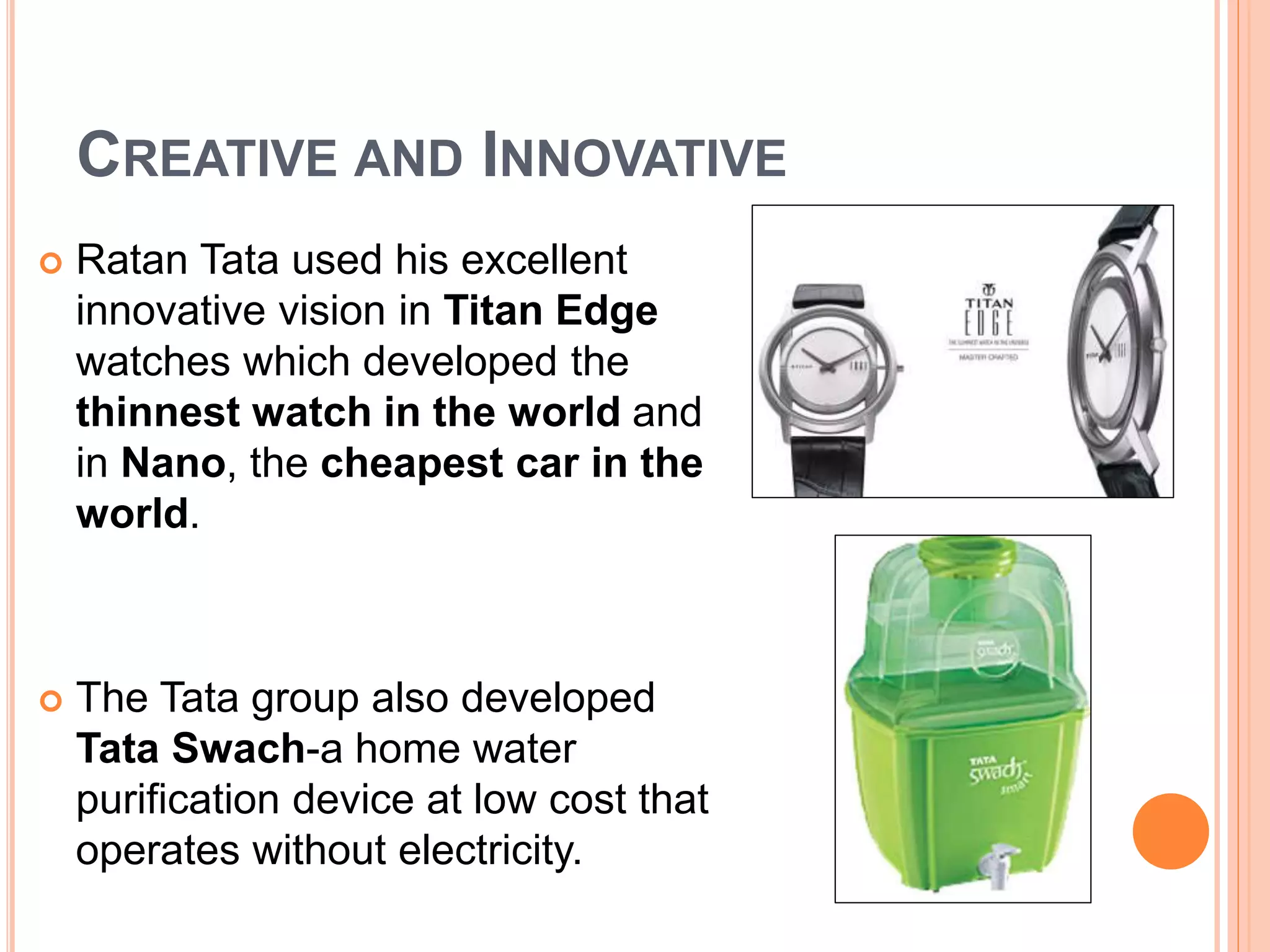
 The Tata group also developed 
Tata Swach-a home water 
purification device at low cost that 
operates without electricity.
STRATEGIST 
 He is a deep thinker and an extremely strategic 
person. He is always thinking 2 steps ahead of his 
competitors. 
 Under his leadership, 32 companies were 
acquired worldwide. 
 He is credited with conceptualizing Nano, the 
cheapest car in the world.
RISK TAKER 
 The critics declared that “the Corus 
deal would lead the group to 
bankruptcy”. But Ratan Tata took the 
risk and today, it is considered one 
of the most successful 
acquisitions. 
 It was said that the Jaguar and 
Land Rover deal would be 
disastrous: the brands were troubled 
and demand was low. But Tata went 
on to prove everyone wrong and 
today, both companies are doing 
really well.
LEADERSHIP QUALITIES 
His qualities Ideal qualities 
 Visionary 
 Strategist 
 Initiator 
 Change champion 
 Risk taker 
 Expertise 
 A man of integrity 
 Personal Integrity 
 Willingness to accept 
responsibility 
 Understanding People 
 Communication 
 Selflessness 
 Confidence 
 Intuition 
 Vision 
 Ability to make decisions 
 Ability to simplify situations
THE SMALL WONDER : NANO 
A SUCCESS STORY 
“ I observed families riding on two-wheelers—the father 
driving the motorcycle , his young child seated in front of 
him, his wife seated behind him holding a little babies. It 
led me to wonder whether one could conceive of a safe, 
affordable, all-weather form of transport for such a family.”
“A PROMISE IS A PROMISE” 
 Ratan Tata's pet project Nano was mired in controversy 
about land acquisition for the factory. 
 After farmers in Singur, West Bengal, protested about 
forcible evictions and inadequate compensation, and 
Mamata Banerjee leapt into the fray to protest, the Tatas 
had to pull out of the state. 
 The company shifted the factory to Sanand, Gujarat, and 
delivered on its promise of building the cheapest car.
LEADERSHIP GRID 
Ratan Tata is a 9,9 manager 
Work accomplished is from committed people with 
interdependence through a common stake in 
organization purpose and with trust and respect.
BUILDING NEXT GENERATION 
LEADERSHIP 
 One of the fundamental 
achievements of Ratan Tata was his 
success in finding and grooming an 
adequate successor for his job : 
Cyrus Mistry, who was chosen after 
much deliberation. 
 Mistry underwent a year long 
grooming as Tata’s understudy to 
augment his relative inexperience 
and ready him for this crucial role. 
 These are the qualities of a visionary 
leader. One who thinks ahead, and 
acts to that effect.
POST RETIREMENT PLANS 
 Breaking from tradition, Ratan Tata did not retire from the 
position of Chairman of Tata Trusts, the philanthropic arm 
of the Tata Group. 
 As seen from the example of Nano, frugal engineering has 
been an issue close to Mr Tata’s heart, and it is said that he 
intends to push his agenda of using technology to deliver 
low cost solutions to problems through the Trusts’ 
multimillion dollar funding of various NGOs etc. 
 As the head of the Trusts’, he is said to have revolutionized 
their working by bringing in professionals like M. S. 
Swaminathan and E. Sreedharan on the board of trustees to 
formulate strategic plans for the Trusts’ working. 
 He has also been very active in pursuing policymakers and 
regulators to promote the Tata Group’s new airline 
venture.
CONCLUSION 
Though there are different models around for 
leadership, all successful leaders mostly do three 
things. 
 One, with a vision and purpose, add value and 
create a new possibility. 
 Two, build next-in-line leaders and leadership 
pipeline. 
 Three, be a role model, authentic and self-aware. 
Ratan Tata is an ideal example of a leader 
demonstrating all these three things.
SO WHAT SHOULD BE YOUR IDEAS 
FOR ACTION?? 
What skills does a leader need? Effective leaders 
need skills for: 
 Active Listening 
 Managing Conflict 
 Decision Making 
 Strategic Thinking 
 Empowering their followers 
 Building Teams 
 Practice leadership in small things instead of 
waiting for the big crisis or a major product launch.
Ratan tata a great leader

Ratan tata a great leader

  • 1.
    A shy, reclusive51 year old, with little to show on his business report card, took charge of India's largest business house in 1991 and nineteen years on, he succeeded in building a proud legacy……….. Delhi University MCA-1 Batch(2014)
  • 2.
    RATAN TATA –A TRUE LEADER
  • 3.
    A LOOK ATHIS QUALITIES  True visionary  Initiator  A man of values  Good at handling human relations  Firm and determined leader  Creative and innovative  A good strategist  Risk taker
  • 4.
    TRUE VISIONARY It is Ratan Tata’s path breaking vision that has led Tata Group to become one of India’s largest conglomerates with 98 operating companies spread across 56 countries.  At Rs. 3.46 lakh crore, the Tata Group revenue is 40 times the 1991 level (60% of which comes from overseas), while its net profit has gone up four times.  The Tata Group today includes India's largest private steel company, the biggest auto manufacturer and the largest IT outsourcing firm.
  • 5.
    INITIATOR  Hesuccessfully introduced the first indigenously developed passenger car Indica in India in 1998. It became the no. 1 car in its segment in two years.  Tata Tea, now Tata Global Beverages, acquired the Tetley group in 2000, the world's second largest manufacturer of tea.  Tata Global Beverages formed a joint venture with Starbucks i.e. Tata Starbucks Ltd, and helped Starbucks launch themselves in India by opening their first store in Mumbai.
  • 6.
    A MAN OFVALUES  The leadership qualities of Ratan Tata are coupled with his commitment to social service, justice and responsibility.  He holds the chairmanship of the Tata Trusts and is known to promote financial transparency and intense vetting for grants for projects that claim to help the needy.  He is known to be an industrious man with global aspirations, and commitment to quality work that gives real value of money as is amply demonstrated by his interest in frugal engineering ventures like Tata Indica and Tata Nano.
  • 7.
    GOOD AT HANDLINGHUMAN RELATIONS  He is a man who is known to give great importance to Human Relations.  Ratan Tata working style is that of working together with all officers by using unity of command and unity of direction.  The Tata group instituted an eight hour workday before nearly any other company in the world.  He expanded CEO’s concept of community philanthropy to be included in the workplace, as evidenced by the Tata Group’s steadfast commitment to social service. (Jaago Re campaign)
  • 8.
    FIRM DETERMINATION Ratan Tata was appointed the director-in-charge of National Radio and Electronics Company (NELCO). The company held barely 2% of the market share which ultimately led to its collapse.  Later again, he was given charge of the Empress Mills in 1977 which was in bad shape. Due to a weak economy and a prolonged workers’ strike, the Empress Mills floundered and was finally closed.  These two 'failures' haunted Ratan for decades. His track record was held suspect even when he took charge in 1991 but he never looked back, and ultimately proved his critics wrong.
  • 9.
    CREATIVE AND INNOVATIVE  Ratan Tata used his excellent innovative vision in Titan Edge watches which developed the thinnest watch in the world and in Nano, the cheapest car in the world.  The Tata group also developed Tata Swach-a home water purification device at low cost that operates without electricity.
  • 10.
    STRATEGIST  Heis a deep thinker and an extremely strategic person. He is always thinking 2 steps ahead of his competitors.  Under his leadership, 32 companies were acquired worldwide.  He is credited with conceptualizing Nano, the cheapest car in the world.
  • 11.
    RISK TAKER The critics declared that “the Corus deal would lead the group to bankruptcy”. But Ratan Tata took the risk and today, it is considered one of the most successful acquisitions.  It was said that the Jaguar and Land Rover deal would be disastrous: the brands were troubled and demand was low. But Tata went on to prove everyone wrong and today, both companies are doing really well.
  • 12.
    LEADERSHIP QUALITIES Hisqualities Ideal qualities  Visionary  Strategist  Initiator  Change champion  Risk taker  Expertise  A man of integrity  Personal Integrity  Willingness to accept responsibility  Understanding People  Communication  Selflessness  Confidence  Intuition  Vision  Ability to make decisions  Ability to simplify situations
  • 13.
    THE SMALL WONDER: NANO A SUCCESS STORY “ I observed families riding on two-wheelers—the father driving the motorcycle , his young child seated in front of him, his wife seated behind him holding a little babies. It led me to wonder whether one could conceive of a safe, affordable, all-weather form of transport for such a family.”
  • 14.
    “A PROMISE ISA PROMISE”  Ratan Tata's pet project Nano was mired in controversy about land acquisition for the factory.  After farmers in Singur, West Bengal, protested about forcible evictions and inadequate compensation, and Mamata Banerjee leapt into the fray to protest, the Tatas had to pull out of the state.  The company shifted the factory to Sanand, Gujarat, and delivered on its promise of building the cheapest car.
  • 15.
    LEADERSHIP GRID RatanTata is a 9,9 manager Work accomplished is from committed people with interdependence through a common stake in organization purpose and with trust and respect.
  • 16.
    BUILDING NEXT GENERATION LEADERSHIP  One of the fundamental achievements of Ratan Tata was his success in finding and grooming an adequate successor for his job : Cyrus Mistry, who was chosen after much deliberation.  Mistry underwent a year long grooming as Tata’s understudy to augment his relative inexperience and ready him for this crucial role.  These are the qualities of a visionary leader. One who thinks ahead, and acts to that effect.
  • 17.
    POST RETIREMENT PLANS  Breaking from tradition, Ratan Tata did not retire from the position of Chairman of Tata Trusts, the philanthropic arm of the Tata Group.  As seen from the example of Nano, frugal engineering has been an issue close to Mr Tata’s heart, and it is said that he intends to push his agenda of using technology to deliver low cost solutions to problems through the Trusts’ multimillion dollar funding of various NGOs etc.  As the head of the Trusts’, he is said to have revolutionized their working by bringing in professionals like M. S. Swaminathan and E. Sreedharan on the board of trustees to formulate strategic plans for the Trusts’ working.  He has also been very active in pursuing policymakers and regulators to promote the Tata Group’s new airline venture.
  • 18.
    CONCLUSION Though thereare different models around for leadership, all successful leaders mostly do three things.  One, with a vision and purpose, add value and create a new possibility.  Two, build next-in-line leaders and leadership pipeline.  Three, be a role model, authentic and self-aware. Ratan Tata is an ideal example of a leader demonstrating all these three things.
  • 19.
    SO WHAT SHOULDBE YOUR IDEAS FOR ACTION?? What skills does a leader need? Effective leaders need skills for:  Active Listening  Managing Conflict  Decision Making  Strategic Thinking  Empowering their followers  Building Teams  Practice leadership in small things instead of waiting for the big crisis or a major product launch.