Task-based Language Teaching
Wilkins (1976) : synthetic syllabi & analytic syllabi

S.M. Cheng

1
Synthetic
syllabi

• Linguistic unit : grammar
structures, vocab items,
functions,…
• Purpose of communication.

Analytic
syllabi

• For which people are learning L
and the kinds of L performance
that are necessary to meet those
purposes.
• CBI & TBL – analytic syllabus
CSM

2
Tasks
• Students need to communicate.
• Have clear outcome -> T n S knw
communication successful or not.
• Exp : S plan an itinerary for a trip. Work in
small group, given certain schedule, they
decide the most direct route to travel by train.
(time)

CSM

3
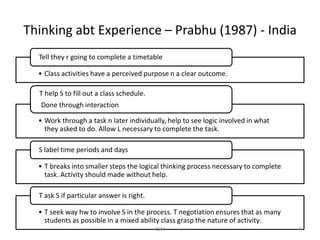
Thinking abt Experience – Prabhu (1987) - India
Tell they r going to complete a timetable
• Class activities have a perceived purpose n a clear outcome.
T help S to fill out a class schedule.
Done through interaction

• Work through a task n later individually, help to see logic involved in what
they asked to do. Allow L necessary to complete the task.
S label time periods and days
• T breaks into smaller steps the logical thinking process necessary to complete
task. Activity should made without help.
T ask S if particular answer is right.
• T seek way hw to involve S in the process. T negotiation ensures that as many
students as possible in a mixed ability class grasp the nature of activity.
CSM

4
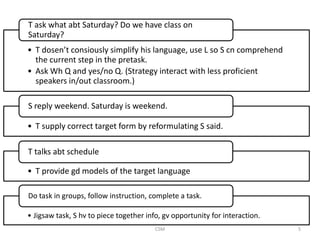
T ask what abt Saturday? Do we have class on
Saturday?
• T dosen’t consiously simplify his language, use L so S cn comprehend
the current step in the pretask.
• Ask Wh Q and yes/no Q. (Strategy interact with less proficient
speakers in/out classroom.)
S reply weekend. Saturday is weekend.
• T supply correct target form by reformulating S said.
T talks abt schedule
• T provide gd models of the target language
Do task in groups, follow instruction, complete a task.
• Jigsaw task, S hv to piece together info, gv opportunity for interaction.
CSM

5
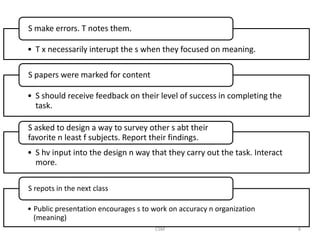
S make errors. T notes them.
• T x necessarily interupt the s when they focused on meaning.
S papers were marked for content
• S should receive feedback on their level of success in completing the
task.
S asked to design a way to survey other s abt their
favorite n least f subjects. Report their findings.
• S hv input into the design n way that they carry out the task. Interact
more.
S repots in the next class

• Public presentation encourages s to work on accuracy n organization
(meaning)
CSM

6
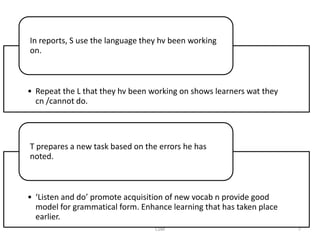
In reports, S use the language they hv been working
on.

• Repeat the L that they hv been working on shows learners wat they
cn /cannot do.

T prepares a new task based on the errors he has
noted.

• ‘Listen and do’ promote acquisition of new vocab n provide good
model for grammatical form. Enhance learning that has taken place
earlier.
CSM

7
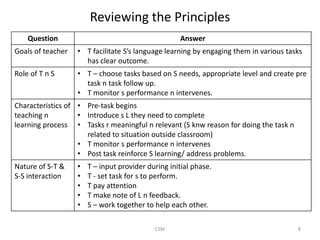
Reviewing the Principles
Question

Answer

Goals of teacher

• T facilitate S’s language learning by engaging them in various tasks
has clear outcome.

Role of T n S

• T – choose tasks based on S needs, appropriate level and create pre
task n task follow up.
• T monitor s performance n intervenes.

Characteristics of • Pre-task begins
teaching n
• Introduce s L they need to complete
learning process • Tasks r meaningful n relevant (S knw reason for doing the task n
related to situation outside classroom)
• T monitor s performance n intervenes
• Post task reinforce S learning/ address problems.
Nature of S-T &
S-S interaction

•
•
•
•
•

T – input provider during initial phase.
T - set task for s to perform.
T pay attention
T make note of L n feedback.
S – work together to help each other.
CSM

8
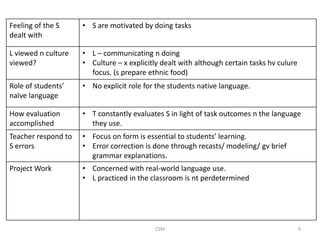
Feeling of the S
dealt with

• S are motivated by doing tasks

L viewed n culture
viewed?

• L – communicating n doing
• Culture – x explicitly dealt with although certain tasks hv culure
focus. (s prepare ethnic food)

Role of students’
naïve language

• No explicit role for the students native language.

How evaluation
accomplished

• T constantly evaluates S in light of task outcomes n the language
they use.

Teacher respond to
S errors

• Focus on form is essential to students’ learning.
• Error correction is done through recasts/ modeling/ gv brief
grammar explanations.

Project Work

• Concerned with real-world language use.
• L practiced in the classroom is nt perdetermined

CSM

9
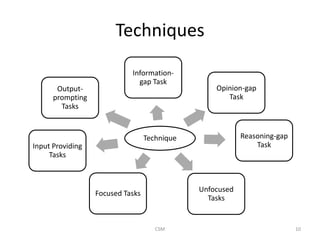
Techniques
Outputprompting
Tasks

Informationgap Task

Opinion-gap
Task

Reasoning-gap
Task

Technique

Input Providing
Tasks

Unfocused
Tasks

Focused Tasks

CSM

10

Task based language teaching

  • 1.
    Task-based Language Teaching Wilkins(1976) : synthetic syllabi & analytic syllabi S.M. Cheng 1
  • 2.
    Synthetic syllabi • Linguistic unit: grammar structures, vocab items, functions,… • Purpose of communication. Analytic syllabi • For which people are learning L and the kinds of L performance that are necessary to meet those purposes. • CBI & TBL – analytic syllabus CSM 2
  • 3.
    Tasks • Students needto communicate. • Have clear outcome -> T n S knw communication successful or not. • Exp : S plan an itinerary for a trip. Work in small group, given certain schedule, they decide the most direct route to travel by train. (time) CSM 3
  • 4.
    Thinking abt Experience– Prabhu (1987) - India Tell they r going to complete a timetable • Class activities have a perceived purpose n a clear outcome. T help S to fill out a class schedule. Done through interaction • Work through a task n later individually, help to see logic involved in what they asked to do. Allow L necessary to complete the task. S label time periods and days • T breaks into smaller steps the logical thinking process necessary to complete task. Activity should made without help. T ask S if particular answer is right. • T seek way hw to involve S in the process. T negotiation ensures that as many students as possible in a mixed ability class grasp the nature of activity. CSM 4
  • 5.
    T ask whatabt Saturday? Do we have class on Saturday? • T dosen’t consiously simplify his language, use L so S cn comprehend the current step in the pretask. • Ask Wh Q and yes/no Q. (Strategy interact with less proficient speakers in/out classroom.) S reply weekend. Saturday is weekend. • T supply correct target form by reformulating S said. T talks abt schedule • T provide gd models of the target language Do task in groups, follow instruction, complete a task. • Jigsaw task, S hv to piece together info, gv opportunity for interaction. CSM 5
  • 6.
    S make errors.T notes them. • T x necessarily interupt the s when they focused on meaning. S papers were marked for content • S should receive feedback on their level of success in completing the task. S asked to design a way to survey other s abt their favorite n least f subjects. Report their findings. • S hv input into the design n way that they carry out the task. Interact more. S repots in the next class • Public presentation encourages s to work on accuracy n organization (meaning) CSM 6
  • 7.
    In reports, Suse the language they hv been working on. • Repeat the L that they hv been working on shows learners wat they cn /cannot do. T prepares a new task based on the errors he has noted. • ‘Listen and do’ promote acquisition of new vocab n provide good model for grammatical form. Enhance learning that has taken place earlier. CSM 7
  • 8.
    Reviewing the Principles Question Answer Goalsof teacher • T facilitate S’s language learning by engaging them in various tasks has clear outcome. Role of T n S • T – choose tasks based on S needs, appropriate level and create pre task n task follow up. • T monitor s performance n intervenes. Characteristics of • Pre-task begins teaching n • Introduce s L they need to complete learning process • Tasks r meaningful n relevant (S knw reason for doing the task n related to situation outside classroom) • T monitor s performance n intervenes • Post task reinforce S learning/ address problems. Nature of S-T & S-S interaction • • • • • T – input provider during initial phase. T - set task for s to perform. T pay attention T make note of L n feedback. S – work together to help each other. CSM 8
  • 9.
    Feeling of theS dealt with • S are motivated by doing tasks L viewed n culture viewed? • L – communicating n doing • Culture – x explicitly dealt with although certain tasks hv culure focus. (s prepare ethnic food) Role of students’ naïve language • No explicit role for the students native language. How evaluation accomplished • T constantly evaluates S in light of task outcomes n the language they use. Teacher respond to S errors • Focus on form is essential to students’ learning. • Error correction is done through recasts/ modeling/ gv brief grammar explanations. Project Work • Concerned with real-world language use. • L practiced in the classroom is nt perdetermined CSM 9
  • 10.