TASK-BASED LANGUAGE TEACHING
Language Teaching Approaches and Methods
Designed by
M.Victoria Saavedra, Rodrigo Miño, Ma tias Hertuszezak, Mara Lopez , Valeria Walpole, Gerardo Diap
TASK-BASED LENGUAJE TEACHING
 It focuses on the use of authentic language and
on asking students to do meaningful tasks using
the target language.
 It refers to an approach based on the use of
tasks as the core unit of planning and instruction
in language teaching
 It is presented as a logical development of
communicative Language Teaching.
THE KEY ASSUMPTIONS OF TASK-BASED INSTRUCTION ARE:
 Focus on process rather than product;
 Purposeful activities with emphasis in communication and
meaning;
 Learners learn language by interacting communicative learning
and purposefully;
 Activities and tasks can be either:
o Those that learners might need to achieve in real life and those that
have a pedagogical purpose;
 Activities and tasks of a task-based syllabus are sequenced
according to difficulty.
Learning by doing…
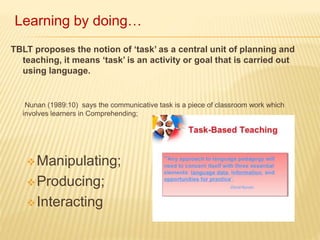
TBLT proposes the notion of ‘task’ as a central unit of planning and
teaching, it means ‘task’ is an activity or goal that is carried out
using language.
Nunan (1989:10) says the communicative task is a piece of classroom work which
involves learners in Comprehending;
Manipulating;
Producing;
Interacting
Task Analysis and Instructional Design initially dealt with solo job
performance on a manual task, attention then turned to team tasks.
There are four categories of team performance function:
 Orientation Functions;
 Organizational Functions;
 Adaptation Functions;
 Motivational Functions.
TBL Approaches
Theory of
language
Theory of
learning
DESIGN
Objetives:
Goals are to be determined by the specific
need of particular learners
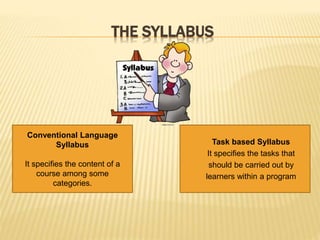
THE SYLLABUS
Conventional Language
Syllabus
It specifies the content of a
course among some
categories.
 Task based Syllabus
 It specifies the tasks that
 should be carried out by
 learners within a program
Task classification
Pica, Kanagy and Falodun (1993):
 Jigsaw tasks
 Information-gap tasks
 Problem-solving tasks
 Decision-making tasks
 Opinion exchange tasks
Other characteristics of tasks
• One-way or two-way
• Convergent or divergent
• Collaborative or competitive
• Single or multiple outcomes
• Concrete or abstract language
• Simple or complex processing
• Simple or complex language
• Reality-based or not realitybased
LERNER ROLES
 Group participant
 Monitor
 Risk-taker and Innovator
TEACHER ROLES
 Selector and sequencer of tasks
 Preparing learners for tasks
 Consciousness-Raising
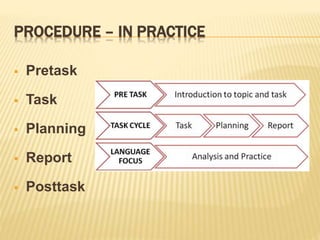
PROCEDURE – IN PRACTICE
 Pretask
 Task
 Planning
 Report
 Posttask
Pretask
Is the introduction to the topic and the task. The teacher helps
the students to understand the theme and objectives of the
task.
Activities
Brainstorming ideas, mime, personal experience, read the text,
think vocabulary, etc.
Task
Is done by the students. The teacher walks monitoring and encouraging them.
Planning
In this stage the students prepares the next step (Report). They make a draft of
what they want to say or write.
Report
The teacher ask the students to report to the whole class what they did in the task.
Post task listening
The students listen to a recording of fluent speakers doing the same task, and
compare the ways in which they did the task themselves.
VIDEOS RECOMENDADOS
https://www.youtube.com/watch?v=BJYbkDK3T-k
Jack C. Richards on Task Based Language Learning
https://www.youtube.com/watch?v=59XMhMO0FMU&t=3s
Demo: Task-Based Learning - International TEFL Academy

Task based language teaching

  • 1.
    TASK-BASED LANGUAGE TEACHING LanguageTeaching Approaches and Methods Designed by M.Victoria Saavedra, Rodrigo Miño, Ma tias Hertuszezak, Mara Lopez , Valeria Walpole, Gerardo Diap
  • 2.
    TASK-BASED LENGUAJE TEACHING It focuses on the use of authentic language and on asking students to do meaningful tasks using the target language.  It refers to an approach based on the use of tasks as the core unit of planning and instruction in language teaching  It is presented as a logical development of communicative Language Teaching.
  • 3.
    THE KEY ASSUMPTIONSOF TASK-BASED INSTRUCTION ARE:  Focus on process rather than product;  Purposeful activities with emphasis in communication and meaning;  Learners learn language by interacting communicative learning and purposefully;  Activities and tasks can be either: o Those that learners might need to achieve in real life and those that have a pedagogical purpose;  Activities and tasks of a task-based syllabus are sequenced according to difficulty.
  • 4.
    Learning by doing… TBLTproposes the notion of ‘task’ as a central unit of planning and teaching, it means ‘task’ is an activity or goal that is carried out using language. Nunan (1989:10) says the communicative task is a piece of classroom work which involves learners in Comprehending; Manipulating; Producing; Interacting
  • 5.
    Task Analysis andInstructional Design initially dealt with solo job performance on a manual task, attention then turned to team tasks. There are four categories of team performance function:  Orientation Functions;  Organizational Functions;  Adaptation Functions;  Motivational Functions.
  • 6.
  • 7.
    DESIGN Objetives: Goals are tobe determined by the specific need of particular learners
  • 8.
    THE SYLLABUS Conventional Language Syllabus Itspecifies the content of a course among some categories.  Task based Syllabus  It specifies the tasks that  should be carried out by  learners within a program
  • 9.
    Task classification Pica, Kanagyand Falodun (1993):  Jigsaw tasks  Information-gap tasks  Problem-solving tasks  Decision-making tasks  Opinion exchange tasks
  • 10.
    Other characteristics oftasks • One-way or two-way • Convergent or divergent • Collaborative or competitive • Single or multiple outcomes • Concrete or abstract language • Simple or complex processing • Simple or complex language • Reality-based or not realitybased
  • 11.
    LERNER ROLES  Groupparticipant  Monitor  Risk-taker and Innovator
  • 12.
    TEACHER ROLES  Selectorand sequencer of tasks  Preparing learners for tasks  Consciousness-Raising
  • 13.
    PROCEDURE – INPRACTICE  Pretask  Task  Planning  Report  Posttask
  • 14.
    Pretask Is the introductionto the topic and the task. The teacher helps the students to understand the theme and objectives of the task. Activities Brainstorming ideas, mime, personal experience, read the text, think vocabulary, etc.
  • 15.
    Task Is done bythe students. The teacher walks monitoring and encouraging them. Planning In this stage the students prepares the next step (Report). They make a draft of what they want to say or write.
  • 16.
    Report The teacher askthe students to report to the whole class what they did in the task. Post task listening The students listen to a recording of fluent speakers doing the same task, and compare the ways in which they did the task themselves.
  • 17.
    VIDEOS RECOMENDADOS https://www.youtube.com/watch?v=BJYbkDK3T-k Jack C.Richards on Task Based Language Learning https://www.youtube.com/watch?v=59XMhMO0FMU&t=3s Demo: Task-Based Learning - International TEFL Academy