Nathan West
Introduction
 There are two kinds of computer graphic one of which is made up of paths
and one which is made up of pixels.
 The one made up of paths is called a vector graphic, this creates images by
using points and paths.
 The other graphic is made up of pixels and is called raster graphic also
known as a bitmap image.
 A bitmap image uses a web of individual pixels and every pixel can be a
different colour or shade.
 At some point every graphic will be finalised as a raster graphic, so at some
point the vector graphic will be rasterized.
Raster Graphic
 Raster graphics are not very clear to make out once its zoomed in it
becomes very blurred and distorted an example of this would be like an
image of a ghost from the classic pacman game.
 From a distance both raster and vector look similar. The more a raster
graphic is zoomed in the harder it is to identify, when zoomed in to 700 % a
raster graphic is very hard to see whilst compared to a vector graphic the
image stays relatively clear.
 A vast amount of the images you see on your computer screen are raster
graphics. Even pictures you take using a camera when imported are raster
images. These graphics are made up of a grid of pixels most commonly
known as a bitmap, the bigger the picture is the larger the file size. Luckily
there is a solution which stops you from loosing more space then is
needed, image compression algorithms are the name the most popular
ones used on the web are JPEG and GIF.
 JPEG : One of the most common uses of lossy compression, mainly used
to format images taken from a camera, whilst JPEG/EXIF is used to format
these images JFIF is used for when an image needs uploading onto the
internet.
 The term “JPEG” is an abbreviation for the joint photographic experts group.
 JPEG supports a maximum file size of 65535×65535.
 GIF:
 The other very common use of lossy compression is GIF which is an
acronym for graphical interchange format. GIF is mainly used for short clips
or animations uploaded to the internet but is also used for high quality
images due to the technique which allows it to decrease the file size without
loosing any of the image quality. This kind of lossy compression was first
introduced in the late 1980’s by the commercial online service.
Vector Graphic
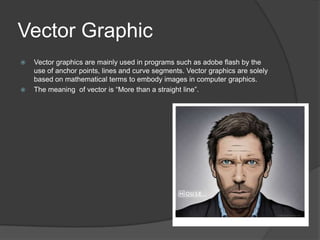
 Vector graphics are mainly used in programs such as adobe flash by the
use of anchor points, lines and curve segments. Vector graphics are solely
based on mathematical terms to embody images in computer graphics.
 The meaning of vector is “More than a straight line”.
PSD
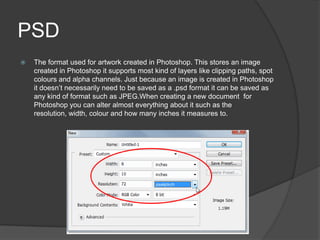
 The format used for artwork created in Photoshop. This stores an image
created in Photoshop it supports most kind of layers like clipping paths, spot
colours and alpha channels. Just because an image is created in Photoshop
it doesn’t necessarily need to be saved as a .psd format it can be saved as
any kind of format such as JPEG.When creating a new document for
Photoshop you can alter almost everything about it such as the
resolution, width, colour and how many inches it measures to.
Compression
 Lossless compression allows you to compress a file keeping all of the data
together this allows you to uncompress it and restore the file to its original
state.
 Lossy compression is when you compress a file by removing data however
if you try to resize it to the original state the image will become pixelated an
example of this is a JPEG.
Image capture devices
 These are devices which you use to take pictures and convert them onto
your computer an example of this would be a scanner which scans an
image in Photoshop by placing a sketch or any kind of image and converting
it into a computer graphic.
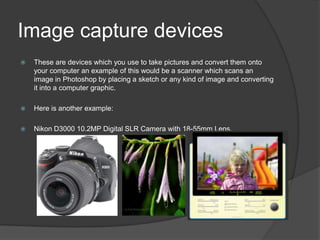
 Here is another example:
 Nikon D3000 10.2MP Digital SLR Camera with 18-55mm Lens.
Pixel & Resolution
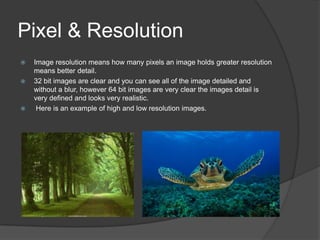
 Image resolution means how many pixels an image holds greater resolution
means better detail.
 32 bit images are clear and you can see all of the image detailed and
without a blur, however 64 bit images are very clear the images detail is
very defined and looks very realistic.
 Here is an example of high and low resolution images.
Optimising
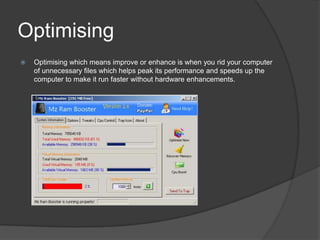
 Optimising which means improve or enhance is when you rid your computer
of unnecessary files which helps peak its performance and speeds up the
computer to make it run faster without hardware enhancements.
Storage and asset
management
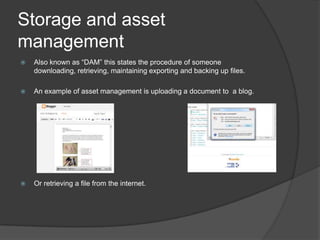
 Also known as “DAM” this states the procedure of someone
downloading, retrieving, maintaining exporting and backing up files.
 An example of asset management is uploading a document to a blog.
 Or retrieving a file from the internet.
Bibliography
 http://www.vickerscreative.co.uk/FAQ/Raster_or_Vector/files/Vector%20and%20Raster%20difference.png
 http://2.bp.blogspot.com/-bBV3qWfzh0c/T2Vf7VUxtKI/AAAAAAAAA6U/EYH3BSIC7lc/s1600/ghosts.jpg
 http://news.diginate.com/wp-content/uploads/2009/09/vector-bitmap_jpg_580x326_crop_upscale_q851.jpg
 http://www.colectiva.tv/wordpress/wp-content/uploads/2009/11/andy_gilmore.gif
 http://upload.wikimedia.org/wikipedia/commons/2/23/Lake_mapourika_NZ.jpeg
 http://fc04.deviantart.net/fs28/f/2008/108/e/0/vector_art__house_m_d__by_mart_art.jpg
 http://pe-images.s3.amazonaws.com/photo-effects/studio-background/new-photoshop-document.gif
 http://www.argos.co.uk/static/Product/partNumber/5593189.htm?CMPID=GS001&_$ja=cgid:5896418222|tsid:4
1408|cid:130166702|lid:47487144182|nw:g|crid:22247322662|rnd:13537557602087638578|dvc:c|adp:1o3
 http://theawesomer.com/photos/2011/05/051411_slr_camera_simulator_1.jpg
 http://0.tqn.com/d/create/1/0/U/d/8/-/Dew-Drop-Buds.jpg
 http://www.techmixer.com/pic/2008/10/mz-ram-booster-to-increase-computer-ram.jpg
 http://www.iamproisrael.com/wp-content/themes/dark-wood/nature-pictures-572.jpg
 http://sabbathian.files.wordpress.com/2010/06/turtle_high_resolution_wallpaper.jpg

Task 1 technical file

  • 1.
  • 2.
    Introduction  There aretwo kinds of computer graphic one of which is made up of paths and one which is made up of pixels.  The one made up of paths is called a vector graphic, this creates images by using points and paths.  The other graphic is made up of pixels and is called raster graphic also known as a bitmap image.  A bitmap image uses a web of individual pixels and every pixel can be a different colour or shade.  At some point every graphic will be finalised as a raster graphic, so at some point the vector graphic will be rasterized.
  • 3.
    Raster Graphic  Rastergraphics are not very clear to make out once its zoomed in it becomes very blurred and distorted an example of this would be like an image of a ghost from the classic pacman game.  From a distance both raster and vector look similar. The more a raster graphic is zoomed in the harder it is to identify, when zoomed in to 700 % a raster graphic is very hard to see whilst compared to a vector graphic the image stays relatively clear.
  • 4.
     A vastamount of the images you see on your computer screen are raster graphics. Even pictures you take using a camera when imported are raster images. These graphics are made up of a grid of pixels most commonly known as a bitmap, the bigger the picture is the larger the file size. Luckily there is a solution which stops you from loosing more space then is needed, image compression algorithms are the name the most popular ones used on the web are JPEG and GIF.  JPEG : One of the most common uses of lossy compression, mainly used to format images taken from a camera, whilst JPEG/EXIF is used to format these images JFIF is used for when an image needs uploading onto the internet.  The term “JPEG” is an abbreviation for the joint photographic experts group.  JPEG supports a maximum file size of 65535×65535.
  • 5.
     GIF:  Theother very common use of lossy compression is GIF which is an acronym for graphical interchange format. GIF is mainly used for short clips or animations uploaded to the internet but is also used for high quality images due to the technique which allows it to decrease the file size without loosing any of the image quality. This kind of lossy compression was first introduced in the late 1980’s by the commercial online service.
  • 6.
    Vector Graphic  Vectorgraphics are mainly used in programs such as adobe flash by the use of anchor points, lines and curve segments. Vector graphics are solely based on mathematical terms to embody images in computer graphics.  The meaning of vector is “More than a straight line”.
  • 7.
    PSD  The formatused for artwork created in Photoshop. This stores an image created in Photoshop it supports most kind of layers like clipping paths, spot colours and alpha channels. Just because an image is created in Photoshop it doesn’t necessarily need to be saved as a .psd format it can be saved as any kind of format such as JPEG.When creating a new document for Photoshop you can alter almost everything about it such as the resolution, width, colour and how many inches it measures to.
  • 8.
    Compression  Lossless compressionallows you to compress a file keeping all of the data together this allows you to uncompress it and restore the file to its original state.  Lossy compression is when you compress a file by removing data however if you try to resize it to the original state the image will become pixelated an example of this is a JPEG.
  • 9.
    Image capture devices These are devices which you use to take pictures and convert them onto your computer an example of this would be a scanner which scans an image in Photoshop by placing a sketch or any kind of image and converting it into a computer graphic.  Here is another example:  Nikon D3000 10.2MP Digital SLR Camera with 18-55mm Lens.
  • 10.
    Pixel & Resolution Image resolution means how many pixels an image holds greater resolution means better detail.  32 bit images are clear and you can see all of the image detailed and without a blur, however 64 bit images are very clear the images detail is very defined and looks very realistic.  Here is an example of high and low resolution images.
  • 11.
    Optimising  Optimising whichmeans improve or enhance is when you rid your computer of unnecessary files which helps peak its performance and speeds up the computer to make it run faster without hardware enhancements.
  • 12.
    Storage and asset management Also known as “DAM” this states the procedure of someone downloading, retrieving, maintaining exporting and backing up files.  An example of asset management is uploading a document to a blog.  Or retrieving a file from the internet.
  • 13.
    Bibliography  http://www.vickerscreative.co.uk/FAQ/Raster_or_Vector/files/Vector%20and%20Raster%20difference.png  http://2.bp.blogspot.com/-bBV3qWfzh0c/T2Vf7VUxtKI/AAAAAAAAA6U/EYH3BSIC7lc/s1600/ghosts.jpg http://news.diginate.com/wp-content/uploads/2009/09/vector-bitmap_jpg_580x326_crop_upscale_q851.jpg  http://www.colectiva.tv/wordpress/wp-content/uploads/2009/11/andy_gilmore.gif  http://upload.wikimedia.org/wikipedia/commons/2/23/Lake_mapourika_NZ.jpeg  http://fc04.deviantart.net/fs28/f/2008/108/e/0/vector_art__house_m_d__by_mart_art.jpg  http://pe-images.s3.amazonaws.com/photo-effects/studio-background/new-photoshop-document.gif  http://www.argos.co.uk/static/Product/partNumber/5593189.htm?CMPID=GS001&_$ja=cgid:5896418222|tsid:4 1408|cid:130166702|lid:47487144182|nw:g|crid:22247322662|rnd:13537557602087638578|dvc:c|adp:1o3  http://theawesomer.com/photos/2011/05/051411_slr_camera_simulator_1.jpg  http://0.tqn.com/d/create/1/0/U/d/8/-/Dew-Drop-Buds.jpg  http://www.techmixer.com/pic/2008/10/mz-ram-booster-to-increase-computer-ram.jpg  http://www.iamproisrael.com/wp-content/themes/dark-wood/nature-pictures-572.jpg  http://sabbathian.files.wordpress.com/2010/06/turtle_high_resolution_wallpaper.jpg