What do youmean by
hybridization?
This concept was introduced by Pauling. Orbital hybridization (or hybridization) is the concept of mixing atomic orbitals into new
hybrid orbitals (with different energies, shapes, etc., than the component atomic orbitals) suitable for the pairing of electrons to form
chemical bonds in valence bond theory.
3.
Project Overview
• Thisproject focuses on showing the hybridization of different atomic orbitals
sp,sp2
,sp3
,sp3
d and sp3
d2
using balloons. The main purpose of this project is
to explain people from science and non- science background that HOW
HYBRIDISATION OF ATOMIC ORBITALS TAKES PLACE?
• The other purpose of this project is to promote the use of toys in teaching and
learning process. This would also contribute in creating interest of students in
learning different concepts with the help of toys.
4.
Types Of Hybridization
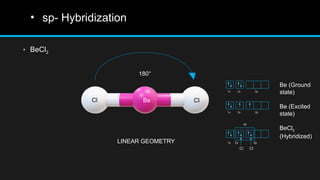
sp-Hybridization
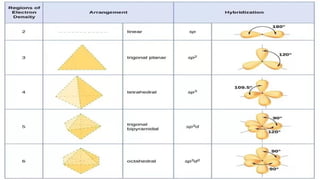
•In sp hybridization , one s and
p- orbitals mix and form two
equivalent sp hybrid orbitals.
• Each sp hybrid orbital has 50%
s-character and 50% p-
character.
• These two sp hybrid orbitals lie
along linear arrangement and
therefore, it is called linear
hybridization.
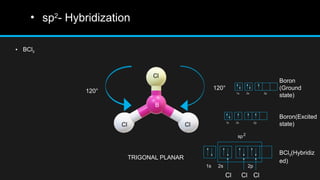
sp2
-Hybridization
• In sp2
hybridization , one s and
two p-orbitals hybridize to form
to form three equivalent sp2
hybrid orbitals.
• Each sp2
hybrid orbital has one-
third(33.3%) s-character and
two-third (66.7%) p-character.
These three sp2
orbitals remain
in the same plane making an
angle 120° with one another.
• This arrangement is also called
trigonal planar arrangement
therefore the molecules having
sp2
hybridization of the central
atom will adopt trigonal planar
geometry.
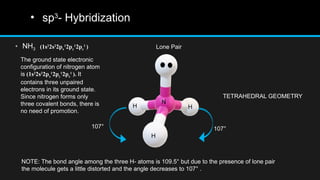
Sp3
-Hybridization
• In sp3
hybridization, one s and
three p- orbitals hybridize to
form four sp3
hybrid orbitals.
• The four hybrid orbitals will be
directed towards the four
corners of a regular tetrahedral
and make an angle of 109.5°.
• Each sp3
hybrid orbital has one-
fourth(25%) s- character and
three- fourth(75%) p- character.
The shape formed with the
central atom is tetrahedral.
5.
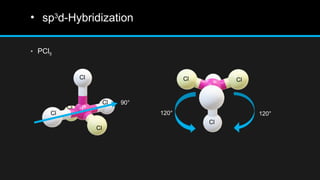
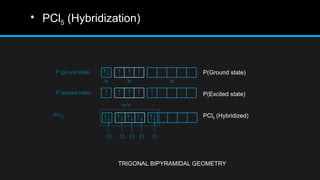
• This hybridizationinvolves the
mixing of one s, three p, one d-
orbitals. These five orbitals
hybridize to form five sp3
d- hybrid
orbitals.
• These hybrid orbitals point towards
the corners of a trigonal
bipyramidal geometry. In this case,
the three orbitals forming a plane
are directed towards the corner of
an equilateral triangle while the
other two are perpendicular to the
plane of a triangle lying above and
below it.
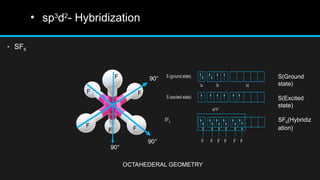
• In this case, one s, three p,
two d- orbitals get
hybridized to form six sp3
d2
hybrid orbitals which adopt
octahedral arrangement.
• The angle formed is of 90°.
sp3
d-Hybridization sp3
d2
-Hybridization
6.
• sp- Hybridization
•BeCl2
Cl Be Cl
180°
LINEAR GEOMETRY
Be (Ground
state)
Be (Excited
state)
BeCl2
(Hybridized)
• sp3
- Hybridization
•NH3
N
H
H
H
Lone Pair
NOTE: The bond angle among the three H- atoms is 109.5° but due to the presence of lone pair
the molecule gets a little distorted and the angle decreases to 107° .
107° 107°
TETRAHEDRAL GEOMETRY
(1s2
2s2
2px
1
2py
1
2pz
1
)
The ground state electronic
configuration of nitrogen atom
is (1s2
2s2
2px
1
2py
1
2pz
1
). It
contains three unpaired
electrons in its ground state.
Since nitrogen forms only
three covalent bonds, there is
no need of promotion.