1
Chapter 8: Sequences and Series
Arithmetic Sequence (common difference)
an = a1 + (n – 1)d
Arithmetic Mean
(a + b)/2
Arithmetic Series
Sn = n(a1 + an)/2
Sn = n[2a1 + (n – 1)d]/2
Geometric Sequence (common ratio)
an = a1rn – 1
Geometric Series
Sn =
( )
r-1
r-1a n
1
Infinite Geometric series
S =
r-1
a
Geometric Mean
G = ab
Harmonic Mean
H =
ab2
ba +
FORMULAS IN INTERMEDIATE ALGEBRA
Chapter 1: Systems of Linear Equations
- Consistent and Independent
f
c
e
b
d
a
≠≠
- Inconsistent
f
c
e
b
d
a
≠=
- Dependent
f
c
e
b
d
a
==
Chapter 4: Quadratic Equations
Quadratic Formula
a2
4ac-bb-
x
2
±
=
Discriminant = b2 – 4ac
Nature of the Roots
b2 – 4ac  0 two real roots
b2 – 4ac > 0 two unequal real roots
b2 – 4ac = 0 two equal real roots
b2 – 4ac < 0 two unequal imaginary
roots
Sum of the Roots = - b/a
Product of the Roots = c/a
Chapter 5: Quadratic Function
The domain of the QF is set of real numbers.
The range is …y 
a4
b-ac4 2
if a is positive.
y 
a4
b-ac4 2
if a is negative.
Vertex (h, k)   a4/)b-(4acb/2a,- 2
Line of symmetry = - b/2a
The QF has a minimum value if a is positive
and is given by the formula y = (4ac – b2)/4a.
The QF has a maximum value if a is negative
and is given by the formula y = (4ac – b2)/4a.
*** The minimum/maximum value occurs at
x = - b/2a
2
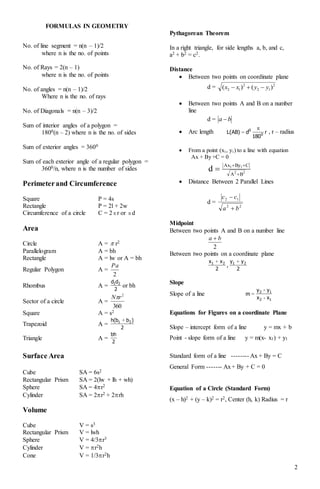
FORMULAS IN GEOMETRY
No. of line segment = n(n – 1)/2
where n is the no. of points
No. of Rays = 2(n – 1)
where n is the no. of points
No. of angles = n(n – 1)/2
Where n is the no. of rays
No. of Diagonals = n(n – 3)/2
Sum of interior angles of a polygon =
1800(n – 2) where n is the no. of sides
Sum of exterior angles = 3600
Sum of each exterior angle of a regular polygon =
3600/n, where n is the number of sides
Perimeterand Circumference
Square P = 4s
Rectangle P = 2l + 2w
Circumference of a circle C = 2  r or  d
Area
Circle A =  r2
Parallelogram A = bh
Rectangle A = lw or A = bh
Regular Polygon A =
2
Pa
Rhombus A =
2
dd 21
or bh
Sector of a circle A =
360
2
rN
Square A = s2
Trapezoid A =
2
)bb(h 21 +
Triangle A =
2
bh
Surface Area
Cube SA = 6s2
Rectangular Prism SA = 2(lw + lh + wh)
Sphere SA = 4r2
Cylinder SA = 2r2 + 2rh
Volume
Cube V = s3
Rectangular Prism V = lwh
Sphere V = 4/3r3
Cylinder V = r2h
Cone V = 1/3r2h
Pythagorean Theorem
In a right triangle, for side lengths a, b, and c,
a2 + b2 = c2.
Distance
 Between two points on coordinate plane
d = 2
12
2
12 )()( yyxx 
 Between two points A and B on a number
line
d = ba 
 Arc length r
180
d)AB(L 0
0 
= , r – radius
 From a point (x1, y1) to a line with equation
Ax + By +C = 0
22
11
BA
CByAx
d



 Distance Between 2 Parallel Lines
d =
22
12
ba
cc


Midpoint
Between two points A and B on a number line
2
ba 
Between two points on a coordinate plane
2
yy
,
2
xx 2121 ++
Slope
Slope of a line
12
12
xx
y-y
m
-
=
Equations for Figures on a coordinate Plane
Slope – intercept form of a line y = mx + b
Point - slope form of a line y = m(x- x1) + y1
Standard form of a line -------- Ax + By = C
General Form ------- Ax+ By + C = 0
Equation of a Circle (Standard Form)
(x – h)2 + (y – k)2 = r2, Center (h, k) Radius = r
3
Theorems for Angles and Circles
Theorems:
1. The radius drawn to the point of tangency is perpendicular to the tangent.
2. An angle inscribed in a semi – circle is a right angle.
3. Inscribed angles subtended by the same arc are equal.
4. Opposite angles of an inscribed quadrilaterals are supplementary.
x = 2x
(It means that the measure of an
inscribed angle is half the measure of the
intercepted arc.)
ABC =
2
1
(arc AB)
2
1 = 2 =
2
1
(arc AB + arc DE)
1 =
2
1
(arc JK – arc LM)
2 =
2
1
(arc SR – arc QR)
3 =
2
1
(arc BJH – arc BH)
4
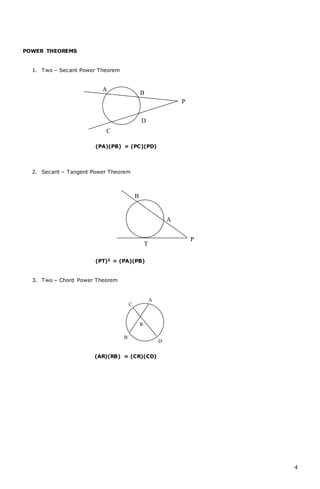
POWER THEOREMS
1. Two – Secant Power Theorem
(PA)(PB) = (PC)(PD)
2. Secant – Tangent Power Theorem
(PT)2 = (PA)(PB)
3. Two – Chord Power Theorem
(AR)(RB) = (CR)(CD)
P
B
A
D
C
P
T
A
B
A
B
C
D
R
5
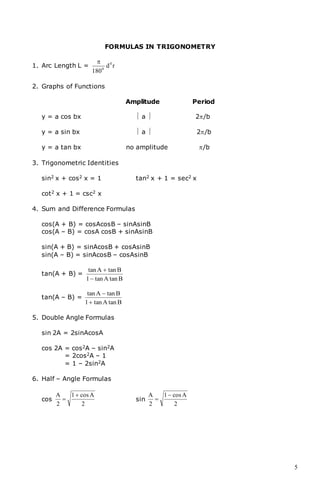
FORMULAS IN TRIGONOMETRY
1. Arc Length L = rd
180
0
0

2. Graphs of Functions
Amplitude Period
y = a cos bx  a  2/b
y = a sin bx  a  2/b
y = a tan bx no amplitude /b
3. Trigonometric Identities
sin2 x + cos2 x = 1 tan2 x + 1 = sec2 x
cot2 x + 1 = csc2 x
4. Sum and Difference Formulas
cos(A + B) = cosAcosB – sinAsinB
cos(A – B) = cosA cosB + sinAsinB
sin(A + B) = sinAcosB + cosAsinB
sin(A – B) = sinAcosB – cosAsinB
tan(A + B) =
BtanAtan1
BtanAtan


tan(A – B) =
BtanAtan1
BtanAtan


5. Double Angle Formulas
sin 2A = 2sinAcosA
cos 2A = cos2A – sin2A
= 2cos2A – 1
= 1 – 2sin2A
6. Half – Angle Formulas
cos
2
Acos1
2
A 
 sin
2
Acos1
2
A 

6
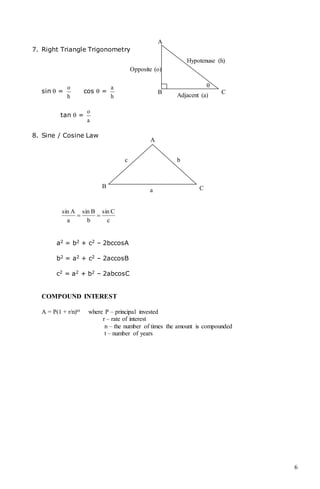
7. Right Triangle Trigonometry
sin  =
h
o
cos  =
h
a
tan  =
a
o
8. Sine / Cosine Law
c
Csin
b
Bsin
a
Asin

a2 = b2 + c2 – 2bccosA
b2 = a2 + c2 – 2accosB
c2 = a2 + b2 – 2abcosC
COMPOUND INTEREST
A = P(1 + r/n)nt where P – principal invested
r – rate of interest
n – the number of times the amount is compounded
t – number of years
A
B C

Opposite (o)
Adjacent (a)
Hypotenuse (h)
CB
A
a
bc
7
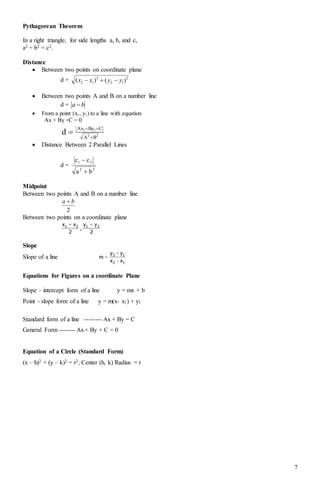
Pythagorean Theorem
In a right triangle, for side lengths a, b, and c,
a2 + b2 = c2.
Distance
 Between two points on coordinate plane
d = 2
12
2
12 )()( yyxx 
 Between two points A and B on a number line
d = ba 
 From a point (x1, y1) to a line with equation
Ax + By +C = 0
22
11
BA
CByAx
d



 Distance Between 2 Parallel Lines
d =
22
21
ba
cc


Midpoint
Between two points A and B on a number line
2
ba 
Between two points on a coordinate plane
2
yy
,
2
xx 2121 ++
Slope
Slope of a line
12
12
xx
y-y
m
-
=
Equations for Figures on a coordinate Plane
Slope – intercept form of a line y = mx + b
Point - slope form of a line y = m(x- x1) + y1
Standard form of a line -------- Ax + By = C
General Form ------- Ax+ By + C = 0
Equation of a Circle (Standard Form)
(x – h)2 + (y – k)2 = r2, Center (h, k) Radius = r

Formulas 2nd year to 4th year

  • 1.
    1 Chapter 8: Sequencesand Series Arithmetic Sequence (common difference) an = a1 + (n – 1)d Arithmetic Mean (a + b)/2 Arithmetic Series Sn = n(a1 + an)/2 Sn = n[2a1 + (n – 1)d]/2 Geometric Sequence (common ratio) an = a1rn – 1 Geometric Series Sn = ( ) r-1 r-1a n 1 Infinite Geometric series S = r-1 a Geometric Mean G = ab Harmonic Mean H = ab2 ba + FORMULAS IN INTERMEDIATE ALGEBRA Chapter 1: Systems of Linear Equations - Consistent and Independent f c e b d a ≠≠ - Inconsistent f c e b d a ≠= - Dependent f c e b d a == Chapter 4: Quadratic Equations Quadratic Formula a2 4ac-bb- x 2 ± = Discriminant = b2 – 4ac Nature of the Roots b2 – 4ac  0 two real roots b2 – 4ac > 0 two unequal real roots b2 – 4ac = 0 two equal real roots b2 – 4ac < 0 two unequal imaginary roots Sum of the Roots = - b/a Product of the Roots = c/a Chapter 5: Quadratic Function The domain of the QF is set of real numbers. The range is …y  a4 b-ac4 2 if a is positive. y  a4 b-ac4 2 if a is negative. Vertex (h, k)   a4/)b-(4acb/2a,- 2 Line of symmetry = - b/2a The QF has a minimum value if a is positive and is given by the formula y = (4ac – b2)/4a. The QF has a maximum value if a is negative and is given by the formula y = (4ac – b2)/4a. *** The minimum/maximum value occurs at x = - b/2a
  • 2.
    2 FORMULAS IN GEOMETRY No.of line segment = n(n – 1)/2 where n is the no. of points No. of Rays = 2(n – 1) where n is the no. of points No. of angles = n(n – 1)/2 Where n is the no. of rays No. of Diagonals = n(n – 3)/2 Sum of interior angles of a polygon = 1800(n – 2) where n is the no. of sides Sum of exterior angles = 3600 Sum of each exterior angle of a regular polygon = 3600/n, where n is the number of sides Perimeterand Circumference Square P = 4s Rectangle P = 2l + 2w Circumference of a circle C = 2  r or  d Area Circle A =  r2 Parallelogram A = bh Rectangle A = lw or A = bh Regular Polygon A = 2 Pa Rhombus A = 2 dd 21 or bh Sector of a circle A = 360 2 rN Square A = s2 Trapezoid A = 2 )bb(h 21 + Triangle A = 2 bh Surface Area Cube SA = 6s2 Rectangular Prism SA = 2(lw + lh + wh) Sphere SA = 4r2 Cylinder SA = 2r2 + 2rh Volume Cube V = s3 Rectangular Prism V = lwh Sphere V = 4/3r3 Cylinder V = r2h Cone V = 1/3r2h Pythagorean Theorem In a right triangle, for side lengths a, b, and c, a2 + b2 = c2. Distance  Between two points on coordinate plane d = 2 12 2 12 )()( yyxx   Between two points A and B on a number line d = ba   Arc length r 180 d)AB(L 0 0  = , r – radius  From a point (x1, y1) to a line with equation Ax + By +C = 0 22 11 BA CByAx d     Distance Between 2 Parallel Lines d = 22 12 ba cc   Midpoint Between two points A and B on a number line 2 ba  Between two points on a coordinate plane 2 yy , 2 xx 2121 ++ Slope Slope of a line 12 12 xx y-y m - = Equations for Figures on a coordinate Plane Slope – intercept form of a line y = mx + b Point - slope form of a line y = m(x- x1) + y1 Standard form of a line -------- Ax + By = C General Form ------- Ax+ By + C = 0 Equation of a Circle (Standard Form) (x – h)2 + (y – k)2 = r2, Center (h, k) Radius = r
  • 3.
    3 Theorems for Anglesand Circles Theorems: 1. The radius drawn to the point of tangency is perpendicular to the tangent. 2. An angle inscribed in a semi – circle is a right angle. 3. Inscribed angles subtended by the same arc are equal. 4. Opposite angles of an inscribed quadrilaterals are supplementary. x = 2x (It means that the measure of an inscribed angle is half the measure of the intercepted arc.) ABC = 2 1 (arc AB) 2 1 = 2 = 2 1 (arc AB + arc DE) 1 = 2 1 (arc JK – arc LM) 2 = 2 1 (arc SR – arc QR) 3 = 2 1 (arc BJH – arc BH)
  • 4.
    4 POWER THEOREMS 1. Two– Secant Power Theorem (PA)(PB) = (PC)(PD) 2. Secant – Tangent Power Theorem (PT)2 = (PA)(PB) 3. Two – Chord Power Theorem (AR)(RB) = (CR)(CD) P B A D C P T A B A B C D R
  • 5.
    5 FORMULAS IN TRIGONOMETRY 1.Arc Length L = rd 180 0 0  2. Graphs of Functions Amplitude Period y = a cos bx  a  2/b y = a sin bx  a  2/b y = a tan bx no amplitude /b 3. Trigonometric Identities sin2 x + cos2 x = 1 tan2 x + 1 = sec2 x cot2 x + 1 = csc2 x 4. Sum and Difference Formulas cos(A + B) = cosAcosB – sinAsinB cos(A – B) = cosA cosB + sinAsinB sin(A + B) = sinAcosB + cosAsinB sin(A – B) = sinAcosB – cosAsinB tan(A + B) = BtanAtan1 BtanAtan   tan(A – B) = BtanAtan1 BtanAtan   5. Double Angle Formulas sin 2A = 2sinAcosA cos 2A = cos2A – sin2A = 2cos2A – 1 = 1 – 2sin2A 6. Half – Angle Formulas cos 2 Acos1 2 A   sin 2 Acos1 2 A  
  • 6.
    6 7. Right TriangleTrigonometry sin  = h o cos  = h a tan  = a o 8. Sine / Cosine Law c Csin b Bsin a Asin  a2 = b2 + c2 – 2bccosA b2 = a2 + c2 – 2accosB c2 = a2 + b2 – 2abcosC COMPOUND INTEREST A = P(1 + r/n)nt where P – principal invested r – rate of interest n – the number of times the amount is compounded t – number of years A B C  Opposite (o) Adjacent (a) Hypotenuse (h) CB A a bc
  • 7.
    7 Pythagorean Theorem In aright triangle, for side lengths a, b, and c, a2 + b2 = c2. Distance  Between two points on coordinate plane d = 2 12 2 12 )()( yyxx   Between two points A and B on a number line d = ba   From a point (x1, y1) to a line with equation Ax + By +C = 0 22 11 BA CByAx d     Distance Between 2 Parallel Lines d = 22 21 ba cc   Midpoint Between two points A and B on a number line 2 ba  Between two points on a coordinate plane 2 yy , 2 xx 2121 ++ Slope Slope of a line 12 12 xx y-y m - = Equations for Figures on a coordinate Plane Slope – intercept form of a line y = mx + b Point - slope form of a line y = m(x- x1) + y1 Standard form of a line -------- Ax + By = C General Form ------- Ax+ By + C = 0 Equation of a Circle (Standard Form) (x – h)2 + (y – k)2 = r2, Center (h, k) Radius = r