Looking at Local Dailies’
Election 2004 Online News
Coverage
Tania H. Cantrell
Graduate Student
School of Journalism
The University of Texas at Austin
Special thanks goes to Dr. Maxwell McCombs and members of his Fall 2004 Graduate Content Analysis class, in which this
researcher participated, for group efforts in providing the data upon which this study is founded. Also, many thanks to UT
graduate student Amy Schmitz-Weiss for her assistance with the methods and appendix.
Overview:
Introduction
Theory
Research Points
Methods
Findings
Discussion
Conclusion & Recommendations
Introduction:
How often do online local newspapers upload new political
information on their sites, and what kind of information do
they upload?
Two Important Points:
•Next to voting, media are the primary channel by which
people actively participate in their own governance and
through which governments and other political actors
communicate with their publics.
•Local news media are commercial enterprises that must make
a profit in order to survive. In an effort to peg down fleeing
readers, newspapers are molding a new niche: Politics on the
Internet.
Theory:
•Intermedia agenda setting occurs when various media interact
with and influence one other.
•Media interdependency is more prevalent as media rely on and
compete with each other to get information to their publics.
•By Election 2000, about twice as many leading newspapers offered
separate online election sections than in 1996.
•Local news has been criticized for focusing less on issues and
positions and more on “quirky, amusing stories” and where each
candidate stands in the “horse race.”
•Online news trend has been to offer more local news on the Web.
•Some public policy analysts believe impact of media and
newspaper candidate endorsements can be decisive.
Research Points:
RQ1: How often do online newspapers upload new political
information on their election sites, and what kind of
information do they upload? In other words, what percentage
of local 2004 election news articles changed over time?
H1: Local online newspapers will rely more on national news
sources to supplement their online national election coverage.
H2: Election 2004 local news coverage will focus on the horse
race.
H3: Local papers will focus more on local elections than the
national election.
RQ2: Does an online paper’s candidate endorsement affect its
coverage of presidential candidates?
Methods:
•A content analysis of 308 stories from October 25-29, 2004
•Media corporations with the highest traffic in 2003 by unique
visitors monthly (2004 State of the Media Report)
•Eight media corporations analyzed by newspaper from the “Who
Owns What” list (Columbia Journalism Review’s Web site)
•two media properties (Advance Publications and Gannett) with
two newspapers each
•Four online newspaper election sections:
The Cleveland Plain Dealer (OH)
Rochester Democrat and Chronicle (NY)
Syracuse Post-Standard (NY)
Lafayette Journal and Courier (IN)
Methods:
•Software tool called Grab-a-Site
•9 a.m., 1 p.m. and 5 p.m.
•Units of analysis: headline and story
•SPSS
•Intercoder reliability: major variables had a 100 percent level of
agreement
•Limitations…
Findings:
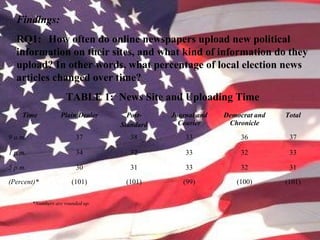
RQ1: How often do online newspapers upload new political
information on their sites, and what kind of information do they
upload? In other words, what percentage of local election news
articles changed over time?
•No relationship was observed between the news site and time of
uploading (p>.05) or date (p>.05)
•For each news site, the majority of uploading occurred by 9
a.m.
•77 percent of stories changed
Findings:
RQ1: How often do online newspapers upload new political
information on their sites, and what kind of information do they
upload? In other words, what percentage of local election news
articles changed over time?
TABLE 1: News Site and Uploading Time
*Numbers are rounded up.
Time Plain Dealer Post-
Standard
Journal and
Courier
Democrat and
Chronicle
Total
9 a.m. 37 38 33 36 37
1 p.m. 34 32 33 32 33
5 p.m. 30 31 33 32 31
(Percent)* (101) (101) (99) (100) (101)
Findings:
H1: Local online newspapers will rely more heavily on
national news sources to supplement their online national
election coverage.
•Supported; a significant relationship exists between local
dailies and geographic election orientation (p<.001).
•The relationship is reversed; as the Spearman’s rho value
(-.260) indicates, local news sites rely somewhat more on local
news coverage than national.
Findings:
H1: Local online newspapers will rely more heavily on national
news sources to supplement their online national election coverage.
TABLE 2: Local News Sites & Their Story Geographical Class.
N= 308; p<.001 (no valid (expected cell count less than 20 percent) Chi square can be provided)
Geographic Focus Local News Site
(in Percentage)
Plain
Dealer
Local or Regional 80
National 16
(Total) (96)
Post-
Standard
Journal and
Courier
Democrat and Chronicle
91 100 100
9 0 0
(100) (100) (100)
Findings:
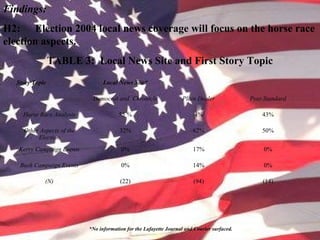
H2: Election 2004 local news coverage will focus on the horse
race election aspects.
•No significant differences in the kind of coverage dailies give to
the election exist, although the Spearman’s rho value fails to show
this (-.032, p>.05, N=130).
Findings:
H2: Election 2004 local news coverage will focus on the horse race
election aspects.
TABLE 3: Local News Site and First Story Topic
*No information for the Lafayette Journal and Courier surfaced.
Story Topic Local News Site*
Democrat and Chronicle
Horse Race Analysis 55 %
Other Aspects of the
Election
32%
Kerry Campaign Events 0%
Bush Campaign Events 0%
(N) (22)
Plain Dealer Post-Standard
4% 43%
62% 50%
17% 0%
14% 0%
(94) (14)
Findings:
H3: Local papers will focus more on local elections than the
national election.
•Supported
•90 percent of the stories in the sample content analyzed is locally
or regionally based, while only 9 percent is nationally focused
Findings:
RQ2: Does an online paper’s candidate endorsement affect its
coverage of presidential candidates?
TABLE 4: Local News Sites’ Declared Partisanship
Online Newspaper 2000 Election 2004 Election
Syracuse Post
Standard
Bush No endorsement
Rochester
Democrat and
Chronicle
Gore Kerry
Lafayette Journal
and Courier
Bush Kerry
Cleveland Plain
Dealer
Bush No endorsement
Findings:
RQ2: Does an online paper’s candidate endorsement affect
its coverage of presidential candidates?
•No relationship between the publication and the story initial
presidential candidate tone variables (positive Bush 1,
negative Bush 1, positive Kerry 1, negative Kerry 1) (all p-
values >.05; Spearman’s rho = .062 and below).
•With the exception of the Rochester Democrat and
Chronicle (Negative to Both, 86%), all the publications were
mostly neutral in their overall story evaluations (Cleveland
Plain Dealer = 70%, Syracuse Post-Standard = 100% and
Lafayette Journal and Courier not listed).
Findings:
RQ2: Does an online paper’s candidate endorsement affect
its coverage of presidential candidates?
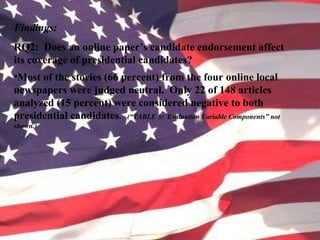
•Most of the stories (66 percent) from the four online local
newspapers were judged neutral. Only 22 of 148 articles
analyzed (15 percent) were considered negative to both
presidential candidates. (“TABLE 5: Evaluation Variable Components” not
shown.)
Discussion:
The purpose of this paper has been to explore online
political news coverage of four local news sites during
one Election 2004 week.
It is important, because few studies of political online
communication at the local level have been conducted.
It is interesting for at least the following four reasons.
Discussion:
•In accordance with general intermedia agenda setting theory, this
study demonstrates that an intermedia dependency occurs at the
local level. Online news sites do supplement their election coverage
with national stories, although the main focus is on local coverage.
•Although the Spearman’s rho test failed to show the “horse race”
predominance in local coverage, the crosstab table did.
•The relationship between partisanship and media bias raises old
and perhaps tautological but also new concerns and trends.
•This study hints at a series of additional interrelated questions.
They range from the role of polls in online local election coverage
to how much local news site visitors learn about elections and
politics. Another question regards the role of technology in
journalism.
Conclusions & Recommendations:
•Bylines -- reporter gender/ethnicity -- and datelines of the
election stories need to also be considered.
•Pinpoint how and why political communication stories are
moved.
•Lack of “horse race” predominance -- another indicator of a
disconnect between media and audience?
•Why have two of the four news sites in this study decided not to
endorse a presidential candidate? Is this lack of opinion among
local news sites a new trend? Was this decision unique to this
election?
•In what direction is political news heading? Will it be more
substantive, or will sensationalism escalate? Will there come a
time when the non-traditional press – including blogs and other
forth-coming media technologies -- will set the elite media agenda?
Conclusion & Recommendations:
•Online journalism must be more seriously considered for its
role in political discourse, principally in the dynamic
democratic process.
• Local news site political news coverage deserves its
opportunity in the media analysis spotlight.
Thank you!

Tania

  • 1.
    Looking at LocalDailies’ Election 2004 Online News Coverage Tania H. Cantrell Graduate Student School of Journalism The University of Texas at Austin Special thanks goes to Dr. Maxwell McCombs and members of his Fall 2004 Graduate Content Analysis class, in which this researcher participated, for group efforts in providing the data upon which this study is founded. Also, many thanks to UT graduate student Amy Schmitz-Weiss for her assistance with the methods and appendix.
  • 2.
  • 3.
    Introduction: How often doonline local newspapers upload new political information on their sites, and what kind of information do they upload? Two Important Points: •Next to voting, media are the primary channel by which people actively participate in their own governance and through which governments and other political actors communicate with their publics. •Local news media are commercial enterprises that must make a profit in order to survive. In an effort to peg down fleeing readers, newspapers are molding a new niche: Politics on the Internet.
  • 4.
    Theory: •Intermedia agenda settingoccurs when various media interact with and influence one other. •Media interdependency is more prevalent as media rely on and compete with each other to get information to their publics. •By Election 2000, about twice as many leading newspapers offered separate online election sections than in 1996. •Local news has been criticized for focusing less on issues and positions and more on “quirky, amusing stories” and where each candidate stands in the “horse race.” •Online news trend has been to offer more local news on the Web. •Some public policy analysts believe impact of media and newspaper candidate endorsements can be decisive.
  • 5.
    Research Points: RQ1: Howoften do online newspapers upload new political information on their election sites, and what kind of information do they upload? In other words, what percentage of local 2004 election news articles changed over time? H1: Local online newspapers will rely more on national news sources to supplement their online national election coverage. H2: Election 2004 local news coverage will focus on the horse race. H3: Local papers will focus more on local elections than the national election. RQ2: Does an online paper’s candidate endorsement affect its coverage of presidential candidates?
  • 6.
    Methods: •A content analysisof 308 stories from October 25-29, 2004 •Media corporations with the highest traffic in 2003 by unique visitors monthly (2004 State of the Media Report) •Eight media corporations analyzed by newspaper from the “Who Owns What” list (Columbia Journalism Review’s Web site) •two media properties (Advance Publications and Gannett) with two newspapers each •Four online newspaper election sections: The Cleveland Plain Dealer (OH) Rochester Democrat and Chronicle (NY) Syracuse Post-Standard (NY) Lafayette Journal and Courier (IN)
  • 7.
    Methods: •Software tool calledGrab-a-Site •9 a.m., 1 p.m. and 5 p.m. •Units of analysis: headline and story •SPSS •Intercoder reliability: major variables had a 100 percent level of agreement •Limitations…
  • 8.
    Findings: RQ1: How oftendo online newspapers upload new political information on their sites, and what kind of information do they upload? In other words, what percentage of local election news articles changed over time? •No relationship was observed between the news site and time of uploading (p>.05) or date (p>.05) •For each news site, the majority of uploading occurred by 9 a.m. •77 percent of stories changed
  • 9.
    Findings: RQ1: How oftendo online newspapers upload new political information on their sites, and what kind of information do they upload? In other words, what percentage of local election news articles changed over time? TABLE 1: News Site and Uploading Time *Numbers are rounded up. Time Plain Dealer Post- Standard Journal and Courier Democrat and Chronicle Total 9 a.m. 37 38 33 36 37 1 p.m. 34 32 33 32 33 5 p.m. 30 31 33 32 31 (Percent)* (101) (101) (99) (100) (101)
  • 10.
    Findings: H1: Local onlinenewspapers will rely more heavily on national news sources to supplement their online national election coverage. •Supported; a significant relationship exists between local dailies and geographic election orientation (p<.001). •The relationship is reversed; as the Spearman’s rho value (-.260) indicates, local news sites rely somewhat more on local news coverage than national.
  • 11.
    Findings: H1: Local onlinenewspapers will rely more heavily on national news sources to supplement their online national election coverage. TABLE 2: Local News Sites & Their Story Geographical Class. N= 308; p<.001 (no valid (expected cell count less than 20 percent) Chi square can be provided) Geographic Focus Local News Site (in Percentage) Plain Dealer Local or Regional 80 National 16 (Total) (96) Post- Standard Journal and Courier Democrat and Chronicle 91 100 100 9 0 0 (100) (100) (100)
  • 12.
    Findings: H2: Election 2004local news coverage will focus on the horse race election aspects. •No significant differences in the kind of coverage dailies give to the election exist, although the Spearman’s rho value fails to show this (-.032, p>.05, N=130).
  • 13.
    Findings: H2: Election 2004local news coverage will focus on the horse race election aspects. TABLE 3: Local News Site and First Story Topic *No information for the Lafayette Journal and Courier surfaced. Story Topic Local News Site* Democrat and Chronicle Horse Race Analysis 55 % Other Aspects of the Election 32% Kerry Campaign Events 0% Bush Campaign Events 0% (N) (22) Plain Dealer Post-Standard 4% 43% 62% 50% 17% 0% 14% 0% (94) (14)
  • 14.
    Findings: H3: Local paperswill focus more on local elections than the national election. •Supported •90 percent of the stories in the sample content analyzed is locally or regionally based, while only 9 percent is nationally focused
  • 15.
    Findings: RQ2: Does anonline paper’s candidate endorsement affect its coverage of presidential candidates? TABLE 4: Local News Sites’ Declared Partisanship Online Newspaper 2000 Election 2004 Election Syracuse Post Standard Bush No endorsement Rochester Democrat and Chronicle Gore Kerry Lafayette Journal and Courier Bush Kerry Cleveland Plain Dealer Bush No endorsement
  • 16.
    Findings: RQ2: Does anonline paper’s candidate endorsement affect its coverage of presidential candidates? •No relationship between the publication and the story initial presidential candidate tone variables (positive Bush 1, negative Bush 1, positive Kerry 1, negative Kerry 1) (all p- values >.05; Spearman’s rho = .062 and below). •With the exception of the Rochester Democrat and Chronicle (Negative to Both, 86%), all the publications were mostly neutral in their overall story evaluations (Cleveland Plain Dealer = 70%, Syracuse Post-Standard = 100% and Lafayette Journal and Courier not listed).
  • 17.
    Findings: RQ2: Does anonline paper’s candidate endorsement affect its coverage of presidential candidates? •Most of the stories (66 percent) from the four online local newspapers were judged neutral. Only 22 of 148 articles analyzed (15 percent) were considered negative to both presidential candidates. (“TABLE 5: Evaluation Variable Components” not shown.)
  • 18.
    Discussion: The purpose ofthis paper has been to explore online political news coverage of four local news sites during one Election 2004 week. It is important, because few studies of political online communication at the local level have been conducted. It is interesting for at least the following four reasons.
  • 19.
    Discussion: •In accordance withgeneral intermedia agenda setting theory, this study demonstrates that an intermedia dependency occurs at the local level. Online news sites do supplement their election coverage with national stories, although the main focus is on local coverage. •Although the Spearman’s rho test failed to show the “horse race” predominance in local coverage, the crosstab table did. •The relationship between partisanship and media bias raises old and perhaps tautological but also new concerns and trends. •This study hints at a series of additional interrelated questions. They range from the role of polls in online local election coverage to how much local news site visitors learn about elections and politics. Another question regards the role of technology in journalism.
  • 20.
    Conclusions & Recommendations: •Bylines-- reporter gender/ethnicity -- and datelines of the election stories need to also be considered. •Pinpoint how and why political communication stories are moved. •Lack of “horse race” predominance -- another indicator of a disconnect between media and audience? •Why have two of the four news sites in this study decided not to endorse a presidential candidate? Is this lack of opinion among local news sites a new trend? Was this decision unique to this election? •In what direction is political news heading? Will it be more substantive, or will sensationalism escalate? Will there come a time when the non-traditional press – including blogs and other forth-coming media technologies -- will set the elite media agenda?
  • 21.
    Conclusion & Recommendations: •Onlinejournalism must be more seriously considered for its role in political discourse, principally in the dynamic democratic process. • Local news site political news coverage deserves its opportunity in the media analysis spotlight.
  • 22.