News Work, News Space in
the Transforming Digital
Newsroom
Sue Robinson
The University of Wisconsin-Madison
April 2009
CONVERGENCE CRISES
Reporter 1: I guess we’re getting
laptops. I feel like I need one …
But I also feel like we’re being
co-opted into the 24-7 world,
man. It never ends.
Reporter 2: I am too old for this
shit. I can’t wait until I retire.
Research Questions
1) Values, considerations, assumptions
influencing physical virtual transition
2) How are digital tools affecting news
performance?
3) How has the newsroom’s culture changed?
4) What works? Are changes in ‘real world’
creating hoped-for digital transformations?
Newspaper Culture Lingers: Even among
staffs directed to go completely virtual
Mobile, cyber-newsroom: Inhospitable to
old-world reporters
Changed Social Patterns: According to
digital skills
 Technology = Replacing journalism
“[The digital camera] makes you feel a
little more small time, like you’re writing
for some little weekly.”
Findings
What Works
Combining Staffs, Changing Physical Space
“What? It’s ‘let’s paint the walls and
move stuff around’? Please. How is that going
to help anyone?”
BUT
Being able to see online editors had “put them
in the front of my mind, whereas before I
never really thought about them because I
could not see them from where I was
sitting.”
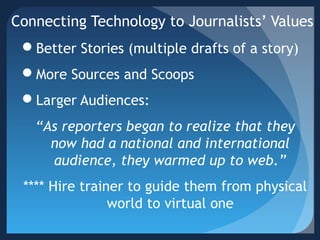
Connecting Technology to Journalists’ Values
Better Stories (multiple drafts of a story)
More Sources and Scoops
Larger Audiences:
“As reporters began to realize that they
now had a national and international
audience, they warmed up to web.”
**** Hire trainer to guide them from physical
world to virtual one
Giving Authority to Online Editors
Visual Presence (as in meetings)
Organizational Leadership
Delegation Authority (assigning
stories)
“I’m not sure if [Online Editor] can tell me
I have to post. Can he? I already have one
boss.”
Building in Physical Reminders of Journalism
Prioritize Stories
Perpetuate Bylines/Photos/Emails
Archive, Aggregate News Work
Create Journalist Sub-Brands
It was so buried, I felt, what is the
point? Sometimes it seems that we lose
our soul.”
Recognizing Altered News Work
Journalism as a Process (An
Unfinished Story, but also:
Journalistic Opportunities)
Omnipresent Work, Cross Platform
Work
Management Expectations

Robinson. 2009.

  • 1.
    News Work, NewsSpace in the Transforming Digital Newsroom Sue Robinson The University of Wisconsin-Madison April 2009 CONVERGENCE CRISES
  • 2.
    Reporter 1: Iguess we’re getting laptops. I feel like I need one … But I also feel like we’re being co-opted into the 24-7 world, man. It never ends. Reporter 2: I am too old for this shit. I can’t wait until I retire.
  • 3.
    Research Questions 1) Values,considerations, assumptions influencing physical virtual transition 2) How are digital tools affecting news performance? 3) How has the newsroom’s culture changed? 4) What works? Are changes in ‘real world’ creating hoped-for digital transformations?
  • 4.
    Newspaper Culture Lingers:Even among staffs directed to go completely virtual Mobile, cyber-newsroom: Inhospitable to old-world reporters Changed Social Patterns: According to digital skills  Technology = Replacing journalism “[The digital camera] makes you feel a little more small time, like you’re writing for some little weekly.” Findings
  • 5.
  • 6.
    Combining Staffs, ChangingPhysical Space “What? It’s ‘let’s paint the walls and move stuff around’? Please. How is that going to help anyone?” BUT Being able to see online editors had “put them in the front of my mind, whereas before I never really thought about them because I could not see them from where I was sitting.”
  • 7.
    Connecting Technology toJournalists’ Values Better Stories (multiple drafts of a story) More Sources and Scoops Larger Audiences: “As reporters began to realize that they now had a national and international audience, they warmed up to web.” **** Hire trainer to guide them from physical world to virtual one
  • 8.
    Giving Authority toOnline Editors Visual Presence (as in meetings) Organizational Leadership Delegation Authority (assigning stories) “I’m not sure if [Online Editor] can tell me I have to post. Can he? I already have one boss.”
  • 9.
    Building in PhysicalReminders of Journalism Prioritize Stories Perpetuate Bylines/Photos/Emails Archive, Aggregate News Work Create Journalist Sub-Brands It was so buried, I felt, what is the point? Sometimes it seems that we lose our soul.”
  • 10.
    Recognizing Altered NewsWork Journalism as a Process (An Unfinished Story, but also: Journalistic Opportunities) Omnipresent Work, Cross Platform Work Management Expectations

Editor's Notes

  • #4 What values, considerations and assumptions influence the creation of physical/virtual newsroom spaces in transitioning organizations? 2) What works in this environment? Are the changes in the ‘real world’ creating the hoped-for digital changes in the newsroom’s culture 3) What is the connection between new digital tools, news work and news space that results in performance, and how do these concepts intersect in the newsroom?
  • #5 the presence of the laptop changes the relationship that a reporter has with his work activity (his labor ie the idea that he can work from home, that work is always present and his resulting efficiency and resentment), the relationship he has with his company/brand (his product; ie a blog written from an event, a blog turning reporter himself into an extension of the brand, a brand within a brand), the relationship a reporter has with his newsroom community (ie emails and ims and development of online cliques defying a former cubicle-based culture) and also the relationship he has with his management (workplace organizational power). the relationship that the reporter has with his audiences,
  • #11 No more byline counts. Be aware of where your reporters are.