A unified perspective for Darmon points
2013 CMS Winter Meeting, Ottawa
Xavier Guitart 1 Marc Masdeu 2 Mehmet Haluk Sengun 3
1Institut f¨ur Experimentelle Mathematik
2Columbia University
3University of Warwick
December 7, 2013
Marc Masdeu A unified perspective for Darmon points December 7, 2013 0 / 17
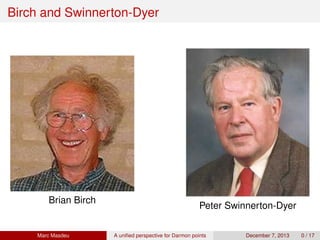
Birch and Swinnerton-Dyer
Brian Birch
Peter Swinnerton-Dyer
Marc Masdeu A unified perspective for Darmon points December 7, 2013 0 / 17
The BSD conjecture
Let F be a number field.
Let E/F be an elliptic curve of conductor N = NE.
Let K/F be a quadratic extension of F.
Assume (for simplicity) that N is square-free, coprime to disc(K/F).
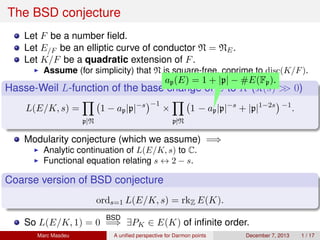
Hasse-Weil L-function of the base change of E to K ( (s) >> 0)
L(E/K, s) =
p|N
1 − ap|p|−s −1
×
p N
1
ap(E) = 1 + |p| − #E(Fp).
− ap|p|−s
+ |p|1−2s −1
.
Modularity conjecture (which we assume) =⇒
Analytic continuation of L(E/K, s) to C.
Functional equation relating s ↔ 2 − s.
Coarse version of BSD conjecture
ords=1 L(E/K, s) = rkZ E(K).
So L(E/K, 1) = 0
BSD
=⇒ ∃PK ∈ E(K) of infinite order.
Marc Masdeu A unified perspective for Darmon points December 7, 2013 1 / 17
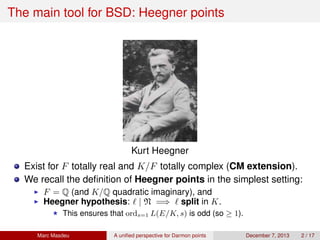
The main tool for BSD: Heegner points
Kurt Heegner
Exist for F totally real and K/F totally complex (CM extension).
We recall the definition of Heegner points in the simplest setting:
F = Q (and K/Q quadratic imaginary), and
Heegner hypothesis: | N =⇒ split in K.
This ensures that ords=1 L(E/K, s) is odd (so ≥ 1).
Marc Masdeu A unified perspective for Darmon points December 7, 2013 2 / 17
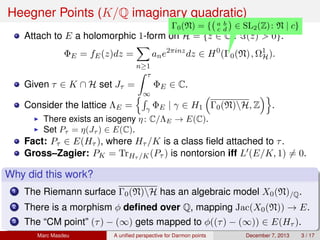
Heegner Points (K/Q imaginary quadratic)
Attach to E a holomorphic 1-form on H = {z ∈ C : (z) > 0}.
ΦE = fE(z)dz =
n≥1
ane2πinz
dz ∈ H0
(Γ0(N)
Γ0(N) = { a b
c d ∈ SL2(Z): N | c}
, Ω1
H).
Given τ ∈ K ∩ H set Jτ =
τ
∞
ΦE ∈ C.
Consider the lattice ΛE = γ ΦE | γ ∈ H1 Γ0(N)H, Z .
There exists an isogeny η: C/ΛE → E(C).
Set Pτ = η(Jτ ) ∈ E(C).
Fact: Pτ ∈ E(Hτ ), where Hτ /K is a class field attached to τ.
Gross–Zagier: PK = TrHτ /K(Pτ ) is nontorsion iff L (E/K, 1) = 0.
Why did this work?
1 The Riemann surface Γ0(N)H has an algebraic model X0(N)/Q.
2 There is a morphism φ defined over Q, mapping Jac(X0(N)) → E.
3 The “CM point” (τ) − (∞) gets mapped to φ((τ) − (∞)) ∈ E(Hτ ).
Marc Masdeu A unified perspective for Darmon points December 7, 2013 3 / 17
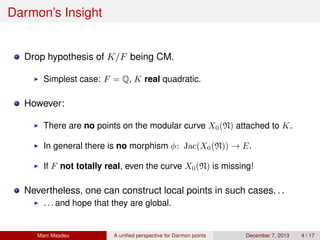
Darmon’s Insight
Drop hypothesis of K/F being CM.
Simplest case: F = Q, K real quadratic.
However:
There are no points on the modular curve X0(N) attached to K.
In general there is no morphism φ: Jac(X0(N)) → E.
If F not totally real, even the curve X0(N) is missing!
Nevertheless, one can construct local points in such cases. . .
. . . and hope that they are global.
Marc Masdeu A unified perspective for Darmon points December 7, 2013 4 / 17
Goals
In this talk I will:
1 Explain what is a Darmon point.
2 Sketch a general construction.
“The fun of the subject seems to me to be in the examples.
B. Gross, in a letter to B. Birch, 1982
”3 Illustrate with an fun example.
Marc Masdeu A unified perspective for Darmon points December 7, 2013 5 / 17
Basic notation
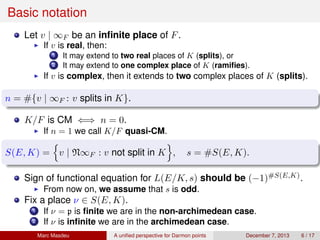
Let v | ∞F be an infinite place of F.
If v is real, then:
1 It may extend to two real places of K (splits), or
2 It may extend to one complex place of K (ramifies).
If v is complex, then it extends to two complex places of K (splits).
n = #{v | ∞F : v splits in K}.
K/F is CM ⇐⇒ n = 0.
If n = 1 we call K/F quasi-CM.
S(E, K) = v | N∞F : v not split in K , s = #S(E, K).
Sign of functional equation for L(E/K, s) should be (−1)#S(E,K).
From now on, we assume that s is odd.
Fix a place ν ∈ S(E, K).
1 If ν = p is finite we are in the non-archimedean case.
2 If ν is infinite we are in the archimedean case.
Marc Masdeu A unified perspective for Darmon points December 7, 2013 6 / 17
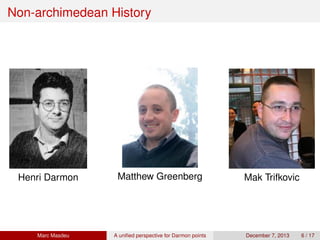
Non-archimedean History
Henri Darmon Matthew Greenberg Mak Trifkovic
Marc Masdeu A unified perspective for Darmon points December 7, 2013 6 / 17
Non-archimedean History
Warning
These constructions are also known as Stark-Heegner points.
H. Darmon (1999): F = Q, quasi-CM, s = 1.
Darmon-Green (2001): special cases, used Riemann products.
Darmon-Pollack (2002): same cases, overconvergent methods.
Guitart-M. (2012): all cases, overconvergent methods.
M. Trifkovic (2006): F imag. quadratic ( =⇒ quasi-CM)), s = 1.
Trifkovic (2006): F euclidean, E of prime conductor.
Guitart-M. (2013): F arbitrary, E arbitrary.
M. Greenberg (2008): F totally real, arbitrary ramification, s ≥ 1.
Guitart-M. (2013): F = Q, quasi-CM case, s ≥ 1.
Marc Masdeu A unified perspective for Darmon points December 7, 2013 7 / 17
Archimedean History
Henri Darmon
Jerome Gartner
Marc Masdeu A unified perspective for Darmon points December 7, 2013 7 / 17
Archimedean History
Warning
Initially called Almost Totally Real (ATR) points.
But this name only makes sense in the original setting of Darmon.
H. Darmon (2000): F totally real, s = 1.
Darmon-Logan (2007): F quadratic norm-euclidean, NE trivial.
Guitart-M. (2011): F quadratic and arbitrary, NE trivial.
Guitart-M. (2012): F quadratic and arbitrary, NE arbitrary.
J. Gartner (2010): F totally real, s ≥ 1.
?
Marc Masdeu A unified perspective for Darmon points December 7, 2013 8 / 17
Our construction
Xavier Guitart M. Mehmet H.
Sengun
Available for arbitrary base number fields F (mixed signature).
Comes in both archimedean and non-archimedean flavors.
All of the previous constructions become particular cases.
We can provide genuinely new numerical evidence.
Marc Masdeu A unified perspective for Darmon points December 7, 2013 9 / 17
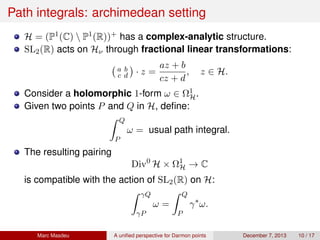
Path integrals: archimedean setting
H = (P1(C)  P1(R))+ has a complex-analytic structure.
SL2(R) acts on Hν through fractional linear transformations:
a b
c d · z =
az + b
cz + d
, z ∈ H.
Consider a holomorphic 1-form ω ∈ Ω1
H.
Given two points P and Q in H, define:
Q
P
ω = usual path integral.
The resulting pairing
Div0
H × Ω1
H → C
is compatible with the action of SL2(R) on H:
γQ
γP
ω =
Q
P
γ∗
ω.
Marc Masdeu A unified perspective for Darmon points December 7, 2013 10 / 17
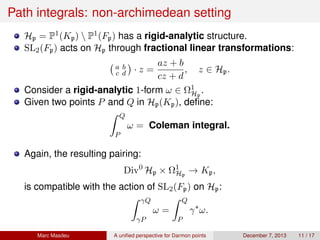
Path integrals: non-archimedean setting
Hp = P1(Kp)  P1(Fp) has a rigid-analytic structure.
SL2(Fp) acts on Hp through fractional linear transformations:
a b
c d · z =
az + b
cz + d
, z ∈ Hp.
Consider a rigid-analytic 1-form ω ∈ Ω1
Hp
.
Given two points P and Q in Hp(Kp), define:
Q
P
ω = Coleman integral.
Again, the resulting pairing:
Div0
Hp × Ω1
Hp
→ Kp,
is compatible with the action of SL2(Fp) on Hp:
γQ
γP
ω =
Q
P
γ∗
ω.
Marc Masdeu A unified perspective for Darmon points December 7, 2013 11 / 17
The group Γ
Let B/F = quaternion algebra with Ram(B) = S(E, K)  {ν}.
B = M2(F) (split case) ⇐⇒ s = 1.
Otherwise, we are in the quaternionic case.
E and K determine a certain {ν}-arithmetic subgroup Γ ⊂ SL2(Fv):
Let m = l|N, split in K l.
Let R be an Eichler order of level m inside B.
Fix an embedding ιν : R → M2(ZF,ν).
Γ = ιν R[1/ν]×
1 ⊂ SL2(Fν).
Marc Masdeu A unified perspective for Darmon points December 7, 2013 12 / 17
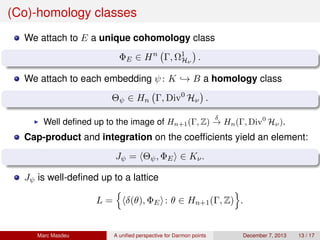
(Co)-homology classes
We attach to E a unique cohomology class
ΦE ∈ Hn
Γ, Ω1
Hν
.
We attach to each embedding ψ: K → B a homology class
Θψ ∈ Hn Γ, Div0
Hν .
Well defined up to the image of Hn+1(Γ, Z)
δ
→ Hn(Γ, Div0
Hν).
Cap-product and integration on the coefficients yield an element:
Jψ = Θψ, ΦE ∈ Kν.
Jψ is well-defined up to a lattice
L = δ(θ), ΦE : θ ∈ Hn+1(Γ, Z) .
Marc Masdeu A unified perspective for Darmon points December 7, 2013 13 / 17
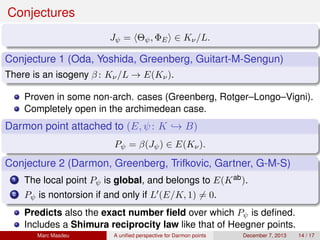
Conjectures
Jψ = Θψ, ΦE ∈ Kν/L.
Conjecture 1 (Oda, Yoshida, Greenberg, Guitart-M-Sengun)
There is an isogeny β : Kν/L → E(Kν).
Proven in some non-arch. cases (Greenberg, Rotger–Longo–Vigni).
Completely open in the archimedean case.
Darmon point attached to (E, ψ: K → B)
Pψ = β(Jψ) ∈ E(Kν).
Conjecture 2 (Darmon, Greenberg, Trifkovic, Gartner, G-M-S)
1 The local point Pψ is global, and belongs to E(Kab).
2 Pψ is nontorsion if and only if L (E/K, 1) = 0.
Predicts also the exact number field over which Pψ is defined.
Includes a Shimura reciprocity law like that of Heegner points.
Marc Masdeu A unified perspective for Darmon points December 7, 2013 14 / 17
Examples
Please show them
the example !
Marc Masdeu A unified perspective for Darmon points December 7, 2013 14 / 17
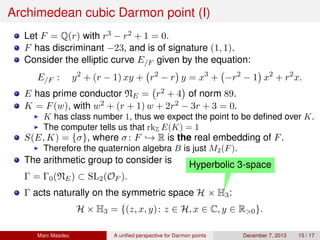
Archimedean cubic Darmon point (I)
Let F = Q(r) with r3 − r2 + 1 = 0.
F has discriminant −23, and is of signature (1, 1).
Consider the elliptic curve E/F given by the equation:
E/F : y2
+ (r − 1) xy + r2
− r y = x3
+ −r2
− 1 x2
+ r2
x.
E has prime conductor NE = r2 + 4 of norm 89.
K = F(w), with w2 + (r + 1) w + 2r2 − 3r + 3 = 0.
K has class number 1, thus we expect the point to be defined over K.
The computer tells us that rkZ E(K) = 1
S(E, K) = {σ}, where σ: F → R is the real embedding of F.
Therefore the quaternion algebra B is just M2(F).
The arithmetic group to consider is
Γ = Γ0(NE) ⊂ SL2(OF ).
Γ acts naturally on the symmetric space H
Hyperbolic 3-space
× H3:
H × H3 = {(z, x, y): z ∈ H, x ∈ C, y ∈ R>0}.
Marc Masdeu A unified perspective for Darmon points December 7, 2013 15 / 17
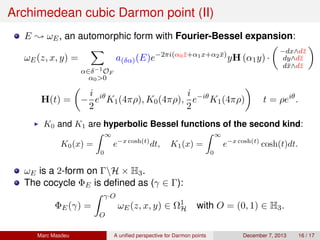
Archimedean cubic Darmon point (II)
E ; ωE, an automorphic form with Fourier-Bessel expansion:
ωE(z, x, y) =
α∈δ−1OF
α0>0
a(δα)(E)e−2πi(α0 ¯z+α1x+α2 ¯x)
yH (α1y) ·
−dx∧d¯z
dy∧d¯z
d¯x∧d¯z
H(t) = −
i
2
eiθ
K1(4πρ), K0(4πρ),
i
2
e−iθ
K1(4πρ) t = ρeiθ
.
K0 and K1 are hyperbolic Bessel functions of the second kind:
K0(x) =
∞
0
e−x cosh(t)
dt, K1(x) =
∞
0
e−x cosh(t)
cosh(t)dt.
ωE is a 2-form on ΓH × H3.
The cocycle ΦE is defined as (γ ∈ Γ):
ΦE(γ) =
γ·O
O
ωE(z, x, y) ∈ Ω1
H with O = (0, 1) ∈ H3.
Marc Masdeu A unified perspective for Darmon points December 7, 2013 16 / 17
Archimedean cubic Darmon point (III)
Consider the embedding ψ: K → M2(F) given by:
w →
−2r2 + 3r r − 3
r2 + 4 2r2 − 4r − 1
Let γψ = ψ(u), where u is a fundamental norm-one unit of OK.
γψ fixes τψ = −0.7181328459824 + 0.55312763561813i ∈ H.
Construct Θψ = [γψ ⊗τψ] ∈ H1(Γ, Div H).
Θψ is equivalent to a cycle γi ⊗(si − ri) taking values in Div0
H.
Jψ =
i
si
ri
ΦE(γi) =
i
γi·O
O
si
ri
ωE(z, x, y).
We obtain, summing over all ideals (α) of norm up to 400, 000:
Jψ = 0.0005281284234 + 0.0013607546066i ; Pψ ∈ E(C).
Numerically (up to 32 decimal digits) we obtain:
Pψ
?
= −10 × r − 1, w − r2
+ 2r ∈ E(K).
Marc Masdeu A unified perspective for Darmon points December 7, 2013 17 / 17
Thank you !
Bibliography, code and slides at:
http://www.math.columbia.edu/∼masdeu/
Marc Masdeu A unified perspective for Darmon points December 7, 2013 17 / 17
What to do next?
1 Available code
2 Non-archimedean example
3 Details for Cohomology
4 Details for Homology
5 Bibliography
Marc Masdeu A unified perspective for Darmon points December 7, 2013 17 / 17
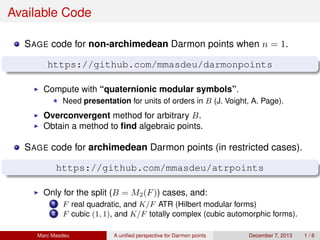
Available Code
SAGE code for non-archimedean Darmon points when n = 1.
https://github.com/mmasdeu/darmonpoints
Compute with “quaternionic modular symbols”.
Need presentation for units of orders in B (J. Voight, A. Page).
Overconvergent method for arbitrary B.
Obtain a method to find algebraic points.
SAGE code for archimedean Darmon points (in restricted cases).
https://github.com/mmasdeu/atrpoints
Only for the split (B = M2(F)) cases, and:
1 F real quadratic, and K/F ATR (Hilbert modular forms)
2 F cubic (1, 1), and K/F totally complex (cubic automorphic forms).
Marc Masdeu A unified perspective for Darmon points December 7, 2013 1 / 6
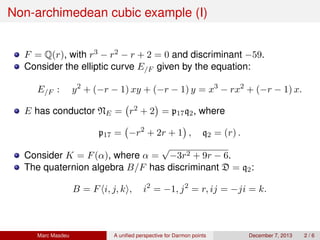
Non-archimedean cubic example (I)
F = Q(r), with r3 − r2 − r + 2 = 0 and discriminant −59.
Consider the elliptic curve E/F given by the equation:
E/F : y2
+ (−r − 1) xy + (−r − 1) y = x3
− rx2
+ (−r − 1) x.
E has conductor NE = r2 + 2 = p17q2, where
p17 = −r2
+ 2r + 1 , q2 = (r) .
Consider K = F(α), where α =
√
−3r2 + 9r − 6.
The quaternion algebra B/F has discriminant D = q2:
B = F i, j, k , i2
= −1, j2
= r, ij = −ji = k.
Marc Masdeu A unified perspective for Darmon points December 7, 2013 2 / 6
Non-archimedean cubic example (II)
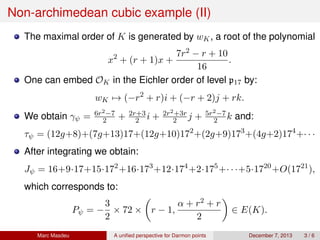
The maximal order of K is generated by wK, a root of the polynomial
x2
+ (r + 1)x +
7r2 − r + 10
16
.
One can embed OK in the Eichler order of level p17 by:
wK → (−r2
+ r)i + (−r + 2)j + rk.
We obtain γψ = 6r2−7
2 + 2r+3
2 i + 2r2+3r
2 j + 5r2−7
2 k and:
τψ = (12g+8)+(7g+13)17+(12g+10)172
+(2g+9)173
+(4g+2)174
+· · ·
After integrating we obtain:
Jψ = 16+9·17+15·172
+16·173
+12·174
+2·175
+· · ·+5·1720
+O(1721
),
which corresponds to:
Pψ = −
3
2
× 72 × r − 1,
α + r2 + r
2
∈ E(K).
Marc Masdeu A unified perspective for Darmon points December 7, 2013 3 / 6
Cohomology
Recall that S(E, K) and ν determine:
Γ = ιν R[1/ν]×
1 ⊂ SL2(Fν).
e.g. S(E, K) = {p} and ν = p give Γ = SL2 OF [1
p ] .
Choose “signs at infinity” s1, . . . , sn ∈ {±1}.
Theorem (Darmon, Greenberg, Trifkovic, Gartner, G.–M.–S.)
There exists a unique (up to sign) class
ΦE ∈ Hn
Γ, Ω1
Hν
such that:
1 TlΦE = alΦE for all l N.
2 UqΦE = aqΦE for all q | N.
3 Wσi ΦE = siΦE for all embeddings σi : F → R which split in K.
Marc Masdeu A unified perspective for Darmon points December 7, 2013 4 / 6
Homology
Let ψ: O → R be an embedding of an order O of K.
Which is optimal: ψ(O) = R ∩ ψ(K).
Consider the group O×
1 = {u ∈ O× : NmK/F (u) = 1}.
rank(O×
1 ) = rank(O×
) − rank(OF ) = n.
Let u1, . . . , un ∈ O×
1 be a basis for the non-torsion units.
; ∆ψ = ψ(u1) · · · ψ(un) ∈ Hn(Γ, Z).
K acts on Hv through ιν ◦ ψ.
Let τψ be the (unique) fixed point of K×
on Hv.
Have the exact sequence
Hn+1(Γ, Z)
δ // Hn(Γ, Div0
Hν) // Hn(Γ, Div Hν)
deg
// Hn(Γ, Z)
Θψ
 ? // [∆ψ ⊗τψ]  // [∆ψ]
Fact: [∆ψ] is torsion.
Can pull back a multiple of [∆ψ ⊗τψ] to Θψ ∈ Hn(Γ, Div0
Hν).
Well defined up to δ(Hn+1(Γ, Z)).
Marc Masdeu A unified perspective for Darmon points December 7, 2013 5 / 6
Bibliography
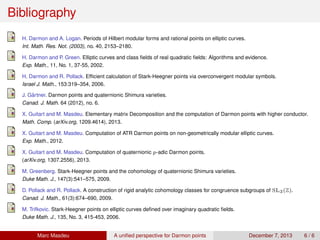
H. Darmon and A. Logan. Periods of Hilbert modular forms and rational points on elliptic curves.
Int. Math. Res. Not. (2003), no. 40, 2153–2180.
H. Darmon and P. Green. Elliptic curves and class fields of real quadratic fields: Algorithms and evidence.
Exp. Math., 11, No. 1, 37-55, 2002.
H. Darmon and R. Pollack. Efficient calculation of Stark-Heegner points via overconvergent modular symbols.
Israel J. Math., 153:319–354, 2006.
J. G¨artner. Darmon points and quaternionic Shimura varieties.
Canad. J. Math. 64 (2012), no. 6.
X. Guitart and M. Masdeu. Elementary matrix Decomposition and the computation of Darmon points with higher conductor.
Math. Comp. (arXiv.org, 1209.4614), 2013.
X. Guitart and M. Masdeu. Computation of ATR Darmon points on non-geometrically modular elliptic curves.
Exp. Math., 2012.
X. Guitart and M. Masdeu. Computation of quaternionic p-adic Darmon points.
(arXiv.org, 1307.2556), 2013.
M. Greenberg. Stark-Heegner points and the cohomology of quaternionic Shimura varieties.
Duke Math. J., 147(3):541–575, 2009.
D. Pollack and R. Pollack. A construction of rigid analytic cohomology classes for congruence subgroups of SL3(Z).
Canad. J. Math., 61(3):674–690, 2009.
M. Trifkovic. Stark-Heegner points on elliptic curves defined over imaginary quadratic fields.
Duke Math. J., 135, No. 3, 415-453, 2006.
Marc Masdeu A unified perspective for Darmon points December 7, 2013 6 / 6

A Unified Perspective for Darmon Points

  • 1.
    A unified perspectivefor Darmon points 2013 CMS Winter Meeting, Ottawa Xavier Guitart 1 Marc Masdeu 2 Mehmet Haluk Sengun 3 1Institut f¨ur Experimentelle Mathematik 2Columbia University 3University of Warwick December 7, 2013 Marc Masdeu A unified perspective for Darmon points December 7, 2013 0 / 17
  • 2.
    Birch and Swinnerton-Dyer BrianBirch Peter Swinnerton-Dyer Marc Masdeu A unified perspective for Darmon points December 7, 2013 0 / 17
  • 3.
    The BSD conjecture LetF be a number field. Let E/F be an elliptic curve of conductor N = NE. Let K/F be a quadratic extension of F. Assume (for simplicity) that N is square-free, coprime to disc(K/F). Hasse-Weil L-function of the base change of E to K ( (s) >> 0) L(E/K, s) = p|N 1 − ap|p|−s −1 × p N 1 ap(E) = 1 + |p| − #E(Fp). − ap|p|−s + |p|1−2s −1 . Modularity conjecture (which we assume) =⇒ Analytic continuation of L(E/K, s) to C. Functional equation relating s ↔ 2 − s. Coarse version of BSD conjecture ords=1 L(E/K, s) = rkZ E(K). So L(E/K, 1) = 0 BSD =⇒ ∃PK ∈ E(K) of infinite order. Marc Masdeu A unified perspective for Darmon points December 7, 2013 1 / 17
  • 4.
    The main toolfor BSD: Heegner points Kurt Heegner Exist for F totally real and K/F totally complex (CM extension). We recall the definition of Heegner points in the simplest setting: F = Q (and K/Q quadratic imaginary), and Heegner hypothesis: | N =⇒ split in K. This ensures that ords=1 L(E/K, s) is odd (so ≥ 1). Marc Masdeu A unified perspective for Darmon points December 7, 2013 2 / 17
  • 5.
    Heegner Points (K/Qimaginary quadratic) Attach to E a holomorphic 1-form on H = {z ∈ C : (z) > 0}. ΦE = fE(z)dz = n≥1 ane2πinz dz ∈ H0 (Γ0(N) Γ0(N) = { a b c d ∈ SL2(Z): N | c} , Ω1 H). Given τ ∈ K ∩ H set Jτ = τ ∞ ΦE ∈ C. Consider the lattice ΛE = γ ΦE | γ ∈ H1 Γ0(N)H, Z . There exists an isogeny η: C/ΛE → E(C). Set Pτ = η(Jτ ) ∈ E(C). Fact: Pτ ∈ E(Hτ ), where Hτ /K is a class field attached to τ. Gross–Zagier: PK = TrHτ /K(Pτ ) is nontorsion iff L (E/K, 1) = 0. Why did this work? 1 The Riemann surface Γ0(N)H has an algebraic model X0(N)/Q. 2 There is a morphism φ defined over Q, mapping Jac(X0(N)) → E. 3 The “CM point” (τ) − (∞) gets mapped to φ((τ) − (∞)) ∈ E(Hτ ). Marc Masdeu A unified perspective for Darmon points December 7, 2013 3 / 17
  • 6.
    Darmon’s Insight Drop hypothesisof K/F being CM. Simplest case: F = Q, K real quadratic. However: There are no points on the modular curve X0(N) attached to K. In general there is no morphism φ: Jac(X0(N)) → E. If F not totally real, even the curve X0(N) is missing! Nevertheless, one can construct local points in such cases. . . . . . and hope that they are global. Marc Masdeu A unified perspective for Darmon points December 7, 2013 4 / 17
  • 7.
    Goals In this talkI will: 1 Explain what is a Darmon point. 2 Sketch a general construction. “The fun of the subject seems to me to be in the examples. B. Gross, in a letter to B. Birch, 1982 ”3 Illustrate with an fun example. Marc Masdeu A unified perspective for Darmon points December 7, 2013 5 / 17
  • 8.
    Basic notation Let v| ∞F be an infinite place of F. If v is real, then: 1 It may extend to two real places of K (splits), or 2 It may extend to one complex place of K (ramifies). If v is complex, then it extends to two complex places of K (splits). n = #{v | ∞F : v splits in K}. K/F is CM ⇐⇒ n = 0. If n = 1 we call K/F quasi-CM. S(E, K) = v | N∞F : v not split in K , s = #S(E, K). Sign of functional equation for L(E/K, s) should be (−1)#S(E,K). From now on, we assume that s is odd. Fix a place ν ∈ S(E, K). 1 If ν = p is finite we are in the non-archimedean case. 2 If ν is infinite we are in the archimedean case. Marc Masdeu A unified perspective for Darmon points December 7, 2013 6 / 17
  • 9.
    Non-archimedean History Henri DarmonMatthew Greenberg Mak Trifkovic Marc Masdeu A unified perspective for Darmon points December 7, 2013 6 / 17
  • 10.
    Non-archimedean History Warning These constructionsare also known as Stark-Heegner points. H. Darmon (1999): F = Q, quasi-CM, s = 1. Darmon-Green (2001): special cases, used Riemann products. Darmon-Pollack (2002): same cases, overconvergent methods. Guitart-M. (2012): all cases, overconvergent methods. M. Trifkovic (2006): F imag. quadratic ( =⇒ quasi-CM)), s = 1. Trifkovic (2006): F euclidean, E of prime conductor. Guitart-M. (2013): F arbitrary, E arbitrary. M. Greenberg (2008): F totally real, arbitrary ramification, s ≥ 1. Guitart-M. (2013): F = Q, quasi-CM case, s ≥ 1. Marc Masdeu A unified perspective for Darmon points December 7, 2013 7 / 17
  • 11.
    Archimedean History Henri Darmon JeromeGartner Marc Masdeu A unified perspective for Darmon points December 7, 2013 7 / 17
  • 12.
    Archimedean History Warning Initially calledAlmost Totally Real (ATR) points. But this name only makes sense in the original setting of Darmon. H. Darmon (2000): F totally real, s = 1. Darmon-Logan (2007): F quadratic norm-euclidean, NE trivial. Guitart-M. (2011): F quadratic and arbitrary, NE trivial. Guitart-M. (2012): F quadratic and arbitrary, NE arbitrary. J. Gartner (2010): F totally real, s ≥ 1. ? Marc Masdeu A unified perspective for Darmon points December 7, 2013 8 / 17
  • 13.
    Our construction Xavier GuitartM. Mehmet H. Sengun Available for arbitrary base number fields F (mixed signature). Comes in both archimedean and non-archimedean flavors. All of the previous constructions become particular cases. We can provide genuinely new numerical evidence. Marc Masdeu A unified perspective for Darmon points December 7, 2013 9 / 17
  • 14.
    Path integrals: archimedeansetting H = (P1(C) P1(R))+ has a complex-analytic structure. SL2(R) acts on Hν through fractional linear transformations: a b c d · z = az + b cz + d , z ∈ H. Consider a holomorphic 1-form ω ∈ Ω1 H. Given two points P and Q in H, define: Q P ω = usual path integral. The resulting pairing Div0 H × Ω1 H → C is compatible with the action of SL2(R) on H: γQ γP ω = Q P γ∗ ω. Marc Masdeu A unified perspective for Darmon points December 7, 2013 10 / 17
  • 15.
    Path integrals: non-archimedeansetting Hp = P1(Kp) P1(Fp) has a rigid-analytic structure. SL2(Fp) acts on Hp through fractional linear transformations: a b c d · z = az + b cz + d , z ∈ Hp. Consider a rigid-analytic 1-form ω ∈ Ω1 Hp . Given two points P and Q in Hp(Kp), define: Q P ω = Coleman integral. Again, the resulting pairing: Div0 Hp × Ω1 Hp → Kp, is compatible with the action of SL2(Fp) on Hp: γQ γP ω = Q P γ∗ ω. Marc Masdeu A unified perspective for Darmon points December 7, 2013 11 / 17
  • 16.
    The group Γ LetB/F = quaternion algebra with Ram(B) = S(E, K) {ν}. B = M2(F) (split case) ⇐⇒ s = 1. Otherwise, we are in the quaternionic case. E and K determine a certain {ν}-arithmetic subgroup Γ ⊂ SL2(Fv): Let m = l|N, split in K l. Let R be an Eichler order of level m inside B. Fix an embedding ιν : R → M2(ZF,ν). Γ = ιν R[1/ν]× 1 ⊂ SL2(Fν). Marc Masdeu A unified perspective for Darmon points December 7, 2013 12 / 17
  • 17.
    (Co)-homology classes We attachto E a unique cohomology class ΦE ∈ Hn Γ, Ω1 Hν . We attach to each embedding ψ: K → B a homology class Θψ ∈ Hn Γ, Div0 Hν . Well defined up to the image of Hn+1(Γ, Z) δ → Hn(Γ, Div0 Hν). Cap-product and integration on the coefficients yield an element: Jψ = Θψ, ΦE ∈ Kν. Jψ is well-defined up to a lattice L = δ(θ), ΦE : θ ∈ Hn+1(Γ, Z) . Marc Masdeu A unified perspective for Darmon points December 7, 2013 13 / 17
  • 18.
    Conjectures Jψ = Θψ,ΦE ∈ Kν/L. Conjecture 1 (Oda, Yoshida, Greenberg, Guitart-M-Sengun) There is an isogeny β : Kν/L → E(Kν). Proven in some non-arch. cases (Greenberg, Rotger–Longo–Vigni). Completely open in the archimedean case. Darmon point attached to (E, ψ: K → B) Pψ = β(Jψ) ∈ E(Kν). Conjecture 2 (Darmon, Greenberg, Trifkovic, Gartner, G-M-S) 1 The local point Pψ is global, and belongs to E(Kab). 2 Pψ is nontorsion if and only if L (E/K, 1) = 0. Predicts also the exact number field over which Pψ is defined. Includes a Shimura reciprocity law like that of Heegner points. Marc Masdeu A unified perspective for Darmon points December 7, 2013 14 / 17
  • 19.
    Examples Please show them theexample ! Marc Masdeu A unified perspective for Darmon points December 7, 2013 14 / 17
  • 20.
    Archimedean cubic Darmonpoint (I) Let F = Q(r) with r3 − r2 + 1 = 0. F has discriminant −23, and is of signature (1, 1). Consider the elliptic curve E/F given by the equation: E/F : y2 + (r − 1) xy + r2 − r y = x3 + −r2 − 1 x2 + r2 x. E has prime conductor NE = r2 + 4 of norm 89. K = F(w), with w2 + (r + 1) w + 2r2 − 3r + 3 = 0. K has class number 1, thus we expect the point to be defined over K. The computer tells us that rkZ E(K) = 1 S(E, K) = {σ}, where σ: F → R is the real embedding of F. Therefore the quaternion algebra B is just M2(F). The arithmetic group to consider is Γ = Γ0(NE) ⊂ SL2(OF ). Γ acts naturally on the symmetric space H Hyperbolic 3-space × H3: H × H3 = {(z, x, y): z ∈ H, x ∈ C, y ∈ R>0}. Marc Masdeu A unified perspective for Darmon points December 7, 2013 15 / 17
  • 21.
    Archimedean cubic Darmonpoint (II) E ; ωE, an automorphic form with Fourier-Bessel expansion: ωE(z, x, y) = α∈δ−1OF α0>0 a(δα)(E)e−2πi(α0 ¯z+α1x+α2 ¯x) yH (α1y) · −dx∧d¯z dy∧d¯z d¯x∧d¯z H(t) = − i 2 eiθ K1(4πρ), K0(4πρ), i 2 e−iθ K1(4πρ) t = ρeiθ . K0 and K1 are hyperbolic Bessel functions of the second kind: K0(x) = ∞ 0 e−x cosh(t) dt, K1(x) = ∞ 0 e−x cosh(t) cosh(t)dt. ωE is a 2-form on ΓH × H3. The cocycle ΦE is defined as (γ ∈ Γ): ΦE(γ) = γ·O O ωE(z, x, y) ∈ Ω1 H with O = (0, 1) ∈ H3. Marc Masdeu A unified perspective for Darmon points December 7, 2013 16 / 17
  • 22.
    Archimedean cubic Darmonpoint (III) Consider the embedding ψ: K → M2(F) given by: w → −2r2 + 3r r − 3 r2 + 4 2r2 − 4r − 1 Let γψ = ψ(u), where u is a fundamental norm-one unit of OK. γψ fixes τψ = −0.7181328459824 + 0.55312763561813i ∈ H. Construct Θψ = [γψ ⊗τψ] ∈ H1(Γ, Div H). Θψ is equivalent to a cycle γi ⊗(si − ri) taking values in Div0 H. Jψ = i si ri ΦE(γi) = i γi·O O si ri ωE(z, x, y). We obtain, summing over all ideals (α) of norm up to 400, 000: Jψ = 0.0005281284234 + 0.0013607546066i ; Pψ ∈ E(C). Numerically (up to 32 decimal digits) we obtain: Pψ ? = −10 × r − 1, w − r2 + 2r ∈ E(K). Marc Masdeu A unified perspective for Darmon points December 7, 2013 17 / 17
  • 23.
    Thank you ! Bibliography,code and slides at: http://www.math.columbia.edu/∼masdeu/ Marc Masdeu A unified perspective for Darmon points December 7, 2013 17 / 17
  • 24.
    What to donext? 1 Available code 2 Non-archimedean example 3 Details for Cohomology 4 Details for Homology 5 Bibliography Marc Masdeu A unified perspective for Darmon points December 7, 2013 17 / 17
  • 25.
    Available Code SAGE codefor non-archimedean Darmon points when n = 1. https://github.com/mmasdeu/darmonpoints Compute with “quaternionic modular symbols”. Need presentation for units of orders in B (J. Voight, A. Page). Overconvergent method for arbitrary B. Obtain a method to find algebraic points. SAGE code for archimedean Darmon points (in restricted cases). https://github.com/mmasdeu/atrpoints Only for the split (B = M2(F)) cases, and: 1 F real quadratic, and K/F ATR (Hilbert modular forms) 2 F cubic (1, 1), and K/F totally complex (cubic automorphic forms). Marc Masdeu A unified perspective for Darmon points December 7, 2013 1 / 6
  • 26.
    Non-archimedean cubic example(I) F = Q(r), with r3 − r2 − r + 2 = 0 and discriminant −59. Consider the elliptic curve E/F given by the equation: E/F : y2 + (−r − 1) xy + (−r − 1) y = x3 − rx2 + (−r − 1) x. E has conductor NE = r2 + 2 = p17q2, where p17 = −r2 + 2r + 1 , q2 = (r) . Consider K = F(α), where α = √ −3r2 + 9r − 6. The quaternion algebra B/F has discriminant D = q2: B = F i, j, k , i2 = −1, j2 = r, ij = −ji = k. Marc Masdeu A unified perspective for Darmon points December 7, 2013 2 / 6
  • 27.
    Non-archimedean cubic example(II) The maximal order of K is generated by wK, a root of the polynomial x2 + (r + 1)x + 7r2 − r + 10 16 . One can embed OK in the Eichler order of level p17 by: wK → (−r2 + r)i + (−r + 2)j + rk. We obtain γψ = 6r2−7 2 + 2r+3 2 i + 2r2+3r 2 j + 5r2−7 2 k and: τψ = (12g+8)+(7g+13)17+(12g+10)172 +(2g+9)173 +(4g+2)174 +· · · After integrating we obtain: Jψ = 16+9·17+15·172 +16·173 +12·174 +2·175 +· · ·+5·1720 +O(1721 ), which corresponds to: Pψ = − 3 2 × 72 × r − 1, α + r2 + r 2 ∈ E(K). Marc Masdeu A unified perspective for Darmon points December 7, 2013 3 / 6
  • 28.
    Cohomology Recall that S(E,K) and ν determine: Γ = ιν R[1/ν]× 1 ⊂ SL2(Fν). e.g. S(E, K) = {p} and ν = p give Γ = SL2 OF [1 p ] . Choose “signs at infinity” s1, . . . , sn ∈ {±1}. Theorem (Darmon, Greenberg, Trifkovic, Gartner, G.–M.–S.) There exists a unique (up to sign) class ΦE ∈ Hn Γ, Ω1 Hν such that: 1 TlΦE = alΦE for all l N. 2 UqΦE = aqΦE for all q | N. 3 Wσi ΦE = siΦE for all embeddings σi : F → R which split in K. Marc Masdeu A unified perspective for Darmon points December 7, 2013 4 / 6
  • 29.
    Homology Let ψ: O→ R be an embedding of an order O of K. Which is optimal: ψ(O) = R ∩ ψ(K). Consider the group O× 1 = {u ∈ O× : NmK/F (u) = 1}. rank(O× 1 ) = rank(O× ) − rank(OF ) = n. Let u1, . . . , un ∈ O× 1 be a basis for the non-torsion units. ; ∆ψ = ψ(u1) · · · ψ(un) ∈ Hn(Γ, Z). K acts on Hv through ιν ◦ ψ. Let τψ be the (unique) fixed point of K× on Hv. Have the exact sequence Hn+1(Γ, Z) δ // Hn(Γ, Div0 Hν) // Hn(Γ, Div Hν) deg // Hn(Γ, Z) Θψ ? // [∆ψ ⊗τψ] // [∆ψ] Fact: [∆ψ] is torsion. Can pull back a multiple of [∆ψ ⊗τψ] to Θψ ∈ Hn(Γ, Div0 Hν). Well defined up to δ(Hn+1(Γ, Z)). Marc Masdeu A unified perspective for Darmon points December 7, 2013 5 / 6
  • 30.
    Bibliography H. Darmon andA. Logan. Periods of Hilbert modular forms and rational points on elliptic curves. Int. Math. Res. Not. (2003), no. 40, 2153–2180. H. Darmon and P. Green. Elliptic curves and class fields of real quadratic fields: Algorithms and evidence. Exp. Math., 11, No. 1, 37-55, 2002. H. Darmon and R. Pollack. Efficient calculation of Stark-Heegner points via overconvergent modular symbols. Israel J. Math., 153:319–354, 2006. J. G¨artner. Darmon points and quaternionic Shimura varieties. Canad. J. Math. 64 (2012), no. 6. X. Guitart and M. Masdeu. Elementary matrix Decomposition and the computation of Darmon points with higher conductor. Math. Comp. (arXiv.org, 1209.4614), 2013. X. Guitart and M. Masdeu. Computation of ATR Darmon points on non-geometrically modular elliptic curves. Exp. Math., 2012. X. Guitart and M. Masdeu. Computation of quaternionic p-adic Darmon points. (arXiv.org, 1307.2556), 2013. M. Greenberg. Stark-Heegner points and the cohomology of quaternionic Shimura varieties. Duke Math. J., 147(3):541–575, 2009. D. Pollack and R. Pollack. A construction of rigid analytic cohomology classes for congruence subgroups of SL3(Z). Canad. J. Math., 61(3):674–690, 2009. M. Trifkovic. Stark-Heegner points on elliptic curves defined over imaginary quadratic fields. Duke Math. J., 135, No. 3, 415-453, 2006. Marc Masdeu A unified perspective for Darmon points December 7, 2013 6 / 6