Harmonic trinoids in complex projective spaces

        Shimpei Kobayashi, Hirosaki University


                     12/12, 2008
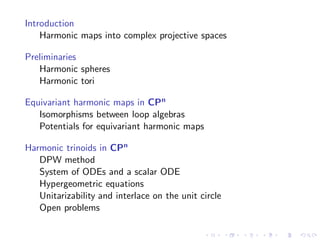
Introduction
    Harmonic maps into complex projective spaces

Preliminaries
   Harmonic spheres
   Harmonic tori

Equivariant harmonic maps in CPn
   Isomorphisms between loop algebras
   Potentials for equivariant harmonic maps

Harmonic trinoids in CPn
   DPW method
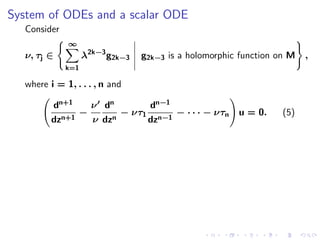
   System of ODEs and a scalar ODE
   Hypergeometric equations
   Unitarizability and interlace on the unit circle
   Open problems
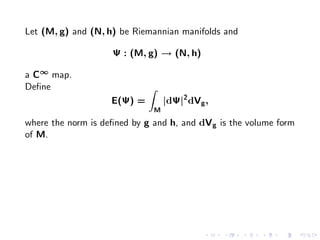
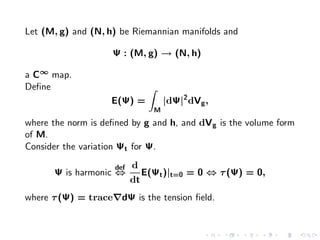
Let (M, g) and (N, h) be Riemannian manifolds and

                    Ψ : (M, g) → (N, h)

a C∞ map.
Define
                    E(Ψ) =        |dΨ|2 dVg ,
                              M
where the norm is defined by g and h, and dV g is the volume form
of M.
Let (M, g) and (N, h) be Riemannian manifolds and

                    Ψ : (M, g) → (N, h)

a C∞ map.
Define
                    E(Ψ) =          |dΨ|2 dVg ,
                                M
where the norm is defined by g and h, and dV g is the volume form
of M.
Consider the variation Ψt for Ψ.

                     def   d
      Ψ is harmonic ⇔         E(Ψt )|t=0 = 0 ⇔ τ (Ψ) = 0,
                           dt
where τ (Ψ) = trace dΨ is the tension field.
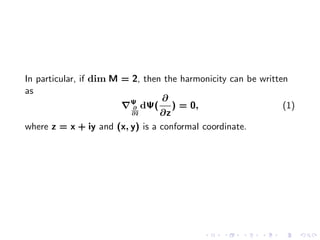
In particular, if dim M = 2, then the harmonicity can be written
as
                         Ψ       ∂
                          ∂ dΨ(     ) = 0,                     (1)
                          ∂¯
                           z     ∂z
where z = x + iy and (x, y) is a conformal coordinate.
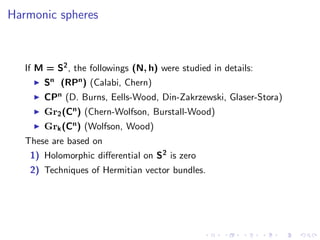
Harmonic spheres


   If M = S2 , the followings (N, h) were studied in details:
       Sn (RPn ) (Calabi, Chern)
       CPn (D. Burns, Eells-Wood, Din-Zakrzewski, Glaser-Stora)
       Gr2 (Cn ) (Chern-Wolfson, Burstall-Wood)
       Grk (Cn ) (Wolfson, Wood)
   These are based on
    1) Holomorphic differential on S2 is zero
    2) Techniques of Hermitian vector bundles.
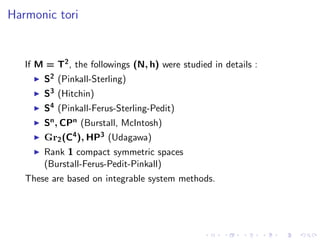
Harmonic tori


   If M = T2 , the followings (N, h) were studied in details :
       S2 (Pinkall-Sterling)
       S3 (Hitchin)
       S4 (Pinkall-Ferus-Sterling-Pedit)
       Sn , CPn (Burstall, McIntosh)
       Gr2 (C4 ), HP3 (Udagawa)
       Rank 1 compact symmetric spaces
       (Burstall-Ferus-Pedit-Pinkall)
   These are based on integrable system methods.
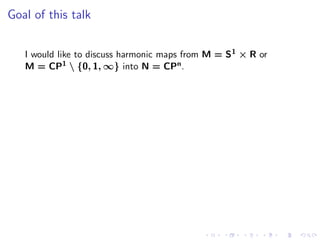
Goal of this talk


   I would like to discuss harmonic maps from M = S 1 × R or
   M = CP1  {0, 1, ∞} into N = CPn .
Goal of this talk


   I would like to discuss harmonic maps from M = S 1 × R or
   M = CP1  {0, 1, ∞} into N = CPn .
   Consider a C∞ map Ψ from a Riemann surface M into a
   symmetric space G/K:

                ∂                 1
     Ψ                      dαk + 2 [αk ∧ αk ] = −[αp ∧ αp ] = 0,
     ∂    dΨ(      )=0 ⇔
     ∂¯
      z         ∂z          dαp + [αk ∧ αp ] = 0,
                                  1
                            dαλ + 2 [αλ ∧ αλ ] = 0,
                      ⇔
                            αλ = λ−1 αp + αk + λαp , λ ∈ S1 .

   where α = F−1 dF is the Maurer-Cartan form of a lift
   F : M → G, g = k ⊕ p and TMC = T M + T M.
Equivariant harmonic maps in k-symmetric spaces
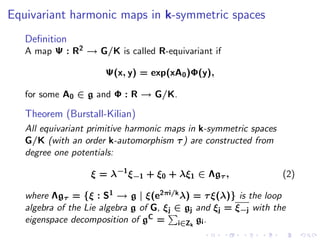
   Definition
   A map Ψ : R2 → G/K is called R-equivariant if

                      Ψ(x, y) = exp(xA0 )Φ(y),

   for some A0 ∈ g and Φ : R → G/K.

   Theorem (Burstall-Kilian)
   All equivariant primitive harmonic maps in k-symmetric spaces
   G/K (with an order k-automorphism τ ) are constructed from
   degree one potentials:

                   ξ = λ−1 ξ−1 + ξ0 + λξ1 ∈ Λgτ ,                  (2)

   where Λgτ = {ξ : S1 → g | ξ(e2πi/k λ) = τ ξ(λ)} is the loop
   algebra of the Lie algebra g of G, ξj ∈ gj and ξj = ξ−j with the
   eigenspace decomposition of gC = i∈Zk gi .
Equivariant harmonic maps in CPn


   For CPn case, G = SU(n + 1) with the involution
   σ = Ad diag [1, −1, . . . , −1], thus K = S(U(1) × U(n)) and
   GC = SL(n + 1, C).
   It is known that harmonic maps in CPn can be classified into
       isotropic,
       non-isotropic weakly conformal with isotropic dimension
       r ∈ {1, . . . , n − 1},
       non-conformal.
   Problem: Which degree one potentials are corresponding to the
   above cases?
Isomorphism
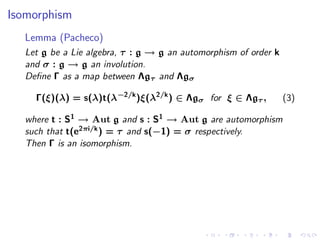
  Lemma (Pacheco)
  Let g be a Lie algebra, τ : g → g an automorphism of order k
  and σ : g → g an involution.
  Define Γ as a map between Λgτ and Λgσ

    Γ(ξ)(λ) = s(λ)t(λ−2/k )ξ(λ2/k ) ∈ Λgσ for ξ ∈ Λgτ ,          (3)

  where t : S1 → Aut g and s : S1 → Aut g are automorphism
  such that t(e2πi/k ) = τ and s(−1) = σ respectively.
  Then Γ is an isomorphism.
Isomorphism
  Lemma (Pacheco)
  Let g be a Lie algebra, τ : g → g an automorphism of order k
  and σ : g → g an involution.
  Define Γ as a map between Λgτ and Λgσ

    Γ(ξ)(λ) = s(λ)t(λ−2/k )ξ(λ2/k ) ∈ Λgσ for ξ ∈ Λgτ ,                (3)

  where t : S1 → Aut g and s : S1 → Aut g are automorphism
  such that t(e2πi/k ) = τ and s(−1) = σ respectively.
  Then Γ is an isomorphism.
  Let t and s be t(λ) = Ad diag[1, λ, . . . , λ k−2 , λk−1 , . . . , λk−1 ]
  and s(λ) = Ad diag[1, λ, . . . , λ] respectively. Then it is easy to
  see t(e2πi/k ) = τ and s(−1) = σ. Define Γ as in (3), and let
                                           t
             ξ = λ−1 ξ−1 + ξ0 + λξ−1 ∈ Λsu(n + 1)τ

  be the degree one potential.
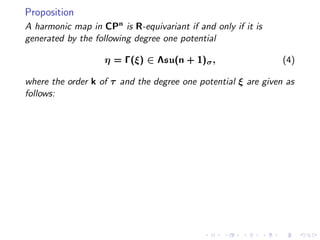
Proposition
A harmonic map in CPn is R-equivariant if and only if it is
generated by the following degree one potential

                   η = Γ(ξ) ∈ Λsu(n + 1)σ ,                    (4)

where the order k of τ and the degree one potential ξ are given as
follows:
Proposition
A harmonic map in CPn is R-equivariant if and only if it is
generated by the following degree one potential

                      η = Γ(ξ) ∈ Λsu(n + 1)σ ,                 (4)

where the order k of τ and the degree one potential ξ are given as
follows:
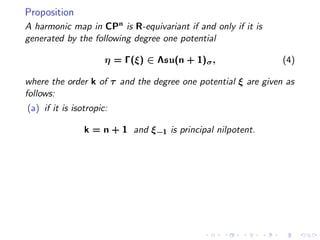
(a) if it is isotropic:

                k = n + 1 and ξ−1 is principal nilpotent.
Proposition
A harmonic map in CPn is R-equivariant if and only if it is
generated by the following degree one potential

                      η = Γ(ξ) ∈ Λsu(n + 1)σ ,                   (4)

where the order k of τ and the degree one potential ξ are given as
follows:
(a) if it is isotropic:

                k = n + 1 and ξ−1 is principal nilpotent.

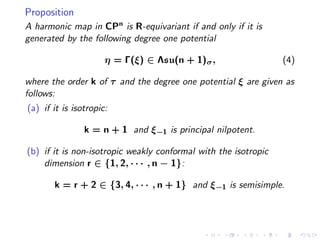
(b) if it is non-isotropic weakly conformal with the isotropic
    dimension r ∈ {1, 2, · · · , n − 1}:

       k = r + 2 ∈ {3, 4, · · · , n + 1} and ξ−1 is semisimple.
Proposition
A harmonic map in CPn is R-equivariant if and only if it is
generated by the following degree one potential

                      η = Γ(ξ) ∈ Λsu(n + 1)σ ,                   (4)

where the order k of τ and the degree one potential ξ are given as
follows:
(a) if it is isotropic:

                k = n + 1 and ξ−1 is principal nilpotent.

(b) if it is non-isotropic weakly conformal with the isotropic
    dimension r ∈ {1, 2, · · · , n − 1}:

       k = r + 2 ∈ {3, 4, · · · , n + 1} and ξ−1 is semisimple.

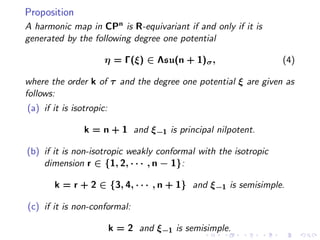
(c) if it is non-conformal:

                          k = 2 and ξ−1 is semisimple.
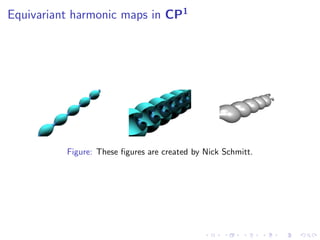
Equivariant harmonic maps in CP1


          Figure: These figures are created by Nick Schmitt.
Loop groups


   Definition


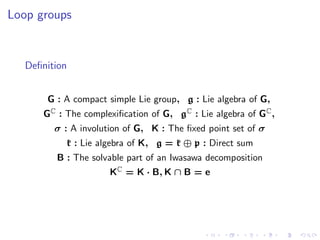
       G : A compact simple Lie group, g : Lie algebra of G,
      GC : The complexification of G, gC : Lie algebra of GC ,
         σ : A involution of G, K : The fixed point set of σ
           k : Lie algebra of K, g = k ⊕ p : Direct sum
         B : The solvable part of an Iwasawa decomposition
                      KC = K · B, K ∩ B = e
Loop groups

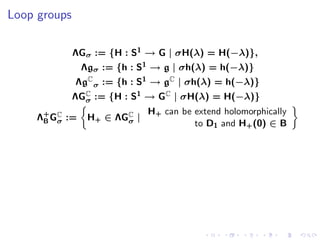
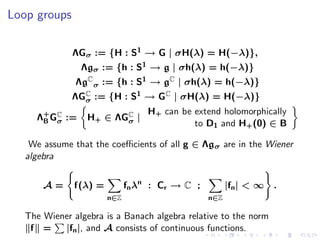
              ΛGσ := {H : S1 → G | σH(λ) = H(−λ)},
                Λgσ := {h : S1 → g | σh(λ) = h(−λ)}
              ΛgC σ := {h : S1 → gC | σh(λ) = h(−λ)}
              ΛGC := {H : S1 → GC | σH(λ) = H(−λ)}
                σ
                              H+ can be extend holomorphically
     Λ+ GC :=
      B σ        H+ ∈ ΛGC |
                        σ               to D1 and H+ (0) ∈ B
Loop groups

              ΛGσ := {H : S1 → G | σH(λ) = H(−λ)},
                Λgσ := {h : S1 → g | σh(λ) = h(−λ)}
               ΛgC σ := {h : S1 → gC | σh(λ) = h(−λ)}
              ΛGC := {H : S1 → GC | σH(λ) = H(−λ)}
                σ
                                  H+ can be extend holomorphically
     Λ+ GC :=
      B σ         H+ ∈ ΛGC |
                         σ                  to D1 and H+ (0) ∈ B

    We assume that the coefficients of all g ∈ Λg σ are in the Wiener
   algebra


       A=     f(λ) =         fn λn : C r → C ;         |fn | < ∞ .
                       n∈Z                       n∈Z

   The Wiener algebra is a Banach algebra relative to the norm
    f =    |fn |, and A consists of continuous functions.
DPW method
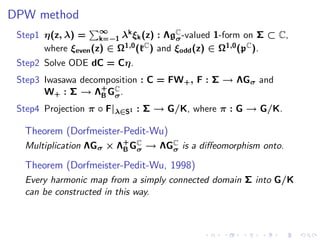
 Step1 η(z, λ) = ∞ λk ξk (z) : ΛgC -valued 1-form on Σ ⊂ C,
                     k=−1               σ
       where ξeven (z) ∈ Ω1,0 (kC ) and ξodd (z) ∈ Ω1,0 (pC ).
 Step2 Solve ODE dC = Cη.
 Step3 Iwasawa decomposition : C = FW + , F : Σ → ΛGσ and
       W+ : Σ → Λ + GC .
                   B σ
 Step4 Projection π ◦ F|λ∈S1 : Σ → G/K, where π : G → G/K.

  Theorem (Dorfmeister-Pedit-Wu)
  Multiplication ΛGσ × Λ+ GC → ΛGC is a diffeomorphism onto.
                        B σ      σ

  Theorem (Dorfmeister-Pedit-Wu, 1998)
  Every harmonic map from a simply connected domain Σ into G/K
  can be constructed in this way.
DPW method
 Step1 η(z, λ) = ∞ λk ξk (z) : ΛgC -valued 1-form on Σ ⊂ C,
                     k=−1               σ
       where ξeven (z) ∈ Ω1,0 (kC ) and ξodd (z) ∈ Ω1,0 (pC ).
 Step2 Solve ODE dC = Cη.
 Step3 Iwasawa decomposition : C = FW + , F : Σ → ΛGσ and
       W+ : Σ → Λ + GC .
                   B σ
 Step4 Projection π ◦ F|λ∈S1 : Σ → G/K, where π : G → G/K.

  Theorem (Dorfmeister-Pedit-Wu)
  Multiplication ΛGσ × Λ+ GC → ΛGC is a diffeomorphism onto.
                        B σ      σ

  Theorem (Dorfmeister-Pedit-Wu, 1998)
  Every harmonic map from a simply connected domain Σ into G/K
  can be constructed in this way.
  From now on, CPn is represented as the symmetric space
  U(n + 1)/U(1) × U(n) with the involution
  σ = Ad diag [1, −1, . . . , −1].
System of ODEs and a scalar ODE
  Consider
             ∞
  ν, τj ∈          λ2k−3 g2k−3   g2k−3 is a holomorphic function on M   ,
             k=1

  where i = 1, . . . , n and

         dn+1    ν dn       dn−1
               −       − ντ1 n−1 − · · · − ντn         u = 0.     (5)
         dzn+1   ν dzn      dz
System of ODEs and a scalar ODE
  Consider
                  ∞
  ν, τj ∈             λ2k−3 g2k−3       g2k−3 is a holomorphic function on M   ,
              k=1

  where i = 1, . . . , n and

         dn+1    ν dn       dn−1
               −       − ντ1 n−1 − · · · − ντn                 u = 0.    (5)
         dzn+1   ν dzn      dz

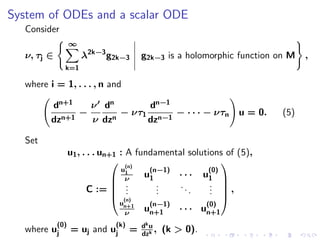
  Set
                  u1 , . . . un+1 : A fundamental solutions of (5),
                                 (n)                       
                                   u1    (n−1)          (0)
                                 ν     u1     · · · u1 
                                 . .      .
                                           .    ..      . 
                                                        .
                         C :=  .          .       .    . ,
                                 (n)                       
                                  un+1   (n−1)         (0)
                                    ν
                                        un+1   · · · un+1
            (0)               (k)       dk u
  where uj        = uj and uj       =   dzk
                                             ,   (k > 0).
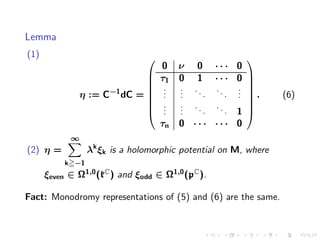
Lemma
(1)                                                       
                                    0 ν 0 ···          0
                            
                                   τ1 0 1 · · ·       0 
                                                         
                      −1
                                    . . ..
                                     . .       ..      .
                                                       . 
                η := C dC =         . .     .     .   . .      (6)
                                     . . ..
                                                        
                                    . .       ..        
                                    . .     .     .   1 
                                    τn 0 · · · · · ·   0
            ∞
(2) η =           λk ξk is a holomorphic potential on M, where
           k −1
      ξeven ∈ Ω1,0 (kC ) and ξodd ∈ Ω1,0 (pC ).

Fact: Monodromy representations of (5) and (6) are the same.
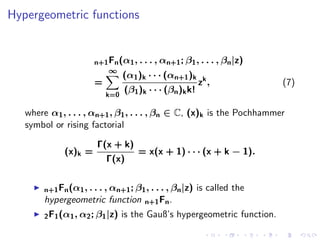
Hypergeometric functions


                       n+1 Fn (α1 , . . . , αn+1 ; β1 , . . . , βn |z)
                          ∞
                               (α1 )k · · · (αn+1 )k k
                       =                                  z ,             (7)
                           k=0
                                 (β1 )k · · · (βn )k k!

   where α1 , . . . , αn+1 , β1 , . . . , βn ∈ C, (x)k is the Pochhammer
   symbol or rising factorial

                        Γ(x + k)
              (x)k =             = x(x + 1) · · · (x + k − 1).
                          Γ(x)


        n+1 Fn (α1 , . . . , αn+1 ; β1 , . . . , βn |z) is called the
        hypergeometric function n+1 Fn .
        2 F1 (α1 , α2 ; β1 |z)   is the Gauß’s hypergeometric function.
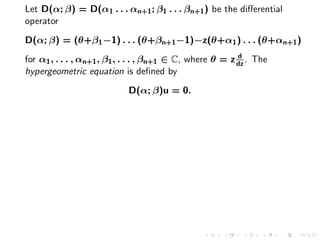
Let D(α; β) = D(α1 . . . αn+1 ; β1 . . . βn+1 ) be the differential
operator
D(α; β) = (θ+β1 −1) . . . (θ+βn+1 −1)−z(θ+α1 ) . . . (θ+αn+1 )
                                                           d
for α1 , . . . , αn+1 , β1 , . . . , βn+1 ∈ C, where θ = z dz . The
hypergeometric equation is defined by
                            D(α; β)u = 0.
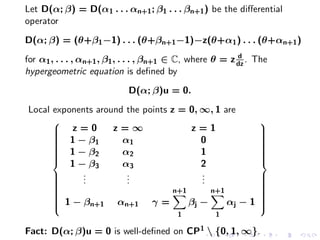
Let D(α; β) = D(α1 . . . αn+1 ; β1 . . . βn+1 ) be the differential
operator
D(α; β) = (θ+β1 −1) . . . (θ+βn+1 −1)−z(θ+α1 ) . . . (θ+αn+1 )
                                                           d
for α1 , . . . , αn+1 , β1 , . . . , βn+1 ∈ C, where θ = z dz . The
hypergeometric equation is defined by
                            D(α; β)u = 0.
Local exponents around the points z = 0, ∞, 1 are
                                                               
       z=0
                   z=∞                z=1                      
                                                                
       1−β           α1                  0                     
      
      
               1                                               
                                                                
                                                                
       1 − β2
      
                     α2                  1
                                                                
                                                                
                                                                
                                                               
          1 − β3      α3                  2
                                                               
             .
             .         .
                       .                  .
                                          .
      
      
      
            .         .                  .                     
                                                                
                                                                
                                                                
      
      
                                  n+1      n+1                 
                                                                
                                                                
       1 − βn+1 αn+1 γ =
      
                                      βj −     αj − 1
                                                                
                                                                
                                                                
                                                               
                                          1         1

Fact: D(α; β)u = 0 is well-defined on CP 1  {0, 1, ∞}.
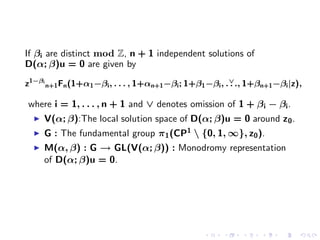
If βi are distinct mod Z, n + 1 independent solutions of
D(α; β)u = 0 are given by

z1−βi n+1 Fn (1+α1 −βi , . . . , 1+αn+1 −βi ; 1+β1 −βi , . ∨ ., 1+βn+1 −βi |z),
                                                           .

where i = 1, . . . , n + 1 and ∨ denotes omission of 1 + β i − βi .
     V(α; β):The local solution space of D(α; β)u = 0 around z 0 .
     G : The fundamental group π1 (CP1  {0, 1, ∞}, z0 ).
     M(α, β) : G → GL(V(α; β)) : Monodromy representation
     of D(α; β)u = 0.
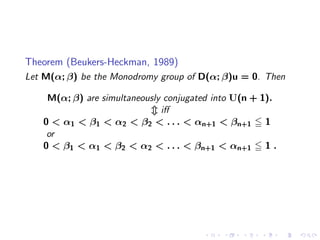
Theorem (Beukers-Heckman, 1989)
Let M(α; β) be the Monodromy group of D(α; β)u = 0. Then

    M(α; β) are simultaneously conjugated into U(n + 1).
                              iff
   0 < α1 < β1 < α2 < β2 < . . . < αn+1 < βn+1 1
    or
   0 < β1 < α1 < β2 < α2 < . . . < βn+1 < αn+1 1 .
Remark
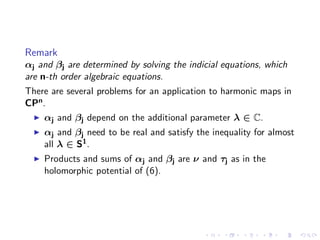
αj and βj are determined by solving the indicial equations, which
are n-th order algebraic equations.
There are several problems for an application to harmonic maps in
CPn .
    αj and βj depend on the additional parameter λ ∈ C.
    αj and βj need to be real and satisfy the inequality for almost
    all λ ∈ S1 .
    Products and sums of αj and βj are ν and τj as in the
    holomorphic potential of (6).
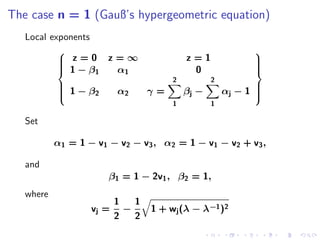
The case n = 1 (Gauß’s hypergeometric equation)
   Local exponents
                                                                
            z=0
                        z=∞                    z=1              
                                                                 
            1−β          α1                     0               
                    1                                           
                                            2          2
            1 − β2
           
                          α2          γ=       βj −       αj − 1 
                                                                  
                                                                  
                                                                 
                                            1          1

   Set

           α1 = 1 − v 1 − v 2 − v 3 , α 2 = 1 − v 1 − v 2 + v 3 ,

   and
                         β1 = 1 − 2v1 , β2 = 1,
   where
                           1       1
                    vj =       −       1 + wj (λ − λ−1 )2
                           2       2
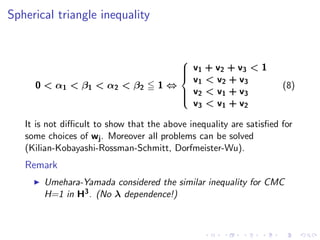
Spherical triangle inequality


                                       
                                        v1 + v 2 + v 3 < 1
                                       
                                         v1 < v 2 + v 3
                                       
     0 < α 1 < β1 < α2 < β2         1⇔                              (8)
                                        v2 < v 1 + v 3
                                       
                                         v3 < v 1 + v 2
                                       

   It is not difficult to show that the above inequality are satisfied for
   some choices of wj . Moreover all problems can be solved
   (Kilian-Kobayashi-Rossman-Schmitt, Dorfmeister-Wu).
   Remark
       Umehara-Yamada considered the similar inequality for CMC
       H=1 in H3 . (No λ dependence!)
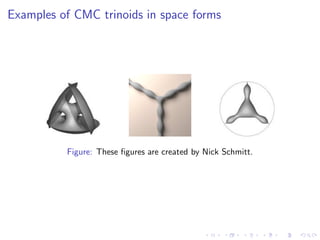
Examples of CMC trinoids in space forms


          Figure: These figures are created by Nick Schmitt.
The case n > 1


  Example
      For the isotropic case, αj and βj do not depend on λ. Thus
      there exist isotropic harmonic trinoids in CP n .
      For n = 2, 3, the indicial equation can be solved explicitly.
      We can show that there exist examples of harmonic trinoids in
      CP2 and CP3 .
Open problem


      What are behaviors around the punctures? Are they
      asymptotically converge to equivariant ones?
      Prove the existence of non-isotropic harmonic trinoids for
      n 4.

Igv2008

  • 1.
    Harmonic trinoids incomplex projective spaces Shimpei Kobayashi, Hirosaki University 12/12, 2008
  • 2.
    Introduction Harmonic maps into complex projective spaces Preliminaries Harmonic spheres Harmonic tori Equivariant harmonic maps in CPn Isomorphisms between loop algebras Potentials for equivariant harmonic maps Harmonic trinoids in CPn DPW method System of ODEs and a scalar ODE Hypergeometric equations Unitarizability and interlace on the unit circle Open problems
  • 3.
    Let (M, g)and (N, h) be Riemannian manifolds and Ψ : (M, g) → (N, h) a C∞ map. Define E(Ψ) = |dΨ|2 dVg , M where the norm is defined by g and h, and dV g is the volume form of M.
  • 4.
    Let (M, g)and (N, h) be Riemannian manifolds and Ψ : (M, g) → (N, h) a C∞ map. Define E(Ψ) = |dΨ|2 dVg , M where the norm is defined by g and h, and dV g is the volume form of M. Consider the variation Ψt for Ψ. def d Ψ is harmonic ⇔ E(Ψt )|t=0 = 0 ⇔ τ (Ψ) = 0, dt where τ (Ψ) = trace dΨ is the tension field.
  • 5.
    In particular, ifdim M = 2, then the harmonicity can be written as Ψ ∂ ∂ dΨ( ) = 0, (1) ∂¯ z ∂z where z = x + iy and (x, y) is a conformal coordinate.
  • 6.
    Harmonic spheres If M = S2 , the followings (N, h) were studied in details: Sn (RPn ) (Calabi, Chern) CPn (D. Burns, Eells-Wood, Din-Zakrzewski, Glaser-Stora) Gr2 (Cn ) (Chern-Wolfson, Burstall-Wood) Grk (Cn ) (Wolfson, Wood) These are based on 1) Holomorphic differential on S2 is zero 2) Techniques of Hermitian vector bundles.
  • 7.
    Harmonic tori If M = T2 , the followings (N, h) were studied in details : S2 (Pinkall-Sterling) S3 (Hitchin) S4 (Pinkall-Ferus-Sterling-Pedit) Sn , CPn (Burstall, McIntosh) Gr2 (C4 ), HP3 (Udagawa) Rank 1 compact symmetric spaces (Burstall-Ferus-Pedit-Pinkall) These are based on integrable system methods.
  • 8.
    Goal of thistalk I would like to discuss harmonic maps from M = S 1 × R or M = CP1 {0, 1, ∞} into N = CPn .
  • 9.
    Goal of thistalk I would like to discuss harmonic maps from M = S 1 × R or M = CP1 {0, 1, ∞} into N = CPn . Consider a C∞ map Ψ from a Riemann surface M into a symmetric space G/K: ∂ 1 Ψ dαk + 2 [αk ∧ αk ] = −[αp ∧ αp ] = 0, ∂ dΨ( )=0 ⇔ ∂¯ z ∂z dαp + [αk ∧ αp ] = 0, 1 dαλ + 2 [αλ ∧ αλ ] = 0, ⇔ αλ = λ−1 αp + αk + λαp , λ ∈ S1 . where α = F−1 dF is the Maurer-Cartan form of a lift F : M → G, g = k ⊕ p and TMC = T M + T M.
  • 10.
    Equivariant harmonic mapsin k-symmetric spaces Definition A map Ψ : R2 → G/K is called R-equivariant if Ψ(x, y) = exp(xA0 )Φ(y), for some A0 ∈ g and Φ : R → G/K. Theorem (Burstall-Kilian) All equivariant primitive harmonic maps in k-symmetric spaces G/K (with an order k-automorphism τ ) are constructed from degree one potentials: ξ = λ−1 ξ−1 + ξ0 + λξ1 ∈ Λgτ , (2) where Λgτ = {ξ : S1 → g | ξ(e2πi/k λ) = τ ξ(λ)} is the loop algebra of the Lie algebra g of G, ξj ∈ gj and ξj = ξ−j with the eigenspace decomposition of gC = i∈Zk gi .
  • 11.
    Equivariant harmonic mapsin CPn For CPn case, G = SU(n + 1) with the involution σ = Ad diag [1, −1, . . . , −1], thus K = S(U(1) × U(n)) and GC = SL(n + 1, C). It is known that harmonic maps in CPn can be classified into isotropic, non-isotropic weakly conformal with isotropic dimension r ∈ {1, . . . , n − 1}, non-conformal. Problem: Which degree one potentials are corresponding to the above cases?
  • 12.
    Isomorphism Lemma(Pacheco) Let g be a Lie algebra, τ : g → g an automorphism of order k and σ : g → g an involution. Define Γ as a map between Λgτ and Λgσ Γ(ξ)(λ) = s(λ)t(λ−2/k )ξ(λ2/k ) ∈ Λgσ for ξ ∈ Λgτ , (3) where t : S1 → Aut g and s : S1 → Aut g are automorphism such that t(e2πi/k ) = τ and s(−1) = σ respectively. Then Γ is an isomorphism.
  • 13.
    Isomorphism Lemma(Pacheco) Let g be a Lie algebra, τ : g → g an automorphism of order k and σ : g → g an involution. Define Γ as a map between Λgτ and Λgσ Γ(ξ)(λ) = s(λ)t(λ−2/k )ξ(λ2/k ) ∈ Λgσ for ξ ∈ Λgτ , (3) where t : S1 → Aut g and s : S1 → Aut g are automorphism such that t(e2πi/k ) = τ and s(−1) = σ respectively. Then Γ is an isomorphism. Let t and s be t(λ) = Ad diag[1, λ, . . . , λ k−2 , λk−1 , . . . , λk−1 ] and s(λ) = Ad diag[1, λ, . . . , λ] respectively. Then it is easy to see t(e2πi/k ) = τ and s(−1) = σ. Define Γ as in (3), and let t ξ = λ−1 ξ−1 + ξ0 + λξ−1 ∈ Λsu(n + 1)τ be the degree one potential.
  • 14.
    Proposition A harmonic mapin CPn is R-equivariant if and only if it is generated by the following degree one potential η = Γ(ξ) ∈ Λsu(n + 1)σ , (4) where the order k of τ and the degree one potential ξ are given as follows:
  • 15.
    Proposition A harmonic mapin CPn is R-equivariant if and only if it is generated by the following degree one potential η = Γ(ξ) ∈ Λsu(n + 1)σ , (4) where the order k of τ and the degree one potential ξ are given as follows: (a) if it is isotropic: k = n + 1 and ξ−1 is principal nilpotent.
  • 16.
    Proposition A harmonic mapin CPn is R-equivariant if and only if it is generated by the following degree one potential η = Γ(ξ) ∈ Λsu(n + 1)σ , (4) where the order k of τ and the degree one potential ξ are given as follows: (a) if it is isotropic: k = n + 1 and ξ−1 is principal nilpotent. (b) if it is non-isotropic weakly conformal with the isotropic dimension r ∈ {1, 2, · · · , n − 1}: k = r + 2 ∈ {3, 4, · · · , n + 1} and ξ−1 is semisimple.
  • 17.
    Proposition A harmonic mapin CPn is R-equivariant if and only if it is generated by the following degree one potential η = Γ(ξ) ∈ Λsu(n + 1)σ , (4) where the order k of τ and the degree one potential ξ are given as follows: (a) if it is isotropic: k = n + 1 and ξ−1 is principal nilpotent. (b) if it is non-isotropic weakly conformal with the isotropic dimension r ∈ {1, 2, · · · , n − 1}: k = r + 2 ∈ {3, 4, · · · , n + 1} and ξ−1 is semisimple. (c) if it is non-conformal: k = 2 and ξ−1 is semisimple.
  • 18.
    Equivariant harmonic mapsin CP1 Figure: These figures are created by Nick Schmitt.
  • 19.
    Loop groups Definition G : A compact simple Lie group, g : Lie algebra of G, GC : The complexification of G, gC : Lie algebra of GC , σ : A involution of G, K : The fixed point set of σ k : Lie algebra of K, g = k ⊕ p : Direct sum B : The solvable part of an Iwasawa decomposition KC = K · B, K ∩ B = e
  • 20.
    Loop groups ΛGσ := {H : S1 → G | σH(λ) = H(−λ)}, Λgσ := {h : S1 → g | σh(λ) = h(−λ)} ΛgC σ := {h : S1 → gC | σh(λ) = h(−λ)} ΛGC := {H : S1 → GC | σH(λ) = H(−λ)} σ H+ can be extend holomorphically Λ+ GC := B σ H+ ∈ ΛGC | σ to D1 and H+ (0) ∈ B
  • 21.
    Loop groups ΛGσ := {H : S1 → G | σH(λ) = H(−λ)}, Λgσ := {h : S1 → g | σh(λ) = h(−λ)} ΛgC σ := {h : S1 → gC | σh(λ) = h(−λ)} ΛGC := {H : S1 → GC | σH(λ) = H(−λ)} σ H+ can be extend holomorphically Λ+ GC := B σ H+ ∈ ΛGC | σ to D1 and H+ (0) ∈ B We assume that the coefficients of all g ∈ Λg σ are in the Wiener algebra A= f(λ) = fn λn : C r → C ; |fn | < ∞ . n∈Z n∈Z The Wiener algebra is a Banach algebra relative to the norm f = |fn |, and A consists of continuous functions.
  • 22.
    DPW method Step1η(z, λ) = ∞ λk ξk (z) : ΛgC -valued 1-form on Σ ⊂ C, k=−1 σ where ξeven (z) ∈ Ω1,0 (kC ) and ξodd (z) ∈ Ω1,0 (pC ). Step2 Solve ODE dC = Cη. Step3 Iwasawa decomposition : C = FW + , F : Σ → ΛGσ and W+ : Σ → Λ + GC . B σ Step4 Projection π ◦ F|λ∈S1 : Σ → G/K, where π : G → G/K. Theorem (Dorfmeister-Pedit-Wu) Multiplication ΛGσ × Λ+ GC → ΛGC is a diffeomorphism onto. B σ σ Theorem (Dorfmeister-Pedit-Wu, 1998) Every harmonic map from a simply connected domain Σ into G/K can be constructed in this way.
  • 23.
    DPW method Step1η(z, λ) = ∞ λk ξk (z) : ΛgC -valued 1-form on Σ ⊂ C, k=−1 σ where ξeven (z) ∈ Ω1,0 (kC ) and ξodd (z) ∈ Ω1,0 (pC ). Step2 Solve ODE dC = Cη. Step3 Iwasawa decomposition : C = FW + , F : Σ → ΛGσ and W+ : Σ → Λ + GC . B σ Step4 Projection π ◦ F|λ∈S1 : Σ → G/K, where π : G → G/K. Theorem (Dorfmeister-Pedit-Wu) Multiplication ΛGσ × Λ+ GC → ΛGC is a diffeomorphism onto. B σ σ Theorem (Dorfmeister-Pedit-Wu, 1998) Every harmonic map from a simply connected domain Σ into G/K can be constructed in this way. From now on, CPn is represented as the symmetric space U(n + 1)/U(1) × U(n) with the involution σ = Ad diag [1, −1, . . . , −1].
  • 24.
    System of ODEsand a scalar ODE Consider ∞ ν, τj ∈ λ2k−3 g2k−3 g2k−3 is a holomorphic function on M , k=1 where i = 1, . . . , n and dn+1 ν dn dn−1 − − ντ1 n−1 − · · · − ντn u = 0. (5) dzn+1 ν dzn dz
  • 25.
    System of ODEsand a scalar ODE Consider ∞ ν, τj ∈ λ2k−3 g2k−3 g2k−3 is a holomorphic function on M , k=1 where i = 1, . . . , n and dn+1 ν dn dn−1 − − ντ1 n−1 − · · · − ντn u = 0. (5) dzn+1 ν dzn dz Set u1 , . . . un+1 : A fundamental solutions of (5),  (n)  u1 (n−1) (0)  ν u1 · · · u1   . . . . .. .  . C :=  . . . . ,  (n)  un+1 (n−1) (0) ν un+1 · · · un+1 (0) (k) dk u where uj = uj and uj = dzk , (k > 0).
  • 26.
    Lemma (1)   0 ν 0 ··· 0   τ1 0 1 · · · 0   −1  . . .. . . .. . .  η := C dC =  . . . . . . (6) . . ..    . . ..   . . . . 1  τn 0 · · · · · · 0 ∞ (2) η = λk ξk is a holomorphic potential on M, where k −1 ξeven ∈ Ω1,0 (kC ) and ξodd ∈ Ω1,0 (pC ). Fact: Monodromy representations of (5) and (6) are the same.
  • 27.
    Hypergeometric functions n+1 Fn (α1 , . . . , αn+1 ; β1 , . . . , βn |z) ∞ (α1 )k · · · (αn+1 )k k = z , (7) k=0 (β1 )k · · · (βn )k k! where α1 , . . . , αn+1 , β1 , . . . , βn ∈ C, (x)k is the Pochhammer symbol or rising factorial Γ(x + k) (x)k = = x(x + 1) · · · (x + k − 1). Γ(x) n+1 Fn (α1 , . . . , αn+1 ; β1 , . . . , βn |z) is called the hypergeometric function n+1 Fn . 2 F1 (α1 , α2 ; β1 |z) is the Gauß’s hypergeometric function.
  • 28.
    Let D(α; β)= D(α1 . . . αn+1 ; β1 . . . βn+1 ) be the differential operator D(α; β) = (θ+β1 −1) . . . (θ+βn+1 −1)−z(θ+α1 ) . . . (θ+αn+1 ) d for α1 , . . . , αn+1 , β1 , . . . , βn+1 ∈ C, where θ = z dz . The hypergeometric equation is defined by D(α; β)u = 0.
  • 29.
    Let D(α; β)= D(α1 . . . αn+1 ; β1 . . . βn+1 ) be the differential operator D(α; β) = (θ+β1 −1) . . . (θ+βn+1 −1)−z(θ+α1 ) . . . (θ+αn+1 ) d for α1 , . . . , αn+1 , β1 , . . . , βn+1 ∈ C, where θ = z dz . The hypergeometric equation is defined by D(α; β)u = 0. Local exponents around the points z = 0, ∞, 1 are    z=0  z=∞ z=1    1−β α1 0     1     1 − β2   α2 1      1 − β3 α3 2   . . . . . .     . . .        n+1 n+1     1 − βn+1 αn+1 γ =   βj − αj − 1      1 1 Fact: D(α; β)u = 0 is well-defined on CP 1 {0, 1, ∞}.
  • 30.
    If βi aredistinct mod Z, n + 1 independent solutions of D(α; β)u = 0 are given by z1−βi n+1 Fn (1+α1 −βi , . . . , 1+αn+1 −βi ; 1+β1 −βi , . ∨ ., 1+βn+1 −βi |z), . where i = 1, . . . , n + 1 and ∨ denotes omission of 1 + β i − βi . V(α; β):The local solution space of D(α; β)u = 0 around z 0 . G : The fundamental group π1 (CP1 {0, 1, ∞}, z0 ). M(α, β) : G → GL(V(α; β)) : Monodromy representation of D(α; β)u = 0.
  • 31.
    Theorem (Beukers-Heckman, 1989) LetM(α; β) be the Monodromy group of D(α; β)u = 0. Then M(α; β) are simultaneously conjugated into U(n + 1). iff 0 < α1 < β1 < α2 < β2 < . . . < αn+1 < βn+1 1 or 0 < β1 < α1 < β2 < α2 < . . . < βn+1 < αn+1 1 .
  • 32.
    Remark αj and βjare determined by solving the indicial equations, which are n-th order algebraic equations. There are several problems for an application to harmonic maps in CPn . αj and βj depend on the additional parameter λ ∈ C. αj and βj need to be real and satisfy the inequality for almost all λ ∈ S1 . Products and sums of αj and βj are ν and τj as in the holomorphic potential of (6).
  • 33.
    The case n= 1 (Gauß’s hypergeometric equation) Local exponents    z=0  z=∞ z=1    1−β α1 0   1  2 2  1 − β2   α2 γ= βj − αj − 1      1 1 Set α1 = 1 − v 1 − v 2 − v 3 , α 2 = 1 − v 1 − v 2 + v 3 , and β1 = 1 − 2v1 , β2 = 1, where 1 1 vj = − 1 + wj (λ − λ−1 )2 2 2
  • 34.
    Spherical triangle inequality   v1 + v 2 + v 3 < 1  v1 < v 2 + v 3  0 < α 1 < β1 < α2 < β2 1⇔ (8)  v2 < v 1 + v 3  v3 < v 1 + v 2  It is not difficult to show that the above inequality are satisfied for some choices of wj . Moreover all problems can be solved (Kilian-Kobayashi-Rossman-Schmitt, Dorfmeister-Wu). Remark Umehara-Yamada considered the similar inequality for CMC H=1 in H3 . (No λ dependence!)
  • 35.
    Examples of CMCtrinoids in space forms Figure: These figures are created by Nick Schmitt.
  • 36.
    The case n> 1 Example For the isotropic case, αj and βj do not depend on λ. Thus there exist isotropic harmonic trinoids in CP n . For n = 2, 3, the indicial equation can be solved explicitly. We can show that there exist examples of harmonic trinoids in CP2 and CP3 .
  • 37.
    Open problem What are behaviors around the punctures? Are they asymptotically converge to equivariant ones? Prove the existence of non-isotropic harmonic trinoids for n 4.