THEOREM OF THE DAY
      Sokal’s Theorem on Chromatic Roots The roots of chromatic polynomials of graphs, taken together,
      are dense in the whole complex plane. (... in fact, except for a unit disc around z = 1, it is enough to take the generalised theta graphs Θ(r,s),
                                                                                                                which consist of s paths of length r joining two end vertices.)
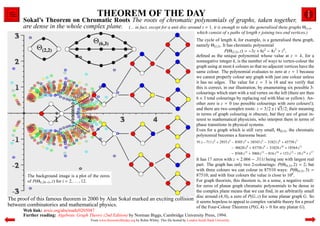
                                                                                                               The cycle of length 4, for example, is a generalised theta graph,
                                                                                                               namely Θ(2,2) . It has chromatic polynomial
                                                                                                                                 P(Θ(2,2) , z) = −3z + 6z2 − 4z3 + z4 ,
                                                                                                               defined as the unique polynomial whose value at z = k, for a
                                                                                                               nonnegative integer k, is the number of ways to vertex-colour the
                                                                                                               graph using at most k colours so that no adjacent vertices have the
                                                                                                               same colour. The polynomial evaluates to zero at z = 1 because
                                                                                                               we cannot properly colour any graph with just one colour unless
                                                                                                               it has no edges. The value for z = 3 is 18 and we verify that
                                                                                                               this is correct, in our illustration, by enumerating six possible 3-
                                                                                                               colourings which start with a red vertex on the left (there are then
                                                                                                               6 × 3 total colourings by replacing red with blue or yellow). An-
                                                                                                               other zero is z = 0 (no possible colourings √     with zero colours!);
                                                                                                               and there are two complex roots: z = 3/2 ± i 3/2; their meaning
                                                                                                               in terms of graph colouring is obscure, but they are of great in-
                                                                                                               terest to mathematical physicists, who interpret them in terms of
                                                                                                               phase transitions in physical systems.
                                                                                                               Even for a graph which is still very small, Θ(6,3) , the chromatic
                                                                                                               polynomial becomes a fearsome beast:
                                                                                                                91 z −711 z2 + 2955 z3 − 8505 z4 + 18543 z5 − 31821 z6 + 43758 z7
                                                                                                                                         − 48620 z8 + 43758 z9 − 31824 z10 + 18564 z11
                                                                                                                                         − 8568 z12 + 3060 z13 − 816 z14 + 153 z15 − 18 z16 + z17
                                                                                                               It has 17 zeros with z ≈ 2.066 − .311i being one with largest real
                                                                                                               part. The graph has only two 2-colourings: P(Θ(6,3) , 2) = 2; but
                                                                                                               with three colours we can colour in 87510 ways: P(Θ(6,3) , 3) =
        The background image is a plot of the zeros                                                            87510; and with four colours the value is close to 108 .
        of P(Θ(i,20−i) , z) for i = 2, . . . , 12.                                                             For graph theorists, this theorem is, in a sense, a negative result:
                                                                                                               for zeros of planar graph chromatic polynomials to be dense in
                                                                                                               the complex plane means that we can find, in an arbitrarily small
                                                                                                               disc around (4, 0), a zero of P(G, z) for some planar graph G. So
The proof of this famous theorem in 2000 by Alan Sokal marked an exciting collision                            it seems hopeless to appeal to complex variable theory for a proof
between combinatorics and mathematical physics.                                                                of the Four-Colour Theorem (P(G, 4) > 0 for any planar G).
      Web link: arxiv.org/abs/math/0205047
      Further reading: Algebraic Graph Theory (2nd Edition) by Norman Biggs, Cambridge University Press, 1994.
                                         From www.theoremoftheday.org by Robin Whitty. This file hosted by London South Bank University

Tot d sokal

  • 1.
    THEOREM OF THEDAY Sokal’s Theorem on Chromatic Roots The roots of chromatic polynomials of graphs, taken together, are dense in the whole complex plane. (... in fact, except for a unit disc around z = 1, it is enough to take the generalised theta graphs Θ(r,s), which consist of s paths of length r joining two end vertices.) The cycle of length 4, for example, is a generalised theta graph, namely Θ(2,2) . It has chromatic polynomial P(Θ(2,2) , z) = −3z + 6z2 − 4z3 + z4 , defined as the unique polynomial whose value at z = k, for a nonnegative integer k, is the number of ways to vertex-colour the graph using at most k colours so that no adjacent vertices have the same colour. The polynomial evaluates to zero at z = 1 because we cannot properly colour any graph with just one colour unless it has no edges. The value for z = 3 is 18 and we verify that this is correct, in our illustration, by enumerating six possible 3- colourings which start with a red vertex on the left (there are then 6 × 3 total colourings by replacing red with blue or yellow). An- other zero is z = 0 (no possible colourings √ with zero colours!); and there are two complex roots: z = 3/2 ± i 3/2; their meaning in terms of graph colouring is obscure, but they are of great in- terest to mathematical physicists, who interpret them in terms of phase transitions in physical systems. Even for a graph which is still very small, Θ(6,3) , the chromatic polynomial becomes a fearsome beast: 91 z −711 z2 + 2955 z3 − 8505 z4 + 18543 z5 − 31821 z6 + 43758 z7 − 48620 z8 + 43758 z9 − 31824 z10 + 18564 z11 − 8568 z12 + 3060 z13 − 816 z14 + 153 z15 − 18 z16 + z17 It has 17 zeros with z ≈ 2.066 − .311i being one with largest real part. The graph has only two 2-colourings: P(Θ(6,3) , 2) = 2; but with three colours we can colour in 87510 ways: P(Θ(6,3) , 3) = The background image is a plot of the zeros 87510; and with four colours the value is close to 108 . of P(Θ(i,20−i) , z) for i = 2, . . . , 12. For graph theorists, this theorem is, in a sense, a negative result: for zeros of planar graph chromatic polynomials to be dense in the complex plane means that we can find, in an arbitrarily small disc around (4, 0), a zero of P(G, z) for some planar graph G. So The proof of this famous theorem in 2000 by Alan Sokal marked an exciting collision it seems hopeless to appeal to complex variable theory for a proof between combinatorics and mathematical physics. of the Four-Colour Theorem (P(G, 4) > 0 for any planar G). Web link: arxiv.org/abs/math/0205047 Further reading: Algebraic Graph Theory (2nd Edition) by Norman Biggs, Cambridge University Press, 1994. From www.theoremoftheday.org by Robin Whitty. This file hosted by London South Bank University