

Optimum Healthcare IT
A physician’s perspective on Big Data, Predictive
Analytics &
Business Intelligence (BI) tools
Professor Steven Boyages
JCMIT 2013
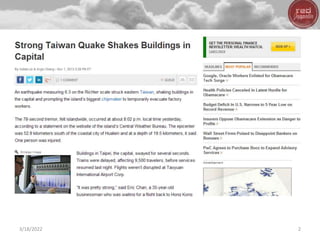
TAIWAN
3/18/2022 2
3/18/2022 3
Summary
• Healthcare organizations face growing, complex cost-containment pressures.
Increasing regulation, diminishing reimbursement, changes in the patient mix, and
other challenges mean providers must maximize operational and financial
efficiency through best practices and analytics-based decision making.
• A combination of insufficient information, poor incentives for cost control along
with deficient monitoring and inefficiencies in health care processes—all of those
factors have led to much waste of time and funds.
• The ability to contain costs while delivering quality healthcare outcomes is
eminently possible, but will require a better understanding of what today’s data
technologies can achieve. Most people in healthcare are aware of BI tools and
analytics but generally its benefits are under-appreciated. As a result, BI in
healthcare remains under-implemented.
• This presentation will outline uses of BI for clinical and non clinical purposes, how
to govern such activity using real world examples.
3/18/2022 4
Bridging the Gap
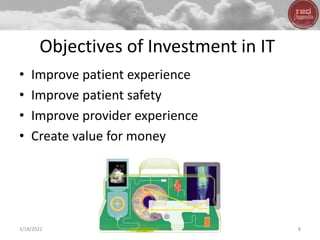
Objectives of Investment in IT
• Improve patient experience
• Improve patient safety
• Improve provider experience
• Create value for money
3/18/2022 8
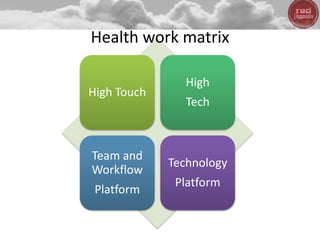
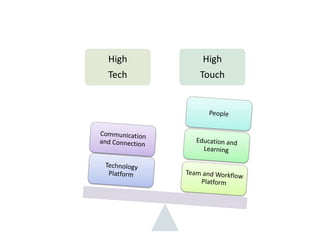
High Touch
High
Tech
Team and
Workflow
Platform
Technology
Platform
Health work matrix
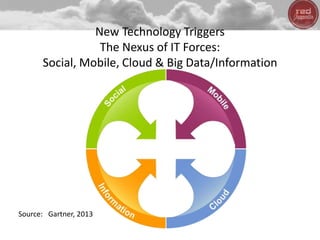
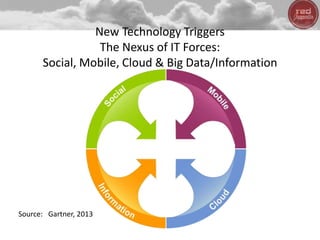
New Technology Triggers
The Nexus of IT Forces:
Social, Mobile, Cloud & Big Data/Information
Source: Gartner, 2013
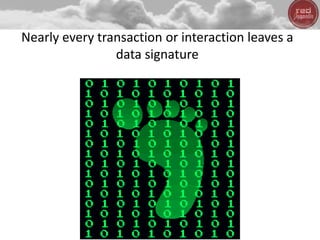
Nearly every transaction or interaction leaves a
data signature
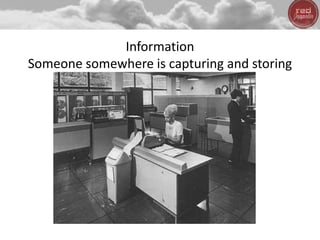
Information
Someone somewhere is capturing and storing
Sheer scale has far exceeded human sense-
making capabilities
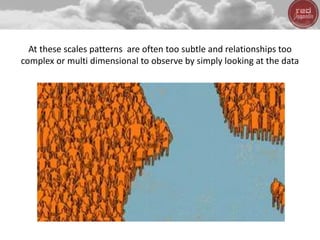
At these scales patterns are often too subtle and relationships too
complex or multi dimensional to observe by simply looking at the data
Data mining is a means of automating the
process to detect interpretable patterns
It helps us see the forest without
getting lost in the trees
3/18/2022 ©2011 Healthcare Information and Management Systems Society 16
Summary
• Big data describes the way we deal with the
astonishing accumulation of digital information
which is often stored in large unstructured data
repositories.
• New tools such as business intelligence (BI) have
emerged to organise and interpret this vast array
of information with benefits in public health,
research, patient care and hospital operational
systems.
3/18/2022 ©2011 Healthcare Information and Management Systems Society 17
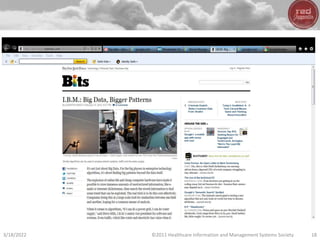
3/18/2022 ©2011 Healthcare Information and Management Systems Society 18
Looking for patterns
• The trend of looking for commonalities and
overlapping interests is emerging in many parts of both
academia and business
• At the ultra small nanoscale examination of a cell,
researchers say, the disciplines of biology, chemistry
and physics begin to collapse in on each other
• Online marketers look at your behaviour in a number
of contexts to sell you something you may not even
know you wanted.
3/18/2022 19
Algorithms
• When it comes to algorithms, “if I can do a power
grid, I can do water supply,” said Steve Mills,
I.B.M.’s senior vice president for software and
systems. Even traffic, which like water and
electricity has value when it flows effectively, can
reuse some of the same algorithms.
• “leveraging the cost structure of new
mathematics.”
• Patient flow
3/18/2022 20
Potential areas for use
• MGI studied big data in five domains—healthcare in the
United States, the public sector in Europe, retail in the
United States, and manufacturing and personal-location
data globally. Big data can generate value in each.
• If US healthcare were to use big data creatively and
effectively to drive efficiency and quality, the sector could
create more than $300 billion in value every year.
• Two-thirds of that would be in the form of reducing US
healthcare expenditure by about 8 percent.
3/18/2022 21
Five broad areas in which big data can
create value
• First, big data can unlock significant value by making
information transparent and usable at much higher frequency
• Secondly, as organizations create and store more transactional
data in digital form, they can collect more accurate and
detailed performance information on everything from product
inventories to sick days, and therefore expose variability and
boost performance.
• Using data for basic low-frequency forecasting to high-
frequency nowcasting to adjust their business levers just in
time.
3/18/2022 y 22
Five broad areas in which big data can
create value
• Third, big data allows ever-narrower segmentation of
customers and therefore much more precisely tailored
products or services
• Fourth, sophisticated analytics can substantially
improve decision-making
• Finally, big data can be used to improve the
development of the next generation of products and
services. Eg data obtained from sensors embedded in
products to create innovative after-sales service
offerings
3/18/2022 23
USING DATA
Google trends, Google analytics
3/18/2022 24
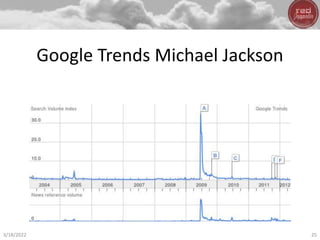
Google Trends Michael Jackson
3/18/2022 25
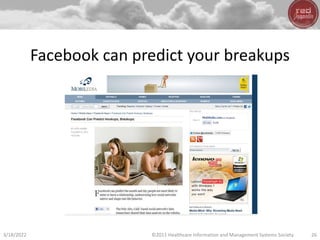
Facebook can predict your breakups
3/18/2022 ©2011 Healthcare Information and Management Systems Society 26
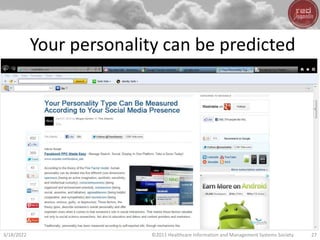
Your personality can be predicted
3/18/2022 ©2011 Healthcare Information and Management Systems Society 27
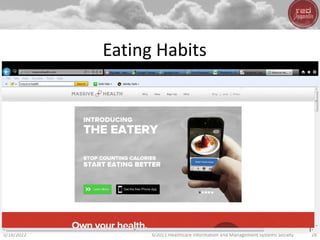
Eating Habits
3/18/2022 ©2011 Healthcare Information and Management Systems Society 28
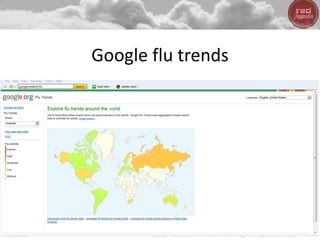
Google flu trends
3/18/2022 ©2011 Healthcare Information and Management Systems Society 29
Health Intelligence:
Keeping Score in Health
30
Moving from Analogue to Digital
Scoreboards
31
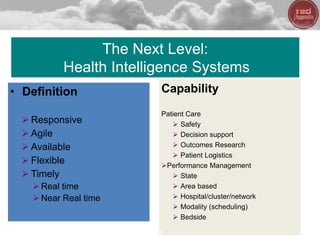
The Next Level:
Health Intelligence Systems
• Definition
 Responsive
 Agile
 Available
 Flexible
 Timely
Real time
Near Real time
Capability
Patient Care
 Safety
 Decision support
 Outcomes Research
 Patient Logistics
Performance Management
 State
 Area based
 Hospital/cluster/network
 Modality (scheduling)
 Bedside
32
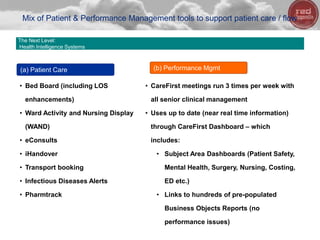
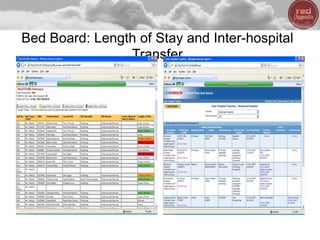
• Bed Board (including LOS
enhancements)
• Ward Activity and Nursing Display
(WAND)
• eConsults
• iHandover
• Transport booking
• Infectious Diseases Alerts
• Pharmtrack
• CareFirst meetings run 3 times per week with
all senior clinical management
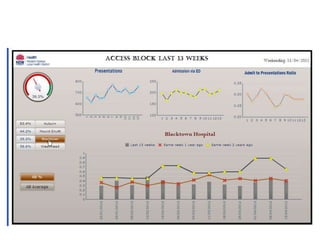
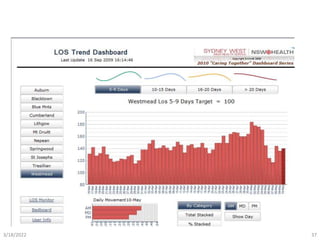
• Uses up to date (near real time information)
through CareFirst Dashboard – which
includes:
• Subject Area Dashboards (Patient Safety,
Mental Health, Surgery, Nursing, Costing,
ED etc.)
• Links to hundreds of pre-populated
Business Objects Reports (no
performance issues)
(a) Patient Care (b) Performance Mgmt
Mix of Patient & Performance Management tools to support patient care / flow
33
The Next Level:
Health Intelligence Systems
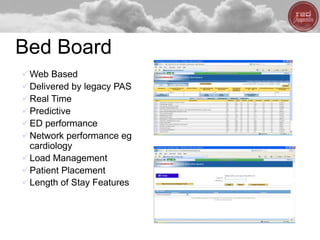
Bed Board
Web Based
Delivered by legacy PAS
Real Time
Predictive
ED performance
Network performance eg
cardiology
Load Management
Patient Placement
Length of Stay Features
34
Bed Board: Length of Stay and Inter-hospital
Transfer
35
3/18/2022 37
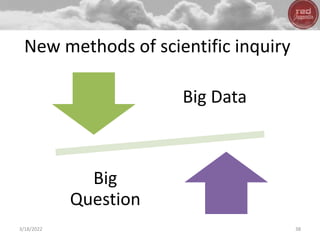
New methods of scientific inquiry
Big Data
Big
Question
3/18/2022 38
New methods of scientific inquiry
• While it is attractive to contemplate the way
everything may become connected to everything
else, it presents a number of large challenges.
• The lab research model has been important for
over a century in both scientific advancement
and product development; soon it may also have
to accommodate a search for truth based only on
pattern-spotting.
3/18/2022 ©2011 Healthcare Information and Management Systems Society 39
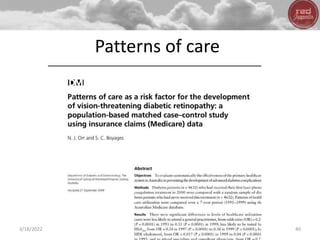
Patterns of care
3/18/2022 40
3/18/2022 41
3/18/2022 ©2011 Healthcare Information and Management Systems Society 42
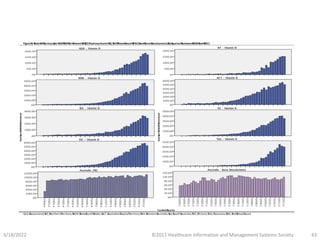
3/18/2022 ©2011 Healthcare Information and Management Systems Society 43
Year%
and%
Quarter
QLD,%
Queensland;%
NT,%
Northern%
Territory;%
NSW,%
New%
South%
Wales;%
ACT,%
Australian%
Capital%
Territory;%
WA,%
Western%
Australia;%
SA,%
South%
Australia;%
VIC,%
Victoria;%
TAS,%
Tasmania;%
FBC,%
Full%
blood%
count
Rate%
per%
100000%
individuals
Rate%
per%
100000%
individuals
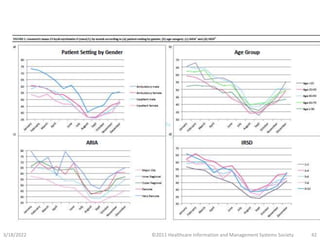
Figure%
1:%
Rate%
of%
Services%
per%
100%
000%
for%
vitamin%
D%
(25?hydroxyvitamin%
D),%
full%
blood%
count%
(FBC)%
and%
bone%
densitometry%
by%
quarter%
between%
2000%
and%
2011
3/18/2022 44
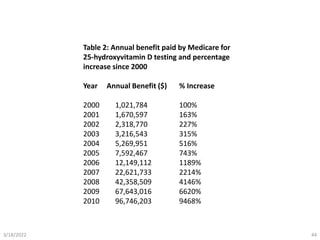
Table 2: Annual benefit paid by Medicare for
25-hydroxyvitamin D testing and percentage
increase since 2000
Year Annual Benefit ($) % Increase
2000 1,021,784 100%
2001 1,670,597 163%
2002 2,318,770 227%
2003 3,216,543 315%
2004 5,269,951 516%
2005 7,592,467 743%
2006 12,149,112 1189%
2007 22,621,733 2214%
2008 42,358,509 4146%
2009 67,643,016 6620%
2010 96,746,203 9468%
3/18/2022 45
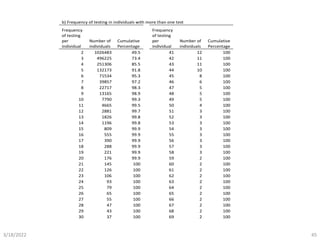
b) Frequency of testing in individuals with more than one test
Frequency
of testing
per
individual
Number of
individuals
Cumulative
Percentage
Frequency
of testing
per
individual
Number of
individuals
Cumulative
Percentage
2 1026483 49.5 41 12 100
3 496225 73.4 42 11 100
4 251306 85.5 43 11 100
5 132173 91.8 44 10 100
6 71534 95.3 45 8 100
7 39857 97.2 46 6 100
8 22717 98.3 47 5 100
9 13165 98.9 48 5 100
10 7790 99.3 49 5 100
11 4665 99.5 50 4 100
12 2881 99.7 51 3 100
13 1826 99.8 52 3 100
14 1196 99.8 53 3 100
15 809 99.9 54 3 100
16 555 99.9 55 3 100
17 390 99.9 56 3 100
18 288 99.9 57 3 100
19 221 99.9 58 3 100
20 176 99.9 59 2 100
21 145 100 60 2 100
22 126 100 61 2 100
23 106 100 62 2 100
24 93 100 63 2 100
25 79 100 64 2 100
26 65 100 65 2 100
27 55 100 66 2 100
28 47 100 67 2 100
29 43 100 68 2 100
30 37 100 69 2 100
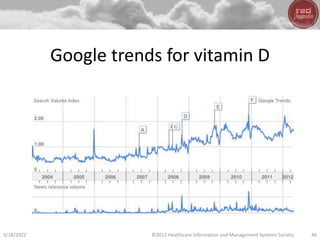
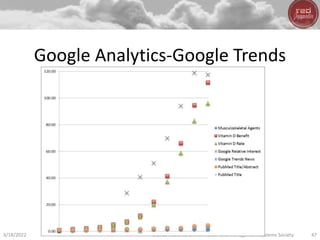
Google trends for vitamin D
3/18/2022 ©2011 Healthcare Information and Management Systems Society 46
Google Analytics-Google Trends
3/18/2022 ©2011 Healthcare Information and Management Systems Society 47
New Technology Triggers
The Nexus of IT Forces:
Social, Mobile, Cloud & Big Data/Information
Source: Gartner, 2013
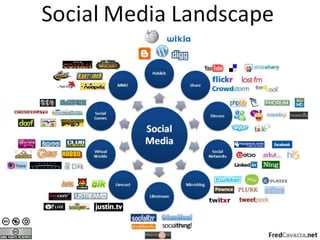
We need to embrace social media
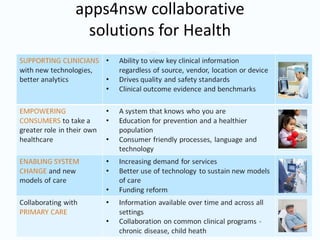
apps4nsw collaborative
solutions for Health
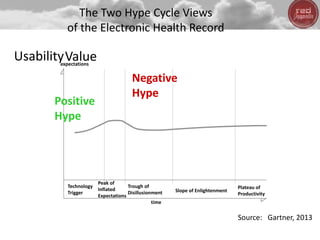
The Two Hype Cycle Views
of the Electronic Health Record
Technology
Trigger
Peak of
Inflated
Expectations
Trough of
Disillusionment Slope of Enlightenment
Plateau of
Productivity
time
expectations
Positive
Hype
Negative
Hype
UsabilityValue
Source: Gartner, 2013
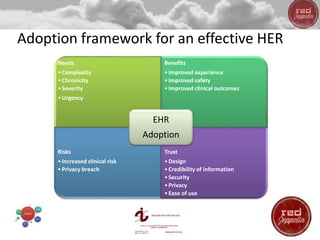
Needs
•Complexity
•Chronicity
•Severity
•Urgency
Benefits
•Improved experience
•Improved safety
•Improved clinical outcomes
Risks
•Increased clinical risk
•Privacy breach
Trust
•Design
•Credibility of information
•Security
•Privacy
•Ease of use
EHR
Adoption
Adoption framework for an effective HER
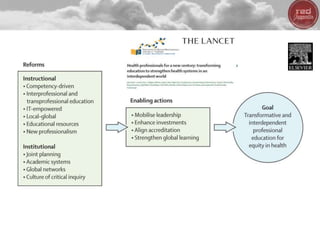
Source: The Lancet (DOI:10.1016/S0140-6736(10)61854-5)
Terms and Conditions
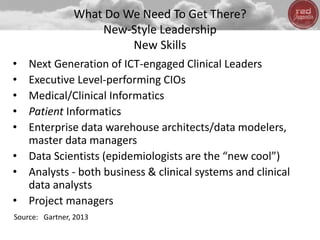
What Do We Need To Get There?
New-Style Leadership
New Skills
• Next Generation of ICT-engaged Clinical Leaders
• Executive Level-performing CIOs
• Medical/Clinical Informatics
• Patient Informatics
• Enterprise data warehouse architects/data modelers,
master data managers
• Data Scientists (epidemiologists are the “new cool”)
• Analysts - both business & clinical systems and clinical
data analysts
• Project managers
Source: Gartner, 2013
High
Tech
High
Touch
High Touch
• “I tell them that their first reflex should be to
look at the patient, not the computer,”
• Dr. Heineken said. And he tells the team to
return to each patient’s bedside at day’s end.
“I say, ‘Don’t go to a computer; go back to the
room, sit down and listen to them. And don’t
look like you’re in a hurry.’ ”
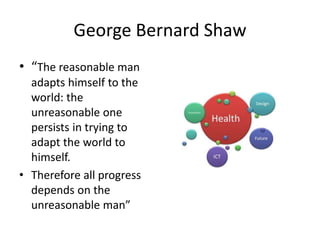
George Bernard Shaw
• “The reasonable man
adapts himself to the
world: the
unreasonable one
persists in trying to
adapt the world to
himself.
• Therefore all progress
depends on the
unreasonable man”

Optimum Healthcare IT A physician’s perspective on Big Data, Predictive Analytics & Business Intelligence (BI) tools

  • 1.
    Optimum Healthcare IT Aphysician’s perspective on Big Data, Predictive Analytics & Business Intelligence (BI) tools Professor Steven Boyages JCMIT 2013 TAIWAN
  • 2.
  • 3.
  • 4.
    Summary • Healthcare organizationsface growing, complex cost-containment pressures. Increasing regulation, diminishing reimbursement, changes in the patient mix, and other challenges mean providers must maximize operational and financial efficiency through best practices and analytics-based decision making. • A combination of insufficient information, poor incentives for cost control along with deficient monitoring and inefficiencies in health care processes—all of those factors have led to much waste of time and funds. • The ability to contain costs while delivering quality healthcare outcomes is eminently possible, but will require a better understanding of what today’s data technologies can achieve. Most people in healthcare are aware of BI tools and analytics but generally its benefits are under-appreciated. As a result, BI in healthcare remains under-implemented. • This presentation will outline uses of BI for clinical and non clinical purposes, how to govern such activity using real world examples. 3/18/2022 4
  • 7.
  • 8.
    Objectives of Investmentin IT • Improve patient experience • Improve patient safety • Improve provider experience • Create value for money 3/18/2022 8
  • 9.
  • 10.
    New Technology Triggers TheNexus of IT Forces: Social, Mobile, Cloud & Big Data/Information Source: Gartner, 2013
  • 11.
    Nearly every transactionor interaction leaves a data signature
  • 12.
    Information Someone somewhere iscapturing and storing
  • 13.
    Sheer scale hasfar exceeded human sense- making capabilities
  • 14.
    At these scalespatterns are often too subtle and relationships too complex or multi dimensional to observe by simply looking at the data
  • 15.
    Data mining isa means of automating the process to detect interpretable patterns
  • 16.
    It helps ussee the forest without getting lost in the trees 3/18/2022 ©2011 Healthcare Information and Management Systems Society 16
  • 17.
    Summary • Big datadescribes the way we deal with the astonishing accumulation of digital information which is often stored in large unstructured data repositories. • New tools such as business intelligence (BI) have emerged to organise and interpret this vast array of information with benefits in public health, research, patient care and hospital operational systems. 3/18/2022 ©2011 Healthcare Information and Management Systems Society 17
  • 18.
    3/18/2022 ©2011 HealthcareInformation and Management Systems Society 18
  • 19.
    Looking for patterns •The trend of looking for commonalities and overlapping interests is emerging in many parts of both academia and business • At the ultra small nanoscale examination of a cell, researchers say, the disciplines of biology, chemistry and physics begin to collapse in on each other • Online marketers look at your behaviour in a number of contexts to sell you something you may not even know you wanted. 3/18/2022 19
  • 20.
    Algorithms • When itcomes to algorithms, “if I can do a power grid, I can do water supply,” said Steve Mills, I.B.M.’s senior vice president for software and systems. Even traffic, which like water and electricity has value when it flows effectively, can reuse some of the same algorithms. • “leveraging the cost structure of new mathematics.” • Patient flow 3/18/2022 20
  • 21.
    Potential areas foruse • MGI studied big data in five domains—healthcare in the United States, the public sector in Europe, retail in the United States, and manufacturing and personal-location data globally. Big data can generate value in each. • If US healthcare were to use big data creatively and effectively to drive efficiency and quality, the sector could create more than $300 billion in value every year. • Two-thirds of that would be in the form of reducing US healthcare expenditure by about 8 percent. 3/18/2022 21
  • 22.
    Five broad areasin which big data can create value • First, big data can unlock significant value by making information transparent and usable at much higher frequency • Secondly, as organizations create and store more transactional data in digital form, they can collect more accurate and detailed performance information on everything from product inventories to sick days, and therefore expose variability and boost performance. • Using data for basic low-frequency forecasting to high- frequency nowcasting to adjust their business levers just in time. 3/18/2022 y 22
  • 23.
    Five broad areasin which big data can create value • Third, big data allows ever-narrower segmentation of customers and therefore much more precisely tailored products or services • Fourth, sophisticated analytics can substantially improve decision-making • Finally, big data can be used to improve the development of the next generation of products and services. Eg data obtained from sensors embedded in products to create innovative after-sales service offerings 3/18/2022 23
  • 24.
    USING DATA Google trends,Google analytics 3/18/2022 24
  • 25.
    Google Trends MichaelJackson 3/18/2022 25
  • 26.
    Facebook can predictyour breakups 3/18/2022 ©2011 Healthcare Information and Management Systems Society 26
  • 27.
    Your personality canbe predicted 3/18/2022 ©2011 Healthcare Information and Management Systems Society 27
  • 28.
    Eating Habits 3/18/2022 ©2011Healthcare Information and Management Systems Society 28
  • 29.
    Google flu trends 3/18/2022©2011 Healthcare Information and Management Systems Society 29
  • 30.
  • 31.
    Moving from Analogueto Digital Scoreboards 31
  • 32.
    The Next Level: HealthIntelligence Systems • Definition  Responsive  Agile  Available  Flexible  Timely Real time Near Real time Capability Patient Care  Safety  Decision support  Outcomes Research  Patient Logistics Performance Management  State  Area based  Hospital/cluster/network  Modality (scheduling)  Bedside 32
  • 33.
    • Bed Board(including LOS enhancements) • Ward Activity and Nursing Display (WAND) • eConsults • iHandover • Transport booking • Infectious Diseases Alerts • Pharmtrack • CareFirst meetings run 3 times per week with all senior clinical management • Uses up to date (near real time information) through CareFirst Dashboard – which includes: • Subject Area Dashboards (Patient Safety, Mental Health, Surgery, Nursing, Costing, ED etc.) • Links to hundreds of pre-populated Business Objects Reports (no performance issues) (a) Patient Care (b) Performance Mgmt Mix of Patient & Performance Management tools to support patient care / flow 33 The Next Level: Health Intelligence Systems
  • 34.
    Bed Board Web Based Deliveredby legacy PAS Real Time Predictive ED performance Network performance eg cardiology Load Management Patient Placement Length of Stay Features 34
  • 35.
    Bed Board: Lengthof Stay and Inter-hospital Transfer 35
  • 37.
  • 38.
    New methods ofscientific inquiry Big Data Big Question 3/18/2022 38
  • 39.
    New methods ofscientific inquiry • While it is attractive to contemplate the way everything may become connected to everything else, it presents a number of large challenges. • The lab research model has been important for over a century in both scientific advancement and product development; soon it may also have to accommodate a search for truth based only on pattern-spotting. 3/18/2022 ©2011 Healthcare Information and Management Systems Society 39
  • 40.
  • 41.
  • 42.
    3/18/2022 ©2011 HealthcareInformation and Management Systems Society 42
  • 43.
    3/18/2022 ©2011 HealthcareInformation and Management Systems Society 43 Year% and% Quarter QLD,% Queensland;% NT,% Northern% Territory;% NSW,% New% South% Wales;% ACT,% Australian% Capital% Territory;% WA,% Western% Australia;% SA,% South% Australia;% VIC,% Victoria;% TAS,% Tasmania;% FBC,% Full% blood% count Rate% per% 100000% individuals Rate% per% 100000% individuals Figure% 1:% Rate% of% Services% per% 100% 000% for% vitamin% D% (25?hydroxyvitamin% D),% full% blood% count% (FBC)% and% bone% densitometry% by% quarter% between% 2000% and% 2011
  • 44.
    3/18/2022 44 Table 2:Annual benefit paid by Medicare for 25-hydroxyvitamin D testing and percentage increase since 2000 Year Annual Benefit ($) % Increase 2000 1,021,784 100% 2001 1,670,597 163% 2002 2,318,770 227% 2003 3,216,543 315% 2004 5,269,951 516% 2005 7,592,467 743% 2006 12,149,112 1189% 2007 22,621,733 2214% 2008 42,358,509 4146% 2009 67,643,016 6620% 2010 96,746,203 9468%
  • 45.
    3/18/2022 45 b) Frequencyof testing in individuals with more than one test Frequency of testing per individual Number of individuals Cumulative Percentage Frequency of testing per individual Number of individuals Cumulative Percentage 2 1026483 49.5 41 12 100 3 496225 73.4 42 11 100 4 251306 85.5 43 11 100 5 132173 91.8 44 10 100 6 71534 95.3 45 8 100 7 39857 97.2 46 6 100 8 22717 98.3 47 5 100 9 13165 98.9 48 5 100 10 7790 99.3 49 5 100 11 4665 99.5 50 4 100 12 2881 99.7 51 3 100 13 1826 99.8 52 3 100 14 1196 99.8 53 3 100 15 809 99.9 54 3 100 16 555 99.9 55 3 100 17 390 99.9 56 3 100 18 288 99.9 57 3 100 19 221 99.9 58 3 100 20 176 99.9 59 2 100 21 145 100 60 2 100 22 126 100 61 2 100 23 106 100 62 2 100 24 93 100 63 2 100 25 79 100 64 2 100 26 65 100 65 2 100 27 55 100 66 2 100 28 47 100 67 2 100 29 43 100 68 2 100 30 37 100 69 2 100
  • 46.
    Google trends forvitamin D 3/18/2022 ©2011 Healthcare Information and Management Systems Society 46
  • 47.
    Google Analytics-Google Trends 3/18/2022©2011 Healthcare Information and Management Systems Society 47
  • 48.
    New Technology Triggers TheNexus of IT Forces: Social, Mobile, Cloud & Big Data/Information Source: Gartner, 2013
  • 52.
    We need toembrace social media
  • 53.
  • 54.
    The Two HypeCycle Views of the Electronic Health Record Technology Trigger Peak of Inflated Expectations Trough of Disillusionment Slope of Enlightenment Plateau of Productivity time expectations Positive Hype Negative Hype UsabilityValue Source: Gartner, 2013
  • 55.
    Needs •Complexity •Chronicity •Severity •Urgency Benefits •Improved experience •Improved safety •Improvedclinical outcomes Risks •Increased clinical risk •Privacy breach Trust •Design •Credibility of information •Security •Privacy •Ease of use EHR Adoption Adoption framework for an effective HER
  • 56.
    Source: The Lancet(DOI:10.1016/S0140-6736(10)61854-5) Terms and Conditions
  • 57.
    What Do WeNeed To Get There? New-Style Leadership New Skills • Next Generation of ICT-engaged Clinical Leaders • Executive Level-performing CIOs • Medical/Clinical Informatics • Patient Informatics • Enterprise data warehouse architects/data modelers, master data managers • Data Scientists (epidemiologists are the “new cool”) • Analysts - both business & clinical systems and clinical data analysts • Project managers Source: Gartner, 2013
  • 58.
  • 59.
    High Touch • “Itell them that their first reflex should be to look at the patient, not the computer,” • Dr. Heineken said. And he tells the team to return to each patient’s bedside at day’s end. “I say, ‘Don’t go to a computer; go back to the room, sit down and listen to them. And don’t look like you’re in a hurry.’ ”
  • 60.
    George Bernard Shaw •“The reasonable man adapts himself to the world: the unreasonable one persists in trying to adapt the world to himself. • Therefore all progress depends on the unreasonable man”

Editor's Notes

  • #58 Placeholder for text (substitute your own text; delete when not used)