20 ICT l November 2017
Superior Strategy
The Internet of Everything is being used among industries across
the board, with significant benefits throughout – healthcare being
no exception. Applying this to clinical trials could revolutionise the
patient experience and increase patient focus
From retail and telecommunications to banking and
financial services, the Internet of Everything (IoE) is the
centre of attention across all main industries. Expanding
on the Internet of Things (IoT) theory, IoE covers a wider
remit to include ‘the intelligent connection of people,
process, data and things.’ Experts forecast the global IoT
healthcare market to be worth $117 billion by 2020, with
the number of smart items worldwide projected at around
$25 billion (1,2).
Some crucial factors anticipated to propel the healthcare
market include growing demand for real time disease
management, improved patient care services and effective
and efficient treatment outcomes (3).
Cisco believe the IoE is a $19 trillion global opportunity over
the next decade, and private-sector firms can create as much
as $14.4 trillion in value, while cities, governments and other
public-sector organisations can create $4.6 trillion (4). The IoE
has the capability to bring together processes, people and
data to make networked connections more significant and
essential. The IoE phenomenon is only going to continue to
increase, with Gartner research listing the IoE as one of the
top 10 strategic technology trends.
Maybe the time is right for the clinical trials industry to
welcome the fresh perspective, capabilities, experiences
and unprecedented economic opportunities that the
IoE can bring. In practice, a connected IoE system could
monitor continuous data from a wearable device, transmit
the information from the patient’s home via Wi-Fi or a
smartphone to a data analysis server and enable reports to
be analysed instantly. An integrated, secure and scalable
platform for wirelessly collecting, transmitting and
analysing biometric data would hold great promise for the
digital health industry, not to mention patients.
When considering the merits of applying an IoE strategy to a
clinical trial, an accessible flow of instantaneous information
would enable those monitoring the study to act on any risk
factors almost immediately, ensuring compliance in real time.
New technology that improves connectivity between patients
and trials, as well as instant access to real time data, will have
a far-reaching impact on clinical research. However, the need
for more data – and then figuring out what to do with all the
information once you have it – will require a significant focus
from the industry.
IoE Establishment Challenges
With increasing geographical reach, larger numbers of
patients and intensifying data, clinical trials are becoming
more expensive, time-consuming and complex. As the
number of global studies has increased, on-site monitoring
and face-to-face visits have become more challenging.
This has led to a heightened pressure to monitor clinical
trials more effectively and use technology more efficiently
to optimise processes.
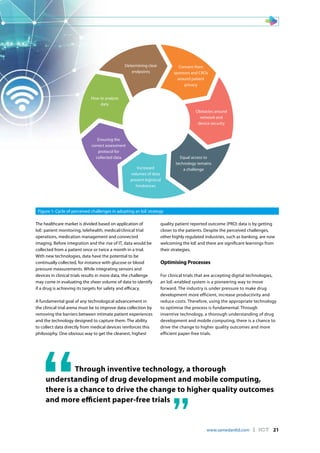
An IoE strategy appears to offer numerous benefits to the
clinical trials industry. However, any initiative that includes
user-generated communications and interactions associated
with global networked devices has its challenges, as
demonstrated in Figure 1.
Richard Strobridge
at CRF Health
ICT	 IoE in Clinical Trials
Image:©shutterstock.com
The healthcare market is divided based on application of
IoE: patient monitoring, telehealth, medical/clinical trial
operations, medication management and connected
imaging. Before integration and the rise of IT, data would be
collected from a patient once or twice a month in a trial.
With new technologies, data have the potential to be
continually collected, for instance with glucose or blood
pressure measurements. While integrating sensors and
devices in clinical trials results in more data, the challenge
may come in evaluating the sheer volume of data to identify
if a drug is achieving its targets for safety and efficacy.
A fundamental goal of any technological advancement in
the clinical trial arena must be to improve data collection by
removing the barriers between intimate patient experiences
and the technology designed to capture them. The ability
to collect data directly from medical devices reinforces this
philosophy. One obvious way to get the cleanest, highest
quality patient reported outcome (PRO) data is by getting
closer to the patients. Despite the perceived challenges,
other highly regulated industries, such as banking, are now
welcoming the IoE and there are significant learnings from
their strategies.
Optimising Processes
For clinical trials that are accepting digital technologies,
an IoE-enabled system is a pioneering way to move
forward. The industry is under pressure to make drug
development more efficient, increase productivity and
reduce costs. Therefore, using the appropriate technology
to optimise the process is fundamental. Through
inventive technology, a thorough understanding of drug
development and mobile computing, there is a chance to
drive the change to higher quality outcomes and more
efficient paper-free trials.
www.samedanltd.com l ICT 21
Figure 1: Cycle of perceived challenges in adopting an IoE strategy
Determining clear
endpoints
Concern from
sponsors and CROs
around patient
privacy
Obstacles around
network and
device security
Equal access to
technology remains
a challengeIncreased
volumes of data
present logistical
hindrances
Ensuring the
correct assessment
protocol for
collected data
How to analyse
data
	 Through inventive technology, a thorough
understanding of drug development and mobile computing,
there is a chance to drive the change to higher quality outcomes
and more efficient paper-free trials
22 ICT l www.samedanltd.com
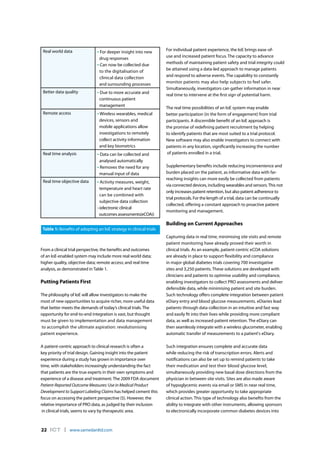
From a clinical trial perspective, the benefits and outcomes
of an IoE-enabled system may include more real world data;
higher quality, objective data; remote access; and real time
analysis, as demonstrated in Table 1.
Putting Patients First
The philosophy of IoE will allow investigators to make the
most of new opportunities to acquire richer, more useful data
that better meets the demands of today’s clinical trials. The
opportunity for end-to-end integration is vast, but thought
must be given to implementation and data management
to accomplish the ultimate aspiration: revolutionising
patient experience.
A patient-centric approach to clinical research is often a
key priority of trial design. Gaining insight into the patient
experience during a study has grown in importance over
time, with stakeholders increasingly understanding the fact
that patients are the true experts in their own symptoms and
experience of a disease and treatment. The 2009 FDA document
Patient-Reported Outcome Measures: Use in Medical Product
Development to Support Labeling Claims has helped cement this
focus on accessing the patient perspective (5). However, the
relative importance of PRO data, as judged by their inclusion
in clinical trials, seems to vary by therapeutic area.
For individual patient experience, the IoE brings ease-of-
use and increased patient focus. The capacity to advance
methods of maintaining patient safety and trial integrity could
be attained using a data-led approach to manage patients
and respond to adverse events. The capability to constantly
monitor patients may also help subjects to feel safer.
Simultaneously, investigators can gather information in near
real time to intervene at the first sign of potential harm.
The real time possibilities of an IoE system may enable
better participation (in the form of engagement) from trial
participants. A discernible benefit of an IoE approach is
the promise of redefining patient recruitment by helping
to identify patients that are most suited to a trial protocol.
New software may also enable investigators to connect with
patients in any location, significantly increasing the number
of patients enrolled in a trial.
Supplementary benefits include reducing inconvenience and
burden placed on the patient, as informative data with far-
reaching insights can more easily be collected from patients
via connected devices, including wearables and sensors.This not
only increases patient retention, but also patient adherence to
trial protocols. For the length of a trial, data can be continually
collected, offering a constant approach to proactive patient
monitoring and management.
Building on Current Approaches
Capturing data in real time, minimising site visits and remote
patient monitoring have already proved their worth in
clinical trials. As an example, patient-centric eCOA solutions
are already in place to support flexibility and compliance
in major global diabetes trials covering 700 investigative
sites and 3,250 patients. These solutions are developed with
clinicians and patients to optimise usability and compliance,
enabling investigators to collect PRO assessments and deliver
defensible data, while minimising patient and site burden.
Such technology offers complete integration between patient
eDiary entry and blood glucose measurements. eDiaries lead
patients through data collection in an intuitive and fast way
and easily fit into their lives while providing more compliant
data, as well as increased patient retention. The eDiary can
then seamlessly integrate with a wireless glucometer, enabling
automatic transfer of measurements to a patient's eDiary.
Such integration ensures complete and accurate data
while reducing the risk of transcription errors. Alerts and
notifications can also be set up to remind patients to take
their medication and test their blood glucose level,
simultaneously providing new basal dose directions from the
physician in between site visits. Sites are also made aware
of hypoglycemic events via email or SMS in near real time,
which provides greater opportunity to take appropriate
clinical action. This type of technology also benefits from the
ability to integrate with other instruments, allowing sponsors
to electronically incorporate common diabetes devices into
Real world data • For deeper insight into new
drug responses
• Can now be collected due
to the digitalisation of
clinical data collection
and surrounding processes
Better data quality • Due to more accurate and
continuous patient
management
Remote access •Wireless wearables, medical
devices, sensors and
mobile applications allow
investigations to remotely
collect activity information
and key biometrics
Real time analysis • Data can be collected and
analysed automatically
• Removes the need for any
manual input of data
Real time objective data • Activity measures, weight,
temperature and heart rate
can be combined with
subjective data collection
–(electronic clinical
outcomes assessments(eCOA))
Table 1: Benefits of adopting an IoE strategy in clinical trials
24 ICT l www.samedanltd.com
the solution. Moving beyond this example, the IoE takes
integration to a new level. Complete home health monitoring
platforms would enable remote observation of both clinical
trial and non-trial patient populations across a variety of
therapeutic areas, as well as post-surgical, preventative and
chronic care. Early adopters will potentially see the biggest
rewards and stand to achieve a competitive advantage.
In action, there is real merit from being able to integrate, for
example, a tablet with activity trackers, body weight scales,
blood pressure monitors, thermometers, pulse oximeters,
glucose meters, electrocardiograms, spirometers and inhalers
to gather and collate real time data. It gives patients freedom
and flexibility and allows healthcare providers to improve staff
efficiencies, shorten hospital stays and adopt a more holistic
approach to managed care.
Where DoWe Go From Here?
A new era of mobile, digital and wearable devices has marked
a shift in the way technology permeates our everyday lives.
The line between clinical trials and digital health is no longer
distinctly noticeable, with clinical technology companies
utilising digital health to improve clinical trials for the
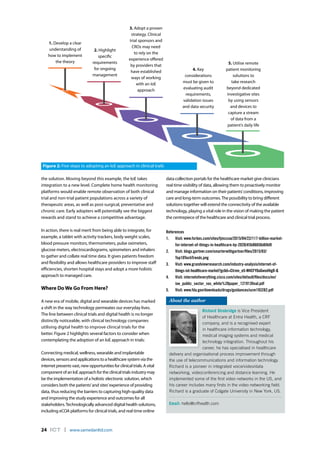
better. Figure 2 highlights several factors to consider when
contemplating the adoption of an IoE approach in trials:
Connecting medical, wellness, wearable and implantable
devices, sensors and applications to a healthcare system via the
internet presents vast, new opportunities for clinical trials. A vital
component of an IoE approach for the clinical trials industry may
be the implementation of a holistic electronic solution, which
considers both the patients’and sites’experience of providing
data, thus reducing the barriers to capturing high-quality data
and improving the study experience and outcomes for all
stakeholders.Technologically advanced digital health solutions,
including eCOA platforms for clinical trials, and real time online
Richard Strobridge is Vice President
of Healthcare at Entra Health, a CRF
company, and is a recognised expert
in healthcare information technology,
medical imaging systems and medical
technology integration. Throughout his
career, he has specialised in healthcare
delivery and organisational process improvement through
the use of telecommunications and information technology.
Richard is a pioneer in integrated voice/video/data
networking, videoconferencing and distance learning. He
implemented some of the first video networks in the US, and
his career includes many firsts in the video networking field.
Richard is a graduate of Colgate University in New York, US.
Email: hello@crfhealth.com
About the author
data collection portals for the healthcare market give clinicians
real time visibility of data, allowing them to proactively monitor
and manage information on their patients’conditions, improving
care and long-term outcomes.The possibility to bring different
solutions together will extend the connectivity of the available
technology, playing a vital role in the vision of making the patient
the centrepiece of the healthcare and clinical trial process.
References
1.	 Visit: www.forbes.com/sites/tjmccue/2015/04/22/117-billion-market-
for-internet-of-things-in-healthcare-by-2020/#3b86656d69d9
2.	 Visit: blogs.gartner.com/smarterwithgartner/files/2015/03/
Top10TechTrends.png
3.	 Visit: www.grandviewresearch.com/industry-analysis/internet-of-
things-iot-healthcare-market?gclid=CIrnm_e5-M4CFY0aGwod4igD-Q
4.	 Visit: internetofeverything.cisco.com/sites/default/files/docs/en/
ioe_public_sector_vas_white%20paper_121913final.pdf
5.	 Visit: www.fda.gov/downloads/drugs/guidances/ucm193282.pdf
2. Highlight
specific
requirements
for ongoing
management
3. Adopt a proven
strategy. Clinical
trial sponsors and
CROs may need
to rely on the
experience offered
by providers that
have established
ways of working
with an IoE
approach
4. Key
considerations
must be given to
evaluating audit
requirements,
validation issues
and data security
5. Utilise remote
patient monitoring
solutions to
take research
beyond dedicated
investigative sites
by using sensors
and devices to
capture a stream
of data from a
patient’s daily life
Figure 2: Five steps to adopting an IoE approach in clinical trails
1. Develop a clear
understanding of
how to implement
the theory

IoE in Clinical Trials

  • 1.
    20 ICT lNovember 2017 Superior Strategy The Internet of Everything is being used among industries across the board, with significant benefits throughout – healthcare being no exception. Applying this to clinical trials could revolutionise the patient experience and increase patient focus From retail and telecommunications to banking and financial services, the Internet of Everything (IoE) is the centre of attention across all main industries. Expanding on the Internet of Things (IoT) theory, IoE covers a wider remit to include ‘the intelligent connection of people, process, data and things.’ Experts forecast the global IoT healthcare market to be worth $117 billion by 2020, with the number of smart items worldwide projected at around $25 billion (1,2). Some crucial factors anticipated to propel the healthcare market include growing demand for real time disease management, improved patient care services and effective and efficient treatment outcomes (3). Cisco believe the IoE is a $19 trillion global opportunity over the next decade, and private-sector firms can create as much as $14.4 trillion in value, while cities, governments and other public-sector organisations can create $4.6 trillion (4). The IoE has the capability to bring together processes, people and data to make networked connections more significant and essential. The IoE phenomenon is only going to continue to increase, with Gartner research listing the IoE as one of the top 10 strategic technology trends. Maybe the time is right for the clinical trials industry to welcome the fresh perspective, capabilities, experiences and unprecedented economic opportunities that the IoE can bring. In practice, a connected IoE system could monitor continuous data from a wearable device, transmit the information from the patient’s home via Wi-Fi or a smartphone to a data analysis server and enable reports to be analysed instantly. An integrated, secure and scalable platform for wirelessly collecting, transmitting and analysing biometric data would hold great promise for the digital health industry, not to mention patients. When considering the merits of applying an IoE strategy to a clinical trial, an accessible flow of instantaneous information would enable those monitoring the study to act on any risk factors almost immediately, ensuring compliance in real time. New technology that improves connectivity between patients and trials, as well as instant access to real time data, will have a far-reaching impact on clinical research. However, the need for more data – and then figuring out what to do with all the information once you have it – will require a significant focus from the industry. IoE Establishment Challenges With increasing geographical reach, larger numbers of patients and intensifying data, clinical trials are becoming more expensive, time-consuming and complex. As the number of global studies has increased, on-site monitoring and face-to-face visits have become more challenging. This has led to a heightened pressure to monitor clinical trials more effectively and use technology more efficiently to optimise processes. An IoE strategy appears to offer numerous benefits to the clinical trials industry. However, any initiative that includes user-generated communications and interactions associated with global networked devices has its challenges, as demonstrated in Figure 1. Richard Strobridge at CRF Health ICT IoE in Clinical Trials Image:©shutterstock.com
  • 2.
    The healthcare marketis divided based on application of IoE: patient monitoring, telehealth, medical/clinical trial operations, medication management and connected imaging. Before integration and the rise of IT, data would be collected from a patient once or twice a month in a trial. With new technologies, data have the potential to be continually collected, for instance with glucose or blood pressure measurements. While integrating sensors and devices in clinical trials results in more data, the challenge may come in evaluating the sheer volume of data to identify if a drug is achieving its targets for safety and efficacy. A fundamental goal of any technological advancement in the clinical trial arena must be to improve data collection by removing the barriers between intimate patient experiences and the technology designed to capture them. The ability to collect data directly from medical devices reinforces this philosophy. One obvious way to get the cleanest, highest quality patient reported outcome (PRO) data is by getting closer to the patients. Despite the perceived challenges, other highly regulated industries, such as banking, are now welcoming the IoE and there are significant learnings from their strategies. Optimising Processes For clinical trials that are accepting digital technologies, an IoE-enabled system is a pioneering way to move forward. The industry is under pressure to make drug development more efficient, increase productivity and reduce costs. Therefore, using the appropriate technology to optimise the process is fundamental. Through inventive technology, a thorough understanding of drug development and mobile computing, there is a chance to drive the change to higher quality outcomes and more efficient paper-free trials. www.samedanltd.com l ICT 21 Figure 1: Cycle of perceived challenges in adopting an IoE strategy Determining clear endpoints Concern from sponsors and CROs around patient privacy Obstacles around network and device security Equal access to technology remains a challengeIncreased volumes of data present logistical hindrances Ensuring the correct assessment protocol for collected data How to analyse data Through inventive technology, a thorough understanding of drug development and mobile computing, there is a chance to drive the change to higher quality outcomes and more efficient paper-free trials
  • 3.
    22 ICT lwww.samedanltd.com From a clinical trial perspective, the benefits and outcomes of an IoE-enabled system may include more real world data; higher quality, objective data; remote access; and real time analysis, as demonstrated in Table 1. Putting Patients First The philosophy of IoE will allow investigators to make the most of new opportunities to acquire richer, more useful data that better meets the demands of today’s clinical trials. The opportunity for end-to-end integration is vast, but thought must be given to implementation and data management to accomplish the ultimate aspiration: revolutionising patient experience. A patient-centric approach to clinical research is often a key priority of trial design. Gaining insight into the patient experience during a study has grown in importance over time, with stakeholders increasingly understanding the fact that patients are the true experts in their own symptoms and experience of a disease and treatment. The 2009 FDA document Patient-Reported Outcome Measures: Use in Medical Product Development to Support Labeling Claims has helped cement this focus on accessing the patient perspective (5). However, the relative importance of PRO data, as judged by their inclusion in clinical trials, seems to vary by therapeutic area. For individual patient experience, the IoE brings ease-of- use and increased patient focus. The capacity to advance methods of maintaining patient safety and trial integrity could be attained using a data-led approach to manage patients and respond to adverse events. The capability to constantly monitor patients may also help subjects to feel safer. Simultaneously, investigators can gather information in near real time to intervene at the first sign of potential harm. The real time possibilities of an IoE system may enable better participation (in the form of engagement) from trial participants. A discernible benefit of an IoE approach is the promise of redefining patient recruitment by helping to identify patients that are most suited to a trial protocol. New software may also enable investigators to connect with patients in any location, significantly increasing the number of patients enrolled in a trial. Supplementary benefits include reducing inconvenience and burden placed on the patient, as informative data with far- reaching insights can more easily be collected from patients via connected devices, including wearables and sensors.This not only increases patient retention, but also patient adherence to trial protocols. For the length of a trial, data can be continually collected, offering a constant approach to proactive patient monitoring and management. Building on Current Approaches Capturing data in real time, minimising site visits and remote patient monitoring have already proved their worth in clinical trials. As an example, patient-centric eCOA solutions are already in place to support flexibility and compliance in major global diabetes trials covering 700 investigative sites and 3,250 patients. These solutions are developed with clinicians and patients to optimise usability and compliance, enabling investigators to collect PRO assessments and deliver defensible data, while minimising patient and site burden. Such technology offers complete integration between patient eDiary entry and blood glucose measurements. eDiaries lead patients through data collection in an intuitive and fast way and easily fit into their lives while providing more compliant data, as well as increased patient retention. The eDiary can then seamlessly integrate with a wireless glucometer, enabling automatic transfer of measurements to a patient's eDiary. Such integration ensures complete and accurate data while reducing the risk of transcription errors. Alerts and notifications can also be set up to remind patients to take their medication and test their blood glucose level, simultaneously providing new basal dose directions from the physician in between site visits. Sites are also made aware of hypoglycemic events via email or SMS in near real time, which provides greater opportunity to take appropriate clinical action. This type of technology also benefits from the ability to integrate with other instruments, allowing sponsors to electronically incorporate common diabetes devices into Real world data • For deeper insight into new drug responses • Can now be collected due to the digitalisation of clinical data collection and surrounding processes Better data quality • Due to more accurate and continuous patient management Remote access •Wireless wearables, medical devices, sensors and mobile applications allow investigations to remotely collect activity information and key biometrics Real time analysis • Data can be collected and analysed automatically • Removes the need for any manual input of data Real time objective data • Activity measures, weight, temperature and heart rate can be combined with subjective data collection –(electronic clinical outcomes assessments(eCOA)) Table 1: Benefits of adopting an IoE strategy in clinical trials
  • 4.
    24 ICT lwww.samedanltd.com the solution. Moving beyond this example, the IoE takes integration to a new level. Complete home health monitoring platforms would enable remote observation of both clinical trial and non-trial patient populations across a variety of therapeutic areas, as well as post-surgical, preventative and chronic care. Early adopters will potentially see the biggest rewards and stand to achieve a competitive advantage. In action, there is real merit from being able to integrate, for example, a tablet with activity trackers, body weight scales, blood pressure monitors, thermometers, pulse oximeters, glucose meters, electrocardiograms, spirometers and inhalers to gather and collate real time data. It gives patients freedom and flexibility and allows healthcare providers to improve staff efficiencies, shorten hospital stays and adopt a more holistic approach to managed care. Where DoWe Go From Here? A new era of mobile, digital and wearable devices has marked a shift in the way technology permeates our everyday lives. The line between clinical trials and digital health is no longer distinctly noticeable, with clinical technology companies utilising digital health to improve clinical trials for the better. Figure 2 highlights several factors to consider when contemplating the adoption of an IoE approach in trials: Connecting medical, wellness, wearable and implantable devices, sensors and applications to a healthcare system via the internet presents vast, new opportunities for clinical trials. A vital component of an IoE approach for the clinical trials industry may be the implementation of a holistic electronic solution, which considers both the patients’and sites’experience of providing data, thus reducing the barriers to capturing high-quality data and improving the study experience and outcomes for all stakeholders.Technologically advanced digital health solutions, including eCOA platforms for clinical trials, and real time online Richard Strobridge is Vice President of Healthcare at Entra Health, a CRF company, and is a recognised expert in healthcare information technology, medical imaging systems and medical technology integration. Throughout his career, he has specialised in healthcare delivery and organisational process improvement through the use of telecommunications and information technology. Richard is a pioneer in integrated voice/video/data networking, videoconferencing and distance learning. He implemented some of the first video networks in the US, and his career includes many firsts in the video networking field. Richard is a graduate of Colgate University in New York, US. Email: hello@crfhealth.com About the author data collection portals for the healthcare market give clinicians real time visibility of data, allowing them to proactively monitor and manage information on their patients’conditions, improving care and long-term outcomes.The possibility to bring different solutions together will extend the connectivity of the available technology, playing a vital role in the vision of making the patient the centrepiece of the healthcare and clinical trial process. References 1. Visit: www.forbes.com/sites/tjmccue/2015/04/22/117-billion-market- for-internet-of-things-in-healthcare-by-2020/#3b86656d69d9 2. Visit: blogs.gartner.com/smarterwithgartner/files/2015/03/ Top10TechTrends.png 3. Visit: www.grandviewresearch.com/industry-analysis/internet-of- things-iot-healthcare-market?gclid=CIrnm_e5-M4CFY0aGwod4igD-Q 4. Visit: internetofeverything.cisco.com/sites/default/files/docs/en/ ioe_public_sector_vas_white%20paper_121913final.pdf 5. Visit: www.fda.gov/downloads/drugs/guidances/ucm193282.pdf 2. Highlight specific requirements for ongoing management 3. Adopt a proven strategy. Clinical trial sponsors and CROs may need to rely on the experience offered by providers that have established ways of working with an IoE approach 4. Key considerations must be given to evaluating audit requirements, validation issues and data security 5. Utilise remote patient monitoring solutions to take research beyond dedicated investigative sites by using sensors and devices to capture a stream of data from a patient’s daily life Figure 2: Five steps to adopting an IoE approach in clinical trails 1. Develop a clear understanding of how to implement the theory