8 XI November 2020
https://doi.org/10.22214/ijraset.2020.32068
International Journal for Research in Applied Science & Engineering Technology (IJRASET)
ISSN: 2321-9653; IC Value: 45.98; SJ Impact Factor: 7.429
Volume 8 Issue XI Nov 2020- Available at www.ijraset.com
©IJRASET: All Rights are Reserved 92
Taguchi Method for Analysing the Lathe Machine
Chirag Kishor Kolambe1
, Sambhaji. V. Sagare2
1
Student, Department of Mechanical Engineering, Matoshri College of Engineering; Research Centre, Nashik, India
2
Student, Department of Mechanical Engineering, Sarvepalli Radhakrishnan University Bhopal, India
Abstract: The aim of the study of this method in Taguchi is to analyst a lathe machine operation while turning by some given
parameter. The parameter on which we will study is speed, feed, depth of cut, MRR, cutting force, feed force, thrust force. We
will use the Taguchi method to measure this type of parameter. Orthogonal arrays of Taguchi, the analysis of variance
(ANOVA) will help to measure the effect and error Confirmation tests with the optimal levels of cutting parameters are
administered so, for instance, the effectiveness of Taguchi optimization method. It is thus shown that the Taguchi method is
extremely suitable to solve the problem.
Keywords: Taguchi method, ANOVA, speed, analysing
I. INTRODUCTION
This paper is based on the Taguchi method as we all know that the method is used to improve the engineering in the company and it
basic use in quality control of the machine in this paper we will going to study about the lathe machine but by using Taguchi which
help us to define the problem of the machine which we are using in this process. As we all know that lathe machine conventional
machines which manual use due to it takes time and also a human force because on one machine only one worker will work. Due to
this cost of job(workpiece) increase and quality of job can have many human errors which are not good for one company. In this
modern era of machines and industry, we need a modern solution that can help users to improve the quality and productivity of the
company. The main challenge of the industry is high quality, dimensional accuracy, surface finish, high production rate, less wear
on the cutting tools, cost-saving, and time-saving process, and reducing the production working impact.
A. Materials And Methods
Material: In this process of analysing the lathe match of Taguchi, we will use high-speed steel. The workpiece is 1.74kg and from a
circle bar, its diameter is 42.6mm.
High-speed steel composition (table:1)
Sr no Material Percentage(%)
1 chromium 4%
2 tungsten 6% approx.
3 vanadium 2% around
4 molybdenum (up to 10%)
5 cobalt up to 9%
6 carbon 1%
In this process, we will use Minitab 19 which basic use for analysis a data in this software there one confirmation know as Taguchi
which very uses full for this process our basic parameter will be speed (RPM), feed (mm), and depth of cut (mm) which will help us
to find the error and effects of the machine in the form of a chart. In the process we will use a turning method on a lathe machine in
which the workpiece (HSS) rotates in a single direction cut by cutting a sharp tool around its axis it has many features of cutting like
boring, drilling, facing, threading, tapping, and etc. In this process, we are using a mild steel cutting tool because its cost is low then
another tool. In the experiment which we will take place in the software of Minitab 19, we will use the L9 orthogonal array of the
Taguchi Approach.
International Journal for Research in Applied Science & Engineering Technology (IJRASET)
ISSN: 2321-9653; IC Value: 45.98; SJ Impact Factor: 7.429
Volume 8 Issue XI Nov 2020- Available at www.ijraset.com
©IJRASET: All Rights are Reserved 93
II. PROBLEM DEFINITION
In the experiment we are performing turning operations on the workpiece which is in a circle shape bar as we all know that every
material has a rough surface which we clear while the operation has a good job .This process is very time consuming, therefore, the
machine will optimization on given parameter like speed (RPM), feed (mm), and depth of cut (mm).on these 3 Parmenter, we will
try to find the error by using ANOVA
A. Objective
As we are focusing on 3 input like Speed, Feed, and depth of cut to find the error of MRR(Kg/min), cutting force(N)Feed force(N),
Thrust force(N)
To study the influence of lathe machines on HHS.
Study the Taguchi method
To find MRR(Kg/min), cutting force(N)Feed force(N), Thrust force(N)
i.
B. Experiment Setup
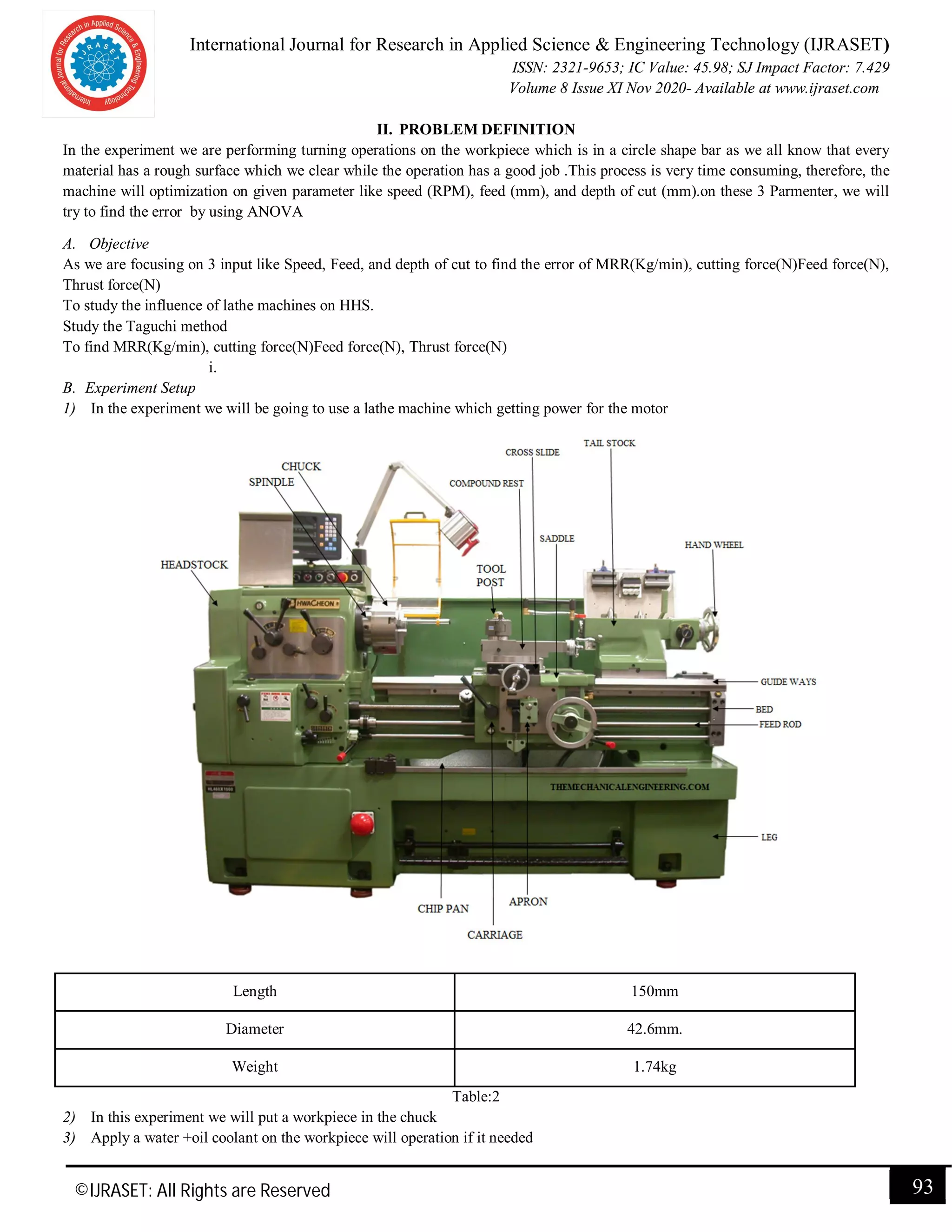
1) In the experiment we will be going to use a lathe machine which getting power for the motor
Length 150mm
Diameter 42.6mm.
Weight 1.74kg
Table:2
2) In this experiment we will put a workpiece in the chuck
3) Apply a water +oil coolant on the workpiece will operation if it needed
International Journal for Research in Applied Science & Engineering Technology (IJRASET)
ISSN: 2321-9653; IC Value: 45.98; SJ Impact Factor: 7.429
Volume 8 Issue XI Nov 2020- Available at www.ijraset.com
©IJRASET: All Rights are Reserved 94
C. Parameter
Speed(rpm) Feed(mm) DOC (mm)
880 11.1 0.4
880 18.1 0.9
880 25.7 1.5
1110 11.1 0.9
1110 18.1 1.5
1110 25.7 0.4
1500 11.1 1.5
1500 18.1 0.4
1500 25.7 0.9
Table: 3
III.RESULT AND CALCULATION FOR HIGH-SPEED STEEL
To measure the workpiece, we are using a vernier calliper. To measure the speed, we will use a Speedometer we take 9 readings and
then apply the Taguchi method on it.
Design Summary
Taguchi Array L9(3^3)
Factors: 3
Runs: 9
Columns of L9(3^4) array: 1 2 3
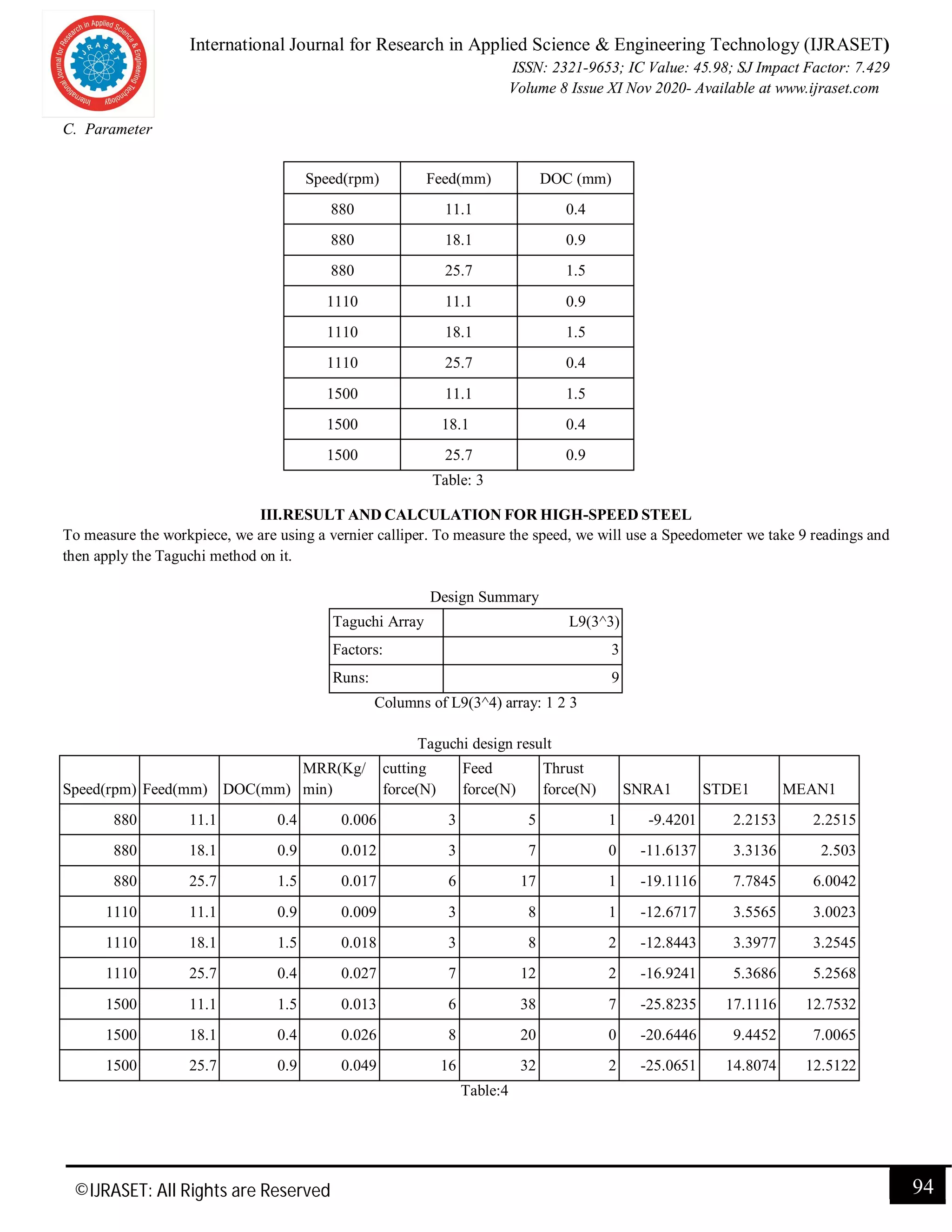
Taguchi design result
Speed(rpm) Feed(mm) DOC(mm)
MRR(Kg/
min)
cutting
force(N)
Feed
force(N)
Thrust
force(N) SNRA1 STDE1 MEAN1
880 11.1 0.4 0.006 3 5 1 -9.4201 2.2153 2.2515
880 18.1 0.9 0.012 3 7 0 -11.6137 3.3136 2.503
880 25.7 1.5 0.017 6 17 1 -19.1116 7.7845 6.0042
1110 11.1 0.9 0.009 3 8 1 -12.6717 3.5565 3.0023
1110 18.1 1.5 0.018 3 8 2 -12.8443 3.3977 3.2545
1110 25.7 0.4 0.027 7 12 2 -16.9241 5.3686 5.2568
1500 11.1 1.5 0.013 6 38 7 -25.8235 17.1116 12.7532
1500 18.1 0.4 0.026 8 20 0 -20.6446 9.4452 7.0065
1500 25.7 0.9 0.049 16 32 2 -25.0651 14.8074 12.5122
Table:4
International Journal for Research in Applied Science & Engineering Technology (IJRASET)
ISSN: 2321-9653; IC Value: 45.98; SJ Impact Factor: 7.429
Volume 8 Issue XI Nov 2020- Available at www.ijraset.com
©IJRASET: All Rights are Reserved 95
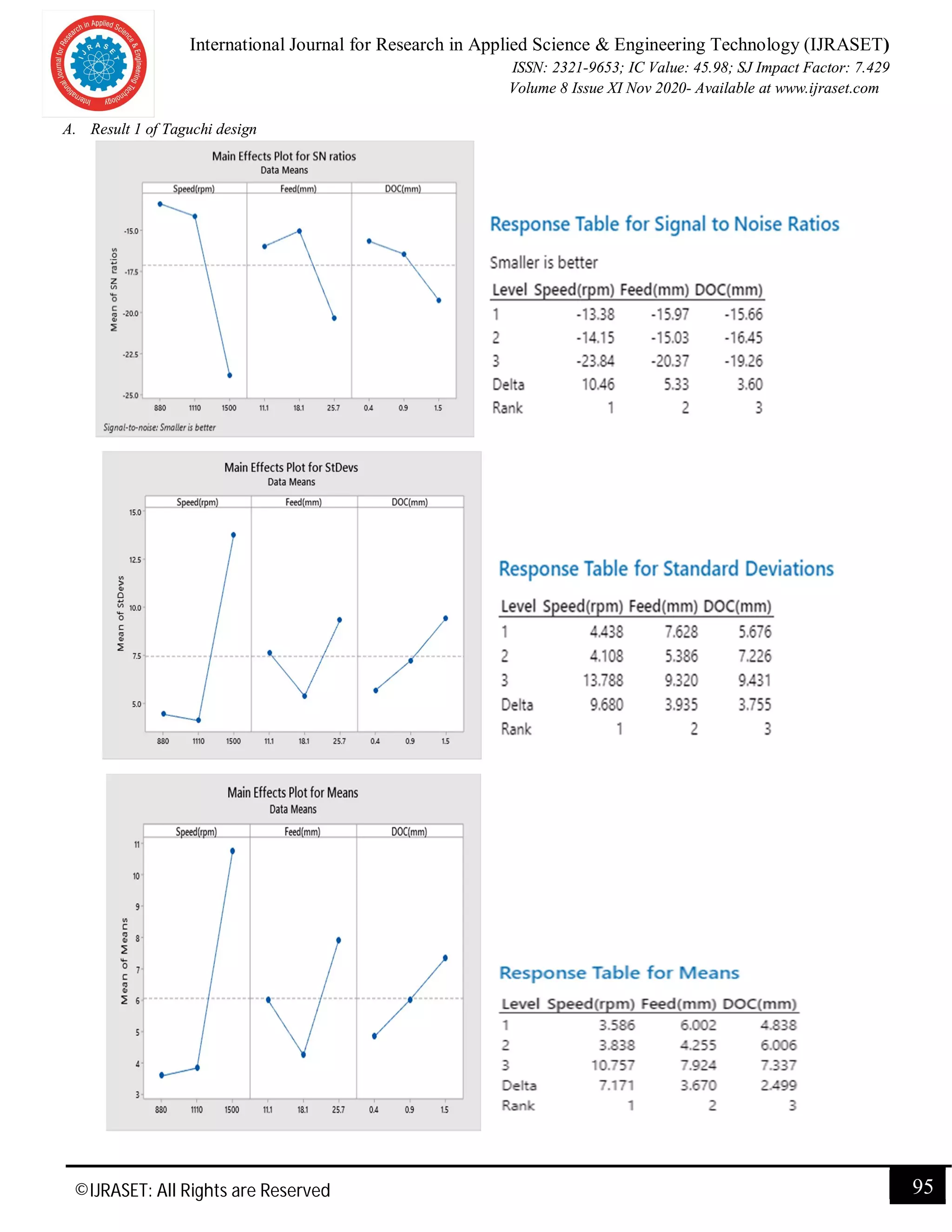
A. Result 1 of Taguchi design
International Journal for Research in Applied Science & Engineering Technology (IJRASET)
ISSN: 2321-9653; IC Value: 45.98; SJ Impact Factor: 7.429
Volume 8 Issue XI Nov 2020- Available at www.ijraset.com
©IJRASET: All Rights are Reserved 96
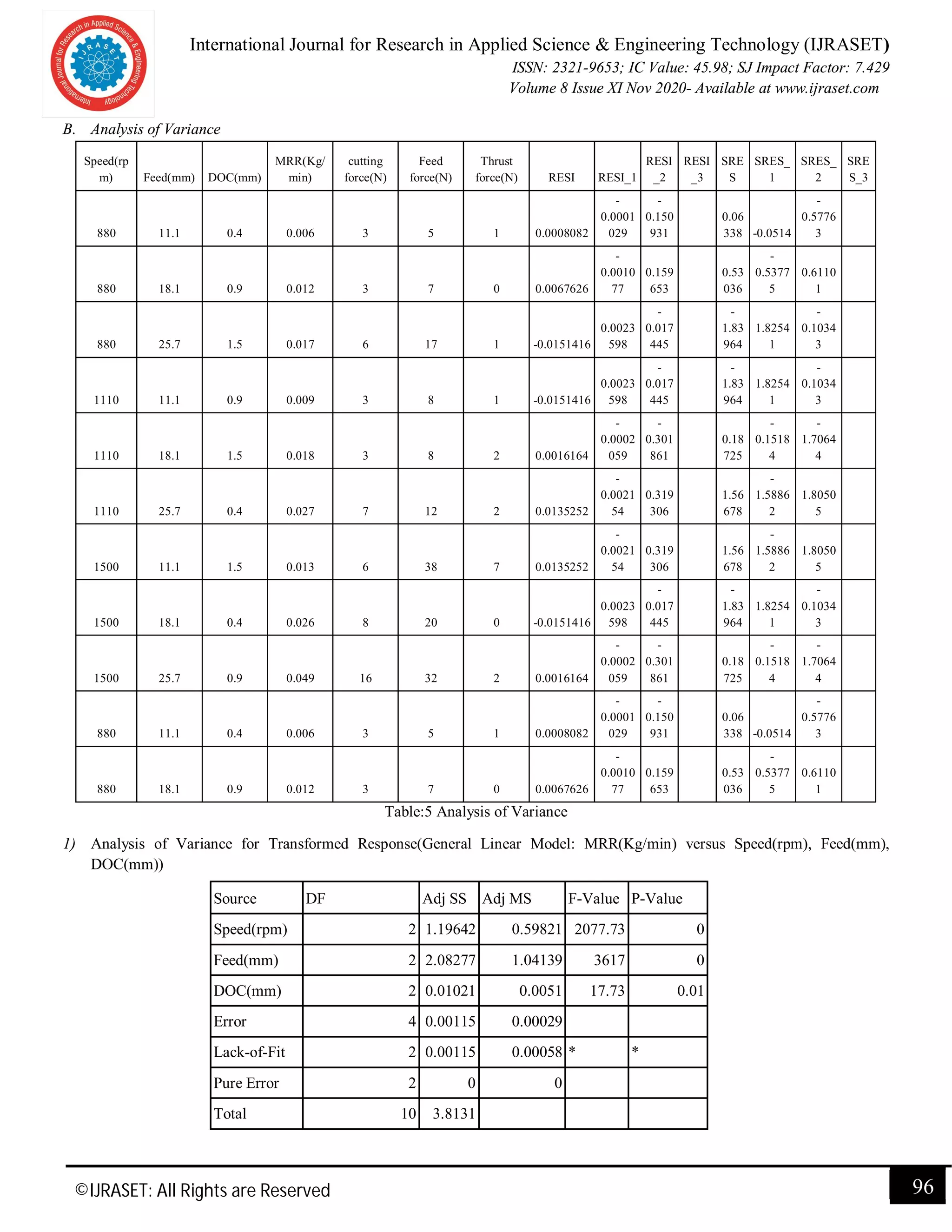
B. Analysis of Variance
Speed(rp
m) Feed(mm) DOC(mm)
MRR(Kg/
min)
cutting
force(N)
Feed
force(N)
Thrust
force(N) RESI RESI_1
RESI
_2
RESI
_3
SRE
S
SRES_
1
SRES_
2
SRE
S_3
880 11.1 0.4 0.006 3 5 1 0.0008082
-
0.0001
029
-
0.150
931
0.06
338 -0.0514
-
0.5776
3
880 18.1 0.9 0.012 3 7 0 0.0067626
-
0.0010
77
0.159
653
0.53
036
-
0.5377
5
0.6110
1
880 25.7 1.5 0.017 6 17 1 -0.0151416
0.0023
598
-
0.017
445
-
1.83
964
1.8254
1
-
0.1034
3
1110 11.1 0.9 0.009 3 8 1 -0.0151416
0.0023
598
-
0.017
445
-
1.83
964
1.8254
1
-
0.1034
3
1110 18.1 1.5 0.018 3 8 2 0.0016164
-
0.0002
059
-
0.301
861
0.18
725
-
0.1518
4
-
1.7064
4
1110 25.7 0.4 0.027 7 12 2 0.0135252
-
0.0021
54
0.319
306
1.56
678
-
1.5886
2
1.8050
5
1500 11.1 1.5 0.013 6 38 7 0.0135252
-
0.0021
54
0.319
306
1.56
678
-
1.5886
2
1.8050
5
1500 18.1 0.4 0.026 8 20 0 -0.0151416
0.0023
598
-
0.017
445
-
1.83
964
1.8254
1
-
0.1034
3
1500 25.7 0.9 0.049 16 32 2 0.0016164
-
0.0002
059
-
0.301
861
0.18
725
-
0.1518
4
-
1.7064
4
880 11.1 0.4 0.006 3 5 1 0.0008082
-
0.0001
029
-
0.150
931
0.06
338 -0.0514
-
0.5776
3
880 18.1 0.9 0.012 3 7 0 0.0067626
-
0.0010
77
0.159
653
0.53
036
-
0.5377
5
0.6110
1
Table:5 Analysis of Variance
1) Analysis of Variance for Transformed Response(General Linear Model: MRR(Kg/min) versus Speed(rpm), Feed(mm),
DOC(mm))
Source DF Adj SS Adj MS F-Value P-Value
Speed(rpm) 2 1.19642 0.59821 2077.73 0
Feed(mm) 2 2.08277 1.04139 3617 0
DOC(mm) 2 0.01021 0.0051 17.73 0.01
Error 4 0.00115 0.00029
Lack-of-Fit 2 0.00115 0.00058 * *
Pure Error 2 0 0
Total 10 3.8131
International Journal for Research in Applied Science & Engineering Technology (IJRASET)
ISSN: 2321-9653; IC Value: 45.98; SJ Impact Factor: 7.429
Volume 8 Issue XI Nov 2020- Available at www.ijraset.com
©IJRASET: All Rights are Reserved 97
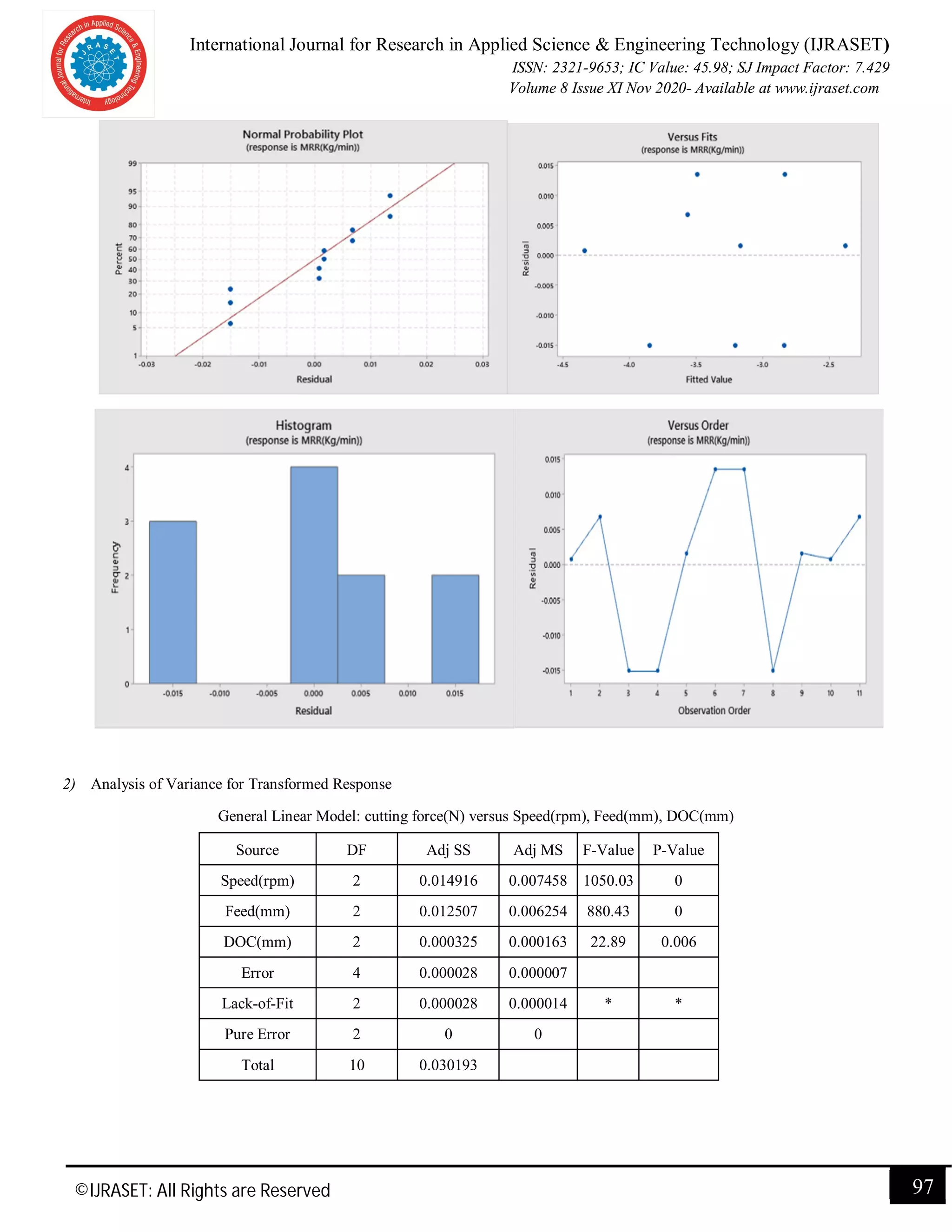
2) Analysis of Variance for Transformed Response
General Linear Model: cutting force(N) versus Speed(rpm), Feed(mm), DOC(mm)
Source DF Adj SS Adj MS F-Value P-Value
Speed(rpm) 2 0.014916 0.007458 1050.03 0
Feed(mm) 2 0.012507 0.006254 880.43 0
DOC(mm) 2 0.000325 0.000163 22.89 0.006
Error 4 0.000028 0.000007
Lack-of-Fit 2 0.000028 0.000014 * *
Pure Error 2 0 0
Total 10 0.030193
International Journal for Research in Applied Science & Engineering Technology (IJRASET)
ISSN: 2321-9653; IC Value: 45.98; SJ Impact Factor: 7.429
Volume 8 Issue XI Nov 2020- Available at www.ijraset.com
©IJRASET: All Rights are Reserved 98
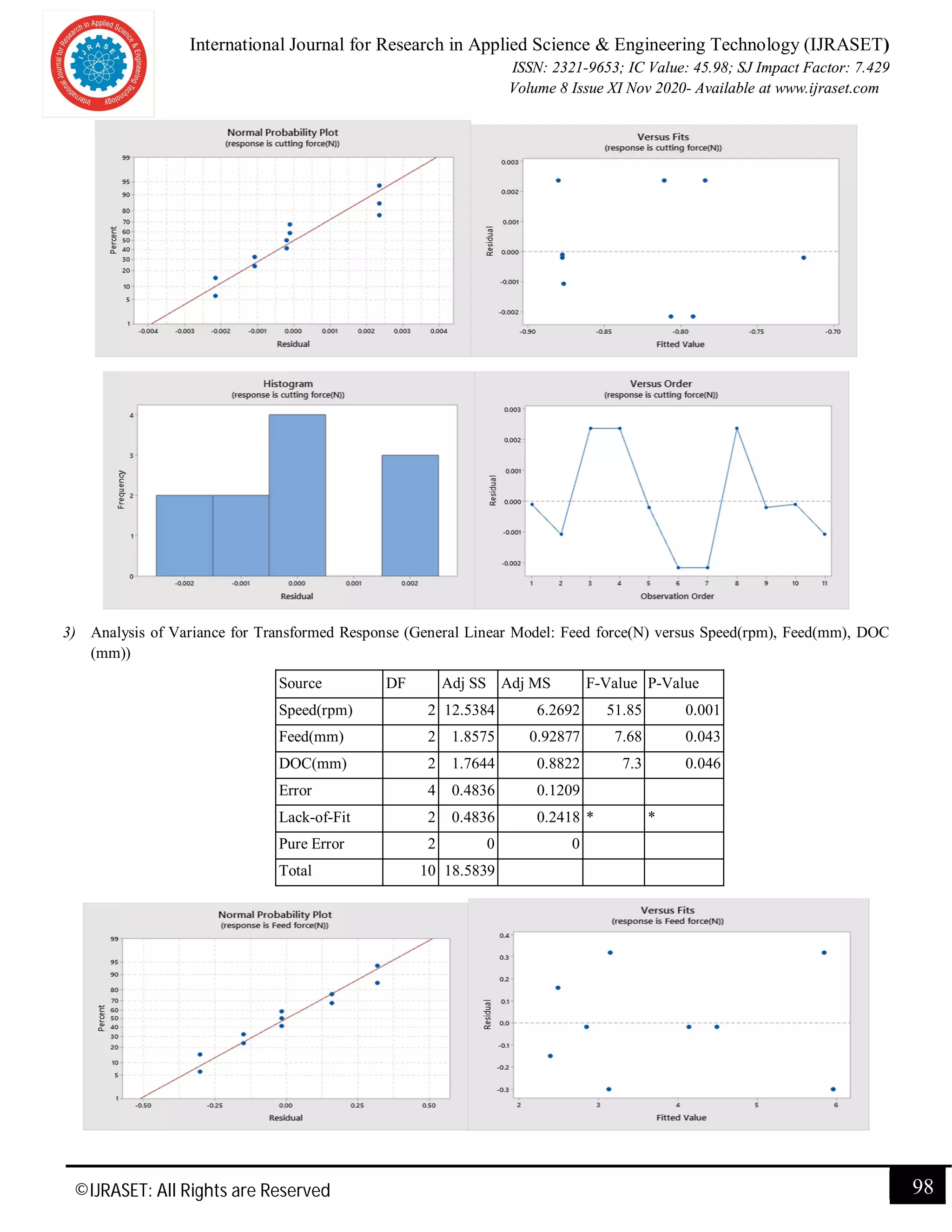
3) Analysis of Variance for Transformed Response (General Linear Model: Feed force(N) versus Speed(rpm), Feed(mm), DOC
(mm))
Source DF Adj SS Adj MS F-Value P-Value
Speed(rpm) 2 12.5384 6.2692 51.85 0.001
Feed(mm) 2 1.8575 0.92877 7.68 0.043
DOC(mm) 2 1.7644 0.8822 7.3 0.046
Error 4 0.4836 0.1209
Lack-of-Fit 2 0.4836 0.2418 * *
Pure Error 2 0 0
Total 10 18.5839
International Journal for Research in Applied Science & Engineering Technology (IJRASET)
ISSN: 2321-9653; IC Value: 45.98; SJ Impact Factor: 7.429
Volume 8 Issue XI Nov 2020- Available at www.ijraset.com
©IJRASET: All Rights are Reserved 99
IV.CONCLUSIONS
It is found that the relation between RPM and MRR, cutting force, Feed force
A. Regression Equation
MRR(Kg/min) ^-0.28694
=-3.29579 - 0.40748 Speed(rpm)_880 + 0.01255 Speed(rpm)_1110
+ 0.39494 Speed(rpm)_1500 - 0.59764 Feed(mm)_11.1
+ 0.10661 Feed(mm)_18.1 + 0.49103 Feed(mm)_25.7 - 0.04038 DOC(mm)_0.4
+ 0.03226 DOC (mm)_0.9 + 0.00812 DOC (mm)_1.5
B. Regression Equation
cutting force(N)^-0.118481
=-0.825131 - 0.03014 Speed(rpm)_880 - 0.02487 Speed(rpm)_1110
+ 0.05501 Speed(rpm)_1500 - 0.02978 Feed(mm)_11.1
- 0.02107 Feed(mm)_18.1 + 0.05085 Feed(mm)_25.7
+ 0.00720 DOC (mm)_0.4 - 0.00053 DOC (mm)_0.9
- 0.00667 DOC (mm)_1.5
C. Regression Equation
Feed force(N)^0.5
=3.825 - 0.821 Speed(rpm)_880 - 0.785 Speed(rpm)_1110
+ 1.606 Speed(rpm)_1500 - 0.133 Feed(mm)_11.1 - 0.457 Feed(mm)_18.1
+ 0.589 Feed(mm)_25.7 - 0.485 DOC (mm)_0.4 - 0.062 DOC (mm)_0.9
+ 0.547 DOC (mm)_1.5
This paper is made of a study of the given parameter of the lathe machine by using the Taguchi method. It found that the parameter
design of the Taguchi method provides a simple, efficient methodology for analysing the process
REFERENCES
[1] Ng Chin Fei,1 Nik Mizamzul Mehat,2 and Shahrul Kamaruddin1, Practical Applications of Taguchi Method for Optimization of Processing Parameters for
Plastic Injection Moulding: A Retrospective Review 2nd ed., 1 School of Mechanical Engineering, Universiti Sains Malaysia, Engineering Campus, 14300
Nibong Tebal, Penang, Malaysia 2 Department of Mould Technology, Kolej Kemahiran Tinggi MARA, Balik Pulau, Genting, 11000 Balik Pulau, Penang,
Malaysia.Hindawi Publishing Corporation ISRN Industrial Engineering Volume 2013, Article ID 462174, 11 pages
[2] T. Tamizharasan1 · N. Senthilkumar2 · V. Selvakumar3 · S. Dinesh4: “Taguchi’s methodology of optimizing turning parameters over chip thickness ratio in
machining P/M AMMC”, SN Applied Sciences (2019) 1:160
[3] Samruddhi Rao, Pragati Samant, Athira Kadampatta, Reshma Shenoy “An Overview of Taguchi Method: Evolution, Concept and Interdisciplinary
Applications International Journal of Scientific & Engineering Research, Volume 4, Issue 10, October-2013 page 622
[4] Dudhat Hiren Pragajibhai1 , Sulabh Nalwaya2 , Pavan Singh3 , Rahul Jain 4 , “Optimization of Machining Parameters on Surface Roughness by Taguchi
Approach,” International Journal of Research and Scientific Innovation (IJRSI) | Volume V, Issue IV, April 2018 page 349-351
Taguchi method for analysing the lathe machine

Taguchi method for analysing the lathe machine

  • 1.
    8 XI November2020 https://doi.org/10.22214/ijraset.2020.32068
  • 2.
    International Journal forResearch in Applied Science & Engineering Technology (IJRASET) ISSN: 2321-9653; IC Value: 45.98; SJ Impact Factor: 7.429 Volume 8 Issue XI Nov 2020- Available at www.ijraset.com ©IJRASET: All Rights are Reserved 92 Taguchi Method for Analysing the Lathe Machine Chirag Kishor Kolambe1 , Sambhaji. V. Sagare2 1 Student, Department of Mechanical Engineering, Matoshri College of Engineering; Research Centre, Nashik, India 2 Student, Department of Mechanical Engineering, Sarvepalli Radhakrishnan University Bhopal, India Abstract: The aim of the study of this method in Taguchi is to analyst a lathe machine operation while turning by some given parameter. The parameter on which we will study is speed, feed, depth of cut, MRR, cutting force, feed force, thrust force. We will use the Taguchi method to measure this type of parameter. Orthogonal arrays of Taguchi, the analysis of variance (ANOVA) will help to measure the effect and error Confirmation tests with the optimal levels of cutting parameters are administered so, for instance, the effectiveness of Taguchi optimization method. It is thus shown that the Taguchi method is extremely suitable to solve the problem. Keywords: Taguchi method, ANOVA, speed, analysing I. INTRODUCTION This paper is based on the Taguchi method as we all know that the method is used to improve the engineering in the company and it basic use in quality control of the machine in this paper we will going to study about the lathe machine but by using Taguchi which help us to define the problem of the machine which we are using in this process. As we all know that lathe machine conventional machines which manual use due to it takes time and also a human force because on one machine only one worker will work. Due to this cost of job(workpiece) increase and quality of job can have many human errors which are not good for one company. In this modern era of machines and industry, we need a modern solution that can help users to improve the quality and productivity of the company. The main challenge of the industry is high quality, dimensional accuracy, surface finish, high production rate, less wear on the cutting tools, cost-saving, and time-saving process, and reducing the production working impact. A. Materials And Methods Material: In this process of analysing the lathe match of Taguchi, we will use high-speed steel. The workpiece is 1.74kg and from a circle bar, its diameter is 42.6mm. High-speed steel composition (table:1) Sr no Material Percentage(%) 1 chromium 4% 2 tungsten 6% approx. 3 vanadium 2% around 4 molybdenum (up to 10%) 5 cobalt up to 9% 6 carbon 1% In this process, we will use Minitab 19 which basic use for analysis a data in this software there one confirmation know as Taguchi which very uses full for this process our basic parameter will be speed (RPM), feed (mm), and depth of cut (mm) which will help us to find the error and effects of the machine in the form of a chart. In the process we will use a turning method on a lathe machine in which the workpiece (HSS) rotates in a single direction cut by cutting a sharp tool around its axis it has many features of cutting like boring, drilling, facing, threading, tapping, and etc. In this process, we are using a mild steel cutting tool because its cost is low then another tool. In the experiment which we will take place in the software of Minitab 19, we will use the L9 orthogonal array of the Taguchi Approach.
  • 3.
    International Journal forResearch in Applied Science & Engineering Technology (IJRASET) ISSN: 2321-9653; IC Value: 45.98; SJ Impact Factor: 7.429 Volume 8 Issue XI Nov 2020- Available at www.ijraset.com ©IJRASET: All Rights are Reserved 93 II. PROBLEM DEFINITION In the experiment we are performing turning operations on the workpiece which is in a circle shape bar as we all know that every material has a rough surface which we clear while the operation has a good job .This process is very time consuming, therefore, the machine will optimization on given parameter like speed (RPM), feed (mm), and depth of cut (mm).on these 3 Parmenter, we will try to find the error by using ANOVA A. Objective As we are focusing on 3 input like Speed, Feed, and depth of cut to find the error of MRR(Kg/min), cutting force(N)Feed force(N), Thrust force(N) To study the influence of lathe machines on HHS. Study the Taguchi method To find MRR(Kg/min), cutting force(N)Feed force(N), Thrust force(N) i. B. Experiment Setup 1) In the experiment we will be going to use a lathe machine which getting power for the motor Length 150mm Diameter 42.6mm. Weight 1.74kg Table:2 2) In this experiment we will put a workpiece in the chuck 3) Apply a water +oil coolant on the workpiece will operation if it needed
  • 4.
    International Journal forResearch in Applied Science & Engineering Technology (IJRASET) ISSN: 2321-9653; IC Value: 45.98; SJ Impact Factor: 7.429 Volume 8 Issue XI Nov 2020- Available at www.ijraset.com ©IJRASET: All Rights are Reserved 94 C. Parameter Speed(rpm) Feed(mm) DOC (mm) 880 11.1 0.4 880 18.1 0.9 880 25.7 1.5 1110 11.1 0.9 1110 18.1 1.5 1110 25.7 0.4 1500 11.1 1.5 1500 18.1 0.4 1500 25.7 0.9 Table: 3 III.RESULT AND CALCULATION FOR HIGH-SPEED STEEL To measure the workpiece, we are using a vernier calliper. To measure the speed, we will use a Speedometer we take 9 readings and then apply the Taguchi method on it. Design Summary Taguchi Array L9(3^3) Factors: 3 Runs: 9 Columns of L9(3^4) array: 1 2 3 Taguchi design result Speed(rpm) Feed(mm) DOC(mm) MRR(Kg/ min) cutting force(N) Feed force(N) Thrust force(N) SNRA1 STDE1 MEAN1 880 11.1 0.4 0.006 3 5 1 -9.4201 2.2153 2.2515 880 18.1 0.9 0.012 3 7 0 -11.6137 3.3136 2.503 880 25.7 1.5 0.017 6 17 1 -19.1116 7.7845 6.0042 1110 11.1 0.9 0.009 3 8 1 -12.6717 3.5565 3.0023 1110 18.1 1.5 0.018 3 8 2 -12.8443 3.3977 3.2545 1110 25.7 0.4 0.027 7 12 2 -16.9241 5.3686 5.2568 1500 11.1 1.5 0.013 6 38 7 -25.8235 17.1116 12.7532 1500 18.1 0.4 0.026 8 20 0 -20.6446 9.4452 7.0065 1500 25.7 0.9 0.049 16 32 2 -25.0651 14.8074 12.5122 Table:4
  • 5.
    International Journal forResearch in Applied Science & Engineering Technology (IJRASET) ISSN: 2321-9653; IC Value: 45.98; SJ Impact Factor: 7.429 Volume 8 Issue XI Nov 2020- Available at www.ijraset.com ©IJRASET: All Rights are Reserved 95 A. Result 1 of Taguchi design
  • 6.
    International Journal forResearch in Applied Science & Engineering Technology (IJRASET) ISSN: 2321-9653; IC Value: 45.98; SJ Impact Factor: 7.429 Volume 8 Issue XI Nov 2020- Available at www.ijraset.com ©IJRASET: All Rights are Reserved 96 B. Analysis of Variance Speed(rp m) Feed(mm) DOC(mm) MRR(Kg/ min) cutting force(N) Feed force(N) Thrust force(N) RESI RESI_1 RESI _2 RESI _3 SRE S SRES_ 1 SRES_ 2 SRE S_3 880 11.1 0.4 0.006 3 5 1 0.0008082 - 0.0001 029 - 0.150 931 0.06 338 -0.0514 - 0.5776 3 880 18.1 0.9 0.012 3 7 0 0.0067626 - 0.0010 77 0.159 653 0.53 036 - 0.5377 5 0.6110 1 880 25.7 1.5 0.017 6 17 1 -0.0151416 0.0023 598 - 0.017 445 - 1.83 964 1.8254 1 - 0.1034 3 1110 11.1 0.9 0.009 3 8 1 -0.0151416 0.0023 598 - 0.017 445 - 1.83 964 1.8254 1 - 0.1034 3 1110 18.1 1.5 0.018 3 8 2 0.0016164 - 0.0002 059 - 0.301 861 0.18 725 - 0.1518 4 - 1.7064 4 1110 25.7 0.4 0.027 7 12 2 0.0135252 - 0.0021 54 0.319 306 1.56 678 - 1.5886 2 1.8050 5 1500 11.1 1.5 0.013 6 38 7 0.0135252 - 0.0021 54 0.319 306 1.56 678 - 1.5886 2 1.8050 5 1500 18.1 0.4 0.026 8 20 0 -0.0151416 0.0023 598 - 0.017 445 - 1.83 964 1.8254 1 - 0.1034 3 1500 25.7 0.9 0.049 16 32 2 0.0016164 - 0.0002 059 - 0.301 861 0.18 725 - 0.1518 4 - 1.7064 4 880 11.1 0.4 0.006 3 5 1 0.0008082 - 0.0001 029 - 0.150 931 0.06 338 -0.0514 - 0.5776 3 880 18.1 0.9 0.012 3 7 0 0.0067626 - 0.0010 77 0.159 653 0.53 036 - 0.5377 5 0.6110 1 Table:5 Analysis of Variance 1) Analysis of Variance for Transformed Response(General Linear Model: MRR(Kg/min) versus Speed(rpm), Feed(mm), DOC(mm)) Source DF Adj SS Adj MS F-Value P-Value Speed(rpm) 2 1.19642 0.59821 2077.73 0 Feed(mm) 2 2.08277 1.04139 3617 0 DOC(mm) 2 0.01021 0.0051 17.73 0.01 Error 4 0.00115 0.00029 Lack-of-Fit 2 0.00115 0.00058 * * Pure Error 2 0 0 Total 10 3.8131
  • 7.
    International Journal forResearch in Applied Science & Engineering Technology (IJRASET) ISSN: 2321-9653; IC Value: 45.98; SJ Impact Factor: 7.429 Volume 8 Issue XI Nov 2020- Available at www.ijraset.com ©IJRASET: All Rights are Reserved 97 2) Analysis of Variance for Transformed Response General Linear Model: cutting force(N) versus Speed(rpm), Feed(mm), DOC(mm) Source DF Adj SS Adj MS F-Value P-Value Speed(rpm) 2 0.014916 0.007458 1050.03 0 Feed(mm) 2 0.012507 0.006254 880.43 0 DOC(mm) 2 0.000325 0.000163 22.89 0.006 Error 4 0.000028 0.000007 Lack-of-Fit 2 0.000028 0.000014 * * Pure Error 2 0 0 Total 10 0.030193
  • 8.
    International Journal forResearch in Applied Science & Engineering Technology (IJRASET) ISSN: 2321-9653; IC Value: 45.98; SJ Impact Factor: 7.429 Volume 8 Issue XI Nov 2020- Available at www.ijraset.com ©IJRASET: All Rights are Reserved 98 3) Analysis of Variance for Transformed Response (General Linear Model: Feed force(N) versus Speed(rpm), Feed(mm), DOC (mm)) Source DF Adj SS Adj MS F-Value P-Value Speed(rpm) 2 12.5384 6.2692 51.85 0.001 Feed(mm) 2 1.8575 0.92877 7.68 0.043 DOC(mm) 2 1.7644 0.8822 7.3 0.046 Error 4 0.4836 0.1209 Lack-of-Fit 2 0.4836 0.2418 * * Pure Error 2 0 0 Total 10 18.5839
  • 9.
    International Journal forResearch in Applied Science & Engineering Technology (IJRASET) ISSN: 2321-9653; IC Value: 45.98; SJ Impact Factor: 7.429 Volume 8 Issue XI Nov 2020- Available at www.ijraset.com ©IJRASET: All Rights are Reserved 99 IV.CONCLUSIONS It is found that the relation between RPM and MRR, cutting force, Feed force A. Regression Equation MRR(Kg/min) ^-0.28694 =-3.29579 - 0.40748 Speed(rpm)_880 + 0.01255 Speed(rpm)_1110 + 0.39494 Speed(rpm)_1500 - 0.59764 Feed(mm)_11.1 + 0.10661 Feed(mm)_18.1 + 0.49103 Feed(mm)_25.7 - 0.04038 DOC(mm)_0.4 + 0.03226 DOC (mm)_0.9 + 0.00812 DOC (mm)_1.5 B. Regression Equation cutting force(N)^-0.118481 =-0.825131 - 0.03014 Speed(rpm)_880 - 0.02487 Speed(rpm)_1110 + 0.05501 Speed(rpm)_1500 - 0.02978 Feed(mm)_11.1 - 0.02107 Feed(mm)_18.1 + 0.05085 Feed(mm)_25.7 + 0.00720 DOC (mm)_0.4 - 0.00053 DOC (mm)_0.9 - 0.00667 DOC (mm)_1.5 C. Regression Equation Feed force(N)^0.5 =3.825 - 0.821 Speed(rpm)_880 - 0.785 Speed(rpm)_1110 + 1.606 Speed(rpm)_1500 - 0.133 Feed(mm)_11.1 - 0.457 Feed(mm)_18.1 + 0.589 Feed(mm)_25.7 - 0.485 DOC (mm)_0.4 - 0.062 DOC (mm)_0.9 + 0.547 DOC (mm)_1.5 This paper is made of a study of the given parameter of the lathe machine by using the Taguchi method. It found that the parameter design of the Taguchi method provides a simple, efficient methodology for analysing the process REFERENCES [1] Ng Chin Fei,1 Nik Mizamzul Mehat,2 and Shahrul Kamaruddin1, Practical Applications of Taguchi Method for Optimization of Processing Parameters for Plastic Injection Moulding: A Retrospective Review 2nd ed., 1 School of Mechanical Engineering, Universiti Sains Malaysia, Engineering Campus, 14300 Nibong Tebal, Penang, Malaysia 2 Department of Mould Technology, Kolej Kemahiran Tinggi MARA, Balik Pulau, Genting, 11000 Balik Pulau, Penang, Malaysia.Hindawi Publishing Corporation ISRN Industrial Engineering Volume 2013, Article ID 462174, 11 pages [2] T. Tamizharasan1 · N. Senthilkumar2 · V. Selvakumar3 · S. Dinesh4: “Taguchi’s methodology of optimizing turning parameters over chip thickness ratio in machining P/M AMMC”, SN Applied Sciences (2019) 1:160 [3] Samruddhi Rao, Pragati Samant, Athira Kadampatta, Reshma Shenoy “An Overview of Taguchi Method: Evolution, Concept and Interdisciplinary Applications International Journal of Scientific & Engineering Research, Volume 4, Issue 10, October-2013 page 622 [4] Dudhat Hiren Pragajibhai1 , Sulabh Nalwaya2 , Pavan Singh3 , Rahul Jain 4 , “Optimization of Machining Parameters on Surface Roughness by Taguchi Approach,” International Journal of Research and Scientific Innovation (IJRSI) | Volume V, Issue IV, April 2018 page 349-351