International Research Journal of Engineering and Technology (IRJET) e-ISSN: 2395 -0056
Volume: 04 Issue: 06 | June -2017 www.irjet.net p-ISSN: 2395-0072
© 2017, IRJET | Impact Factor value: 5.181 | ISO 9001:2008 Certified Journal | Page 1274
Optimization of Cutting Parameters for MRR in Turning Process of EN-
31 Steel Using Taguchi Approach
Kishor Tupe, Vijay Zanje, Sadik Shaikh, Avinash Shigwan, Omkar Kulkarni, Shalaka Kulkarni
Research Scholars, ZCOER, Savitribai Phule Pune University, India
Assistant Professor, ZCOER, Savitribai Phule Pune University, India.
---------------------------------------------------------------------***----------------------------------------------------------------------
Abstract - The turning operation on the EN-31 hardened
steel using tool CNMG 120408 manufactured by Sandvik
Company. Analysis of the MRR (material removal rate) is
done experimentally with specific input values of speed,
feed, and depth of cut and gradually the optimal condition
is found out. A relation between the inputs and the output
is determined and thereafter, the analysis is done. First
using the full factorial composite design a layout of the
experiment is made after which it is conducted. Here the
L9 Taguchi method is used for the determination of the
change in material removal rate with respect to the speed
depth of cut, speed and feed. This can be analyzed with
help of MINTAB 17 software which helps in to produce
different graphs. By using ANOVA (Analysis of Variance)
technique, the most effective or the optimal parameters
for the output is determined. The regression equations are
also obtained. All the parameters are found to be
significant in determination of the material removal rate
and possible conclusions are made at the end. From the
analysis, it was found that, the CVD inserts have performed
well and provide us with an optimal operating condition
when at a combination of speed of 900 RPM, Feed Rate of
0.3 mm/rev and Depth of Cut 0.9 mm.
KEYWORDS: Material Removal Rate (MRR), Taguchi
Method, ANOVA, S/N Ratio.
1. INTRODUCTION
Turning is a machining operation perform on lathe
machine, a material removal process, which is used to
remove unwanted material from the work piece. Turning
operation used single point cutting tool for material
removal operation. The cutting tool feeds into the
rotating work piece and removes unwanted material in
the form of chips to create the required shape and size of
work piece. Turning can done on both surfaces to
produce and axially-symmetrical contoured part. The
aim of turning process is to reduce diameter of work
piece at required size to obtain material removal rate.
Various optimizing methods are used to obtain optimum
values for turning process parameters to get high quality
of the machining component when operation is done. S.
S. Acharya et al. [1] investigated the turning operation in
MQL system and WET system on EN-31 alloy steel. From
the analysis of various response variables like MRR,
surface roughness etc. it is found that optimum results
obtain from MQL system. MQL system enables
improvement in MRR by allowing higher feed rate and
higher cutting speed. MQL requires less coolant due to
which cutting tool and work piece will remain clean
which also save the recycling cost of lubricant oil. G.
harinath Gowd et al. [2] have studied machining
parameters for machining in turning operation on EN-
31. Method used is ANN methodology. It is found that
the speed, feed depth of cut have great significance on
the force and temperature, whereas the feed has less
significance on both the outputs.
1.1 Design of Experiment
The design of experiments for this study was based on
Taguchi’s design of experiments (DOE) and orthogonal
array helps to investigate the effects of input variables or
impact factor on an output variable or response variable
at the same time. These experiments consist of a number
of tests in which different output obtain by changing the
input variable. Results are collected from each test run
during experimentation. Experimentation use design of
experiment to identify the various factors and input
parameters that affect quality, and then determine the
factor settings that optimize results. After identifying the
process conditions and product components that affect
product quality, it is easy to calculate efforts to enhance
a product's manufacturing ability, reliability, quality, and
on machine performance. Here factors are depth of cut,
speed, feed and work piece material which affect the
output variable.
1.2 Selection of Orthogonal Array
The experiment design is done based on the Taguchi
Methodology. Orthogonal array consists number of
experiments in which master matrices used to obtain
desired optimum result. This technique almost used in
different fields of engineering to optimize the process
parameters. The control factors considered for the study
are speed, feed and depth of cut. Three levels for each
control factor are be used. On the basis of different
number of process parameters and their levels, L9
orthogonal array (OA) is selected.Table-1 represents
Factors and Levels of Process Parameters and Table-2
represents orthogonal design matrix.
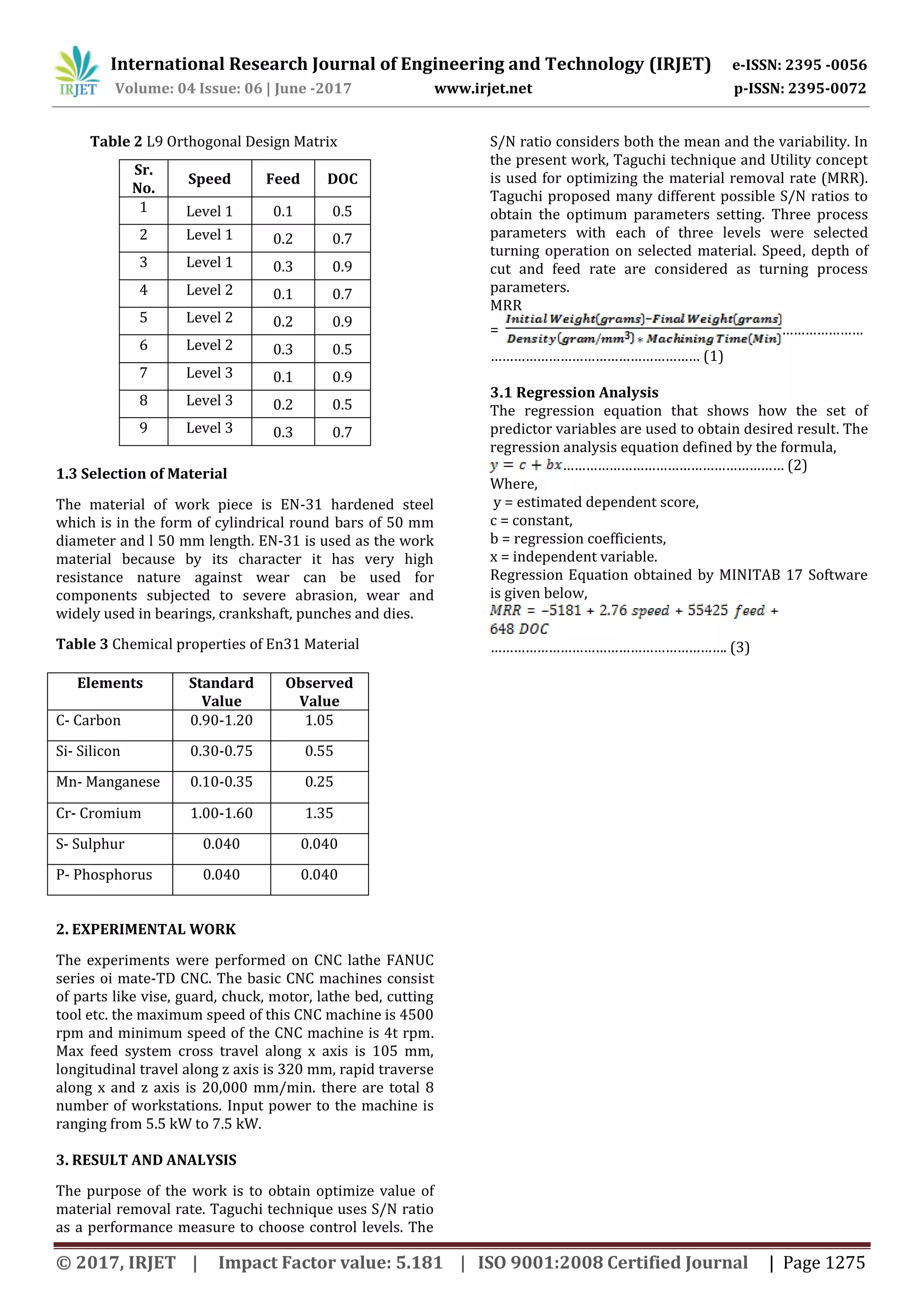
Table 1 Factors And Levels of Process Parameters
LEVEL
Cutting
Speed
(RPM)
Feed Rate
(mm/rev)
Depth of
Cut (mm)
1 600 0.1 0.5
2 900 0.2 0.7
3 1200 0.3 0.9
International Research Journal of Engineering and Technology (IRJET) e-ISSN: 2395 -0056
Volume: 04 Issue: 06 | June -2017 www.irjet.net p-ISSN: 2395-0072
© 2017, IRJET | Impact Factor value: 5.181 | ISO 9001:2008 Certified Journal | Page 1275
Table 2 L9 Orthogonal Design Matrix
Sr.
No.
Speed Feed DOC
1 Level 1 0.1 0.5
2 Level 1 0.2 0.7
3 Level 1 0.3 0.9
4 Level 2 0.1 0.7
5 Level 2 0.2 0.9
6 Level 2 0.3 0.5
7 Level 3 0.1 0.9
8 Level 3 0.2 0.5
9 Level 3 0.3 0.7
1.3 Selection of Material
The material of work piece is EN-31 hardened steel
which is in the form of cylindrical round bars of 50 mm
diameter and l 50 mm length. EN-31 is used as the work
material because by its character it has very high
resistance nature against wear can be used for
components subjected to severe abrasion, wear and
widely used in bearings, crankshaft, punches and dies.
Table 3 Chemical properties of En31 Material
2. EXPERIMENTAL WORK
The experiments were performed on CNC lathe FANUC
series oi mate-TD CNC. The basic CNC machines consist
of parts like vise, guard, chuck, motor, lathe bed, cutting
tool etc. the maximum speed of this CNC machine is 4500
rpm and minimum speed of the CNC machine is 4t rpm.
Max feed system cross travel along x axis is 105 mm,
longitudinal travel along z axis is 320 mm, rapid traverse
along x and z axis is 20,000 mm/min. there are total 8
number of workstations. Input power to the machine is
ranging from 5.5 kW to 7.5 kW.
3. RESULT AND ANALYSIS
The purpose of the work is to obtain optimize value of
material removal rate. Taguchi technique uses S/N ratio
as a performance measure to choose control levels. The
S/N ratio considers both the mean and the variability. In
the present work, Taguchi technique and Utility concept
is used for optimizing the material removal rate (MRR).
Taguchi proposed many different possible S/N ratios to
obtain the optimum parameters setting. Three process
parameters with each of three levels were selected
turning operation on selected material. Speed, depth of
cut and feed rate are considered as turning process
parameters.
MRR
= …………………
……………………………………………… (1)
3.1 Regression Analysis
The regression equation that shows how the set of
predictor variables are used to obtain desired result. The
regression analysis equation defined by the formula,
………………………………………………… (2)
Where,
y = estimated dependent score,
c = constant,
b = regression coefficients,
x = independent variable.
Regression Equation obtained by MINITAB 17 Software
is given below,
……………………………………………………. (3)
Elements Standard
Value
Observed
Value
C- Carbon 0.90-1.20 1.05
Si- Silicon 0.30-0.75 0.55
Mn- Manganese 0.10-0.35 0.25
Cr- Cromium 1.00-1.60 1.35
S- Sulphur 0.040 0.040
P- Phosphorus 0.040 0.040
International Research Journal of Engineering and Technology (IRJET) e-ISSN: 2395 -0056
Volume: 04 Issue: 06 | June -2017 www.irjet.net p-ISSN: 2395-0072
© 2017, IRJET | Impact Factor value: 5.181 | ISO 9001:2008 Certified Journal | Page 1276
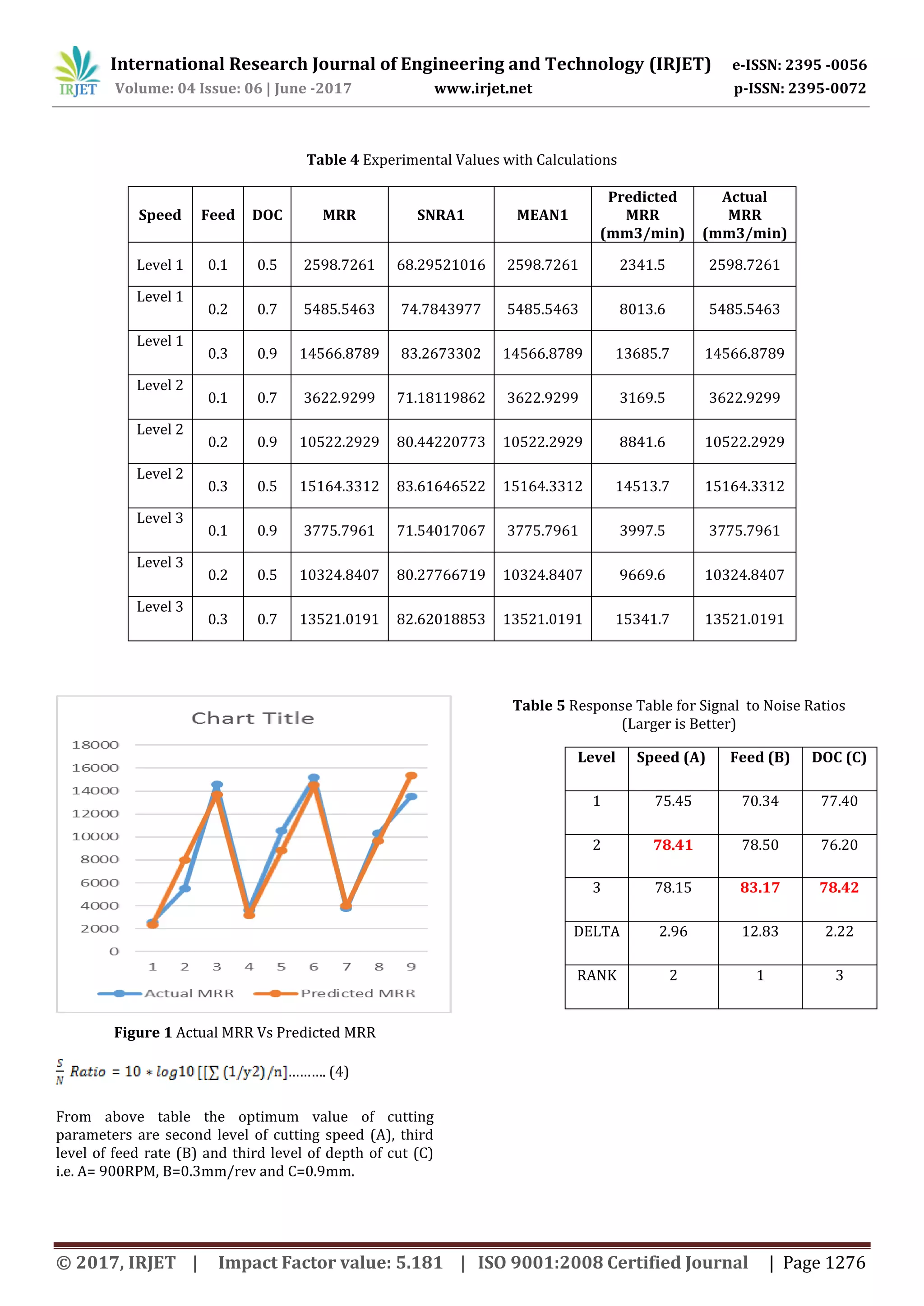
Table 4 Experimental Values with Calculations
Speed Feed DOC MRR SNRA1 MEAN1
Predicted
MRR
(mm3/min)
Actual
MRR
(mm3/min)
Level 1 0.1 0.5 2598.7261 68.29521016 2598.7261 2341.5 2598.7261
Level 1
0.2 0.7 5485.5463 74.7843977 5485.5463 8013.6 5485.5463
Level 1
0.3 0.9 14566.8789 83.2673302 14566.8789 13685.7 14566.8789
Level 2
0.1 0.7 3622.9299 71.18119862 3622.9299 3169.5 3622.9299
Level 2
0.2 0.9 10522.2929 80.44220773 10522.2929 8841.6 10522.2929
Level 2
0.3 0.5 15164.3312 83.61646522 15164.3312 14513.7 15164.3312
Level 3
0.1 0.9 3775.7961 71.54017067 3775.7961 3997.5 3775.7961
Level 3
0.2 0.5 10324.8407 80.27766719 10324.8407 9669.6 10324.8407
Level 3
0.3 0.7 13521.0191 82.62018853 13521.0191 15341.7 13521.0191
Figure 1 Actual MRR Vs Predicted MRR
………. (4)
From above table the optimum value of cutting
parameters are second level of cutting speed (A), third
level of feed rate (B) and third level of depth of cut (C)
i.e. A= 900RPM, B=0.3mm/rev and C=0.9mm.
Table 5 Response Table for Signal to Noise Ratios
(Larger is Better)
Level Speed (A) Feed (B) DOC (C)
1 75.45 70.34 77.40
2 78.41 78.50 76.20
3 78.15 83.17 78.42
DELTA 2.96 12.83 2.22
RANK 2 1 3
International Research Journal of Engineering and Technology (IRJET) e-ISSN: 2395 -0056
Volume: 04 Issue: 06 | June -2017 www.irjet.net p-ISSN: 2395-0072
© 2017, IRJET | Impact Factor value: 5.181 | ISO 9001:2008 Certified Journal | Page 1277
Figure 2 S/N Ratio
Table 6 Analysis of Variance
4. CONCLUSION
Present work is concerned with determining the
optimum value of process parameters for response
variable like material removal rate on the basis of
taguchi method. The L9 Orthogonal Array was used for
experimental planning. The research finding along with
the various mathematical analysis will provide the
effective guideline to select favorable parameters for
optimum value of MRR. The results obtained from
ANOVA shows that the mathematical models allow
prediction MRR with 95% of confident interval. From the
analysis, it was found that, the CVD inserts have
performed well and provide us with an optimal
operating condition when at a combination of speed of
900 RPM, Feed Rate of 0.3 mm/rev and Depth of Cut 0.9
mm. The actual and predicted values are nearly same
and percentage error between actual MRR and predicted
MRR is 1.82 %.
5. REFERENCES
[1]. S.S. Acharya, R.L. Karwande, “Experimental
investigation of turning process of EN-31 Alloy
Steels,” International journal of advance
research in science and engineering, vol. 05,
issue no. 01, March 2010.
[2]. G. Harinath Gowd, K. Divya Theja, “Optimal
Selection of Machining Parameters in CNC
Turning Process of EN-31 Using Intelligent
Hybrid decision Making Tools,” Procedia
engineering 97(2014) 125-133.
[3]. Sayak Mukherjee, Anurag Kamal, “Optimization
of Material Removal Rate during Turning of SAE
1020 Material in CNC Lathe Using Taguchi
Technique,” Procedia engineering 97(2014) 29-
35.
[4]. Aditya kulkarni, Vajay Sabnis, “Optimization of
Power Consumption for CNC Turning of AISI
1040 Steel Using Taguchi Approach,”
International Journal of Innovative Research in
Science, Engineering and technology, vol.3, Issue
8, August 2014.
[5]. Rastee D. Koyee, Uwe Heisel, Rocco Eisseler,
“Modeling and optimization of turning duplex
stainless steels,” Journal of Manufacturing
process 2014 1526-6125.
[6]. D. Manivel, R. Gandhinathan, “ Optimization of
surface roughness and tool wear in hard turning
of austempered ductile iron (grade 3) using
taguchi method”, 2016.
[7]. N. Satheesh Kumar, Ajay Shetty, Ashay Shetty,
“Effect of spindle and feed rate on surface
roughness of carbon Steels in CNC turning,”
international Conference on Modeling,
Optimization and Computing, Procedia
engineering 38 (2012) 691-697.
[8]. Sujit Kumar Jha, Pramod K Shahabadkar,
“Experimental Investigation of CNC Turning of
Aluminum Using Taguchi Method,” International
Research journal of Engineering and
Technology, vol. 02 issue: 03 june- 2015.
[9]. Janez Kopac, Marko Bahor, Mirko Sokovic,
“Optimal machining parameters for
achieving the desired surface roughness in fine
turning of cold preformed steel work pieces,”
International journal of machine tools and
manufacture 42(2002) 707-716.
[10]. K. Vijaykumar, G. Prabhaharan, P. Asokan, R.
Saravanan, “ Optimization of multi pass turning
operation using ant colony system,”
International journal of machine tools and
manufacture 43 (2003) 1633-1639.
[11]. Kamal Hassan, Anish Kumar, M.P. Garg, “
Experimental investigation of Material removal
rate in CC turning using Taguchi method,”
International journal of research and
Applications, vol. 02, issue 2, Mar-Apr 2012, pp.
1581-1590.
[12]. Carmita Composeco-negrete, “Optimization of
cutting parameters for minimizing energy
consumption in turning of AISI 6061 t6 using
Taguchi methodology and ANNOVA,” journal of
Cleaner Production, 2013 1-9.
[13]. Mlan Kumar Das, Kaushik Kumar,
“Optimization of MRR and Surface Roughness in
PAC of EN-31 Steels Using Weighted Principals
Component Analysis,” 2nd international
Conference on Innovations in Automation and
mechatronics Engineering, ICIAME 2014,
Procedia engineering 14 (2014) 211-214.
[14]. Chetan Darshan, Lakhvir Singh,“Analysis and
Optimization of Ceramic Cutting Tools In Hard
Turning of EN-31 Using Factorial Design,”
International journal of mechanical and
Source DF Adj SS Adj MS F-
Value
P-
Value
Speed 2 7987694 3993847 2.86 0.259
Feed 2 184332335 92166168 65.99 0.015
DOC 2 7697680 3848840 2.76 0.266
Error 2 2793185 1396593
Total 8 202810894
International Research Journal of Engineering and Technology (IRJET) e-ISSN: 2395 -0056
Volume: 04 Issue: 06 | June -2017 www.irjet.net p-ISSN: 2395-0072
© 2017, IRJET | Impact Factor value: 5.181 | ISO 9001:2008 Certified Journal | Page 1278
industrial engineering (IJMIE), vol-1,issue-
4,2012.
[15]. Roy R. K., “design of experiment using the
taguchi approach: 16 steps to product and
process improvement,” New York, Wiley, 2001.
[16]. Kishor Tupe, Avinash Shigwan, Vijay Zanje,
Sadik Shaikh, Omkar Kulkarni, Shalaka Kulkarni,
“A Brief Study on Process Parameter
Optimization in Turning Process: A Review”
International Journal of Innovative and
Emerging Research in Engineering, Volume 4,
Issue 1, 2017.
BIOGRAPHIES
Prof. Omkar Kulkarni
M.E – Mechanical – (CADME)
Assistant Professor
ZCOER, Pune-411041
Prof. Shalaka Kulkarni
M.E – Mechanical – (CAD/CAM)
Assistant Professor
ZCOER, Pune-411041
Avinash Shigwan
Student,
ZCOER, Pune-411041
Kishor Tupe
Student,
ZCOER, Pune-411041
Vijay Zanje
Student,
ZCOER, Pune-411041
Sadik Shaikh
Student,
ZCOER, Pune-411041

Optimization of Cutting Parameters for MRR in Turning Process of EN-31 Steel Using Taguchi Approach

  • 1.
    International Research Journalof Engineering and Technology (IRJET) e-ISSN: 2395 -0056 Volume: 04 Issue: 06 | June -2017 www.irjet.net p-ISSN: 2395-0072 © 2017, IRJET | Impact Factor value: 5.181 | ISO 9001:2008 Certified Journal | Page 1274 Optimization of Cutting Parameters for MRR in Turning Process of EN- 31 Steel Using Taguchi Approach Kishor Tupe, Vijay Zanje, Sadik Shaikh, Avinash Shigwan, Omkar Kulkarni, Shalaka Kulkarni Research Scholars, ZCOER, Savitribai Phule Pune University, India Assistant Professor, ZCOER, Savitribai Phule Pune University, India. ---------------------------------------------------------------------***---------------------------------------------------------------------- Abstract - The turning operation on the EN-31 hardened steel using tool CNMG 120408 manufactured by Sandvik Company. Analysis of the MRR (material removal rate) is done experimentally with specific input values of speed, feed, and depth of cut and gradually the optimal condition is found out. A relation between the inputs and the output is determined and thereafter, the analysis is done. First using the full factorial composite design a layout of the experiment is made after which it is conducted. Here the L9 Taguchi method is used for the determination of the change in material removal rate with respect to the speed depth of cut, speed and feed. This can be analyzed with help of MINTAB 17 software which helps in to produce different graphs. By using ANOVA (Analysis of Variance) technique, the most effective or the optimal parameters for the output is determined. The regression equations are also obtained. All the parameters are found to be significant in determination of the material removal rate and possible conclusions are made at the end. From the analysis, it was found that, the CVD inserts have performed well and provide us with an optimal operating condition when at a combination of speed of 900 RPM, Feed Rate of 0.3 mm/rev and Depth of Cut 0.9 mm. KEYWORDS: Material Removal Rate (MRR), Taguchi Method, ANOVA, S/N Ratio. 1. INTRODUCTION Turning is a machining operation perform on lathe machine, a material removal process, which is used to remove unwanted material from the work piece. Turning operation used single point cutting tool for material removal operation. The cutting tool feeds into the rotating work piece and removes unwanted material in the form of chips to create the required shape and size of work piece. Turning can done on both surfaces to produce and axially-symmetrical contoured part. The aim of turning process is to reduce diameter of work piece at required size to obtain material removal rate. Various optimizing methods are used to obtain optimum values for turning process parameters to get high quality of the machining component when operation is done. S. S. Acharya et al. [1] investigated the turning operation in MQL system and WET system on EN-31 alloy steel. From the analysis of various response variables like MRR, surface roughness etc. it is found that optimum results obtain from MQL system. MQL system enables improvement in MRR by allowing higher feed rate and higher cutting speed. MQL requires less coolant due to which cutting tool and work piece will remain clean which also save the recycling cost of lubricant oil. G. harinath Gowd et al. [2] have studied machining parameters for machining in turning operation on EN- 31. Method used is ANN methodology. It is found that the speed, feed depth of cut have great significance on the force and temperature, whereas the feed has less significance on both the outputs. 1.1 Design of Experiment The design of experiments for this study was based on Taguchi’s design of experiments (DOE) and orthogonal array helps to investigate the effects of input variables or impact factor on an output variable or response variable at the same time. These experiments consist of a number of tests in which different output obtain by changing the input variable. Results are collected from each test run during experimentation. Experimentation use design of experiment to identify the various factors and input parameters that affect quality, and then determine the factor settings that optimize results. After identifying the process conditions and product components that affect product quality, it is easy to calculate efforts to enhance a product's manufacturing ability, reliability, quality, and on machine performance. Here factors are depth of cut, speed, feed and work piece material which affect the output variable. 1.2 Selection of Orthogonal Array The experiment design is done based on the Taguchi Methodology. Orthogonal array consists number of experiments in which master matrices used to obtain desired optimum result. This technique almost used in different fields of engineering to optimize the process parameters. The control factors considered for the study are speed, feed and depth of cut. Three levels for each control factor are be used. On the basis of different number of process parameters and their levels, L9 orthogonal array (OA) is selected.Table-1 represents Factors and Levels of Process Parameters and Table-2 represents orthogonal design matrix. Table 1 Factors And Levels of Process Parameters LEVEL Cutting Speed (RPM) Feed Rate (mm/rev) Depth of Cut (mm) 1 600 0.1 0.5 2 900 0.2 0.7 3 1200 0.3 0.9
  • 2.
    International Research Journalof Engineering and Technology (IRJET) e-ISSN: 2395 -0056 Volume: 04 Issue: 06 | June -2017 www.irjet.net p-ISSN: 2395-0072 © 2017, IRJET | Impact Factor value: 5.181 | ISO 9001:2008 Certified Journal | Page 1275 Table 2 L9 Orthogonal Design Matrix Sr. No. Speed Feed DOC 1 Level 1 0.1 0.5 2 Level 1 0.2 0.7 3 Level 1 0.3 0.9 4 Level 2 0.1 0.7 5 Level 2 0.2 0.9 6 Level 2 0.3 0.5 7 Level 3 0.1 0.9 8 Level 3 0.2 0.5 9 Level 3 0.3 0.7 1.3 Selection of Material The material of work piece is EN-31 hardened steel which is in the form of cylindrical round bars of 50 mm diameter and l 50 mm length. EN-31 is used as the work material because by its character it has very high resistance nature against wear can be used for components subjected to severe abrasion, wear and widely used in bearings, crankshaft, punches and dies. Table 3 Chemical properties of En31 Material 2. EXPERIMENTAL WORK The experiments were performed on CNC lathe FANUC series oi mate-TD CNC. The basic CNC machines consist of parts like vise, guard, chuck, motor, lathe bed, cutting tool etc. the maximum speed of this CNC machine is 4500 rpm and minimum speed of the CNC machine is 4t rpm. Max feed system cross travel along x axis is 105 mm, longitudinal travel along z axis is 320 mm, rapid traverse along x and z axis is 20,000 mm/min. there are total 8 number of workstations. Input power to the machine is ranging from 5.5 kW to 7.5 kW. 3. RESULT AND ANALYSIS The purpose of the work is to obtain optimize value of material removal rate. Taguchi technique uses S/N ratio as a performance measure to choose control levels. The S/N ratio considers both the mean and the variability. In the present work, Taguchi technique and Utility concept is used for optimizing the material removal rate (MRR). Taguchi proposed many different possible S/N ratios to obtain the optimum parameters setting. Three process parameters with each of three levels were selected turning operation on selected material. Speed, depth of cut and feed rate are considered as turning process parameters. MRR = ………………… ……………………………………………… (1) 3.1 Regression Analysis The regression equation that shows how the set of predictor variables are used to obtain desired result. The regression analysis equation defined by the formula, ………………………………………………… (2) Where, y = estimated dependent score, c = constant, b = regression coefficients, x = independent variable. Regression Equation obtained by MINITAB 17 Software is given below, ……………………………………………………. (3) Elements Standard Value Observed Value C- Carbon 0.90-1.20 1.05 Si- Silicon 0.30-0.75 0.55 Mn- Manganese 0.10-0.35 0.25 Cr- Cromium 1.00-1.60 1.35 S- Sulphur 0.040 0.040 P- Phosphorus 0.040 0.040
  • 3.
    International Research Journalof Engineering and Technology (IRJET) e-ISSN: 2395 -0056 Volume: 04 Issue: 06 | June -2017 www.irjet.net p-ISSN: 2395-0072 © 2017, IRJET | Impact Factor value: 5.181 | ISO 9001:2008 Certified Journal | Page 1276 Table 4 Experimental Values with Calculations Speed Feed DOC MRR SNRA1 MEAN1 Predicted MRR (mm3/min) Actual MRR (mm3/min) Level 1 0.1 0.5 2598.7261 68.29521016 2598.7261 2341.5 2598.7261 Level 1 0.2 0.7 5485.5463 74.7843977 5485.5463 8013.6 5485.5463 Level 1 0.3 0.9 14566.8789 83.2673302 14566.8789 13685.7 14566.8789 Level 2 0.1 0.7 3622.9299 71.18119862 3622.9299 3169.5 3622.9299 Level 2 0.2 0.9 10522.2929 80.44220773 10522.2929 8841.6 10522.2929 Level 2 0.3 0.5 15164.3312 83.61646522 15164.3312 14513.7 15164.3312 Level 3 0.1 0.9 3775.7961 71.54017067 3775.7961 3997.5 3775.7961 Level 3 0.2 0.5 10324.8407 80.27766719 10324.8407 9669.6 10324.8407 Level 3 0.3 0.7 13521.0191 82.62018853 13521.0191 15341.7 13521.0191 Figure 1 Actual MRR Vs Predicted MRR ………. (4) From above table the optimum value of cutting parameters are second level of cutting speed (A), third level of feed rate (B) and third level of depth of cut (C) i.e. A= 900RPM, B=0.3mm/rev and C=0.9mm. Table 5 Response Table for Signal to Noise Ratios (Larger is Better) Level Speed (A) Feed (B) DOC (C) 1 75.45 70.34 77.40 2 78.41 78.50 76.20 3 78.15 83.17 78.42 DELTA 2.96 12.83 2.22 RANK 2 1 3
  • 4.
    International Research Journalof Engineering and Technology (IRJET) e-ISSN: 2395 -0056 Volume: 04 Issue: 06 | June -2017 www.irjet.net p-ISSN: 2395-0072 © 2017, IRJET | Impact Factor value: 5.181 | ISO 9001:2008 Certified Journal | Page 1277 Figure 2 S/N Ratio Table 6 Analysis of Variance 4. CONCLUSION Present work is concerned with determining the optimum value of process parameters for response variable like material removal rate on the basis of taguchi method. The L9 Orthogonal Array was used for experimental planning. The research finding along with the various mathematical analysis will provide the effective guideline to select favorable parameters for optimum value of MRR. The results obtained from ANOVA shows that the mathematical models allow prediction MRR with 95% of confident interval. From the analysis, it was found that, the CVD inserts have performed well and provide us with an optimal operating condition when at a combination of speed of 900 RPM, Feed Rate of 0.3 mm/rev and Depth of Cut 0.9 mm. The actual and predicted values are nearly same and percentage error between actual MRR and predicted MRR is 1.82 %. 5. REFERENCES [1]. S.S. Acharya, R.L. Karwande, “Experimental investigation of turning process of EN-31 Alloy Steels,” International journal of advance research in science and engineering, vol. 05, issue no. 01, March 2010. [2]. G. Harinath Gowd, K. Divya Theja, “Optimal Selection of Machining Parameters in CNC Turning Process of EN-31 Using Intelligent Hybrid decision Making Tools,” Procedia engineering 97(2014) 125-133. [3]. Sayak Mukherjee, Anurag Kamal, “Optimization of Material Removal Rate during Turning of SAE 1020 Material in CNC Lathe Using Taguchi Technique,” Procedia engineering 97(2014) 29- 35. [4]. Aditya kulkarni, Vajay Sabnis, “Optimization of Power Consumption for CNC Turning of AISI 1040 Steel Using Taguchi Approach,” International Journal of Innovative Research in Science, Engineering and technology, vol.3, Issue 8, August 2014. [5]. Rastee D. Koyee, Uwe Heisel, Rocco Eisseler, “Modeling and optimization of turning duplex stainless steels,” Journal of Manufacturing process 2014 1526-6125. [6]. D. Manivel, R. Gandhinathan, “ Optimization of surface roughness and tool wear in hard turning of austempered ductile iron (grade 3) using taguchi method”, 2016. [7]. N. Satheesh Kumar, Ajay Shetty, Ashay Shetty, “Effect of spindle and feed rate on surface roughness of carbon Steels in CNC turning,” international Conference on Modeling, Optimization and Computing, Procedia engineering 38 (2012) 691-697. [8]. Sujit Kumar Jha, Pramod K Shahabadkar, “Experimental Investigation of CNC Turning of Aluminum Using Taguchi Method,” International Research journal of Engineering and Technology, vol. 02 issue: 03 june- 2015. [9]. Janez Kopac, Marko Bahor, Mirko Sokovic, “Optimal machining parameters for achieving the desired surface roughness in fine turning of cold preformed steel work pieces,” International journal of machine tools and manufacture 42(2002) 707-716. [10]. K. Vijaykumar, G. Prabhaharan, P. Asokan, R. Saravanan, “ Optimization of multi pass turning operation using ant colony system,” International journal of machine tools and manufacture 43 (2003) 1633-1639. [11]. Kamal Hassan, Anish Kumar, M.P. Garg, “ Experimental investigation of Material removal rate in CC turning using Taguchi method,” International journal of research and Applications, vol. 02, issue 2, Mar-Apr 2012, pp. 1581-1590. [12]. Carmita Composeco-negrete, “Optimization of cutting parameters for minimizing energy consumption in turning of AISI 6061 t6 using Taguchi methodology and ANNOVA,” journal of Cleaner Production, 2013 1-9. [13]. Mlan Kumar Das, Kaushik Kumar, “Optimization of MRR and Surface Roughness in PAC of EN-31 Steels Using Weighted Principals Component Analysis,” 2nd international Conference on Innovations in Automation and mechatronics Engineering, ICIAME 2014, Procedia engineering 14 (2014) 211-214. [14]. Chetan Darshan, Lakhvir Singh,“Analysis and Optimization of Ceramic Cutting Tools In Hard Turning of EN-31 Using Factorial Design,” International journal of mechanical and Source DF Adj SS Adj MS F- Value P- Value Speed 2 7987694 3993847 2.86 0.259 Feed 2 184332335 92166168 65.99 0.015 DOC 2 7697680 3848840 2.76 0.266 Error 2 2793185 1396593 Total 8 202810894
  • 5.
    International Research Journalof Engineering and Technology (IRJET) e-ISSN: 2395 -0056 Volume: 04 Issue: 06 | June -2017 www.irjet.net p-ISSN: 2395-0072 © 2017, IRJET | Impact Factor value: 5.181 | ISO 9001:2008 Certified Journal | Page 1278 industrial engineering (IJMIE), vol-1,issue- 4,2012. [15]. Roy R. K., “design of experiment using the taguchi approach: 16 steps to product and process improvement,” New York, Wiley, 2001. [16]. Kishor Tupe, Avinash Shigwan, Vijay Zanje, Sadik Shaikh, Omkar Kulkarni, Shalaka Kulkarni, “A Brief Study on Process Parameter Optimization in Turning Process: A Review” International Journal of Innovative and Emerging Research in Engineering, Volume 4, Issue 1, 2017. BIOGRAPHIES Prof. Omkar Kulkarni M.E – Mechanical – (CADME) Assistant Professor ZCOER, Pune-411041 Prof. Shalaka Kulkarni M.E – Mechanical – (CAD/CAM) Assistant Professor ZCOER, Pune-411041 Avinash Shigwan Student, ZCOER, Pune-411041 Kishor Tupe Student, ZCOER, Pune-411041 Vijay Zanje Student, ZCOER, Pune-411041 Sadik Shaikh Student, ZCOER, Pune-411041