FUEL WORLD
Prepared By: Engr. Mohammad Imam Hossain (Rubel)
B.Sc. Engineering (Mechanical), MBA (Finance), MIEB-23982
E-Mail: rubelduet04@gmail.com, Skype: mdimam
FUEL
The word “Fuel” is came from Old French feuaile, from feu fire, ultimately from Latin
focus fireplace, hearth.
A fuel is defined as any compound containing carbon and hydrogen in elemental
form which undergo combustion in the presence of air to produce a large amount of
heat that can be used economically for domestic and industrial purpose .It is simply
the reaction of substances with oxygen and converts chemical energy into heat and
light. There are chemical fuels, nuclear fuels and fossil fuels.
Fuels are any materials that store potential energy in forms that can be practicably
released and used for work or as heat energy. The concept originally applied solely
to those materials storing energy in the form of chemical energy that could be
released through combustion, but the concept has since been also applied to other
sources of heat energy such as nuclear energy (via nuclear fission or nuclear fusion).
The heat energy released by many fuels is harnessed into mechanical energy via
an engine. Other times the heat itself is valued for warmth, cooking, or industrial
processes, as well as the illumination that comes with combustion. Fuels are also
used in the cells of organisms in a process known as cellular respiration, where
organic molecules are oxidized to release un-usable energy. Hydrocarbons are by far
the most common source of fuel used by humans, but other substances, including
radioactive metals, are also utilized.
Fuels are contrasted with other methods of storing potential energy, such as those
that directly release electrical energy (such as batteries and capacitors)
or mechanical energy (such as flywheels, springs, compressed air, or water in a
reservoir).
Fuels contain one or several of the combustible elements: carbon, hydrogen,
sulphur, etc.
An example might be the combustion of methane
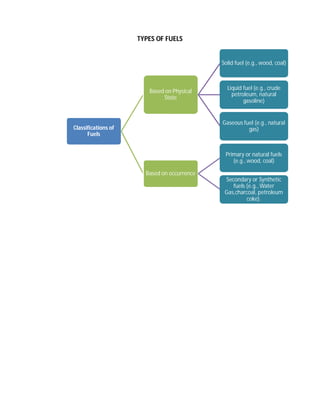
TYPES OF FUELS
Classifications of
Fuels
Based on Physical
State
Solid fuel (e.g., wood, coal)
Liquid fuel (e.g., crude
petroleum, natural
gasoline)
Gaseous fuel (e.g., natural
gas)
Based on occurrence
Primary or natural fuels
(e.g., wood, coal)
Secondary or Synthetic
fuels (e.g., Water
Gas,charcoal, petroleum
coke).
DETAILS CLASSIFICATION OF FUELS
1. Solid Fuels:
a. Coal (Steam Power Plant Fuels)
b. Bagasse, wood barks and ipil –ipil( Dendron thermal fuels)
c. Fuel from garbage (Biomass)
d. Waste products from industrial and agricultural operations
e. Coke (blast furnace fuel)
2. Liquids Fuel:
a. Gasoline (C8H18)-Octane
b. Distilled Fuel Oil-Diesoline (C16H32)
c. Blended Fuel Oil-Diesel Fuel Oil (C12H26)-Dodecane (CH₃(CH₂)₁₀CH₃)
d. Alcohols (CxHyO2)-ethyl and methyl Alcohols
e. Alco-gas(Green Gasoline)-blend :70% gasoline+30% anhydrous alcohol
f. Light heating oils
g. Kerosene
h. Jet Fuel
i. Liquefied Petroleum Gas (LPG)-Propane + Butane +Odorized at high
pressure
3. Gaseous Fuels:
a. Natural Gas
a. -Methane (CH4)
b. -Ethane (C2H6)
c. -Propane (C3H8)
d. -Butane (C4H20)
b. Coke –Oven Gas
c. Blast Furnace Gas
d. Water Gas
e. Enriched Water Gas, Carbureted Water Gas
f. Producer Gas
g. Biogas (Gas Emitted from Animal waste)
4. Nuclear Fuels:
a. Natural -U238( Natural Uranium)
b. Prepared -U235( Enriched Uranium)
1. According to the physical state in which they exist in nature – solid, liquid
and gaseous, for example:
PRIMAY SECONDARY
Solid Fuels Solid Fuels
Wood, Peat, Brown coal, Bituminous,
tar sands, shale’s
Semi-coke, coke, charcoal,
Petroleum, solid rocket fuel
Liquid Fuels Liquid Fuels
Crude oil or petroleum Gasoline, motor spirit, diesel,
kerosene, coal tar
Gaseous Fuels Gaseous Fuels
Natural gas Coal gas, blast furnace gas, oil gas,
LPG, water gas
2. According to the mode of their procurement – natural and manufactured.
CHARACTERISTICS FUEL
Characteristics of a Good Fuel:
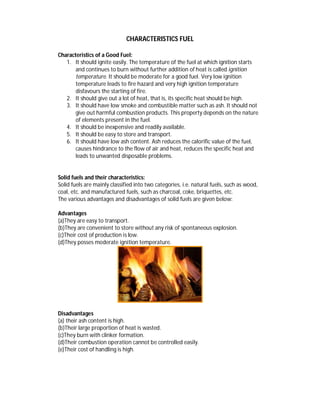
1. It should ignite easily. The temperature of the fuel at which ignition starts
and continues to burn without further addition of heat is called ignition
temperature. It should be moderate for a good fuel. Very low ignition
temperature leads to fire hazard and very high ignition temperature
disfavours the starting of fire.
2. It should give out a lot of heat, that is, its specific heat should be high.
3. It should have low smoke and combustible matter such as ash. It should not
give out harmful combustion products. This property depends on the nature
of elements present in the fuel.
4. It should be inexpensive and readily available.
5. It should be easy to store and transport.
6. It should have low ash content. Ash reduces the calorific value of the fuel,
causes hindrance to the flow of air and heat, reduces the specific heat and
leads to unwanted disposable problems.
Solid fuels and their characteristics:
Solid fuels are mainly classified into two categories, i.e. natural fuels, such as wood,
coal, etc. and manufactured fuels, such as charcoal, coke, briquettes, etc.
The various advantages and disadvantages of solid fuels are given below:
Advantages
(a)They are easy to transport.
(b)They are convenient to store without any risk of spontaneous explosion.
(c)Their cost of production is low.
(d)They posses moderate ignition temperature.
Disadvantages
(a) their ash content is high.
(b)Their large proportion of heat is wasted.
(c)They burn with clinker formation.
(d)Their combustion operation cannot be controlled easily.
(e)Their cost of handling is high.
Liquid fuels and their characteristics:
The liquid fuels can be classified as following
(a)Natural or crude oil, and
(b) Artificial or manufactured oils.
The advantages and disadvantages of liquid fuels can be summarized as following
Advantages
(a)They posses higher calorific value per unit mass than solid fuels.
(b)They burn without dust, ash, clinkers, etc.
(c) Their firing is easier and also fire can be extinguished easily by stopping liquid fuel
supply.
(d)They are easy to transport through pipes.
(e)They can be stored indefinitely without any loss.
(f)They are clean in use and economic to handle.
(g)Loss of heat in chimney is very low due to greater cleanliness.
(h)They require less excess air for complete combustion.
(i)They require less furnace space for combustion.
Disadvantages
(a)The cost of liquid fuel is relatively much higher as compared to solid fuel.
(b)Costly special storage tanks are required for storing liquid fuels.
(c)There is a greater risk of five hazards, particularly, in case of highly inflammable
and volatile liquid fuels.
(d)They give bad odor.
(e)For efficient burning of liquid fuels, specially constructed burners and spraying
apparatus are required.
Gaseous fuels and their characteristics:
Gaseous fuels occur in nature, besides being manufactured from solid and liquid
fuels.
1) Water gas:
A mixture of carbon monoxide and hydrogen gas is commonly known as water
gas. [CO + H2] = Water gas
it is used as a fuel.
PREPARATION:
It is prepared by passing steamover red hot coke.
C + H2O = CO + H2
2) Coal gas:
Coal gas, gaseous mixture—mainly hydrogen, methane, and carbon monoxide—
formed by the destructive distillation (i.e., heating in the absence of air) of
bituminous coal and used as a fuel. Sometimes steam is added to react with the hot
coke, thus increasing the yield of gas. Coal tar and coke are obtained as by-products.
3) Natural Gas:
Natural gas is a vital component of the world's supply of energy. It is one of the
cleanest, safest, and most useful of all energy sources.
Natural gas is a combustible mixture of hydrocarbon gases. While natural gas is
formed primarily of methane, it can also include ethane, propane, butane and
pentane. The composition of natural gas can vary widely, but below is a chart
outlining the typical makeup of natural gas before it is refined.
4) Bio Gas:
Biogas is produced by anaerobic digestion with anaerobic bacteria
or fermentation of biodegradable materials such as manure, sewage, municipal
waste, green waste, plant material, and crops. Biogas comprises primarily
of methane (CH4) and carbon dioxide (CO2) and may have small amounts
of hydrogen sulphide (H2S), moisture and siloxanes.
The gases methane, hydrogen, and carbon monoxide (CO) can be combusted or
oxidized with oxygen. This energy release allows biogas to be used as a fuel. Biogas
can be used as a fuel in any country for any heating purpose, such as cooking. It can
also be used in a gas engine to convert the energy in the gas into electricity and heat.
Some examples of Gaseous Fuels
NAME COMPOSITION USES
Water Gas C + H2O = CO + H2  Fuels in industries
 Preparation of NH3
Natural Gas CH4 =85%
C2H6=10%
Hydrocarbons= 5%
 Cooking
 Fuel
Coal Gas H2 =50%
CH4=25-35%
CO=4-10%
 Industrial fuel
Bio Gas Gobar Gas:
 CH4=50%
 CO2=35%
Organic Waste
 Power generation
 Vehicle fuel
The advantages and disadvantages of gaseous fuels are given below:
Advantages
Gaseous fuels due to erase and flexibility of their applications possess the following
advantages over solid or liquid fuels:
(a)They can be conveyed easily through pipelines to the actual place of need,
thereby eliminating manual labor in transportation.
(b)They can be lighted at ease.
(c)They have high heat contents and hence help us in having higher temperatures.
(d)They can be pre-heated by the heat of hot waste gases, thereby affecting
economy in heat.
(e)Their combustion can readily by controlled for change in demand like oxidizing or
reducing atmosphere, length flame, temperature, etc.
(f) they are clean in use.
(g)They do not require any special burner.
(h)They burn without any shoot, or smoke and ashes.
(i)They are free from impurities found in solid and liquid fuels.
Disadvantages
(a) Very large storage tanks are needed.
(b)They are highly inflammable, so chances of fire hazards in their use are high.
NATURAL GAS
Natural gas is generally considered a nonrenewable fossil fuel. Natural gas is called a
fossil fuel because most scientists believe that natural gas was formed from the
remains of tiny sea animals and plants that died 200-400 million years ago.
Natural gas exists in nature under pressure in rock reservoirs in the Earth’s crust,
either in conjunction with and dissolved in heavier hydrocarbons and water or by
itself. It is produced from the reservoir similarly to or in conjunction with crude oil.
Natural gas has been formed by the degradation of organic matter accumulated in
the past millions of years. Two main mechanisms (biogenic and thermogenic) are
responsible for this degradation
Raw natural gas comes primarily from any one of three types of gas wells.
1) crude oil wells
2) gas wells
3) Condensate wells.
Natural gas wells average 6000 feet deep.
Natural gas produced from geological formations comes in a wide array of
compositions. The varieties of gas compositions can be broadly categorized into
three distinct groups:
(1) Non-associated gas that occurs in conventional gas fields,
(2) Associated gas that occurs in conventional oil fields,
(3) Continuous (or unconventional) gas.
Composition
Natural gas is a complex mixture of hydrocarbon and non-hydrocarbon constituents
and exists as a gas under atmospheric conditions.
Raw natural gas typically consists primarily of methane (CH4), the shortest and
lightest hydrocarbon molecule. It also contains varying amounts of:
• Heavier gaseous hydrocarbons: ethane (C2H6), propane (C3H8),
normal butane (n-C4H10), iso-butane (i-C4H10), pentanes and even
higher molecular weight hydrocarbons. When processed and purified
into finished by-products, all of these are collectively referred to NGL
(Natural Gas Liquids).
• Acid gases: carbon dioxide (CO2), hydrogen sulfide (H2S) and
mercaptans such as methanethiol (CH3SH) and ethanethiol (C2H5SH).
• Other gases: nitrogen (N2) and helium (He).
• Water: water vapor and liquid water.
• Liquid hydrocarbons: perhaps some natural gas condensate (also
referred to as casing-head gasoline or natural gasoline) and/or crude
oil.
• Mercury: very small amounts of mercury primarily in elementary
form, but chlorides and other species are possibly present.
Table (1) outlines the typical makeup of natural gas before it is refined. Natural gas is
considered “dry” when it is almost pure methane, having had most of the other
commonly associated hydrocarbons removed. When other hydrocarbons are
present, the natural gas is “wet”. The composition of natural gas varies depending
on the field, formation, or reservoir from which it is extracted.
Typical Composition of NaturalGas
Gas Specifications
Market sales of natural gas require some specifications set by the consumers
regarding the maximum contents allowable for the following: acidic gases and sulfur,
oxygen and carbon dioxide, water vapor, and liquefiable hydrocarbons. The thermal
heating content of the gas sets another value to be met as a minimum.
Irrespective of the source of natural gas, the final specifications set for market sales
requirements are usually the following:
Effect of Impurities Found in Natural Gas
Field processing operations of natural gas, which is classified as a part of gas
engineering, generally include the following:
1. Removal of water vapor, dehydration
2. Removal of acidic gases (H2S and CO2)
3. Separation of heavy hydrocarbons
The effect of each of these impurities has on the gas industry, as end user, is briefly
outlined:
Natural Gas Phase Behavior
The natural gas phase behavior is a plot of pressure vs temperature that determines
whether the natural gas stream at a given pressure and temperature consists of a
single gas phase or two phases: gas and liquid. The phase behavior for natural gas
with a given composition is typically displayed on a phase diagram, an example of
which is shown in Figure
(3).
Fig.(3): Pressure-temperature diagram for a typical natural gas mixture.
Natural Gas Properties
Chemical and Physical Properties
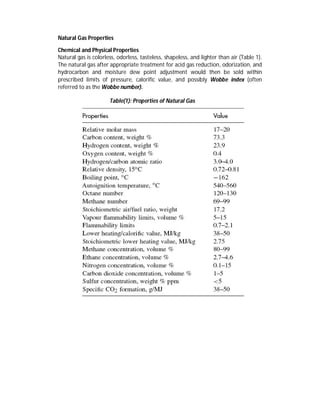
Natural gas is colorless, odorless, tasteless, shapeless, and lighter than air (Table 1).
The natural gas after appropriate treatment for acid gas reduction, odorization, and
hydrocarbon and moisture dew point adjustment would then be sold within
prescribed limits of pressure, calorific value, and possibly Wobbe index (often
referred to as the Wobbe number).
Table(1): Properties of Natural Gas
1. Gas-Specific Gravity
Specific gravity of gas is defined as
---------------------(1)
Where Mair is the molecular weight of air, which is equal to 29. Once we can
calculate the value of the molecular weight of the mixture, we can calculate the
specific gravity of the mixture. For a gas mixture, we can calculate the molecular
weight as
------------------(2)
Where Mi is the molecular weight of component i, yi is the mole fraction of
component i, and n is the total number of components.
Various gas properties, including the molecular weights for pure components, are
given in Table 2.
2. Ideal and Real Gas Laws
The volume of a real gas is usually less than what the volume of an ideal gas would
be, and hence a real gas is said to be super compressible. The ratio of the real
volume to the ideal volume, which is a measure of the amount the gas deviates from
perfect behavior, is called the super compressibility factor, sometimes shortened to
the compressibility factor. It is also called the gas deviation factor and is given the
symbol Z. The real gas equation of state is then written as:
----------------------(3)
where P is the pressure, V is the volume, T is the absolute temperature, Z is the
compressibility, n is the number of kilo-moles of the gas, and R is the gas constant.
The theory of corresponding states dictates that the Z factor can be uniquely defined
as a function of reduced pressure and reduced temperature. The reduced pressure
and reduced temperature are defined as
-----------------------(4)
Table 2
where Pr and Tr are reduced pressure and reduced temperature, respectively, and
Pc and Tc are critical pressure and critical temperature of the gas, respectively. The
values of critical pressure and critical temperature can be estimated from the
following equations if the composition of the gas and the critical properties of the
individual components are known:
----------------------(5)
where Pci and Tci are the critical pressure and critical temperature of component i,
respectively; and yi is the mole fraction of component i. The values of critical
pressure and critical temperature can be estimated from its specific gravity if the
composition of the gas and the critical properties of the individual components are
not known. Sutton (1985) used regression analysis on raw data to obtain the
following second-order fits for the pseudocritical properties:
These equations are valid over the range of specific gas gravities with which Sutton
(1985) worked 0.57 < γg < 1.68.
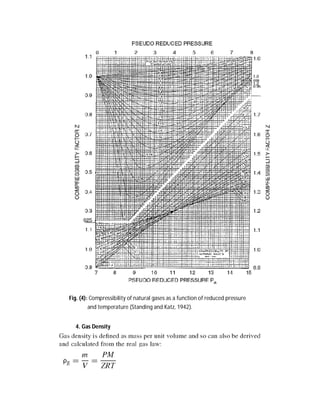
The most commonly used method to estimate the Z factor is the chart provided by
Standing and Katz (1942). The Z factor chart is shown in Fig.(4).
3. Gas Formation Volume Factor
The formation volume factor for gas is defined as the ratio of volume of 1 mol of gas
at a given pressure and temperature to the volume of 1 mole of gas at standard
conditions ( Ps and Ts). Using the real gas law and assuming that the Z factor at
standard conditions is 1, the equation for formation volume factor (Bg) can be
written as
Fig. (4): Compressibility of natural gases as a function of reduced pressure
and temperature (Standing and Katz, 1942).
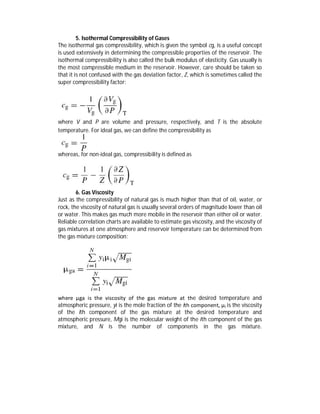
4. Gas Density
5. Isothermal Compressibility of Gases
The isothermal gas compressibility, which is given the symbol cg, is a useful concept
is used extensively in determining the compressible properties of the reservoir. The
isothermal compressibility is also called the bulk modulus of elasticity. Gas usually is
the most compressible medium in the reservoir. However, care should be taken so
that it is not confused with the gas deviation factor, Z, which is sometimes called the
super compressibility factor:
where V and P are volume and pressure, respectively, and T is the absolute
temperature. For ideal gas, we can define the compressibility as
whereas, for non-ideal gas, compressibility is defined as
6. Gas Viscosity
Just as the compressibility of natural gas is much higher than that of oil, water, or
rock, the viscosity of natural gas is usually several orders of magnitude lower than oil
or water. This makes gas much more mobile in the reservoir than either oil or water.
Reliable correlation charts are available to estimate gas viscosity, and the viscosity of
gas mixtures at one atmosphere and reservoir temperature can be determined from
the gas mixture composition:
where μga is the viscosity of the gas mixture at the desired temperature and
atmospheric pressure, yi is the mole fraction of the ith component, μi is the viscosity
of the ith component of the gas mixture at the desired temperature and
atmospheric pressure, Mgi is the molecular weight of the ith component of the gas
mixture, and N is the number of components in the gas mixture.
BASIC CONCEPTS OF NATURAL GAS PROCESSING
Raw natural gas after transmission through the field-gathering network must be
processed before it can be moved into long-distance pipeline systems for use by
consumers. The objective of gas processing is to separate
• natural gas,
• condensate,
• non-condensable,
• acid gases, and
• water
from a gas-producing well and condition these fluids for sale or disposal. The typical
process operation modules are shown in Figure 1. Each module consists of a single
piece or a group of equipment performing a specific function. All the modules shown
will not necessarily be present in every gas plant. In some cases, little processing is
needed; however, most natural gas requires processing equipment at the gas
processing plant
1) to remove
• impurities,
• water, and
• excess hydrocarbon liquid
2) to control delivery pressure.
PROCESS MODULES
1. The first unit module is the physical separation of the distinct phases, which
are typically
 gas,
 liquid hydrocarbons,
 liquid water, and/or
 solids.
Phase separation of the production stream is usually performed in an inlet separator.
Simplified typical onshore treatment process
Hydrocarbon condensate recovered from natural gas may be shipped without
further processing but is typically stabilized to produce a safe transportable liquid.
Un-stabilized condensates contain a large percentage of methane and ethane, which
will vaporize easily in storage tanks.
The next step in natural gas processing is acid gas treating.
In addition to heavy hydrocarbons and water vapor, natural gas often contains other
contaminants that may have to be removed. Carbon
dioxide (CO2), hydrogen sulfide (H2S), and other sulfur-containing species such as
mercaptans are compounds that require complete or
partial removal. These compounds are collectively known as “acid gases.” H2S when
combined with water forms a weak sulfuric acid, whereas CO2 and water form
carbonic acid, thus the term “acid gas.”
Natural gas with H2S or other sulfur compounds present is called “sour gas,”
whereas gas with only CO2 is called “sweet.”
Both H2S and CO2 are very undesirable, as they cause corrosion and present a major
safety risk.
Depending on the pressure at the plant gate, the next step in processing will either
be inlet compression to an “interstage” pressure, typically 300–400 psig or be dew
point control and natural gas liquid recovery.
CONDENSATE STABILIZATION
The process of increasing the amount of intermediates (C3 to C5) and heavy (C+6)
components in the condensate is called “condensate stabilization.” In other word,
the scope of this process is to separate the very light hydrocarbon gases, methane
and ethane in particular, from the heavier hydrocarbon components (C+3).
STABILIZATION PROCESSES
Stabilization of condensate streams can be accomplished through either flash
vaporization or fractionation.
1. Flash Vaporization
Stabilization by flash vaporization is a simple operation employing only two or three
flash tanks. Figure 1 shows a typical scheme of condensate stabilization through the
flash vaporization process.
Figure(1): Schematic of condensate stabilization through Flash vaporization
process. H.P., high pressure; M.P., middle pressure; L.P., low pressure
2. Stabilization by Fractionation
Stabilization by fractionation is a detailed process, very popular in the industry and
precise enough to produce liquids of suitable vapor pressure.
Figure 2: Schematic of a condensate stabilization system.
Design Considerations of Stabilization Column
In most cases of lease operation, the stabilization column will operate as a
nonrefluxed tower. This type of operation is simpler but less efficient than the
refluxed tower operation. Because the nonrefluxed tower requires no external
cooling source, it is particularly applicable to remote locations.
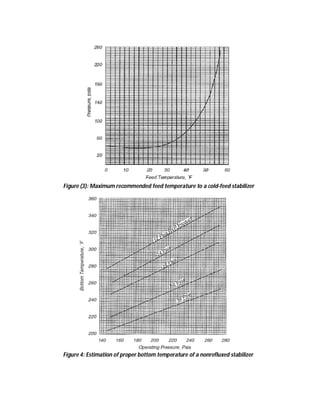
Figure (3) shows the maximum recommended feed temperature to a stabilizer as a
function of operating pressure of the stabilizer.
After the pressure has been chosen and the operating temperatures have been
established through use of Figures (3) and (4), the split in the tower must be
predicted. There are several methods in which this can be done, but one of the most
convenient manual methods involves utilization of pseudo-equilibrium constant (K)
values for each component between the top and the bottom of the tower. Using this
concept, the separation that can be achieved across a nonrefluxed stabilizer can be
estimated by use of the pseudo K values and a simple flash calculation. The vapor
from the flash calculation will be the composition of the overhead product, and the
liquid from the flash calculation will be the composition of the bottom liquid.
Figure (3): Maximum recommended feed temperature to a cold-feed stabilizer
Figure 4: Estimation of proper bottom temperature of a nonrefluxed stabilizer
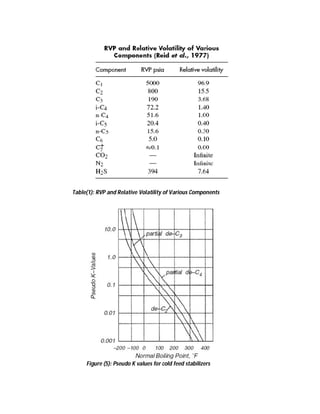
Table(1): RVP and Relative Volatility of Various Components
Figure (5): Pseudo K values for cold feed stabilizers
Natural Gas Sweetening
Hydrogen sulfide, carbon dioxide, mercaptans, and other contaminants are often
found in natural gas streams. Gas sweetening processes remove these contaminants
so that the gas is marketable and suitable for transportation. The removal of H2S
from natural gas is accompanied by the removal of CO2 and COS if present, since
these have similar acid characteristics.
Desulfurization processes are primarily of two types:
• adsorption on a solid (dry process), and
• absorption into a liquid (wet process).
Both the adsorption and absorption processes may be of the physical or chemical
type.
The dominant sulfur removal/complex train,
1. amine scrubbing.
2. Claus unit.
3. SCOT-type tail gas treating.
4. The Beavon-Stretford tail gas system.
1- Amine Scrubbing
Amine gas treating (also known as Gridler process) refers to a group of processes
that use aqueous solutions of various amines to remove hydrogen sulfide (H2S),
mercaptans and/or carbon dioxide (CO2) from gases through absorption and
chemical reaction.
It is a common unit process used in refineries, petrochemical plants, natural gas
processing plants and other industries.
The process is also known as Acid gas removal and Gas sweetening because they
results in products which no longer have the sour, foul odors of mercaptans and
hydrogen sulfide.
A typical amine gas treating process, as shown in figure (1), includes an absorber
unit and a regenerator unit as well as accessory equipments.
Fig. (2): Process flow diagram of a typical amine treating process
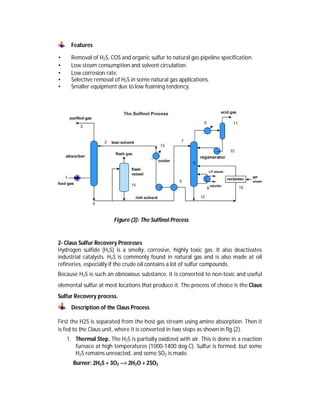
Sulfinol Process
The Sulfinol process is a regenerative process developed to reduce H2S, CO2, COS
and mercaptans from gases. The sulfur compounds in the product gas can be
reduced to low ppm levels.This process has been developed specifically for treating
large quantities of gas, such as natural gas, which are available at elevated pressures.
The Sulfinol process is unique in the class of absorption processes because it uses a
mixture of solvents, which allows it to behave as both a chemical and a physical
absorption process.
Operating Conditions
Very wide ranges of treating pressures and contaminant concentrations can be
accommodated. Natural gas pipeline specifications are easily met. Removal of
organic sulfur compounds is usually accomplished by the solvent circulations as set
by H2S and CO2. In LNG plants a specification of 50 ppm CO2 prior to liquefaction is
attained without difficulty.
Features
• Removal of H2S, COS and organic sulfur to natural gas pipeline specification.
• Low steam consumption and solvent circulation.
• Low corrosion rate.
• Selective removal of H2S in some natural gas applications.
• Smaller equipment due to low foaming tendency.
Figure (3): The Sulfinol Process
2- Claus Sulfur Recovery Processes
Hydrogen sulfide (H2S) is a smelly, corrosive, highly toxic gas. It also deactivates
industrial catalysts. H2S is commonly found in natural gas and is also made at oil
refineries, especially if the crude oil contains a lot of sulfur compounds.
Because H2S is such an obnoxious substance, it is converted to non-toxic and useful
elemental sulfur at most locations that produce it. The process of choice is the Claus
Sulfur Recovery process.
Description of the Claus Process
First the H2S is separated from the host gas stream using amine absorption. Then it
is fed to the Claus unit, where it is converted in two steps as shown in fig.(2).
1. Thermal Step. The H2S is partially oxidized with air. This is done in a reaction
furnace at high temperatures (1000-1400 deg C). Sulfur is formed, but some
H2S remains unreacted, and some SO2 is made.
Burner: 2H2S + 3O2 --> 2H2O + 2SO2
2. Catalytic Step. The remaining H2S is reacted with the SO2 at lower
temperatures 450 deg F (about 200-350 deg C) > dew point of S to prevent
condensation on the catalyst, to make more sulfur. A catalyst is needed in the
second step to help the components react with reasonable speed.
Unfortunately the reaction does not go to completion even with the best
catalyst. For this reason two or three stages are used, with sulfur being
removed between the stages. Engineers know how different factors like
concentration, contact time and reaction temperature influence the reaction,
and these are set to give the best conversions.
Reactor/Converter: 2H2S + SO2 --> 2H2O + 3S
Condenser outlet must be 350oF > melting point of S to prevent the
formation of solid S. Inevitably a small amount of H2S remains in the tail gas.
This residual quantity, together with other trace sulfur compounds, COS and
CS2, formed in the burner side reaction, is usually dealt with in a tail gas unit.
The latter can give overall sulfur recoveries of about 99.8%.
Converts H2S to elemental S
Fig. (2) : Claus process
3- Sulfur Plant Tail Gas Clean-Up Processes
Because of the more stringent requirements of pollution control, requirements for
tail gas clean-up processes are developed..
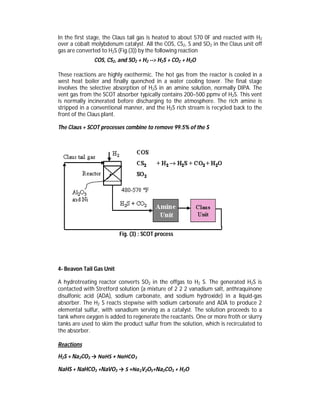
SCOT process
In the first stage, the Claus tail gas is heated to about 570 0F and reacted with H2
over a cobalt molybdenum catalyst. All the COS, CS2, S and SO2 in the Claus unit off
gas are converted to H2S (Fig.(3)) by the following reaction
COS, CS2, and SO2 + H2 --> H2S + CO2 + H2O
These reactions are highly exothermic. The hot gas from the reactor is cooled in a
west heat boiler and finally quenched in a water cooling tower. The final stage
involves the selective absorption of H2S in an amine solution, normally DIPA. The
vent gas from the SCOT absorber typically contains 200–500 ppmv of H2S. This vent
is normally incinerated before discharging to the atmosphere. The rich amine is
stripped in a conventional manner, and the H2S rich stream is recycled back to the
front of the Claus plant.
The Claus + SCOT processes combine to remove 99.5% of the S
Fig. (3) : SCOT process
4- Beavon Tail Gas Unit
A hydrotreating reactor converts SO2 in the offgas to H2 S. The generated H2S is
contacted with Stretford solution (a mixture of 2 2 2 vanadium salt, anthraquinone
disulfonic acid (ADA), sodium carbonate, and sodium hydroxide) in a liquid-gas
absorber. The H2 S reacts stepwise with sodium carbonate and ADA to produce 2
elemental sulfur, with vanadium serving as a catalyst. The solution proceeds to a
tank where oxygen is added to regenerate the reactants. One or more froth or slurry
tanks are used to skim the product sulfur from the solution, which is recirculated to
the absorber.
Reactions
H2S + Na2CO3 → NaHS + NaHCO3
NaHS + NaHCO3 +NaVO3 → S +Na2V2O5+Na2CO3 + H2O
Na2V2O5 +1/2 O2 → 2NaVO3
Gas Dehydration
Natural gas dehydration is the process of removing water vapor from the gas
stream to lower the dew point of that gas. The dew point is defined as the
temperature at which water vapor condenses from the gas stream. The sale
contracts of natural gas specify either its dew point or the maximum amount of
water vapor present.
There are three basic reasons for the dehydration of natural gas streams:
1. To prevent hydrate formation. The primary conditions promoting hydration
formation are the following:
 Gas must be at or below its water (dew) point with ‘‘free’’ water present.
 Low temperature.
 High pressure.
2. To avoid corrosion problems.
3. Downstream processing requirements. In most commercial hydrocarbon
processes, the presence of water may cause side reactions, foaming, or catalyst
deactivation. Consequently, purchasers typically require that gas and liquid
petroleum gas (LPG) feedstocks meet certain specifications for maximum water
content. This ensures that water-based problems will not hamper downstream
operations.
Dehydration Methods
Classification of dehydration methods is given in Figure 1.
Figure (1): Classification of gas dehydration methods.
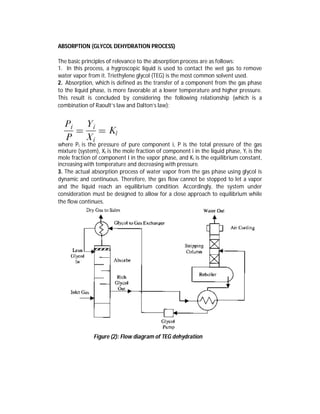
ABSORPTION (GLYCOL DEHYDRATION PROCESS)
The basic principles of relevance to the absorption process are as follows:
1. In this process, a hygroscopic liquid is used to contact the wet gas to remove
water vapor from it. Triethylene glycol (TEG) is the most common solvent used.
2. Absorption, which is defined as the transfer of a component from the gas phase
to the liquid phase, is more favorable at a lower temperature and higher pressure.
This result is concluded by considering the following relationship (which is a
combination of Raoult’s law and Dalton’s law):
where Pi is the pressure of pure component i, P is the total pressure of the gas
mixture (system), Xi is the mole fraction of component i in the liquid phase, Yi is the
mole fraction of component I in the vapor phase, and Ki is the equilibrium constant,
increasing with temperature and decreasing with pressure.
3. The actual absorption process of water vapor from the gas phase using glycol is
dynamic and continuous. Therefore, the gas flow cannot be stopped to let a vapor
and the liquid reach an equilibrium condition. Accordingly, the system under
consideration must be designed to allow for a close approach to equilibrium while
the flow continues.
Figure (2): Flow diagram of TEG dehydration
ADSORPTION: SOLID-BED DEHYDRATION
When very low dew points are required, solid-bed dehydration becomes the logical
choice. It is based on fixed-bed adsorption of water vapor by a selected desiccant. A
number of solid desiccants could be used such as silica gel, activated alumina, or
molecular sieves.
The selection of these solids depends on economics. The most important property is
the capacity of the desiccant, which determines the loading design expressed as the
percentage of water to be adsorbed by the bed. The capacity decreases as
temperature increases.
Operation of Solid-Bed Dehydrator
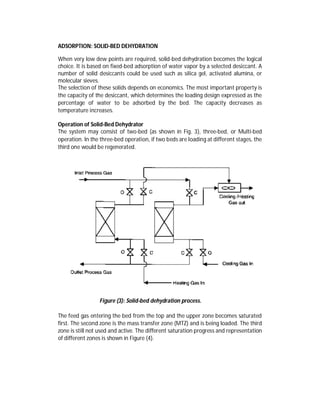
The system may consist of two-bed (as shown in Fig. 3), three-bed, or Multi-bed
operation. In the three-bed operation, if two beds are loading at different stages, the
third one would be regenerated.
Figure (3): Solid-bed dehydration process.
The feed gas entering the bed from the top and the upper zone becomes saturated
first. The second zone is the mass transfer zone (MTZ) and is being loaded. The third
zone is still not used and active. The different saturation progress and representation
of different zones is shown in Figure (4).
Figure (4): Mode operation.
Figure (5): Breakthrough diagram in a fixed bed.
Syngas
Syngas (from synthesis gas ) is the name given to a gas mixture that contains varying
amounts of carbon monoxide and hydrogen generated by the gasification of a
carbon containing fuel to a gaseous product with a heating value. Examples include;
• The gasification of coal and in some types of waste-to-energy gasification
facilities.
• Steam reforming of natural gas or liquid hydrocarbons to produce
hydrogen,
The name comes from their use as;
• intermediates in creating synthetic natural gas (SNG).
• for producing ammonia or methanol.
• Syngas is also used as an intermediate in producing synthetic petroleum for
use as a fuel or lubricant via Fischer-Tropsch synthesis and previously the
Mobil methanol to gasoline process.
Gasification
Gasification is a process that converts carbonaceous materials, such as coal,
petroleum, or biomass, into carbon monoxide and hydrogen by reacting the raw
material at high temperatures > 700 °C with a controlled amount of oxygen (partial
combustion). The resulting gas mixture is called synthesis gas or syngas and is itself
a fuel. Gasification is a very efficient method for extracting energy from many
different types of organic materials, and also has applications as a clean waste
disposal technique.
The advantage of gasification is that;
• using the syngas is more efficient than direct combustion of the original
fuel; more of the energy contained in the fuel is extracted.
• Syngas may be burned directly in internal combustion engines, used to
produce methanol and hydrogen, or converted via the Fischer-Tropsch
process into synthetic fuel.
• Gasification can also begin with materials that are not otherwise useful
fuels, such as biomass or organic waste.
• In addition, the high-temperature combustion refines out corrosive ash
elements such as chloride and potassium, allowing clean gas production
from otherwise problematic fuels.
Gasification of fossil fuels is currently widely used on industrial scales to generate
electricity. However, almost any type of organic material can be used as the raw
material for gasification, such as wood, biomass, or even plastic waste. Thus,
gasification may be an important technology for renewable energy.
Chemistry
In a gasifier, the carbonaceous material undergoes several different processes:
• The pyrolysis (or devolatilization) process occurs as the carbonaceous
particle heats up. Volatiles are released and char is produced, resulting in
up to 70% weight loss for coal. The process is dependent on the properties
of the carbonaceous material and determines the structure and composition
of the char, which will then undergo gasification reactions.
• The combustion process occurs as the volatile products and some of the
char reacts with oxygen to form carbon dioxide and carbon monoxide,
which provides heat for the subsequent gasification reactions. Letting C
represent a carbon-containing organic compound, the basic reaction here
is;
C + 1/2 O2 → 2CO
• The gasification process occurs as the char reacts with carbon dioxide and
steam to produce carbon monoxide and hydrogen, via the reaction;
CO + H2O → CO2 + H2
In addition, the reversible gas phase water gas shift reaction reaches
equilibrium very fast at the temperatures in a gasifier. This balances the
concentrations of carbon monoxide, steam, carbon dioxide and hydrogen.
Hydrogen production
Hydrogen is used for the hydrotreating and hydrocracking processes. The hydrogen
from reformer is often not sufficient for hydrotreating process.
Hydrogen is commonly produced from hydrocarbon fossil fuels via a chemical path.
Hydrogen may also be extracted from water via biological production in an algae
bioreactor, or using electricity (by electrolysis ) or heat (by thermolysis); these
methods are presently not cost effective for bulk generation in comparison to
chemical paths derived from hydrocarbons. Cheap bulk production of hydrogen is a
requirement for a healthy hydrogen economy.
Hydrogen can be generated from natural gas with approximately 80% efficiency or
other hydrocarbons to a varying degree of efficiency.
1. Steam reforming of natural gas
Commercial bulk hydrogen is usually produced by the steam reforming of natural
gas as shown in Fig.(1). At high temperatures (700–1100 °C), steam (H2O) reacts with
methane (CH4) to yield syngas.
CH4 + H2O → CO + 3 H2 - 191.7 kJ/mol
25-40% NiO/low SiO2/Al2O3 catalyst, (760-816oC)
The heat required to drive the process is generally supplied by burning some portion
of the methane.
Shift Conversion
Additional hydrogen can be recovered from the carbon monoxide (CO) through the
lower-temperature water gas shift reaction, performed at about 130 °C:
CO + H2O → CO2 + H2 + 40.4 kJ/mol
Cr2O3 and Fe2O3 as catalyst
Gas Purification:
The Shift Converter product stream is then scrubbed, usually through absorption
with a potassium carbonate solution to remove the carbon dioxide.
The potassium carbonate solution is regenerated in a Carbon Dioxide Still by
applying reboiler heat to the tower bottoms. This heat drives off the carbon dioxide
from the solution which is then re-circulated.
• Methanation
Since carbon monoxide (CO) and carbon dioxide (CO2) are poisons to the catalysts of
some of the hydrogen consuming refinery processes. Methanation is employed as
the final step to remove any remaining CO and CO2 in the hydrogen stream.
The methanation reaction takes place in a fixed-bed reactor consisting of a nickel -
based catalyst. The resulting hydrogen product stream is typically approximately
95% hydrogen and the balance methane with only trace amounts of CO and CO2.
The Methanation reactions are:
CO + 3H2 --> CH4 + H2O
CO2 + 4H2 --> CH4 + 2H2O
Reaction conditions are at 425oF over Ni/Al2O3 catalyst. Trace
amounts of CH4 can be present in the H2 stream.
37 | P a g e
Figure (1) Hydrogen production by steam reforming of natural gas
2. Partial Oxidation of fuel oil
Partial oxidation of fuel oil accomplished by burning the fuel at high pressure (80 - 1300psig )
with pure oxygen which is limited to heat required to convert the fuel oil to CO and H2.
Steam is added to shift the CO and H2 in a catalytic shift conversion step. CO2 is removed by
absorption with hot K2CO3 or other solvent.
2CnHm + nO2 → 2nCO + mH2 (Oxidation) 2nCO+ 2nH2O
→ 2nCO2 + 2nH2
Fig.(2): Hydrogen Production by Partial Oxidation of Fuel Oil
38 | P a g e
FORM OF NATURAL GAS
There are three form of Natural Gas
1. Normal Natural Gas
2. CNG
3. LNG
Normal Natural Gas:
Natural gas is a naturally occurring hydrocarbon gas mixture consisting primarily of methane,
with other hydrocarbons, carbon dioxide, nitrogen and hydrogen sulfide. Normally it preserve
within 1 bar pressure.
Source:
Natural gas is found in deep underground natural rock formations or associated with other
hydrocarbon reservoirs in coal beds and as methane clathrates. Petroleum is also another
resource found in proximity to and with natural gas.
CNG:
CNG is made by compressing natural gas (which is mainly composed of methane [CH4]), to less
than 1% of the volume it occupies at standard atmospheric pressure.
Compressed natural gas (CNG) is a fossil fuel substitute for gasoline (petrol), diesel, or
propane/LPG. Although its combustion does produce greenhouse gases, it is a more
environmentally clean alternative to those fuels, and it is much safer than other fuels in the
event of a spill (natural gas is lighter than air, and disperses quickly when released). CNG may
also be mixed with biogas, produced from landfills or wastewater, which doesn't increase the
concentration of carbon in the atmosphere.
LNG:
Liquefied natural gas or LNG is natural gas (predominantly methane, CH4) that has been
converted to liquid form for ease of storage or transport. Liquefied natural gas takes up about
1/600th the volume of natural gas in the gaseous state. It is odorless, colorless, non-toxic and
non-corrosive. The liquefaction process involves removal of certain components, such as dust,
acid gases, helium, water, and heavy hydrocarbons, which could cause difficulty downstream.
The natural gas is then condensed into a liquid at close to atmospheric pressure (maximum
transport pressure set at around 25 kPa/3.6 psi) by cooling it to approximately −162 °C (−260
°F).LNG is principally used for transporting natural gas to markets, where it is re-gasified and
distributed as pipeline natural gas. It can be used in natural gas vehicles, although it is more
common to design vehicles to use compressed natural gas. Its relatively high cost of production
and the need to store it in expensive cryogenic tanks have hindered widespread commercial
use but it can emerge as an alternative fuel for heavy duty vehicles like bus, trucks, ships etc.
39 | P a g e
CRUDE OIL
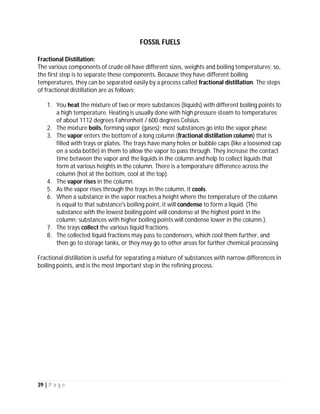
Fractional Distillation:
The various components of crude oil have different sizes, weights and boiling temperatures; so,
the first step is to separate these components. Because they have different boiling
temperatures, they can be separated easily by a process called fractional distillation. The steps
of fractional distillation are as follows:
1. You heat the mixture of two or more substances (liquids) with different boiling points to
a high temperature. Heating is usually done with high pressure steam to temperatures
of about 1112 degrees Fahrenheit / 600 degrees Celsius.
2. The mixture boils, forming vapor (gases); most substances go into the vapor phase.
3. The vapor enters the bottom of a long column (fractional distillation column) that is
filled with trays or plates. The trays have many holes or bubble caps (like a loosened cap
on a soda bottle) in them to allow the vapor to pass through. They increase the contact
time between the vapor and the liquids in the column and help to collect liquids that
form at various heights in the column. There is a temperature difference across the
column (hot at the bottom, cool at the top).
4. The vapor rises in the column.
5. As the vapor rises through the trays in the column, it cools.
6. When a substance in the vapor reaches a height where the temperature of the column
is equal to that substance's boiling point, it will condense to form a liquid. (The
substance with the lowest boiling point will condense at the highest point in the
column; substances with higher boiling points will condense lower in the column.).
7. The trays collect the various liquid fractions.
8. The collected liquid fractions may pass to condensers, which cool them further, and
then go to storage tanks, or they may go to other areas for further chemical processing
Fractional distillation is useful for separating a mixture of substances with narrow differences in
boiling points, and is the most important step in the refining process.
40 | P a g e
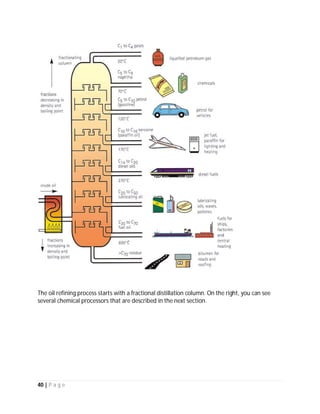
The oil refining process starts with a fractional distillation column. On the right, you can see
several chemical processors that are described in the next section.
41 | P a g e
LIQUEFIED PETROLEUM GAS
Liquefied petroleum gas, also called LPG, GPL, LP Gas, liquid petroleum gas or
simply propane or butane, is a flammable mixture of hydrocarbon gases used as
a fuel in heating appliances and vehicles. It is increasingly used as an aerosol propellant and
a refrigerant, replacing chlorofluorocarbons in an effort to reduce damage to the ozone layer.
When specifically used as a vehicle fuel it is often referred to as autogas.
Varieties of LPG bought and sold include mixes that are primarily propane (C3H8),
primarily butane (C4H10) and, most commonly, mixes including both propane and butane,
depending on the season — in winter more propane, in summer more butaneIn the United
States, primarily only two grades of LPG are sold, commercial propane and HD-5. These
specifications are published by the Gas Processors Association (GPA) and the American Society
of Testing and Materials (ASTM). Propane/butane blends are also listed in these
specifications. Propylene, butylenes and various other hydrocarbons are usually also present in
small concentrations. HD-5 limits the amount of propylene that can be placed in LPG, and is
utilized as an autogas specification. A powerful odorant, ethanethiol, is added so that leaks can
be detected easily. The international standard is EN 589. In the United
States, tetrahydrothiophene (thiophane) or amyl mercaptan are also approved
odorants, although neither is currently being utilized. Major suppliers of LPG in the UK
include AvantiGas, Calor gas and Flogas.
LPG is prepared by refining petroleum or "wet" natural gas, and is almost entirely derived
from fossil fuel sources, being manufactured during the refining of petroleum (crude oil), or
extracted from petroleum or natural gas streams as they emerge from the ground. It was first
produced in 1910 by Dr. Walter Snelling, and the first commercial products appeared in 1912. It
currently provides about 3% of all energy consumed, and burns relatively cleanly with
no soot and very few sulfur emissions. As it is a gas, it does not pose ground or water
pollution hazards, but it can cause air pollution. LPG has a typical specific calorific value of
46.1 MJ/kg compared with 42.5 MJ/kg for fuel oil and 43.5 MJ/kg for premium
grade petrol (gasoline). However, its energy density per volume unit of 26 MJ/L is lower than
either that of petrol or fuel oil, as its liquid density is lower (about 0.5—0.58, compared to
0.71—0.77 for gasoline).
As its boiling point is below room temperature, LPG will evaporate quickly at
normal temperatures and pressures and is usually supplied in pressurised steel vessels.
They are typically filled to between 80% and 85% of their capacity to allow forthermal
expansion of the contained liquid. The ratio between the volumes of the vaporized gas and the
liquefied gas varies depending on composition, pressure, and temperature, but is typically
around 250:1.
The pressure at which LPG becomes liquid, called its vapour pressure, likewise varies depending
on composition and temperature; for example, it is approximately 220 kilopascals (32 psi) for
pure butane at 20 °C (68 °F), and approximately 2.2 megapascals (320 psi) for
pure propane at55 °C (131 °F). LPG is heavier than air, unlike natural gas, and thus will flow
along floors and tend to settle in low spots, such as basements. There are two main dangers
42 | P a g e
from this. The first is a possible explosion if the mixture of LPG and air is right and if there is an
ignition source. The second is suffocation due to LPG displacing air, causing a decrease in
oxygen concentration. In addition, an odorant is mixed with LPG used for fuel purposes so that
leaks can be detected more easily. Large amounts of LPG can be stored in bulk cylinders and
can be buried underground.
Normally, the gas is stored in liquid form under pressure in a steel container, cylinder or tank.
The pressure inside the container will depend on the type of LPG (commercial butane or
commercial propane) and the outside temperature.
When you start using LPG, some of the pressure in the container is released. Some of the liquid
LPG then boils to produce vapour. Heat is needed to convert the liquid to vapour (known as the
latent heat of vaporization). As the liquid boils, it draws the heat energy from its surroundings.
This explains why containers feel cold to touch and why, if there is a heavy off-take, water or ice
may appear on the container. When you stop using LPG, the pressure will return to the
equilibrium value for the surrounding temperature.
The pressure of the LPG in the container varies with the surrounding temperature. It is also
much higher than is needed by the appliances that use it; it needs to be controlled to ensure a
steady supply at constant pressure. This is done by a regulator, which limits the pressure to suit
the appliance that is being fuelled. It is a colourless and odourless gas to which foul-smelling
mercaptan is added so that leak can be easily detected.
LPG is highly inflammable and must therefore be stored away from sources of ignition and in a
well-ventilated area, so that any leak can disperse safely. Another reason why care should be
taken during storage is that LPG vapour is heavier than air, so any leakage will sink to the
ground and accumulate in low lying areas and may be difficult to disperse. LPG expands rapidly
when its temperature rises. So whenever a container is filled, sufficient space is left to allow for
such expansion. LPG will cause natural rubber and some plastics to deteriorate. This is why only
hoses and other equipment specifically designed for LPG should be used.
Although LPG is non-toxic, its abuse – (like that of solvents) – is highly dangerous. LPG should
always be treated with respect and kept away from children whenever possible.
Liquid petroleum gases were discovered in 1912 when Dr. Walter Snelling, an American
scientist, realized that these gases could be changed into liquids and stored under moderate
pressure. From 1912 and 1920, LP-gas uses were developed. The first LPG cook stove was made
in 1912, and the first LPG -fueled car was developed in 1913. The LPG industry began sometime
shortly before World War I. At that time, a problem in the natural gas distribution process
popped up. Gradually facilities were built to cool and compress natural gas, and to separate the
gases that could be turned into liquids (including propane and butane). LPG was sold
commercially by 1920.
43 | P a g e
LPG Production and Delivery
LPG is a by-product from two sources: natural gas processing and crude oil refining. Natural gas,
as extracted at the well head,
contains methane and other light hydrocarbons. The lighthydrocarbons are separated in gas
processing plant using
highpressures and low temperatures. The natural gas liquidcomponents recovered during proce
ssing include ethane, propane, and butane, as well as heavier hydrocarbons. Propane and
butane, along with other gases, are also produced during crude oil refining as a by-product of
the processes that rearrange and or break down molecular structures to obtain more desirable
petroleum compounds
PHYSICAL PROPERTIES AND CHARACTERISTICS
DENSITY
LPG at atmospheric pressure and temperature is a gas which is 1.5 to 2.0 times heavier than air.
It is readily liquefied under moderate pressures. The density of the liquid is approximately half
that of water and ranges from 0.525 to 0.580 @ 15 deg. C.
Since LPG vapour is heavier than air, it would normally settle down at ground level/ low lying
places, and accumulate in depressions.
VAPOUR PRESSURE
The pressure inside a LPG storage vessel/ cylinder will be equal to the vapour pressure
corresponding to the temperature of LPG in the storage vessel. The vapour pressure is
dependent on temperature as well as on the ratio of mixture of hydrocarbons. At liquid full
condition any further expansion of the liquid, the cylinder pressure will rise by approx. 14 to 15
kg./sq.cm. for each degree centigrade. This clearly explains the hazardous situation that could
arise due to overfilling of cylinders.
FLAMMABILITY
LPG has an explosive range of 1.8% to 9.5% volume of gas in air. This is considerably narrower
than other common gaseous fuels. This gives an indication of hazard of LPG vapour
accumulated in low lying area in the eventuality of the leakage or spillage.
The auto-ignition temperature of LPG is around 410-580 deg. C and hence it will not ignite on
its own at normal temperature. Entrapped air in the vapour is hazardous in an unpurged vessel/
cylinder during pumping/ filling-in operation. In view of this it is not advisable to use air
pressure to unload LPG cargoes or tankers.
44 | P a g e
COMBUSTION
The combustion reaction of LPG increases the volume of products in addition to the generation
of heat. LPG requires up to 50 times its own volume of air for complete combustion. Thus it is
essential that adequate ventilation is provided when LPG is burnt in enclosed spaces otherwise
asphyxiation due to depletion of oxygen apart from the formation of carbon-dioxide can occur.
ADVANTAGES OF LPG
 Cold engine start emission reduction due to its gaseous state.
 It has lower peak pressure during combustion, which generally reduces noise and
improves durability.
 LPG fuel systems are sealed and evaporative losses are negligible.
 Eas ily trans portable with minimum s upport infras tructure compared to
CNG.
 LPG vehicles do not require special catalysts.
 LPG has lower particle emissions and lower noise levels relative to diesel and
petrol. Also it contains negligible toxic components.
 Its low emissions have low greenhouse gas effects and low NOx precursors.
 LPG can be produced from both natural gas fields and oil refinery sources.
Bear in mind that fuel consumption alone is not the only criterion in promoting the use of LPG,
and all the other advantages where applicable should be stressed. The useful characteristics of
LPG fired equipment can be summarised as follows:
Portability
Cylinders can be transported easily to the jobs, or can be fixed to mobile equipment. The
smallest ones can be carried by hand.
Own Storage
Alternative gas supplies make use of piped delivery. Should the supply fail the effect is
immediate. LPG, in the form of cylinder or bulk on the other hand, provides a margin of safety.
Wide turn down: By this is meant the range of gas flow from maximum to minimum for a
particular burner. LPG burners can be designed to operate over a wide range.
45 | P a g e
Ease of control
Gaseous fuels are the easiest to control, and are very quick in response. Solid fuels are the
slowest.
Small flames
Many processes require a small flame, or a number of small flames rather than a big one. Gas is
the best fuel for such flames.
Self pressurizing
LPG is stored under moderate pressure and therefore no pumps or gravity systems are needed
to get the fuel to the burner. Simple LPG burners are quite independent of any electrical supply.
Consistent quality
LPG, like all other petroleum fuels, is subject to stringent quality controls.
Ample supply pressure
Many competitive types of fuel gas supplies rely on low pressure piped delivery. If the systemis
old or inadequate the burner pressure may fluctuate as demand varies. This can upset certain
processes. An LPG supply is normally installed for one factory or process and has adequate
pressure at all times if properly designed.
Clean combustion
LPG is a high grade fuel with negligible impurities, producing clean sulphur-free combustion
gases. This can be important for many processes especially where the gases come into contact
with the products.
Little maintenance
Many LPG burners are very simple and require little or no maintenance. The clean combustion
gases mean that very little fouling occurs and ensures long life even for the more complex
burners.
46 | P a g e
DISADVANTAGES OF LPG
 Ignition requirements for LPG are not the same as for petrol operation; At low
RPM the burning rate of LPG is slower and more advance is needed; at high speeds the
burning rate is faster, consequently less advance is needed.
 LPG has relatively high energy content per unit mass but energy content per unit
volume is lower than diesel and petrol, which explains why LPG tank stake more space
than liquid fuel tanks. These are pressure vessels so that they also weigh more
than liquid fuel tanks but less than CNG cylinder.
 It is heavier than air, which requires appropriate handling. CNG which is
lighter than air and move upwards in case of leakage whereas LPG travels like
a snake and can reach to the source of ignition.
 In case of leakage LPG converts to gaseous state, in this case LPG has much higher
flammability limits compared to CNG and even higher than petrol.
 It has a high expansion coefficient so that tanks can only be filled to 80%
of capacity. LPG cylinder can explode when Liquid converts to vapor i f exposed to
high temperature; phenomena called BLEVES (Boiling Liquid Expanding Vapor
Explosion).
 LPG in liquid form can cause cold bums to the skin in case of inappropriate handling as it
is cryogenic to some extent
USES OF LPG
Rural heating
Predominantly in Europe and rural parts of many countries, LPG can provide an alternative to
electricity and heating oil (kerosene). LPG is most often used where there is no access to piped
natural gas.
LPG can be used as a power source for combined heat and power technologies (CHP). CHP is
the process of generating both electrical power and useful heat from a single fuel source. This
technology has allowed LPG to be used not just as fuel for heating and cooking, but also for de-
centralized generation of electricity.
LPG can be stored in a variety of ways. LPG, as with other fossil fuels, can be combined with
renewable power sources to provide greater reliability while still achieving some reduction in
CO2 emissions.
47 | P a g e
Motor fuel
When LPG is used to fuel internal combustion engines, it is often referred to as auto-gas or auto
propane. In some countries, it has been used since the 1940s as a petrol alternative for spark
ignition engines. In some countries, there are additives in the liquid that extend engine life and
the ratio of butane to propane is kept quite precise in fuel LPG. Two recent studies have
examined LPG-fuel-oil fuel mixes and found that smoke emissions and fuel consumption are
reduced but hydrocarbon emissions are increased. The studies were split on CO emissions, with
one finding significant increases, and the other finding slight increases at low engine load but a
considerable decrease at high engine load. Its advantage is that it is non-toxic, non-corrosive
and free of tetraethyl lead or any additives, and has a high octane rating (102-108 RON
depending on local specifications). It burns more cleanly than petrol or fuel-oil and is especially
free of the particulates from the latter.
LPG has a lower energy density than either petrol or fuel-oil, so the equivalent fuel
consumption is higher. Many governments impose less tax on LPG than on petrol or fuel-oil,
which helps offset the greater consumption of LPG than of petrol or fuel-oil. However, in many
European countries this tax break is often compensated by a much higher annual road tax on
cars using LPG than on cars using petrol or fuel-oil. Propane is the third most widely used motor
fuel in the world. 2008 estimates are that over 13 million vehicles are fueled by propane gas
worldwide. Over 20 million tonnes (over 7 billion US gallons) are used annually as a vehicle fuel.
Not all automobile engines are suitable for use with LPG as a fuel. LPG provides less upper
cylinder lubrication than petrol or diesel, so LPG-fueled engines are more prone to valve wear if
they are not suitably modified. Many modern common rail diesel engines respond well to LPG
use as a supplementary fuel. This is where LPG is used as fuel as well as diesel. Systems are now
available that integrate with OEM engine management systems.
Refrigeration
LPG is instrumental in providing off-the-grid refrigeration, usually by means of a gas absorption
refrigerator.
Blended of pure, dry propane (refrigerant designator R-290 ) and isobutane (R-600a) the
blend—"R-290a"—has negligible ozone depletion potential and very low global warming
potential and can serve as a functional replacement for R-12, R-22, R-134a,and
other chlorofluorocarbon or hydro-fluorocarbon refrigerants in conventional stationary
refrigeration and air conditioning systems.
Such substitution is widely prohibited or discouraged in motor vehicle air conditioning systems,
on the grounds that using flammable hydrocarbons in systems originally designed to carry non-
flammable refrigerant presents a significant risk of fire or explosion.[
Vendors and advocates of hydrocarbon refrigerants argue against such bans on the grounds
that there have been very few such incidents relative to the number of vehicle air conditioning
systems filled with hydrocarbons. One particular test was conducted by a professor at
the University of New South Wales that unintentionally tested the worst case scenario of a
sudden and complete refrigerant loss into the passenger compartment followed by subsequent
48 | P a g e
ignition. He and several others in the car sustained minor burns to their face, ears, and hands,
and several observers received lacerations from the burst glass of the front passenger window.
No one was seriously injured.
Cooking
According to the 2001 Census of India, 17.5% of Indian households or 33.6 million Indian
households used LPG as cooking fuel in 2001, which is supplied to their homes by Indian Oil
which is known as Indane 76.64% of such households were from urban India making up 48% of
urban Indian households as compared to a usage of 5.7% only in rural Indian households. LPG is
subsidized by the government. Increase in LPG prices has been a politically sensitive matter in
India as it potentially affects the urban middle class voting pattern.
The Government of Bangladesh is taken more initiative for promoting LPG uses in households
and vehicles. Now almost 15% of households used LPG as Cooking fuel.
LPG was once a popular cooking fuel in Hong Kong; however, the continued expansion of town
gas to buildings has reduced LPG usage to less than 24% of residential units.
LPG is the most common cooking fuel in Brazilian urban areas, being used in virtually all
households. Poor families receive a government grant ("Vale Gás") used exclusively for the
acquisition of LPG.
Security of supply
Because of the natural gas and the oil-refining industry, Europe is almost self-sufficient in LPG.
Europe's security of supply is further safeguarded by:
 a wide range of sources, both inside and outside Europe;
 a flexible supply chain via water, rail and road with numerous routes and entry points into
Europe;
As of early 2008, world reserves of natural gas — from which most LPG is derived — stood at
6,342.411 trillion cubic feet. Added to the LPG derived from cracking crude oil, this amounts to
a major energy source that is virtually untapped and has massive potential. Production
continues to grow at an average annual rate of 2.2%, virtually assuring that there is no risk of
demand outstripping supply for the foreseeable future.
Comparison with natural gas
LPG is composed primarily of propane and butane, while natural gas is composed of the lighter
methane and ethane. LPG, vaporised and at atmospheric pressure, has a higher calorific
value (94 MJ/m3 equivalent to 26.1kWh/m3) than natural gas (methane) (38 MJ/m3 equivalent
to 10.6 kWh/m3), which means that LPG cannot simply be substituted for natural gas. In order
to allow the use of the same burner controls and to provide for similar combustion
characteristics, LPG can be mixed with air to produce a synthetic natural gas (SNG) that can be
easily substituted. LPG/air mixing ratios average 60/40, though this is widely variable based on
the gases making up the LPG. The method for determining the mixing ratios is by calculating
49 | P a g e
the Wobbe index of the mix. Gases having the same Wobbe index are held to be
interchangeable.
LPG-based SNG is used in emergency backup systems for many public, industrial and military
installations, and many utilities use LPG peak shaving plants in times of high demand to make
up shortages in natural gas supplied to their distributions systems. LPG-SNG installations are
also used during initial gas systemintroductions, when the distribution infrastructure is in place
before gas supplies can be connected. Developing markets in India and China (among others)
use LPG-SNG systems to build up customer bases prior to expanding existing natural gas
systems.
Environmental effects
Commercially available LPG is currently derived from fossil fuels. Burning LPG releases CO2, an
important greenhouse gas, contributing to global warming. LPG does, however, release
less CO2 per unit of energy than that of coal or oil. It emits 81% of the CO2 per kWh produced by
oil, 70% of that of coal, and less than 50% of that emitted by coal-generated electricity
distributed via the grid. Being a mix of propane and butane, LPG emits less carbon
per joule than butane but more carbon per joule than propane.
LPG can be considered to burn more cleanly than heavier molecule hydrocarbons, in that it
releases very few particulates.
Fire risk and mitigation
In a refinery or gas plant, LPG must be stored in pressure vessels. These containers are either
cylindrical and horizontal or spherical. Typically, these vessels are designed and manufactured
according to some code. In the United States, this code is governed by the American Society of
Mechanical Engineers (ASME).
LPG containers have pressure relief valves, such that when subjected to exterior heating
sources, they will vent LPGs to the atmosphere. If a tank is subjected to a fire of sufficient
duration and intensity, it can undergo a boiling liquid expanding vapour explosion (BLEVE). This
is typically a concern for large refineries and petrochemical plants that maintain very large
containers. In general, tanks are designed that the product will vent faster than pressure can
build to dangerous levels.
One remedy, that is to utilized in industrial settings, is to equip such containers with a measure
to provide a fire-resistance rating. Large, spherical LPG containers may have up to a 15 cm steel
wall thickness. They are equipped with an approved pressure relief valve. A large fire in the
vicinity of the vessel will increases its temperature and pressure, following the basic gas laws.
The relief valve on the top is designed to vent off excess pressure in order to prevent the
rupture of the container itself. Given a fire of sufficient duration and intensity, the pressure
being generated by the boiling and expanding gas can exceed the ability of the valve to vent the
excess. If that occurs, an overexposed container may rupture violently, launching pieces at high
velocity, while the released products can ignite as well, potentially causing catastrophic damage
to anything nearby, including other containers.
50 | P a g e
PETROLEUM DIESEL
Like petrol, petroleum diesel (or diesel fuel), is made from crude oil and is a hydrocarbon
mixture. Diesel is made from the fractional distillation of oil. It is denser and heavier than
petrol. Diesel can only be used in diesel engines.
Advantages
 Has a very high energy density
 Greater fuel economy than petrol - up to 20-30%
 New forms of diesel have been developed; modern diesel is much cleaner, quieter and
more efficient than they were previously.
 Better performance; faster acceleration
 In diesel engines, it has the power to pull larger and heavier loads
 Highly available in Australia
Disadvantages
 Diesel produces more carbon dioxide and nitrogen oxide than petrol does
 Diesel cars emit more particles of soot into the air. This contributes to smog and health
issues like asthma and lung cancer
 The initial cost of buying a diesel car is more than a normal car running on petrol
 Diesel is slightly more expensive than petrol
 Diesel has an energy density of about 38.6MJ/L.
 Diesel is highly available and can be found at any service station that sells petrol as well.
However, in other diesel is only available at truck stops and 30% of service stations as
they have less diesel vehicles in use.
 Burning 100L of diesel emits about 270kg of carbon dioxide into the atmosphere.
Compared to petrol, it may emit more carbon dioxide but it has much greater fuel
efficiency and more kilometres per litre.
LITHIUM-ION POLYMER BATTERIES
Lithium-ion polymer batteries (or Li-Poly) are rechargeable battery packs that have evolved
from Lithium-ion batteries. They are already in use in portable devices and the technology is
already there for its use in electric cars.
Advantages
 They are much cleaner than petrol and diesel vehicles, especially if they are recharged
with renewable energy. Cars with these batteries can be carbon neutral
 Li-Poly batteries are very energy efficient
 They provide enough distance per recharge for the average person to drive around a
city
 Li-poly batteries can be easily recharged at home or at recharging stations
 They are 20% lighter, more robust and more efficient than other battery technologies
51 | P a g e
like lithium-ion and NiMH (used in the original EV1)
Disadvantages
 They are still fairly expensive to manufacture. They are usually the most expensive part
of an electric car. However, prices of rechargeable batteries are rapidly decreasing
 The lifespan of the battery is currently only 2-3 years. However, technology is always
developing and this is sure to increase
 There may not be enough infrastructure, like public recharging stations for electric cars
 Li-Poly batteries have an energy density of 300Wh/L or 0.72MJ/L. The more batteries
you have, the more energy you get. This can be compared to Lithium-ion batteries'
energy density of 270Wh/L or 0.58Wh/kg.
 Li-Poly batteries are currently not commercially available. However, vehicles like the
Hyundai-Kia hybrid are currently being developed with these batteries and will be mass
produced in 2009.
 Li-Poly batteries can be carbon neutral if they are recharged with renewable energy. If
they are recharged from coal-powered energy, they will have a bigger ecological
footprint and the emissions depend on how much energy is used.
LPG Advantages and Disadvantages
LPG Liquid Petroleum Gas is made up of two major ingredients, namely propane and butane.
The percentage of the two depends upon the season, as a higher percentage of propane is kept
in winter and the same for butane in summer. It is a non-renewable fossil fuel that is prepared
in a liquid state under certain conditions. The mixture is popularly known as propane for use in
cars, and as LPG when it is used in cars and contains 90 percent propane in contrast to 2.5
percent butane. It is obtained from crude oil refining, and is also considered to be eco friendly
because it doesn't cause any lead in the environment as a by-product.
LPG is used in homes as a cooking gas, and in cars as an alternate for petrol or diesel. With
more and more people buying vehicles running on LPG, most of the gas stations provide
refueling systems for LPG-run cars. LPG turns out to be a lot cheaper and efficient in
comparison to petrol and diesel. After petrol and diesel, LPG is the 3rd most extensively used
fuel for transportation the world over. The LPG-fitted cars are very popular in countries such as
Japan, Italy, Canada, and Austria. However, people making use of LPG cylinders for cooking is
not allowed, as the cylinders in many countries are available at fairly low rates compared to the
ones available at gas stations.
Today, the LPG kits that are available in the market offer dual-fuelled or bi-fuelled systems.
Automatic and manual switching to LPG from petrol or diesel or vice versa is available. Using
LPG increases the fuel efficiency of the vehicle as LPG has a high octane value. It causes less
corrosion of the engine because less water is vaporised, however, not everybody is aware of
the safety risks and conservation issues that surround it. Being a flammable gas, LPG is
potentially hazardous. The major disadvantage of using LPG in a vehicle is that because it
doesn't use lead or any other substitute for combustion, it damages the valves, resulting in a
52 | P a g e
decrease of the life of the engine. Moreover, as it is a low-density energy fuel, in comparison to
petrol or diesel, LPG is consumed more but because of the subsidised rates available, it proves
to be a lot cheaper.
Further, LPG is not recommended for mountains or any kind of rough terrain as it does not
provide power and torque to the vehicle, as with other fuels. Using LPG means the vehicle
drives 20% less than with other sources of fuel, resulting in more frequent refuelling. In
contrast to petrol or diesel vehicles, starting is always a problem with LPG driven vehicles under
32 degrees Fahrenheit (cold conditions), because at lower temperatures it has a lower vapor
pressure. It is considered to be eco-friendly as it reduces the emission of carbon dioxide by
more than 40 percent. The use of LPG in homes and cars is growing day by day, so in future a
gradual increase in its consumption can be seen.
Commercial Uses of LPG Domestic Uses of LPG
Disadvantages of LPG Uses
LPG is said to have some properties which makes it dangerous to handle it. Although the
advantages of using LPG far outweigh the disadvantages, it always helps to know how LPG
usage can also cause some disadvantages.
The main disadvantage associated with the usage of LPG is to do with the storage and safety. To
store LPG, you require very sturdy tanks and cylinders. The gas has to be kept pressurized to
accommodate it in 274tines lesser space. This can also be perceived by the number of cases
LPG cylinders have exploded and resulted in serious damages to lives and property.
In colder climates or conditions, there is a known problem related to starting due to the low
vapour pressure of propane. This is known to happen in conditions with sub 32 degrees
Fahrenheit temperatures.
LPG is also known to be more expensive than CNG or gasoline.
When it comes to using LPG in vehicles, it is known to shorten the life of an engine. This is due
to the fact that LPG lacks combustive properties with lead and lead substitutes. Also, LPG is not
safe to be used in vehicles running or plying on rough terrains and mountain roads. An LPG run
car is less powerful than the car which uses diesel or petrol, since LPG is known to have low
energy density.
Also, with time, it has been noticed in some Asian countries that as LPG uses have gained
popularity, the prices have also been increased. The initial installation fees with respect to
equipments and an LPG connection for domestic uses is also priced higher. But yes, LPG is far
much cheaper in the long run.
53 | P a g e
LPG boilers and gas stoves also need regular maintenance to ensure that they are running
efficiently. Also, there has to be increased awareness yet to be created with regard to safe
storage of LPG cylinders in domestic properties.
Today, LPG fitted cars are very common in countries like Italy, Japan, Austria and Canada. But
still, when you compare this usage to petrol or even gasoline, LPG is way down the number
chart since it is not easily available in many parts of the world. Also, many people feel that the
initial cost of conversion for switching to LPG fuel is very high with respect to domestic vehicles.
It leaves lesser boot space in the cars.
Since LPG is highly inflammable, it is potentially very hazardous. It also damages valves of the
vehicles. Transporting LPG is also not very easy.
The advantages of LPG include:
Because LPG vaporizes when released from the tank and is not water soluble, LPG does not
pollute underground water sources.
Power, acceleration, payload and cruise speed are comparable to those of an equivalent vehicle
fueled on gasoline. Propane has a high octane rating of 104, in-between Compressed Natural
Gas (CNG) (130) and regular unleaded gasoline (87).
Refueling a propane vehicle is similar to filling a gas grill tank; the time it takes is comparable
with that needed to fill a CNG, gasoline or diesel fuel tank.
Its high octane rating enables it to mix better with air and to burn more completely than does
gasoline, generating less carbon. With less carbon buildup, spark plugs often last longer and oil
changes are needed less frequently.
Because it burns in the engine in the gaseous phase, propane results in less corrosion and
engine wear than does gasoline.
The drawbacks of LPG include:
In cold conditions, below 32 degrees Fahrenheit, starting could be a problem because of the
low vapor pressure of propane at low temperatures.
One gallon of LPG contains less energy than a gallon of gasoline. The driving range of a propane
vehicle is about 14 percent lower than a comparable gasoline-powered vehicle.
LPG is generally higher priced than other fuel alternatives such as CNG and gasoline.
There are over 4,000 LPG refueling sites in the US, more than all of the other alternative fuels
54 | P a g e
combined. Most of these stations, however, are not readily available to consumers on a 24/7
basis. This is one of the reasons why most on-road applications are bi-fuel vehicles, which burn
LPG and gasoline.
LPG Conversion - Specialist Words
Ecotec Autogas is a London based LPG Conversion Specialists helping the residents of London
save a hand full of money on their fuel and also the Environment in which their families are
living.
Advantages and disadvantages of LPG conversion
LPG has significant environmentaland financial benefits as outlined below:
1. By converting to LPG you can automatically reduce your environmental impact as the amount
of carbon dioxide your vehicle produces decreases. Compared to most petroleum vehicles, LPG
vehicles produce 20% less CO2.
2. They are much quieter than diesel engines, LPG quickly evaporates if a spillage occurs and
produces fewer particulates and nitrogen oxides.
3. Reduces reliance on petrol and diesel; there are already more than 1400 refueling stations
across the UK.
4. As a result LPG is substantially cheaper at the pumps than petrol and diesel. It is estimated
that a high mileage driver can save as much as 40% of their fuel costs with LPG compared to
petrol, and 20% compared to diesel.
5. Congestion charges/road tax; Cars that run on LPG qualify for reduced taxation as they fit
into lower tax bands. Many LPG vehicles are also exempt from congestion charges such as
those in the city of London, Richmond and Westminster.
Disadvantages to consider:
1. It is important to have a fully trained LPG conversion specialist carry out the installation on
your car. Generally this costs from £7, 50-£2,000.
2. The LPG fuel systemwill need servicing at approximately 10,000 miles or typically once a
year.
3. You should also consider your insurance costs, as some insurance companies may charge an
excess for an LPG approved conversion Specialist.
4. Not all petrol stations sell LPG, though the number is increasing. Typically you will not be able
to travel as far on a full tank of LPG as you would on a full tank of petrol. However, with the
petrol tank usually left in place during a conversion you can always use petrol as a back-up.
55 | P a g e
5. Bear in mind that your manufacturer warranty could be affected by an LPG conversion. At
Ecotec conversion centre, we provide Life Time Warranty (including parts and Labor)
How do you get an LPG vehicle? With increasing demand for LPG in UK especially London, many
vehicle manufacturers are creating cars with bi-fuel capacity - running on both LPG and
petroleum. Among the manufacturers that offer LPG in their vehicles are Citroen, Ford, Nissan,
Proton, Renault and Vauxhall. If you do not have the cash to buy or lease a brand new car, you
can still significantly reduce your carbon emissions and save cash with an LPG conversion. If you
are looking for quality and low price LPG Conversion carried by Approved conversion specialist
under controlled Environment and the one that comes with life time warranty then visit
www.ecotecautogas.com or www.lpgconversionlondon.com or call us at 01895 348 088 or just
pop in and chat with our LPG Conversion Specialist. You can get the directions of the centre
from our contact us page.
COMPOSITION
LPG is a predominant mixture of Propane and Butane with a small percentage of unsaturates
(Propylene and Butylene) and some lighter C2 as well as heavier C5 fractions.Included in the
LPG range are Propane (C3H8), Propylene (C3H6), normal and Iso-butane (C4H10) and Butylene
(C4H8). Commercial LP Gases invariably contain traces of lighter hydrocarbons like ethane
(C2H6) and ethylene (C2H4) and heavier hydrocarbons like pentane (C5H12).
SPECIFICATION
LPG is a clean burning, non-poisonous, dependable, high calorific value fuel. It is mainly used as
a domestic fuel but also finds wide uses in industry, where very low sulphur fuels are required
and also where a very fine degree of temperature controls are required. Bharat Petroleum
markets LPG as Bharat Gas and presently meet IS 4576:1999 for Liquefied Petroleum Gases.
Auto LPG is a fuel for use in passenger & commercial vehicles. The Petrol engines can be
retrofitted with a specialised kit to run the engine either on Petrol or on Auto LPG, without
doing any modifications in the engine. However, diesel engines cannot be retrofitted with auto
LPG kit. A separate engine, which runs on Auto LPG, has to be placed in place of diesel engine
and these engines will run only on Auto LPG. Use of Auto LPG in automobile vehicles will reduce
the pollutants emitted be these engines. Auto LPG meets IS 14861:2000 Specification for
Liquefied Petroleum Gases (LPG) for Automotive Purposes.
MANFACTURE OF LPG
There are two main sources from which LPG are produced, namely:
(a) Wet Natural Gas or Associated Gas &
56 | P a g e
(b) Refinery operations
LPG prepared from wet natural gas consists entirely of “saturated” hydrocarbons, i.e. propane
and butaneLPG produced by straight distillation process will have “Saturated” hydrocarbons,
i.e. propane and butane (both normal and iso).LPG produced by both cracking and reforming
processes will have, in addition to saturated hydrocarbons, some quantities of unsaturated
hydrocarbons also (i.e. propylene and butylene).LPG Gases produced will have impurities like
moisture & sulphur compounds like hydrogen sulphide and mercaptans. Moisture may lead to
clogging of regulators, valves, etc. and sulphur compounds cause corrosion. Moisture and
sulphur compounds are, therefore removed by suitable treatment at the refinery.However, to
alert the user of LPG in case a leak takes place, ‘ethyl mercaptan’, which has a distinctive odour,
is added in minute quantities at the refinery. At BPCL Refinery, LPG is produced at the CDU and
CCU. We are also getting LPG from Associated Gas obtained from Bombay High wells and
processed at Uran. PROPERTIES AND THEIR BEARING ON STORAGE, HANDLING AND
APPLICATIONS.
Some of the important properties and theirbearings are:
1. Liquid Density
LPG in the liquid state is nearly half as heavy as water. Specific gravity ranges from 0.55 –0.58.
Knowledge of this property helps us in calculating the safe quantities that can be filled in a
given container whose volume is known. An LPG container should be filled in such a way that
there will be a 5% ullage left at the design temperature, otherwise, as temperature rises
excessive pressures are likely to be encountered leading to bursting of cylinders.
2. Vapour Specific Gravity
LPG vapour is nearly 1 ½ to 2 times as heavy as air. This would mean that any escaping vapours
of LPG would tend to settle down. Hence, there should be adequate ground level ventilation
where LPG cylinders are stored.For this very reason LPG cylinder installations should not be
undertaken in cellars or basements which have no ventilation at ground level. Also, cylinder
installation should not be within 1 meter of drain openings.
3. Co-efficient of Expansion of Liquid
Co-efficient of expansion of liquid LPG is approximately 12 times that of water. This property in
conjunction with liquid density should be taken into consideration for arriving at safe filling
capacities of containers.
4. Vapour Pressure
This is the most important property of LPG. The vapour of LPG in equilibrium with its liquid
exerts a pressure called the vapour pressure and the magnitude of this pressure is dependent
on the ambient temperature and not on the quantity of the contents. Vapour pressure
57 | P a g e
increases rapidly with temperature. (See vapour pressure chart). Boiling point of a liquid is that
temperature at which the vapour pressure of the liquid equals atmospheric pressure. Since
boiling point of LPG is below 0°C the pressure inside a cylinder is always higher than the
atmospheric pressure for temperatures above °C and hence, this is the reason that gas gushes
out of a cylinder when the valve is opened.
From this it naturally follows that LPG cannot be withdrawn in the vapour state from cylinders
when the temperature outside is below its boiling point.
Since, as already mentioned, the vapour pressure is dependent on the temperature and not on
the quantity of the contents two points emerge from this property of LPG.
a) As external equipment i.e. a pressure regulator is needed for obtaining gas at a constant
pressure for use in appliances irrespective of the ambient temperature.
b) Fitment of a pressure gauge to a cylinder cannot indicate the quantity of gas contained
unlike in the case of oxygen or other gas cylinders where the gas is contained in the gaseous
state and the pressure inside is gaseous pressure.
5. Explosive Limits
Combustible gases will only ignite with air when mixed with it in certain proportion. As a
combustible gas is gradually mixed with air in increasing proportions a concentration is
reached at which the mixture just becomes explosive i.e. ignitable. This is called the “lower
explosive limit”.
As concentration of the gas is further increased, a point is reached at which the mixture ceases
to be ignitable, and the concentration of the gas just before this point is called the “Upper
explosive limit”.
A flame can only be propagated in a mixture of the gas and air, if the gaseous concentration lies
between these two limits. The limits of inflammability of LPG and some other fuel gases in air
are as follows:
58 | P a g e
COAL
Coal is a fossil fuel mined from ancient deposits.
It is a black mineral of plant origin which is chemically, a complex mixture of elemental carbon,
compounds of carbon containing hydrogen, oxygen, nitrogen and sulphur.
Formation of coal:
Coal is believed to have been formed about 300 million years ago under the Earth by a process
called carbonization.
Carbonization is the process of slow conversion of vegetable matter to coal under the Earth due
to the action of high pressure, high temperature, anaerobic bacteria and absence of oxygen.
59 | P a g e
Classification of coal:
Depending upon the extent of carbonization, coal can be classified into four types as follows:
Type of Coal Carbon content Commonly known as
Peat (first stage) 11% -
Lignite 38% Soft coal / brown coal
Bituminous 65% Household coal
60 | P a g e
Type of Coal Carbon content Commonly known as
Anthracite(last stage) 96% Hard coal
Lignite coal
Used almost exclusively for electric power generation lignite is a young type of coal. Lignite is
brownish black, has a high moisture content (up to 45 %), and a high sulphur content. Lignite is
more like soil than a rock and tends to disintegrate when exposed to the weather. Lignite is also
called brown coal.
Lignite has a calorific value of less than 5 kw/kg approximately.
Sub-bituminous coal
Sub-bituminous coal is also called black lignite. Sub-bituminous coal black and contains 20-30 %
moisture. Sub-bituminous coal is used for generating electricity and space heating.
Sub-bituminous coal has calorific values ranging from 5 - 6.8 kW/kG approximately.
Bituminous coal
Bituminous coal is a soft, dense, black coal. Bituminous coal often has bands of bright and dull
material in it. Bituminous coal is the most common coal and has moisture content less than 20
%. Bituminous coal is used for generating electricity, making coke, and space heating.
Bituminous coal has calorific values ranging from 6.8 - 9 kW/kG approximately.
Anthracite coal
Often referred to as hard coal, anthracite is hard, black and lustrous. Anthracite is low in
sulphur and high in carbon. It is the highest rank of coal. Moisture content generally is less than
15 %.
Anthracite has calorific values of around 9 kW/kG or above.
61 | P a g e
Destructive distillation of coal:
When coal is heated without air, it does not burn but produces many by-products. This process
of heating coal in the absence of air is called destructive distillation of coal.
The main by products are:
 Coke (solid fuel)
 Coal tar
 Amino acid liquor
 Coal gas (gaseous fuel)
Laboratory method of destructive distillation of coal:
Materials required:
Two hard glass test tubes marked A and B, delivery tubes, clamp stand, burner, rubber
stoppers, pieces of coal and water.
Principle
The volatile matter present in coal escapes on heating coal to a high temperature in the
absence of oxygen.
Procedure:
 Small pieces of coal are taken in test tube A.
 Test tube A is fitted with a rubber stopper carrying a delivery tube and is clamped to the
clamp stand.
62 | P a g e
 Test tube B containing water is clamped vertically to the clamp stand.
 The apparatus is assembled as shown in the figure.
 The burner is lighted and the test tube A is heated first gently and then intensely.
Products formed and theiruses:
Product Formed/collected in Uses
Coal Tar (complex
mixture of carbon
Bottom of the test tube B.
Liquid residue insoluble in
Can be distilled to obtain: Benzene —
solvent Toluene — manufacture of
63 | P a g e
Product Formed/collected in Uses
compounds) water explosive TNT Naphthalene — insect
repellent
Coal gas (CH4+CO+H2)
Combustible gas insoluble in
water. Escapes through the
side tube
Industrial fuel
Liquor ammonia
(NH4OH)
Soluble in water present in
test tube
Manufacture of nitrogenous fertilizers
Coke (98%C)
Solid residue left behind in
test tube A
i) Reducing agent in metallurgy
ii) Manufacture of water gas and
producer gas — Industrial fuel
Coal analysis
The main purpose of coal sample analysis is to determine;
 The rank of the coal along with its characteristics
 Its proportions;
 Physical parameters like;
 Moisture
 Volatile content
 Carbon content etc.
Moisture
First of all coals are mined out wet, after that moisture is removed that is known as inherent
moisture. Inherent moisture can further be elaborated as;
64 | P a g e
Moisture Characteristic
Surface moisture Present on the surface of coal.
Hygroscopic Moisture inside the coal’s micro-fractures due
to capillary action.
Decomposition Moisture released when coal is decomposed.
Mineral moisture The moisture held with the mineral crystal
that is associated with coal.
Volatile matter
It is the pat liberated at increasing the temperature in the absence of air. This is usually a
mixture of short and long chain hydrocarbons, aromatic hydrocarbons and some amount of
sulphur.
Ash content
It the noncombustible residue left after coal is burnt. It is the bulk mineral matter, after Carbon,
Oxygen, Sulphur and water is removed during combustion.
Fixed Carbon
It is the carbon found in the material which is left after volatile material are driven out. Fixed
carbon is used as an estimation of the amount of coke that will be yielded from the sample of
coal, i.e. it is determined by removing the mass of volatile content
Proximate Analysis
Proximate analysis indicates the percentage by weight of the Fixed Carbon, Volatiles, Ash, and
Moisture Content in coal. The amounts of fixed carbon and volatile combustible matter directly
contribute to the heating value of coal. Fixed carbon acts as a main heat generator during
burning. High volatile matter content indicates easy ignition of fuel. The ash content is
important in the design of the furnace grate,
combustion volume, pollution control equipment and ash handling systems of a furnace.
65 | P a g e
Significance of Various Parameters in Proximate Analysis
Fixed carbon:
Fixed carbon is the solid fuel left in the furnace after volatile matter is distilled off. It
consists mostly of carbon but also contains some hydrogen, oxygen, sulphur and
nitrogen not driven off with the gases. Fixed carbon gives a rough estimate of heating
value of coal
Volatile Matter:
Volatile matters are the methane, hydrocarbons, hydrogen and carbon monoxide, and
incombustible gases like carbon dioxide and nitrogen found in coal. Thus the volatile
matter is an index of the gaseous fuels present.
Volatile Matter
1. Proportionately increases flame length, and helps in easier ignition of coal.
2. Sets minimum limit on the furnace height and volume.
3. Influences secondary air requirement and distribution aspects.
4. Influences secondary oil support
Ash Content:
Ash is an impurity that will not burn.
Ash
1. Reduces handling and burning capacity.
66 | P a g e
2. Increases handling costs.
3. Affects combustion efficiency and boiler efficiency
4. Causes clinkering and slagging.
Moisture Content:
Moisture in coal must be transported, handled and stored. Since it replaces combustible
matter, it decreases the heat content per kg of coal.
Moisture
1. Increases heat loss, due to evaporation and superheating of vapour
2. Helps, to a limit, in binding fines.
3. Aids radiation heat transfer
Sulphur Content:
Sulphur
1. Affects clinkering and slagging tendencies
2. Corrodes chimney and other equipment such as air heaters and economizers
3. Limits exit flue gas temperature.
PROXIMATE ANALYSIS UNIT AS
RECEIVED
AIR DRIED DRY BASIS DRY ASH
FREE
MOISTURE WT% 3.3 2.7 - -
ASH WT% 22.1 22.2 22.8 -
VOLATILE MATTER WT% 27.3 27.5 28.3 36.6
FIXED CARBON WT% 47.3 47.6 48.9 63.4
GROSS CALORIFIC VALUE WT% 24.73 24.88 25.5 33.13
Formulae
% moisture content of coal= loss in wt / initial wt taken of coal x 100
% volatile matter = loss in wt due to volatile matter / initial wt taken of coal x 100
67 | P a g e
% ash= wt of residue / initial wt taken of coal x 100
Ultimate Analysis:
The ultimate analysis indicates the various elemental chemical constituents such as Carbon,
Hydrogen, Oxygen, Sulphur, etc. It is useful in determining the quantity of air required for
combustion and the volume and composition of the combustion gases. It is done through Laser
Induced Break down Spectroscopy (LIBS)
ULTIMATE
ANALYSIS
UNIT AS RECEIVED AIR DRIED DRY BASIS DRY ASH FREE
C WT% 61.1 61.5 63.2 81
H WT% 3.0 3.02 3.10 4.0
N WT% 1.35 1.36 1.40 1.8
TOTAL WT% 0.4 0.39 0.39 -
O WT% 8.8 8.8 9.1 -
NUCLEAR FUEL
Nuclear fuel is the source of energy production in a nuclear reactor and it is manufactured in
different forms depending on reactor type.
68 | P a g e
A nuclear fuel cycle is the path that we put heavy atoms through in order to extract energy
from them, starting at the day we find them and ending when their wastes are no longer
dangerous. Fuel cycles can take on a wide variety of configurations, leading to lively debate
about one particular cycle being superior to another. All commercial power-producing reactors
in the USA are on a once-through cycle (which is more of a line than a cycle), while some in
Europe and Asia go through a single-recycle cycle (which sounds funny). The economics,
politics, and long-term sustainability of nuclear energy depend critically on fuel cycles.
Nuclear Fuel Cycle:
Starts with extraction of ore and terminates with disposal:
(4) Mining uranium ore
U-238 = 99.28%
U-235 = 0.711%
69 | P a g e
U-234 = 0.006%
(5) Milling (Yellow cake- U3O8)
(6) Conversion (UF6)
(7) Uranium enrichment (U-235)
(8) Uranium fuel fabrication (UO2)
(9) In-core fuel management
(10) Post-use temporary storage
(11) Reprocessing
(12) Waste management and disposal
1. Uranium Ore
2. Enriched U (UF6)
3. Yellowcake (U308)
4. Nuclear Fuel (UO2)
5. Fuel Rods (Zirconium alloy)
70 | P a g e
71 | P a g e
Fuel Type and Composition
Nuclear fuel is the source of energy production in a nuclear reactor and it is manufactured in
different forms depending on reactor type. Fuel used in most operating commercial nuclear
reactors, including both pressurized (PWR) and boiling (BWR) water reactors, is in the form of
uranium oxide (UO2) pellets that are typically about 1 cm in diameter and 1 cm long.
Manufacturing of this form of uranium fuel starts with mined uranium that passes through
processes of conversion and enrichment before it is made into a final form of solid dense
pellets. Typically UO2 fuel is enriched in the fissile isotope U‐235 to about 3‐5% (U‐235 fraction
in natural uranium is about 0.7%) compared to the fertile isotope U‐238.
Fuel Rod and Fuel Assembly
A fuel rod consists of a number of pellets that are stacked (about 4 to 5 meters long) into a
metallic zirconium alloy (zircalloy) thin tubes (or cladding) that are 0.4‐0.8 mm thick and
sealed from both ends. A thin gap between the pellets and cladding is filled with helium gas
(pressurized to about 3 atmospheric pressure) to improve heat transport from the fuel pellets
to the reactor coolant.
A number of fuel rods are arranged in a grid assembly which restricts fuel vibration and
movement in all directions (see figure). The typical number of fuel rods per assembly varies by
reactor designs and can be between 49 to over 300 rods per assembly. The number of
assemblies in a reactor core and the frequency of loading and discharging assemblies in and out
of the reactor depends on reactor type and power production. For example, a 1100 MWe
pressurized water reactor may contain 193 fuel assemblies composed of over 50,000 fuel rods
and some 18 million fuel pellets.
Typical reactor refueling intervals vary from 12 to 24 months, after which the reactor is
shutdown for a few weeks to a
month for refueling and maintenance operations. The current average fuel burnup (energy per
unit uranium mass) achieved in reactors is up to about 50,000 MWd/t (Mega‐Watt‐ day/metric
ton of initial uranium), with future goals of increasing the burnup to 70,000 MWd/t or more.
Diagram of a pressurized water reactor assembly (©Nuclear Fuels Industries, Ltd)
72 | P a g e
Defense Barrier
A fuel rod consisting of fuel pellets and surrounding cladding tube provides a barrier against
release of radioactive materials to the outside under the extreme reactor operating conditions.
The first barrier against the release of radioactive fission products that are produced during the
fission process is the fuel pellet. Fuel cladding is the second barrier that separates radioactive
fuel from the rest of the reactor system. Although fuel fabrication procedures are stringent and
require high quality assurance procedures to minimize manufacturing defects, fuel failures can
take place during reactor operations. In addition, limited fuel failures can take place due to
other operational phenomena such as pellet cladding interaction and crud deposition. Small
amounts of fuel leaks (due to rod failure) are allowed during normal operations and anticipated
off‐normal conditions. Those failures do not affect reactor safety and rather affect reactor
operations. The nuclear industry has set a goal of eliminating those leaks aiming at zero fuel
failure operations in the near future.
Operating Conditions
Although the melting point of UO2 is over 2,800oC, fuel is usually operated at a much lower
peak centerline temperatures (less than 1,400oC). This provides enough margin to fuel melting
and to loss of fuel integrity. In general, pre‐specified design criteria and limits for nuclear fuel
operating conditions are aimed at ensuring fuel integrity during normal reactor operations and
off‐normal conditions.
Design Criteria and Limits
Design criteria for fuel rods are such that fuel integrity is maintained during normal operations
and during off‐normal events. Even under off‐normal conditions fuel design criteria requires
maintaining fuel integrity, ability to cool the fuel, ability to shutdown the reactor, and ability to
maintain specified acceptable design limits.
Temperature Limit: Fuel design limits are prescribed to ensure cladding integrity under the
severe reactor operating conditions and during off‐normal conditions. There are design limits
set by the NRC for cladding temperatures and heat fluxes, in addition to limits on cladding
oxidation and hydrogen generation from chemical reaction between water/steam with
cladding. The cladding temperature limit is
2200oF (1204oC) for zircalloy cladding of LWR fuel. This outer cladding temperature limit is
related to the instability of water and two‐phase boiling that can lead to runaway heating of the
cladding, and eventual hydrogen release as a result of cladding oxidation and interaction with
generated steam. Scenarios when such a high temperature limit is exceeded include a loss of
coolant accident (LOCA) with possibility of evaporation of the water cooling the fuel rods, as the
water temperature rise while heat generation in the fuel continues (even if the reactor is shut
down, heat generation from decay heat, at the rate of a few percents of the fission heat
generation, can lead to overheating of the cladding under those accident conditions).
Heat Flux Limit: The other important design limit is related to the critical heat flux (CHF) which
is a major factor in limiting the outer cladding temperature to slightly above the saturated
73 | P a g e
temperature. Approaching CHF leads to a sudden reduction in heat transfer capability of the
coolant and associated increase in cladding temperature. It is important that those
temperature and heat flux limits are maintained to assure fuel integrity and prevention of
release of radioactive materials to the outside of the reactor system.
Limits in Spent Fuel Pool: Heat generation in fuel continues after its removal from the reactor
core due to decay heat production. Consequently, spent fuel is cooled and stored in a water
pool near the reactor where it remains covered by about 20 feet of water (per NRC regulations)
for a number of years until decay heat generation is reduced. About 50oC limit is usually set for
water temperature in the pool to prevent fuel degradation and limit changes in water
chemistry. Increase in water‐pool temperature beyond this limit or drainage of water in the
pool and exposure of fuel rods to the atmosphere can compromise spent fuel integrity.
Limits in Dry Storage: After cooling in wet storage pool for 10 to 20 years, spent fuel can be
sent to interim dry storage facility on the nuclear plant site. Again, there are design limits for
spent fuel cladding temperature to prevent cladding failure during storage. Possible failure is
mainly caused by cladding creep rupture and mechanical strength degradation combined with
hydride re‐orientation. The United States design limit for cladding temperature in dry storage is
40oC
74 | P a g e
FUEL CELL
A fuel cell is a device that converts the chemical energy from a fuel into electricity through a
chemical reaction of positively charged hydrogen ions with oxygen or another oxidizing agent.
Fuel cells are different from batteries in that they require a continuous source of fuel and
oxygen or air to sustain the chemical reaction, whereas in a battery the chemicals present in
the battery react with each other to generate an electromotive force (emf). Fuel cells can
produce electricity continuously for as long as these inputs are supplied. A fuel cell uses the
chemical energy of hydrogen or another fuel to cleanly and efficiently produce electricity. If
hydrogen is the fuel, electricity, water, and heat are the only products. Fuel cells are unique in
terms of the variety of their potential applications; they can provide power for systems as large
as a utility power station and as small as a laptop computer.
Types of Fuel Cells:
There are four primary fuel cell technologies, including carbonate, solid oxide, phosphoric acid
and polymer membrane (PEM). Each type is well-suited for specific applications including large
or small scale applications and stationary or mobile applications, but there is not one fuel cell
technology that is well suited for all the possible applications.
The commercial product line of Fuel Cell Energy utilizes carbonate technology and is well suited
for megawatt-class applications. We are actively researching solid oxide fuel cell technology for
smaller sub-megawatt applications as well as select mobile applications such as unmanned
military drones.
75 | P a g e
MW Class Sub-MW Class Micro CHP Mobile
Technology
Carbonate
(MCFC)
Phosphoric
Acid (PAFC)
Solid Oxide
(SOFC) PEM / SOFC
Polymer
Electrolyte
Membrane (PEM)
System size
range
300kW –
2.8MW 400kW up to 200 kW < 10 kW up to 100 kW
Typical
Application
Utilities, large
universities,
industrial – base
load
Commercial
buildings –
base load
Commercial
buildings –
base load
Residential
and small
commercial Transportation
Fuel
Natural gas,
Biogas, others Natural gas Natural gas Natural gas Hydrogen
Advantages
High efficiency,
scalable, fuel
flexible & CHP CHP
High
efficiency
Load
following &
CHP
Load following &
low temperature
Electrical
efficiency
43%-47%
(higher w/
turbine or
organic rankine
cycle) 40% – 42% 50% – 60% 25% – 35% 25% – 35%
Combined
Heat &
Power (CHP)
Steam, hot
water, chilling &
bottoming
cycles
Hot water,
chilling
Depends on
technology
used
Suitable for
facility
heating
No, which is an
advantage for
transportation
76 | P a g e
Polymer electrolyte membrane fuel cells:
Polymer electrolyte membrane (PEM) fuel cells—also called proton exchange membrane fuel
cells—deliver high power density and offer the advantages of low weight and volume
compared with other fuel cells. PEMfuel cells use a solid polymer as an electrolyte and porous
carbon electrodes containing a platinum or platinum alloy catalyst. They need only hydrogen,
oxygen from the air, and water to operate. They are typically fueled with pure hydrogen
supplied from storage tanks or reformers.
PEM fuel cells operate at relatively low temperatures, around 80°C (176°F). Low-temperature
operation allows them to start quickly (less warm-up time) and results in less wear on system
components, resulting in better durability. However, it requires that a noble-metal catalyst
(typically platinum) be used to separate the hydrogen's electrons and protons, adding to system
cost. The platinum catalyst is also extremely sensitive to carbon monoxide poisoning, making it
necessary to employ an additional reactor to reduce carbon monoxide in the fuel gas if the
hydrogen is derived from a hydrocarbon fuel. This reactor also adds cost.
PEM fuel cells are used primarily for transportation applications and some stationary
applications. Due to their fast startup time and favorable power-to-weight ratio, PEM fuel cells
are particularly suitable for use in passenger vehicles, such as cars and buses.
Direct methanol fuel cells:
Most fuel cells are powered by hydrogen, which can be fed to the fuel cell system directly or
can be generated within the fuel cell system by reforming hydrogen-rich fuels such as
methanol, ethanol, and hydrocarbon fuels. Direct methanol fuel cells (DMFCs), however, are
powered by pure methanol, which is usually mixed with water and fed directly to the fuel cell
anode.
77 | P a g e
Direct methanol fuel cells do not have many of the fuel storage problems typical of some fuel
cell systems because methanol has a higher energy density than hydrogen—though less than
gasoline or diesel fuel. Methanol is also easier to transport and supply to the public using our
current infrastructure because it is a liquid, like gasoline. DMFCs are often used to provide
power for portable fuel cell applications such as cell phones or laptop computers.
Alkaline fuel cells:
Alkaline fuel cells (AFCs) were one of the first fuel cell
technologies developed, and they were the first type widely used in the U.S. space program to
produce electrical energy and water on-board spacecraft. These fuel cells use a solution of
potassium hydroxide in water as the electrolyte and can use a variety of non-precious metals as
a catalyst at the anode and cathode. High-temperature AFCs operate at temperatures between
100°C and 250°C (212°F and 482°F). However, newer AFC designs operate at lower
temperatures of roughly 23°C to 70°C (74°F to 158°F). In recent years, novel AFCs that use a
polymer membrane as the electrolyte have been developed. These fuel cells are closely related
to conventional PEM fuel cells, except that they use an alkaline membrane instead of an acid
membrane. The high performance of AFCs is due to the rate at which electro-chemical
reactions take place in the cell. They have also demonstrated efficiencies above 60% in space
applications.
The disadvantage of this fuel cell type is that it is easily poisoned by carbon dioxide (CO2). In
fact, even the small amount of CO2 in the air can affect this cell's operation, making it necessary
to purify both the hydrogen and oxygen used in the cell. This purification process is costly.
Susceptibility to poisoning also affects the cell's lifetime (the amount of time before it must be
replaced), further adding to cost. Alkaline membrane cells have lower susceptibility to
CO2 poisoning than liquid-electrolyte AFCs do, but performance still suffers as a result of
CO2 that dissolves into the membrane.
Cost is less of a factor for remote locations, such as in space or under the sea. However, to
compete effectively in most mainstream commercial markets, these fuel cells will have to
78 | P a g e
become more cost-effective. To be economically viable in large-scale utility applications, AFCs
need to reach operating times exceeding 40,000 hours, something that has not yet been
achieved due to material durability issues. This obstacle is possibly the most significant in
commercializing this fuel cell technology.
Phosphoric acid fuel cells:
Phosphoric acid fuel cells (PAFCs) use liquid phosphoric acid as
an electrolyte—the acid is contained in a Teflon-bonded silicon carbide matrix—and porous
carbon electrodes containing a platinum catalyst. The electro-chemical reactions that take place
in the cell are shown in the diagram to the right.
The PAFC is considered the "first generation" of modern fuel cells. It is one of the most mature
cell types and the first to be used commercially. This type of fuel cell is typically used for
stationary power generation, but some PAFCs have been used to power large vehicles such as
city buses.
PAFCs are more tolerant of impurities in fossil fuels that have been reformed into hydrogen
than PEM cells, which are easily "poisoned" by carbon monoxide because carbon monoxide
binds to the platinum catalyst at the anode, decreasing the fuel cell's efficiency. PAFCs are more
than 85% efficient when used for the co-generation of electricity and heat but they are less
efficient at generating electricity alone (37%–42%). PAFC efficiency is only slightly more than
that of combustion-based power plants, which typically operate at around 33% efficiency.
PAFCs are also less powerful than other fuel cells, given the same weight and volume. As a
result, these fuel cells are typically large and heavy. PAFCs are also expensive. They require
much higher loadings of expensive platinum catalyst than other types of fuel cells do, which
raises the cost.
79 | P a g e
Molten carbonate fuel cells:
Molten carbonate fuel cells (MCFCs) are currently being developed for natural gas and coal-
based power plants for electrical utility, industrial, and military applications. MCFCs are high-
temperature fuel cells that use an electrolyte composed of a molten carbonate salt mixture
suspended in a porous, chemically inert ceramic lithium aluminum oxide matrix. Because they
operate at high temperatures of 650°C (roughly 1,200°F), non-precious metals can be used as
catalysts at the anode and cathode, reducing costs.
Improved efficiency is another reason MCFCs offer significant cost reductions over phosphoric
acid fuel cells. Molten carbonate fuel cells, when coupled with a turbine, can reach efficiencies
approaching 65%, considerably higher than the 37%–42% efficiencies of a phosphoric acid fuel
cell plant. When the waste heat is captured and used, overall fuel efficiencies can be over 85%.
Unlike alkaline, phosphoric acid, and PEM fuel cells, MCFCs do not require an external reformer
to convert fuels such as natural gas and biogas to hydrogen. At the high temperatures at which
MCFCs operate, methane and other light hydrocarbons in these fuels are converted to
hydrogen within the fuel cell itself by a process called internal reforming, which also reduces
cost.
The primary disadvantage of current MCFC technology is durability. The high temperatures at
which these cells operate and the corrosive electrolyte used accelerate component breakdown
and corrosion, decreasing cell life. Scientists are currently exploring corrosion-resistant
materials for components as well as fuel cell designs that double cell life from the current
40,000 hours (~5 years) without decreasing performance.
80 | P a g e
Solid oxide fuel cells:
Solid oxide fuel cells (SOFCs) use a hard, non-porous ceramic compound as the electrolyte.
SOFCs are around 60% efficient at converting fuel to electricity. In applications designed to
capture and utilize the system's waste heat (co-generation), overall fuel use efficiencies could
top 85%.
SOFCs operate at very high temperatures—as high as 1,000°C (1,830°F). High-temperature
operation removes the need for precious-metal catalyst, thereby reducing cost. It also allows
SOFCs to reform fuels internally, which enables the use of a variety of fuels and reduces the
cost associated with adding a reformer to the system.
SOFCs are also the most sulfur-resistant fuel cell type; they can tolerate several orders of
magnitude more sulfur than other cell types can. In addition, they are not poisoned by carbon
monoxide, which can even be used as fuel. This property allows SOFCs to use natural gas,
biogas, and gases made from coal. High-temperature operation has disadvantages. It results in
a slow start-up and requires significant thermal shielding to retain heat and protect personnel,
which may be acceptable for utility applications but not for transportation. The high operating
temperatures also place stringent durability requirements on materials. The development of
low-cost materials with high durability at cell operating temperatures is the key technical
challenge facing this technology.
Scientists are currently exploring the potential for developing lower-temperature SOFCs
operating at or below 700°C that have fewer durability problems and cost less. Lower-
temperature SOFCs have not yet matched the performance of the higher temperature systems,
however, and stack materials that will function in this lower temperature range are still under
development.
81 | P a g e
CALORIFOC VALUE
Calorific value refers to the energy contained in fuel or food, determined by measuring the heat
produced by the complete combustion of a specified quantity of it. This is usually expressed in
kilo calories per kilogram. Other names for calorific values are:
 Heat of combustion,
 Heating value.
CALORIE
The energy stored in food is measured in terms of calories.
Technically, 1 calorie is the amount of energy required to raise the temperature of 1 gram of
water 1 degree centigrade.
HIGHER CALORIFIC VALUE
Higher calorific value of a fuel portion is defined as the amount of heat evolved when a unit
weight (or volume in the case of gaseous fuels) of the fuel is completely burnt and the products
of combustion cooled to the normal conditions (with water vapor condensed as a result). The
heat contained in the water vapor must be recovered in the condensation process.
Corresponding names for higher calorific value (HCV), are:
 Gross Calorific Value (GCV),
 Higher Heating Value (HHV).
LOWER CALORIFIC VALUE
Lower calorific value of a fuel portion is defined as the amount of heat evolved when a unit
weight (or volume in the case of gaseous fuels) of the fuel is completely burnt and water vapor
leaves with the combustion products without being condensed. There are other names for
lower calorific value (LCV), which are:
 Net Calorific Value (NCV),
 Lower Heating Value (LHV).
Units
The SI unit of calorific value is Cal/k.
It may be expressed with the quantities:
 energy/mole of fuel (kCal/mol)
 energy/mass of fuel (Cal/gm)
 energy/volume of fuel (BTU/lb)
82 | P a g e
CONVERSIONS
Other heating value unit conversions
Kcal/kg = MJ/kg * 238.846
Btu/lb = MJ/kg * 429.923
Btu/lb = kcals * 1.8
The heat of combustion for fuels is expressed as the HCV, LCV, or GCV.
THEROTICAL DETERMINATION
GROSS CALORIFIC VALUE
The gross calorific value of a substance is the number of heat units that are liberated when a
unit weight of that substance is burned in oxygen, and the residual materials are oxygen,
carbon dioxide, sulphur dioxide, nitrogen, water, and ash. The energy content of biological
materials has been expressed traditionally in calories (c) or kilocalories (C) per gram dry weight.
Sometimes results are expressed more significantly in terms of ash-free dry weight, i.e. in terms
of organic constituents only. Contemporary studies of ecological energetic express results in
terms of the SI energy unit, the joule (4,182 J = 1 calorie).
DULONG’S FORMULA
The first formula for the calculation of theoretical heating values from the composition of a
fuel as determined from an ultimate analysis is due to Dulong, and this formula, slightly
modified, is the most commonly used to-day. Other formulae have been proposed, some of
which are more accurate for certain specific classes of fuel, but all have their basis in
Dulong’s formula, the accepted modified form of which is:
GCV = 1/100 [8080C + 34500(H2 + O2/8) +2240 S] Kcal/Kg
EXPERIMENTAL DETERMINATION
The higher heating value is experimentally determined in a bomb calorimeter. The combustion
of a stoichiometric mixture of fuel and oxidizer (e.g., two moles of hydrogen and one mole of
oxygen) in a steel container at 25° is initiated by an ignition device and the reactions allowed
completing. When hydrogen and oxygen react during combustion, water vapor is produced.
The vessel and its contents are then cooled to the original 25°C and the higher heating value is
determined as the heat released between identical initial and final temperatures.
When the lower heating value (LHV) is determined, cooling is stopped at 150°C and the reaction
heat is only partially recovered. The limit of 150°C is an arbitrary choice.
83 | P a g e
BOMB CALORIMER
84 | P a g e
EXERCISES OF ANALYSIS AND CALORIFIC VALUE
CalorificValue
Units
1. Mean British Thermal Unit (BTU)
2. Calorie (cal)
Gross and Net Calorific Values
1. Higher calorific value (HCV) or gross calorific value
Lower calorific value (LCV) or net calorific value
Determination of Calorific Value
Theoretically Determination
Dulong’s formula for calculating the calorific value from the chemical composition of the fuel
may be written as follows:
Experimentally Determination
Bomb calorimeter
1. For calorific values of solid and liquid fuels
2. Known amount of fuel is burnt at constant volume
3. Temperature of surrounding water increases as heat is produced.
4. Quantity of heat and calorific values are calculated.
85 | P a g e
Boy’s calorimeter
1. Gas or volatile liquid burns at constant rate.
2. Water flowing at constant rate absorbs the heat produced.
3. Calorific value is calculated from volume of water, increase in temperature and volume
of gas/liquid burnt.
86 | P a g e
Junker’s calorimeter
1. Control of rate of burning of gaseous/liquid fuel and water circulation is maintained.
2. The combustible products are released at nearly the atmospheric pressure.
3. Calorific value is calculated from amount of water passed, volume of gas burnt, the
steady rise in temperature and mass of the condensed water flowing out.
Calculations
Calculation of theoretical air for combustion of a fuel requires the following points:
1. Percentage of oxygen in air by volume is 21% and 23.2% by weight.
2. Stoichiometric equations involved in combustion
87 | P a g e
Flue Gas Analysis
It comprises the gaseous products of combustion of fuel. Its analysis helps in finding out the
correct quantity of air to be supplied in a furnace.
Orsat’s apparatus
88 | P a g e
Thanks …………………..

FUEL ( LPG,LNG,Coal,Natural Gas, Nuclear Fuel & Fuel Cell)

  • 1.
    FUEL WORLD Prepared By:Engr. Mohammad Imam Hossain (Rubel) B.Sc. Engineering (Mechanical), MBA (Finance), MIEB-23982 E-Mail: rubelduet04@gmail.com, Skype: mdimam
  • 2.
    FUEL The word “Fuel”is came from Old French feuaile, from feu fire, ultimately from Latin focus fireplace, hearth. A fuel is defined as any compound containing carbon and hydrogen in elemental form which undergo combustion in the presence of air to produce a large amount of heat that can be used economically for domestic and industrial purpose .It is simply the reaction of substances with oxygen and converts chemical energy into heat and light. There are chemical fuels, nuclear fuels and fossil fuels. Fuels are any materials that store potential energy in forms that can be practicably released and used for work or as heat energy. The concept originally applied solely to those materials storing energy in the form of chemical energy that could be released through combustion, but the concept has since been also applied to other sources of heat energy such as nuclear energy (via nuclear fission or nuclear fusion). The heat energy released by many fuels is harnessed into mechanical energy via an engine. Other times the heat itself is valued for warmth, cooking, or industrial processes, as well as the illumination that comes with combustion. Fuels are also used in the cells of organisms in a process known as cellular respiration, where organic molecules are oxidized to release un-usable energy. Hydrocarbons are by far the most common source of fuel used by humans, but other substances, including radioactive metals, are also utilized. Fuels are contrasted with other methods of storing potential energy, such as those that directly release electrical energy (such as batteries and capacitors) or mechanical energy (such as flywheels, springs, compressed air, or water in a reservoir). Fuels contain one or several of the combustible elements: carbon, hydrogen, sulphur, etc. An example might be the combustion of methane
  • 3.
    TYPES OF FUELS Classificationsof Fuels Based on Physical State Solid fuel (e.g., wood, coal) Liquid fuel (e.g., crude petroleum, natural gasoline) Gaseous fuel (e.g., natural gas) Based on occurrence Primary or natural fuels (e.g., wood, coal) Secondary or Synthetic fuels (e.g., Water Gas,charcoal, petroleum coke).
  • 4.
    DETAILS CLASSIFICATION OFFUELS 1. Solid Fuels: a. Coal (Steam Power Plant Fuels) b. Bagasse, wood barks and ipil –ipil( Dendron thermal fuels) c. Fuel from garbage (Biomass) d. Waste products from industrial and agricultural operations e. Coke (blast furnace fuel) 2. Liquids Fuel: a. Gasoline (C8H18)-Octane b. Distilled Fuel Oil-Diesoline (C16H32) c. Blended Fuel Oil-Diesel Fuel Oil (C12H26)-Dodecane (CH₃(CH₂)₁₀CH₃) d. Alcohols (CxHyO2)-ethyl and methyl Alcohols e. Alco-gas(Green Gasoline)-blend :70% gasoline+30% anhydrous alcohol f. Light heating oils g. Kerosene h. Jet Fuel i. Liquefied Petroleum Gas (LPG)-Propane + Butane +Odorized at high pressure 3. Gaseous Fuels: a. Natural Gas a. -Methane (CH4) b. -Ethane (C2H6) c. -Propane (C3H8) d. -Butane (C4H20) b. Coke –Oven Gas c. Blast Furnace Gas d. Water Gas e. Enriched Water Gas, Carbureted Water Gas f. Producer Gas g. Biogas (Gas Emitted from Animal waste) 4. Nuclear Fuels: a. Natural -U238( Natural Uranium) b. Prepared -U235( Enriched Uranium)
  • 5.
    1. According tothe physical state in which they exist in nature – solid, liquid and gaseous, for example: PRIMAY SECONDARY Solid Fuels Solid Fuels Wood, Peat, Brown coal, Bituminous, tar sands, shale’s Semi-coke, coke, charcoal, Petroleum, solid rocket fuel Liquid Fuels Liquid Fuels Crude oil or petroleum Gasoline, motor spirit, diesel, kerosene, coal tar Gaseous Fuels Gaseous Fuels Natural gas Coal gas, blast furnace gas, oil gas, LPG, water gas 2. According to the mode of their procurement – natural and manufactured.
  • 6.
    CHARACTERISTICS FUEL Characteristics ofa Good Fuel: 1. It should ignite easily. The temperature of the fuel at which ignition starts and continues to burn without further addition of heat is called ignition temperature. It should be moderate for a good fuel. Very low ignition temperature leads to fire hazard and very high ignition temperature disfavours the starting of fire. 2. It should give out a lot of heat, that is, its specific heat should be high. 3. It should have low smoke and combustible matter such as ash. It should not give out harmful combustion products. This property depends on the nature of elements present in the fuel. 4. It should be inexpensive and readily available. 5. It should be easy to store and transport. 6. It should have low ash content. Ash reduces the calorific value of the fuel, causes hindrance to the flow of air and heat, reduces the specific heat and leads to unwanted disposable problems. Solid fuels and their characteristics: Solid fuels are mainly classified into two categories, i.e. natural fuels, such as wood, coal, etc. and manufactured fuels, such as charcoal, coke, briquettes, etc. The various advantages and disadvantages of solid fuels are given below: Advantages (a)They are easy to transport. (b)They are convenient to store without any risk of spontaneous explosion. (c)Their cost of production is low. (d)They posses moderate ignition temperature. Disadvantages (a) their ash content is high. (b)Their large proportion of heat is wasted. (c)They burn with clinker formation. (d)Their combustion operation cannot be controlled easily. (e)Their cost of handling is high.
  • 7.
    Liquid fuels andtheir characteristics: The liquid fuels can be classified as following (a)Natural or crude oil, and (b) Artificial or manufactured oils. The advantages and disadvantages of liquid fuels can be summarized as following Advantages (a)They posses higher calorific value per unit mass than solid fuels. (b)They burn without dust, ash, clinkers, etc. (c) Their firing is easier and also fire can be extinguished easily by stopping liquid fuel supply. (d)They are easy to transport through pipes. (e)They can be stored indefinitely without any loss. (f)They are clean in use and economic to handle. (g)Loss of heat in chimney is very low due to greater cleanliness. (h)They require less excess air for complete combustion. (i)They require less furnace space for combustion. Disadvantages (a)The cost of liquid fuel is relatively much higher as compared to solid fuel. (b)Costly special storage tanks are required for storing liquid fuels. (c)There is a greater risk of five hazards, particularly, in case of highly inflammable and volatile liquid fuels. (d)They give bad odor. (e)For efficient burning of liquid fuels, specially constructed burners and spraying apparatus are required. Gaseous fuels and their characteristics: Gaseous fuels occur in nature, besides being manufactured from solid and liquid fuels. 1) Water gas: A mixture of carbon monoxide and hydrogen gas is commonly known as water gas. [CO + H2] = Water gas it is used as a fuel. PREPARATION: It is prepared by passing steamover red hot coke. C + H2O = CO + H2 2) Coal gas: Coal gas, gaseous mixture—mainly hydrogen, methane, and carbon monoxide— formed by the destructive distillation (i.e., heating in the absence of air) of
  • 8.
    bituminous coal andused as a fuel. Sometimes steam is added to react with the hot coke, thus increasing the yield of gas. Coal tar and coke are obtained as by-products. 3) Natural Gas: Natural gas is a vital component of the world's supply of energy. It is one of the cleanest, safest, and most useful of all energy sources. Natural gas is a combustible mixture of hydrocarbon gases. While natural gas is formed primarily of methane, it can also include ethane, propane, butane and pentane. The composition of natural gas can vary widely, but below is a chart outlining the typical makeup of natural gas before it is refined. 4) Bio Gas: Biogas is produced by anaerobic digestion with anaerobic bacteria or fermentation of biodegradable materials such as manure, sewage, municipal waste, green waste, plant material, and crops. Biogas comprises primarily of methane (CH4) and carbon dioxide (CO2) and may have small amounts of hydrogen sulphide (H2S), moisture and siloxanes. The gases methane, hydrogen, and carbon monoxide (CO) can be combusted or oxidized with oxygen. This energy release allows biogas to be used as a fuel. Biogas can be used as a fuel in any country for any heating purpose, such as cooking. It can also be used in a gas engine to convert the energy in the gas into electricity and heat.
  • 9.
    Some examples ofGaseous Fuels NAME COMPOSITION USES Water Gas C + H2O = CO + H2  Fuels in industries  Preparation of NH3 Natural Gas CH4 =85% C2H6=10% Hydrocarbons= 5%  Cooking  Fuel Coal Gas H2 =50% CH4=25-35% CO=4-10%  Industrial fuel Bio Gas Gobar Gas:  CH4=50%  CO2=35% Organic Waste  Power generation  Vehicle fuel The advantages and disadvantages of gaseous fuels are given below: Advantages Gaseous fuels due to erase and flexibility of their applications possess the following advantages over solid or liquid fuels: (a)They can be conveyed easily through pipelines to the actual place of need, thereby eliminating manual labor in transportation. (b)They can be lighted at ease. (c)They have high heat contents and hence help us in having higher temperatures. (d)They can be pre-heated by the heat of hot waste gases, thereby affecting economy in heat. (e)Their combustion can readily by controlled for change in demand like oxidizing or reducing atmosphere, length flame, temperature, etc. (f) they are clean in use. (g)They do not require any special burner. (h)They burn without any shoot, or smoke and ashes. (i)They are free from impurities found in solid and liquid fuels. Disadvantages (a) Very large storage tanks are needed. (b)They are highly inflammable, so chances of fire hazards in their use are high.
  • 10.
    NATURAL GAS Natural gasis generally considered a nonrenewable fossil fuel. Natural gas is called a fossil fuel because most scientists believe that natural gas was formed from the remains of tiny sea animals and plants that died 200-400 million years ago. Natural gas exists in nature under pressure in rock reservoirs in the Earth’s crust, either in conjunction with and dissolved in heavier hydrocarbons and water or by itself. It is produced from the reservoir similarly to or in conjunction with crude oil. Natural gas has been formed by the degradation of organic matter accumulated in the past millions of years. Two main mechanisms (biogenic and thermogenic) are responsible for this degradation Raw natural gas comes primarily from any one of three types of gas wells. 1) crude oil wells 2) gas wells 3) Condensate wells. Natural gas wells average 6000 feet deep. Natural gas produced from geological formations comes in a wide array of compositions. The varieties of gas compositions can be broadly categorized into three distinct groups: (1) Non-associated gas that occurs in conventional gas fields, (2) Associated gas that occurs in conventional oil fields, (3) Continuous (or unconventional) gas. Composition Natural gas is a complex mixture of hydrocarbon and non-hydrocarbon constituents and exists as a gas under atmospheric conditions. Raw natural gas typically consists primarily of methane (CH4), the shortest and lightest hydrocarbon molecule. It also contains varying amounts of: • Heavier gaseous hydrocarbons: ethane (C2H6), propane (C3H8), normal butane (n-C4H10), iso-butane (i-C4H10), pentanes and even higher molecular weight hydrocarbons. When processed and purified into finished by-products, all of these are collectively referred to NGL (Natural Gas Liquids). • Acid gases: carbon dioxide (CO2), hydrogen sulfide (H2S) and mercaptans such as methanethiol (CH3SH) and ethanethiol (C2H5SH). • Other gases: nitrogen (N2) and helium (He). • Water: water vapor and liquid water. • Liquid hydrocarbons: perhaps some natural gas condensate (also referred to as casing-head gasoline or natural gasoline) and/or crude oil. • Mercury: very small amounts of mercury primarily in elementary form, but chlorides and other species are possibly present.
  • 11.
    Table (1) outlinesthe typical makeup of natural gas before it is refined. Natural gas is considered “dry” when it is almost pure methane, having had most of the other commonly associated hydrocarbons removed. When other hydrocarbons are present, the natural gas is “wet”. The composition of natural gas varies depending on the field, formation, or reservoir from which it is extracted. Typical Composition of NaturalGas Gas Specifications Market sales of natural gas require some specifications set by the consumers regarding the maximum contents allowable for the following: acidic gases and sulfur, oxygen and carbon dioxide, water vapor, and liquefiable hydrocarbons. The thermal heating content of the gas sets another value to be met as a minimum. Irrespective of the source of natural gas, the final specifications set for market sales requirements are usually the following:
  • 12.
    Effect of ImpuritiesFound in Natural Gas Field processing operations of natural gas, which is classified as a part of gas engineering, generally include the following: 1. Removal of water vapor, dehydration 2. Removal of acidic gases (H2S and CO2) 3. Separation of heavy hydrocarbons The effect of each of these impurities has on the gas industry, as end user, is briefly outlined: Natural Gas Phase Behavior The natural gas phase behavior is a plot of pressure vs temperature that determines whether the natural gas stream at a given pressure and temperature consists of a single gas phase or two phases: gas and liquid. The phase behavior for natural gas with a given composition is typically displayed on a phase diagram, an example of which is shown in Figure (3). Fig.(3): Pressure-temperature diagram for a typical natural gas mixture.
  • 13.
    Natural Gas Properties Chemicaland Physical Properties Natural gas is colorless, odorless, tasteless, shapeless, and lighter than air (Table 1). The natural gas after appropriate treatment for acid gas reduction, odorization, and hydrocarbon and moisture dew point adjustment would then be sold within prescribed limits of pressure, calorific value, and possibly Wobbe index (often referred to as the Wobbe number). Table(1): Properties of Natural Gas
  • 14.
    1. Gas-Specific Gravity Specificgravity of gas is defined as ---------------------(1) Where Mair is the molecular weight of air, which is equal to 29. Once we can calculate the value of the molecular weight of the mixture, we can calculate the specific gravity of the mixture. For a gas mixture, we can calculate the molecular weight as ------------------(2) Where Mi is the molecular weight of component i, yi is the mole fraction of component i, and n is the total number of components. Various gas properties, including the molecular weights for pure components, are given in Table 2. 2. Ideal and Real Gas Laws The volume of a real gas is usually less than what the volume of an ideal gas would be, and hence a real gas is said to be super compressible. The ratio of the real volume to the ideal volume, which is a measure of the amount the gas deviates from perfect behavior, is called the super compressibility factor, sometimes shortened to the compressibility factor. It is also called the gas deviation factor and is given the symbol Z. The real gas equation of state is then written as: ----------------------(3) where P is the pressure, V is the volume, T is the absolute temperature, Z is the compressibility, n is the number of kilo-moles of the gas, and R is the gas constant. The theory of corresponding states dictates that the Z factor can be uniquely defined as a function of reduced pressure and reduced temperature. The reduced pressure and reduced temperature are defined as -----------------------(4)
  • 15.
  • 16.
    where Pr andTr are reduced pressure and reduced temperature, respectively, and Pc and Tc are critical pressure and critical temperature of the gas, respectively. The values of critical pressure and critical temperature can be estimated from the following equations if the composition of the gas and the critical properties of the individual components are known: ----------------------(5) where Pci and Tci are the critical pressure and critical temperature of component i, respectively; and yi is the mole fraction of component i. The values of critical pressure and critical temperature can be estimated from its specific gravity if the composition of the gas and the critical properties of the individual components are not known. Sutton (1985) used regression analysis on raw data to obtain the following second-order fits for the pseudocritical properties: These equations are valid over the range of specific gas gravities with which Sutton (1985) worked 0.57 < γg < 1.68. The most commonly used method to estimate the Z factor is the chart provided by Standing and Katz (1942). The Z factor chart is shown in Fig.(4). 3. Gas Formation Volume Factor The formation volume factor for gas is defined as the ratio of volume of 1 mol of gas at a given pressure and temperature to the volume of 1 mole of gas at standard conditions ( Ps and Ts). Using the real gas law and assuming that the Z factor at standard conditions is 1, the equation for formation volume factor (Bg) can be written as
  • 17.
    Fig. (4): Compressibilityof natural gases as a function of reduced pressure and temperature (Standing and Katz, 1942). 4. Gas Density
  • 18.
    5. Isothermal Compressibilityof Gases The isothermal gas compressibility, which is given the symbol cg, is a useful concept is used extensively in determining the compressible properties of the reservoir. The isothermal compressibility is also called the bulk modulus of elasticity. Gas usually is the most compressible medium in the reservoir. However, care should be taken so that it is not confused with the gas deviation factor, Z, which is sometimes called the super compressibility factor: where V and P are volume and pressure, respectively, and T is the absolute temperature. For ideal gas, we can define the compressibility as whereas, for non-ideal gas, compressibility is defined as 6. Gas Viscosity Just as the compressibility of natural gas is much higher than that of oil, water, or rock, the viscosity of natural gas is usually several orders of magnitude lower than oil or water. This makes gas much more mobile in the reservoir than either oil or water. Reliable correlation charts are available to estimate gas viscosity, and the viscosity of gas mixtures at one atmosphere and reservoir temperature can be determined from the gas mixture composition: where μga is the viscosity of the gas mixture at the desired temperature and atmospheric pressure, yi is the mole fraction of the ith component, μi is the viscosity of the ith component of the gas mixture at the desired temperature and atmospheric pressure, Mgi is the molecular weight of the ith component of the gas mixture, and N is the number of components in the gas mixture.
  • 19.
    BASIC CONCEPTS OFNATURAL GAS PROCESSING Raw natural gas after transmission through the field-gathering network must be processed before it can be moved into long-distance pipeline systems for use by consumers. The objective of gas processing is to separate • natural gas, • condensate, • non-condensable, • acid gases, and • water from a gas-producing well and condition these fluids for sale or disposal. The typical process operation modules are shown in Figure 1. Each module consists of a single piece or a group of equipment performing a specific function. All the modules shown will not necessarily be present in every gas plant. In some cases, little processing is needed; however, most natural gas requires processing equipment at the gas processing plant 1) to remove • impurities, • water, and • excess hydrocarbon liquid 2) to control delivery pressure.
  • 20.
    PROCESS MODULES 1. Thefirst unit module is the physical separation of the distinct phases, which are typically  gas,  liquid hydrocarbons,  liquid water, and/or  solids. Phase separation of the production stream is usually performed in an inlet separator. Simplified typical onshore treatment process Hydrocarbon condensate recovered from natural gas may be shipped without further processing but is typically stabilized to produce a safe transportable liquid. Un-stabilized condensates contain a large percentage of methane and ethane, which will vaporize easily in storage tanks. The next step in natural gas processing is acid gas treating. In addition to heavy hydrocarbons and water vapor, natural gas often contains other contaminants that may have to be removed. Carbon dioxide (CO2), hydrogen sulfide (H2S), and other sulfur-containing species such as mercaptans are compounds that require complete or partial removal. These compounds are collectively known as “acid gases.” H2S when combined with water forms a weak sulfuric acid, whereas CO2 and water form carbonic acid, thus the term “acid gas.” Natural gas with H2S or other sulfur compounds present is called “sour gas,” whereas gas with only CO2 is called “sweet.” Both H2S and CO2 are very undesirable, as they cause corrosion and present a major safety risk. Depending on the pressure at the plant gate, the next step in processing will either be inlet compression to an “interstage” pressure, typically 300–400 psig or be dew point control and natural gas liquid recovery. CONDENSATE STABILIZATION The process of increasing the amount of intermediates (C3 to C5) and heavy (C+6) components in the condensate is called “condensate stabilization.” In other word, the scope of this process is to separate the very light hydrocarbon gases, methane and ethane in particular, from the heavier hydrocarbon components (C+3). STABILIZATION PROCESSES Stabilization of condensate streams can be accomplished through either flash vaporization or fractionation. 1. Flash Vaporization Stabilization by flash vaporization is a simple operation employing only two or three
  • 21.
    flash tanks. Figure1 shows a typical scheme of condensate stabilization through the flash vaporization process. Figure(1): Schematic of condensate stabilization through Flash vaporization process. H.P., high pressure; M.P., middle pressure; L.P., low pressure 2. Stabilization by Fractionation Stabilization by fractionation is a detailed process, very popular in the industry and precise enough to produce liquids of suitable vapor pressure.
  • 22.
    Figure 2: Schematicof a condensate stabilization system. Design Considerations of Stabilization Column In most cases of lease operation, the stabilization column will operate as a nonrefluxed tower. This type of operation is simpler but less efficient than the refluxed tower operation. Because the nonrefluxed tower requires no external cooling source, it is particularly applicable to remote locations. Figure (3) shows the maximum recommended feed temperature to a stabilizer as a function of operating pressure of the stabilizer. After the pressure has been chosen and the operating temperatures have been established through use of Figures (3) and (4), the split in the tower must be predicted. There are several methods in which this can be done, but one of the most convenient manual methods involves utilization of pseudo-equilibrium constant (K) values for each component between the top and the bottom of the tower. Using this concept, the separation that can be achieved across a nonrefluxed stabilizer can be estimated by use of the pseudo K values and a simple flash calculation. The vapor from the flash calculation will be the composition of the overhead product, and the liquid from the flash calculation will be the composition of the bottom liquid.
  • 23.
    Figure (3): Maximumrecommended feed temperature to a cold-feed stabilizer Figure 4: Estimation of proper bottom temperature of a nonrefluxed stabilizer
  • 24.
    Table(1): RVP andRelative Volatility of Various Components Figure (5): Pseudo K values for cold feed stabilizers
  • 25.
    Natural Gas Sweetening Hydrogensulfide, carbon dioxide, mercaptans, and other contaminants are often found in natural gas streams. Gas sweetening processes remove these contaminants so that the gas is marketable and suitable for transportation. The removal of H2S from natural gas is accompanied by the removal of CO2 and COS if present, since these have similar acid characteristics. Desulfurization processes are primarily of two types: • adsorption on a solid (dry process), and • absorption into a liquid (wet process). Both the adsorption and absorption processes may be of the physical or chemical type. The dominant sulfur removal/complex train, 1. amine scrubbing. 2. Claus unit. 3. SCOT-type tail gas treating. 4. The Beavon-Stretford tail gas system. 1- Amine Scrubbing Amine gas treating (also known as Gridler process) refers to a group of processes that use aqueous solutions of various amines to remove hydrogen sulfide (H2S), mercaptans and/or carbon dioxide (CO2) from gases through absorption and chemical reaction. It is a common unit process used in refineries, petrochemical plants, natural gas processing plants and other industries. The process is also known as Acid gas removal and Gas sweetening because they results in products which no longer have the sour, foul odors of mercaptans and hydrogen sulfide. A typical amine gas treating process, as shown in figure (1), includes an absorber unit and a regenerator unit as well as accessory equipments.
  • 26.
    Fig. (2): Processflow diagram of a typical amine treating process Sulfinol Process The Sulfinol process is a regenerative process developed to reduce H2S, CO2, COS and mercaptans from gases. The sulfur compounds in the product gas can be reduced to low ppm levels.This process has been developed specifically for treating large quantities of gas, such as natural gas, which are available at elevated pressures. The Sulfinol process is unique in the class of absorption processes because it uses a mixture of solvents, which allows it to behave as both a chemical and a physical absorption process. Operating Conditions Very wide ranges of treating pressures and contaminant concentrations can be accommodated. Natural gas pipeline specifications are easily met. Removal of organic sulfur compounds is usually accomplished by the solvent circulations as set by H2S and CO2. In LNG plants a specification of 50 ppm CO2 prior to liquefaction is attained without difficulty.
  • 27.
    Features • Removal ofH2S, COS and organic sulfur to natural gas pipeline specification. • Low steam consumption and solvent circulation. • Low corrosion rate. • Selective removal of H2S in some natural gas applications. • Smaller equipment due to low foaming tendency. Figure (3): The Sulfinol Process 2- Claus Sulfur Recovery Processes Hydrogen sulfide (H2S) is a smelly, corrosive, highly toxic gas. It also deactivates industrial catalysts. H2S is commonly found in natural gas and is also made at oil refineries, especially if the crude oil contains a lot of sulfur compounds. Because H2S is such an obnoxious substance, it is converted to non-toxic and useful elemental sulfur at most locations that produce it. The process of choice is the Claus Sulfur Recovery process. Description of the Claus Process First the H2S is separated from the host gas stream using amine absorption. Then it is fed to the Claus unit, where it is converted in two steps as shown in fig.(2). 1. Thermal Step. The H2S is partially oxidized with air. This is done in a reaction furnace at high temperatures (1000-1400 deg C). Sulfur is formed, but some H2S remains unreacted, and some SO2 is made. Burner: 2H2S + 3O2 --> 2H2O + 2SO2
  • 28.
    2. Catalytic Step.The remaining H2S is reacted with the SO2 at lower temperatures 450 deg F (about 200-350 deg C) > dew point of S to prevent condensation on the catalyst, to make more sulfur. A catalyst is needed in the second step to help the components react with reasonable speed. Unfortunately the reaction does not go to completion even with the best catalyst. For this reason two or three stages are used, with sulfur being removed between the stages. Engineers know how different factors like concentration, contact time and reaction temperature influence the reaction, and these are set to give the best conversions. Reactor/Converter: 2H2S + SO2 --> 2H2O + 3S Condenser outlet must be 350oF > melting point of S to prevent the formation of solid S. Inevitably a small amount of H2S remains in the tail gas. This residual quantity, together with other trace sulfur compounds, COS and CS2, formed in the burner side reaction, is usually dealt with in a tail gas unit. The latter can give overall sulfur recoveries of about 99.8%. Converts H2S to elemental S Fig. (2) : Claus process 3- Sulfur Plant Tail Gas Clean-Up Processes Because of the more stringent requirements of pollution control, requirements for tail gas clean-up processes are developed.. SCOT process
  • 29.
    In the firststage, the Claus tail gas is heated to about 570 0F and reacted with H2 over a cobalt molybdenum catalyst. All the COS, CS2, S and SO2 in the Claus unit off gas are converted to H2S (Fig.(3)) by the following reaction COS, CS2, and SO2 + H2 --> H2S + CO2 + H2O These reactions are highly exothermic. The hot gas from the reactor is cooled in a west heat boiler and finally quenched in a water cooling tower. The final stage involves the selective absorption of H2S in an amine solution, normally DIPA. The vent gas from the SCOT absorber typically contains 200–500 ppmv of H2S. This vent is normally incinerated before discharging to the atmosphere. The rich amine is stripped in a conventional manner, and the H2S rich stream is recycled back to the front of the Claus plant. The Claus + SCOT processes combine to remove 99.5% of the S Fig. (3) : SCOT process 4- Beavon Tail Gas Unit A hydrotreating reactor converts SO2 in the offgas to H2 S. The generated H2S is contacted with Stretford solution (a mixture of 2 2 2 vanadium salt, anthraquinone disulfonic acid (ADA), sodium carbonate, and sodium hydroxide) in a liquid-gas absorber. The H2 S reacts stepwise with sodium carbonate and ADA to produce 2 elemental sulfur, with vanadium serving as a catalyst. The solution proceeds to a tank where oxygen is added to regenerate the reactants. One or more froth or slurry tanks are used to skim the product sulfur from the solution, which is recirculated to the absorber. Reactions H2S + Na2CO3 → NaHS + NaHCO3 NaHS + NaHCO3 +NaVO3 → S +Na2V2O5+Na2CO3 + H2O
  • 30.
    Na2V2O5 +1/2 O2→ 2NaVO3 Gas Dehydration Natural gas dehydration is the process of removing water vapor from the gas stream to lower the dew point of that gas. The dew point is defined as the temperature at which water vapor condenses from the gas stream. The sale contracts of natural gas specify either its dew point or the maximum amount of water vapor present. There are three basic reasons for the dehydration of natural gas streams: 1. To prevent hydrate formation. The primary conditions promoting hydration formation are the following:  Gas must be at or below its water (dew) point with ‘‘free’’ water present.  Low temperature.  High pressure. 2. To avoid corrosion problems. 3. Downstream processing requirements. In most commercial hydrocarbon processes, the presence of water may cause side reactions, foaming, or catalyst deactivation. Consequently, purchasers typically require that gas and liquid petroleum gas (LPG) feedstocks meet certain specifications for maximum water content. This ensures that water-based problems will not hamper downstream operations. Dehydration Methods Classification of dehydration methods is given in Figure 1. Figure (1): Classification of gas dehydration methods.
  • 31.
    ABSORPTION (GLYCOL DEHYDRATIONPROCESS) The basic principles of relevance to the absorption process are as follows: 1. In this process, a hygroscopic liquid is used to contact the wet gas to remove water vapor from it. Triethylene glycol (TEG) is the most common solvent used. 2. Absorption, which is defined as the transfer of a component from the gas phase to the liquid phase, is more favorable at a lower temperature and higher pressure. This result is concluded by considering the following relationship (which is a combination of Raoult’s law and Dalton’s law): where Pi is the pressure of pure component i, P is the total pressure of the gas mixture (system), Xi is the mole fraction of component i in the liquid phase, Yi is the mole fraction of component I in the vapor phase, and Ki is the equilibrium constant, increasing with temperature and decreasing with pressure. 3. The actual absorption process of water vapor from the gas phase using glycol is dynamic and continuous. Therefore, the gas flow cannot be stopped to let a vapor and the liquid reach an equilibrium condition. Accordingly, the system under consideration must be designed to allow for a close approach to equilibrium while the flow continues. Figure (2): Flow diagram of TEG dehydration
  • 32.
    ADSORPTION: SOLID-BED DEHYDRATION Whenvery low dew points are required, solid-bed dehydration becomes the logical choice. It is based on fixed-bed adsorption of water vapor by a selected desiccant. A number of solid desiccants could be used such as silica gel, activated alumina, or molecular sieves. The selection of these solids depends on economics. The most important property is the capacity of the desiccant, which determines the loading design expressed as the percentage of water to be adsorbed by the bed. The capacity decreases as temperature increases. Operation of Solid-Bed Dehydrator The system may consist of two-bed (as shown in Fig. 3), three-bed, or Multi-bed operation. In the three-bed operation, if two beds are loading at different stages, the third one would be regenerated. Figure (3): Solid-bed dehydration process. The feed gas entering the bed from the top and the upper zone becomes saturated first. The second zone is the mass transfer zone (MTZ) and is being loaded. The third zone is still not used and active. The different saturation progress and representation of different zones is shown in Figure (4).
  • 33.
    Figure (4): Modeoperation. Figure (5): Breakthrough diagram in a fixed bed.
  • 34.
    Syngas Syngas (from synthesisgas ) is the name given to a gas mixture that contains varying amounts of carbon monoxide and hydrogen generated by the gasification of a carbon containing fuel to a gaseous product with a heating value. Examples include; • The gasification of coal and in some types of waste-to-energy gasification facilities. • Steam reforming of natural gas or liquid hydrocarbons to produce hydrogen, The name comes from their use as; • intermediates in creating synthetic natural gas (SNG). • for producing ammonia or methanol. • Syngas is also used as an intermediate in producing synthetic petroleum for use as a fuel or lubricant via Fischer-Tropsch synthesis and previously the Mobil methanol to gasoline process. Gasification Gasification is a process that converts carbonaceous materials, such as coal, petroleum, or biomass, into carbon monoxide and hydrogen by reacting the raw material at high temperatures > 700 °C with a controlled amount of oxygen (partial combustion). The resulting gas mixture is called synthesis gas or syngas and is itself a fuel. Gasification is a very efficient method for extracting energy from many different types of organic materials, and also has applications as a clean waste disposal technique. The advantage of gasification is that; • using the syngas is more efficient than direct combustion of the original fuel; more of the energy contained in the fuel is extracted. • Syngas may be burned directly in internal combustion engines, used to produce methanol and hydrogen, or converted via the Fischer-Tropsch process into synthetic fuel. • Gasification can also begin with materials that are not otherwise useful fuels, such as biomass or organic waste. • In addition, the high-temperature combustion refines out corrosive ash elements such as chloride and potassium, allowing clean gas production from otherwise problematic fuels. Gasification of fossil fuels is currently widely used on industrial scales to generate electricity. However, almost any type of organic material can be used as the raw material for gasification, such as wood, biomass, or even plastic waste. Thus,
  • 35.
    gasification may bean important technology for renewable energy. Chemistry In a gasifier, the carbonaceous material undergoes several different processes: • The pyrolysis (or devolatilization) process occurs as the carbonaceous particle heats up. Volatiles are released and char is produced, resulting in up to 70% weight loss for coal. The process is dependent on the properties of the carbonaceous material and determines the structure and composition of the char, which will then undergo gasification reactions. • The combustion process occurs as the volatile products and some of the char reacts with oxygen to form carbon dioxide and carbon monoxide, which provides heat for the subsequent gasification reactions. Letting C represent a carbon-containing organic compound, the basic reaction here is; C + 1/2 O2 → 2CO • The gasification process occurs as the char reacts with carbon dioxide and steam to produce carbon monoxide and hydrogen, via the reaction; CO + H2O → CO2 + H2 In addition, the reversible gas phase water gas shift reaction reaches equilibrium very fast at the temperatures in a gasifier. This balances the concentrations of carbon monoxide, steam, carbon dioxide and hydrogen. Hydrogen production Hydrogen is used for the hydrotreating and hydrocracking processes. The hydrogen from reformer is often not sufficient for hydrotreating process. Hydrogen is commonly produced from hydrocarbon fossil fuels via a chemical path. Hydrogen may also be extracted from water via biological production in an algae bioreactor, or using electricity (by electrolysis ) or heat (by thermolysis); these methods are presently not cost effective for bulk generation in comparison to chemical paths derived from hydrocarbons. Cheap bulk production of hydrogen is a requirement for a healthy hydrogen economy. Hydrogen can be generated from natural gas with approximately 80% efficiency or other hydrocarbons to a varying degree of efficiency. 1. Steam reforming of natural gas Commercial bulk hydrogen is usually produced by the steam reforming of natural gas as shown in Fig.(1). At high temperatures (700–1100 °C), steam (H2O) reacts with
  • 36.
    methane (CH4) toyield syngas. CH4 + H2O → CO + 3 H2 - 191.7 kJ/mol 25-40% NiO/low SiO2/Al2O3 catalyst, (760-816oC) The heat required to drive the process is generally supplied by burning some portion of the methane. Shift Conversion Additional hydrogen can be recovered from the carbon monoxide (CO) through the lower-temperature water gas shift reaction, performed at about 130 °C: CO + H2O → CO2 + H2 + 40.4 kJ/mol Cr2O3 and Fe2O3 as catalyst Gas Purification: The Shift Converter product stream is then scrubbed, usually through absorption with a potassium carbonate solution to remove the carbon dioxide. The potassium carbonate solution is regenerated in a Carbon Dioxide Still by applying reboiler heat to the tower bottoms. This heat drives off the carbon dioxide from the solution which is then re-circulated. • Methanation Since carbon monoxide (CO) and carbon dioxide (CO2) are poisons to the catalysts of some of the hydrogen consuming refinery processes. Methanation is employed as the final step to remove any remaining CO and CO2 in the hydrogen stream. The methanation reaction takes place in a fixed-bed reactor consisting of a nickel - based catalyst. The resulting hydrogen product stream is typically approximately 95% hydrogen and the balance methane with only trace amounts of CO and CO2. The Methanation reactions are: CO + 3H2 --> CH4 + H2O CO2 + 4H2 --> CH4 + 2H2O Reaction conditions are at 425oF over Ni/Al2O3 catalyst. Trace amounts of CH4 can be present in the H2 stream.
  • 37.
    37 | Pa g e Figure (1) Hydrogen production by steam reforming of natural gas 2. Partial Oxidation of fuel oil Partial oxidation of fuel oil accomplished by burning the fuel at high pressure (80 - 1300psig ) with pure oxygen which is limited to heat required to convert the fuel oil to CO and H2. Steam is added to shift the CO and H2 in a catalytic shift conversion step. CO2 is removed by absorption with hot K2CO3 or other solvent. 2CnHm + nO2 → 2nCO + mH2 (Oxidation) 2nCO+ 2nH2O → 2nCO2 + 2nH2 Fig.(2): Hydrogen Production by Partial Oxidation of Fuel Oil
  • 38.
    38 | Pa g e FORM OF NATURAL GAS There are three form of Natural Gas 1. Normal Natural Gas 2. CNG 3. LNG Normal Natural Gas: Natural gas is a naturally occurring hydrocarbon gas mixture consisting primarily of methane, with other hydrocarbons, carbon dioxide, nitrogen and hydrogen sulfide. Normally it preserve within 1 bar pressure. Source: Natural gas is found in deep underground natural rock formations or associated with other hydrocarbon reservoirs in coal beds and as methane clathrates. Petroleum is also another resource found in proximity to and with natural gas. CNG: CNG is made by compressing natural gas (which is mainly composed of methane [CH4]), to less than 1% of the volume it occupies at standard atmospheric pressure. Compressed natural gas (CNG) is a fossil fuel substitute for gasoline (petrol), diesel, or propane/LPG. Although its combustion does produce greenhouse gases, it is a more environmentally clean alternative to those fuels, and it is much safer than other fuels in the event of a spill (natural gas is lighter than air, and disperses quickly when released). CNG may also be mixed with biogas, produced from landfills or wastewater, which doesn't increase the concentration of carbon in the atmosphere. LNG: Liquefied natural gas or LNG is natural gas (predominantly methane, CH4) that has been converted to liquid form for ease of storage or transport. Liquefied natural gas takes up about 1/600th the volume of natural gas in the gaseous state. It is odorless, colorless, non-toxic and non-corrosive. The liquefaction process involves removal of certain components, such as dust, acid gases, helium, water, and heavy hydrocarbons, which could cause difficulty downstream. The natural gas is then condensed into a liquid at close to atmospheric pressure (maximum transport pressure set at around 25 kPa/3.6 psi) by cooling it to approximately −162 °C (−260 °F).LNG is principally used for transporting natural gas to markets, where it is re-gasified and distributed as pipeline natural gas. It can be used in natural gas vehicles, although it is more common to design vehicles to use compressed natural gas. Its relatively high cost of production and the need to store it in expensive cryogenic tanks have hindered widespread commercial use but it can emerge as an alternative fuel for heavy duty vehicles like bus, trucks, ships etc.
  • 39.
    39 | Pa g e CRUDE OIL Fractional Distillation: The various components of crude oil have different sizes, weights and boiling temperatures; so, the first step is to separate these components. Because they have different boiling temperatures, they can be separated easily by a process called fractional distillation. The steps of fractional distillation are as follows: 1. You heat the mixture of two or more substances (liquids) with different boiling points to a high temperature. Heating is usually done with high pressure steam to temperatures of about 1112 degrees Fahrenheit / 600 degrees Celsius. 2. The mixture boils, forming vapor (gases); most substances go into the vapor phase. 3. The vapor enters the bottom of a long column (fractional distillation column) that is filled with trays or plates. The trays have many holes or bubble caps (like a loosened cap on a soda bottle) in them to allow the vapor to pass through. They increase the contact time between the vapor and the liquids in the column and help to collect liquids that form at various heights in the column. There is a temperature difference across the column (hot at the bottom, cool at the top). 4. The vapor rises in the column. 5. As the vapor rises through the trays in the column, it cools. 6. When a substance in the vapor reaches a height where the temperature of the column is equal to that substance's boiling point, it will condense to form a liquid. (The substance with the lowest boiling point will condense at the highest point in the column; substances with higher boiling points will condense lower in the column.). 7. The trays collect the various liquid fractions. 8. The collected liquid fractions may pass to condensers, which cool them further, and then go to storage tanks, or they may go to other areas for further chemical processing Fractional distillation is useful for separating a mixture of substances with narrow differences in boiling points, and is the most important step in the refining process.
  • 40.
    40 | Pa g e The oil refining process starts with a fractional distillation column. On the right, you can see several chemical processors that are described in the next section.
  • 41.
    41 | Pa g e LIQUEFIED PETROLEUM GAS Liquefied petroleum gas, also called LPG, GPL, LP Gas, liquid petroleum gas or simply propane or butane, is a flammable mixture of hydrocarbon gases used as a fuel in heating appliances and vehicles. It is increasingly used as an aerosol propellant and a refrigerant, replacing chlorofluorocarbons in an effort to reduce damage to the ozone layer. When specifically used as a vehicle fuel it is often referred to as autogas. Varieties of LPG bought and sold include mixes that are primarily propane (C3H8), primarily butane (C4H10) and, most commonly, mixes including both propane and butane, depending on the season — in winter more propane, in summer more butaneIn the United States, primarily only two grades of LPG are sold, commercial propane and HD-5. These specifications are published by the Gas Processors Association (GPA) and the American Society of Testing and Materials (ASTM). Propane/butane blends are also listed in these specifications. Propylene, butylenes and various other hydrocarbons are usually also present in small concentrations. HD-5 limits the amount of propylene that can be placed in LPG, and is utilized as an autogas specification. A powerful odorant, ethanethiol, is added so that leaks can be detected easily. The international standard is EN 589. In the United States, tetrahydrothiophene (thiophane) or amyl mercaptan are also approved odorants, although neither is currently being utilized. Major suppliers of LPG in the UK include AvantiGas, Calor gas and Flogas. LPG is prepared by refining petroleum or "wet" natural gas, and is almost entirely derived from fossil fuel sources, being manufactured during the refining of petroleum (crude oil), or extracted from petroleum or natural gas streams as they emerge from the ground. It was first produced in 1910 by Dr. Walter Snelling, and the first commercial products appeared in 1912. It currently provides about 3% of all energy consumed, and burns relatively cleanly with no soot and very few sulfur emissions. As it is a gas, it does not pose ground or water pollution hazards, but it can cause air pollution. LPG has a typical specific calorific value of 46.1 MJ/kg compared with 42.5 MJ/kg for fuel oil and 43.5 MJ/kg for premium grade petrol (gasoline). However, its energy density per volume unit of 26 MJ/L is lower than either that of petrol or fuel oil, as its liquid density is lower (about 0.5—0.58, compared to 0.71—0.77 for gasoline). As its boiling point is below room temperature, LPG will evaporate quickly at normal temperatures and pressures and is usually supplied in pressurised steel vessels. They are typically filled to between 80% and 85% of their capacity to allow forthermal expansion of the contained liquid. The ratio between the volumes of the vaporized gas and the liquefied gas varies depending on composition, pressure, and temperature, but is typically around 250:1. The pressure at which LPG becomes liquid, called its vapour pressure, likewise varies depending on composition and temperature; for example, it is approximately 220 kilopascals (32 psi) for pure butane at 20 °C (68 °F), and approximately 2.2 megapascals (320 psi) for pure propane at55 °C (131 °F). LPG is heavier than air, unlike natural gas, and thus will flow along floors and tend to settle in low spots, such as basements. There are two main dangers
  • 42.
    42 | Pa g e from this. The first is a possible explosion if the mixture of LPG and air is right and if there is an ignition source. The second is suffocation due to LPG displacing air, causing a decrease in oxygen concentration. In addition, an odorant is mixed with LPG used for fuel purposes so that leaks can be detected more easily. Large amounts of LPG can be stored in bulk cylinders and can be buried underground. Normally, the gas is stored in liquid form under pressure in a steel container, cylinder or tank. The pressure inside the container will depend on the type of LPG (commercial butane or commercial propane) and the outside temperature. When you start using LPG, some of the pressure in the container is released. Some of the liquid LPG then boils to produce vapour. Heat is needed to convert the liquid to vapour (known as the latent heat of vaporization). As the liquid boils, it draws the heat energy from its surroundings. This explains why containers feel cold to touch and why, if there is a heavy off-take, water or ice may appear on the container. When you stop using LPG, the pressure will return to the equilibrium value for the surrounding temperature. The pressure of the LPG in the container varies with the surrounding temperature. It is also much higher than is needed by the appliances that use it; it needs to be controlled to ensure a steady supply at constant pressure. This is done by a regulator, which limits the pressure to suit the appliance that is being fuelled. It is a colourless and odourless gas to which foul-smelling mercaptan is added so that leak can be easily detected. LPG is highly inflammable and must therefore be stored away from sources of ignition and in a well-ventilated area, so that any leak can disperse safely. Another reason why care should be taken during storage is that LPG vapour is heavier than air, so any leakage will sink to the ground and accumulate in low lying areas and may be difficult to disperse. LPG expands rapidly when its temperature rises. So whenever a container is filled, sufficient space is left to allow for such expansion. LPG will cause natural rubber and some plastics to deteriorate. This is why only hoses and other equipment specifically designed for LPG should be used. Although LPG is non-toxic, its abuse – (like that of solvents) – is highly dangerous. LPG should always be treated with respect and kept away from children whenever possible. Liquid petroleum gases were discovered in 1912 when Dr. Walter Snelling, an American scientist, realized that these gases could be changed into liquids and stored under moderate pressure. From 1912 and 1920, LP-gas uses were developed. The first LPG cook stove was made in 1912, and the first LPG -fueled car was developed in 1913. The LPG industry began sometime shortly before World War I. At that time, a problem in the natural gas distribution process popped up. Gradually facilities were built to cool and compress natural gas, and to separate the gases that could be turned into liquids (including propane and butane). LPG was sold commercially by 1920.
  • 43.
    43 | Pa g e LPG Production and Delivery LPG is a by-product from two sources: natural gas processing and crude oil refining. Natural gas, as extracted at the well head, contains methane and other light hydrocarbons. The lighthydrocarbons are separated in gas processing plant using highpressures and low temperatures. The natural gas liquidcomponents recovered during proce ssing include ethane, propane, and butane, as well as heavier hydrocarbons. Propane and butane, along with other gases, are also produced during crude oil refining as a by-product of the processes that rearrange and or break down molecular structures to obtain more desirable petroleum compounds PHYSICAL PROPERTIES AND CHARACTERISTICS DENSITY LPG at atmospheric pressure and temperature is a gas which is 1.5 to 2.0 times heavier than air. It is readily liquefied under moderate pressures. The density of the liquid is approximately half that of water and ranges from 0.525 to 0.580 @ 15 deg. C. Since LPG vapour is heavier than air, it would normally settle down at ground level/ low lying places, and accumulate in depressions. VAPOUR PRESSURE The pressure inside a LPG storage vessel/ cylinder will be equal to the vapour pressure corresponding to the temperature of LPG in the storage vessel. The vapour pressure is dependent on temperature as well as on the ratio of mixture of hydrocarbons. At liquid full condition any further expansion of the liquid, the cylinder pressure will rise by approx. 14 to 15 kg./sq.cm. for each degree centigrade. This clearly explains the hazardous situation that could arise due to overfilling of cylinders. FLAMMABILITY LPG has an explosive range of 1.8% to 9.5% volume of gas in air. This is considerably narrower than other common gaseous fuels. This gives an indication of hazard of LPG vapour accumulated in low lying area in the eventuality of the leakage or spillage. The auto-ignition temperature of LPG is around 410-580 deg. C and hence it will not ignite on its own at normal temperature. Entrapped air in the vapour is hazardous in an unpurged vessel/ cylinder during pumping/ filling-in operation. In view of this it is not advisable to use air pressure to unload LPG cargoes or tankers.
  • 44.
    44 | Pa g e COMBUSTION The combustion reaction of LPG increases the volume of products in addition to the generation of heat. LPG requires up to 50 times its own volume of air for complete combustion. Thus it is essential that adequate ventilation is provided when LPG is burnt in enclosed spaces otherwise asphyxiation due to depletion of oxygen apart from the formation of carbon-dioxide can occur. ADVANTAGES OF LPG  Cold engine start emission reduction due to its gaseous state.  It has lower peak pressure during combustion, which generally reduces noise and improves durability.  LPG fuel systems are sealed and evaporative losses are negligible.  Eas ily trans portable with minimum s upport infras tructure compared to CNG.  LPG vehicles do not require special catalysts.  LPG has lower particle emissions and lower noise levels relative to diesel and petrol. Also it contains negligible toxic components.  Its low emissions have low greenhouse gas effects and low NOx precursors.  LPG can be produced from both natural gas fields and oil refinery sources. Bear in mind that fuel consumption alone is not the only criterion in promoting the use of LPG, and all the other advantages where applicable should be stressed. The useful characteristics of LPG fired equipment can be summarised as follows: Portability Cylinders can be transported easily to the jobs, or can be fixed to mobile equipment. The smallest ones can be carried by hand. Own Storage Alternative gas supplies make use of piped delivery. Should the supply fail the effect is immediate. LPG, in the form of cylinder or bulk on the other hand, provides a margin of safety. Wide turn down: By this is meant the range of gas flow from maximum to minimum for a particular burner. LPG burners can be designed to operate over a wide range.
  • 45.
    45 | Pa g e Ease of control Gaseous fuels are the easiest to control, and are very quick in response. Solid fuels are the slowest. Small flames Many processes require a small flame, or a number of small flames rather than a big one. Gas is the best fuel for such flames. Self pressurizing LPG is stored under moderate pressure and therefore no pumps or gravity systems are needed to get the fuel to the burner. Simple LPG burners are quite independent of any electrical supply. Consistent quality LPG, like all other petroleum fuels, is subject to stringent quality controls. Ample supply pressure Many competitive types of fuel gas supplies rely on low pressure piped delivery. If the systemis old or inadequate the burner pressure may fluctuate as demand varies. This can upset certain processes. An LPG supply is normally installed for one factory or process and has adequate pressure at all times if properly designed. Clean combustion LPG is a high grade fuel with negligible impurities, producing clean sulphur-free combustion gases. This can be important for many processes especially where the gases come into contact with the products. Little maintenance Many LPG burners are very simple and require little or no maintenance. The clean combustion gases mean that very little fouling occurs and ensures long life even for the more complex burners.
  • 46.
    46 | Pa g e DISADVANTAGES OF LPG  Ignition requirements for LPG are not the same as for petrol operation; At low RPM the burning rate of LPG is slower and more advance is needed; at high speeds the burning rate is faster, consequently less advance is needed.  LPG has relatively high energy content per unit mass but energy content per unit volume is lower than diesel and petrol, which explains why LPG tank stake more space than liquid fuel tanks. These are pressure vessels so that they also weigh more than liquid fuel tanks but less than CNG cylinder.  It is heavier than air, which requires appropriate handling. CNG which is lighter than air and move upwards in case of leakage whereas LPG travels like a snake and can reach to the source of ignition.  In case of leakage LPG converts to gaseous state, in this case LPG has much higher flammability limits compared to CNG and even higher than petrol.  It has a high expansion coefficient so that tanks can only be filled to 80% of capacity. LPG cylinder can explode when Liquid converts to vapor i f exposed to high temperature; phenomena called BLEVES (Boiling Liquid Expanding Vapor Explosion).  LPG in liquid form can cause cold bums to the skin in case of inappropriate handling as it is cryogenic to some extent USES OF LPG Rural heating Predominantly in Europe and rural parts of many countries, LPG can provide an alternative to electricity and heating oil (kerosene). LPG is most often used where there is no access to piped natural gas. LPG can be used as a power source for combined heat and power technologies (CHP). CHP is the process of generating both electrical power and useful heat from a single fuel source. This technology has allowed LPG to be used not just as fuel for heating and cooking, but also for de- centralized generation of electricity. LPG can be stored in a variety of ways. LPG, as with other fossil fuels, can be combined with renewable power sources to provide greater reliability while still achieving some reduction in CO2 emissions.
  • 47.
    47 | Pa g e Motor fuel When LPG is used to fuel internal combustion engines, it is often referred to as auto-gas or auto propane. In some countries, it has been used since the 1940s as a petrol alternative for spark ignition engines. In some countries, there are additives in the liquid that extend engine life and the ratio of butane to propane is kept quite precise in fuel LPG. Two recent studies have examined LPG-fuel-oil fuel mixes and found that smoke emissions and fuel consumption are reduced but hydrocarbon emissions are increased. The studies were split on CO emissions, with one finding significant increases, and the other finding slight increases at low engine load but a considerable decrease at high engine load. Its advantage is that it is non-toxic, non-corrosive and free of tetraethyl lead or any additives, and has a high octane rating (102-108 RON depending on local specifications). It burns more cleanly than petrol or fuel-oil and is especially free of the particulates from the latter. LPG has a lower energy density than either petrol or fuel-oil, so the equivalent fuel consumption is higher. Many governments impose less tax on LPG than on petrol or fuel-oil, which helps offset the greater consumption of LPG than of petrol or fuel-oil. However, in many European countries this tax break is often compensated by a much higher annual road tax on cars using LPG than on cars using petrol or fuel-oil. Propane is the third most widely used motor fuel in the world. 2008 estimates are that over 13 million vehicles are fueled by propane gas worldwide. Over 20 million tonnes (over 7 billion US gallons) are used annually as a vehicle fuel. Not all automobile engines are suitable for use with LPG as a fuel. LPG provides less upper cylinder lubrication than petrol or diesel, so LPG-fueled engines are more prone to valve wear if they are not suitably modified. Many modern common rail diesel engines respond well to LPG use as a supplementary fuel. This is where LPG is used as fuel as well as diesel. Systems are now available that integrate with OEM engine management systems. Refrigeration LPG is instrumental in providing off-the-grid refrigeration, usually by means of a gas absorption refrigerator. Blended of pure, dry propane (refrigerant designator R-290 ) and isobutane (R-600a) the blend—"R-290a"—has negligible ozone depletion potential and very low global warming potential and can serve as a functional replacement for R-12, R-22, R-134a,and other chlorofluorocarbon or hydro-fluorocarbon refrigerants in conventional stationary refrigeration and air conditioning systems. Such substitution is widely prohibited or discouraged in motor vehicle air conditioning systems, on the grounds that using flammable hydrocarbons in systems originally designed to carry non- flammable refrigerant presents a significant risk of fire or explosion.[ Vendors and advocates of hydrocarbon refrigerants argue against such bans on the grounds that there have been very few such incidents relative to the number of vehicle air conditioning systems filled with hydrocarbons. One particular test was conducted by a professor at the University of New South Wales that unintentionally tested the worst case scenario of a sudden and complete refrigerant loss into the passenger compartment followed by subsequent
  • 48.
    48 | Pa g e ignition. He and several others in the car sustained minor burns to their face, ears, and hands, and several observers received lacerations from the burst glass of the front passenger window. No one was seriously injured. Cooking According to the 2001 Census of India, 17.5% of Indian households or 33.6 million Indian households used LPG as cooking fuel in 2001, which is supplied to their homes by Indian Oil which is known as Indane 76.64% of such households were from urban India making up 48% of urban Indian households as compared to a usage of 5.7% only in rural Indian households. LPG is subsidized by the government. Increase in LPG prices has been a politically sensitive matter in India as it potentially affects the urban middle class voting pattern. The Government of Bangladesh is taken more initiative for promoting LPG uses in households and vehicles. Now almost 15% of households used LPG as Cooking fuel. LPG was once a popular cooking fuel in Hong Kong; however, the continued expansion of town gas to buildings has reduced LPG usage to less than 24% of residential units. LPG is the most common cooking fuel in Brazilian urban areas, being used in virtually all households. Poor families receive a government grant ("Vale Gás") used exclusively for the acquisition of LPG. Security of supply Because of the natural gas and the oil-refining industry, Europe is almost self-sufficient in LPG. Europe's security of supply is further safeguarded by:  a wide range of sources, both inside and outside Europe;  a flexible supply chain via water, rail and road with numerous routes and entry points into Europe; As of early 2008, world reserves of natural gas — from which most LPG is derived — stood at 6,342.411 trillion cubic feet. Added to the LPG derived from cracking crude oil, this amounts to a major energy source that is virtually untapped and has massive potential. Production continues to grow at an average annual rate of 2.2%, virtually assuring that there is no risk of demand outstripping supply for the foreseeable future. Comparison with natural gas LPG is composed primarily of propane and butane, while natural gas is composed of the lighter methane and ethane. LPG, vaporised and at atmospheric pressure, has a higher calorific value (94 MJ/m3 equivalent to 26.1kWh/m3) than natural gas (methane) (38 MJ/m3 equivalent to 10.6 kWh/m3), which means that LPG cannot simply be substituted for natural gas. In order to allow the use of the same burner controls and to provide for similar combustion characteristics, LPG can be mixed with air to produce a synthetic natural gas (SNG) that can be easily substituted. LPG/air mixing ratios average 60/40, though this is widely variable based on the gases making up the LPG. The method for determining the mixing ratios is by calculating
  • 49.
    49 | Pa g e the Wobbe index of the mix. Gases having the same Wobbe index are held to be interchangeable. LPG-based SNG is used in emergency backup systems for many public, industrial and military installations, and many utilities use LPG peak shaving plants in times of high demand to make up shortages in natural gas supplied to their distributions systems. LPG-SNG installations are also used during initial gas systemintroductions, when the distribution infrastructure is in place before gas supplies can be connected. Developing markets in India and China (among others) use LPG-SNG systems to build up customer bases prior to expanding existing natural gas systems. Environmental effects Commercially available LPG is currently derived from fossil fuels. Burning LPG releases CO2, an important greenhouse gas, contributing to global warming. LPG does, however, release less CO2 per unit of energy than that of coal or oil. It emits 81% of the CO2 per kWh produced by oil, 70% of that of coal, and less than 50% of that emitted by coal-generated electricity distributed via the grid. Being a mix of propane and butane, LPG emits less carbon per joule than butane but more carbon per joule than propane. LPG can be considered to burn more cleanly than heavier molecule hydrocarbons, in that it releases very few particulates. Fire risk and mitigation In a refinery or gas plant, LPG must be stored in pressure vessels. These containers are either cylindrical and horizontal or spherical. Typically, these vessels are designed and manufactured according to some code. In the United States, this code is governed by the American Society of Mechanical Engineers (ASME). LPG containers have pressure relief valves, such that when subjected to exterior heating sources, they will vent LPGs to the atmosphere. If a tank is subjected to a fire of sufficient duration and intensity, it can undergo a boiling liquid expanding vapour explosion (BLEVE). This is typically a concern for large refineries and petrochemical plants that maintain very large containers. In general, tanks are designed that the product will vent faster than pressure can build to dangerous levels. One remedy, that is to utilized in industrial settings, is to equip such containers with a measure to provide a fire-resistance rating. Large, spherical LPG containers may have up to a 15 cm steel wall thickness. They are equipped with an approved pressure relief valve. A large fire in the vicinity of the vessel will increases its temperature and pressure, following the basic gas laws. The relief valve on the top is designed to vent off excess pressure in order to prevent the rupture of the container itself. Given a fire of sufficient duration and intensity, the pressure being generated by the boiling and expanding gas can exceed the ability of the valve to vent the excess. If that occurs, an overexposed container may rupture violently, launching pieces at high velocity, while the released products can ignite as well, potentially causing catastrophic damage to anything nearby, including other containers.
  • 50.
    50 | Pa g e PETROLEUM DIESEL Like petrol, petroleum diesel (or diesel fuel), is made from crude oil and is a hydrocarbon mixture. Diesel is made from the fractional distillation of oil. It is denser and heavier than petrol. Diesel can only be used in diesel engines. Advantages  Has a very high energy density  Greater fuel economy than petrol - up to 20-30%  New forms of diesel have been developed; modern diesel is much cleaner, quieter and more efficient than they were previously.  Better performance; faster acceleration  In diesel engines, it has the power to pull larger and heavier loads  Highly available in Australia Disadvantages  Diesel produces more carbon dioxide and nitrogen oxide than petrol does  Diesel cars emit more particles of soot into the air. This contributes to smog and health issues like asthma and lung cancer  The initial cost of buying a diesel car is more than a normal car running on petrol  Diesel is slightly more expensive than petrol  Diesel has an energy density of about 38.6MJ/L.  Diesel is highly available and can be found at any service station that sells petrol as well. However, in other diesel is only available at truck stops and 30% of service stations as they have less diesel vehicles in use.  Burning 100L of diesel emits about 270kg of carbon dioxide into the atmosphere. Compared to petrol, it may emit more carbon dioxide but it has much greater fuel efficiency and more kilometres per litre. LITHIUM-ION POLYMER BATTERIES Lithium-ion polymer batteries (or Li-Poly) are rechargeable battery packs that have evolved from Lithium-ion batteries. They are already in use in portable devices and the technology is already there for its use in electric cars. Advantages  They are much cleaner than petrol and diesel vehicles, especially if they are recharged with renewable energy. Cars with these batteries can be carbon neutral  Li-Poly batteries are very energy efficient  They provide enough distance per recharge for the average person to drive around a city  Li-poly batteries can be easily recharged at home or at recharging stations  They are 20% lighter, more robust and more efficient than other battery technologies
  • 51.
    51 | Pa g e like lithium-ion and NiMH (used in the original EV1) Disadvantages  They are still fairly expensive to manufacture. They are usually the most expensive part of an electric car. However, prices of rechargeable batteries are rapidly decreasing  The lifespan of the battery is currently only 2-3 years. However, technology is always developing and this is sure to increase  There may not be enough infrastructure, like public recharging stations for electric cars  Li-Poly batteries have an energy density of 300Wh/L or 0.72MJ/L. The more batteries you have, the more energy you get. This can be compared to Lithium-ion batteries' energy density of 270Wh/L or 0.58Wh/kg.  Li-Poly batteries are currently not commercially available. However, vehicles like the Hyundai-Kia hybrid are currently being developed with these batteries and will be mass produced in 2009.  Li-Poly batteries can be carbon neutral if they are recharged with renewable energy. If they are recharged from coal-powered energy, they will have a bigger ecological footprint and the emissions depend on how much energy is used. LPG Advantages and Disadvantages LPG Liquid Petroleum Gas is made up of two major ingredients, namely propane and butane. The percentage of the two depends upon the season, as a higher percentage of propane is kept in winter and the same for butane in summer. It is a non-renewable fossil fuel that is prepared in a liquid state under certain conditions. The mixture is popularly known as propane for use in cars, and as LPG when it is used in cars and contains 90 percent propane in contrast to 2.5 percent butane. It is obtained from crude oil refining, and is also considered to be eco friendly because it doesn't cause any lead in the environment as a by-product. LPG is used in homes as a cooking gas, and in cars as an alternate for petrol or diesel. With more and more people buying vehicles running on LPG, most of the gas stations provide refueling systems for LPG-run cars. LPG turns out to be a lot cheaper and efficient in comparison to petrol and diesel. After petrol and diesel, LPG is the 3rd most extensively used fuel for transportation the world over. The LPG-fitted cars are very popular in countries such as Japan, Italy, Canada, and Austria. However, people making use of LPG cylinders for cooking is not allowed, as the cylinders in many countries are available at fairly low rates compared to the ones available at gas stations. Today, the LPG kits that are available in the market offer dual-fuelled or bi-fuelled systems. Automatic and manual switching to LPG from petrol or diesel or vice versa is available. Using LPG increases the fuel efficiency of the vehicle as LPG has a high octane value. It causes less corrosion of the engine because less water is vaporised, however, not everybody is aware of the safety risks and conservation issues that surround it. Being a flammable gas, LPG is potentially hazardous. The major disadvantage of using LPG in a vehicle is that because it doesn't use lead or any other substitute for combustion, it damages the valves, resulting in a
  • 52.
    52 | Pa g e decrease of the life of the engine. Moreover, as it is a low-density energy fuel, in comparison to petrol or diesel, LPG is consumed more but because of the subsidised rates available, it proves to be a lot cheaper. Further, LPG is not recommended for mountains or any kind of rough terrain as it does not provide power and torque to the vehicle, as with other fuels. Using LPG means the vehicle drives 20% less than with other sources of fuel, resulting in more frequent refuelling. In contrast to petrol or diesel vehicles, starting is always a problem with LPG driven vehicles under 32 degrees Fahrenheit (cold conditions), because at lower temperatures it has a lower vapor pressure. It is considered to be eco-friendly as it reduces the emission of carbon dioxide by more than 40 percent. The use of LPG in homes and cars is growing day by day, so in future a gradual increase in its consumption can be seen. Commercial Uses of LPG Domestic Uses of LPG Disadvantages of LPG Uses LPG is said to have some properties which makes it dangerous to handle it. Although the advantages of using LPG far outweigh the disadvantages, it always helps to know how LPG usage can also cause some disadvantages. The main disadvantage associated with the usage of LPG is to do with the storage and safety. To store LPG, you require very sturdy tanks and cylinders. The gas has to be kept pressurized to accommodate it in 274tines lesser space. This can also be perceived by the number of cases LPG cylinders have exploded and resulted in serious damages to lives and property. In colder climates or conditions, there is a known problem related to starting due to the low vapour pressure of propane. This is known to happen in conditions with sub 32 degrees Fahrenheit temperatures. LPG is also known to be more expensive than CNG or gasoline. When it comes to using LPG in vehicles, it is known to shorten the life of an engine. This is due to the fact that LPG lacks combustive properties with lead and lead substitutes. Also, LPG is not safe to be used in vehicles running or plying on rough terrains and mountain roads. An LPG run car is less powerful than the car which uses diesel or petrol, since LPG is known to have low energy density. Also, with time, it has been noticed in some Asian countries that as LPG uses have gained popularity, the prices have also been increased. The initial installation fees with respect to equipments and an LPG connection for domestic uses is also priced higher. But yes, LPG is far much cheaper in the long run.
  • 53.
    53 | Pa g e LPG boilers and gas stoves also need regular maintenance to ensure that they are running efficiently. Also, there has to be increased awareness yet to be created with regard to safe storage of LPG cylinders in domestic properties. Today, LPG fitted cars are very common in countries like Italy, Japan, Austria and Canada. But still, when you compare this usage to petrol or even gasoline, LPG is way down the number chart since it is not easily available in many parts of the world. Also, many people feel that the initial cost of conversion for switching to LPG fuel is very high with respect to domestic vehicles. It leaves lesser boot space in the cars. Since LPG is highly inflammable, it is potentially very hazardous. It also damages valves of the vehicles. Transporting LPG is also not very easy. The advantages of LPG include: Because LPG vaporizes when released from the tank and is not water soluble, LPG does not pollute underground water sources. Power, acceleration, payload and cruise speed are comparable to those of an equivalent vehicle fueled on gasoline. Propane has a high octane rating of 104, in-between Compressed Natural Gas (CNG) (130) and regular unleaded gasoline (87). Refueling a propane vehicle is similar to filling a gas grill tank; the time it takes is comparable with that needed to fill a CNG, gasoline or diesel fuel tank. Its high octane rating enables it to mix better with air and to burn more completely than does gasoline, generating less carbon. With less carbon buildup, spark plugs often last longer and oil changes are needed less frequently. Because it burns in the engine in the gaseous phase, propane results in less corrosion and engine wear than does gasoline. The drawbacks of LPG include: In cold conditions, below 32 degrees Fahrenheit, starting could be a problem because of the low vapor pressure of propane at low temperatures. One gallon of LPG contains less energy than a gallon of gasoline. The driving range of a propane vehicle is about 14 percent lower than a comparable gasoline-powered vehicle. LPG is generally higher priced than other fuel alternatives such as CNG and gasoline. There are over 4,000 LPG refueling sites in the US, more than all of the other alternative fuels
  • 54.
    54 | Pa g e combined. Most of these stations, however, are not readily available to consumers on a 24/7 basis. This is one of the reasons why most on-road applications are bi-fuel vehicles, which burn LPG and gasoline. LPG Conversion - Specialist Words Ecotec Autogas is a London based LPG Conversion Specialists helping the residents of London save a hand full of money on their fuel and also the Environment in which their families are living. Advantages and disadvantages of LPG conversion LPG has significant environmentaland financial benefits as outlined below: 1. By converting to LPG you can automatically reduce your environmental impact as the amount of carbon dioxide your vehicle produces decreases. Compared to most petroleum vehicles, LPG vehicles produce 20% less CO2. 2. They are much quieter than diesel engines, LPG quickly evaporates if a spillage occurs and produces fewer particulates and nitrogen oxides. 3. Reduces reliance on petrol and diesel; there are already more than 1400 refueling stations across the UK. 4. As a result LPG is substantially cheaper at the pumps than petrol and diesel. It is estimated that a high mileage driver can save as much as 40% of their fuel costs with LPG compared to petrol, and 20% compared to diesel. 5. Congestion charges/road tax; Cars that run on LPG qualify for reduced taxation as they fit into lower tax bands. Many LPG vehicles are also exempt from congestion charges such as those in the city of London, Richmond and Westminster. Disadvantages to consider: 1. It is important to have a fully trained LPG conversion specialist carry out the installation on your car. Generally this costs from £7, 50-£2,000. 2. The LPG fuel systemwill need servicing at approximately 10,000 miles or typically once a year. 3. You should also consider your insurance costs, as some insurance companies may charge an excess for an LPG approved conversion Specialist. 4. Not all petrol stations sell LPG, though the number is increasing. Typically you will not be able to travel as far on a full tank of LPG as you would on a full tank of petrol. However, with the petrol tank usually left in place during a conversion you can always use petrol as a back-up.
  • 55.
    55 | Pa g e 5. Bear in mind that your manufacturer warranty could be affected by an LPG conversion. At Ecotec conversion centre, we provide Life Time Warranty (including parts and Labor) How do you get an LPG vehicle? With increasing demand for LPG in UK especially London, many vehicle manufacturers are creating cars with bi-fuel capacity - running on both LPG and petroleum. Among the manufacturers that offer LPG in their vehicles are Citroen, Ford, Nissan, Proton, Renault and Vauxhall. If you do not have the cash to buy or lease a brand new car, you can still significantly reduce your carbon emissions and save cash with an LPG conversion. If you are looking for quality and low price LPG Conversion carried by Approved conversion specialist under controlled Environment and the one that comes with life time warranty then visit www.ecotecautogas.com or www.lpgconversionlondon.com or call us at 01895 348 088 or just pop in and chat with our LPG Conversion Specialist. You can get the directions of the centre from our contact us page. COMPOSITION LPG is a predominant mixture of Propane and Butane with a small percentage of unsaturates (Propylene and Butylene) and some lighter C2 as well as heavier C5 fractions.Included in the LPG range are Propane (C3H8), Propylene (C3H6), normal and Iso-butane (C4H10) and Butylene (C4H8). Commercial LP Gases invariably contain traces of lighter hydrocarbons like ethane (C2H6) and ethylene (C2H4) and heavier hydrocarbons like pentane (C5H12). SPECIFICATION LPG is a clean burning, non-poisonous, dependable, high calorific value fuel. It is mainly used as a domestic fuel but also finds wide uses in industry, where very low sulphur fuels are required and also where a very fine degree of temperature controls are required. Bharat Petroleum markets LPG as Bharat Gas and presently meet IS 4576:1999 for Liquefied Petroleum Gases. Auto LPG is a fuel for use in passenger & commercial vehicles. The Petrol engines can be retrofitted with a specialised kit to run the engine either on Petrol or on Auto LPG, without doing any modifications in the engine. However, diesel engines cannot be retrofitted with auto LPG kit. A separate engine, which runs on Auto LPG, has to be placed in place of diesel engine and these engines will run only on Auto LPG. Use of Auto LPG in automobile vehicles will reduce the pollutants emitted be these engines. Auto LPG meets IS 14861:2000 Specification for Liquefied Petroleum Gases (LPG) for Automotive Purposes. MANFACTURE OF LPG There are two main sources from which LPG are produced, namely: (a) Wet Natural Gas or Associated Gas &
  • 56.
    56 | Pa g e (b) Refinery operations LPG prepared from wet natural gas consists entirely of “saturated” hydrocarbons, i.e. propane and butaneLPG produced by straight distillation process will have “Saturated” hydrocarbons, i.e. propane and butane (both normal and iso).LPG produced by both cracking and reforming processes will have, in addition to saturated hydrocarbons, some quantities of unsaturated hydrocarbons also (i.e. propylene and butylene).LPG Gases produced will have impurities like moisture & sulphur compounds like hydrogen sulphide and mercaptans. Moisture may lead to clogging of regulators, valves, etc. and sulphur compounds cause corrosion. Moisture and sulphur compounds are, therefore removed by suitable treatment at the refinery.However, to alert the user of LPG in case a leak takes place, ‘ethyl mercaptan’, which has a distinctive odour, is added in minute quantities at the refinery. At BPCL Refinery, LPG is produced at the CDU and CCU. We are also getting LPG from Associated Gas obtained from Bombay High wells and processed at Uran. PROPERTIES AND THEIR BEARING ON STORAGE, HANDLING AND APPLICATIONS. Some of the important properties and theirbearings are: 1. Liquid Density LPG in the liquid state is nearly half as heavy as water. Specific gravity ranges from 0.55 –0.58. Knowledge of this property helps us in calculating the safe quantities that can be filled in a given container whose volume is known. An LPG container should be filled in such a way that there will be a 5% ullage left at the design temperature, otherwise, as temperature rises excessive pressures are likely to be encountered leading to bursting of cylinders. 2. Vapour Specific Gravity LPG vapour is nearly 1 ½ to 2 times as heavy as air. This would mean that any escaping vapours of LPG would tend to settle down. Hence, there should be adequate ground level ventilation where LPG cylinders are stored.For this very reason LPG cylinder installations should not be undertaken in cellars or basements which have no ventilation at ground level. Also, cylinder installation should not be within 1 meter of drain openings. 3. Co-efficient of Expansion of Liquid Co-efficient of expansion of liquid LPG is approximately 12 times that of water. This property in conjunction with liquid density should be taken into consideration for arriving at safe filling capacities of containers. 4. Vapour Pressure This is the most important property of LPG. The vapour of LPG in equilibrium with its liquid exerts a pressure called the vapour pressure and the magnitude of this pressure is dependent on the ambient temperature and not on the quantity of the contents. Vapour pressure
  • 57.
    57 | Pa g e increases rapidly with temperature. (See vapour pressure chart). Boiling point of a liquid is that temperature at which the vapour pressure of the liquid equals atmospheric pressure. Since boiling point of LPG is below 0°C the pressure inside a cylinder is always higher than the atmospheric pressure for temperatures above °C and hence, this is the reason that gas gushes out of a cylinder when the valve is opened. From this it naturally follows that LPG cannot be withdrawn in the vapour state from cylinders when the temperature outside is below its boiling point. Since, as already mentioned, the vapour pressure is dependent on the temperature and not on the quantity of the contents two points emerge from this property of LPG. a) As external equipment i.e. a pressure regulator is needed for obtaining gas at a constant pressure for use in appliances irrespective of the ambient temperature. b) Fitment of a pressure gauge to a cylinder cannot indicate the quantity of gas contained unlike in the case of oxygen or other gas cylinders where the gas is contained in the gaseous state and the pressure inside is gaseous pressure. 5. Explosive Limits Combustible gases will only ignite with air when mixed with it in certain proportion. As a combustible gas is gradually mixed with air in increasing proportions a concentration is reached at which the mixture just becomes explosive i.e. ignitable. This is called the “lower explosive limit”. As concentration of the gas is further increased, a point is reached at which the mixture ceases to be ignitable, and the concentration of the gas just before this point is called the “Upper explosive limit”. A flame can only be propagated in a mixture of the gas and air, if the gaseous concentration lies between these two limits. The limits of inflammability of LPG and some other fuel gases in air are as follows:
  • 58.
    58 | Pa g e COAL Coal is a fossil fuel mined from ancient deposits. It is a black mineral of plant origin which is chemically, a complex mixture of elemental carbon, compounds of carbon containing hydrogen, oxygen, nitrogen and sulphur. Formation of coal: Coal is believed to have been formed about 300 million years ago under the Earth by a process called carbonization. Carbonization is the process of slow conversion of vegetable matter to coal under the Earth due to the action of high pressure, high temperature, anaerobic bacteria and absence of oxygen.
  • 59.
    59 | Pa g e Classification of coal: Depending upon the extent of carbonization, coal can be classified into four types as follows: Type of Coal Carbon content Commonly known as Peat (first stage) 11% - Lignite 38% Soft coal / brown coal Bituminous 65% Household coal
  • 60.
    60 | Pa g e Type of Coal Carbon content Commonly known as Anthracite(last stage) 96% Hard coal Lignite coal Used almost exclusively for electric power generation lignite is a young type of coal. Lignite is brownish black, has a high moisture content (up to 45 %), and a high sulphur content. Lignite is more like soil than a rock and tends to disintegrate when exposed to the weather. Lignite is also called brown coal. Lignite has a calorific value of less than 5 kw/kg approximately. Sub-bituminous coal Sub-bituminous coal is also called black lignite. Sub-bituminous coal black and contains 20-30 % moisture. Sub-bituminous coal is used for generating electricity and space heating. Sub-bituminous coal has calorific values ranging from 5 - 6.8 kW/kG approximately. Bituminous coal Bituminous coal is a soft, dense, black coal. Bituminous coal often has bands of bright and dull material in it. Bituminous coal is the most common coal and has moisture content less than 20 %. Bituminous coal is used for generating electricity, making coke, and space heating. Bituminous coal has calorific values ranging from 6.8 - 9 kW/kG approximately. Anthracite coal Often referred to as hard coal, anthracite is hard, black and lustrous. Anthracite is low in sulphur and high in carbon. It is the highest rank of coal. Moisture content generally is less than 15 %. Anthracite has calorific values of around 9 kW/kG or above.
  • 61.
    61 | Pa g e Destructive distillation of coal: When coal is heated without air, it does not burn but produces many by-products. This process of heating coal in the absence of air is called destructive distillation of coal. The main by products are:  Coke (solid fuel)  Coal tar  Amino acid liquor  Coal gas (gaseous fuel) Laboratory method of destructive distillation of coal: Materials required: Two hard glass test tubes marked A and B, delivery tubes, clamp stand, burner, rubber stoppers, pieces of coal and water. Principle The volatile matter present in coal escapes on heating coal to a high temperature in the absence of oxygen. Procedure:  Small pieces of coal are taken in test tube A.  Test tube A is fitted with a rubber stopper carrying a delivery tube and is clamped to the clamp stand.
  • 62.
    62 | Pa g e  Test tube B containing water is clamped vertically to the clamp stand.  The apparatus is assembled as shown in the figure.  The burner is lighted and the test tube A is heated first gently and then intensely. Products formed and theiruses: Product Formed/collected in Uses Coal Tar (complex mixture of carbon Bottom of the test tube B. Liquid residue insoluble in Can be distilled to obtain: Benzene — solvent Toluene — manufacture of
  • 63.
    63 | Pa g e Product Formed/collected in Uses compounds) water explosive TNT Naphthalene — insect repellent Coal gas (CH4+CO+H2) Combustible gas insoluble in water. Escapes through the side tube Industrial fuel Liquor ammonia (NH4OH) Soluble in water present in test tube Manufacture of nitrogenous fertilizers Coke (98%C) Solid residue left behind in test tube A i) Reducing agent in metallurgy ii) Manufacture of water gas and producer gas — Industrial fuel Coal analysis The main purpose of coal sample analysis is to determine;  The rank of the coal along with its characteristics  Its proportions;  Physical parameters like;  Moisture  Volatile content  Carbon content etc. Moisture First of all coals are mined out wet, after that moisture is removed that is known as inherent moisture. Inherent moisture can further be elaborated as;
  • 64.
    64 | Pa g e Moisture Characteristic Surface moisture Present on the surface of coal. Hygroscopic Moisture inside the coal’s micro-fractures due to capillary action. Decomposition Moisture released when coal is decomposed. Mineral moisture The moisture held with the mineral crystal that is associated with coal. Volatile matter It is the pat liberated at increasing the temperature in the absence of air. This is usually a mixture of short and long chain hydrocarbons, aromatic hydrocarbons and some amount of sulphur. Ash content It the noncombustible residue left after coal is burnt. It is the bulk mineral matter, after Carbon, Oxygen, Sulphur and water is removed during combustion. Fixed Carbon It is the carbon found in the material which is left after volatile material are driven out. Fixed carbon is used as an estimation of the amount of coke that will be yielded from the sample of coal, i.e. it is determined by removing the mass of volatile content Proximate Analysis Proximate analysis indicates the percentage by weight of the Fixed Carbon, Volatiles, Ash, and Moisture Content in coal. The amounts of fixed carbon and volatile combustible matter directly contribute to the heating value of coal. Fixed carbon acts as a main heat generator during burning. High volatile matter content indicates easy ignition of fuel. The ash content is important in the design of the furnace grate, combustion volume, pollution control equipment and ash handling systems of a furnace.
  • 65.
    65 | Pa g e Significance of Various Parameters in Proximate Analysis Fixed carbon: Fixed carbon is the solid fuel left in the furnace after volatile matter is distilled off. It consists mostly of carbon but also contains some hydrogen, oxygen, sulphur and nitrogen not driven off with the gases. Fixed carbon gives a rough estimate of heating value of coal Volatile Matter: Volatile matters are the methane, hydrocarbons, hydrogen and carbon monoxide, and incombustible gases like carbon dioxide and nitrogen found in coal. Thus the volatile matter is an index of the gaseous fuels present. Volatile Matter 1. Proportionately increases flame length, and helps in easier ignition of coal. 2. Sets minimum limit on the furnace height and volume. 3. Influences secondary air requirement and distribution aspects. 4. Influences secondary oil support Ash Content: Ash is an impurity that will not burn. Ash 1. Reduces handling and burning capacity.
  • 66.
    66 | Pa g e 2. Increases handling costs. 3. Affects combustion efficiency and boiler efficiency 4. Causes clinkering and slagging. Moisture Content: Moisture in coal must be transported, handled and stored. Since it replaces combustible matter, it decreases the heat content per kg of coal. Moisture 1. Increases heat loss, due to evaporation and superheating of vapour 2. Helps, to a limit, in binding fines. 3. Aids radiation heat transfer Sulphur Content: Sulphur 1. Affects clinkering and slagging tendencies 2. Corrodes chimney and other equipment such as air heaters and economizers 3. Limits exit flue gas temperature. PROXIMATE ANALYSIS UNIT AS RECEIVED AIR DRIED DRY BASIS DRY ASH FREE MOISTURE WT% 3.3 2.7 - - ASH WT% 22.1 22.2 22.8 - VOLATILE MATTER WT% 27.3 27.5 28.3 36.6 FIXED CARBON WT% 47.3 47.6 48.9 63.4 GROSS CALORIFIC VALUE WT% 24.73 24.88 25.5 33.13 Formulae % moisture content of coal= loss in wt / initial wt taken of coal x 100 % volatile matter = loss in wt due to volatile matter / initial wt taken of coal x 100
  • 67.
    67 | Pa g e % ash= wt of residue / initial wt taken of coal x 100 Ultimate Analysis: The ultimate analysis indicates the various elemental chemical constituents such as Carbon, Hydrogen, Oxygen, Sulphur, etc. It is useful in determining the quantity of air required for combustion and the volume and composition of the combustion gases. It is done through Laser Induced Break down Spectroscopy (LIBS) ULTIMATE ANALYSIS UNIT AS RECEIVED AIR DRIED DRY BASIS DRY ASH FREE C WT% 61.1 61.5 63.2 81 H WT% 3.0 3.02 3.10 4.0 N WT% 1.35 1.36 1.40 1.8 TOTAL WT% 0.4 0.39 0.39 - O WT% 8.8 8.8 9.1 - NUCLEAR FUEL Nuclear fuel is the source of energy production in a nuclear reactor and it is manufactured in different forms depending on reactor type.
  • 68.
    68 | Pa g e A nuclear fuel cycle is the path that we put heavy atoms through in order to extract energy from them, starting at the day we find them and ending when their wastes are no longer dangerous. Fuel cycles can take on a wide variety of configurations, leading to lively debate about one particular cycle being superior to another. All commercial power-producing reactors in the USA are on a once-through cycle (which is more of a line than a cycle), while some in Europe and Asia go through a single-recycle cycle (which sounds funny). The economics, politics, and long-term sustainability of nuclear energy depend critically on fuel cycles. Nuclear Fuel Cycle: Starts with extraction of ore and terminates with disposal: (4) Mining uranium ore U-238 = 99.28% U-235 = 0.711%
  • 69.
    69 | Pa g e U-234 = 0.006% (5) Milling (Yellow cake- U3O8) (6) Conversion (UF6) (7) Uranium enrichment (U-235) (8) Uranium fuel fabrication (UO2) (9) In-core fuel management (10) Post-use temporary storage (11) Reprocessing (12) Waste management and disposal 1. Uranium Ore 2. Enriched U (UF6) 3. Yellowcake (U308) 4. Nuclear Fuel (UO2) 5. Fuel Rods (Zirconium alloy)
  • 70.
    70 | Pa g e
  • 71.
    71 | Pa g e Fuel Type and Composition Nuclear fuel is the source of energy production in a nuclear reactor and it is manufactured in different forms depending on reactor type. Fuel used in most operating commercial nuclear reactors, including both pressurized (PWR) and boiling (BWR) water reactors, is in the form of uranium oxide (UO2) pellets that are typically about 1 cm in diameter and 1 cm long. Manufacturing of this form of uranium fuel starts with mined uranium that passes through processes of conversion and enrichment before it is made into a final form of solid dense pellets. Typically UO2 fuel is enriched in the fissile isotope U‐235 to about 3‐5% (U‐235 fraction in natural uranium is about 0.7%) compared to the fertile isotope U‐238. Fuel Rod and Fuel Assembly A fuel rod consists of a number of pellets that are stacked (about 4 to 5 meters long) into a metallic zirconium alloy (zircalloy) thin tubes (or cladding) that are 0.4‐0.8 mm thick and sealed from both ends. A thin gap between the pellets and cladding is filled with helium gas (pressurized to about 3 atmospheric pressure) to improve heat transport from the fuel pellets to the reactor coolant. A number of fuel rods are arranged in a grid assembly which restricts fuel vibration and movement in all directions (see figure). The typical number of fuel rods per assembly varies by reactor designs and can be between 49 to over 300 rods per assembly. The number of assemblies in a reactor core and the frequency of loading and discharging assemblies in and out of the reactor depends on reactor type and power production. For example, a 1100 MWe pressurized water reactor may contain 193 fuel assemblies composed of over 50,000 fuel rods and some 18 million fuel pellets. Typical reactor refueling intervals vary from 12 to 24 months, after which the reactor is shutdown for a few weeks to a month for refueling and maintenance operations. The current average fuel burnup (energy per unit uranium mass) achieved in reactors is up to about 50,000 MWd/t (Mega‐Watt‐ day/metric ton of initial uranium), with future goals of increasing the burnup to 70,000 MWd/t or more. Diagram of a pressurized water reactor assembly (©Nuclear Fuels Industries, Ltd)
  • 72.
    72 | Pa g e Defense Barrier A fuel rod consisting of fuel pellets and surrounding cladding tube provides a barrier against release of radioactive materials to the outside under the extreme reactor operating conditions. The first barrier against the release of radioactive fission products that are produced during the fission process is the fuel pellet. Fuel cladding is the second barrier that separates radioactive fuel from the rest of the reactor system. Although fuel fabrication procedures are stringent and require high quality assurance procedures to minimize manufacturing defects, fuel failures can take place during reactor operations. In addition, limited fuel failures can take place due to other operational phenomena such as pellet cladding interaction and crud deposition. Small amounts of fuel leaks (due to rod failure) are allowed during normal operations and anticipated off‐normal conditions. Those failures do not affect reactor safety and rather affect reactor operations. The nuclear industry has set a goal of eliminating those leaks aiming at zero fuel failure operations in the near future. Operating Conditions Although the melting point of UO2 is over 2,800oC, fuel is usually operated at a much lower peak centerline temperatures (less than 1,400oC). This provides enough margin to fuel melting and to loss of fuel integrity. In general, pre‐specified design criteria and limits for nuclear fuel operating conditions are aimed at ensuring fuel integrity during normal reactor operations and off‐normal conditions. Design Criteria and Limits Design criteria for fuel rods are such that fuel integrity is maintained during normal operations and during off‐normal events. Even under off‐normal conditions fuel design criteria requires maintaining fuel integrity, ability to cool the fuel, ability to shutdown the reactor, and ability to maintain specified acceptable design limits. Temperature Limit: Fuel design limits are prescribed to ensure cladding integrity under the severe reactor operating conditions and during off‐normal conditions. There are design limits set by the NRC for cladding temperatures and heat fluxes, in addition to limits on cladding oxidation and hydrogen generation from chemical reaction between water/steam with cladding. The cladding temperature limit is 2200oF (1204oC) for zircalloy cladding of LWR fuel. This outer cladding temperature limit is related to the instability of water and two‐phase boiling that can lead to runaway heating of the cladding, and eventual hydrogen release as a result of cladding oxidation and interaction with generated steam. Scenarios when such a high temperature limit is exceeded include a loss of coolant accident (LOCA) with possibility of evaporation of the water cooling the fuel rods, as the water temperature rise while heat generation in the fuel continues (even if the reactor is shut down, heat generation from decay heat, at the rate of a few percents of the fission heat generation, can lead to overheating of the cladding under those accident conditions). Heat Flux Limit: The other important design limit is related to the critical heat flux (CHF) which is a major factor in limiting the outer cladding temperature to slightly above the saturated
  • 73.
    73 | Pa g e temperature. Approaching CHF leads to a sudden reduction in heat transfer capability of the coolant and associated increase in cladding temperature. It is important that those temperature and heat flux limits are maintained to assure fuel integrity and prevention of release of radioactive materials to the outside of the reactor system. Limits in Spent Fuel Pool: Heat generation in fuel continues after its removal from the reactor core due to decay heat production. Consequently, spent fuel is cooled and stored in a water pool near the reactor where it remains covered by about 20 feet of water (per NRC regulations) for a number of years until decay heat generation is reduced. About 50oC limit is usually set for water temperature in the pool to prevent fuel degradation and limit changes in water chemistry. Increase in water‐pool temperature beyond this limit or drainage of water in the pool and exposure of fuel rods to the atmosphere can compromise spent fuel integrity. Limits in Dry Storage: After cooling in wet storage pool for 10 to 20 years, spent fuel can be sent to interim dry storage facility on the nuclear plant site. Again, there are design limits for spent fuel cladding temperature to prevent cladding failure during storage. Possible failure is mainly caused by cladding creep rupture and mechanical strength degradation combined with hydride re‐orientation. The United States design limit for cladding temperature in dry storage is 40oC
  • 74.
    74 | Pa g e FUEL CELL A fuel cell is a device that converts the chemical energy from a fuel into electricity through a chemical reaction of positively charged hydrogen ions with oxygen or another oxidizing agent. Fuel cells are different from batteries in that they require a continuous source of fuel and oxygen or air to sustain the chemical reaction, whereas in a battery the chemicals present in the battery react with each other to generate an electromotive force (emf). Fuel cells can produce electricity continuously for as long as these inputs are supplied. A fuel cell uses the chemical energy of hydrogen or another fuel to cleanly and efficiently produce electricity. If hydrogen is the fuel, electricity, water, and heat are the only products. Fuel cells are unique in terms of the variety of their potential applications; they can provide power for systems as large as a utility power station and as small as a laptop computer. Types of Fuel Cells: There are four primary fuel cell technologies, including carbonate, solid oxide, phosphoric acid and polymer membrane (PEM). Each type is well-suited for specific applications including large or small scale applications and stationary or mobile applications, but there is not one fuel cell technology that is well suited for all the possible applications. The commercial product line of Fuel Cell Energy utilizes carbonate technology and is well suited for megawatt-class applications. We are actively researching solid oxide fuel cell technology for smaller sub-megawatt applications as well as select mobile applications such as unmanned military drones.
  • 75.
    75 | Pa g e MW Class Sub-MW Class Micro CHP Mobile Technology Carbonate (MCFC) Phosphoric Acid (PAFC) Solid Oxide (SOFC) PEM / SOFC Polymer Electrolyte Membrane (PEM) System size range 300kW – 2.8MW 400kW up to 200 kW < 10 kW up to 100 kW Typical Application Utilities, large universities, industrial – base load Commercial buildings – base load Commercial buildings – base load Residential and small commercial Transportation Fuel Natural gas, Biogas, others Natural gas Natural gas Natural gas Hydrogen Advantages High efficiency, scalable, fuel flexible & CHP CHP High efficiency Load following & CHP Load following & low temperature Electrical efficiency 43%-47% (higher w/ turbine or organic rankine cycle) 40% – 42% 50% – 60% 25% – 35% 25% – 35% Combined Heat & Power (CHP) Steam, hot water, chilling & bottoming cycles Hot water, chilling Depends on technology used Suitable for facility heating No, which is an advantage for transportation
  • 76.
    76 | Pa g e Polymer electrolyte membrane fuel cells: Polymer electrolyte membrane (PEM) fuel cells—also called proton exchange membrane fuel cells—deliver high power density and offer the advantages of low weight and volume compared with other fuel cells. PEMfuel cells use a solid polymer as an electrolyte and porous carbon electrodes containing a platinum or platinum alloy catalyst. They need only hydrogen, oxygen from the air, and water to operate. They are typically fueled with pure hydrogen supplied from storage tanks or reformers. PEM fuel cells operate at relatively low temperatures, around 80°C (176°F). Low-temperature operation allows them to start quickly (less warm-up time) and results in less wear on system components, resulting in better durability. However, it requires that a noble-metal catalyst (typically platinum) be used to separate the hydrogen's electrons and protons, adding to system cost. The platinum catalyst is also extremely sensitive to carbon monoxide poisoning, making it necessary to employ an additional reactor to reduce carbon monoxide in the fuel gas if the hydrogen is derived from a hydrocarbon fuel. This reactor also adds cost. PEM fuel cells are used primarily for transportation applications and some stationary applications. Due to their fast startup time and favorable power-to-weight ratio, PEM fuel cells are particularly suitable for use in passenger vehicles, such as cars and buses. Direct methanol fuel cells: Most fuel cells are powered by hydrogen, which can be fed to the fuel cell system directly or can be generated within the fuel cell system by reforming hydrogen-rich fuels such as methanol, ethanol, and hydrocarbon fuels. Direct methanol fuel cells (DMFCs), however, are powered by pure methanol, which is usually mixed with water and fed directly to the fuel cell anode.
  • 77.
    77 | Pa g e Direct methanol fuel cells do not have many of the fuel storage problems typical of some fuel cell systems because methanol has a higher energy density than hydrogen—though less than gasoline or diesel fuel. Methanol is also easier to transport and supply to the public using our current infrastructure because it is a liquid, like gasoline. DMFCs are often used to provide power for portable fuel cell applications such as cell phones or laptop computers. Alkaline fuel cells: Alkaline fuel cells (AFCs) were one of the first fuel cell technologies developed, and they were the first type widely used in the U.S. space program to produce electrical energy and water on-board spacecraft. These fuel cells use a solution of potassium hydroxide in water as the electrolyte and can use a variety of non-precious metals as a catalyst at the anode and cathode. High-temperature AFCs operate at temperatures between 100°C and 250°C (212°F and 482°F). However, newer AFC designs operate at lower temperatures of roughly 23°C to 70°C (74°F to 158°F). In recent years, novel AFCs that use a polymer membrane as the electrolyte have been developed. These fuel cells are closely related to conventional PEM fuel cells, except that they use an alkaline membrane instead of an acid membrane. The high performance of AFCs is due to the rate at which electro-chemical reactions take place in the cell. They have also demonstrated efficiencies above 60% in space applications. The disadvantage of this fuel cell type is that it is easily poisoned by carbon dioxide (CO2). In fact, even the small amount of CO2 in the air can affect this cell's operation, making it necessary to purify both the hydrogen and oxygen used in the cell. This purification process is costly. Susceptibility to poisoning also affects the cell's lifetime (the amount of time before it must be replaced), further adding to cost. Alkaline membrane cells have lower susceptibility to CO2 poisoning than liquid-electrolyte AFCs do, but performance still suffers as a result of CO2 that dissolves into the membrane. Cost is less of a factor for remote locations, such as in space or under the sea. However, to compete effectively in most mainstream commercial markets, these fuel cells will have to
  • 78.
    78 | Pa g e become more cost-effective. To be economically viable in large-scale utility applications, AFCs need to reach operating times exceeding 40,000 hours, something that has not yet been achieved due to material durability issues. This obstacle is possibly the most significant in commercializing this fuel cell technology. Phosphoric acid fuel cells: Phosphoric acid fuel cells (PAFCs) use liquid phosphoric acid as an electrolyte—the acid is contained in a Teflon-bonded silicon carbide matrix—and porous carbon electrodes containing a platinum catalyst. The electro-chemical reactions that take place in the cell are shown in the diagram to the right. The PAFC is considered the "first generation" of modern fuel cells. It is one of the most mature cell types and the first to be used commercially. This type of fuel cell is typically used for stationary power generation, but some PAFCs have been used to power large vehicles such as city buses. PAFCs are more tolerant of impurities in fossil fuels that have been reformed into hydrogen than PEM cells, which are easily "poisoned" by carbon monoxide because carbon monoxide binds to the platinum catalyst at the anode, decreasing the fuel cell's efficiency. PAFCs are more than 85% efficient when used for the co-generation of electricity and heat but they are less efficient at generating electricity alone (37%–42%). PAFC efficiency is only slightly more than that of combustion-based power plants, which typically operate at around 33% efficiency. PAFCs are also less powerful than other fuel cells, given the same weight and volume. As a result, these fuel cells are typically large and heavy. PAFCs are also expensive. They require much higher loadings of expensive platinum catalyst than other types of fuel cells do, which raises the cost.
  • 79.
    79 | Pa g e Molten carbonate fuel cells: Molten carbonate fuel cells (MCFCs) are currently being developed for natural gas and coal- based power plants for electrical utility, industrial, and military applications. MCFCs are high- temperature fuel cells that use an electrolyte composed of a molten carbonate salt mixture suspended in a porous, chemically inert ceramic lithium aluminum oxide matrix. Because they operate at high temperatures of 650°C (roughly 1,200°F), non-precious metals can be used as catalysts at the anode and cathode, reducing costs. Improved efficiency is another reason MCFCs offer significant cost reductions over phosphoric acid fuel cells. Molten carbonate fuel cells, when coupled with a turbine, can reach efficiencies approaching 65%, considerably higher than the 37%–42% efficiencies of a phosphoric acid fuel cell plant. When the waste heat is captured and used, overall fuel efficiencies can be over 85%. Unlike alkaline, phosphoric acid, and PEM fuel cells, MCFCs do not require an external reformer to convert fuels such as natural gas and biogas to hydrogen. At the high temperatures at which MCFCs operate, methane and other light hydrocarbons in these fuels are converted to hydrogen within the fuel cell itself by a process called internal reforming, which also reduces cost. The primary disadvantage of current MCFC technology is durability. The high temperatures at which these cells operate and the corrosive electrolyte used accelerate component breakdown and corrosion, decreasing cell life. Scientists are currently exploring corrosion-resistant materials for components as well as fuel cell designs that double cell life from the current 40,000 hours (~5 years) without decreasing performance.
  • 80.
    80 | Pa g e Solid oxide fuel cells: Solid oxide fuel cells (SOFCs) use a hard, non-porous ceramic compound as the electrolyte. SOFCs are around 60% efficient at converting fuel to electricity. In applications designed to capture and utilize the system's waste heat (co-generation), overall fuel use efficiencies could top 85%. SOFCs operate at very high temperatures—as high as 1,000°C (1,830°F). High-temperature operation removes the need for precious-metal catalyst, thereby reducing cost. It also allows SOFCs to reform fuels internally, which enables the use of a variety of fuels and reduces the cost associated with adding a reformer to the system. SOFCs are also the most sulfur-resistant fuel cell type; they can tolerate several orders of magnitude more sulfur than other cell types can. In addition, they are not poisoned by carbon monoxide, which can even be used as fuel. This property allows SOFCs to use natural gas, biogas, and gases made from coal. High-temperature operation has disadvantages. It results in a slow start-up and requires significant thermal shielding to retain heat and protect personnel, which may be acceptable for utility applications but not for transportation. The high operating temperatures also place stringent durability requirements on materials. The development of low-cost materials with high durability at cell operating temperatures is the key technical challenge facing this technology. Scientists are currently exploring the potential for developing lower-temperature SOFCs operating at or below 700°C that have fewer durability problems and cost less. Lower- temperature SOFCs have not yet matched the performance of the higher temperature systems, however, and stack materials that will function in this lower temperature range are still under development.
  • 81.
    81 | Pa g e CALORIFOC VALUE Calorific value refers to the energy contained in fuel or food, determined by measuring the heat produced by the complete combustion of a specified quantity of it. This is usually expressed in kilo calories per kilogram. Other names for calorific values are:  Heat of combustion,  Heating value. CALORIE The energy stored in food is measured in terms of calories. Technically, 1 calorie is the amount of energy required to raise the temperature of 1 gram of water 1 degree centigrade. HIGHER CALORIFIC VALUE Higher calorific value of a fuel portion is defined as the amount of heat evolved when a unit weight (or volume in the case of gaseous fuels) of the fuel is completely burnt and the products of combustion cooled to the normal conditions (with water vapor condensed as a result). The heat contained in the water vapor must be recovered in the condensation process. Corresponding names for higher calorific value (HCV), are:  Gross Calorific Value (GCV),  Higher Heating Value (HHV). LOWER CALORIFIC VALUE Lower calorific value of a fuel portion is defined as the amount of heat evolved when a unit weight (or volume in the case of gaseous fuels) of the fuel is completely burnt and water vapor leaves with the combustion products without being condensed. There are other names for lower calorific value (LCV), which are:  Net Calorific Value (NCV),  Lower Heating Value (LHV). Units The SI unit of calorific value is Cal/k. It may be expressed with the quantities:  energy/mole of fuel (kCal/mol)  energy/mass of fuel (Cal/gm)  energy/volume of fuel (BTU/lb)
  • 82.
    82 | Pa g e CONVERSIONS Other heating value unit conversions Kcal/kg = MJ/kg * 238.846 Btu/lb = MJ/kg * 429.923 Btu/lb = kcals * 1.8 The heat of combustion for fuels is expressed as the HCV, LCV, or GCV. THEROTICAL DETERMINATION GROSS CALORIFIC VALUE The gross calorific value of a substance is the number of heat units that are liberated when a unit weight of that substance is burned in oxygen, and the residual materials are oxygen, carbon dioxide, sulphur dioxide, nitrogen, water, and ash. The energy content of biological materials has been expressed traditionally in calories (c) or kilocalories (C) per gram dry weight. Sometimes results are expressed more significantly in terms of ash-free dry weight, i.e. in terms of organic constituents only. Contemporary studies of ecological energetic express results in terms of the SI energy unit, the joule (4,182 J = 1 calorie). DULONG’S FORMULA The first formula for the calculation of theoretical heating values from the composition of a fuel as determined from an ultimate analysis is due to Dulong, and this formula, slightly modified, is the most commonly used to-day. Other formulae have been proposed, some of which are more accurate for certain specific classes of fuel, but all have their basis in Dulong’s formula, the accepted modified form of which is: GCV = 1/100 [8080C + 34500(H2 + O2/8) +2240 S] Kcal/Kg EXPERIMENTAL DETERMINATION The higher heating value is experimentally determined in a bomb calorimeter. The combustion of a stoichiometric mixture of fuel and oxidizer (e.g., two moles of hydrogen and one mole of oxygen) in a steel container at 25° is initiated by an ignition device and the reactions allowed completing. When hydrogen and oxygen react during combustion, water vapor is produced. The vessel and its contents are then cooled to the original 25°C and the higher heating value is determined as the heat released between identical initial and final temperatures. When the lower heating value (LHV) is determined, cooling is stopped at 150°C and the reaction heat is only partially recovered. The limit of 150°C is an arbitrary choice.
  • 83.
    83 | Pa g e BOMB CALORIMER
  • 84.
    84 | Pa g e EXERCISES OF ANALYSIS AND CALORIFIC VALUE CalorificValue Units 1. Mean British Thermal Unit (BTU) 2. Calorie (cal) Gross and Net Calorific Values 1. Higher calorific value (HCV) or gross calorific value Lower calorific value (LCV) or net calorific value Determination of Calorific Value Theoretically Determination Dulong’s formula for calculating the calorific value from the chemical composition of the fuel may be written as follows: Experimentally Determination Bomb calorimeter 1. For calorific values of solid and liquid fuels 2. Known amount of fuel is burnt at constant volume 3. Temperature of surrounding water increases as heat is produced. 4. Quantity of heat and calorific values are calculated.
  • 85.
    85 | Pa g e Boy’s calorimeter 1. Gas or volatile liquid burns at constant rate. 2. Water flowing at constant rate absorbs the heat produced. 3. Calorific value is calculated from volume of water, increase in temperature and volume of gas/liquid burnt.
  • 86.
    86 | Pa g e Junker’s calorimeter 1. Control of rate of burning of gaseous/liquid fuel and water circulation is maintained. 2. The combustible products are released at nearly the atmospheric pressure. 3. Calorific value is calculated from amount of water passed, volume of gas burnt, the steady rise in temperature and mass of the condensed water flowing out. Calculations Calculation of theoretical air for combustion of a fuel requires the following points: 1. Percentage of oxygen in air by volume is 21% and 23.2% by weight. 2. Stoichiometric equations involved in combustion
  • 87.
    87 | Pa g e Flue Gas Analysis It comprises the gaseous products of combustion of fuel. Its analysis helps in finding out the correct quantity of air to be supplied in a furnace. Orsat’s apparatus
  • 88.
    88 | Pa g e Thanks …………………..