
History
 The inventor is assumed to be the
German engineer Dietrich Uhlhorn
 He used it for measuring the speed of
machines in 1817
 Since 1840, it has been used to measure
the speed of locomotives
 The word comes from Greek ταχος (tachos "speed")
and matron ("measure"). Essentially the words tachometer and
speedometer have identical meaning: a device that measures
speed.
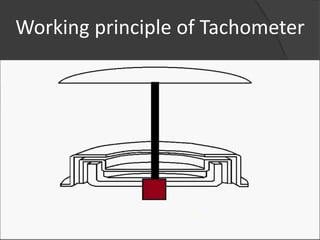
A tachometer is an instrument measuring the rotation speed
of a shaft or disk as in a motor or other machine
Working principle of Tachometer
Block Diagram
IR SENSOR
ACTIVE
FILTER
Microcon
troller7 Segment Display
Types
 Tachometers can be classified on the basis of data
acquisition – contact or non contact types
 They can also be classified on the basis of the
measurement technique – time based or frequency
based technique of measurement
 They can also be classified as analog or digital type
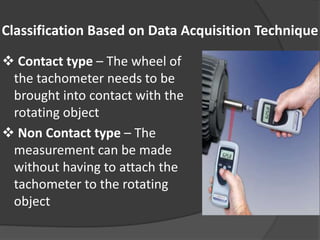
 Contact type – The wheel of
the tachometer needs to be
brought into contact with the
rotating object
 Non Contact type – The
measurement can be made
without having to attach the
tachometer to the rotating
object
Classification Based on Data Acquisition Technique
Classification Based on Measurement Technique
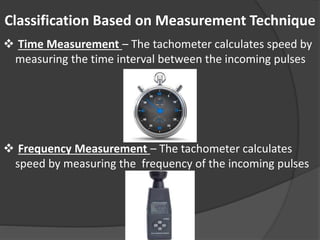
 Time Measurement – The tachometer calculates speed by
measuring the time interval between the incoming pulses
 Frequency Measurement – The tachometer calculates
speed by measuring the frequency of the incoming pulses
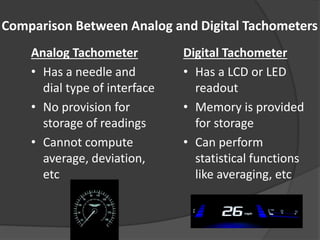
Analog Tachometer
• Has a needle and
dial type of interface
• No provision for
storage of readings
• Cannot compute
average, deviation,
etc
Digital Tachometer
• Has a LCD or LED
readout
• Memory is provided
for storage
• Can perform
statistical functions
like averaging, etc
Comparison Between Analog and Digital Tachometers
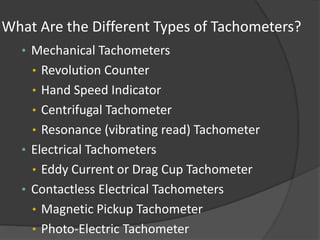
What Are the Different Types of Tachometers?
• Mechanical Tachometers
• Revolution Counter
• Hand Speed Indicator
• Centrifugal Tachometer
• Resonance (vibrating read) Tachometer
• Electrical Tachometers
• Eddy Current or Drag Cup Tachometer
• Contactless Electrical Tachometers
• Magnetic Pickup Tachometer
• Photo-Electric Tachometer
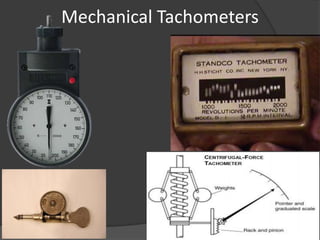
Mechanical Tachometers
16
Revolution Counter
 Revolution counter is used to measure an average
of rational speed instead of instantaneous
rotational speed.
 It consists of a worm gear that is usually attached
to a spindle. It has two dials, an inner one and an
outer one.
 These are limited to low speed engines and
measure satisfactory up to 2000-3000r.p.m.
Hand Speed Indicator
 Hand Speed Indicator has an integral stopwatch and
counter with automatic disconnect.
Centrifugal Tachometer
 Centrifugal Tachometer operates on principle that
centrifugal force is proportional to speed of
rotation.
 They are suitable for 4000r.p.m.
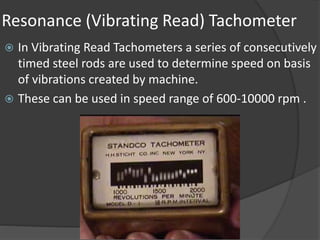
Resonance (Vibrating Read) Tachometer
 In Vibrating Read Tachometers a series of consecutively
timed steel rods are used to determine speed on basis
of vibrations created by machine.
 These can be used in speed range of 600-10000 rpm .
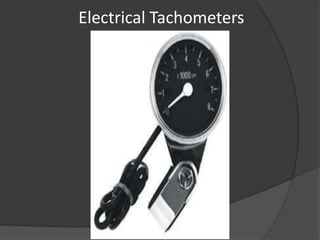
Electrical Tachometers
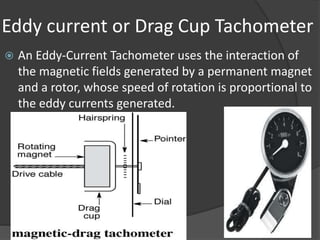
Eddy current or Drag Cup Tachometer
 An Eddy-Current Tachometer uses the interaction of
the magnetic fields generated by a permanent magnet
and a rotor, whose speed of rotation is proportional to
the eddy currents generated.
Contactless Electrical Tachometers
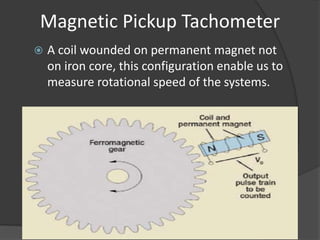
Magnetic Pickup Tachometer
 A coil wounded on permanent magnet not
on iron core, this configuration enable us to
measure rotational speed of the systems.
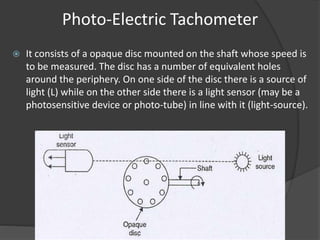
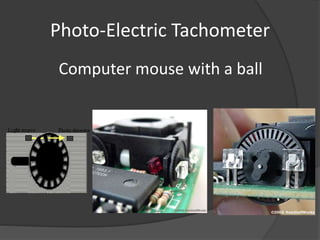
Photo-Electric Tachometer
 It consists of a opaque disc mounted on the shaft whose speed is
to be measured. The disc has a number of equivalent holes
around the periphery. On one side of the disc there is a source of
light (L) while on the other side there is a light sensor (may be a
photosensitive device or photo-tube) in line with it (light-source).
Photo-Electric Tachometer
Computer mouse with a ball
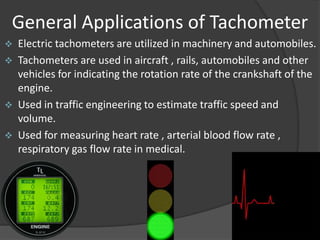
General Applications of Tachometer
 Electric tachometers are utilized in machinery and automobiles.
 Tachometers are used in aircraft , rails, automobiles and other
vehicles for indicating the rotation rate of the crankshaft of the
engine.
 Used in traffic engineering to estimate traffic speed and
volume.
 Used for measuring heart rate , arterial blood flow rate ,
respiratory gas flow rate in medical.
Industrial Applications of Tachometer
 Mixers
 Conveyors
 Compressors
 Printing Equip
 Fans and Blowers
 Winders
 Motor Control
 PLC Interface
 Extruders
 Molding
 Automated Assembly
 Bottling
Thank You

Tachometer

  • 5.
    History  The inventoris assumed to be the German engineer Dietrich Uhlhorn  He used it for measuring the speed of machines in 1817  Since 1840, it has been used to measure the speed of locomotives
  • 6.
     The wordcomes from Greek ταχος (tachos "speed") and matron ("measure"). Essentially the words tachometer and speedometer have identical meaning: a device that measures speed. A tachometer is an instrument measuring the rotation speed of a shaft or disk as in a motor or other machine
  • 7.
  • 9.
  • 10.
    Types  Tachometers canbe classified on the basis of data acquisition – contact or non contact types  They can also be classified on the basis of the measurement technique – time based or frequency based technique of measurement  They can also be classified as analog or digital type
  • 11.
     Contact type– The wheel of the tachometer needs to be brought into contact with the rotating object  Non Contact type – The measurement can be made without having to attach the tachometer to the rotating object Classification Based on Data Acquisition Technique
  • 12.
    Classification Based onMeasurement Technique  Time Measurement – The tachometer calculates speed by measuring the time interval between the incoming pulses  Frequency Measurement – The tachometer calculates speed by measuring the frequency of the incoming pulses
  • 13.
    Analog Tachometer • Hasa needle and dial type of interface • No provision for storage of readings • Cannot compute average, deviation, etc Digital Tachometer • Has a LCD or LED readout • Memory is provided for storage • Can perform statistical functions like averaging, etc Comparison Between Analog and Digital Tachometers
  • 15.
    What Are theDifferent Types of Tachometers? • Mechanical Tachometers • Revolution Counter • Hand Speed Indicator • Centrifugal Tachometer • Resonance (vibrating read) Tachometer • Electrical Tachometers • Eddy Current or Drag Cup Tachometer • Contactless Electrical Tachometers • Magnetic Pickup Tachometer • Photo-Electric Tachometer
  • 16.
  • 17.
    Revolution Counter  Revolutioncounter is used to measure an average of rational speed instead of instantaneous rotational speed.  It consists of a worm gear that is usually attached to a spindle. It has two dials, an inner one and an outer one.  These are limited to low speed engines and measure satisfactory up to 2000-3000r.p.m.
  • 18.
    Hand Speed Indicator Hand Speed Indicator has an integral stopwatch and counter with automatic disconnect.
  • 19.
    Centrifugal Tachometer  CentrifugalTachometer operates on principle that centrifugal force is proportional to speed of rotation.  They are suitable for 4000r.p.m.
  • 20.
    Resonance (Vibrating Read)Tachometer  In Vibrating Read Tachometers a series of consecutively timed steel rods are used to determine speed on basis of vibrations created by machine.  These can be used in speed range of 600-10000 rpm .
  • 21.
  • 22.
    Eddy current orDrag Cup Tachometer  An Eddy-Current Tachometer uses the interaction of the magnetic fields generated by a permanent magnet and a rotor, whose speed of rotation is proportional to the eddy currents generated.
  • 24.
  • 25.
    Magnetic Pickup Tachometer A coil wounded on permanent magnet not on iron core, this configuration enable us to measure rotational speed of the systems.
  • 26.
    Photo-Electric Tachometer  Itconsists of a opaque disc mounted on the shaft whose speed is to be measured. The disc has a number of equivalent holes around the periphery. On one side of the disc there is a source of light (L) while on the other side there is a light sensor (may be a photosensitive device or photo-tube) in line with it (light-source).
  • 27.
  • 28.
    General Applications ofTachometer  Electric tachometers are utilized in machinery and automobiles.  Tachometers are used in aircraft , rails, automobiles and other vehicles for indicating the rotation rate of the crankshaft of the engine.  Used in traffic engineering to estimate traffic speed and volume.  Used for measuring heart rate , arterial blood flow rate , respiratory gas flow rate in medical.
  • 29.
    Industrial Applications ofTachometer  Mixers  Conveyors  Compressors  Printing Equip  Fans and Blowers  Winders  Motor Control  PLC Interface  Extruders  Molding  Automated Assembly  Bottling
  • 32.