W
ReprintedFromTablets&Capsules,October2003 www.tabletscapsules.com
Sticking occurs whengranulesattachthemselvestothefacesof
tablet press punches. Picking is a more specific term that
describes product sticking only within the letters, logos, or
designs on thepunch faces. This article explains thecauses of
sticking and picking and describes the steps you can take to
resolvebothproblems.
hen a product begins sticking to the punch face, the
blame game starts. Unchecked, the finger-pointing can
zoom around to encompass every person with a handin
the tablet-making process. No one wants to bear the
responsibility fortheproblem.
From your colleagues in R&D youhear, “It didn’tstick
to thepunchesinoursingle-stationlabpress.Check with
thetablet press operators. They’re notrunning the tablet
press correctly.” When you check with the tablet press
operators, they say it’s a granulation problem. “If the
product had been granulated correctly we wouldn’t have
sticking problems.” The people in quality assurance point
out that the product is sticking to the tooling. They sug-
gest thatyou look forworntooling ortooling thatneeds to
be polished. Or maybe the tools weren’t made cor- rectly
to start with.“Callthe tooling vendor,” they say.
Andsoit goes.
Is the problem coming from the tablet press or the
productformula?Isit thetooling orisit thegranulating and
dryingprocess?Isit the operators?No oneknowsfor sure.
Sticking andpicking
Sticking is one of the most common problems of
tablet making. It occurs when granules attach and stick to
the faces of the punches instead of locking together to
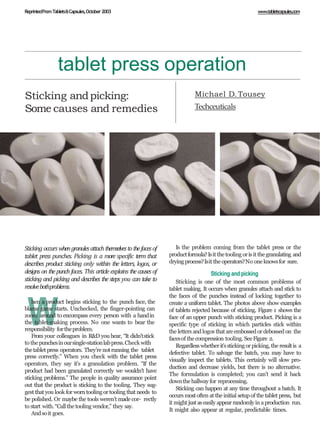
create a uniform tablet. The photos above show examples
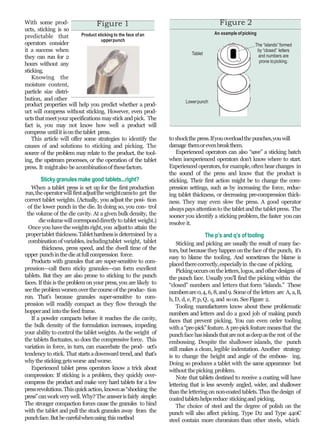
of tablets rejected because of sticking. Figure 1 shows the
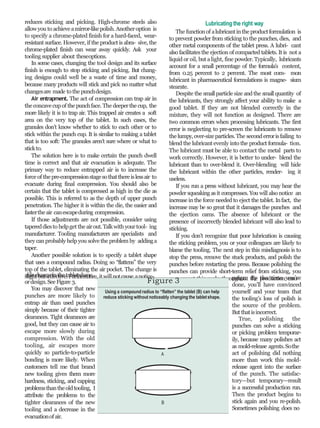
face of an upper punch with sticking product. Picking is a
specific type of sticking in which particles stick within
the letters andlogos thatareembossedordebossed on the
facesof thecompression tooling.SeeFigure 2.
Regardlesswhetherit’ssticking orpicking, the resultis a
defective tablet. To salvage the batch, you may have to
visually inspect the tablets. This certainly will slow pro-
duction and decrease yields, but there is no alternative.
The formulation is completed; you can’t send it back
downthehallwayfor reprocessing.
Sticking can happen at any time throughout a batch. It
occursmostoften at the initial setupof the tablet press, but
it might justaseasily appearrandomlyin aproduction run.
It might also appear at regular, predictable times.
tablet press operation
Sticking andpicking:
Some causes and remedies
Michael D.Tousey
Techceuticals
With some prod-
ucts, sticking is so
predictable that
operators consider
it a success when
they can run for 2
hours without any
sticking.
Knowing the
moisture content,
particle size distri-
bution, and other
product properties will help you predict whether a prod-
uct will compress without sticking. However, even prod-
uctsthatmeetyourspecificationsmaystick andpick. The
fact is, you may not know how well a product will
compress untilit isonthetablet press.
This article will offer some strategies to identify the
causes of and solutions to sticking and picking. The
source of the problem may relate to the product, the tool-
ing, the upstream processes, or the operation of the tablet
press. It mightalso beacombinationof thesefactors.
Sticky granules make good tablets...right?
When a tablet press is set up for the first production
run,theoperatorwill firstadjusttheweightcamsto get the
correct tablet weights. (Actually, you adjust the posi- tion
of the lower punch in the die. In doing so, you con- trol
the volume of the die cavity. At a given bulk density, the
dievolumewillcorresponddirectlyto tablet weight.)
Once you havetheweightsright,you adjustto attain the
propertablet thickness.Tablethardnessis determined by a
combination of variables, includingtablet weight, tablet
thickness, press speed, and the dwell time of the
upper punchinthedieatfullcompression force.
Products with granules that are super-sensitive to com-
pression—call them sticky granules—can form excellent
tablets. But they are also prone to sticking to the punch
faces. If this is the problem on your press, you are likely to
seethe problemworsenoverthe course of the produc- tion
run. That’s because granules super-sensitive to com-
pression will readily compact as they flow through the
hopperand intothefeed frame.
If a powder compacts before it reaches the die cavity,
the bulk density of the formulation increases, impeding
your ability to control the tablet weights. As the weight of
the tablets fluctuates, so does the compressive force. This
variation in force, in turn, can exacerbate the prod- uct’s
tendency to stick. That startsadownward trend, and that’s
whythesticking getsworse andworse.
Experienced tablet press operators know a trick about
compression: If sticking is a problem, they quickly over-
compress the product and make very hard tablets for a few
pressrevolutions.Thisquickaction,knownas“shocking the
press”canworkverywell.Why?The answerisfairly simple:
The stronger compaction forces cause the granules to bind
with the tablet and pull the stuck granules away from the
punchface.Butbecarefulwhenusing this method
to shockthe press.Ifyouoverloadthepunches,youwill
damage themorevenbreakthem.
Experienced operators can also “save” a sticking batch
when inexperienced operators don’t know where to start.
Experienced operators, for example, often hearchanges in
the sound of the press and know that the product is
sticking. Their first action might be to change the com-
pression settings, such as by increasing the force, reduc-
ing tablet thickness, or decreasing pre-compression thick-
ness. They may even slow the press. A good operator
alwayspaysattentionto the tabletandthe tabletpress. The
sooner you identify a sticking problem, the faster you can
resolve it.
The p’s and q’s of tooling
Sticking and picking are usually the result of many fac-
tors, but because they happenon the face of the punch, it’s
easy to blame the tooling. And sometimes the blame is
placedtherecorrectly,especiallyin thecase of picking.
Pickingoccursonthe letters,logos, andotherdesigns of
the punch face. Usually you’ll find the picking within the
“closed” numbers and letters that form “islands.” These
numbersare0,4, 6, 8,and9. Someof the letters are A, a,B,
b, D, d, e, P,p, Q, q, and soon.SeeFigure 2.
Tooling manufacturers know about these problematic
numbers and letters and do a good job of making punch
faces that prevent picking. You can even order tooling
with a“pre-pick”feature.A pre-pickfeature meansthat the
punchface hasislandsthatarenotasdeepasthe rest of the
embossing. Despite the shallower islands, the punch
still makes a clean, legible indentation. Another strategy
is to change the height and angle of the emboss- ing.
Doing so produces a tablet with the same appearance but
withoutthepicking problem.
Note that tablets destined to receive a coating will have
lettering that is less severely angled, wider, and shallower
thanthe lettering onnon-coated tablets. Thus the design of
coatedtabletshelpsreduce stickingand picking.
The choice of steel and the degree of polish on the
punch will also affect picking. Type D2 and Type 440C
steel contain more chromium than other steels, which
Figure 1
Product sticking to the face ofan
upperpunch
Figure 2
An example ofpicking
Tablet
Lowerpunch
The “islands” formed
by “closed” letters
and numbers are
prone topicking.
reduces sticking and picking. High-chrome steels also
allowyou to achieveamirror-likepolish.Anotheroption is
to specify a chrome-plated finish for a hard-faced, wear-
resistant surface. However, if the product is abra- sive, the
chrome-plated finish can wear away quickly. Ask your
tooling supplier about theseoptions.
In some cases, changing the tool design and its surface
finish is enough to stop sticking and picking. But chang-
ing designs could well be a waste of time and money,
because many products will stick and pick no matter what
changesare made to the punchdesign.
Air entrapment. The act of compression can trap air in
the concavecupof the punchface. The deeperthe cup, the
more likely it is to trap air. This trapped air creates a soft
area on the very top of the tablet. In such cases, the
granules don’t know whether to stick to each other or to
stick within the punch cup. It is similar to making a tablet
that is too soft: The granules aren’t sure where or what to
stickto.
The solution here is to make certain the punch dwell
time is correct and that air evacuation is adequate. The
primary way to reduce entrapped air is to increase the
force of thepre-compressionstagesothatthereislessair to
evacuate during final compression. You should also be
certain that the tablet is compressed as high in the die as
possible. This is referred to as the depth of upper punch
penetration. The higher it is within the die, the easier and
fastertheair canescapeduring compression.
If those adjustments are not possible, consider using
tapereddiesto helpget the airout.Talkwithyourtool- ing
manufacturer. Tooling manufacturers are specialists and
they canprobably help you solve the problem by addinga
taper.
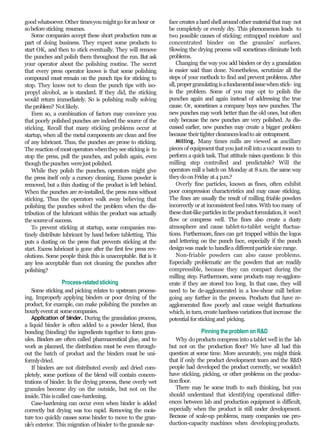
Another possible solution is to specify a tablet shape
that uses a compound radius. Doing so “flattens” the very
top of the tablet, eliminating the air pocket. The change is
slightbut effective.Furthermore, itwillnotcause anotice-ablechangeinthetabletshape
ordesign.SeeFigure 3.
You may discover that new
punches are more likely to
entrap air than used punches
simply because of their tighter
clearances. Tight clearances are
good, but they can cause air to
escape more slowly during
compression. With the old
tooling, air escapes more
quickly so particle-to-particle
bonding is more likely. When
customers tell me that brand
new tooling gives them more
hardness, sticking, and capping
problemsthantheoldtooling, I
attribute the problems to the
tighter clearances of the new
tooling and a decrease in the
evacuationofair.
Lubricating the right way
The functionof alubricantinthe productformulation is
to prevent powder from sticking to the punches, dies, and
other metal components of the tablet press. A lubri- cant
also facilitates the ejection of compacted tablets. It is not a
liquid or oil, but alight, fine powder. Typically, lubricants
account for a small percentage of the formula’s content,
from 0.25 percent to 2 percent. The most com- mon
lubricant in pharmaceutical formulations is magne- sium
stearate.
Despite the smallparticle size and the smallquantity of
the lubricants, they strongly affect your ability to make a
good tablet. If they are not blended correctly in the
mixture, they will not function as designed. There are
two common errors when processing lubricants. The first
error is neglecting to pre-screen the lubricants to remove
the lumpy,over-sizeparticles.The seconderrorisfailing to
blend the lubricant evenly into the product formula- tion.
The lubricant must be able to contact the metal parts to
work correctly. However, it is better to under- blend the
lubricant than to over-blend it. Over-blending will hide
the lubricant within the other particles, render- ing it
useless.
If you run a press without lubricant, you may hear the
powder squeaking asit compresses. You will also notice an
increase in the force needed to eject the tablet. Infact, the
increase may be so great that it damages the punches and
the ejection cams. The absence of lubricant or the
presence of incorrectly blended lubricant will also lead to
sticking.
If you don’t recognize that poor lubrication is causing
the sticking problem, you or your colleagues are likely to
blame the tooling. The next step in this misdiagnosis is to
stop the press, remove the stuck products, and polish the
punches before restarting the press. Because polishing the
punches can provide short-term relief from sticking, you
may repeat this cycle throughout the production cam-paign. By the time you’re
done, you’ll have convinced
yourself and your team that
the tooling’s loss of polish is
the source of the problem.
But thatisincorrect.
True, polishing the
punches can solve a sticking
or picking problem temporar-
ily, because many polishes act
as mold-release agents.Sothe
act of polishing did nothing
more than work this mold-
release agent into the surface
of the punch. The satisfac-
tory—but temporary—result
is a successful production run.
Then the product begins to
stick again and you re-polish.
Sometimes polishing does no
Figure 3
Using a compound radius to “flatten” the tablet (B) can help
reduce sticking without noticeably changing the tabletshape.
A
B
good whatsoever.Other timesyoumightgo foranhour or
sobeforesticking resumes.
Some companies accept these short production runs as
part of doing business. They expect some products to
start OK, and then to stick eventually. They will remove
the punches and polish them throughout the run. But ask
your operator about the polishing routine. The secret
that every press operator knows is that some polishing
compound must remain on the punch tips for sticking to
stop. They know not to clean the punch tips with iso-
propyl alcohol, as is standard. If they did, the sticking
would return immediately. So is polishing really solving
theproblem? Notlikely.
Even so, a combination of factors may convince you
that poorly polished punches are indeed the source of the
sticking. Recall that many sticking problems occur at
startup, when all the metal components are clean and free
of any lubricant. Thus, the punches are prone to sticking.
The reactionof mostoperatorswhentheysee stickingis to
stop the press, pull the punches, and polish again, even
thoughthepunches werejust polished.
While they polish the punches, operators might give
the press itself only a cursory cleaning. Excess powder is
removed, but a thin dusting of the product is left behind.
When the punches are re-installed, the press runs without
sticking. Thus the operators walk away believing that
polishing the punches solved the problem when the dis-
tribution of the lubricant within the product was actually
thesourceof success.
To prevent sticking at startup, some companies rou-
tinely distribute lubricant by hand before tabletting. This
puts a dusting on the press that prevents sticking at the
start. Excess lubricant is gone after the first few press rev-
olutions. Some people think this is unacceptable. But is it
any less acceptable than not cleaning the punches after
polishing?
Process-relatedsticking
Some sticking and picking relates to upstream process-
ing. Improperly applying binders or poor drying of the
product, for example, can make polishing the punches an
hourlyeventat somecompanies.
Application of binder. During the granulation process,
a liquid binder is often added to a powder blend, thus
bonding (binding) the ingredients together to form gran-
ules. Binders are often called pharmaceutical glue, and to
work as planned, the distribution must be even through-
out the batch of product and the binders must be uni-
formlydried.
If binders are not distributed evenly and dried com-
pletely, some portions of the blend will contain concen-
trations of binder. In the drying process, these overly wet
granules become dry on the outside, but not on the
inside.This iscalled case-hardening.
Case-hardening can occur even when binder is added
correctly but drying was too rapid. Removing the mois-
ture too quickly causes some binder to move to the gran-
ule’s exterior. This migration of binder to thegranule sur-
face creates ahardshellaroundothermaterialthatmay not
be completely or evenly dry. This phenomenon leads to
two possible causes of sticking: entrapped moisture and
concentrated binder on the granules’ surfaces.
Slowing the drying process will sometimes eliminate both
problems.
Changing the way you add binders or dry a granulation
is easier said than done. Nonetheless, scrutinize all the
steps of your methods to find and prevent problems. After
all,propergranulatingisafundamentalissuewhenstick- ing
is the problem. Some of you may opt to polish the
punches again and again instead of addressing the true
cause. Or, sometimes a company buys new punches. The
new punches may work better than the old ones, but often
only because the new punches are very polished. As dis-
cussed earlier, new punches may create a bigger problem
because theirtighterclearancesleadto air entrapment.
Milling. Many times mills are viewed as ancillary
piecesof equipmentthatyou justrollintoavacantroom to
perform a quick task. That attitude raises questions: Is this
milling step controlled and predictable? Will the
operators mill a batch on Monday at 8 a.m. the same way
theydoonFriday at4 p.m.?
Overly fine particles, known as fines, often exhibit
poor compression characteristics and may cause sticking.
The fines are usually the result of milling friable powders
incorrectly or at inconsistent feed rates. With too many of
thesedust-likeparticlesintheproductformulation,it won’t
flow or compress well. The fines also create a dusty
atmosphere and cause tablet-to-tablet weight fluctua-
tions. Furthermore, fines can get trapped within the logos
and lettering on the punch face, especially if the punch
designwas made to handlea differentparticle size range.
Non-friable powders can also cause problems.
Especially problematic are the powders that are readily
compressible, because they can compact during the
milling step. Furthermore, some products may re-agglom-
erate if they are stored too long. In that case, they will
need to be de-agglomerated in a low-shear mill before
going any further in the process. Products that have re-
agglomerated flow poorly and cause weight fluctuations
which, inturn, create hardnessvariations that increase the
potential forstickingand picking.
Pinning the problem on R&D
Why do products compress into atablet well in the lab
but not on the production floor? We have all had this
question at some time. More accurately, you might think
that if only the product development team and the R&D
people had developed the product correctly, we wouldn’t
have sticking, picking, or other problems on the produc-
tionfloor.
There may be some truth to such thinking, but you
should understand that identifying operational differ-
ences between lab and production equipment is difficult,
especially when the product is still under development.
Because of scale-up problems, many companies use pro-
duction-capacity machines when developing products.
The substitution of criticalingredientsduringproduct
developmentcanalsohamper scale-up success.
Scale-up. Some machines scale up better than others,
andchangingthe batchsize oramachine’scapacitymay or
may not give your product its intended attributes. Scale-
up guidelines are general, and they don’t always work.
I’ve seen plants that use identical or comparable
processing machinery to make the same product, but the
properties of the products at each plant differ. You can
attribute these differences to environmental factors, the
skill of the people who work at the plant, or both. There is
stilla lot of art inthescienceof tablet making.
Ingredient substitution. Many of the ingredients in
tablet formulations are expensive, especially in the phar-
maceutical industry. Therefore, sometimes a company
substitutesacheapingredientforanexpensiveonedur- ing
product development. Or the company may not have
enough of the active pharmaceutical ingredient to make
tablets and to perform all the developmental tests. In that
case,thecompanywill againuse a substitute.
If the substitute doesn’t have the exact attributes of the
true ingredient, then test results can lead you in the
wrong direction. Time and storage conditions may also
cause the ingredient to behave one way in the lab and
another way on the plant floor. This may include more
fines, de-mixing at the tablet press, and heat sensitivity, all
of whichmay causesticking.
Conclusion
The one conclusion you should drawfrom this article is
thatasticking orpicking problemcanhave one orsev- eral
causes.Polishing the punchesduringa production runis a
temporary fix, not a long-term solution.
Environmental factors can affect how well a tablet will
form. Some products are so sensitive to temperature and
humidity that they may compress differently or not at all
withtheslightest change in the environment.
If you’re the troubleshooter in charge of solving a
sticking problem, evaluate the problem at the press and
work upstream from there. Study all the process variables
and record asmuch data aspossible. Finally, if you make a
change, try to make just one change at a time. This will
help you link each change to aresult. T&C
Michael D. Tousey is ownerandtechnical servicesdirectorof
DI Pharma Tech, 152 Wilkinson Drive, Westminster, SC
29693. Tel. 864 657 5400, fax 864 647 1155. Website:
www.dipharmatech.com.Touseyhasbeeninvolvedinthephar-
maceutical industry since 1973, including work at Thomas
Engineering,Shaklee,PennwaltStokes-Merrill, andLakso. He
foundedhis companyin1989.

Tablet press operation: Sticking and Picking

  • 1.
    W ReprintedFromTablets&Capsules,October2003 www.tabletscapsules.com Sticking occurswhengranulesattachthemselvestothefacesof tablet press punches. Picking is a more specific term that describes product sticking only within the letters, logos, or designs on thepunch faces. This article explains thecauses of sticking and picking and describes the steps you can take to resolvebothproblems. hen a product begins sticking to the punch face, the blame game starts. Unchecked, the finger-pointing can zoom around to encompass every person with a handin the tablet-making process. No one wants to bear the responsibility fortheproblem. From your colleagues in R&D youhear, “It didn’tstick to thepunchesinoursingle-stationlabpress.Check with thetablet press operators. They’re notrunning the tablet press correctly.” When you check with the tablet press operators, they say it’s a granulation problem. “If the product had been granulated correctly we wouldn’t have sticking problems.” The people in quality assurance point out that the product is sticking to the tooling. They sug- gest thatyou look forworntooling ortooling thatneeds to be polished. Or maybe the tools weren’t made cor- rectly to start with.“Callthe tooling vendor,” they say. Andsoit goes. Is the problem coming from the tablet press or the productformula?Isit thetooling orisit thegranulating and dryingprocess?Isit the operators?No oneknowsfor sure. Sticking andpicking Sticking is one of the most common problems of tablet making. It occurs when granules attach and stick to the faces of the punches instead of locking together to create a uniform tablet. The photos above show examples of tablets rejected because of sticking. Figure 1 shows the face of an upper punch with sticking product. Picking is a specific type of sticking in which particles stick within the letters andlogos thatareembossedordebossed on the facesof thecompression tooling.SeeFigure 2. Regardlesswhetherit’ssticking orpicking, the resultis a defective tablet. To salvage the batch, you may have to visually inspect the tablets. This certainly will slow pro- duction and decrease yields, but there is no alternative. The formulation is completed; you can’t send it back downthehallwayfor reprocessing. Sticking can happen at any time throughout a batch. It occursmostoften at the initial setupof the tablet press, but it might justaseasily appearrandomlyin aproduction run. It might also appear at regular, predictable times. tablet press operation Sticking andpicking: Some causes and remedies Michael D.Tousey Techceuticals
  • 2.
    With some prod- ucts,sticking is so predictable that operators consider it a success when they can run for 2 hours without any sticking. Knowing the moisture content, particle size distri- bution, and other product properties will help you predict whether a prod- uct will compress without sticking. However, even prod- uctsthatmeetyourspecificationsmaystick andpick. The fact is, you may not know how well a product will compress untilit isonthetablet press. This article will offer some strategies to identify the causes of and solutions to sticking and picking. The source of the problem may relate to the product, the tool- ing, the upstream processes, or the operation of the tablet press. It mightalso beacombinationof thesefactors. Sticky granules make good tablets...right? When a tablet press is set up for the first production run,theoperatorwill firstadjusttheweightcamsto get the correct tablet weights. (Actually, you adjust the posi- tion of the lower punch in the die. In doing so, you con- trol the volume of the die cavity. At a given bulk density, the dievolumewillcorresponddirectlyto tablet weight.) Once you havetheweightsright,you adjustto attain the propertablet thickness.Tablethardnessis determined by a combination of variables, includingtablet weight, tablet thickness, press speed, and the dwell time of the upper punchinthedieatfullcompression force. Products with granules that are super-sensitive to com- pression—call them sticky granules—can form excellent tablets. But they are also prone to sticking to the punch faces. If this is the problem on your press, you are likely to seethe problemworsenoverthe course of the produc- tion run. That’s because granules super-sensitive to com- pression will readily compact as they flow through the hopperand intothefeed frame. If a powder compacts before it reaches the die cavity, the bulk density of the formulation increases, impeding your ability to control the tablet weights. As the weight of the tablets fluctuates, so does the compressive force. This variation in force, in turn, can exacerbate the prod- uct’s tendency to stick. That startsadownward trend, and that’s whythesticking getsworse andworse. Experienced tablet press operators know a trick about compression: If sticking is a problem, they quickly over- compress the product and make very hard tablets for a few pressrevolutions.Thisquickaction,knownas“shocking the press”canworkverywell.Why?The answerisfairly simple: The stronger compaction forces cause the granules to bind with the tablet and pull the stuck granules away from the punchface.Butbecarefulwhenusing this method to shockthe press.Ifyouoverloadthepunches,youwill damage themorevenbreakthem. Experienced operators can also “save” a sticking batch when inexperienced operators don’t know where to start. Experienced operators, for example, often hearchanges in the sound of the press and know that the product is sticking. Their first action might be to change the com- pression settings, such as by increasing the force, reduc- ing tablet thickness, or decreasing pre-compression thick- ness. They may even slow the press. A good operator alwayspaysattentionto the tabletandthe tabletpress. The sooner you identify a sticking problem, the faster you can resolve it. The p’s and q’s of tooling Sticking and picking are usually the result of many fac- tors, but because they happenon the face of the punch, it’s easy to blame the tooling. And sometimes the blame is placedtherecorrectly,especiallyin thecase of picking. Pickingoccursonthe letters,logos, andotherdesigns of the punch face. Usually you’ll find the picking within the “closed” numbers and letters that form “islands.” These numbersare0,4, 6, 8,and9. Someof the letters are A, a,B, b, D, d, e, P,p, Q, q, and soon.SeeFigure 2. Tooling manufacturers know about these problematic numbers and letters and do a good job of making punch faces that prevent picking. You can even order tooling with a“pre-pick”feature.A pre-pickfeature meansthat the punchface hasislandsthatarenotasdeepasthe rest of the embossing. Despite the shallower islands, the punch still makes a clean, legible indentation. Another strategy is to change the height and angle of the emboss- ing. Doing so produces a tablet with the same appearance but withoutthepicking problem. Note that tablets destined to receive a coating will have lettering that is less severely angled, wider, and shallower thanthe lettering onnon-coated tablets. Thus the design of coatedtabletshelpsreduce stickingand picking. The choice of steel and the degree of polish on the punch will also affect picking. Type D2 and Type 440C steel contain more chromium than other steels, which Figure 1 Product sticking to the face ofan upperpunch Figure 2 An example ofpicking Tablet Lowerpunch The “islands” formed by “closed” letters and numbers are prone topicking.
  • 3.
    reduces sticking andpicking. High-chrome steels also allowyou to achieveamirror-likepolish.Anotheroption is to specify a chrome-plated finish for a hard-faced, wear- resistant surface. However, if the product is abra- sive, the chrome-plated finish can wear away quickly. Ask your tooling supplier about theseoptions. In some cases, changing the tool design and its surface finish is enough to stop sticking and picking. But chang- ing designs could well be a waste of time and money, because many products will stick and pick no matter what changesare made to the punchdesign. Air entrapment. The act of compression can trap air in the concavecupof the punchface. The deeperthe cup, the more likely it is to trap air. This trapped air creates a soft area on the very top of the tablet. In such cases, the granules don’t know whether to stick to each other or to stick within the punch cup. It is similar to making a tablet that is too soft: The granules aren’t sure where or what to stickto. The solution here is to make certain the punch dwell time is correct and that air evacuation is adequate. The primary way to reduce entrapped air is to increase the force of thepre-compressionstagesothatthereislessair to evacuate during final compression. You should also be certain that the tablet is compressed as high in the die as possible. This is referred to as the depth of upper punch penetration. The higher it is within the die, the easier and fastertheair canescapeduring compression. If those adjustments are not possible, consider using tapereddiesto helpget the airout.Talkwithyourtool- ing manufacturer. Tooling manufacturers are specialists and they canprobably help you solve the problem by addinga taper. Another possible solution is to specify a tablet shape that uses a compound radius. Doing so “flattens” the very top of the tablet, eliminating the air pocket. The change is slightbut effective.Furthermore, itwillnotcause anotice-ablechangeinthetabletshape ordesign.SeeFigure 3. You may discover that new punches are more likely to entrap air than used punches simply because of their tighter clearances. Tight clearances are good, but they can cause air to escape more slowly during compression. With the old tooling, air escapes more quickly so particle-to-particle bonding is more likely. When customers tell me that brand new tooling gives them more hardness, sticking, and capping problemsthantheoldtooling, I attribute the problems to the tighter clearances of the new tooling and a decrease in the evacuationofair. Lubricating the right way The functionof alubricantinthe productformulation is to prevent powder from sticking to the punches, dies, and other metal components of the tablet press. A lubri- cant also facilitates the ejection of compacted tablets. It is not a liquid or oil, but alight, fine powder. Typically, lubricants account for a small percentage of the formula’s content, from 0.25 percent to 2 percent. The most com- mon lubricant in pharmaceutical formulations is magne- sium stearate. Despite the smallparticle size and the smallquantity of the lubricants, they strongly affect your ability to make a good tablet. If they are not blended correctly in the mixture, they will not function as designed. There are two common errors when processing lubricants. The first error is neglecting to pre-screen the lubricants to remove the lumpy,over-sizeparticles.The seconderrorisfailing to blend the lubricant evenly into the product formula- tion. The lubricant must be able to contact the metal parts to work correctly. However, it is better to under- blend the lubricant than to over-blend it. Over-blending will hide the lubricant within the other particles, render- ing it useless. If you run a press without lubricant, you may hear the powder squeaking asit compresses. You will also notice an increase in the force needed to eject the tablet. Infact, the increase may be so great that it damages the punches and the ejection cams. The absence of lubricant or the presence of incorrectly blended lubricant will also lead to sticking. If you don’t recognize that poor lubrication is causing the sticking problem, you or your colleagues are likely to blame the tooling. The next step in this misdiagnosis is to stop the press, remove the stuck products, and polish the punches before restarting the press. Because polishing the punches can provide short-term relief from sticking, you may repeat this cycle throughout the production cam-paign. By the time you’re done, you’ll have convinced yourself and your team that the tooling’s loss of polish is the source of the problem. But thatisincorrect. True, polishing the punches can solve a sticking or picking problem temporar- ily, because many polishes act as mold-release agents.Sothe act of polishing did nothing more than work this mold- release agent into the surface of the punch. The satisfac- tory—but temporary—result is a successful production run. Then the product begins to stick again and you re-polish. Sometimes polishing does no Figure 3 Using a compound radius to “flatten” the tablet (B) can help reduce sticking without noticeably changing the tabletshape. A B
  • 4.
    good whatsoever.Other timesyoumightgoforanhour or sobeforesticking resumes. Some companies accept these short production runs as part of doing business. They expect some products to start OK, and then to stick eventually. They will remove the punches and polish them throughout the run. But ask your operator about the polishing routine. The secret that every press operator knows is that some polishing compound must remain on the punch tips for sticking to stop. They know not to clean the punch tips with iso- propyl alcohol, as is standard. If they did, the sticking would return immediately. So is polishing really solving theproblem? Notlikely. Even so, a combination of factors may convince you that poorly polished punches are indeed the source of the sticking. Recall that many sticking problems occur at startup, when all the metal components are clean and free of any lubricant. Thus, the punches are prone to sticking. The reactionof mostoperatorswhentheysee stickingis to stop the press, pull the punches, and polish again, even thoughthepunches werejust polished. While they polish the punches, operators might give the press itself only a cursory cleaning. Excess powder is removed, but a thin dusting of the product is left behind. When the punches are re-installed, the press runs without sticking. Thus the operators walk away believing that polishing the punches solved the problem when the dis- tribution of the lubricant within the product was actually thesourceof success. To prevent sticking at startup, some companies rou- tinely distribute lubricant by hand before tabletting. This puts a dusting on the press that prevents sticking at the start. Excess lubricant is gone after the first few press rev- olutions. Some people think this is unacceptable. But is it any less acceptable than not cleaning the punches after polishing? Process-relatedsticking Some sticking and picking relates to upstream process- ing. Improperly applying binders or poor drying of the product, for example, can make polishing the punches an hourlyeventat somecompanies. Application of binder. During the granulation process, a liquid binder is often added to a powder blend, thus bonding (binding) the ingredients together to form gran- ules. Binders are often called pharmaceutical glue, and to work as planned, the distribution must be even through- out the batch of product and the binders must be uni- formlydried. If binders are not distributed evenly and dried com- pletely, some portions of the blend will contain concen- trations of binder. In the drying process, these overly wet granules become dry on the outside, but not on the inside.This iscalled case-hardening. Case-hardening can occur even when binder is added correctly but drying was too rapid. Removing the mois- ture too quickly causes some binder to move to the gran- ule’s exterior. This migration of binder to thegranule sur- face creates ahardshellaroundothermaterialthatmay not be completely or evenly dry. This phenomenon leads to two possible causes of sticking: entrapped moisture and concentrated binder on the granules’ surfaces. Slowing the drying process will sometimes eliminate both problems. Changing the way you add binders or dry a granulation is easier said than done. Nonetheless, scrutinize all the steps of your methods to find and prevent problems. After all,propergranulatingisafundamentalissuewhenstick- ing is the problem. Some of you may opt to polish the punches again and again instead of addressing the true cause. Or, sometimes a company buys new punches. The new punches may work better than the old ones, but often only because the new punches are very polished. As dis- cussed earlier, new punches may create a bigger problem because theirtighterclearancesleadto air entrapment. Milling. Many times mills are viewed as ancillary piecesof equipmentthatyou justrollintoavacantroom to perform a quick task. That attitude raises questions: Is this milling step controlled and predictable? Will the operators mill a batch on Monday at 8 a.m. the same way theydoonFriday at4 p.m.? Overly fine particles, known as fines, often exhibit poor compression characteristics and may cause sticking. The fines are usually the result of milling friable powders incorrectly or at inconsistent feed rates. With too many of thesedust-likeparticlesintheproductformulation,it won’t flow or compress well. The fines also create a dusty atmosphere and cause tablet-to-tablet weight fluctua- tions. Furthermore, fines can get trapped within the logos and lettering on the punch face, especially if the punch designwas made to handlea differentparticle size range. Non-friable powders can also cause problems. Especially problematic are the powders that are readily compressible, because they can compact during the milling step. Furthermore, some products may re-agglom- erate if they are stored too long. In that case, they will need to be de-agglomerated in a low-shear mill before going any further in the process. Products that have re- agglomerated flow poorly and cause weight fluctuations which, inturn, create hardnessvariations that increase the potential forstickingand picking. Pinning the problem on R&D Why do products compress into atablet well in the lab but not on the production floor? We have all had this question at some time. More accurately, you might think that if only the product development team and the R&D people had developed the product correctly, we wouldn’t have sticking, picking, or other problems on the produc- tionfloor. There may be some truth to such thinking, but you should understand that identifying operational differ- ences between lab and production equipment is difficult, especially when the product is still under development. Because of scale-up problems, many companies use pro- duction-capacity machines when developing products.
  • 5.
    The substitution ofcriticalingredientsduringproduct developmentcanalsohamper scale-up success. Scale-up. Some machines scale up better than others, andchangingthe batchsize oramachine’scapacitymay or may not give your product its intended attributes. Scale- up guidelines are general, and they don’t always work. I’ve seen plants that use identical or comparable processing machinery to make the same product, but the properties of the products at each plant differ. You can attribute these differences to environmental factors, the skill of the people who work at the plant, or both. There is stilla lot of art inthescienceof tablet making. Ingredient substitution. Many of the ingredients in tablet formulations are expensive, especially in the phar- maceutical industry. Therefore, sometimes a company substitutesacheapingredientforanexpensiveonedur- ing product development. Or the company may not have enough of the active pharmaceutical ingredient to make tablets and to perform all the developmental tests. In that case,thecompanywill againuse a substitute. If the substitute doesn’t have the exact attributes of the true ingredient, then test results can lead you in the wrong direction. Time and storage conditions may also cause the ingredient to behave one way in the lab and another way on the plant floor. This may include more fines, de-mixing at the tablet press, and heat sensitivity, all of whichmay causesticking. Conclusion The one conclusion you should drawfrom this article is thatasticking orpicking problemcanhave one orsev- eral causes.Polishing the punchesduringa production runis a temporary fix, not a long-term solution. Environmental factors can affect how well a tablet will form. Some products are so sensitive to temperature and humidity that they may compress differently or not at all withtheslightest change in the environment. If you’re the troubleshooter in charge of solving a sticking problem, evaluate the problem at the press and work upstream from there. Study all the process variables and record asmuch data aspossible. Finally, if you make a change, try to make just one change at a time. This will help you link each change to aresult. T&C Michael D. Tousey is ownerandtechnical servicesdirectorof DI Pharma Tech, 152 Wilkinson Drive, Westminster, SC 29693. Tel. 864 657 5400, fax 864 647 1155. Website: www.dipharmatech.com.Touseyhasbeeninvolvedinthephar- maceutical industry since 1973, including work at Thomas Engineering,Shaklee,PennwaltStokes-Merrill, andLakso. He foundedhis companyin1989.