Copyright,CSCPublishing.Tablets&
Capsules
O
tabletting
relying on tablet press technicians Michael Tousey
Techceuticals
Manycompanieslimittheadjustmentsthattechnicianscanmaketo
the tablet press during a production run, even though such
adjustmentsareanormalpartoftabletting.Thisarticlediscusses
what adjustments may benecessary and encourages manufac-
turingmanagerstosupporttheirtablettechnicians.
in charge of the press
bear the bad news.
Before shooting the
messenger, try to un-
derstand what’s hap-
pened and how to ad-
dress it. The best way
to do that is to talk
withyourtechnicians.
Many times, over-
cautious colleagues
working in the regu-
latory and compliance areas—in the name of valida-
tion—impose unrealistic limitations that prevent techni-
cians from making proper adjustments to the tablet press.
Press technicians must be allowed to make adjustments.
Otherwise they can’t solve the problem and make the
tablet meet final specifications. In fact, micro-managing
tablet press operation may create more problems than it
solves. Of course, a validated process demands that we
follow guidelines to ensure reproducible results, but I’m
going to let you in on a secret: Many products that are
validated don’t work. How can these products pass “vali-
dation” and yet not perform right in production? It’s sim-
ple: Good and bad processes can both be validated.
Validated does not mean optimized, only that we
obtained reproducible results during (maybe) three pro-
duction runs. The joke on validation thus becomes: The
first result is luck, the second coincidence, and the third is
validated.
Of course, making pharmaceutical orother tabletsis no
joke. It’s serious business, and we want high quality time
aftertime.So testtheproposedvalidatedprocedures before
they’reexecuted. That maysoundelementary, but I’ve seen
people propose avalidation procedure, docu- ment it, and
then hand it off to production staff without ever testing it.
Good managers wouldn’t allow that to happen. Instead,
they would work with their colleagues in regulatory
compliance and with their technicians to avoid the
implementation of unrealistic limitations. I sug- gest
running the product morethan three times. Then conduct
at least three test runs to prove that the valida- tion
procedures really work, and have the production staff
signoff on them.
Areyoua goodmanager?
Good managers share several traits. They are active inall areas of manufacturing. They invite communication
ver the last 3 decades, I’ve been on the front line of
many pharmaceutical and nutritional manufacturing oper-
ations, both as a worker and as a consultant. It’s no sur-
prise that at each company, the best managers have the
most production success. This article describes how to
support and promote advanced press operation. Wise
managers will recognize that room should be left for
technicians to account for typical variation in the press, its
tooling, theenvironment,and the product.
In tablet manufacturing, there is one clear objective:
making a good tablet, and what actually comes off the
tablet press reflects the activity of upstream operations. In
that sense, a “bad” tablet is often destined to be so long
before it reaches the press. Tablets are also affected by the
processes that follow compression, including dedusting,
coating, and packaging. Good tablets stem from good for-
mulas andprocesses andwell-trained technicians.
Validationisnotoptimization
Many companies are plagued by troubled products.
One day the product isrunningperfectly, andthenext day
it suddenlyactsupandcreateshavoc. Becausethe problem
is first observed atthetabletpress,thetechnicians
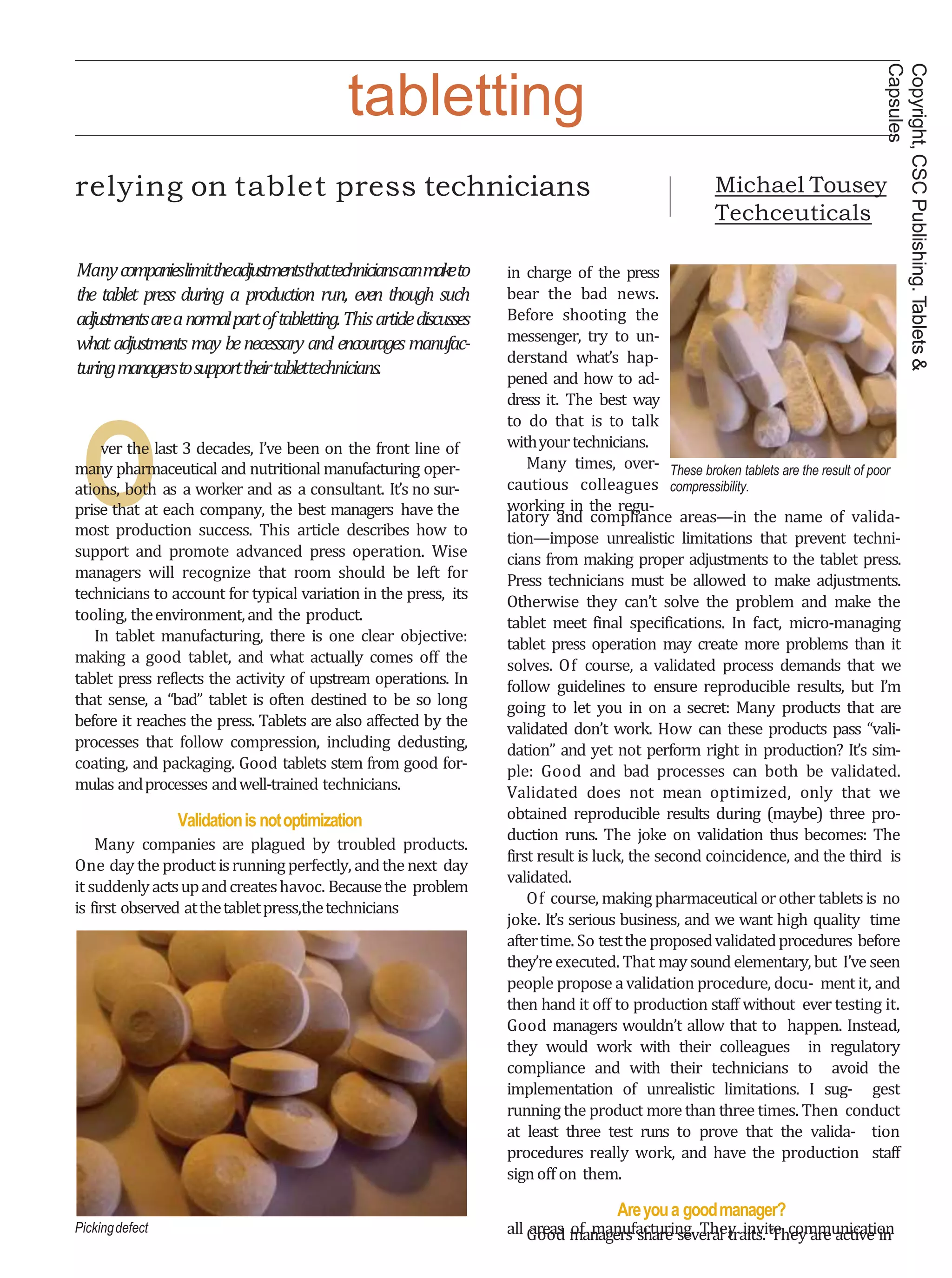
Pickingdefect
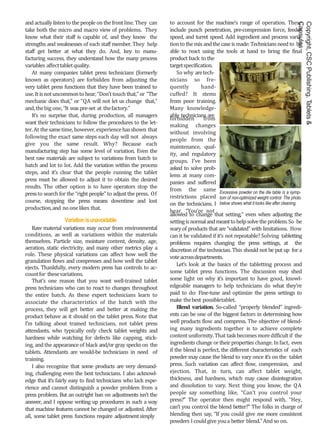
These broken tablets are the result of poor
compressibility.
Copyright,CSCPublishing.Tablets&
Capsules
andactuallylistento the peopleon thefront line. They can
take both the micro and macro view of problems. They
know what their staff is capable of, and they know the
strengths and weaknesses of each staff member. They help
staff get better at what they do. And, key to manu-
facturing success, they understand how the many process
variables affecttabletquality.
At many companies tablet press technicians (formerly
known as operators) are forbidden from adjusting the
very tablet press functions that they have been trained to
use.It isnot uncommonto hear,“Don’t touch that,” or “The
mechanic does that,” or “QA will not let us change that,”
and,thebig one,“It was pre-set at thefactory.”
It’s no surprise that, during production, all managers
want their technicians to follow the procedures to the let-
ter.At thesametime, however,experiencehasshown that
following the exact same steps each day will not always
give you the same result. Why? Because each
manufacturing step has some level of variation. Even the
best raw materials are subject to variations from batch to
batch and lot to lot. Add the variation within the process
steps, and it’s clear that the people running the tablet
press must be allowed to adjust it to obtain the desired
results. The other option is to have operators stop the
pressto search for the “right people” to adjustthe press. Of
course, stopping the press means downtime and lost
production,and no onelikes that.
Variationisunavoidable
Raw material variations may occur from environmental
conditions, as well as variations within the materials
themselves. Particle size, moisture content, density, age,
aeration, static electricity, and many other metrics play a
role. These physical variations can affect how well the
granulation flows and compresses and how well the tablet
ejects. Thankfully, every modern press has controls to ac-
countfor thesevariations.
That’s one reason that you want well-trained tablet
press technicians who can to react to changes throughout
the entire batch. As these expert technicians learn to
associate the characteristics of the batch with the
process, they will get better and better at making the
product behave as it should on the tablet press. Note that
I’m talking about trained technicians, not tablet press
attendants, who typically only check tablet weights and
hardness while watching for defects like capping, stick-
ing, andthe appearance of black and/or gray specks on the
tablets. Attendants are would-be technicians in need of
training.
I also recognize that some products are very demand-
ing, challenging even the best technicians. I also acknowl-
edge that it’s fairly easy to find technicians who lack expe-
rience and cannot distinguish a powder problem from a
press problem. But an outright ban on adjustments isn’t the
answer, and I oppose writing up procedures in such a way
that machine features cannot be changed or adjusted. After
all, some tablet press functions require adjustmentsimply
to account for the machine’s range of operation. These
include punch penetration, pre-compression force, feeder
speed, and turret speed. Add ingredient and process varia-
tion to themixandthecaseismade:Techniciansneedto be
able to react using the tools at hand to bring the final
product back to the
targetspecification.
So why aretech-
nicians so fre-
quently hand-
cuffed? It stems
from poor training.
Many knowledge-
able technicians are
forbidden from
making changes
without involving
people from the
maintenance, qual-
ity, and regulatory
groups. I’ve been
asked to solve prob-
lems at many com-
panies and suffered
from the same
restrictions placed
on the technicians. I
hear, “You’re not
allowed to change that setting,” even when adjusting the
settingisnormalandmeantto helpsolvethe problem.So be
wary of products that are“validated” with limitations. How
can it be validated if it’s not repeatable? Solving tabletting
problems requires changing the press settings, at the
discretion of the technician. This should not be put up for a
voteacrossdepartments.
Let’s look at the basics of the tabletting process and
some tablet press functions. The discussion may shed
some light on why it’s important to have good, knowl-
edgeable managers to help technicians do what they’re
paid to do: Fine-tune and optimize the press settings to
make thebest possibletablet.
Blend variation. So-called “properly blended” ingredi-
ents can be one of the biggest factors in determining how
well products flow and compress. The objective of blend-
ing many ingredients together is to achieve complete
contentuniformity.That taskbecomesmoredifficultif the
ingredients change ortheir properties change. Infact, even
if the blend is perfect, the different characteristics of each
powder may cause the blend to vary once it’s on the tablet
press. Such variation can affect flow, compression, and
ejection. That, in turn, can affect tablet weight,
thickness, and hardness, which may cause disintegration
and dissolution to vary. Next thing you know, the QA
people say something like, “Can’t you control your
press?” The operator then might respond with, “Hey,
can’t you control the blend better?” The folks in charge of
blending then say, “If you could give me more consistent
powders Icouldgive youa better blend.”And so on.
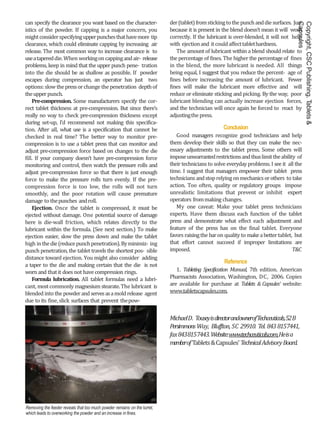
Excessive powder on the die table is a symp-
tom of non-optimized weight control. The photo
below shows what it looks like after cleaning.
Copyright,CSCPublishing.Tablets&
Capsules
When troubleshooting material-related problems, it’s
easy to say the formula is the problem. That may be, but
how is it “wrong?” There are many good formulas that are
just not put together correctly. It’s analogous to having a
dozen people follow the same recipe but not creating the
same dish. Certainly, they’d be similar, but without a writ-
ten procedure for each cooking step, the outcome is not
wholly predicable. That’s why technicians need to be
able to adjust the press: to offset the variation in the
blend. Likewise, just because you lay out clothes for a
young child doesn’t mean he or she will don all the gar-
ments or, if the child does, maybe not in the correct
order. Maybe the socks end up over the shoes. Here’s the
point: Ingredients must be added properly and in the cor-
rect order or you will encounter problems and defects.
Well-trained technicians with the support of their man-
ager might be able to save such batches. This would be an
impossible task for poorly trained operators or well-
trained technicianswho lacktheirmanager’s support.
Filling thedie. Getting powdersto flow uniformly into
the dies is an important skill. Without consistent fill- ing,
compressibility changes and thus the force required to
compressthe tablet varies.Inthat case,thetechnician hasa
choice: Slow the press, adjust pre-compression, adjust
punch penetration, or change the feeder speed. How do
technicians know whether they’ve responded correctly?
They perform weight checks. Under normal
circumstances,weights arechecked every30minutesor so.
But weight must be checked much more often if any
variation is discovered. In fact, the behavior of some
products is so unpredictable that they may require con-
tinuous weight monitoring. In short, the greater the vari-
ation of the ingredients and blend, the more often press
techniciansmust check(and adjust for)tablet weight.
Keeping powder in the die. If we’ve optimized die fill-
ing andtabletweightisundercontrol,thatmeanswe’ve also
optimized the feeder speed, turret speed, and scrape- off
function. Now it’s time to ensure that compression occurs
without the powders being “splashed”orpushed out of the
die.
During tabletting, compression squeezes the powder,
causing its particles to lock together as the interstitial air
escapes through the clearance between the die wall and
punch tip. Worn upper punch tips allow air to escape
morequickly thannewonesdo, andthatfact explains why
capping—a defect in which the tablet separates after
ejection due to unrelieved mechanical stress—occurs
more often with new tooling than with worn tooling. Less
escaping air can also lead to less brilliant, slightly softer
tablets. Controlling how much air escapes will often
improve tablet appearance, lock the particles together bet-
ter, and thus eliminate any capping while improving the
hardness andglossy appearance.
In fact, the best solution to capping is to compress the
powder lightly using pre-compression or by decreasing
turret speed. That method locks the particles together, so
that when the remaining air is pushed from the powder, it
to tamp the powders lightly to prevent fine particles from
migrating and causing a defect. Turret speed should be
adjusted in conjunction with the amount of clearance
between the die wall and punch tip, the punch depth pen-
etration,and theforceof pre-compression.
Upper punch tip clearance. When specifying or adjust-
ing the upper punch tip clearance, you might consult the
Tableting Specification Manual (TSM) [1]. The TSM pro-
vides a standard recommended clearance, which is a
mechanical clearance based on proper punch entrance into
the die. But you don’t have to abide by that standard.You
Powders thatform lumps make tablettinga real challenge.Also,inconsistent
powders make inconsistenttablets.
Copyright,CSCPublishing.Tablets&
Capsules
can specify the clearance you want based on the character-
istics of the powder. If capping is a major concern, you
mightconsiderspecifyingupperpunchesthathavemore tip
clearance, which could eliminate capping by increasing air
release. The most common way to increase clearance is to
useatapereddie.When workingoncappingandair- release
problems, keep in mind that the upper punch pene- tration
into the die should be as shallow as possible. If powder
escapes during compression, an operator has just two
options:slowthepressorchange thepenetration depthof
theupperpunch.
Pre-compression. Some manufacturers specify the cor-
rect tablet thickness at pre-compression. But since there’s
really no way to check pre-compression thickness except
during set-up, I’d recommend not making this specifica-
tion. After all, what use is a specification that cannot be
checked in real time? The better way to monitor pre-
compression is to use a tablet press that can monitor and
adjust pre-compression force based on changes to the die
fill. If your company doesn’t have pre-compression force
monitoring and control, then watch the pressure rolls and
adjust pre-compression force so that there is just enough
force to make the pressure rolls turn evenly. If the pre-
compression force is too low, the rolls will not turn
smoothly, and the poor rotation will cause premature
damage to thepunches androll.
Ejection. Once the tablet is compressed, it must be
ejected without damage. One potential source of damage
here is die-wall friction, which relates directly to the
lubricant within the formula. (See next section.) To make
ejection easier, slow the press down and make the tablet
high inthedie(reducepunchpenetration).Byminimiz- ing
punch penetration, the tablet travelsthe shortest pos- sible
distance toward ejection. You might also consider adding
a taper to the die and making certain that the die is not
worn and that it does not havecompression rings.
Formula lubrication. All tablet formulas need a lubri-
cant, mostcommonly magnesiumstearate.The lubricant is
blended into the powderandservesasamoldrelease agent
due to its fine,slick surfaces that prevent thepow-
der(tablet)fromstickingto the punchanddiesurfaces. Just
because it is present in the blend doesn’t mean it will work
correctly. If the lubricant is over-blended, it will not help
with ejectionand it couldaffecttablethardness.
The amount of lubricant within a blend should relate to
the percentage of fines. The higher the percentage of fines
in the blend, the more lubricant is needed. All things
being equal, I suggest that you reduce the percent- age of
fines before increasing the amount of lubricant. Fewer
fines will make the lubricant more effective and will
reduce or eliminate sticking and picking. By the way, poor
lubricant blending can actually increase ejection forces,
and the technician will once again be forced to react by
adjustingthepress.
Conclusion
Good managers recognize good technicians and help
them develop their skills so that they can make the nec-
essary adjustments to the tablet press. Some others will
imposeunwarrantedrestrictionsandthuslimittheability of
their technicians to solve everydayproblems. I see it all the
time. I suggest that managers empower their tablet press
techniciansandstoprelying onmechanicsorothers to take
action. Too often, quality or regulatory groups impose
unrealistic limitations that prevent or inhibit expert
operators frommaking changes.
My one caveat: Make your tablet press technicians
experts. Have them discuss each function of the tablet
press and demonstrate what effect each adjustment and
feature of the press has on the final tablet. Everyone
favors raisingthe baron quality to makeabettertablet, but
that effort cannot succeed if improper limitations are
imposed. T&C
Reference
1. Tableting Specification Manual, 7th edition. American
Pharmacists Association, Washington, DC, 2006. Copies
are available for purchase at Tablets & Capsules‘ website:
www.tabletscapsules.com.
MichaelD. TouseyisdirectorandownerofTechceuticals,52B
PersimmonsWay, Bluffton, SC 29910. Tel. 843 8157441,
fax8438157443.Website:www.techceuticals.com.Heisa
memberofTablets&Capsules’TechnicalAdvisoryBoard.
Removing the feeder reveals that too much powder remains on the turret,
which leads to overworking the powder and an increase in fines.

Tabletting - Relying on Tablet Press Technicians

  • 1.
    Copyright,CSCPublishing.Tablets& Capsules O tabletting relying on tabletpress technicians Michael Tousey Techceuticals Manycompanieslimittheadjustmentsthattechnicianscanmaketo the tablet press during a production run, even though such adjustmentsareanormalpartoftabletting.Thisarticlediscusses what adjustments may benecessary and encourages manufac- turingmanagerstosupporttheirtablettechnicians. in charge of the press bear the bad news. Before shooting the messenger, try to un- derstand what’s hap- pened and how to ad- dress it. The best way to do that is to talk withyourtechnicians. Many times, over- cautious colleagues working in the regu- latory and compliance areas—in the name of valida- tion—impose unrealistic limitations that prevent techni- cians from making proper adjustments to the tablet press. Press technicians must be allowed to make adjustments. Otherwise they can’t solve the problem and make the tablet meet final specifications. In fact, micro-managing tablet press operation may create more problems than it solves. Of course, a validated process demands that we follow guidelines to ensure reproducible results, but I’m going to let you in on a secret: Many products that are validated don’t work. How can these products pass “vali- dation” and yet not perform right in production? It’s sim- ple: Good and bad processes can both be validated. Validated does not mean optimized, only that we obtained reproducible results during (maybe) three pro- duction runs. The joke on validation thus becomes: The first result is luck, the second coincidence, and the third is validated. Of course, making pharmaceutical orother tabletsis no joke. It’s serious business, and we want high quality time aftertime.So testtheproposedvalidatedprocedures before they’reexecuted. That maysoundelementary, but I’ve seen people propose avalidation procedure, docu- ment it, and then hand it off to production staff without ever testing it. Good managers wouldn’t allow that to happen. Instead, they would work with their colleagues in regulatory compliance and with their technicians to avoid the implementation of unrealistic limitations. I sug- gest running the product morethan three times. Then conduct at least three test runs to prove that the valida- tion procedures really work, and have the production staff signoff on them. Areyoua goodmanager? Good managers share several traits. They are active inall areas of manufacturing. They invite communication ver the last 3 decades, I’ve been on the front line of many pharmaceutical and nutritional manufacturing oper- ations, both as a worker and as a consultant. It’s no sur- prise that at each company, the best managers have the most production success. This article describes how to support and promote advanced press operation. Wise managers will recognize that room should be left for technicians to account for typical variation in the press, its tooling, theenvironment,and the product. In tablet manufacturing, there is one clear objective: making a good tablet, and what actually comes off the tablet press reflects the activity of upstream operations. In that sense, a “bad” tablet is often destined to be so long before it reaches the press. Tablets are also affected by the processes that follow compression, including dedusting, coating, and packaging. Good tablets stem from good for- mulas andprocesses andwell-trained technicians. Validationisnotoptimization Many companies are plagued by troubled products. One day the product isrunningperfectly, andthenext day it suddenlyactsupandcreateshavoc. Becausethe problem is first observed atthetabletpress,thetechnicians Pickingdefect These broken tablets are the result of poor compressibility.
  • 2.
    Copyright,CSCPublishing.Tablets& Capsules andactuallylistento the peopleonthefront line. They can take both the micro and macro view of problems. They know what their staff is capable of, and they know the strengths and weaknesses of each staff member. They help staff get better at what they do. And, key to manu- facturing success, they understand how the many process variables affecttabletquality. At many companies tablet press technicians (formerly known as operators) are forbidden from adjusting the very tablet press functions that they have been trained to use.It isnot uncommonto hear,“Don’t touch that,” or “The mechanic does that,” or “QA will not let us change that,” and,thebig one,“It was pre-set at thefactory.” It’s no surprise that, during production, all managers want their technicians to follow the procedures to the let- ter.At thesametime, however,experiencehasshown that following the exact same steps each day will not always give you the same result. Why? Because each manufacturing step has some level of variation. Even the best raw materials are subject to variations from batch to batch and lot to lot. Add the variation within the process steps, and it’s clear that the people running the tablet press must be allowed to adjust it to obtain the desired results. The other option is to have operators stop the pressto search for the “right people” to adjustthe press. Of course, stopping the press means downtime and lost production,and no onelikes that. Variationisunavoidable Raw material variations may occur from environmental conditions, as well as variations within the materials themselves. Particle size, moisture content, density, age, aeration, static electricity, and many other metrics play a role. These physical variations can affect how well the granulation flows and compresses and how well the tablet ejects. Thankfully, every modern press has controls to ac- countfor thesevariations. That’s one reason that you want well-trained tablet press technicians who can to react to changes throughout the entire batch. As these expert technicians learn to associate the characteristics of the batch with the process, they will get better and better at making the product behave as it should on the tablet press. Note that I’m talking about trained technicians, not tablet press attendants, who typically only check tablet weights and hardness while watching for defects like capping, stick- ing, andthe appearance of black and/or gray specks on the tablets. Attendants are would-be technicians in need of training. I also recognize that some products are very demand- ing, challenging even the best technicians. I also acknowl- edge that it’s fairly easy to find technicians who lack expe- rience and cannot distinguish a powder problem from a press problem. But an outright ban on adjustments isn’t the answer, and I oppose writing up procedures in such a way that machine features cannot be changed or adjusted. After all, some tablet press functions require adjustmentsimply to account for the machine’s range of operation. These include punch penetration, pre-compression force, feeder speed, and turret speed. Add ingredient and process varia- tion to themixandthecaseismade:Techniciansneedto be able to react using the tools at hand to bring the final product back to the targetspecification. So why aretech- nicians so fre- quently hand- cuffed? It stems from poor training. Many knowledge- able technicians are forbidden from making changes without involving people from the maintenance, qual- ity, and regulatory groups. I’ve been asked to solve prob- lems at many com- panies and suffered from the same restrictions placed on the technicians. I hear, “You’re not allowed to change that setting,” even when adjusting the settingisnormalandmeantto helpsolvethe problem.So be wary of products that are“validated” with limitations. How can it be validated if it’s not repeatable? Solving tabletting problems requires changing the press settings, at the discretion of the technician. This should not be put up for a voteacrossdepartments. Let’s look at the basics of the tabletting process and some tablet press functions. The discussion may shed some light on why it’s important to have good, knowl- edgeable managers to help technicians do what they’re paid to do: Fine-tune and optimize the press settings to make thebest possibletablet. Blend variation. So-called “properly blended” ingredi- ents can be one of the biggest factors in determining how well products flow and compress. The objective of blend- ing many ingredients together is to achieve complete contentuniformity.That taskbecomesmoredifficultif the ingredients change ortheir properties change. Infact, even if the blend is perfect, the different characteristics of each powder may cause the blend to vary once it’s on the tablet press. Such variation can affect flow, compression, and ejection. That, in turn, can affect tablet weight, thickness, and hardness, which may cause disintegration and dissolution to vary. Next thing you know, the QA people say something like, “Can’t you control your press?” The operator then might respond with, “Hey, can’t you control the blend better?” The folks in charge of blending then say, “If you could give me more consistent powders Icouldgive youa better blend.”And so on. Excessive powder on the die table is a symp- tom of non-optimized weight control. The photo below shows what it looks like after cleaning.
  • 3.
    Copyright,CSCPublishing.Tablets& Capsules When troubleshooting material-relatedproblems, it’s easy to say the formula is the problem. That may be, but how is it “wrong?” There are many good formulas that are just not put together correctly. It’s analogous to having a dozen people follow the same recipe but not creating the same dish. Certainly, they’d be similar, but without a writ- ten procedure for each cooking step, the outcome is not wholly predicable. That’s why technicians need to be able to adjust the press: to offset the variation in the blend. Likewise, just because you lay out clothes for a young child doesn’t mean he or she will don all the gar- ments or, if the child does, maybe not in the correct order. Maybe the socks end up over the shoes. Here’s the point: Ingredients must be added properly and in the cor- rect order or you will encounter problems and defects. Well-trained technicians with the support of their man- ager might be able to save such batches. This would be an impossible task for poorly trained operators or well- trained technicianswho lacktheirmanager’s support. Filling thedie. Getting powdersto flow uniformly into the dies is an important skill. Without consistent fill- ing, compressibility changes and thus the force required to compressthe tablet varies.Inthat case,thetechnician hasa choice: Slow the press, adjust pre-compression, adjust punch penetration, or change the feeder speed. How do technicians know whether they’ve responded correctly? They perform weight checks. Under normal circumstances,weights arechecked every30minutesor so. But weight must be checked much more often if any variation is discovered. In fact, the behavior of some products is so unpredictable that they may require con- tinuous weight monitoring. In short, the greater the vari- ation of the ingredients and blend, the more often press techniciansmust check(and adjust for)tablet weight. Keeping powder in the die. If we’ve optimized die fill- ing andtabletweightisundercontrol,thatmeanswe’ve also optimized the feeder speed, turret speed, and scrape- off function. Now it’s time to ensure that compression occurs without the powders being “splashed”orpushed out of the die. During tabletting, compression squeezes the powder, causing its particles to lock together as the interstitial air escapes through the clearance between the die wall and punch tip. Worn upper punch tips allow air to escape morequickly thannewonesdo, andthatfact explains why capping—a defect in which the tablet separates after ejection due to unrelieved mechanical stress—occurs more often with new tooling than with worn tooling. Less escaping air can also lead to less brilliant, slightly softer tablets. Controlling how much air escapes will often improve tablet appearance, lock the particles together bet- ter, and thus eliminate any capping while improving the hardness andglossy appearance. In fact, the best solution to capping is to compress the powder lightly using pre-compression or by decreasing turret speed. That method locks the particles together, so that when the remaining air is pushed from the powder, it to tamp the powders lightly to prevent fine particles from migrating and causing a defect. Turret speed should be adjusted in conjunction with the amount of clearance between the die wall and punch tip, the punch depth pen- etration,and theforceof pre-compression. Upper punch tip clearance. When specifying or adjust- ing the upper punch tip clearance, you might consult the Tableting Specification Manual (TSM) [1]. The TSM pro- vides a standard recommended clearance, which is a mechanical clearance based on proper punch entrance into the die. But you don’t have to abide by that standard.You Powders thatform lumps make tablettinga real challenge.Also,inconsistent powders make inconsistenttablets.
  • 4.
    Copyright,CSCPublishing.Tablets& Capsules can specify theclearance you want based on the character- istics of the powder. If capping is a major concern, you mightconsiderspecifyingupperpunchesthathavemore tip clearance, which could eliminate capping by increasing air release. The most common way to increase clearance is to useatapereddie.When workingoncappingandair- release problems, keep in mind that the upper punch pene- tration into the die should be as shallow as possible. If powder escapes during compression, an operator has just two options:slowthepressorchange thepenetration depthof theupperpunch. Pre-compression. Some manufacturers specify the cor- rect tablet thickness at pre-compression. But since there’s really no way to check pre-compression thickness except during set-up, I’d recommend not making this specifica- tion. After all, what use is a specification that cannot be checked in real time? The better way to monitor pre- compression is to use a tablet press that can monitor and adjust pre-compression force based on changes to the die fill. If your company doesn’t have pre-compression force monitoring and control, then watch the pressure rolls and adjust pre-compression force so that there is just enough force to make the pressure rolls turn evenly. If the pre- compression force is too low, the rolls will not turn smoothly, and the poor rotation will cause premature damage to thepunches androll. Ejection. Once the tablet is compressed, it must be ejected without damage. One potential source of damage here is die-wall friction, which relates directly to the lubricant within the formula. (See next section.) To make ejection easier, slow the press down and make the tablet high inthedie(reducepunchpenetration).Byminimiz- ing punch penetration, the tablet travelsthe shortest pos- sible distance toward ejection. You might also consider adding a taper to the die and making certain that the die is not worn and that it does not havecompression rings. Formula lubrication. All tablet formulas need a lubri- cant, mostcommonly magnesiumstearate.The lubricant is blended into the powderandservesasamoldrelease agent due to its fine,slick surfaces that prevent thepow- der(tablet)fromstickingto the punchanddiesurfaces. Just because it is present in the blend doesn’t mean it will work correctly. If the lubricant is over-blended, it will not help with ejectionand it couldaffecttablethardness. The amount of lubricant within a blend should relate to the percentage of fines. The higher the percentage of fines in the blend, the more lubricant is needed. All things being equal, I suggest that you reduce the percent- age of fines before increasing the amount of lubricant. Fewer fines will make the lubricant more effective and will reduce or eliminate sticking and picking. By the way, poor lubricant blending can actually increase ejection forces, and the technician will once again be forced to react by adjustingthepress. Conclusion Good managers recognize good technicians and help them develop their skills so that they can make the nec- essary adjustments to the tablet press. Some others will imposeunwarrantedrestrictionsandthuslimittheability of their technicians to solve everydayproblems. I see it all the time. I suggest that managers empower their tablet press techniciansandstoprelying onmechanicsorothers to take action. Too often, quality or regulatory groups impose unrealistic limitations that prevent or inhibit expert operators frommaking changes. My one caveat: Make your tablet press technicians experts. Have them discuss each function of the tablet press and demonstrate what effect each adjustment and feature of the press has on the final tablet. Everyone favors raisingthe baron quality to makeabettertablet, but that effort cannot succeed if improper limitations are imposed. T&C Reference 1. Tableting Specification Manual, 7th edition. American Pharmacists Association, Washington, DC, 2006. Copies are available for purchase at Tablets & Capsules‘ website: www.tabletscapsules.com. MichaelD. TouseyisdirectorandownerofTechceuticals,52B PersimmonsWay, Bluffton, SC 29910. Tel. 843 8157441, fax8438157443.Website:www.techceuticals.com.Heisa memberofTablets&Capsules’TechnicalAdvisoryBoard. Removing the feeder reveals that too much powder remains on the turret, which leads to overworking the powder and an increase in fines.