TABE Level L Training (Updated to Forms 9/10) Developed by ACLS & SABES September 2010
Learning Objectives: Participants will be able to: understand the basics of standardized assessment administer the TABE Level L assessment appropriately and consistently score examinee booklets and interpret results with accuracy determine whether re-testing with a different assessment is warranted.
Agenda for Today Overview of assessment basics Where We Stand with GLE 0–1.9 Assessment Overview of TABE Complete Battery Examination of TABE Level L Sections Administration Walk-Through Scoring Activities Questions & (Hopefully) Answers
Status of 0-1.9 GLE Assessment Level 1 ELA Curriculum Frameworks Reading Standards are being developed. For now, we must use TABE Level L to report learner gain. Consider using the Diagnostic Assessment of Reading (DAR)— not required. Yields more diagnostic information. Information more closely aligned with CFs
TABE Forms 9/10 Overview:  Interview Locator Test “ Complete Battery” required sub-tests:   Applied Mathematics Reading Comprehension  Math Computation Language (grammar) Five Levels  for each test Equivalent Forms 9/10 L (Literacy) E (Easy) M (Medium) D (Difficult) A (Advanced)
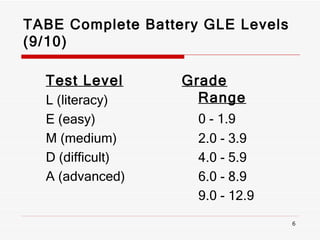
TABE Complete Battery GLE Levels (9/10) Test Level L (literacy) E (easy) M (medium) D (difficult) A (advanced) Grade Range 0 - 1.9 2.0 - 3.9 4.0 - 5.9 6.0 - 8.9 9.0 - 12.9
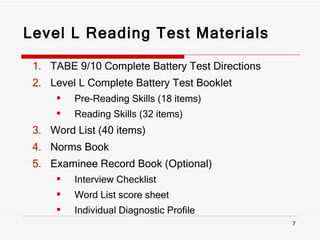
Level L Reading Test Materials TABE 9/10 Complete Battery Test Directions Level L Complete Battery Test Booklet Pre-Reading Skills (18 items) Reading Skills (32 items) Word List (40 items) Norms Book Examinee Record Book (Optional) Interview Checklist Word List score sheet Individual Diagnostic Profile
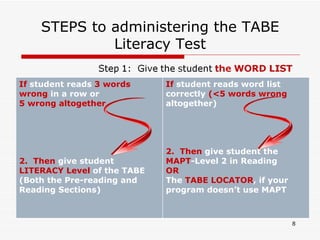
STEPS to administering the TABE Literacy Test If  student reads  3 words wrong  in a row or  5 wrong altogether 2.  Then  give student  LITERACY Level  of the TABE (Both the Pre-reading and Reading Sections) If  student reads word list correctly  (<5 words wrong  altogether) 2.  Then  give student the  MAPT -Level 2 in Reading OR The  TABE LOCATOR , if your program doesn’t use MAPT
Word List IS Are When City Do Like Know Only Be Have Some Best Of  What Could Also My Said About Give Can Two There Food For Eat Would Again All Hot Other Money The One People Phone Out New Any Because
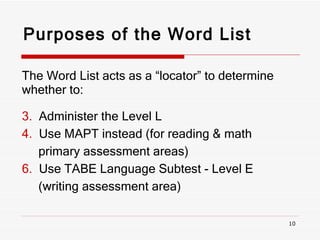
Purposes of the Word List The Word List acts as a “locator” to determine whether to: Administer the Level L Use MAPT instead (for reading & math  primary assessment areas) Use TABE Language Subtest - Level E  (writing assessment area)
Word List Administration Please turn to p. 17 of the Complete Battery Test Directions and briefly read through it. Would someone please summarize how this  List is administered? And would someone please summarize the  scoring and interpreting results section on  p.18?
The Two Tests: Pre-Reading Skills Sections   Items Matching Letters    6 Recognizing Letters  4 Beginning Sounds 2 Ending Sounds  2 Middle Sounds  4 All testing is entirely ‘scripted’ in  Complete Battery Test Directions and must not be changed/adapted
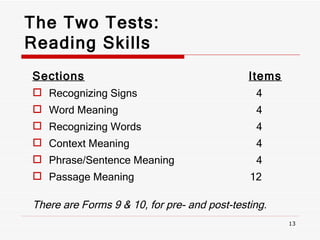
The Two Tests:  Reading Skills Sections     Items Recognizing Signs    4 Word Meaning    4 Recognizing Words 4 Context Meaning    4 Phrase/Sentence Meaning  4 Passage Meaning      12 There are Forms 9 & 10, for pre- and post-testing.
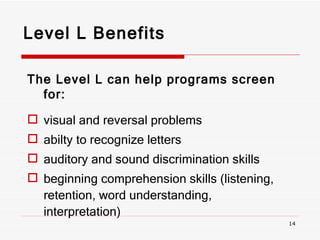
Level L Benefits The Level L can help programs screen for: visual and reversal problems abilty to recognize letters auditory and sound discrimination skills beginning comprehension skills (listening, retention, word understanding, interpretation)
Administration: Quick Overview The Pre-Reading and Reading Tests are: group administered hand-scorable administered orally by examiner while examinee chooses answers from a printed test booklet.
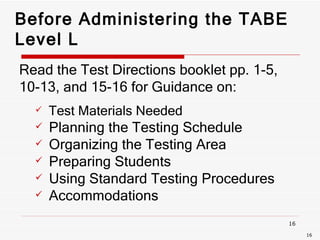
Before Administering the TABE Level L Read the Test Directions booklet pp. 1-5,  10-13, and 15-16 for Guidance on:  Test Materials Needed  Planning the Testing Schedule Organizing the Testing Area Preparing Students Using Standard Testing Procedures Accommodations
Tests must be administered as directed in the Tests Directions booklet. Test Administrators must read scripts exactly as provided in the Test Directions   booklet. The ultimate responsibility for appropriate test use and interpretation rests with you. Before Administering, cont’d.
Administration: Procedure Step One:  Word List Step Two:  Literacy Test (2 Parts) Step Three: Scoring
Suggested Testing Time There are no fixed times… Word List 15 Minutes Pre-Reading Skills 13 Minutes Reading Skills  32 Minutes From start to finish, approximately one hour.
Administration Walk-Through: Word List Pick a partner to “assess” with.  Choose who will be the examiner and who the examinee, give card to Examinee. Examinee:  Look at Word List card. Examiner: Turn to Page 5 of the  Examinee Record Book  and begin administering at the word “Say”. Examinee: Pretend to “pass”.
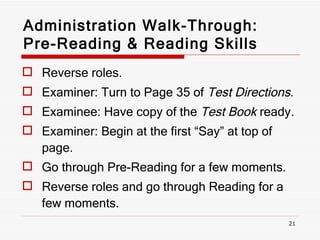
Administration Walk-Through: Pre-Reading & Reading Skills Reverse roles. Examiner: Turn to Page 35 of  Test Directions . Examinee: Have copy of the  Test Book  ready. Examiner: Begin at the first “Say” at top of page.  Go through Pre-Reading for a few moments. Reverse roles and go through Reading for a few moments.
Scoring:  Activity One Only the Reading Skills test results are used in determining Scale Scores (SSs), but both Pre-Reading and Reading are required. Locate the TABE 9 Complete Battery Level L norms table for Reading. If a student’s NC is 17, what is their SS? What is the Standard Error of Measurement (SEM) for that SS? What then are the Grade Level Equivalents (GLEs) for that SS?
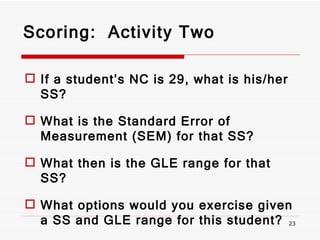
Scoring:  Activity Two If a student’s NC is 29, what is his/her SS? What is the Standard Error of Measurement (SEM) for that SS? What then is the GLE range for that SS? What options would you exercise given a SS and GLE range for this student?
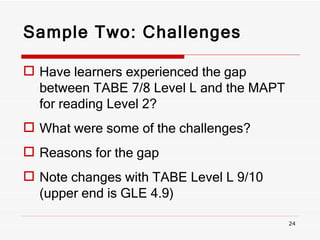
Sample Two: Challenges   Have learners experienced the gap between TABE 7/8 Level L and the MAPT for reading Level 2? What were some of the challenges? Reasons for the gap Note changes with TABE Level L 9/10 (upper end is GLE 4.9)
Sample Two: Options The goal is to have 2 tests in either TABE Level L or MAPT per FY Test Administrators may opt to use Level L for both Pre- and post-testing up to the GLE 4.9+ level Or they may opt to retest learners immediately in MAPT Level 2 and select reading as their Primary Assessment Area
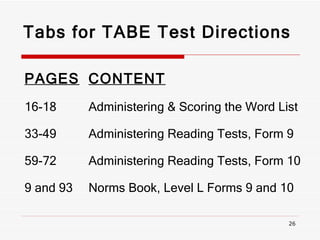
Tabs for TABE Test Directions PAGES CONTENT 16-18 Administering & Scoring the Word List 33-49 Administering Reading Tests, Form 9 59-72 Administering Reading Tests, Form 10 9 and 93 Norms Book, Level L Forms 9 and 10
Sample Two: Options (cont’d) Test administrators may opt to give both tests and list one in the Primary Assessment Area and one in the non-Primary Assessment Area (e.g., MAPT) Goal is to test appropriately—so learners can show what they know  Learners should not struggle to complete MAPT or take overlong (2+ hours)
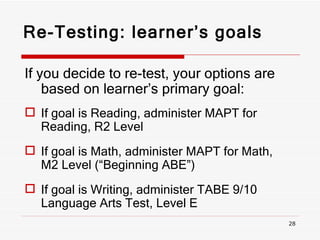
Re-Testing: learner’s goals If you decide to re-test, your options are based on learner’s primary goal: If goal is Reading, administer MAPT for Reading, R2 Level If goal is Math, administer MAPT for Math, M2 Level (“Beginning ABE”) If goal is Writing, administer TABE 9/10 Language Arts Test, Level E
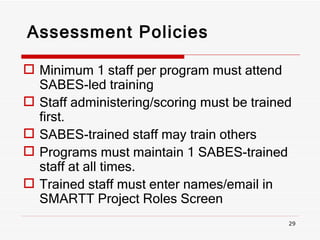
Assessment Policies Minimum 1 staff per program must attend SABES-led training Staff administering/scoring must be trained first. SABES-trained staff may train others Programs must maintain 1 SABES-trained staff at all times. Trained staff must enter names/email in SMARTT Project Roles Screen
Assessment Policies (cont’d) No certification/recertification Level L may be given at intake. See accommodations information in policy manual Teachers may administer/score their students.
Pre- and Post-Testing   Policies Pre-test within the first 2-4 weeks of class Recommended to post-test after 4 months or 65 hours of instruction, whichever comes first Learners with 65+ attended hours instruction before 2 months  may  test learners  May  not  test learners more than three times in a fiscal year Level L Reading for the pre-test must remain the same for the post-test; use alternate forms
“ Meaningful” Educational Gain Scale score points will be determined in  the Fall of 2011, after there is enough test  data to analyze.
Q&A and  Your Feedback! Let’s take some questions!

Tabe level l training ppt (fy11 final)[1]

  • 1.
    TABE Level LTraining (Updated to Forms 9/10) Developed by ACLS & SABES September 2010
  • 2.
    Learning Objectives: Participantswill be able to: understand the basics of standardized assessment administer the TABE Level L assessment appropriately and consistently score examinee booklets and interpret results with accuracy determine whether re-testing with a different assessment is warranted.
  • 3.
    Agenda for TodayOverview of assessment basics Where We Stand with GLE 0–1.9 Assessment Overview of TABE Complete Battery Examination of TABE Level L Sections Administration Walk-Through Scoring Activities Questions & (Hopefully) Answers
  • 4.
    Status of 0-1.9GLE Assessment Level 1 ELA Curriculum Frameworks Reading Standards are being developed. For now, we must use TABE Level L to report learner gain. Consider using the Diagnostic Assessment of Reading (DAR)— not required. Yields more diagnostic information. Information more closely aligned with CFs
  • 5.
    TABE Forms 9/10Overview: Interview Locator Test “ Complete Battery” required sub-tests: Applied Mathematics Reading Comprehension Math Computation Language (grammar) Five Levels for each test Equivalent Forms 9/10 L (Literacy) E (Easy) M (Medium) D (Difficult) A (Advanced)
  • 6.
    TABE Complete BatteryGLE Levels (9/10) Test Level L (literacy) E (easy) M (medium) D (difficult) A (advanced) Grade Range 0 - 1.9 2.0 - 3.9 4.0 - 5.9 6.0 - 8.9 9.0 - 12.9
  • 7.
    Level L ReadingTest Materials TABE 9/10 Complete Battery Test Directions Level L Complete Battery Test Booklet Pre-Reading Skills (18 items) Reading Skills (32 items) Word List (40 items) Norms Book Examinee Record Book (Optional) Interview Checklist Word List score sheet Individual Diagnostic Profile
  • 8.
    STEPS to administeringthe TABE Literacy Test If student reads 3 words wrong in a row or 5 wrong altogether 2. Then give student LITERACY Level of the TABE (Both the Pre-reading and Reading Sections) If student reads word list correctly (<5 words wrong altogether) 2. Then give student the MAPT -Level 2 in Reading OR The TABE LOCATOR , if your program doesn’t use MAPT
  • 9.
    Word List ISAre When City Do Like Know Only Be Have Some Best Of What Could Also My Said About Give Can Two There Food For Eat Would Again All Hot Other Money The One People Phone Out New Any Because
  • 10.
    Purposes of theWord List The Word List acts as a “locator” to determine whether to: Administer the Level L Use MAPT instead (for reading & math primary assessment areas) Use TABE Language Subtest - Level E (writing assessment area)
  • 11.
    Word List AdministrationPlease turn to p. 17 of the Complete Battery Test Directions and briefly read through it. Would someone please summarize how this List is administered? And would someone please summarize the scoring and interpreting results section on p.18?
  • 12.
    The Two Tests:Pre-Reading Skills Sections Items Matching Letters 6 Recognizing Letters 4 Beginning Sounds 2 Ending Sounds 2 Middle Sounds 4 All testing is entirely ‘scripted’ in Complete Battery Test Directions and must not be changed/adapted
  • 13.
    The Two Tests: Reading Skills Sections Items Recognizing Signs 4 Word Meaning 4 Recognizing Words 4 Context Meaning 4 Phrase/Sentence Meaning 4 Passage Meaning 12 There are Forms 9 & 10, for pre- and post-testing.
  • 14.
    Level L BenefitsThe Level L can help programs screen for: visual and reversal problems abilty to recognize letters auditory and sound discrimination skills beginning comprehension skills (listening, retention, word understanding, interpretation)
  • 15.
    Administration: Quick OverviewThe Pre-Reading and Reading Tests are: group administered hand-scorable administered orally by examiner while examinee chooses answers from a printed test booklet.
  • 16.
    Before Administering theTABE Level L Read the Test Directions booklet pp. 1-5, 10-13, and 15-16 for Guidance on: Test Materials Needed Planning the Testing Schedule Organizing the Testing Area Preparing Students Using Standard Testing Procedures Accommodations
  • 17.
    Tests must beadministered as directed in the Tests Directions booklet. Test Administrators must read scripts exactly as provided in the Test Directions booklet. The ultimate responsibility for appropriate test use and interpretation rests with you. Before Administering, cont’d.
  • 18.
    Administration: Procedure StepOne: Word List Step Two: Literacy Test (2 Parts) Step Three: Scoring
  • 19.
    Suggested Testing TimeThere are no fixed times… Word List 15 Minutes Pre-Reading Skills 13 Minutes Reading Skills 32 Minutes From start to finish, approximately one hour.
  • 20.
    Administration Walk-Through: WordList Pick a partner to “assess” with. Choose who will be the examiner and who the examinee, give card to Examinee. Examinee: Look at Word List card. Examiner: Turn to Page 5 of the Examinee Record Book and begin administering at the word “Say”. Examinee: Pretend to “pass”.
  • 21.
    Administration Walk-Through: Pre-Reading& Reading Skills Reverse roles. Examiner: Turn to Page 35 of Test Directions . Examinee: Have copy of the Test Book ready. Examiner: Begin at the first “Say” at top of page. Go through Pre-Reading for a few moments. Reverse roles and go through Reading for a few moments.
  • 22.
    Scoring: ActivityOne Only the Reading Skills test results are used in determining Scale Scores (SSs), but both Pre-Reading and Reading are required. Locate the TABE 9 Complete Battery Level L norms table for Reading. If a student’s NC is 17, what is their SS? What is the Standard Error of Measurement (SEM) for that SS? What then are the Grade Level Equivalents (GLEs) for that SS?
  • 23.
    Scoring: ActivityTwo If a student’s NC is 29, what is his/her SS? What is the Standard Error of Measurement (SEM) for that SS? What then is the GLE range for that SS? What options would you exercise given a SS and GLE range for this student?
  • 24.
    Sample Two: Challenges Have learners experienced the gap between TABE 7/8 Level L and the MAPT for reading Level 2? What were some of the challenges? Reasons for the gap Note changes with TABE Level L 9/10 (upper end is GLE 4.9)
  • 25.
    Sample Two: OptionsThe goal is to have 2 tests in either TABE Level L or MAPT per FY Test Administrators may opt to use Level L for both Pre- and post-testing up to the GLE 4.9+ level Or they may opt to retest learners immediately in MAPT Level 2 and select reading as their Primary Assessment Area
  • 26.
    Tabs for TABETest Directions PAGES CONTENT 16-18 Administering & Scoring the Word List 33-49 Administering Reading Tests, Form 9 59-72 Administering Reading Tests, Form 10 9 and 93 Norms Book, Level L Forms 9 and 10
  • 27.
    Sample Two: Options(cont’d) Test administrators may opt to give both tests and list one in the Primary Assessment Area and one in the non-Primary Assessment Area (e.g., MAPT) Goal is to test appropriately—so learners can show what they know Learners should not struggle to complete MAPT or take overlong (2+ hours)
  • 28.
    Re-Testing: learner’s goalsIf you decide to re-test, your options are based on learner’s primary goal: If goal is Reading, administer MAPT for Reading, R2 Level If goal is Math, administer MAPT for Math, M2 Level (“Beginning ABE”) If goal is Writing, administer TABE 9/10 Language Arts Test, Level E
  • 29.
    Assessment Policies Minimum1 staff per program must attend SABES-led training Staff administering/scoring must be trained first. SABES-trained staff may train others Programs must maintain 1 SABES-trained staff at all times. Trained staff must enter names/email in SMARTT Project Roles Screen
  • 30.
    Assessment Policies (cont’d)No certification/recertification Level L may be given at intake. See accommodations information in policy manual Teachers may administer/score their students.
  • 31.
    Pre- and Post-Testing Policies Pre-test within the first 2-4 weeks of class Recommended to post-test after 4 months or 65 hours of instruction, whichever comes first Learners with 65+ attended hours instruction before 2 months may test learners May not test learners more than three times in a fiscal year Level L Reading for the pre-test must remain the same for the post-test; use alternate forms
  • 32.
    “ Meaningful” EducationalGain Scale score points will be determined in the Fall of 2011, after there is enough test data to analyze.
  • 33.
    Q&A and Your Feedback! Let’s take some questions!