SAT
Raihanul Islam
The SAT Focuses on College
Success Skills
2
 Critical Reading
 Mathematics
 Writing
The SAT® tests students’ reasoning based on knowledge and
skills developed through their course work.
It measures their ability to analyze and solve problems by
applying what they have learned in school.
How hard is the SAT?
3
• 97% of college-bound students complete 3 years of math so
the test measures the math they are already studying.
• Extensive field trials confirmed that students are taking
more upper level math, which is why the overall difficulty
of the test is not affected.
• While the test is long, field trials also confirmed that
the increased length of the test has no impact on the
students’ scores.
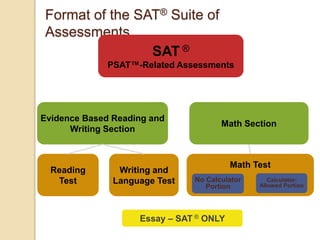
Format of the SAT® Suite of
Assessments
SAT ®
PSAT™-Related Assessments
Evidence Based Reading and
Writing Section
Math Section
Reading
Test
Writing and
Language Test
Math Test
No Calculator
Portion
Calculator-
Allowed Portion
Essay – SAT ® ONLY
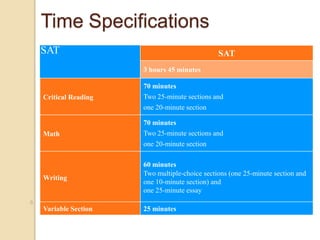
Time Specifications
6
SAT SAT
3 hours 45 minutes
Critical Reading
70 minutes
Two 25-minute sections and
one 20-minute section
Math
70 minutes
Two 25-minute sections and
one 20-minute section
Writing
60 minutes
Two multiple-choice sections (one 25-minute section and
one 10-minute section) and
one 25-minute essay
Variable Section 25 minutes
SAT ENGLISH
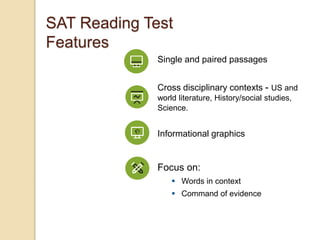
SAT Reading Test
Features
Single and paired passages
Cross disciplinary contexts - US and
world literature, History/social studies,
Science.
Informational graphics
Focus on:
 Words in context
 Command of evidence
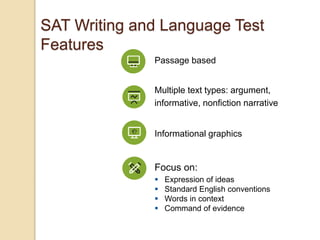
SAT Writing and Language Test
Features
Passage based
Multiple text types: argument,
informative, nonfiction narrative
Informational graphics
Focus on:
 Expression of ideas
 Standard English conventions
 Words in context
 Command of evidence
Content of the SAT
1
0
Critical Reading
• There are no analogies.
• Short reading passages have replaced analogies
and measure the kind of reasoning formerly
measured by analogies.
Writing
• Multiple-choice grammar and usage questions
• Measure the student’s understanding of how to use language in a
clear, consistent manner, how to revise and edit, and how to
recognize an error in a sentence.
• Student-written essay
1
1
•
 Measures the student’s use of language: logical presentation of
ideas, development of a point of view, and clarity of expression
under timed conditions.
 Essay practice tool provided AT NO COST to all schools
administering the PSAT/NMSQT.
Contents of the SAT
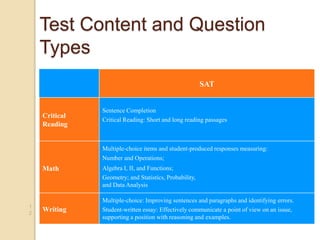
Test Content and Question
Types
1
2
SAT
Critical
Reading
Sentence Completion
Critical Reading: Short and long reading passages
Math
Multiple-choice items and student-produced responses measuring:
Number and Operations;
Algebra I, II, and Functions;
Geometry; and Statistics, Probability,
and Data Analysis
Writing
Multiple-choice: Improving sentences and paragraphs and identifying errors.
Student-written essay: Effectively communicate a point of view on an issue,
supporting a position with reasoning and examples.
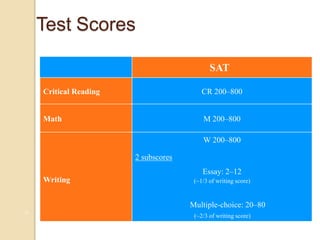
Test Scores
13
SAT
Critical Reading CR 200–800
Math M 200–800
Writing
W 200–800
2 subscores
Essay: 2–12
(~1/3 of writing score)
Multiple-choice: 20–80
(~2/3 of writing score)
11
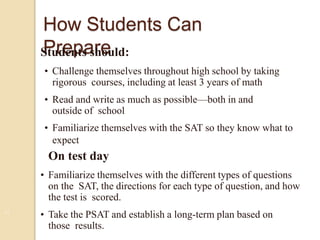
How Students Can
PrepareStudents should:
• Challenge themselves throughout high school by taking
rigorous courses, including at least 3 years of math
• Read and write as much as possible—both in and
outside of school
• Familiarize themselves with the SAT so they know what to
expect
On test day
• Familiarize themselves with the different types of questions
on the SAT, the directions for each type of question, and how
the test is scored.
• Take the PSAT and establish a long-term plan based on
those results.
THANK YOU

SAT Exam Structure

  • 1.
  • 2.
    The SAT Focuseson College Success Skills 2  Critical Reading  Mathematics  Writing The SAT® tests students’ reasoning based on knowledge and skills developed through their course work. It measures their ability to analyze and solve problems by applying what they have learned in school.
  • 3.
    How hard isthe SAT? 3 • 97% of college-bound students complete 3 years of math so the test measures the math they are already studying. • Extensive field trials confirmed that students are taking more upper level math, which is why the overall difficulty of the test is not affected. • While the test is long, field trials also confirmed that the increased length of the test has no impact on the students’ scores.
  • 4.
    Format of theSAT® Suite of Assessments SAT ® PSAT™-Related Assessments Evidence Based Reading and Writing Section Math Section Reading Test Writing and Language Test Math Test No Calculator Portion Calculator- Allowed Portion Essay – SAT ® ONLY
  • 6.
    Time Specifications 6 SAT SAT 3hours 45 minutes Critical Reading 70 minutes Two 25-minute sections and one 20-minute section Math 70 minutes Two 25-minute sections and one 20-minute section Writing 60 minutes Two multiple-choice sections (one 25-minute section and one 10-minute section) and one 25-minute essay Variable Section 25 minutes
  • 7.
  • 8.
    SAT Reading Test Features Singleand paired passages Cross disciplinary contexts - US and world literature, History/social studies, Science. Informational graphics Focus on:  Words in context  Command of evidence
  • 9.
    SAT Writing andLanguage Test Features Passage based Multiple text types: argument, informative, nonfiction narrative Informational graphics Focus on:  Expression of ideas  Standard English conventions  Words in context  Command of evidence
  • 10.
    Content of theSAT 1 0 Critical Reading • There are no analogies. • Short reading passages have replaced analogies and measure the kind of reasoning formerly measured by analogies.
  • 11.
    Writing • Multiple-choice grammarand usage questions • Measure the student’s understanding of how to use language in a clear, consistent manner, how to revise and edit, and how to recognize an error in a sentence. • Student-written essay 1 1 •  Measures the student’s use of language: logical presentation of ideas, development of a point of view, and clarity of expression under timed conditions.  Essay practice tool provided AT NO COST to all schools administering the PSAT/NMSQT. Contents of the SAT
  • 12.
    Test Content andQuestion Types 1 2 SAT Critical Reading Sentence Completion Critical Reading: Short and long reading passages Math Multiple-choice items and student-produced responses measuring: Number and Operations; Algebra I, II, and Functions; Geometry; and Statistics, Probability, and Data Analysis Writing Multiple-choice: Improving sentences and paragraphs and identifying errors. Student-written essay: Effectively communicate a point of view on an issue, supporting a position with reasoning and examples.
  • 13.
    Test Scores 13 SAT Critical ReadingCR 200–800 Math M 200–800 Writing W 200–800 2 subscores Essay: 2–12 (~1/3 of writing score) Multiple-choice: 20–80 (~2/3 of writing score)
  • 14.
    11 How Students Can PrepareStudentsshould: • Challenge themselves throughout high school by taking rigorous courses, including at least 3 years of math • Read and write as much as possible—both in and outside of school • Familiarize themselves with the SAT so they know what to expect On test day • Familiarize themselves with the different types of questions on the SAT, the directions for each type of question, and how the test is scored. • Take the PSAT and establish a long-term plan based on those results.
  • 15.