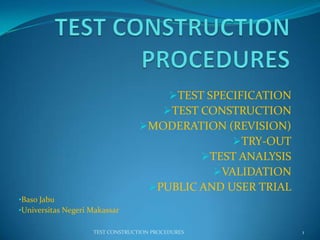
TEST SPECIFICATION
TEST CONSTRUCTION
MODERATION (REVISION)
TRY-OUT
TEST ANALYSIS
VALIDATION
PUBLIC AND USER TRIAL
•Baso Jabu
•Universitas Negeri Makassar
1TEST CONSTRUCTION PROCEDURES
Test Specifications
A test’s specifications provide the official statement
about what the test tests and how it tests it
 What is the purpose of the test?
 What sort of learner will be taking the test?
 How many sections should the test have?
 What text types should be chosen – written/spoken?
 What language skills should be tested?
 What language elements should be tested?
 What sort of tasks are required
2TEST CONSTRUCTION PROCEDURES
Test Specifications
 How many items are required for each section?
 What test methods are to be used?
 What rubrics are to be used as instructions?
 Which criteria will be used for assessment by markers?
3TEST CONSTRUCTION PROCEDURES
Test Specifications
Test specifications should include all or some of the following:
 The test’s purpose
 Description of the test taker
 Test level
 Construct (theoretical framework for test)
 Description of suitable language course or textbook
 Number of sections/papers
 Time of each section/paper
 Target language situation
 Text-types
 Text length
 Language skills to be tested
4TEST CONSTRUCTION PROCEDURES
Test Specifications
Test specifications should include all or some of the following:
 Language elements to be tested
 Test tasks
 Test methods
 Rubrics
 Criteria for marking
 Descriptions of typical performance of each level
 Descriptions of candidates at each level can do in the
real world
 Sample papers and Samples of students’ performance
on tasks
5TEST CONSTRUCTION PROCEDURES
Test Specifications
Three Domains
of Taxonomy
(Bloom):
Cognitive
Knowledge
Affective
Attitudes
Psychomotor
Skills
6TEST CONSTRUCTION PROCEDURES
Test Specifications
Cognitive
 Cognitive domains are objectives which emphasize
remembering or reproducing something which has
presumably been learned, as well as objectives which
involve the solving of some intellectual tasks for which
the individual has to determine the essential problem
and then reorder given material or combine it with
ideas, methods, or procedures previously learned.
7TEST CONSTRUCTION PROCEDURES
Test Specifications
Cognitive Domain
Six Major Areas
Evaluation
Synthesis
Analysis
Application
Knowledge
Comprehension
New Forms (Verbs)
Creating
Evaluating
Analyzing
Applying
Understanding
Remembering
8TEST CONSTRUCTION PROCEDURES
Test Specification
Cognitive Domain
 Knowledge refers to the recall of specific information;
 Comprehension refers to an understanding of what was
read;
 Application refers to the converting of abstract content to
concrete situations;
 Analysis refers to the comparison and contrast of the content
to personal experiences;
 Synthesis refers to the organization of thoughts, ideas, and
information from the content; and
 Evaluation refers to the judgment and evaluation of
characters, actions, outcome, etc., for personal reflection and
understanding
9TEST CONSTRUCTION PROCEDURES
Test Specification
Cognitive Domain
 Remembering indicates recalling information
(recognising, listing, describing, retrieving, naming, finding).
 Understanding signifies explaining ideas or concepts
(interpreting, summarising, paraphrasing, classifying, and
explaining).
 Applying conveys using information in another familiar situation
(implementing, carrying out, using, executing).
 Analysing denotes breaking information into parts to explore
understandings and relationships
(comparing, organising, deconstructing, interrogating, and
finding).
 Evaluating implies justifying a decision or course of action
(checking, hypothesising, critiquing, experimenting, and judging).
 Creating refers to generating new ideas, products, or ways of
viewing things
(designing, constructing, planning, producing, inventing).
10TEST CONSTRUCTION PROCEDURES
Test Specification
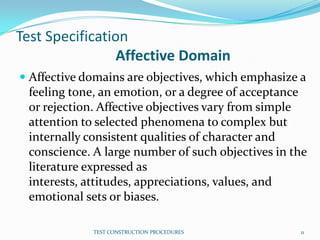
Affective Domain
 Affective domains are objectives, which emphasize a
feeling tone, an emotion, or a degree of acceptance
or rejection. Affective objectives vary from simple
attention to selected phenomena to complex but
internally consistent qualities of character and
conscience. A large number of such objectives in the
literature expressed as
interests, attitudes, appreciations, values, and
emotional sets or biases.
11TEST CONSTRUCTION PROCEDURES
Test Specification
Affective Domain
 Affective domains:
 Spiritual Attitude:  pious, virtuous
 Social Attitude:
1. Honest  to oneself and others
2. Disciplined  punctual and orderly
3. Responsible  take risk and apologize
4.Tolerance  respect others
5. Cooperative  work together
6.Polite  respect and behave well
7. Self-confident  brave and courageous
12TEST CONSTRUCTION PROCEDURES
Test Specification
Psychomotor Domain
 Psychomotor domains are objectives, which
emphasize some muscular or motor skill, some
manipulation of materials and objectives, or some
acts that requires a neuromuscular coordination.
13TEST CONSTRUCTION PROCEDURES
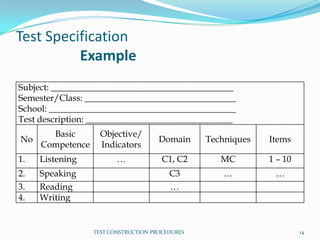
Test Specification
Example
Subject: _________________________________________
Semester/Class: __________________________________
School: __________________________________________
Test description: _________________________________
No
Basic
Competence
Objective/
Indicators
Domain Techniques Items
1. Listening … C1, C2 MC 1 – 10
2. Speaking C3 … …
3. Reading …
4. Writing
14TEST CONSTRUCTION PROCEDURES
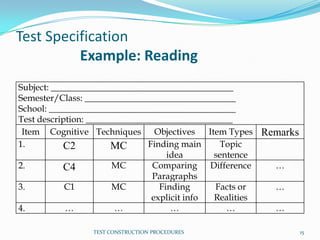
Test Specification
Example: Reading
Subject: _________________________________________
Semester/Class: __________________________________
School: __________________________________________
Test description: _________________________________
Item Cognitive Techniques Objectives Item Types Remarks
1. C2 MC Finding main
idea
Topic
sentence
2. C4 MC Comparing
Paragraphs
Difference …
3. C1 MC Finding
explicit info
Facts or
Realities
…
4. … … … … …
15TEST CONSTRUCTION PROCEDURES
Test Construction and Moderation
Item Writing and Revision
 In writing test items, one should ideally combine both necessary
formal professional
 The item writing must be based on the test specifications
 The method used for testing a language ability may itself affect
the students’ score, which is called the method effect
 It is likely that particular test methods will lend themselves to
testing some abilities, and not be so good at testing others
 In terms of test editing or moderation, each item and the test as
a whole are considered for the degree of match with the test
specifications, likely level of difficulty, possible unforeseen
problems, ambiguities in the wording of items and of
instructions, problems of layout, match between stems and
choices, and overall balance of the subtest or paper.
16TEST CONSTRUCTION PROCEDURES
Try-out
 However well designed a test may be, and however carefully
it has been edited, it is not likely to know how it will work
until it has been tried out on students.
 We do not only need to know how difficult the test items
are, but we also need to know whether they work.
 The number of students on whom a test should be trialed
depends on the importance and type of test, and also the
availability of suitable students. The only guiding rule is
the more the better, since the more students there are, the
less effect change will have on the results.
17TEST CONSTRUCTION PROCEDURES
Test Analysis
 This analysis will show us the extent to which each item works.
For objective test items, traditionally there are two measures of
calculation – the facility value and the discrimination index.
 For subjectively marked tests although item analysis is
inappropriate, such as summaries, essays, and oral
interviews, these tests still need to be tried out to see whether
the items elicit the intended sample of language; whether the
marking system, which should have been drafted during the
item writing stage, is usable; and whether the examiners are able
to mark consistently.
 Once the papers or interviews have been administered, there
should be trial marking sessions to see whether the test item
prompts have produced the intended kinds of responses, and
whether the marking guidelines and criteria are working
satisfactorily.
18TEST CONSTRUCTION PROCEDURES
Validation
 The most important question of all in language testing
is validity.
 The validation process involves the terms internal and
external validity, with the distinction being that
internal validity relates to studies of the perceived
content of the test and its perceived effect, and
external validity relates to studies comparing students’
test scores with measures of their ability gleaned from
outside the test.
 The commonest types of external validity are
concurrent validity and predictive validity.
 Expert Validation
19TEST CONSTRUCTION PROCEDURES
Public or User Trial
 The tests that have been constructed, tried out, and
analyzed should also be evaluated by public, especially
the future users of the tests. The tests are presented to
the future users and they analyze the tests, give
comments or suggestions to the improvement of the
tests, and approve the tests.
20TEST CONSTRUCTION PROCEDURES
Exercises
 What are the procedures in constructing a test?
 What should be included in the test specifications?
 Explain the three domains of taxonomy.
 What are the new terms in cognitive domains?
21TEST CONSTRUCTION PROCEDURES

Lt j-test construction procedure

  • 1.
    TEST SPECIFICATION TEST CONSTRUCTION MODERATION(REVISION) TRY-OUT TEST ANALYSIS VALIDATION PUBLIC AND USER TRIAL •Baso Jabu •Universitas Negeri Makassar 1TEST CONSTRUCTION PROCEDURES
  • 2.
    Test Specifications A test’sspecifications provide the official statement about what the test tests and how it tests it  What is the purpose of the test?  What sort of learner will be taking the test?  How many sections should the test have?  What text types should be chosen – written/spoken?  What language skills should be tested?  What language elements should be tested?  What sort of tasks are required 2TEST CONSTRUCTION PROCEDURES
  • 3.
    Test Specifications  Howmany items are required for each section?  What test methods are to be used?  What rubrics are to be used as instructions?  Which criteria will be used for assessment by markers? 3TEST CONSTRUCTION PROCEDURES
  • 4.
    Test Specifications Test specificationsshould include all or some of the following:  The test’s purpose  Description of the test taker  Test level  Construct (theoretical framework for test)  Description of suitable language course or textbook  Number of sections/papers  Time of each section/paper  Target language situation  Text-types  Text length  Language skills to be tested 4TEST CONSTRUCTION PROCEDURES
  • 5.
    Test Specifications Test specificationsshould include all or some of the following:  Language elements to be tested  Test tasks  Test methods  Rubrics  Criteria for marking  Descriptions of typical performance of each level  Descriptions of candidates at each level can do in the real world  Sample papers and Samples of students’ performance on tasks 5TEST CONSTRUCTION PROCEDURES
  • 6.
    Test Specifications Three Domains ofTaxonomy (Bloom): Cognitive Knowledge Affective Attitudes Psychomotor Skills 6TEST CONSTRUCTION PROCEDURES
  • 7.
    Test Specifications Cognitive  Cognitivedomains are objectives which emphasize remembering or reproducing something which has presumably been learned, as well as objectives which involve the solving of some intellectual tasks for which the individual has to determine the essential problem and then reorder given material or combine it with ideas, methods, or procedures previously learned. 7TEST CONSTRUCTION PROCEDURES
  • 8.
    Test Specifications Cognitive Domain SixMajor Areas Evaluation Synthesis Analysis Application Knowledge Comprehension New Forms (Verbs) Creating Evaluating Analyzing Applying Understanding Remembering 8TEST CONSTRUCTION PROCEDURES
  • 9.
    Test Specification Cognitive Domain Knowledge refers to the recall of specific information;  Comprehension refers to an understanding of what was read;  Application refers to the converting of abstract content to concrete situations;  Analysis refers to the comparison and contrast of the content to personal experiences;  Synthesis refers to the organization of thoughts, ideas, and information from the content; and  Evaluation refers to the judgment and evaluation of characters, actions, outcome, etc., for personal reflection and understanding 9TEST CONSTRUCTION PROCEDURES
  • 10.
    Test Specification Cognitive Domain Remembering indicates recalling information (recognising, listing, describing, retrieving, naming, finding).  Understanding signifies explaining ideas or concepts (interpreting, summarising, paraphrasing, classifying, and explaining).  Applying conveys using information in another familiar situation (implementing, carrying out, using, executing).  Analysing denotes breaking information into parts to explore understandings and relationships (comparing, organising, deconstructing, interrogating, and finding).  Evaluating implies justifying a decision or course of action (checking, hypothesising, critiquing, experimenting, and judging).  Creating refers to generating new ideas, products, or ways of viewing things (designing, constructing, planning, producing, inventing). 10TEST CONSTRUCTION PROCEDURES
  • 11.
    Test Specification Affective Domain Affective domains are objectives, which emphasize a feeling tone, an emotion, or a degree of acceptance or rejection. Affective objectives vary from simple attention to selected phenomena to complex but internally consistent qualities of character and conscience. A large number of such objectives in the literature expressed as interests, attitudes, appreciations, values, and emotional sets or biases. 11TEST CONSTRUCTION PROCEDURES
  • 12.
    Test Specification Affective Domain Affective domains:  Spiritual Attitude:  pious, virtuous  Social Attitude: 1. Honest  to oneself and others 2. Disciplined  punctual and orderly 3. Responsible  take risk and apologize 4.Tolerance  respect others 5. Cooperative  work together 6.Polite  respect and behave well 7. Self-confident  brave and courageous 12TEST CONSTRUCTION PROCEDURES
  • 13.
    Test Specification Psychomotor Domain Psychomotor domains are objectives, which emphasize some muscular or motor skill, some manipulation of materials and objectives, or some acts that requires a neuromuscular coordination. 13TEST CONSTRUCTION PROCEDURES
  • 14.
    Test Specification Example Subject: _________________________________________ Semester/Class:__________________________________ School: __________________________________________ Test description: _________________________________ No Basic Competence Objective/ Indicators Domain Techniques Items 1. Listening … C1, C2 MC 1 – 10 2. Speaking C3 … … 3. Reading … 4. Writing 14TEST CONSTRUCTION PROCEDURES
  • 15.
    Test Specification Example: Reading Subject:_________________________________________ Semester/Class: __________________________________ School: __________________________________________ Test description: _________________________________ Item Cognitive Techniques Objectives Item Types Remarks 1. C2 MC Finding main idea Topic sentence 2. C4 MC Comparing Paragraphs Difference … 3. C1 MC Finding explicit info Facts or Realities … 4. … … … … … 15TEST CONSTRUCTION PROCEDURES
  • 16.
    Test Construction andModeration Item Writing and Revision  In writing test items, one should ideally combine both necessary formal professional  The item writing must be based on the test specifications  The method used for testing a language ability may itself affect the students’ score, which is called the method effect  It is likely that particular test methods will lend themselves to testing some abilities, and not be so good at testing others  In terms of test editing or moderation, each item and the test as a whole are considered for the degree of match with the test specifications, likely level of difficulty, possible unforeseen problems, ambiguities in the wording of items and of instructions, problems of layout, match between stems and choices, and overall balance of the subtest or paper. 16TEST CONSTRUCTION PROCEDURES
  • 17.
    Try-out  However welldesigned a test may be, and however carefully it has been edited, it is not likely to know how it will work until it has been tried out on students.  We do not only need to know how difficult the test items are, but we also need to know whether they work.  The number of students on whom a test should be trialed depends on the importance and type of test, and also the availability of suitable students. The only guiding rule is the more the better, since the more students there are, the less effect change will have on the results. 17TEST CONSTRUCTION PROCEDURES
  • 18.
    Test Analysis  Thisanalysis will show us the extent to which each item works. For objective test items, traditionally there are two measures of calculation – the facility value and the discrimination index.  For subjectively marked tests although item analysis is inappropriate, such as summaries, essays, and oral interviews, these tests still need to be tried out to see whether the items elicit the intended sample of language; whether the marking system, which should have been drafted during the item writing stage, is usable; and whether the examiners are able to mark consistently.  Once the papers or interviews have been administered, there should be trial marking sessions to see whether the test item prompts have produced the intended kinds of responses, and whether the marking guidelines and criteria are working satisfactorily. 18TEST CONSTRUCTION PROCEDURES
  • 19.
    Validation  The mostimportant question of all in language testing is validity.  The validation process involves the terms internal and external validity, with the distinction being that internal validity relates to studies of the perceived content of the test and its perceived effect, and external validity relates to studies comparing students’ test scores with measures of their ability gleaned from outside the test.  The commonest types of external validity are concurrent validity and predictive validity.  Expert Validation 19TEST CONSTRUCTION PROCEDURES
  • 20.
    Public or UserTrial  The tests that have been constructed, tried out, and analyzed should also be evaluated by public, especially the future users of the tests. The tests are presented to the future users and they analyze the tests, give comments or suggestions to the improvement of the tests, and approve the tests. 20TEST CONSTRUCTION PROCEDURES
  • 21.
    Exercises  What arethe procedures in constructing a test?  What should be included in the test specifications?  Explain the three domains of taxonomy.  What are the new terms in cognitive domains? 21TEST CONSTRUCTION PROCEDURES