













SCHOLASTIC ASSESSMENT TEST
(SAT)
The test that takes you places!
Go Global!
What’s inside?
 What is SAT?
 What is the purpose of this test?
 Features of SAT
 Who takes this test?
 Structure of the test
- Critical Reading
- Mathematics
- Writing
 SAT style of questions
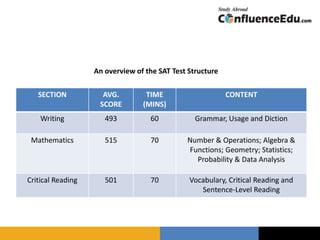
 An overview of the SAT test structure
 Preparing for the test
 How is the SAT scored?
More of what’s inside?
 How to interpret your SAT scores?
 Tips and tricks for the test day
 How to register for SAT?
 Paying for the test
 SAT – Your gateway to USA
 How important is your SAT score?
 Benefits of taking the SAT test
 What do colleges look for in your SAT scores?
THE WAY TO
SUCCESS!
What is SAT?
The SAT is a standardized test for
most undergraduate college admissions in
the United States. It is owned, published and
developed by the College Board, a nonprofit
organization in the United States.
It was formerly developed, published, and
scored by the Educational Testing Service which
still administers the exam.
What is the purpose of this test?
 SAT, as the name suggests, tests the aptitude
or intelligence through a standardized
medium.
 The test is intended to assess a student's
readiness for college.
 It measures literacy and writing skills that
are needed for academic success in college.
 The test assesses how well the test takers
analyze and solve problems.
 SAT scores will help to determine admission
of a student at American institutions.
The main idea behind conducting the SAT is to
have a common scale through which all
students seeking admission in colleges can be
judged.
This makes the task simpler for the college
authorities in addition to being fair to the
students.
Features of SAT
 It’s more of an aptitude test, measuring reasoning
and verbal abilities
 Results are accepted by virtually all U.S. colleges and
universities
 These scores are intended to supplement your
transcript but are often used for college admissions
requirements, course placement and scholarships
 It has a mandatory writing portion, including one 25-
minute essay and a 35-minute multiple-choice section
 The SAT counts off for wrong answers, except in the
math section where you fill in your responses
 It has 44 fewer questions than the ACT, which means
the SAT takes less time to complete
 The SAT has three components: critical reading,
mathematics and writing, but offers additional
subject tests – at an additional cost – in specific
areas
 In addition to multiple choice questions, the SAT has
a math section that requires students to produce
their own answers.
 It’s more of an aptitude test, measuring
reasoning and verbal abilities.
 Results are accepted by virtually all U.S.
colleges and universities.
 The SAT counts off for wrong answers
except in the math section
 It has 44 fewer questions than the ACT
Who takes this test?
The SAT is typically taken by
- High school sophomores
- Juniors
- Seniors
Structure of the test
SAT consists of three major sections:
 Critical Reading
 Mathematics
- Calculator Use
 Writing
Each section receives a score on the scale of
200–800. All scores are multiples of 10. Total
scores are calculated by adding up scores of
the three sections. Each major section is
divided into three parts. There are 10 sub-
sections.
Test Structure
Section 1 – Critical Reading
This section (a.k.a Verbal Section) is made up of 3
scored sections. This section is basically designed to
test your ability to read and understand written
English of the level you need to make the most of a
university course. There are two types of questions:
 Sentence Completion
 Reading Comprehension
The questions in the Critical Reading section require
a level of vocabulary that should not be a problem if
you have been in the habit of reading good books
throughout your high school career.
However, if you are not a good reader, or if English is
your second language, you will have to work hard to
raise your vocabulary to the required level.
Critical Reading – Tips and Tricks!
 Focus on the main idea of the passage
 Here you’re not looking for an exactly right
answer. You have to look for the best possible
answer among the choices they give you
 Time management is quite essential here. Spend
as less time as possible on sentence completion
and more on passage based reading
 Reading each word carefully is the key
WE HELP
YOU CRACK
THOSE
PASSAGES
AND READ
BETWEEN
THE LINES!
Test Structure
Section 2 – Mathematics
The Mathematics section of the SAT is widely known
as the Quantitative Section or Calculation Section
and consists of three scored sections.
The SAT has done away with quantitative
comparison questions on the math section, leaving
only questions with symbolic or numerical answers.
The Mathematics section goes as follows:
 One of the 25-minute sections is entirely multiple
choice, with 20 questions.
 The other 25-minute section contains 8 multiple
choice questions and 10 grid-in questions. There
is no penalty for incorrect answers on grid-in
questions because the test-taker is not limited to
a few possible choices
 The 20-minute section is all multiple choice, with
16 questions.
Mathematics section – calculator use
Four-function, scientific, and graphing calculators
are permitted on the SAT math section; however,
calculators are not permitted on either of the other
sections. Calculators with QWERTY keyboards, cell
phone calculators, portable computers, and personal
organizers are not permitted.
Mathematics – Tips and Tricks!
 The test does not require you to memorize formulas.
Commonly used formulas are provided in the test book
at the beginning of each mathematics section. It is up
to you to decide which formula is appropriate
 With some problems, it may be useful to draw a sketch
or diagram of the given information
WE HELP YOU
PERFORM
MATH
MIRACLES!
Test Structure
Section 3 – Writing
The writing section of the SAT includes multiple
choice questions and a brief essay. The essay
subscore contributes about 28% to the total writing
score, with the multiple choice questions
contributing 70%.
The multiple choice questions section include error
identification questions, sentence improvement
questions, and paragraph improvement questions.
This section tests the student's knowledge of
grammar, presenting an awkward or grammatically
incorrect sentence; the student must locate the
word producing the source of the error or indicate
that the sentence has no error, while the sentence
improvement section requires the student to select
an acceptable fix to the awkward sentence.
The essay section, which is always administered as
the first section of the test, is 25 minutes long. All
essays must be in response to a given prompt. The
prompts are broad and often philosophical and are
designed to be accessible to students regardless of
their educational and social backgrounds.
LET
CREATIVITY
FLOW
THROUGH
YOU!
SAT – Style of questions
 Most of the questions on the SAT, except for the
essay and the grid-in math responses, are multiple
choice; all multiple-choice questions have five
answer choices, one of which is correct
 The questions of each section of the same type
are generally ordered by difficulty.
An overview of the SAT Test Structure
SECTION AVG.
SCORE
TIME
(MINS)
CONTENT
Writing 493 60 Grammar, Usage and Diction
Mathematics 515 70 Number & Operations; Algebra &
Functions; Geometry; Statistics;
Probability & Data Analysis
Critical Reading 501 70 Vocabulary, Critical Reading and
Sentence-Level Reading
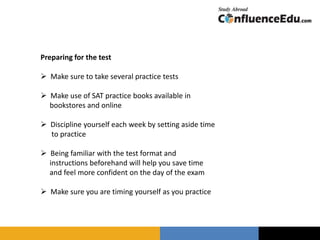
Preparing for the test
 Make sure to take several practice tests
 Make use of SAT practice books available in
bookstores and online
 Discipline yourself each week by setting aside time
to practice
 Being familiar with the test format and
instructions beforehand will help you save time
and feel more confident on the day of the exam
 Make sure you are timing yourself as you practice
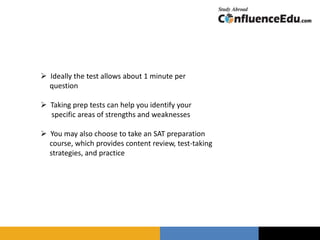
 Ideally the test allows about 1 minute per
question
 Taking prep tests can help you identify your
specific areas of strengths and weaknesses
 You may also choose to take an SAT preparation
course, which provides content review, test-taking
strategies, and practice
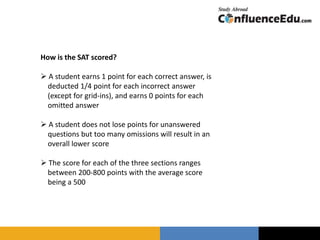
How is the SAT scored?
 A student earns 1 point for each correct answer, is
deducted 1/4 point for each incorrect answer
(except for grid-ins), and earns 0 points for each
omitted answer
 A student does not lose points for unanswered
questions but too many omissions will result in an
overall lower score
 The score for each of the three sections ranges
between 200-800 points with the average score
being a 500
 1500 is an average composite score and the
maximum score is 2400
 The essay is given a score between 2-12, whereby
two graders each give the essay a score from 1-6
 It is believed that there is a strong positive
correlation between the length of the essay and
the essay’s score
How to interpret your SAT scores?
There are two key ways to interpret your test results: in
terms of your own expectations and abilities and in
comparison to reported college averages and score
ranges.
On the first count, if you have been doing a reasonable
amount of SAT test prep, you should have a sense of a
realistic score range to expect for yourself. Then
evaluate how you perform on the actual SAT:
(P.T.O)
 If you exceed that practice range, then you probably
don’t need to retake the test
 If you are substantially below the range, then you
probably should try to take the SAT again, preferably
after taking additional SAT prep
 If you hit somewhere in the middle of what you
hoped for, then take a break from the test and
consider retaking it, after continued review shows
you that you have a reasonable expectation of
bringing up your scores about 30 to 40 points in one
or more sections
Tips for the Test Day
 Eat breakfast. It will help prevent light headedness
that may result from hunger and give you enough
energy to make it though the test.
 Be on time. Moderators of these tests are strict, and
you could be disqualified if you show up late.
 Read each answer. Some questions have several
answers that might work
 Read and consider each possible answer before
choosing the one that best responds to the question.
 Pace yourself. Don’t spend too much time on any one
question. If you’re stumped, move on to the next
question and come back later. Remember time is of
the essence.
 Answer easy questions first. Then, go back and
answer the more difficult ones.
 Use logic. Eliminate as many incorrect answers as you
can – then make an educated guess from the ones
left.
BE SAT READY
AND
LEAP TO SUCCESS!
How to register for SAT?
International students can register for the SAT in any of
the three ways:
 Online
 By mail with a copy of The Paper Registration Guide
for the SAT and the SAT Subject Tests, which should
be available at your school
 Through an SAT International Representative (see
below)
Students outside the U.S. may visit an Education USA
advising center or an abroad education consultancy in
their city or region to learn more about college
admission testing. Many also offer SAT registration
materials and computers for students to register online.
Paying for the test
All payment must be paid in United States dollars in one
of the following forms:
 Credit card
- Visa
- MasterCard
- American Express
- Discover
 Bank draft
 Check drawn on a U.S. bank
 United States Postal Service money order
 International money order
 UNESCO coupon
How much does the
test cost?
The test costs $51
SAT – Your gateway to USA!
In the ever-changing landscape of college admissions,
SAT plays an important and direct role towards your
college application and ultimately your admission.
SAT serves as the admission criteria for UG colleges in
the US. A good score could land you in the top colleges
which offer the best courses to get your career on track!
The relative importance of test scores depends on two
things:
1) which college to which you are applying
2) whether we are talking about admissions or
scholarships
BE A
CAREER
SUPERSTAR!
STUDY IN
THE US!
How important are your SAT scores?
 Your SAT scores can tell admissions staff members
how well prepared you are for college-level
academics
 The SAT is the best independent, standardized
measure of a student's college readiness. It is
standardized across all students, schools, and
states—providing a common and objective scale for
comparison
 SAT scores help colleges interpret students' overall
academic performance in relation to the national
applicant pool
GO GLOBAL !!!
Benefits of taking the SAT test
 It is one of the eligibility factors to get into colleges
in the U.S
 Holds open many study abroad opportunities
 Gateway to career building
 Gives you a competitive edge over others
 Accepted throughout USA
What do colleges look for in your CAT scores?
When applying to colleges, it is important to understand
what college admissions officers are looking for. Most
colleges place great importance on a student’s
cumulative high school GPA (Grade Point Average),
rigorous coursework, SAT/ACT standardized test scores,
application essay, and letters of recommendation. In
addition, extracurricular activities, volunteer work,
ethnicity, work experience, and state residency are also
strongly considered.
WE ARE
CONFLUENCE EDUCATIONAL SERVICES PVT LTD
STUDY ABROAD CAREER PROFESSIONALS
WE ARE
OPPORTUNITIES
AND POSSIBILITES
AT ITS BEST!
JOIN US AND LET US
MAKE YOUR
WORLD WIDE DREAMS
COME TRUE.
OH YES! WE MEAN IT –
BE IT ANY PART OF THE
WORLD!
THANK YOU

SAT Test by Confluence Educational Services Pvt Ltd

  • 1.
    SCHOLASTIC ASSESSMENT TEST (SAT) Thetest that takes you places! Go Global!
  • 2.
    What’s inside?  Whatis SAT?  What is the purpose of this test?  Features of SAT  Who takes this test?  Structure of the test - Critical Reading - Mathematics - Writing  SAT style of questions  An overview of the SAT test structure  Preparing for the test  How is the SAT scored?
  • 3.
    More of what’sinside?  How to interpret your SAT scores?  Tips and tricks for the test day  How to register for SAT?  Paying for the test  SAT – Your gateway to USA  How important is your SAT score?  Benefits of taking the SAT test  What do colleges look for in your SAT scores?
  • 4.
  • 5.
    What is SAT? TheSAT is a standardized test for most undergraduate college admissions in the United States. It is owned, published and developed by the College Board, a nonprofit organization in the United States. It was formerly developed, published, and scored by the Educational Testing Service which still administers the exam.
  • 6.
    What is thepurpose of this test?  SAT, as the name suggests, tests the aptitude or intelligence through a standardized medium.  The test is intended to assess a student's readiness for college.  It measures literacy and writing skills that are needed for academic success in college.  The test assesses how well the test takers analyze and solve problems.  SAT scores will help to determine admission of a student at American institutions.
  • 7.
    The main ideabehind conducting the SAT is to have a common scale through which all students seeking admission in colleges can be judged. This makes the task simpler for the college authorities in addition to being fair to the students.
  • 8.
    Features of SAT It’s more of an aptitude test, measuring reasoning and verbal abilities  Results are accepted by virtually all U.S. colleges and universities  These scores are intended to supplement your transcript but are often used for college admissions requirements, course placement and scholarships  It has a mandatory writing portion, including one 25- minute essay and a 35-minute multiple-choice section
  • 9.
     The SATcounts off for wrong answers, except in the math section where you fill in your responses  It has 44 fewer questions than the ACT, which means the SAT takes less time to complete  The SAT has three components: critical reading, mathematics and writing, but offers additional subject tests – at an additional cost – in specific areas  In addition to multiple choice questions, the SAT has a math section that requires students to produce their own answers.
  • 10.
     It’s moreof an aptitude test, measuring reasoning and verbal abilities.  Results are accepted by virtually all U.S. colleges and universities.  The SAT counts off for wrong answers except in the math section  It has 44 fewer questions than the ACT
  • 11.
    Who takes thistest? The SAT is typically taken by - High school sophomores - Juniors - Seniors
  • 12.
    Structure of thetest SAT consists of three major sections:  Critical Reading  Mathematics - Calculator Use  Writing
  • 13.
    Each section receivesa score on the scale of 200–800. All scores are multiples of 10. Total scores are calculated by adding up scores of the three sections. Each major section is divided into three parts. There are 10 sub- sections.
  • 14.
    Test Structure Section 1– Critical Reading This section (a.k.a Verbal Section) is made up of 3 scored sections. This section is basically designed to test your ability to read and understand written English of the level you need to make the most of a university course. There are two types of questions:  Sentence Completion  Reading Comprehension
  • 15.
    The questions inthe Critical Reading section require a level of vocabulary that should not be a problem if you have been in the habit of reading good books throughout your high school career. However, if you are not a good reader, or if English is your second language, you will have to work hard to raise your vocabulary to the required level.
  • 16.
    Critical Reading –Tips and Tricks!  Focus on the main idea of the passage  Here you’re not looking for an exactly right answer. You have to look for the best possible answer among the choices they give you  Time management is quite essential here. Spend as less time as possible on sentence completion and more on passage based reading  Reading each word carefully is the key
  • 17.
    WE HELP YOU CRACK THOSE PASSAGES ANDREAD BETWEEN THE LINES!
  • 18.
    Test Structure Section 2– Mathematics The Mathematics section of the SAT is widely known as the Quantitative Section or Calculation Section and consists of three scored sections. The SAT has done away with quantitative comparison questions on the math section, leaving only questions with symbolic or numerical answers.
  • 19.
    The Mathematics sectiongoes as follows:  One of the 25-minute sections is entirely multiple choice, with 20 questions.  The other 25-minute section contains 8 multiple choice questions and 10 grid-in questions. There is no penalty for incorrect answers on grid-in questions because the test-taker is not limited to a few possible choices  The 20-minute section is all multiple choice, with 16 questions.
  • 20.
    Mathematics section –calculator use Four-function, scientific, and graphing calculators are permitted on the SAT math section; however, calculators are not permitted on either of the other sections. Calculators with QWERTY keyboards, cell phone calculators, portable computers, and personal organizers are not permitted.
  • 21.
    Mathematics – Tipsand Tricks!  The test does not require you to memorize formulas. Commonly used formulas are provided in the test book at the beginning of each mathematics section. It is up to you to decide which formula is appropriate  With some problems, it may be useful to draw a sketch or diagram of the given information
  • 22.
  • 23.
    Test Structure Section 3– Writing The writing section of the SAT includes multiple choice questions and a brief essay. The essay subscore contributes about 28% to the total writing score, with the multiple choice questions contributing 70%.
  • 24.
    The multiple choicequestions section include error identification questions, sentence improvement questions, and paragraph improvement questions. This section tests the student's knowledge of grammar, presenting an awkward or grammatically incorrect sentence; the student must locate the word producing the source of the error or indicate that the sentence has no error, while the sentence improvement section requires the student to select an acceptable fix to the awkward sentence.
  • 25.
    The essay section,which is always administered as the first section of the test, is 25 minutes long. All essays must be in response to a given prompt. The prompts are broad and often philosophical and are designed to be accessible to students regardless of their educational and social backgrounds.
  • 26.
  • 27.
    SAT – Styleof questions  Most of the questions on the SAT, except for the essay and the grid-in math responses, are multiple choice; all multiple-choice questions have five answer choices, one of which is correct  The questions of each section of the same type are generally ordered by difficulty.
  • 28.
    An overview ofthe SAT Test Structure SECTION AVG. SCORE TIME (MINS) CONTENT Writing 493 60 Grammar, Usage and Diction Mathematics 515 70 Number & Operations; Algebra & Functions; Geometry; Statistics; Probability & Data Analysis Critical Reading 501 70 Vocabulary, Critical Reading and Sentence-Level Reading
  • 29.
    Preparing for thetest  Make sure to take several practice tests  Make use of SAT practice books available in bookstores and online  Discipline yourself each week by setting aside time to practice  Being familiar with the test format and instructions beforehand will help you save time and feel more confident on the day of the exam  Make sure you are timing yourself as you practice
  • 30.
     Ideally thetest allows about 1 minute per question  Taking prep tests can help you identify your specific areas of strengths and weaknesses  You may also choose to take an SAT preparation course, which provides content review, test-taking strategies, and practice
  • 31.
    How is theSAT scored?  A student earns 1 point for each correct answer, is deducted 1/4 point for each incorrect answer (except for grid-ins), and earns 0 points for each omitted answer  A student does not lose points for unanswered questions but too many omissions will result in an overall lower score  The score for each of the three sections ranges between 200-800 points with the average score being a 500
  • 32.
     1500 isan average composite score and the maximum score is 2400  The essay is given a score between 2-12, whereby two graders each give the essay a score from 1-6  It is believed that there is a strong positive correlation between the length of the essay and the essay’s score
  • 33.
    How to interpretyour SAT scores? There are two key ways to interpret your test results: in terms of your own expectations and abilities and in comparison to reported college averages and score ranges. On the first count, if you have been doing a reasonable amount of SAT test prep, you should have a sense of a realistic score range to expect for yourself. Then evaluate how you perform on the actual SAT: (P.T.O)
  • 34.
     If youexceed that practice range, then you probably don’t need to retake the test  If you are substantially below the range, then you probably should try to take the SAT again, preferably after taking additional SAT prep  If you hit somewhere in the middle of what you hoped for, then take a break from the test and consider retaking it, after continued review shows you that you have a reasonable expectation of bringing up your scores about 30 to 40 points in one or more sections
  • 35.
    Tips for theTest Day  Eat breakfast. It will help prevent light headedness that may result from hunger and give you enough energy to make it though the test.  Be on time. Moderators of these tests are strict, and you could be disqualified if you show up late.  Read each answer. Some questions have several answers that might work  Read and consider each possible answer before choosing the one that best responds to the question.
  • 36.
     Pace yourself.Don’t spend too much time on any one question. If you’re stumped, move on to the next question and come back later. Remember time is of the essence.  Answer easy questions first. Then, go back and answer the more difficult ones.  Use logic. Eliminate as many incorrect answers as you can – then make an educated guess from the ones left.
  • 37.
  • 38.
    How to registerfor SAT? International students can register for the SAT in any of the three ways:  Online  By mail with a copy of The Paper Registration Guide for the SAT and the SAT Subject Tests, which should be available at your school  Through an SAT International Representative (see below)
  • 39.
    Students outside theU.S. may visit an Education USA advising center or an abroad education consultancy in their city or region to learn more about college admission testing. Many also offer SAT registration materials and computers for students to register online.
  • 40.
    Paying for thetest All payment must be paid in United States dollars in one of the following forms:  Credit card - Visa - MasterCard - American Express - Discover  Bank draft  Check drawn on a U.S. bank  United States Postal Service money order  International money order  UNESCO coupon How much does the test cost? The test costs $51
  • 41.
    SAT – Yourgateway to USA! In the ever-changing landscape of college admissions, SAT plays an important and direct role towards your college application and ultimately your admission. SAT serves as the admission criteria for UG colleges in the US. A good score could land you in the top colleges which offer the best courses to get your career on track! The relative importance of test scores depends on two things: 1) which college to which you are applying 2) whether we are talking about admissions or scholarships
  • 42.
  • 43.
    How important areyour SAT scores?  Your SAT scores can tell admissions staff members how well prepared you are for college-level academics  The SAT is the best independent, standardized measure of a student's college readiness. It is standardized across all students, schools, and states—providing a common and objective scale for comparison  SAT scores help colleges interpret students' overall academic performance in relation to the national applicant pool
  • 44.
  • 45.
    Benefits of takingthe SAT test  It is one of the eligibility factors to get into colleges in the U.S  Holds open many study abroad opportunities  Gateway to career building  Gives you a competitive edge over others  Accepted throughout USA
  • 46.
    What do collegeslook for in your CAT scores? When applying to colleges, it is important to understand what college admissions officers are looking for. Most colleges place great importance on a student’s cumulative high school GPA (Grade Point Average), rigorous coursework, SAT/ACT standardized test scores, application essay, and letters of recommendation. In addition, extracurricular activities, volunteer work, ethnicity, work experience, and state residency are also strongly considered.
  • 47.
    WE ARE CONFLUENCE EDUCATIONALSERVICES PVT LTD STUDY ABROAD CAREER PROFESSIONALS
  • 48.
  • 49.
    JOIN US ANDLET US MAKE YOUR WORLD WIDE DREAMS COME TRUE. OH YES! WE MEAN IT – BE IT ANY PART OF THE WORLD!
  • 50.