Administering & Scoring  TABE 9/10: Transitioning from Forms 7/8 to 9/10 July 2010 SABES is funded by the Massachusetts Department of Elementary and Secondary Education.
Course Learning Objectives: Understand the basics and importance of  standardized  testing. Administer, score and interpret the TABE 9/10 Locator and Levels  E  through  A   appropriately, accurately, and consistently. Identify the  differences  between Forms 7/8 and 9/10.
Level L  (Literacy) & New Administrators: Level L Test Administrators  & those new to TABE will need to attend a face-to-face  SABES training in order to be trained and certified to administer the TABE Levels L through A. Please contact the  SABES  Curriculum and Assessment Coordinator in your region for more information.  http://sabes.org/assessment/people.htm
Please have these materials in hand before continuing with this PPT: TABE 9/10 Norms Book TABE 9/10 Locator Directions TABE 9/10 Complete Battery Test Directions Booklet MA DESE TABE Policy Manual (revised) Paper and a Writing Instrument
History/Background  of Using  TABE  in Massachusetts ABE Programs
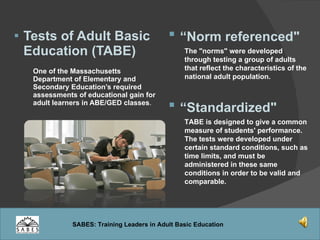
Tests of Adult Basic Education (TABE) One of the Massachusetts Department of Elementary and Secondary Education’s required assessments of educational gain for adult learners in ABE/GED classes .  “ Norm referenced"  The "norms" were developed through testing a group of adults that reflect the characteristics of the national adult population.  “ Standardized"  TABE is designed to give a common measure of students' performance. The tests were developed under certain standard conditions, such as time limits, and must be administered in these same conditions in order to be valid and comparable.
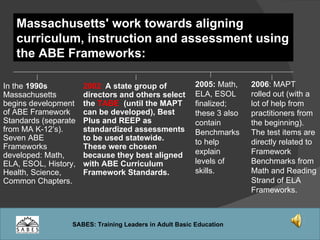
In the  1990s  Massachusetts begins development of ABE Framework Standards (separate from MA K-12’s). Seven ABE Frameworks developed: Math, ELA, ESOL, History, Health, Science, Common Chapters. 2002 :  A state group of directors and others select the  TABE   (until the MAPT can be developed), Best Plus and REEP as standardized assessments to be used statewide.  These were chosen because they best aligned with ABE Curriculum Framework Standards. 2005:  Math, ELA, ESOL finalized; these 3 also contain Benchmarks to help explain levels of skills. 2006 : MAPT rolled out (with a lot of help from practitioners from the beginning). The test items are directly related to Framework Benchmarks from Math and Reading Strand of ELA Frameworks. Massachusetts' work towards aligning curriculum, instruction and assessment using the ABE Frameworks:
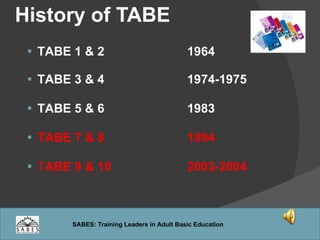
History of TABE TABE 1 & 2 1964 TABE 3 & 4   1974-1975 TABE 5 & 6 1983 TABE 7 & 8 1994 T ABE 9 & 10   2003-2004
TABE Changes  from 7/8 to 9/10
except for a few additions and revisions…. Mathematics content area  added to Level L   (although we are only using Reading) “ Order of Operations” content  added to Mathematics Computation  “ Statistics and Probability” content  added to  Applied Mathematics and  objectives revised Basic Structure is the Same
9/10’s  Updated Content Measuring three types of literacy needed for today’s jobs: PROSE LITERACY —reading and understanding written text  DOCUMENT LITERACY —understanding content  of common documents QUANTITATIVE LITERACY —merging knowledge  of numerical and word content
Grounded in Basic Skills &  Higher Order Thinking Skills   Assessing for everyday  basic literacy  demands AND  cognitive complexity Literacy Level expanded Aligned with the 2003  NALS Report  to the Nation on Adult Literacy Performance Higher level content matches the  GED
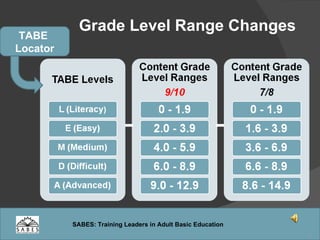
Grade Level Range Changes TABE  Locator
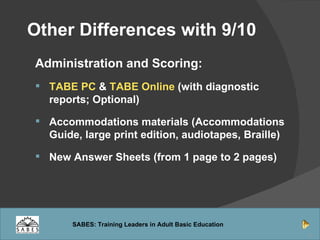
  Other Differences with 9/10   Administration and Scoring: TABE PC  &  TABE Online  (with diagnostic reports; Optional) Accommodations materials (Accommodations Guide, large print edition, audiotapes, Braille) New Answer Sheets (from 1 page to 2 pages)
Who Should Use the TABE?
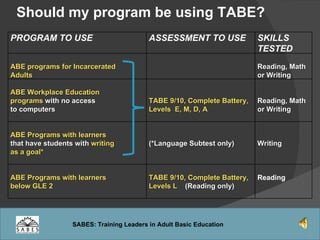
Should my program be using TABE?  PROGRAM TO USE ASSESSMENT TO USE SKILLS TESTED ABE programs for Incarcerated  Adults Reading, Math or Writing ABE Workplace Education  programs  with no access  to computers TABE 9/10, Complete Battery, Levels  E, M, D, A Reading, Math or Writing ABE Programs with learners  that have students with  writing  as a goal* (*Language Subtest only) Writing ABE Programs with learners  below GLE 2  TABE 9/10, Complete Battery, Levels L  (Reading only) Reading
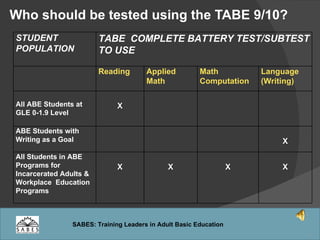
Who should be tested using the TABE 9/10?  STUDENT  POPULATION TABE  COMPLETE BATTERY TEST/SUBTEST TO USE Reading Applied Math Math Computation Language (Writing) All ABE Students at GLE 0-1.9 Level  X ABE Students with Writing as a Goal  X All Students in ABE Programs for Incarcerated Adults &  Workplace  Education Programs X X X X
Who should  NOT  be tested with TABE? ABE Students at GLE 2.0 + being  tested in Reading & Math Students in ESOL classes
Administering the TABE
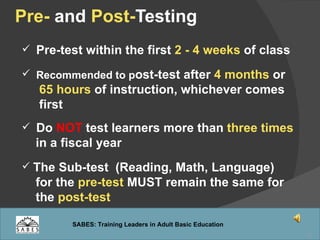
Pre-  and  Post- Testing  Pre-test within the first  2 - 4 weeks  of class Recommended to p ost-test after  4 months  or  65 hours  of instruction, whichever comes  first Do  NOT  test learners more than  three times in a fiscal year The Sub-test  (Reading, Math, Language)  for the  pre-test  MUST remain the same for  the  post-test
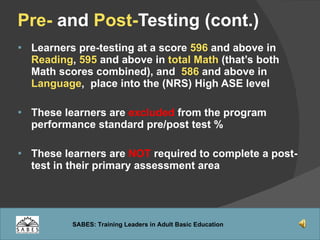
Pre-  and  Post- Testing (cont.) Learners pre-testing at a score  596   and above in  Reading ,  595  and above in  total Math  (that’s both Math scores combined), and  586  and above in  Language ,  place into the (NRS) High ASE level These learners are  excluded  from the program performance standard pre/post test % These learners are  NOT  required to complete a post-test in their primary assessment area
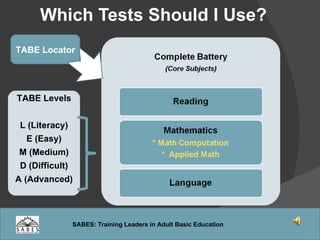
Which Tests Should I Use? TABE Locator TABE Levels L (Literacy) E (Easy) M (Medium) D (Difficult) A (Advanced)
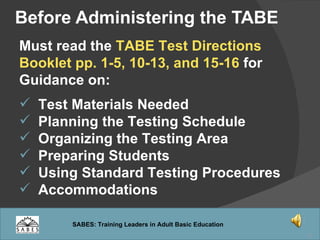
Before Administering the TABE Must read the  TABE Test Directions Booklet pp. 1-5, 10-13, and 15-16  for Guidance on: Test Materials Needed Planning the Testing Schedule Organizing the Testing Area Preparing Students Using Standard Testing Procedures Accommodations
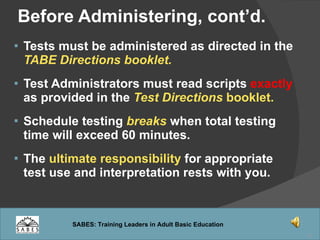
Tests must be administered as directed in the  TABE Directions booklet. Test Administrators must read scripts  exactly  as provided in the  Test Directions  booklet. Schedule testing  breaks  when total testing time will exceed 60 minutes. The  ultimate responsibility  for appropriate test use and interpretation rests with you. Before Administering, cont’d.
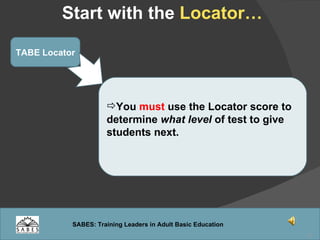
Start with the  Locator… TABE Locator You  must  use the Locator score to determine  what level  of test to give students next.
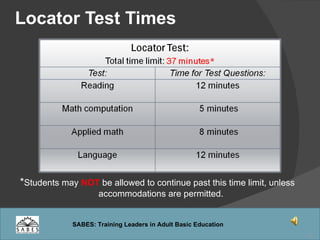
Locator Test Times * Students may  NOT  be allowed to continue past this time limit, unless accommodations are permitted.
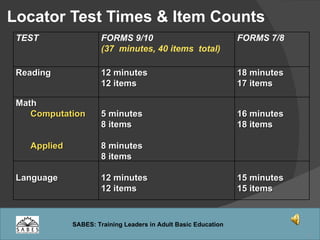
Locator   Test Times & Item Counts  TEST FORMS 9/10 (37  minutes, 40 items  total) FORMS 7/8 Reading 12 minutes 12 items 18 minutes 17 items Math Computation  Applied 5 minutes 8 items 8 minutes 8 items 16 minutes 18 items Language 12 minutes 12 items 15 minutes 15 items
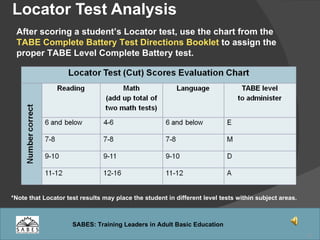
Locator Test Analysis After scoring a student’s Locator test, use the chart from the  TABE Complete Battery Test Directions Booklet  to assign the proper TABE Level Complete Battery test. *Note that Locator test results may place the student in different level tests within subject areas.
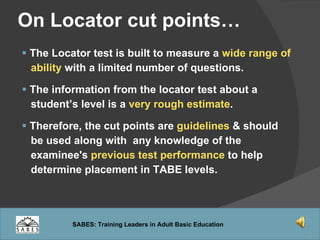
On Locator cut points… The Locator test is built to measure a  wide range of  ability  with a limited number of questions. The information from the locator test about a  student’s level is a  very rough estimate . Therefore, the cut points are  guidelines  & should be used along with  any knowledge of the  examinee's  previous test performance  to help  determine placement in TABE levels.
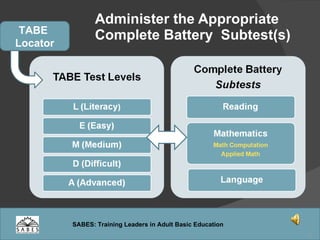
Administer the Appropriate Complete Battery  Subtest(s) TABE  Locator
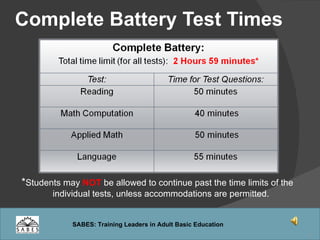
Complete Battery Test Times * Students may  NOT  be allowed to continue past the time limits of the individual tests, unless accommodations are permitted.
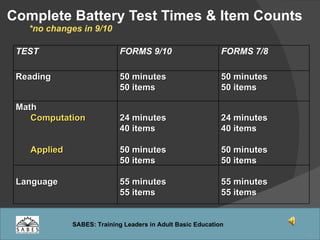
Complete Battery Test Times & Item Counts   *no changes in 9/10  TEST FORMS 9/10 FORMS 7/8 Reading 50 minutes 50 items 50 minutes 50 items Math Computation  Applied 24 minutes 40 items 50 minutes 50 items 24 minutes 40 items 50 minutes 50 items Language 55 minutes 55 items 55 minutes 55 items
Scoring & Reporting TABE Test Results
Scoring Specifics (non-Math) Total the numbers of correct (NC) items on the test. In the  Norms Book , locate the appropriate Norms Table for the level of the Test you are scoring for Reading, Math Computation, Applied Math and/or Language. Convert the NC score to its corresponding scale score. Record the scale score in  SMARTT .
Math  Scoring Specifics (1) Math Computation  and  Applied Math  have  separate  NC scores, which must be combined into a single Scale Score and GE. Determine the Number-Correct scores  separately  for Math Computation and Applied Math tests. Go to the appropriate level and form (9 or 10) in the Norms Book and locate the set of tables used to determine Total Math scale scores  Level E = Table 11 or 78 Level M = Table 19 or 86 Level D = Table 27 or 94 Level A = Table 35 or 102
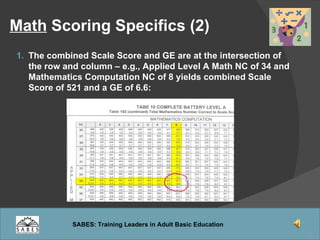
Math  Scoring Specifics (2) The combined Scale Score and GE are at the intersection of the row and column – e.g., Applied Level A Math NC of 34 and Mathematics Computation NC of 8 yields combined Scale Score of 521 and a GE of 6.6:
“ Meaningful” Educational Gain Scale score points will be determined in the spring of 2011, after there is test data to analyze
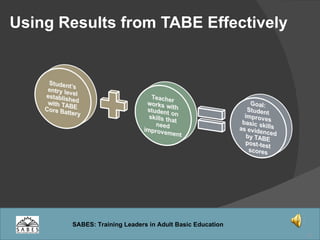
Using Results from TABE Effectively
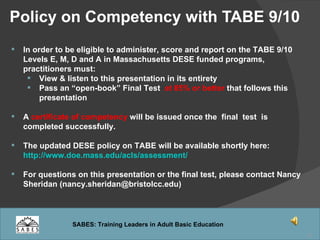
Policy on Competency with TABE 9/10  In order to be eligible to administer, score and report on the TABE 9/10 Levels E, M, D and A in Massachusetts DESE funded programs, practitioners must: View & listen to this presentation in its entirety Pass an “open-book” Final Test  at 85% or better  that follows this presentation A  certificate of competency  will be issued once the  final  test  is completed successfully. The updated DESE policy on TABE will be available shortly here:  http://www.doe.mass.edu/acls/assessment/ For questions on this presentation or the final test, please contact Nancy Sheridan (nancy.sheridan@bristolcc.edu)
You’ve come to the end of the PowerPoint Activity Your next step is to take the short test, which is located in the Moodle course. Please go back to the Moodle course and take the test. You will have one attempt at the test.

Administering & scoring tabe 9 10

  • 1.
    Administering & Scoring TABE 9/10: Transitioning from Forms 7/8 to 9/10 July 2010 SABES is funded by the Massachusetts Department of Elementary and Secondary Education.
  • 2.
    Course Learning Objectives:Understand the basics and importance of standardized testing. Administer, score and interpret the TABE 9/10 Locator and Levels E through A appropriately, accurately, and consistently. Identify the differences between Forms 7/8 and 9/10.
  • 3.
    Level L (Literacy) & New Administrators: Level L Test Administrators & those new to TABE will need to attend a face-to-face SABES training in order to be trained and certified to administer the TABE Levels L through A. Please contact the SABES Curriculum and Assessment Coordinator in your region for more information. http://sabes.org/assessment/people.htm
  • 4.
    Please have thesematerials in hand before continuing with this PPT: TABE 9/10 Norms Book TABE 9/10 Locator Directions TABE 9/10 Complete Battery Test Directions Booklet MA DESE TABE Policy Manual (revised) Paper and a Writing Instrument
  • 5.
    History/Background ofUsing TABE in Massachusetts ABE Programs
  • 6.
    Tests of AdultBasic Education (TABE) One of the Massachusetts Department of Elementary and Secondary Education’s required assessments of educational gain for adult learners in ABE/GED classes . “ Norm referenced" The "norms" were developed through testing a group of adults that reflect the characteristics of the national adult population. “ Standardized" TABE is designed to give a common measure of students' performance. The tests were developed under certain standard conditions, such as time limits, and must be administered in these same conditions in order to be valid and comparable.
  • 7.
    In the 1990s Massachusetts begins development of ABE Framework Standards (separate from MA K-12’s). Seven ABE Frameworks developed: Math, ELA, ESOL, History, Health, Science, Common Chapters. 2002 : A state group of directors and others select the TABE (until the MAPT can be developed), Best Plus and REEP as standardized assessments to be used statewide. These were chosen because they best aligned with ABE Curriculum Framework Standards. 2005: Math, ELA, ESOL finalized; these 3 also contain Benchmarks to help explain levels of skills. 2006 : MAPT rolled out (with a lot of help from practitioners from the beginning). The test items are directly related to Framework Benchmarks from Math and Reading Strand of ELA Frameworks. Massachusetts' work towards aligning curriculum, instruction and assessment using the ABE Frameworks:
  • 8.
    History of TABETABE 1 & 2 1964 TABE 3 & 4 1974-1975 TABE 5 & 6 1983 TABE 7 & 8 1994 T ABE 9 & 10 2003-2004
  • 9.
    TABE Changes from 7/8 to 9/10
  • 10.
    except for afew additions and revisions…. Mathematics content area added to Level L (although we are only using Reading) “ Order of Operations” content added to Mathematics Computation “ Statistics and Probability” content added to Applied Mathematics and objectives revised Basic Structure is the Same
  • 11.
    9/10’s UpdatedContent Measuring three types of literacy needed for today’s jobs: PROSE LITERACY —reading and understanding written text DOCUMENT LITERACY —understanding content of common documents QUANTITATIVE LITERACY —merging knowledge of numerical and word content
  • 12.
    Grounded in BasicSkills & Higher Order Thinking Skills Assessing for everyday basic literacy demands AND cognitive complexity Literacy Level expanded Aligned with the 2003 NALS Report to the Nation on Adult Literacy Performance Higher level content matches the GED
  • 13.
    Grade Level RangeChanges TABE Locator
  • 14.
    OtherDifferences with 9/10 Administration and Scoring: TABE PC & TABE Online (with diagnostic reports; Optional) Accommodations materials (Accommodations Guide, large print edition, audiotapes, Braille) New Answer Sheets (from 1 page to 2 pages)
  • 15.
    Who Should Usethe TABE?
  • 16.
    Should my programbe using TABE? PROGRAM TO USE ASSESSMENT TO USE SKILLS TESTED ABE programs for Incarcerated Adults Reading, Math or Writing ABE Workplace Education programs with no access to computers TABE 9/10, Complete Battery, Levels E, M, D, A Reading, Math or Writing ABE Programs with learners that have students with writing as a goal* (*Language Subtest only) Writing ABE Programs with learners below GLE 2 TABE 9/10, Complete Battery, Levels L (Reading only) Reading
  • 17.
    Who should betested using the TABE 9/10? STUDENT POPULATION TABE COMPLETE BATTERY TEST/SUBTEST TO USE Reading Applied Math Math Computation Language (Writing) All ABE Students at GLE 0-1.9 Level X ABE Students with Writing as a Goal X All Students in ABE Programs for Incarcerated Adults & Workplace Education Programs X X X X
  • 18.
    Who should NOT be tested with TABE? ABE Students at GLE 2.0 + being tested in Reading & Math Students in ESOL classes
  • 19.
  • 20.
    Pre- and Post- Testing Pre-test within the first 2 - 4 weeks of class Recommended to p ost-test after 4 months or 65 hours of instruction, whichever comes first Do NOT test learners more than three times in a fiscal year The Sub-test (Reading, Math, Language) for the pre-test MUST remain the same for the post-test
  • 21.
    Pre- and Post- Testing (cont.) Learners pre-testing at a score 596 and above in Reading , 595 and above in total Math (that’s both Math scores combined), and 586 and above in Language , place into the (NRS) High ASE level These learners are excluded from the program performance standard pre/post test % These learners are NOT required to complete a post-test in their primary assessment area
  • 22.
    Which Tests ShouldI Use? TABE Locator TABE Levels L (Literacy) E (Easy) M (Medium) D (Difficult) A (Advanced)
  • 23.
    Before Administering theTABE Must read the TABE Test Directions Booklet pp. 1-5, 10-13, and 15-16 for Guidance on: Test Materials Needed Planning the Testing Schedule Organizing the Testing Area Preparing Students Using Standard Testing Procedures Accommodations
  • 24.
    Tests must beadministered as directed in the TABE Directions booklet. Test Administrators must read scripts exactly as provided in the Test Directions booklet. Schedule testing breaks when total testing time will exceed 60 minutes. The ultimate responsibility for appropriate test use and interpretation rests with you. Before Administering, cont’d.
  • 25.
    Start with the Locator… TABE Locator You must use the Locator score to determine what level of test to give students next.
  • 26.
    Locator Test Times* Students may NOT be allowed to continue past this time limit, unless accommodations are permitted.
  • 27.
    Locator Test Times & Item Counts TEST FORMS 9/10 (37 minutes, 40 items total) FORMS 7/8 Reading 12 minutes 12 items 18 minutes 17 items Math Computation Applied 5 minutes 8 items 8 minutes 8 items 16 minutes 18 items Language 12 minutes 12 items 15 minutes 15 items
  • 28.
    Locator Test AnalysisAfter scoring a student’s Locator test, use the chart from the TABE Complete Battery Test Directions Booklet to assign the proper TABE Level Complete Battery test. *Note that Locator test results may place the student in different level tests within subject areas.
  • 29.
    On Locator cutpoints… The Locator test is built to measure a wide range of ability with a limited number of questions. The information from the locator test about a student’s level is a very rough estimate . Therefore, the cut points are guidelines & should be used along with any knowledge of the examinee's previous test performance to help determine placement in TABE levels.
  • 30.
    Administer the AppropriateComplete Battery Subtest(s) TABE Locator
  • 31.
    Complete Battery TestTimes * Students may NOT be allowed to continue past the time limits of the individual tests, unless accommodations are permitted.
  • 32.
    Complete Battery TestTimes & Item Counts *no changes in 9/10 TEST FORMS 9/10 FORMS 7/8 Reading 50 minutes 50 items 50 minutes 50 items Math Computation Applied 24 minutes 40 items 50 minutes 50 items 24 minutes 40 items 50 minutes 50 items Language 55 minutes 55 items 55 minutes 55 items
  • 33.
    Scoring & ReportingTABE Test Results
  • 34.
    Scoring Specifics (non-Math)Total the numbers of correct (NC) items on the test. In the Norms Book , locate the appropriate Norms Table for the level of the Test you are scoring for Reading, Math Computation, Applied Math and/or Language. Convert the NC score to its corresponding scale score. Record the scale score in SMARTT .
  • 35.
    Math ScoringSpecifics (1) Math Computation and Applied Math have separate NC scores, which must be combined into a single Scale Score and GE. Determine the Number-Correct scores separately for Math Computation and Applied Math tests. Go to the appropriate level and form (9 or 10) in the Norms Book and locate the set of tables used to determine Total Math scale scores Level E = Table 11 or 78 Level M = Table 19 or 86 Level D = Table 27 or 94 Level A = Table 35 or 102
  • 36.
    Math ScoringSpecifics (2) The combined Scale Score and GE are at the intersection of the row and column – e.g., Applied Level A Math NC of 34 and Mathematics Computation NC of 8 yields combined Scale Score of 521 and a GE of 6.6:
  • 37.
    “ Meaningful” EducationalGain Scale score points will be determined in the spring of 2011, after there is test data to analyze
  • 38.
    Using Results fromTABE Effectively
  • 39.
    Policy on Competencywith TABE 9/10 In order to be eligible to administer, score and report on the TABE 9/10 Levels E, M, D and A in Massachusetts DESE funded programs, practitioners must: View & listen to this presentation in its entirety Pass an “open-book” Final Test at 85% or better that follows this presentation A certificate of competency will be issued once the final test is completed successfully. The updated DESE policy on TABE will be available shortly here: http://www.doe.mass.edu/acls/assessment/ For questions on this presentation or the final test, please contact Nancy Sheridan (nancy.sheridan@bristolcc.edu)
  • 40.
    You’ve come tothe end of the PowerPoint Activity Your next step is to take the short test, which is located in the Moodle course. Please go back to the Moodle course and take the test. You will have one attempt at the test.